coolant temperature Hyundai Sonata
[x] Cancel search | Manufacturer: HYUNDAI, Model Year: , Model line: , Model:Pages: 283, PDF Size: 13.5 MB
Page 236 of 283
6
DO-IT-YOURSELF MAINTENANCE
25
!
!
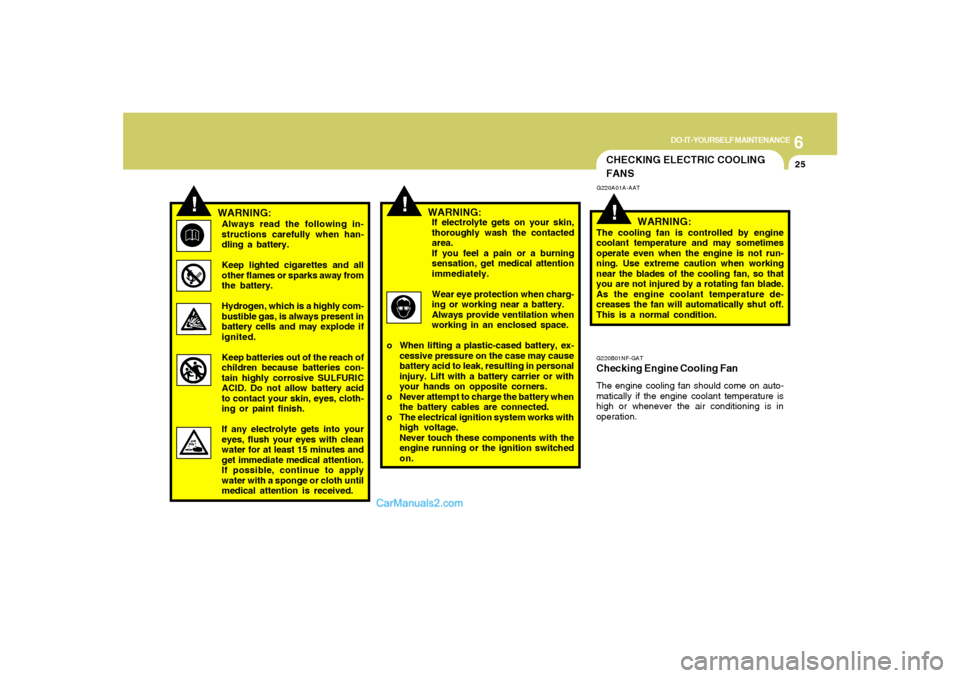
WARNING:Always read the following in-
structions carefully when han-
dling a battery.
Keep lighted cigarettes and all
other flames or sparks away from
the battery.
Hydrogen, which is a highly com-
bustible gas, is always present in
battery cells and may explode if
ignited.
Keep batteries out of the reach of
children because batteries con-
tain highly corrosive SULFURIC
ACID. Do not allow battery acid
to contact your skin, eyes, cloth-
ing or paint finish.
If any electrolyte gets into your
eyes, flush your eyes with clean
water for at least 15 minutes and
get immediate medical attention.
If possible, continue to apply
water with a sponge or cloth until
medical attention is received.If electrolyte gets on your skin,
thoroughly wash the contacted
area.
If you feel a pain or a burning
sensation, get medical attention
immediately.
Wear eye protection when charg-
ing or working near a battery.
Always provide ventilation when
working in an enclosed space.
o When lifting a plastic-cased battery, ex-
cessive pressure on the case may cause
battery acid to leak, resulting in personal
injury. Lift with a battery carrier or with
your hands on opposite corners.
o Never attempt to charge the battery when
the battery cables are connected.
o The electrical ignition system works with
high voltage.
Never touch these components with the
engine running or the ignition switched
on.
WARNING:
CHECKING ELECTRIC COOLING
FANS!
G220A01A-AAT
WARNING:
The cooling fan is controlled by engine
coolant temperature and may sometimes
operate even when the engine is not run-
ning. Use extreme caution when working
near the blades of the cooling fan, so that
you are not injured by a rotating fan blade.
As the engine coolant temperature de-
creases the fan will automatically shut off.
This is a normal condition.G220B01NF-GATChecking Engine Cooling FanThe engine cooling fan should come on auto-
matically if the engine coolant temperature is
high or whenever the air conditioning is in
operation.
Page 253 of 283
7
EMISSION CONTROL SYSTEMS2
EMISSION CONTROL
SYSTEMS
H010B01A-AAT1. Crankcase Emission Control SystemThe positive crankcase ventilation system is
employed to prevent air pollution caused by
blow-by gases being emitted from the crank-
case. This system supplies fresh filtered air to
the crankcase through the air intake hose.
Inside the crankcase, the fresh air mixes with
blow-by gases, which then pass through the
PCV valve into the induction system.
CanisterFuel vapors generated inside the fuel tank are
absorbed and stored in the onboard canister.
When the engine is running, the fuel vapors
absorbed in the canister are drawn into the
surge tank through the purge control solenoid
valve.Purge Control Solenoid Valve (PCSV)The purge control solenoid valve is controlled
by the Engine Control Module (ECM); when the
engine coolant temperature is low during idling,
the PCSV closes so that evaporated fuel is not
taken into the engine. After the engine warms-
up during ordinary driving, the PCSV opens to
introduce evaporated fuel to the engine.H010D01A-AAT3. Exhaust Emission Control
SystemThe Exhaust Emission Control System is a
highly effective system which controls exhaust
emissions while maintaining good vehicle per-
formance.
H010A01NF-AATYour Hyundai is equipped with an emission
control system to meet all emission regulations.
There are three emission control systems which
are as follows.
(1) Crankcase emission control system
(2) Evaporative emission control system
(3) Exhaust emission control system
In order to assure the proper function of the
emission control systems, it is recommended
that you have your car inspected and main-
tained by an authorized Hyundai dealer in ac-
cordance with the maintenance schedule in this
manual.
Caution for the Inspection and Maintenance
Test (With Electronic Stability Control (ESC)
system)
o To prevent the vehicle from misfiring
during dynamometer testing, turn the
Electronic Stability Control (ESC) sys-
tem off by pressing the ESC switch.
o After dynamometer testing is completed,
turn the ESC system back on by pressing
the ESC switch again.
H010C01S-AAT2. Evaporative Emission Control (Includ-
ing ORVR: Onboard Refueling Vapor
Recovery) SystemThe Evaporative Emission Control System is
designed to prevent fuel vapors from escaping
into the atmosphere.
(The ORVR system is designed to allow the
vapors from the fuel tank to be loaded into a
canister while refueling at the gas station, pre-
venting the escape of fuel vapors into the
atmosphere.)
Page 261 of 283
8
CONSUMER INFORMATION, REPORTING SAFETY DEFECTS & BINDING ARBITRATION OF WARRANTY CLAIMS
7
6. Maximum load rating
This number indicates the maximum
load in kilograms and pounds that
can be carried by the tire. When
replacing the tires on the vehicle,
always use a tire that has the same
load rating as the factory installed
tire.
7. Uniform Tire Quality Grading
(UTQG):
Tire manufacturers are required to
grade tires based on three perfor-
mance factors: treadwear, traction
and temperature resistance. For more
information, see Uniform Tire Qual-
ity Grading on page 8-14.
I030D01JM-AATTIRE TERMINOLOGY AND DEFINI-
TIONS
Air Pressure: The amount of air inside
the tire pressing outward on the tire. Air
pressure is expressed in pounds per
square inch (psi) or kilopascal (kPa).
Accessory Weight: This means the
combined weight of optional accesso-
ries. Some examples of optional ac-
cessories are, automatic transmission,
power seats, and air conditioning.
Aspect Ratio: The relationship of a
tire's height to its width.
Belt: A rubber coated layer of cords that
is located between the plies and the
tread. Cords may be made from steel or
other reinforcing materials.
Bead: The tire bead contains steel
wires wrapped by steel cords that hold
the tire onto the rim.
Bias Ply Tire: A pneumatic tire in which
the plies are laid at alternate angles
less than 90 degrees to the centerline of
the tread.Cold Tire Pressure: The amount of air
pressure in a tire, measured in pounds
per square inch (psi) or kilopascals
(kPa) before a tire has built up heat from
driving.
Curb Weight: This means the weight of
a motor vehicle with standard and op-
tional equipment including the maxi-
mum capacity of fuel, oil and coolant,
but without passengers and cargo.
DOT Markings: A code molded into the
sidewall of a tire signifying that the tire
is in compliance with the U.S. Depart-
ment of Transportation motor vehicle
safety standards. The DOT code in-
cludes the Tire Identification Number
(TIN), an alphanumeric designator which
can also identify the tire manufacturer,
production plant, brand and date of
production.
GVWR: Gross Vehicle Weight Rating
GAWR FRT: Gross Axle Weight Rating
for the front Axle.
GAWR RR: Gross Axle Weight Rating
for the rear axle.
Page 278 of 283
10
INDEX
3
Combination Light
Auto Light .....................................................................................1-64
Headlight flasher..........................................................................1-64
Headlight switch...........................................................................1-63
High-beam switch........................................................................1-63
Lane change signal.....................................................................1-63
Parking light auto off ....................................................................1-63
Turn signal operation...................................................................1-62
Consumer Information .....................................................................8-14
Cooling Fans....................................................................................6-26
Corrosion protection
Cleaning the interior....................................................................... 4-5
Protecting your Hyundai from corrosion ...................................... 4-2
Washing and waxing ..................................................................... 4-3
Cruise Control..................................................................................1-94
D
Day/night Inside Rearview Mirror ...................................................1-79
Defrosting/Defogging.....................................................................1-107
Door
Central door locks......................................................................... 1-6
Door locks ...................................................................................... 1-4
Front door warning light ..............................................................1-93
Locking and unlocking front door with a key.............................. 1-5
Drink Holder.....................................................................................1-69
Driving
Economical driving.......................................................................2-16
Smooth cornering.........................................................................2-17
Winter driving...............................................................................2-17E
Electronic Stability Control (ESC) System.....................................2-13
Emission Control System.................................................................. 7-2
Engine
Before starting the engine ............................................................. 2-3
Compartment (2.4 DOHC) ............................................................ 6-2
Compartment (3.3 V6)................................................................... 6-3
Coolant............................................................................................ 6-8
Coolant temperature gauge ........................................................1-57
If the engine overheats ...............................................................3-10
Number........................................................................................... 8-2
Oil .................................................................................................... 6-4
Starting............................................................................................ 2-5
Engine Exhaust Can Be Dangerous!............................................... 2-2
F
Fan Speed Control.............................................................. 1-99, 1-110
Fog Light
Front
.............................................................................................1-65
Front Seats
Active headrests ..........................................................................1-16
Adjustable front seats ..................................................................1-14
Adjustable headrests...................................................................1-15
Adjusting seat forward and rearward............................... 1-14, 1-18
Adjusting seatback angle.................................................. 1-15, 1-18
Power driver's seat .....................................................................1-17
Seat cushion height adjustment....................................... 1-17, 1-18
Seat warmer.................................................................................1-19