spare tire Hyundai Sonata
[x] Cancel search | Manufacturer: HYUNDAI, Model Year: , Model line: , Model:Pages: 283, PDF Size: 13.5 MB
Page 215 of 283
6
DO-IT-YOURSELF MAINTENANCE
4
G020C01A-AATVehicle InteriorThe following should be checked each time
when the vehicle is driven:
o Lights operation
o Windshield wiper operation
o Horn operation
o Defroster, heating system operation (and air
conditioning, if installed)
o Steering operation and condition
o Mirror condition and operation
o Turn signal operation
o Accelerator pedal operation
o Brake operation, including parking brake
o Manual transaxle operation, including clutch
operation
o Automatic transaxle operation, including
"Park" mechanism operation
o Seat control condition and operation
o Seat belt condition and operation
o Sun visor operation
If you notice anything that does not operate
correctly or appears to be functioning correctly,
inspect it carefully and seek assistance from
your Hyundai dealer if service is needed.
G020B01A-AATVehicle ExteriorThe following should be checked monthly:
o Overall appearance and condition
o Wheel condition and wheel nut torque
o Exhaust system condition
o Light condition and operation
o Windshield glass condition
o Wiper blade condition
o Paint condition and body corrosion
o Fluid leaks
o Door and hood lock condition
o Tire pressure and condition
(including spare tire)GENERAL CHECKSG020A01NF-AATEngine CompartmentThe following should be checked regularly:
o Engine oil level and condition
o Transaxle fluid level and condition
o Brake fluid level
o Engine coolant level
o Windshield washer fluid level
o Accessory drive belt condition
o Engine coolant hose condition
o Fluid leaks (on or below components)
o Power steering fluid level
o Battery condition
o Air filter condition
o Engine vibration
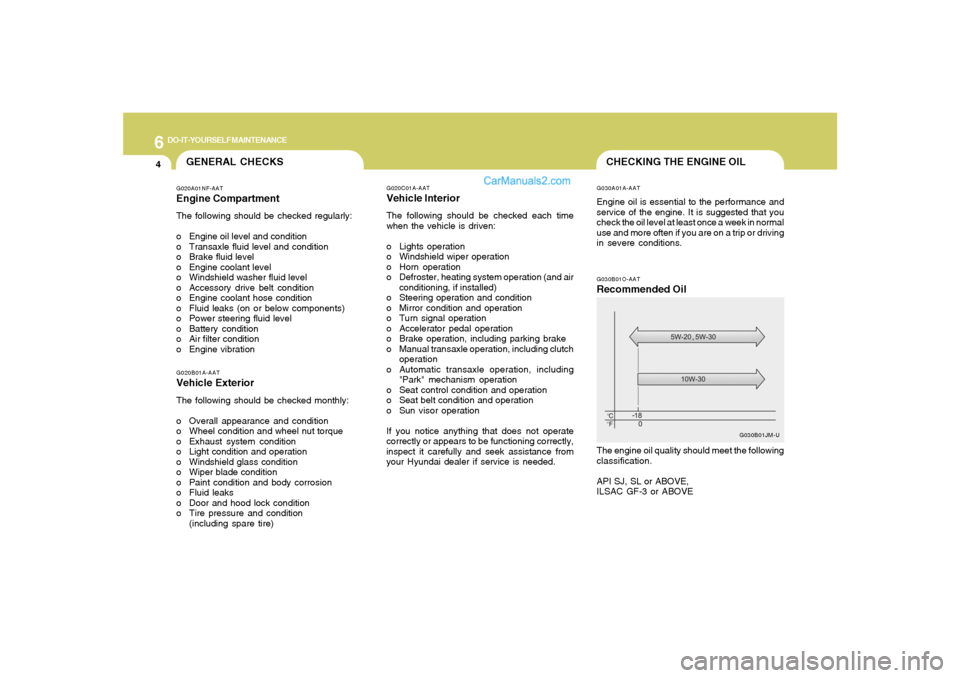
CHECKING THE ENGINE OILG030B01O-AATRecommended OilThe engine oil quality should meet the following
classification.
API SJ, SL or ABOVE,
ILSAC GF-3 or ABOVE
G030B01JM-U G030A01A-AAT
Engine oil is essential to the performance and
service of the engine. It is suggested that you
check the oil level at least once a week in normal
use and more often if you are on a trip or driving
in severe conditions.
Page 238 of 283
6
DO-IT-YOURSELF MAINTENANCE
27
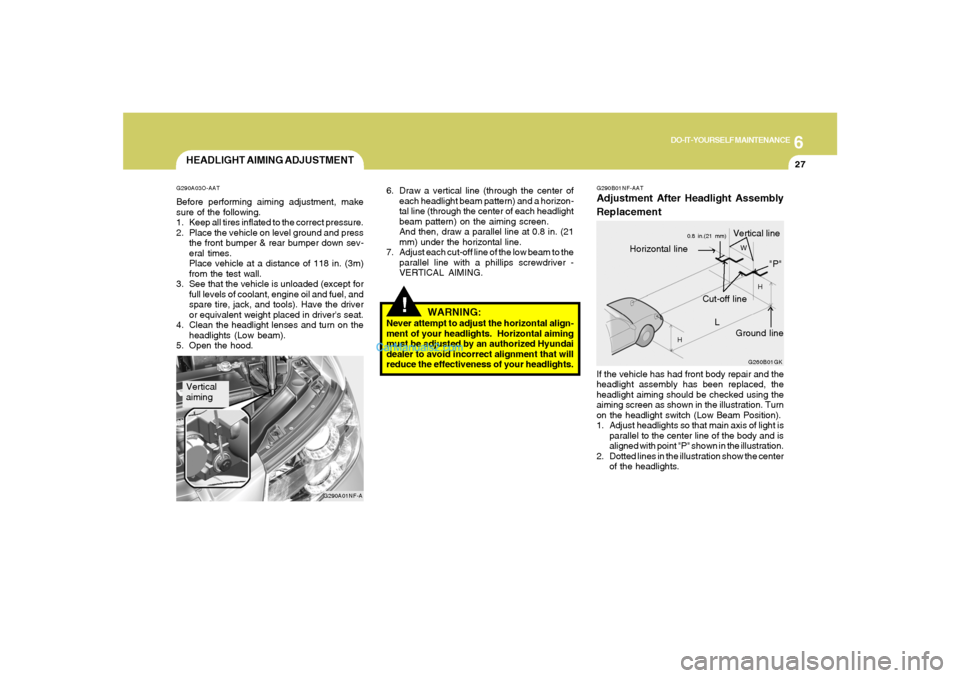
HEADLIGHT AIMING ADJUSTMENTG290A03O-AATBefore performing aiming adjustment, make
sure of the following.
1. Keep all tires inflated to the correct pressure.
2. Place the vehicle on level ground and press
the front bumper & rear bumper down sev-
eral times.
Place vehicle at a distance of 118 in. (3m)
from the test wall.
3. See that the vehicle is unloaded (except for
full levels of coolant, engine oil and fuel, and
spare tire, jack, and tools). Have the driver
or equivalent weight placed in driver's seat.
4. Clean the headlight lenses and turn on the
headlights (Low beam).
5. Open the hood.
G290A01NF-A
Vertical
aiming
!
6. Draw a vertical line (through the center of
each headlight beam pattern) and a horizon-
tal line (through the center of each headlight
beam pattern) on the aiming screen.
And then, draw a parallel line at 0.8 in. (21
mm) under the horizontal line.
7. Adjust each cut-off line of the low beam to the
parallel line with a phillips screwdriver -
VERTICAL AIMING.
WARNING:
Never attempt to adjust the horizontal align-
ment of your headlights. Horizontal aiming
must be adjusted by an authorized Hyundai
dealer to avoid incorrect alignment that will
reduce the effectiveness of your headlights.
G290B01NF-AATAdjustment After Headlight Assembly
Replacement
G260B01GK
L
W
H
H
Cut-off line
Ground line
"P"
Horizontal line
Vertical line
0.8 in.(21 mm)
If the vehicle has had front body repair and the
headlight assembly has been replaced, the
headlight aiming should be checked using the
aiming screen as shown in the illustration. Turn
on the headlight switch (Low Beam Position).
1. Adjust headlights so that main axis of light is
parallel to the center line of the body and is
aligned with point "P" shown in the illustration.
2. Dotted lines in the illustration show the center
of the headlights.
Page 255 of 283
Vehicle Identification Number (VIN) .............................. 8-2
Engine Number ............................................................. 8-2
Tire Information ............................................................. 8-2
Recommended Cold Tire Inflation Pressures ............... 8-3
Checking Tire Inflation Pressure ................................... 8-4
Tire Sidewall Labeling ................................................... 8-5
Tire Terminology and Definitions ................................... 8-7
All Season Tires ............................................................ 8-9
Snow Tires .................................................................... 8-9
Tire Chains .................................................................... 8-9
Tire Rotation................................................................8-10
Tire Balancing.............................................................8-10
Tire Traction................................................................8-11
When to Replace Tires ...............................................8-11
Tire Maintenance........................................................8-12
Spare Tire and Tools ...................................................8-13
Warranties for Your Hyundai Vehicle..........................8-13
Consumer Information.................................................8-14
Reporting Safety Defects............................................8-16
Binding Arbitration of Warranty Claims.......................8-17
8
8
CONSUMER INFORMATION, REPORTING
SAFETY DEFECTS & BINDING
ARBITRATION OF WARRANTY CLAIMS
Page 258 of 283
8
CONSUMER INFORMATION, REPORTING SAFETY DEFECTS & BINDING ARBITRATION OF WARRANTY CLAIMS4
!
CAUTION:
Always observe the following:
o Check pressures when the tires
are cold. (After the vehicle has
been parked for at least three hours
or hasn't been driven more than 1
mile (1.6 km) since starting up.)
o Check the pressure of your spare
tire each time you check the pres-
sure of other tires.
o Worn, old tires can cause acci-
dents. If your tread is badly worn,
or if your tires have been dam-
aged, replace them.
!
NOTE:
o Underinflation also results in ex-
cessive wear, poor handling and
reduced fuel economy. Wheel de-
formation also is possible. Keep
your tire pressures at the proper
levels. If a tire frequently needs
refilling, have it checked by your
Hyundai Dealer.
o Overinflation produces a harsh
ride, excessive wear at the center
of the tire tread, and a greater
possibility of damage from road
hazards.
WARNING:
Overinflation or underinflation can
reduce the tire life, adversely affect
vehicle handling, and lead to sud-
den tire failure. This could rusult in
loss of vehicle control and potential
injury.
!
WARNING:
o Inspect your tires frequently for
proper inflation as well as wear
and damage. Always use a tire
pressure gauge.
o Tires with too much or too little
pressure wear unevenly causing
poor handling, loss of vehicle
control, and sudden tire failure
leading to accidents, injuries, and
even death. The recommended
cold tire pressure for your vehicle
can be found in this manual and
on the tire label located on the
driver's side of the center pillar.
o Worn tires can cause accidents.
Replace tires that are worn, show
uneven wear, or are damaged. See
page 8-11.
o Remember to check the pressure
of your spare tire. Hyundai recom-
mends that you check the spare
every time you check the pressure
of the other tires on your vehicle.
Page 259 of 283
8
CONSUMER INFORMATION, REPORTING SAFETY DEFECTS & BINDING ARBITRATION OF WARRANTY CLAIMS
5
Remove the valve cap from the tire
valve stem. Press the tire gauge firmly
onto the valve to get a pressure mea-
surement. If the cold tire inflation pres-
sure matches the recommended pres-
sure on the tire and loading information
label, no further adjustment is neces-
sary. If the pressure is low, add air until
you reach the recommended amount.
If you overfill the tire, release air by
pushing on the metal stem in the center
of the tire valve. Recheck the tire pres-
sure with the tire gauge. Be sure to put
the valve caps back on the valve stems.
They help prevent leaks by keeping out
dirt and moisture.
I035A01JM-AATCHECKING TIRE INFLATION PRES-
SURE
Check your tires once a month or more.
Also, check the tire pressure of the
spare tire.
How to Check
Use a good quality gauge to check tire
pressure. You cannot tell if your tires
are properly inflated simply by looking
at them. Radial tires may look properly
inflated even when they're underinflated.
Check the tire's inflation pressure when
the tires are cold. - "Cold" means your
vehicle has been sitting for at least
three hours or driven no more than 1
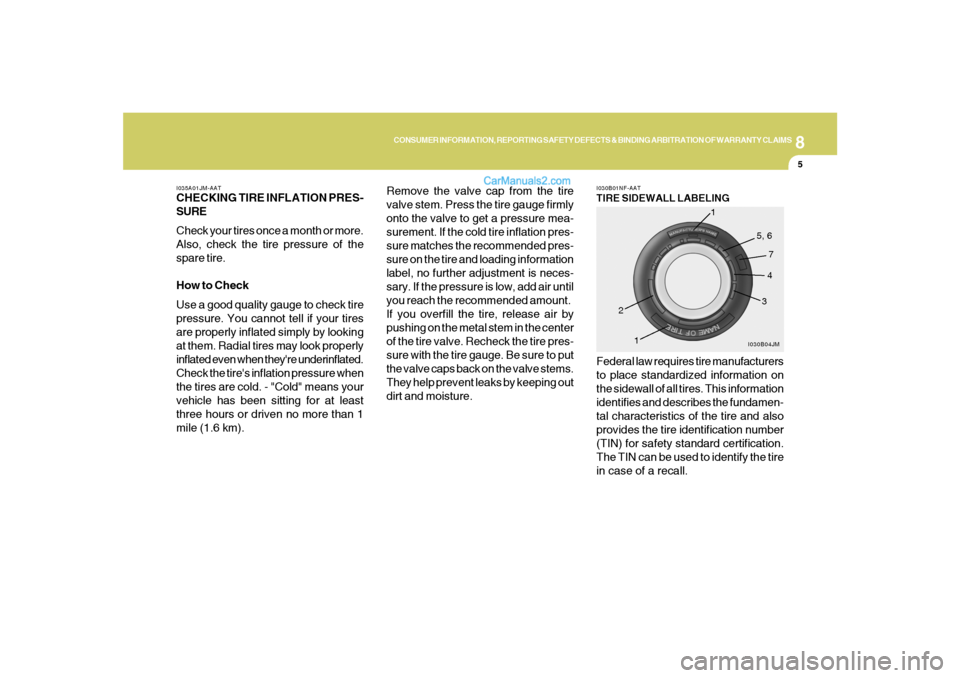
mile (1.6 km).Federal law requires tire manufacturers
to place standardized information on
the sidewall of all tires. This information
identifies and describes the fundamen-
tal characteristics of the tire and also
provides the tire identification number
(TIN) for safety standard certification.
The TIN can be used to identify the tire
in case of a recall.
I030B01NF-AATTIRE SIDEWALL LABELING
I030B04JM
1
234 5, 6
7
1
Page 264 of 283
8
CONSUMER INFORMATION, REPORTING SAFETY DEFECTS & BINDING ARBITRATION OF WARRANTY CLAIMS
10
I070A01A-AATTIRE BALANCING
A tire that is out of balance may affect
handling and tire wear. The tires on your
Hyundai were balanced before the car
was delivered but may need balancing
again during the years you own the car.
Whenever a tire is dismounted for re-
pair, it should be rebalanced before
being reinstalled on the car.
!
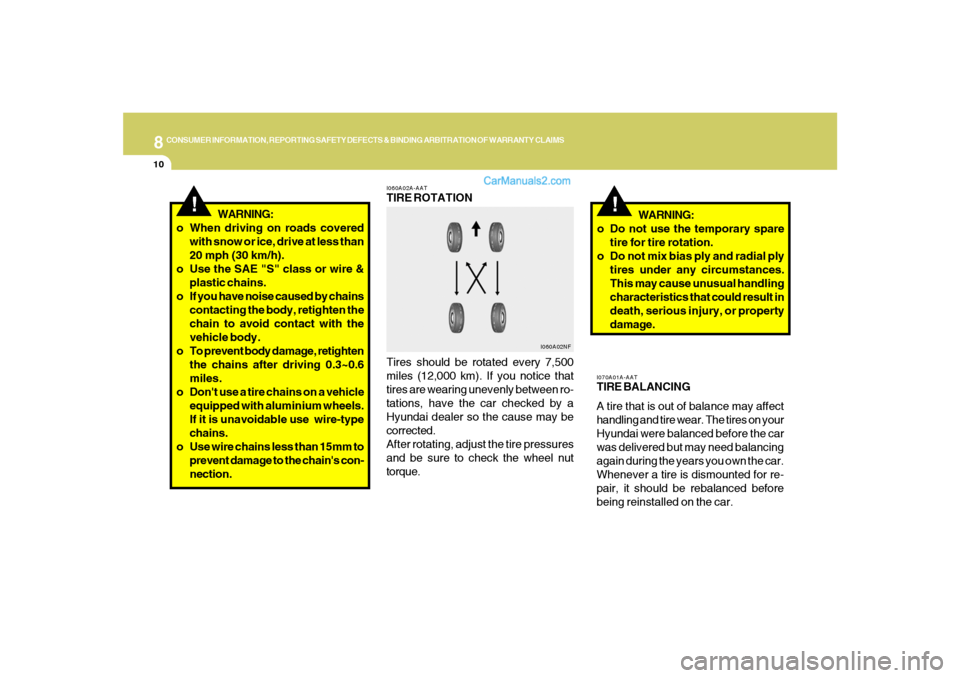
I060A02A-AATTIRE ROTATION
Tires should be rotated every 7,500
miles (12,000 km). If you notice that
tires are wearing unevenly between ro-
tations, have the car checked by a
Hyundai dealer so the cause may be
corrected.
After rotating, adjust the tire pressures
and be sure to check the wheel nut
torque.WARNING:
o Do not use the temporary spare
tire for tire rotation.
o Do not mix bias ply and radial ply
tires under any circumstances.
This may cause unusual handling
characteristics that could result in
death, serious injury, or property
damage.
I060A02NF
!
WARNING:
o When driving on roads covered
with snow or ice, drive at less than
20 mph (30 km/h).
o Use the SAE "S" class or wire &
plastic chains.
o If you have noise caused by chains
contacting the body, retighten the
chain to avoid contact with the
vehicle body.
o To prevent body damage, retighten
the chains after driving 0.3~0.6
miles.
o Don't use a tire chains on a vehicle
equipped with aluminium wheels.
If it is unavoidable use wire-type
chains.
o Use wire chains less than 15mm to
prevent damage to the chain's con-
nection.
Page 265 of 283
8
CONSUMER INFORMATION, REPORTING SAFETY DEFECTS & BINDING ARBITRATION OF WARRANTY CLAIMS
11
!
WARNING:
To reduce the chance or serious or
fatal injuries from an accident caused
by tire failure or loss of vehicle con-
trol:
o Replace tires that are worn, show
uneven wear, or are damaged.
Worn tires can cause loss of brak-
ing effectiveness, steering con-
trol, and traction.
o Do not drive your vehicle with too
little or too much pressure in your
tires. This can lead to uneven
wear and tire failure.
o When replacing tires, never mix
radial and bias-ply tires on the
same car. You must replace all
tires (including the spare) if mov-
ing from radial to bias-ply tires.
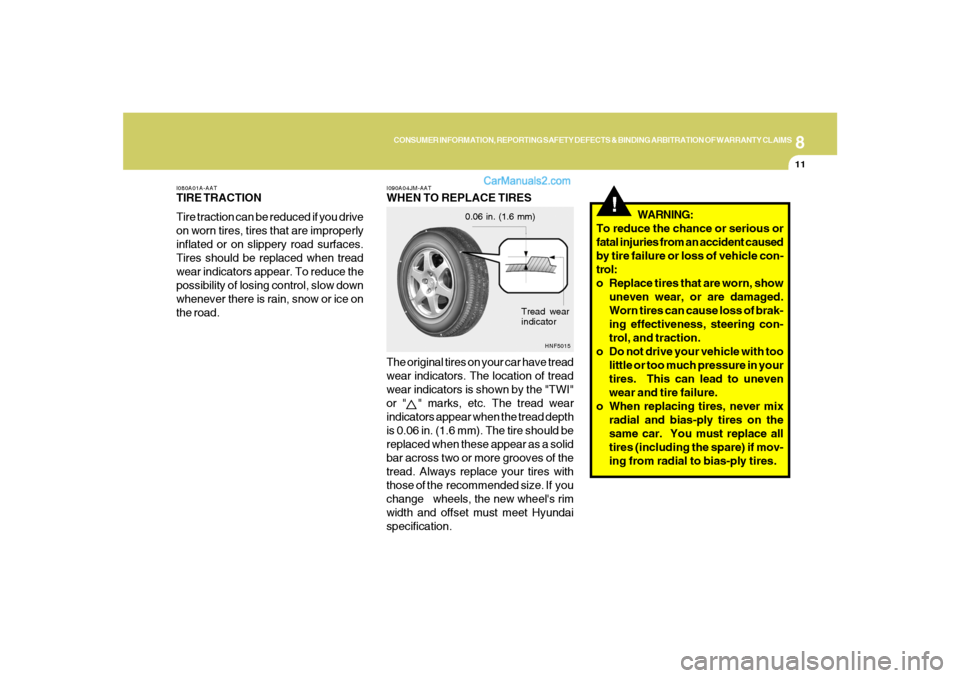
HNF5015 I090A04JM-AAT
WHEN TO REPLACE TIRES
The original tires on your car have tread
wear indicators. The location of tread
wear indicators is shown by the "TWI"
or " " marks, etc. The tread wear
indicators appear when the tread depth
is 0.06 in. (1.6 mm). The tire should be
replaced when these appear as a solid
bar across two or more grooves of the
tread. Always replace your tires with
those of the recommended size. If you
change wheels, the new wheel's rim
width and offset must meet Hyundai
specification.
Tread wear
indicator 0.06 in. (1.6 mm)
I080A01A-AATTIRE TRACTION
Tire traction can be reduced if you drive
on worn tires, tires that are improperly
inflated or on slippery road surfaces.
Tires should be replaced when tread
wear indicators appear. To reduce the
possibility of losing control, slow down
whenever there is rain, snow or ice on
the road.
Page 267 of 283
8
CONSUMER INFORMATION, REPORTING SAFETY DEFECTS & BINDING ARBITRATION OF WARRANTY CLAIMS
13
!
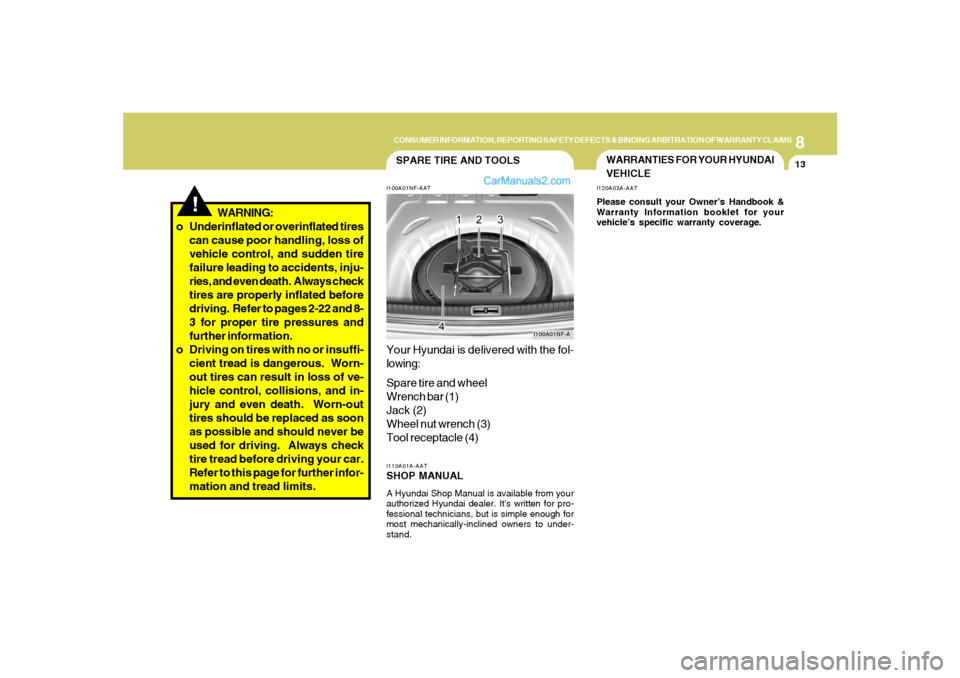
SPARE TIRE AND TOOLSI100A01NF-AATYour Hyundai is delivered with the fol-
lowing:
Spare tire and wheel
Wrench bar (1)
Jack (2)
Wheel nut wrench (3)
Tool receptacle (4)
I100A01NF-A
I110A01A-AAT
SHOP MANUALA Hyundai Shop Manual is available from your
authorized Hyundai dealer. It's written for pro-
fessional technicians, but is simple enough for
most mechanically-inclined owners to under-
stand.
WARNING:
o Underinflated or overinflated tires
can cause poor handling, loss of
vehicle control, and sudden tire
failure leading to accidents, inju-
ries, and even death. Always check
tires are properly inflated before
driving. Refer to pages 2-22 and 8-
3 for proper tire pressures and
further information.
o Driving on tires with no or insuffi-
cient tread is dangerous. Worn-
out tires can result in loss of ve-
hicle control, collisions, and in-
jury and even death. Worn-out
tires should be replaced as soon
as possible and should never be
used for driving. Always check
tire tread before driving your car.
Refer to this page for further infor-
mation and tread limits.
WARRANTIES FOR YOUR HYUNDAI
VEHICLEI120A03A-AATPlease consult your Owner’s Handbook &
Warranty Information booklet for your
vehicle’s specific warranty coverage.
Page 281 of 283
10
INDEX
6
Steering Wheel
Free-play......................................................................................6-20
Tilt and telescopic type ...............................................................1-93
Tilt type .........................................................................................1-92
Stereo Sound System ...................................................................1-115
Sunglass Holder..............................................................................1-75
Sun Visor..........................................................................................1-91
Sunroof.............................................................................................1-71
T
Tachometer......................................................................................1-57
Theft-Alarm System........................................................................... 1-8
Tires
All season tires.............................................................................. 8-9
Balancing......................................................................................8-10
Chains............................................................................................. 8-9
Changing a flat tire ......................................................................3-10
Checking the inflation pressure.................................................... 8-4
If you have a flat tire...................................................................3-10
Information...................................................................................... 8-2
Maintenance.................................................................................8-12
Pressure......................................................................................... 8-3
Replacement................................................................................8-11
Rotation.........................................................................................8-10
Sidewall labeling............................................................................. 8-5
Snow tires...................................................................................... 8-9
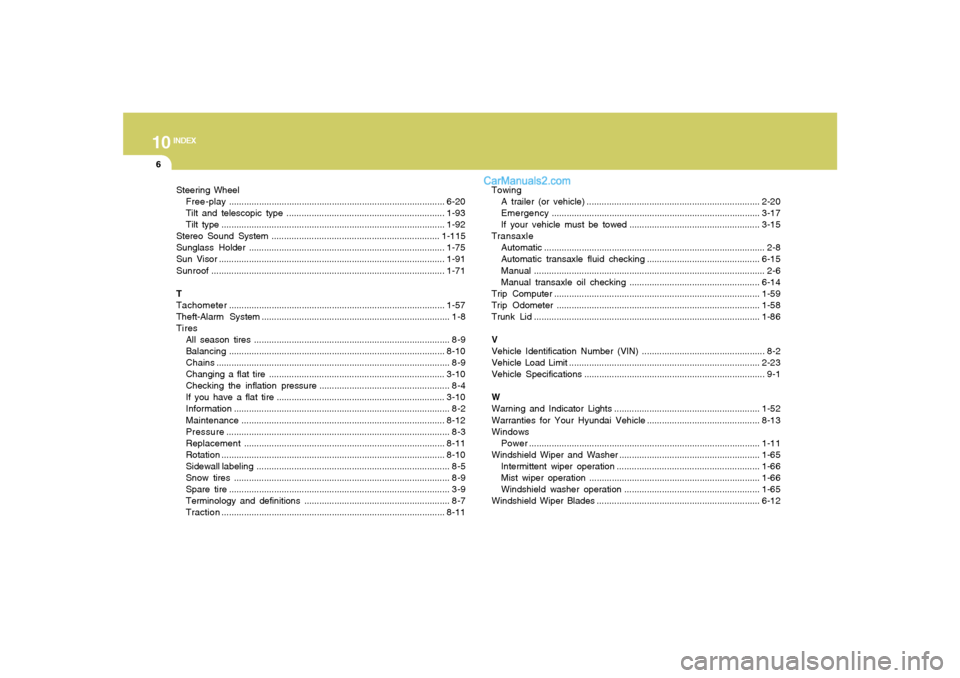
Spare tire........................................................................................ 3-9
Terminology and definitions.......................................................... 8-7
Traction.........................................................................................8-11Towing
A trailer (or vehicle) .....................................................................2-20
Emergency...................................................................................3-17
If your vehicle must be towed....................................................3-15
Transaxle
Automatic........................................................................................ 2-8
Automatic transaxle fluid checking.............................................6-15
Manual............................................................................................ 2-6
Manual transaxle oil checking....................................................6-14
Trip Computer..................................................................................1-59
Trip Odometer.................................................................................1-58
Trunk Lid..........................................................................................1-86
V
Vehicle Identification Number (VIN) ................................................. 8-2
Vehicle Load Limit ............................................................................2-23
Vehicle Specifications........................................................................ 9-1
W
Warning and Indicator Lights ..........................................................1-52
Warranties for Your Hyundai Vehicle.............................................8-13
Windows
Power............................................................................................1-11
Windshield Wiper and Washer ........................................................1-65
Intermittent wiper operation .........................................................1-66
Mist wiper operation....................................................................1-66
Windshield washer operation......................................................1-65
Windshield Wiper Blades .................................................................6-12