instrument panel Hyundai Sonata
[x] Cancel search | Manufacturer: HYUNDAI, Model Year: , Model line: , Model:Pages: 276, PDF Size: 12.9 MB
Page 77 of 276
1
FEATURES OF YOUR HYUNDAI
63
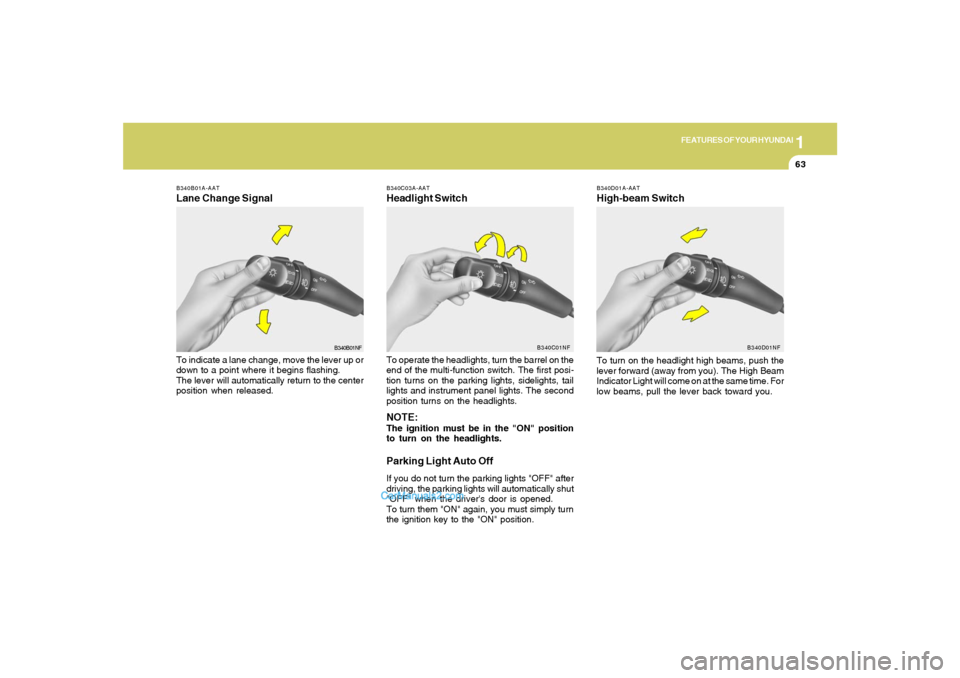
B340D01A-AATHigh-beam Switch
B340B01A-AATLane Change SignalTo indicate a lane change, move the lever up or
down to a point where it begins flashing.
The lever will automatically return to the center
position when released.
B340C03A-AATHeadlight SwitchTo operate the headlights, turn the barrel on the
end of the multi-function switch. The first posi-
tion turns on the parking lights, sidelights, tail
lights and instrument panel lights. The second
position turns on the headlights.NOTE:The ignition must be in the "ON" position
to turn on the headlights.Parking Light Auto OffIf you do not turn the parking lights "OFF" after
driving, the parking lights will automatically shut
"OFF" when the driver's door is opened.
To turn them "ON" again, you must simply turn
the ignition key to the "ON" position.
B340B01NFB340C01NF
To turn on the headlight high beams, push the
lever forward (away from you). The High Beam
Indicator Light will come on at the same time. For
low beams, pull the lever back toward you.
B340D01NF
Page 78 of 276
1FEATURES OF YOUR HYUNDAI64
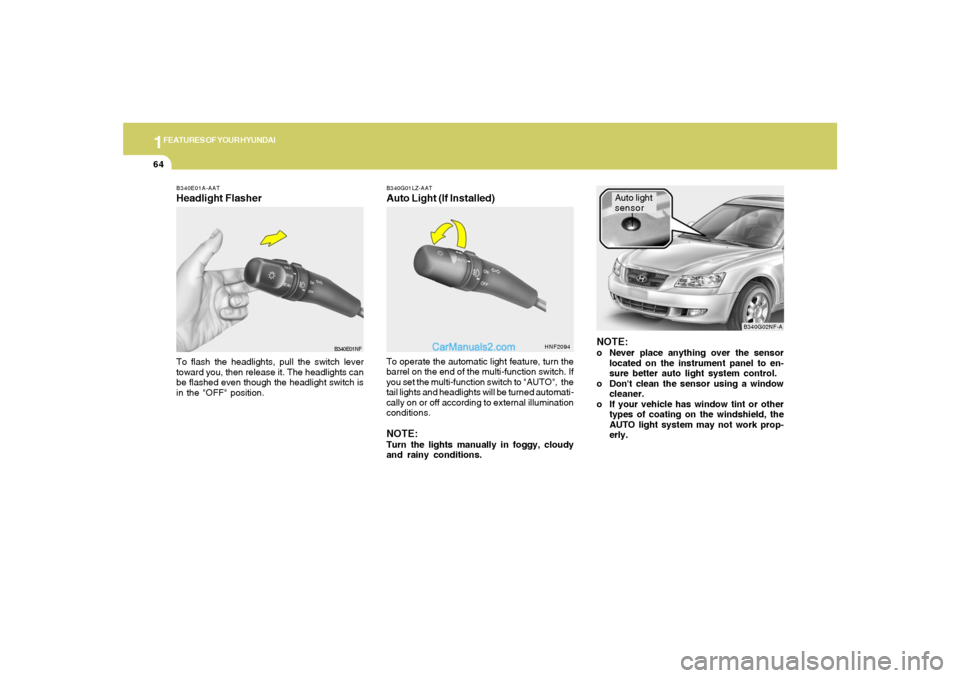
B340E01A-AATHeadlight FlasherTo flash the headlights, pull the switch lever
toward you, then release it. The headlights can
be flashed even though the headlight switch is
in the "OFF" position.
B340E01NFB340G01LZ-AAT
Auto Light (If Installed)
HNF2094
To operate the automatic light feature, turn the
barrel on the end of the multi-function switch. If
you set the multi-function switch to "AUTO", the
tail lights and headlights will be turned automati-
cally on or off according to external illumination
conditions.NOTE:Turn the lights manually in foggy, cloudy
and rainy conditions.
NOTE:o Never place anything over the sensor
located on the instrument panel to en-
sure better auto light system control.
o Don't clean the sensor using a window
cleaner.
o If your vehicle has window tint or other
types of coating on the windshield, the
AUTO light system may not work prop-
erly.
Auto light
sensor
B340G02NF-A
Page 82 of 276
1FEATURES OF YOUR HYUNDAI68
INSTRUMENT PANEL LIGHT
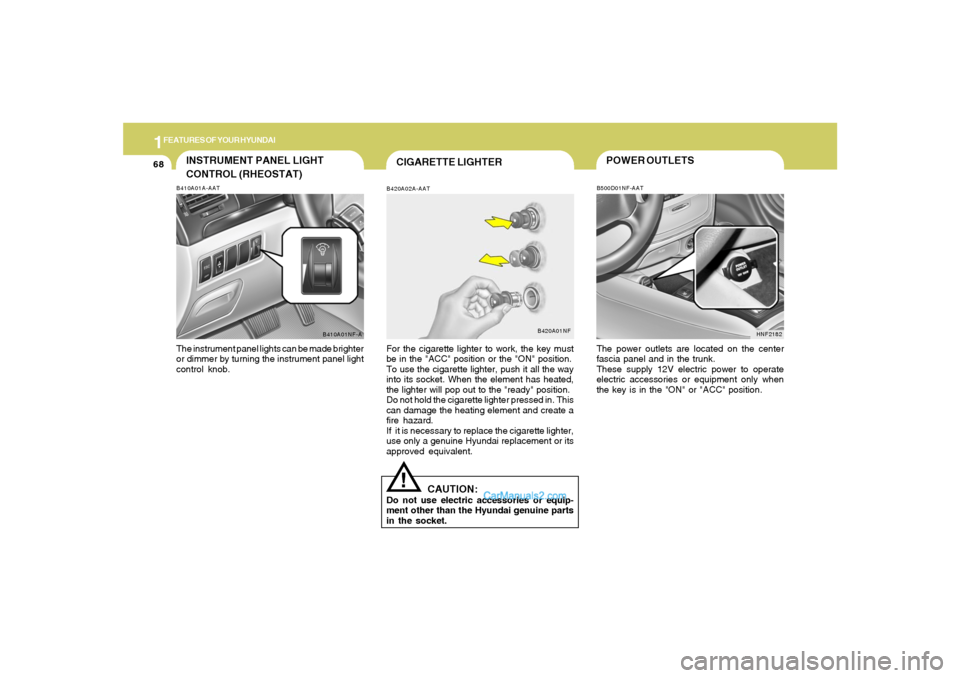
CONTROL (RHEOSTAT)B410A01A-AATThe instrument panel lights can be made brighter
or dimmer by turning the instrument panel light
control knob.
B410A01NF-A
CIGARETTE LIGHTERB420A02A-AATFor the cigarette lighter to work, the key must
be in the "ACC" position or the "ON" position.
To use the cigarette lighter, push it all the way
into its socket. When the element has heated,
the lighter will pop out to the "ready" position.
Do not hold the cigarette lighter pressed in. This
can damage the heating element and create a
fire hazard.
If it is necessary to replace the cigarette lighter,
use only a genuine Hyundai replacement or its
approved equivalent.
B420A01NF
!
CAUTION:
Do not use electric accessories or equip-
ment other than the Hyundai genuine parts
in the socket.
POWER OUTLETSB500D01NF-AATThe power outlets are located on the center
fascia panel and in the trunk.
These supply 12V electric power to operate
electric accessories or equipment only when
the key is in the "ON" or "ACC" position.
HNF2182
Page 123 of 276
1
FEATURES OF YOUR HYUNDAI
109109
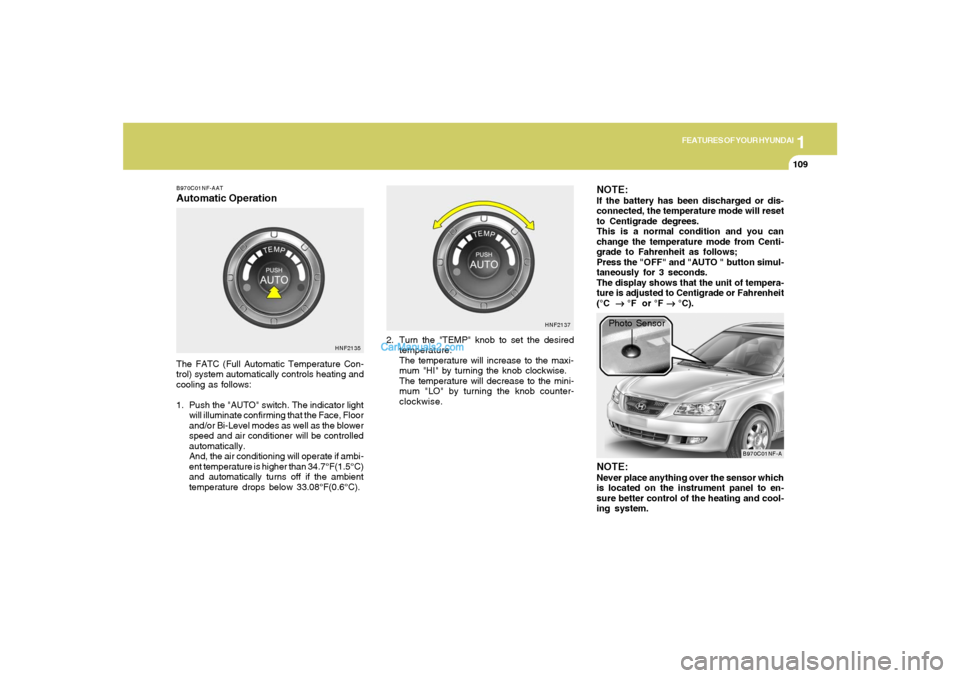
B970C01NF-AATAutomatic OperationThe FATC (Full Automatic Temperature Con-
trol) system automatically controls heating and
cooling as follows:
1. Push the "AUTO" switch. The indicator light
will illuminate confirming that the Face, Floor
and/or Bi-Level modes as well as the blower
speed and air conditioner will be controlled
automatically.
And, the air conditioning will operate if ambi-
ent temperature is higher than 34.7°F(1.5°C)
and automatically turns off if the ambient
temperature drops below 33.08°F(0.6°C).2. Turn the "TEMP" knob to set the desired
temperature.
The temperature will increase to the maxi-
mum "HI" by turning the knob clockwise.
The temperature will decrease to the mini-
mum "LO" by turning the knob counter-
clockwise.
NOTE:If the battery has been discharged or dis-
connected, the temperature mode will reset
to Centigrade degrees.
This is a normal condition and you can
change the temperature mode from Centi-
grade to Fahrenheit as follows;
Press the "OFF" and "AUTO " button simul-
taneously for 3 seconds.
The display shows that the unit of tempera-
ture is adjusted to Centigrade or Fahrenheit
(°C
→ →→ →
→ °F or °F
→ →→ →
→ °C).
HNF2135HNF2137
B970C01NF-A
Photo Sensor
NOTE:Never place anything over the sensor which
is located on the instrument panel to en-
sure better control of the heating and cool-
ing system.
Page 128 of 276
1FEATURES OF YOUR HYUNDAI
114
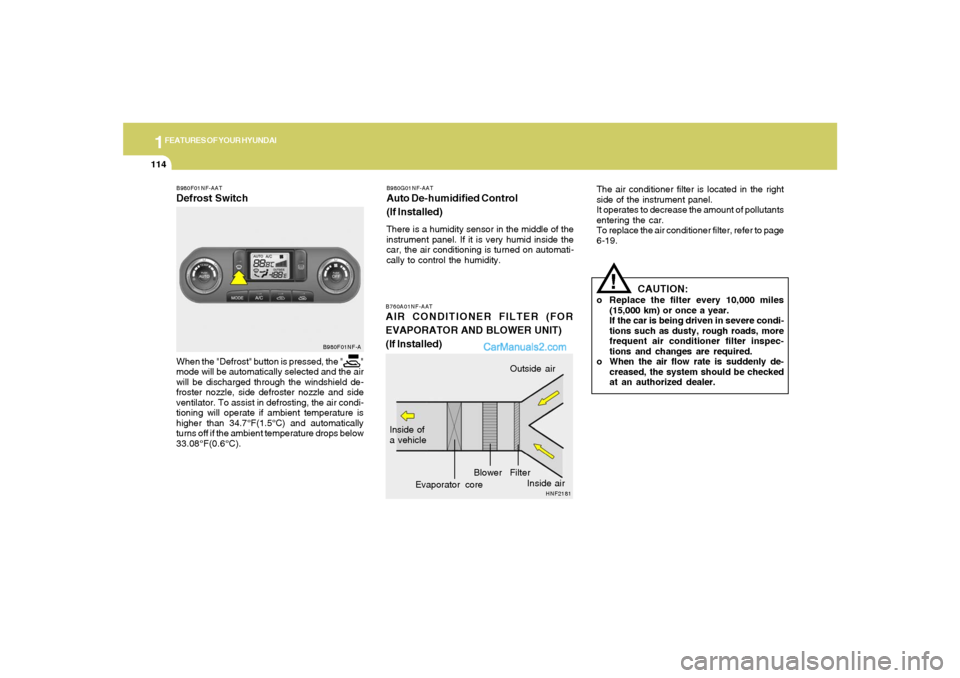
B760A01NF-AATAIR CONDITIONER FILTER (FOR
EVAPORATOR AND BLOWER UNIT)
(If Installed)
The air conditioner filter is located in the right
side of the instrument panel.
It operates to decrease the amount of pollutants
entering the car.
To replace the air conditioner filter, refer to page
6-19.
HNF2181
Inside of
a vehicle
Evaporator coreFilter BlowerOutside air
Inside air
CAUTION:
o Replace the filter every 10,000 miles
(15,000 km) or once a year.
If the car is being driven in severe condi-
tions such as dusty, rough roads, more
frequent air conditioner filter inspec-
tions and changes are required.
o When the air flow rate is suddenly de-
creased, the system should be checked
at an authorized dealer.
!
B980F01NF-AATDefrost SwitchWhen the "Defrost" button is pressed, the " "
mode will be automatically selected and the air
will be discharged through the windshield de-
froster nozzle, side defroster nozzle and side
ventilator. To assist in defrosting, the air condi-
tioning will operate if ambient temperature is
higher than 34.7°F(1.5°C) and automatically
turns off if the ambient temperature drops below
33.08°F(0.6°C).
B980F01NF-AB980G01NF-AAT
Auto De-humidified Control
(If Installed)There is a humidity sensor in the middle of the
instrument panel. If it is very humid inside the
car, the air conditioning is turned on automati-
cally to control the humidity.
Page 223 of 276
6
DO-IT-YOURSELF MAINTENANCE
19
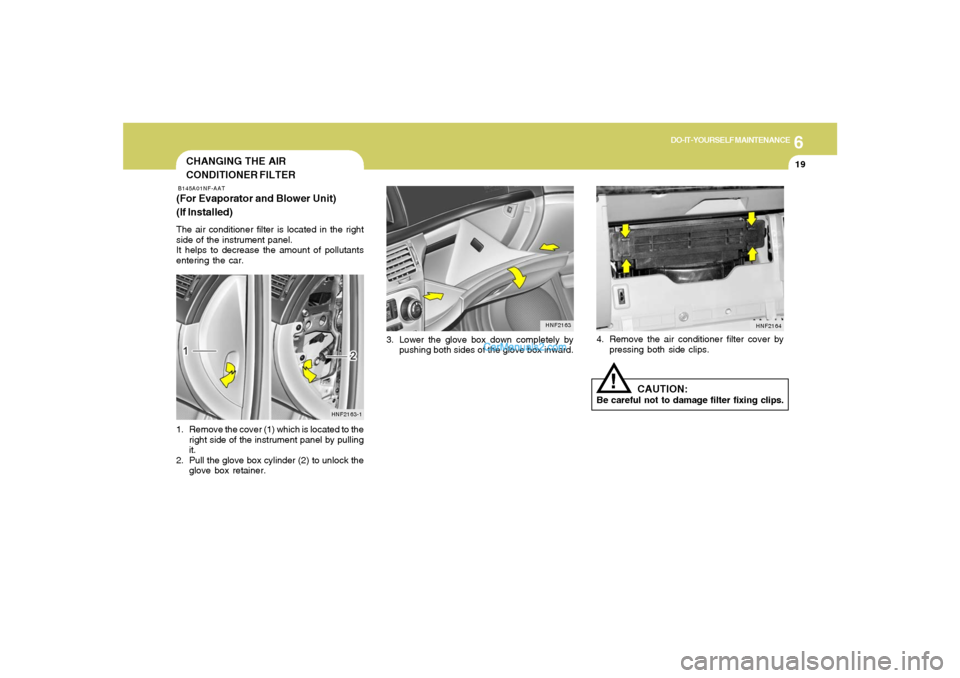
3. Lower the glove box down completely by
pushing both sides of the glove box inward.
HNF2163
CHANGING THE AIR
CONDITIONER FILTERB145A01NF-AAT(For Evaporator and Blower Unit)
(If Installed)The air conditioner filter is located in the right
side of the instrument panel.
It helps to decrease the amount of pollutants
entering the car.
1. Remove the cover (1) which is located to the
right side of the instrument panel by pulling
it.
2. Pull the glove box cylinder (2) to unlock the
glove box retainer.
HNF2163-1
4. Remove the air conditioner filter cover by
pressing both side clips.
HNF2164
CAUTION:
Be careful not to damage filter fixing clips.
!
Page 227 of 276
6
DO-IT-YOURSELF MAINTENANCE
23
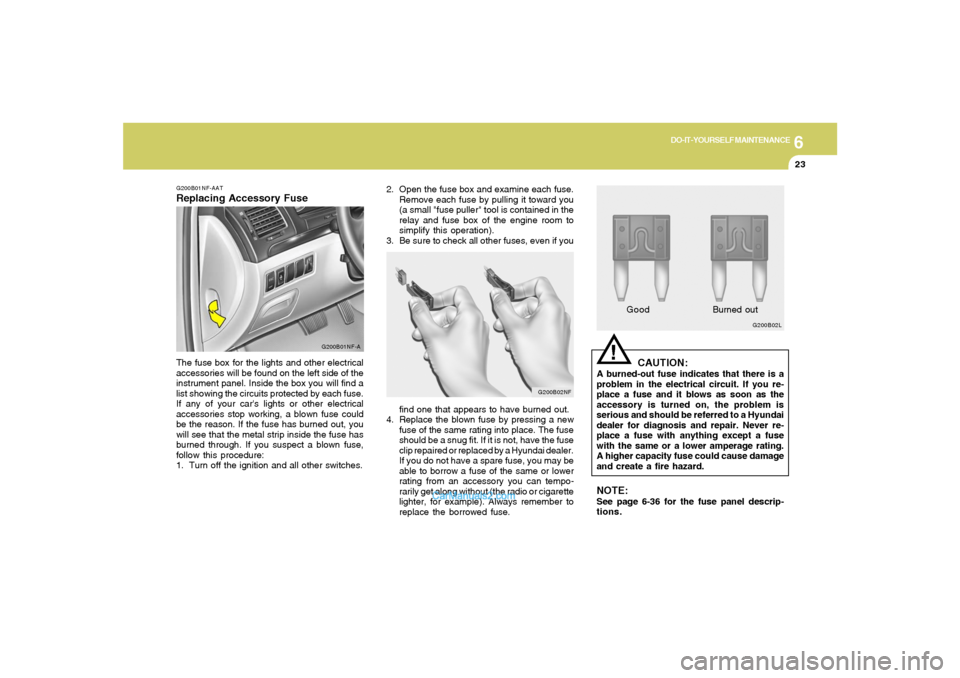
2. Open the fuse box and examine each fuse.
Remove each fuse by pulling it toward you
(a small "fuse puller" tool is contained in the
relay and fuse box of the engine room to
simplify this operation).
3. Be sure to check all other fuses, even if you
G200B02NF
find one that appears to have burned out.
4. Replace the blown fuse by pressing a new
fuse of the same rating into place. The fuse
should be a snug fit. If it is not, have the fuse
clip repaired or replaced by a Hyundai dealer.
If you do not have a spare fuse, you may be
able to borrow a fuse of the same or lower
rating from an accessory you can tempo-
rarily get along without (the radio or cigarette
lighter, for example). Always remember to
replace the borrowed fuse.
!
G200B02L
GoodBurned outCAUTION:
A burned-out fuse indicates that there is a
problem in the electrical circuit. If you re-
place a fuse and it blows as soon as the
accessory is turned on, the problem is
serious and should be referred to a Hyundai
dealer for diagnosis and repair. Never re-
place a fuse with anything except a fuse
with the same or a lower amperage rating.
A higher capacity fuse could cause damage
and create a fire hazard.NOTE:See page 6-36 for the fuse panel descrip-
tions.
G200B01NF-AATReplacing Accessory Fuse
G200B01NF-A
The fuse box for the lights and other electrical
accessories will be found on the left side of the
instrument panel. Inside the box you will find a
list showing the circuits protected by each fuse.
If any of your car's lights or other electrical
accessories stop working, a blown fuse could
be the reason. If the fuse has burned out, you
will see that the metal strip inside the fuse has
burned through. If you suspect a blown fuse,
follow this procedure:
1. Turn off the ignition and all other switches.
Page 249 of 276
8
CONSUMER INFORMATION, REPORTING SAFETY DEFECTS & BINDING ARBITRATION OF WARRANTY CLAIMS2
ENGINE NUMBER
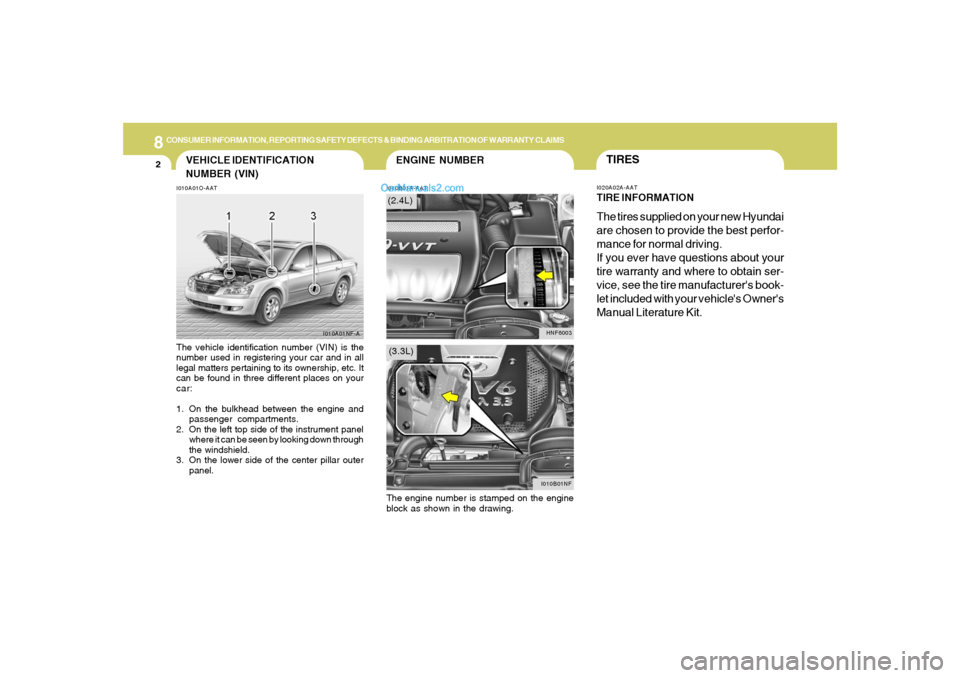
VEHICLE IDENTIFICATION
NUMBER (VIN)
I010B01A-AAT I010A01O-AAT
The vehicle identification number (VIN) is the
number used in registering your car and in all
legal matters pertaining to its ownership, etc. It
can be found in three different places on your
car:
1. On the bulkhead between the engine and
passenger compartments.
2. On the left top side of the instrument panel
where it can be seen by looking down through
the windshield.
3. On the lower side of the center pillar outer
panel.
The engine number is stamped on the engine
block as shown in the drawing.
TIRESI020A02A-AATTIRE INFORMATIONThe tires supplied on your new Hyundai
are chosen to provide the best perfor-
mance for normal driving.
If you ever have questions about your
tire warranty and where to obtain ser-
vice, see the tire manufacturer's book-
let included with your vehicle's Owner's
Manual Literature Kit.
I010A01NF-AHNF6003
(2.4L)(3.3L)
I010B01NF
Page 272 of 276
10
INDEX
4
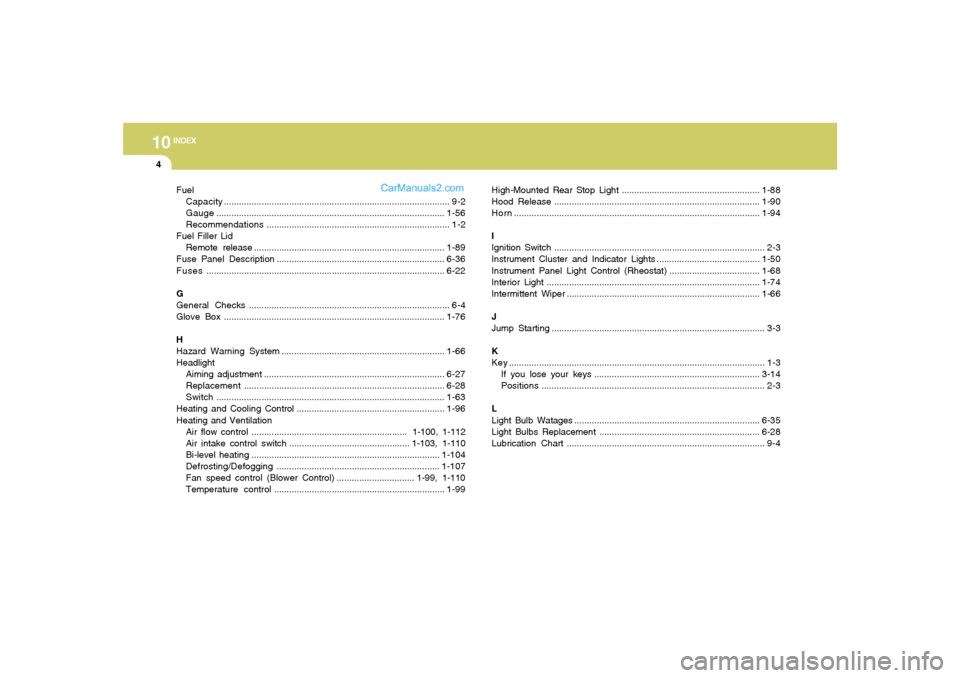
Fuel
Capacity.......................................................................................... 9-2
Gauge...........................................................................................1-56
Recommendations......................................................................... 1-2
Fuel Filler Lid
Remote release............................................................................1-89
Fuse Panel Description...................................................................6-36
Fuses ...............................................................................................6-22
G
General Checks................................................................................ 6-4
Glove Box........................................................................................1-76
H
Hazard Warning System .................................................................1-66
Headlight
Aiming adjustment........................................................................6-27
Replacement................................................................................6-28
Switch...........................................................................................1-63
Heating and Cooling Control ...........................................................1-96
Heating and Ventilation
Air flow control.............................................................. 1-100, 1-112
Air intake control switch................................................ 1-103, 1-110
Bi-level heating...........................................................................1-104
Defrosting/Defogging.................................................................1-107
Fan speed control (Blower Control) ............................... 1-99, 1-110
Temperature control....................................................................1-99High-Mounted Rear Stop Light .......................................................1-88
Hood Release..................................................................................1-90
Horn..................................................................................................1-94
I
Ignition Switch.................................................................................... 2-3
Instrument Cluster and Indicator Lights .........................................1-50
Instrument Panel Light Control (Rheostat)....................................1-68
Interior Light.....................................................................................1-74
Intermittent Wiper.............................................................................1-66
J
Jump Starting..................................................................................... 3-3
K
Key ...................................................................................................... 1-3
If you lose your keys ..................................................................3-14
Positions......................................................................................... 2-3
L
Light Bulb Watages..........................................................................6-35
Light Bulbs Replacement................................................................
6-28
Lubrication Chart............................................................................... 9-4