child restraint Hyundai Sonata
[x] Cancel search | Manufacturer: HYUNDAI, Model Year: , Model line: , Model:Pages: 271, PDF Size: 12.44 MB
Page 46 of 271
1
FEATURES OF YOUR HYUNDAI
33
!
WARNING:
o If the retractor is not in the Automatic
Locking mode, the child restraint sys-
tem can move when your vehicle turns or
stops abruptly.
o Do not install any child restraint system
in the front passenger seat. Should an
accident occur and cause the passenger
side airbag to deploy, it could severely
injure or kill an infant or child seated in
an infant or child seat. Therefore, only
use a child restraint system in the rear
seat of your vehicle.NOTE:o Before installing the child restraint sys-
tem in any seating position, read the
instructions supplied by the child re-
straint system manufacturer.
o If the seat belt does not operate as de-
scribed, have the system checked imme-
diately by your authorized Hyundai dealer.
!
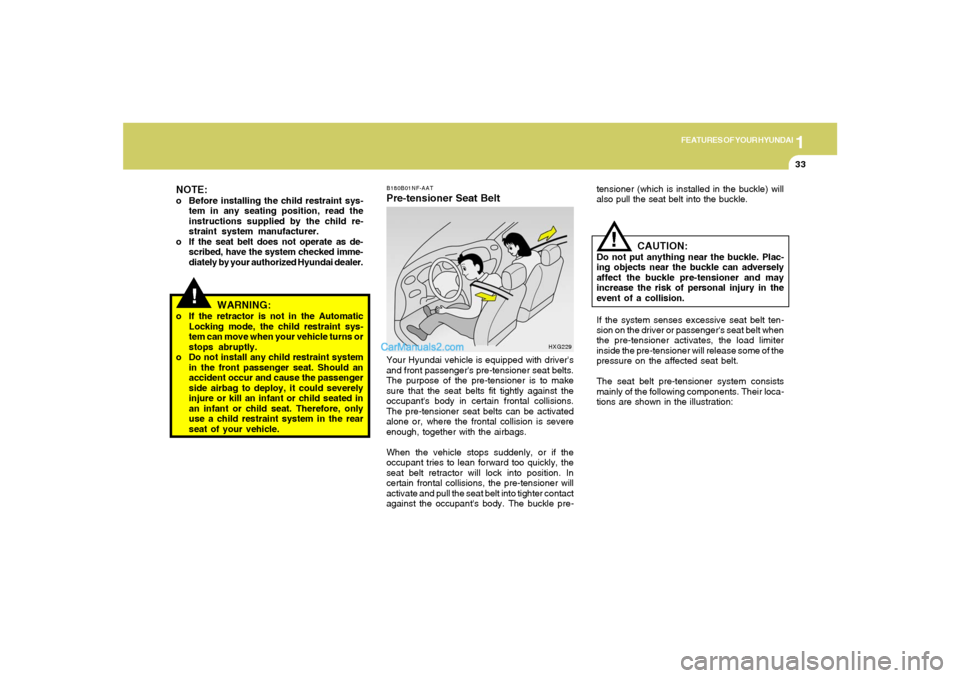
B180B01NF-AATPre-tensioner Seat BeltYour Hyundai vehicle is equipped with driver's
and front passenger's pre-tensioner seat belts.
The purpose of the pre-tensioner is to make
sure that the seat belts fit tightly against the
occupant's body in certain frontal collisions.
The pre-tensioner seat belts can be activated
alone or, where the frontal collision is severe
enough, together with the airbags.
When the vehicle stops suddenly, or if the
occupant tries to lean forward too quickly, the
seat belt retractor will lock into position. In
certain frontal collisions, the pre-tensioner will
activate and pull the seat belt into tighter contact
against the occupant's body. The buckle pre-
HXG229
CAUTION:
Do not put anything near the buckle. Plac-
ing objects near the buckle can adversely
affect the buckle pre-tensioner and may
increase the risk of personal injury in the
event of a collision.
If the system senses excessive seat belt ten-
sion on the driver or passenger's seat belt when
the pre-tensioner activates, the load limiter
inside the pre-tensioner will release some of the
pressure on the affected seat belt.
The seat belt pre-tensioner system consists
mainly of the following components. Their loca-
tions are shown in the illustration: tensioner (which is installed in the buckle) will
also pull the seat belt into the buckle.
Page 52 of 271
1
FEATURES OF YOUR HYUNDAI
39
!
WARNING:
o No objects should be placed over or near
the airbag modules on the steering
wheel, instrument panel, and the front
passenger's panel above the glove box,
because any such object could cause
harm if the vehicle is in a crash severe
enough to cause the airbags to deploy.
o If the airbags deploy, they must be re-
placed by an authorized Hyundai dealer.
o Do not tamper with or disconnect SRS
wiring or other components of the SRS
system. Doing so could result in injury,
due to accidental deployment of the
airbags or by rendering the SRS inopera-
tive.
o Even though your vehicle is equipped
with the occupant classification sys-
tem, do not install a child restraint sys-
tem in the front passenger seat position.
A child restraint system must never be
placed in the front seat. The infant or
child could be severely injured or killed
by an airbag deployment in case of an
accident.
o Do not allow children to ride in the front
passenger seat. If older children (teen-
agers and older) must ride in the front
seat, make sure they are always properly
belted and the seat is moved back as far
as possible.
o For maximum safety protection in all
types of crashes, all occupants includ-
ing the driver should always wear their
seat belts whether or not an airbag is
also provided at their seating position to
minimize the risk of severe injury or
death in the event of a crash. Do not sit
or lean unnecessarily close to the airbag
while the vehicle is in motion.
o Sitting improperly or out of position can
result in serious or fatal injury in a crash.
All occupants should sit upright with
the seat back in an upright position,
centered on the seat cushion with their
seat belt on, legs comfortably extended
and their feet on the floor until the ve-
hicle is parked and the ignition key is
removed.
o The SRS airbag system must deploy very
rapidly to provide protection in a crash.
If an occupant is out of position because
of not wearing a seat belt, the airbag may
forcefully contact the occupant causing
serious or fatal injuries.
!
WARNING:
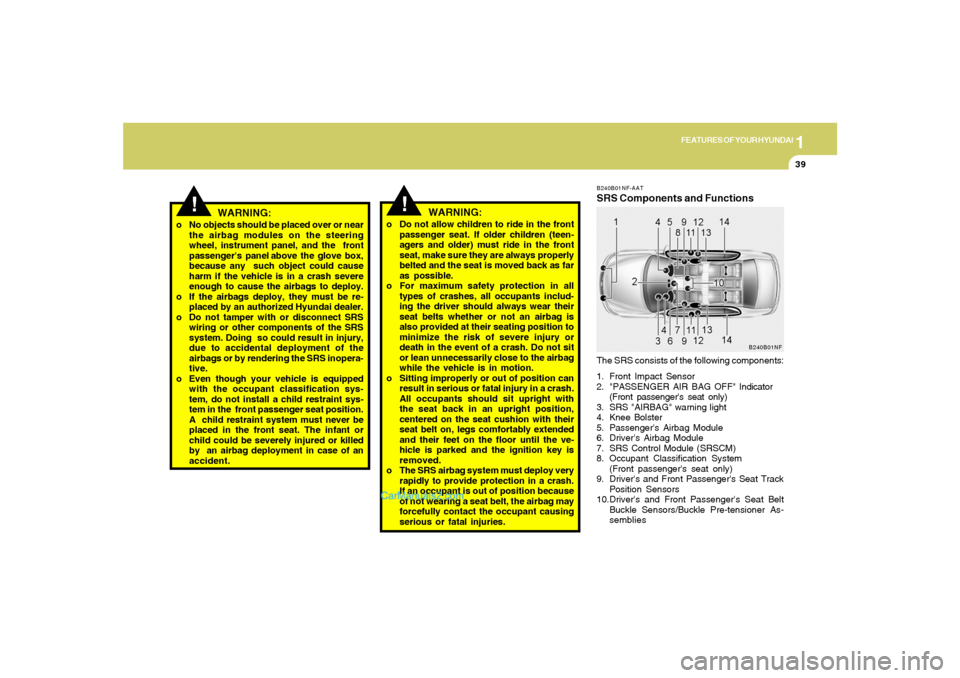
B240B01NF-AATSRS Components and FunctionsThe SRS consists of the following components:
1. Front Impact Sensor
2. "PASSENGER AIR BAG OFF" Indicator
(Front passenger's seat only)
3. SRS "AIRBAG" warning light
4. Knee Bolster
5. Passenger's Airbag Module
6. Driver's Airbag Module
7. SRS Control Module (SRSCM)
8. Occupant Classification System
(Front passenger's seat only)
9. Driver's and Front Passenger's Seat Track
Position Sensors
10.Driver's and Front Passenger's Seat Belt
Buckle Sensors/Buckle Pre-tensioner As-
semblies
B240B01NF
Page 55 of 271
1FEATURES OF YOUR HYUNDAI42
!
legs comfortably extended and their feet on the
floor), the "PASSENGER AIR BAG OFF" indi-
cator will be turned off and the front passenger's
airbag will be able to inflate, if necessary, in
frontal crashes.
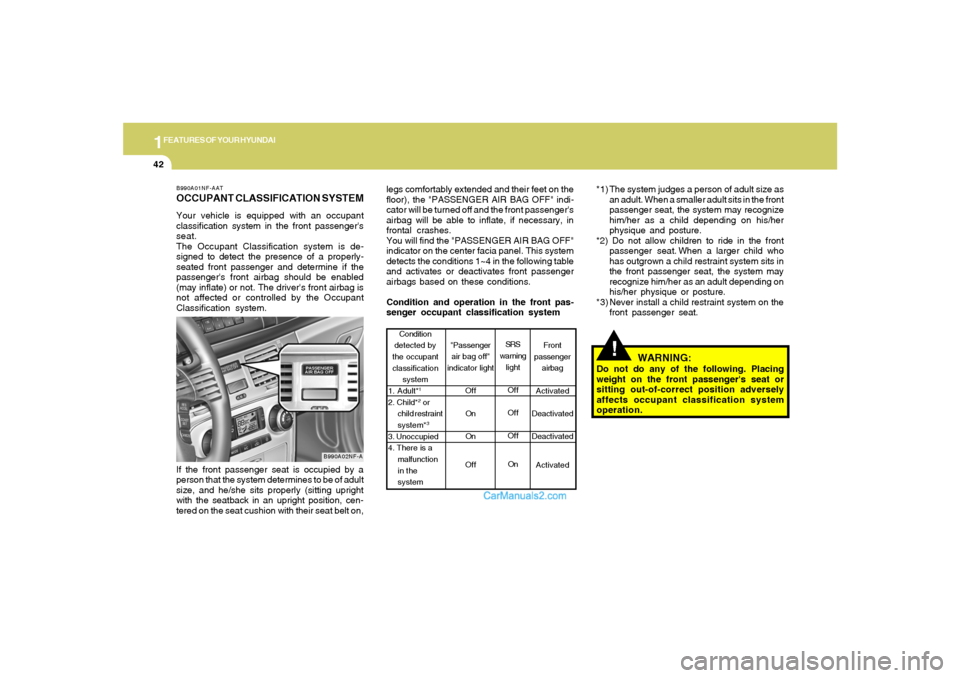
You will find the "PASSENGER AIR BAG OFF"
indicator on the center facia panel. This system
detects the conditions 1~4 in the following table
and activates or deactivates front passenger
airbags based on these conditions.
Condition and operation in the front pas-
senger occupant classification system*1) The system judges a person of adult size as
an adult. When a smaller adult sits in the front
passenger seat, the system may recognize
him/her as a child depending on his/her
physique and posture.
*2) Do not allow children to ride in the front
passenger seat. When a larger child who
has outgrown a child restraint system sits in
the front passenger seat, the system may
recognize him/her as an adult depending on
his/her physique or posture.
*3) Never install a child restraint system on the
front passenger seat.
Front
passenger
airbag
Activated
Deactivated
Deactivated
Activated Condition
detected by
the occupant
classification
system
1. Adult*
1
2. Child*
2 or
child restraint
system*3
3. Unoccupied
4. There is a
malfunction
in the
systemSRS
warning
light
Off
Off
Off
On
"Passenger
air bag off"
indicator light
Off
On
On
Off
B990A01NF-AATOCCUPANT CLASSIFICATION SYSTEMYour vehicle is equipped with an occupant
classification system in the front passenger's
seat.
The Occupant Classification system is de-
signed to detect the presence of a properly-
seated front passenger and determine if the
passenger's front airbag should be enabled
(may inflate) or not. The driver's front airbag is
not affected or controlled by the Occupant
Classification system.
If the front passenger seat is occupied by a
person that the system determines to be of adult
size, and he/she sits properly (sitting upright
with the seatback in an upright position, cen-
tered on the seat cushion with their seat belt on,
B990A02NF-A
WARNING:
Do not do any of the following. Placing
weight on the front passenger's seat or
sitting out-of-correct position adversely
affects occupant classification system
operation.
Page 57 of 271
1FEATURES OF YOUR HYUNDAI44
!
NOTE:The "PASSENGER AIR BAG OFF" indicator
illuminates for about 6 seconds after the
ignition key is turned to the "ON" position
or after the engine is started. If the front
passenger seat is occupied, the occupant
classification sensor will then classify the
front passenger within approximately 10
seconds after the ignition is turned on.
CAUTION:
If the occupant classification system is not
working properly, the SRS airbag warning
light on the instrument panel will
illuminate because the passenger's front
airbags are connected with the occupant
classification system. If there is a malfunc-
tion of the occupant classification system,
the "PASSENGER AIR BAG OFF" indicator
will not illuminate and the passenger's front
airbags will inflate in frontal impact crashes
even if there is no occupant in the front
passenger's seat. If the SRS airbag warning
light does not illuminate when the ignition
key is turned to the "ON" position, remains
illuminated after approximately 6 seconds
when the ignition key is turned to the "ON"
position, or if it illuminates while the vehicle
is being driven, have an authorized Hyundai
dealer inspect the occupant classification
system and the SRS airbag system as soon
as possible.
!
WARNING:
o Even though your vehicle is equipped
with the occupant classification sys-
tem, do not install a child restraint sys-
tem in the front passenger's seat. A child
restraint system must never be placed in
the front seat. Children who are too large
for child restraint systems should al-
ways occupy the rear seat and use the
available lap/shoulder belts. Children are
afforded the most safety in the event of
an accident when they are restrained by
a proper restraint system in the rear seat.
o If the "PASSENGER AIR BAG OFF" indi-
cator is illuminated when the front
passenger's seat is occupied by an adult
and he/she sits properly (sitting upright
with the seatback in an upright position,
centered on the seat cushion with their
seat belt on, legs comfortably extended
and their feet on the floor), have that
person sit in the rear seat.
o If you change the weight on the front
passenger seat just after sit-in or restart
of the engine, the "PASSENGER AIR
BAG OFF" indicator may be turned on or
off for a few seconds, disabling or en-
abling the passenger airbags. After the
initial stage of about 30 seconds, the
"PASSENGER AIR BAG OFF" indicator
will not toggle.
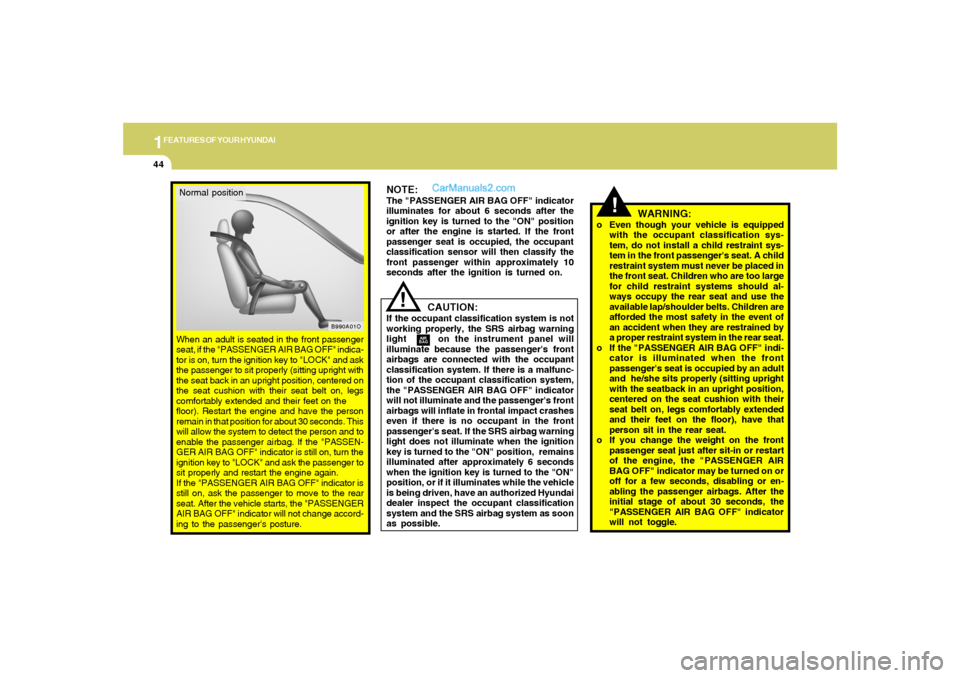
When an adult is seated in the front passenger
seat, if the "PASSENGER AIR BAG OFF" indica-
tor is on, turn the ignition key to "LOCK" and ask
the passenger to sit properly (sitting upright with
the seat back in an upright position, centered on
the seat cushion with their seat belt on, legs
comfortably extended and their feet on the
floor). Restart the engine and have the person
remain in that position for about 30 seconds. This
will allow the system to detect the person and to
enable the passenger airbag. If the "PASSEN-
GER AIR BAG OFF" indicator is still on, turn the
ignition key to "LOCK" and ask the passenger to
sit properly and restart the engine again.
If the "PASSENGER AIR BAG OFF" indicator is
still on, ask the passenger to move to the rear
seat. After the vehicle starts, the "PASSENGER
AIR BAG OFF" indicator will not change accord-
ing to the passenger's posture.Normal position
B990A01O
Page 58 of 271
1
FEATURES OF YOUR HYUNDAI
45
!
WARNING:
o Do not modify or replace the front pas-
senger seat. Don't place anything on or
attach anything such as a blanket or
after market seat heater to the front
passenger seat. This can adversely af-
fect the occupant classification system.
o Do not sit on sharp objects such as tools
when occupying the front passenger
seat. This can adversely affect the occu-
pant classification system.
o Do not use accessory seat covers on the
front seats.
o Accident statistics show that children
are safer if they are restrained in the rear,
as opposed to the front seat. It is recom-
mended that child restraints be secured
in a rear seat, including an infant riding
in a rear-facing infant seat, a child riding
in a forward-facing child seat and an
older child riding in a booster seat.
!
WARNING:
o A smaller-stature adult who is not seated
correctly (for example: seat excessively
reclined, leaning on the center console,
or hips shifted forward in the seat) can
cause a condition where the advanced
frontal airbag system senses less weight
than if the occupant were seated prop-
erly (sitting upright with the seatback in
an upright position, centered on the seat
cushion with their seat belt on, legs
comfortably extended and their feet on
the floor). This condition can result in an
adult potentially being misclassified and
illumination of the "PASSENGER AIR
BAG OFF" indicator.
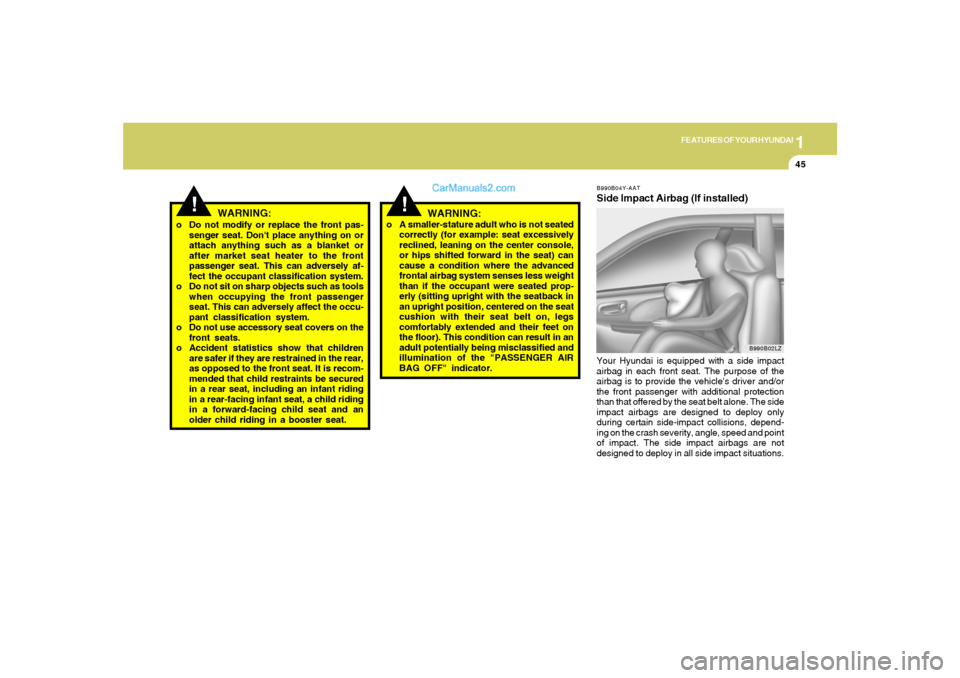
B990B04Y-AATSide Impact Airbag (If installed)Your Hyundai is equipped with a side impact
airbag in each front seat. The purpose of the
airbag is to provide the vehicle's driver and/or
the front passenger with additional protection
than that offered by the seat belt alone. The side
impact airbags are designed to deploy only
during certain side-impact collisions, depend-
ing on the crash severity, angle, speed and point
of impact. The side impact airbags are not
designed to deploy in all side impact situations.
B990B02LZ
Page 60 of 271

1
FEATURES OF YOUR HYUNDAI
47
B990C01LZ-GATCurtain AirbagCurtain airbags are located along both sides of
the roof rails above the front and rear doors.
They are designed to help protect the heads of
the front seat occupants and the rear outboard
seat occupants in certain side impact collisions.
The curtain airbags are designed to deploy only
during certain side impact collisions, depending
on the crash severity, angle, speed and impact.
The curtain airbags are not designed to deploy
in all side impact situations, collisions from the
front or rear of the vehicle or in most rollover
situations.
HLZ2051
Curtain Airbag
B240C01NF-AATSRS CareThe SRS is virtually maintenance-free and so
there are no parts you can safely service by
yourself. If the SRS "AIRBAG" warning light
does not illuminate, or continuously remains on,
have your vehicle immediately inspected by
your Hyundai dealer.
Any work on the SRS system, such as remov-
ing, installing, repairing, or any work on the
steering wheel must be performed by a qualified
Hyundai technician. Improper handling of the
SRS system may result in serious personal
injury.
WARNING:
o Do not install a child restraint system in
the front passenger seat position.
A child restraint system must never be
placed in the front seat. The infant or
child could be severely injured by an
airbag deployment in case of an acci-
dent.
o Modification to SRS components or wir-
ing, including the addition of any kind of
badges to the pad covers or modifica-
tions to the body structure, can ad-
versely affect SRS performance and lead
to possible injury.
o For cleaning the airbag pad covers, use
only a soft, dry cloth or one which has
been moistened with plain water. Sol-
vents or cleaners could adversely affect
the airbag covers and proper deploy-
ment of the system.
o No objects should be placed over or near
the airbag modules on the steering wheel,
instrument panel, and the front
passenger's panel above the glove box,
because any such object could cause
harm if the vehicle is in a crash severe
enough to cause the airbags to inflate.
!
HSM393
Page 170 of 271
2
DRIVING YOUR HYUNDAI
26
!
WARNING:
Items you carry inside your vehicle
can strike and injure people in a
sudden stop or turn, or in a crash.
o Put things in the cargo area of
your vehicle. Try to spread the
weight evenly.
o Never stack items, like suitcases,
inside the vehicle above the tops
of the seats.
o Do not leave an unsecured child
restraint in your vehicle.
o When you carry something inside
the vehicle, secure it.
o Do not drive with a seat folded
down unless necessary. NOTE:
o Overloading your vehicle may
cause damage. Repairs would not
be covered by your warranty. Do
not overload your vehicle.
o Using heavier suspension com-
ponents to get added durability
might not change your weight rat-
ings. Ask your dealer to help you
load your vehicle the right way.
The label will help you decide how much
cargo and installed equipment your
vehicle can carry.
If you carry items inside your vehicle –
like suitcases, tools, packages, or any-
thing else – they move as fast as the
vehicle goes. If you have to stop or turn
quickly, or if there is a crash, the items
will keep going and can cause an injury
if they strike the driver or a passenger.
Page 265 of 271
10
INDEX
2
A
Accessory Box................................................................................1-75
Advanced Supplemental Restraint (AIRBAG) System (SRS) ......1-36
Curtain airbag...............................................................................1-47
Driver's and passenger's front airbag.......................................1-37
Occupant classification system..................................................1-42
Side impact airbag .......................................................................1-45
Air Cleaner Filter ..............................................................................6-14
Air Conditioning
Care..............................................................................................6-21
Filter.................................................................................. 1-112, 6-22
Operation.......................................................................... 1-103, 6-21
Switch.........................................................................................1-103
Antenna..........................................................................................1-130
Ashtray.............................................................................................1-68
Audio System
Audio remote control switch .......................................................1-95
Compact disc player operation (V480)....................................1-118
Compact disc player operation (V490)....................................1-125
Stereo radio operation (V480) ..................................................1-115
Stereo radio operation (V490) ..................................................1-122
Automatic Heating and Cooling Control System.........................1-106
Automatic-Dimming Mirror with Z-Nav™ Electronic Compass
Display and HomeLink
®
...........................................................................................................
1-79B
Battery..............................................................................................6-27
Binding Arbitration............................................................................8-15
Brake
Anti-lock brake system (ABS) ....................................................2-12
Checking the brakes...................................................................6-20
Fluid ..............................................................................................6-20
Pedal clearance...........................................................................6-24
Pedal free-play.............................................................................6-24
Practices......................................................................................2-14
Breaking-In your New Hyundai ........................................................ 1-3
C
Care of Discs ................................................................................1-130
Catalytic Converter............................................................................ 7-3
Center Console Compartment........................................................1-76
Child Restraint System ...................................................................1-28
Installing a child restraint system with
"Tether Anchorage" system ......................................................1-30
Securing a child restraint system with "ISOFIX" system .........1-31
Child-Protector Rear Door Lock ...................................................... 1-6
Cigarette Lighter..............................................................................1-67
Clock................................................................................................1-66
Clutch
Pedal free-play.............................................................................6-23