battery Hyundai Sonata
[x] Cancel search | Manufacturer: HYUNDAI, Model Year: , Model line: , Model:Pages: 271, PDF Size: 12.44 MB
Page 200 of 271
6
DO-IT-YOURSELF MAINTENANCE
2
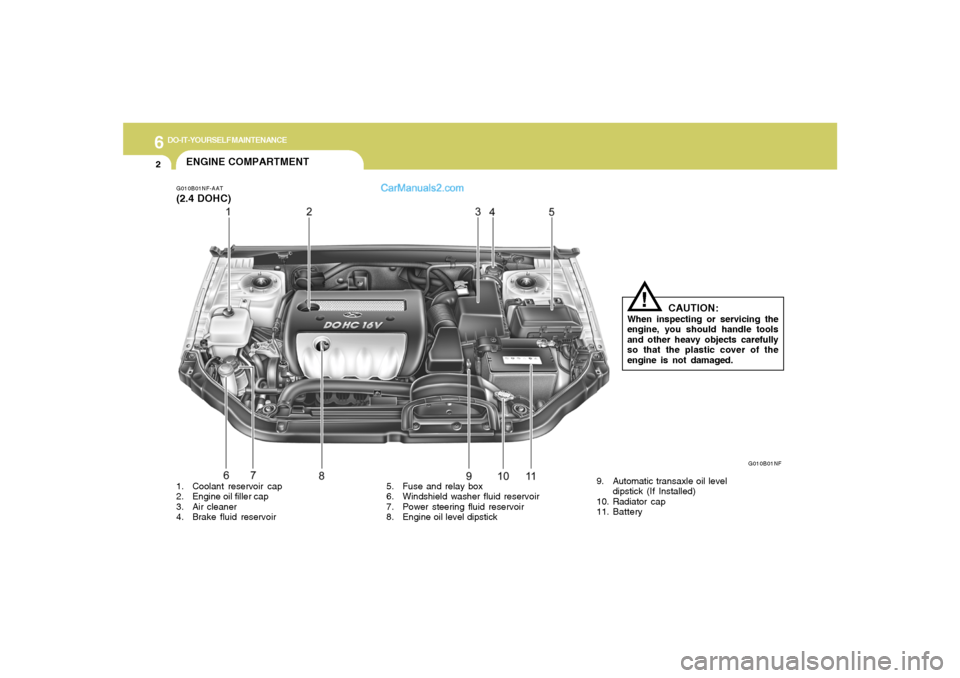
G010B01NF-AAT(2.4 DOHC)ENGINE COMPARTMENT
G010B01NF
CAUTION:
When inspecting or servicing the
engine, you should handle tools
and other heavy objects carefully
so that the plastic cover of the
engine is not damaged.
!
1. Coolant reservoir cap
2. Engine oil filler cap
3. Air cleaner
4. Brake fluid reservoir5. Fuse and relay box
6. Windshield washer fluid reservoir
7. Power steering fluid reservoir
8. Engine oil level dipstick9. Automatic transaxle oil level
dipstick (If Installed)
10. Radiator cap
11. Battery
Page 201 of 271

6
DO-IT-YOURSELF MAINTENANCE
3
G010A01NF-AAT(3.3 V6)
G010A01NF
CAUTION:
When inspecting or servicing the
engine, you should handle tools
and other heavy objects carefully
so that the plastic cover of the
engine is not damaged.
!
1. Coolant reservoir cap
2. Engine oil filler cap
3. Air cleaner
4. Brake fluid reservoir5. Fuse and relay box
6. Windshield washer fluid reservoir
7. Power steering fluid reservoir
8. Engine oil level dipstick9. Automatic transaxle oil level dipstick
10. Radiator cap
11. Battery
Page 202 of 271
6
DO-IT-YOURSELF MAINTENANCE
4
G020C01A-AATVehicle InteriorThe following should be checked each time
when the vehicle is driven:
o Lights operation
o Windshield wiper operation
o Horn operation
o Defroster, heating system operation (and air
conditioning, if installed)
o Steering operation and condition
o Mirror condition and operation
o Turn signal operation
o Accelerator pedal operation
o Brake operation, including parking brake
o Manual transaxle operation, including clutch
operation
o Automatic transaxle operation, including
"Park" mechanism operation
o Seat control condition and operation
o Seat belt condition and operation
o Sun visor operation
If you notice anything that does not operate
correctly or appears to be functioning correctly,
inspect it carefully and seek assistance from
your Hyundai dealer if service is needed.
G020B01A-AATVehicle ExteriorThe following should be checked monthly:
o Overall appearance and condition
o Wheel condition and wheel nut torque
o Exhaust system condition
o Light condition and operation
o Windshield glass condition
o Wiper blade condition
o Paint condition and body corrosion
o Fluid leaks
o Door and hood lock condition
o Tire pressure and condition
(including spare tire)
GENERAL CHECKSG020A01NF-AATEngine CompartmentThe following should be checked regularly:
o Engine oil level and condition
o Transaxle fluid level and condition
o Brake fluid level
o Engine coolant level
o Windshield washer fluid level
o Accessory drive belt condition
o Engine coolant hose condition
o Fluid leaks (on or below components)
o Power steering fluid level
o Battery condition
o Air filter condition
o Engine vibration
Page 223 of 271
6
DO-IT-YOURSELF MAINTENANCE
25
Drive belts should be checked periodically for
proper tension. At the same time, belts should
be examined for cracks, wear, fraying or other
evidence of deterioration and replaced if neces-
sary.
When a new belt is replaced, the belt should be
located within the pulley of flat idler.
Belt routing should also be checked to be sure
there is no interference between the belts and
other parts of the engine.
NOTE:Drive belt tension is adjusted automatically
by the auto tensioner.
CHECKING AND REPLACING
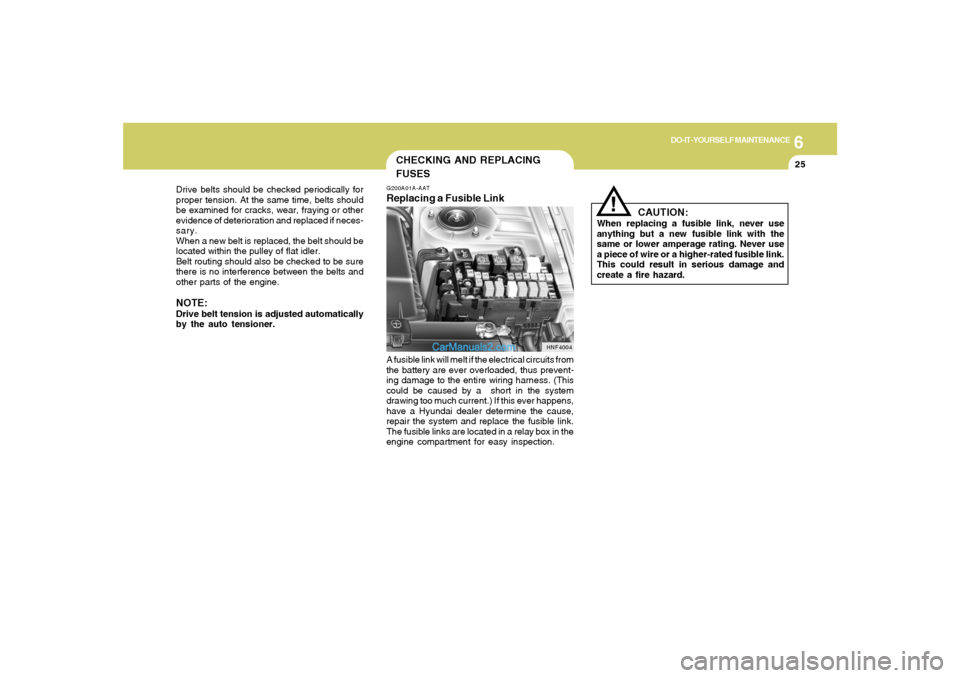
FUSESG200A01A-AATReplacing a Fusible LinkA fusible link will melt if the electrical circuits from
the battery are ever overloaded, thus prevent-
ing damage to the entire wiring harness. (This
could be caused by a short in the system
drawing too much current.) If this ever happens,
have a Hyundai dealer determine the cause,
repair the system and replace the fusible link.
The fusible links are located in a relay box in the
engine compartment for easy inspection.
HNF4004
!
CAUTION:
When replacing a fusible link, never use
anything but a new fusible link with the
same or lower amperage rating. Never use
a piece of wire or a higher-rated fusible link.
This could result in serious damage and
create a fire hazard.
Page 225 of 271
6
DO-IT-YOURSELF MAINTENANCE
27
CHECKING THE BATTERY!
G210A01A-AAT
WARNING:
Batteries can be dangerous! When working
with batteries, carefully observe the follow-
ing precautions to avoid serious injuries.
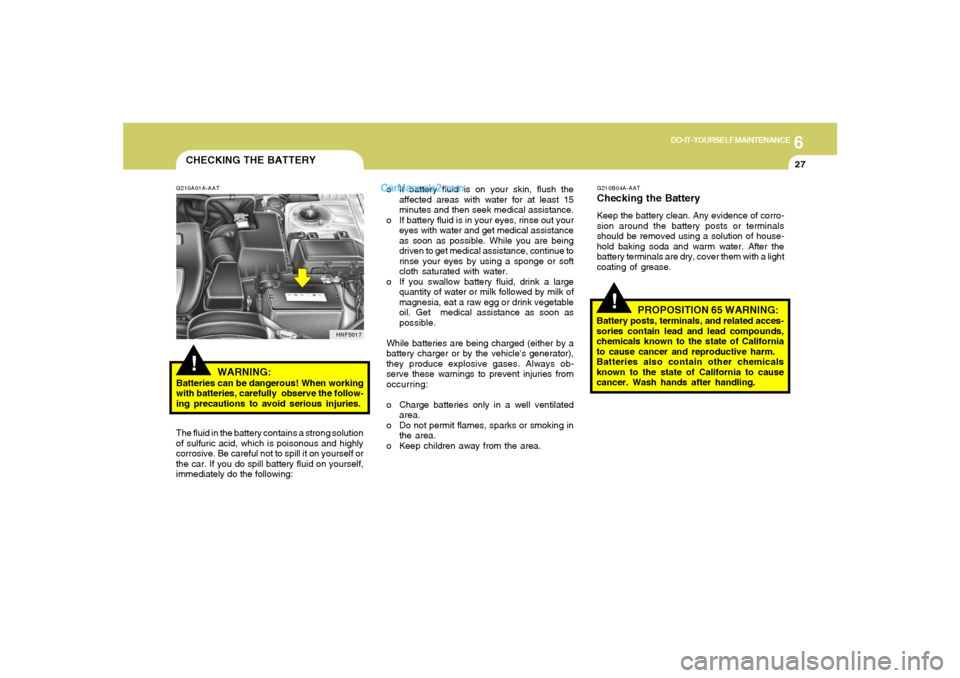
The fluid in the battery contains a strong solution
of sulfuric acid, which is poisonous and highly
corrosive. Be careful not to spill it on yourself or
the car. If you do spill battery fluid on yourself,
immediately do the following:
HNF5017
o If battery fluid is on your skin, flush the
affected areas with water for at least 15
minutes and then seek medical assistance.
o If battery fluid is in your eyes, rinse out your
eyes with water and get medical assistance
as soon as possible. While you are being
driven to get medical assistance, continue to
rinse your eyes by using a sponge or soft
cloth saturated with water.
o If you swallow battery fluid, drink a large
quantity of water or milk followed by milk of
magnesia, eat a raw egg or drink vegetable
oil. Get medical assistance as soon as
possible.
While batteries are being charged (either by a
battery charger or by the vehicle's generator),
they produce explosive gases. Always ob-
serve these warnings to prevent injuries from
occurring:
o Charge batteries only in a well ventilated
area.
o Do not permit flames, sparks or smoking in
the area.
o Keep children away from the area.
!
G210B04A-AATChecking the BatteryKeep the battery clean. Any evidence of corro-
sion around the battery posts or terminals
should be removed using a solution of house-
hold baking soda and warm water. After the
battery terminals are dry, cover them with a light
coating of grease.
PROPOSITION 65 WARNING:
Battery posts, terminals, and related acces-
sories contain lead and lead compounds,
chemicals known to the state of California
to cause cancer and reproductive harm.
Batteries also contain other chemicals
known to the state of California to cause
cancer. Wash hands after handling.
Page 226 of 271
6
DO-IT-YOURSELF MAINTENANCE
28
!
!
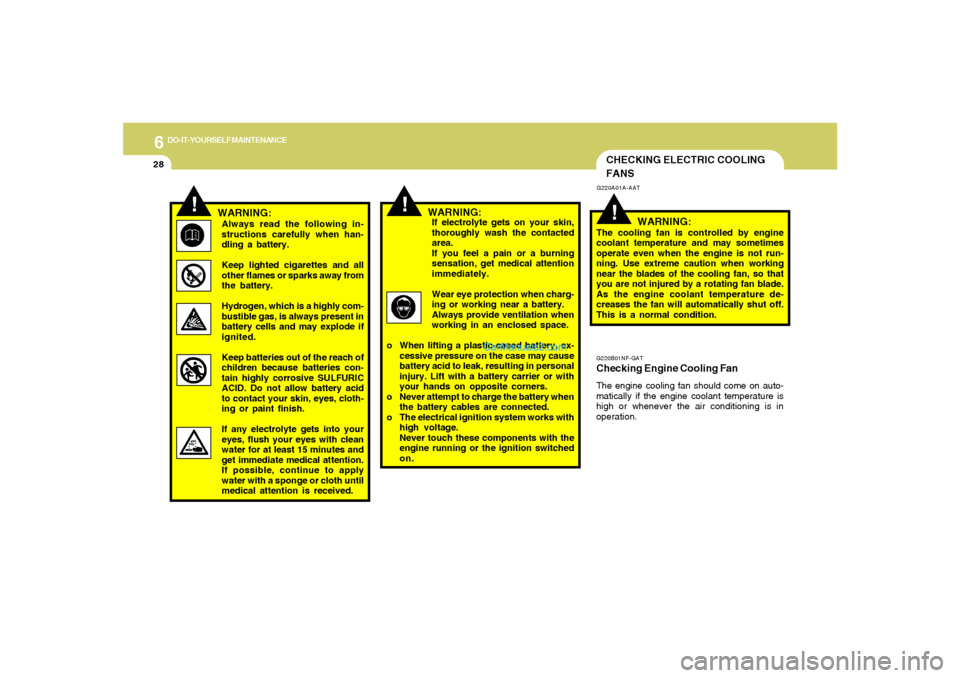
WARNING:Always read the following in-
structions carefully when han-
dling a battery.
Keep lighted cigarettes and all
other flames or sparks away from
the battery.
Hydrogen, which is a highly com-
bustible gas, is always present in
battery cells and may explode if
ignited.
Keep batteries out of the reach of
children because batteries con-
tain highly corrosive SULFURIC
ACID. Do not allow battery acid
to contact your skin, eyes, cloth-
ing or paint finish.
If any electrolyte gets into your
eyes, flush your eyes with clean
water for at least 15 minutes and
get immediate medical attention.
If possible, continue to apply
water with a sponge or cloth until
medical attention is received.If electrolyte gets on your skin,
thoroughly wash the contacted
area.
If you feel a pain or a burning
sensation, get medical attention
immediately.
Wear eye protection when charg-
ing or working near a battery.
Always provide ventilation when
working in an enclosed space.
o When lifting a plastic-cased battery, ex-
cessive pressure on the case may cause
battery acid to leak, resulting in personal
injury. Lift with a battery carrier or with
your hands on opposite corners.
o Never attempt to charge the battery when
the battery cables are connected.
o The electrical ignition system works with
high voltage.
Never touch these components with the
engine running or the ignition switched
on.
WARNING:
CHECKING ELECTRIC COOLING
FANS!
G220A01A-AAT
WARNING:
The cooling fan is controlled by engine
coolant temperature and may sometimes
operate even when the engine is not run-
ning. Use extreme caution when working
near the blades of the cooling fan, so that
you are not injured by a rotating fan blade.
As the engine coolant temperature de-
creases the fan will automatically shut off.
This is a normal condition.G220B01NF-GATChecking Engine Cooling FanThe engine cooling fan should come on auto-
matically if the engine coolant temperature is
high or whenever the air conditioning is in
operation.
Page 261 of 271
9
VEHICLE SPECIFICATIONS2
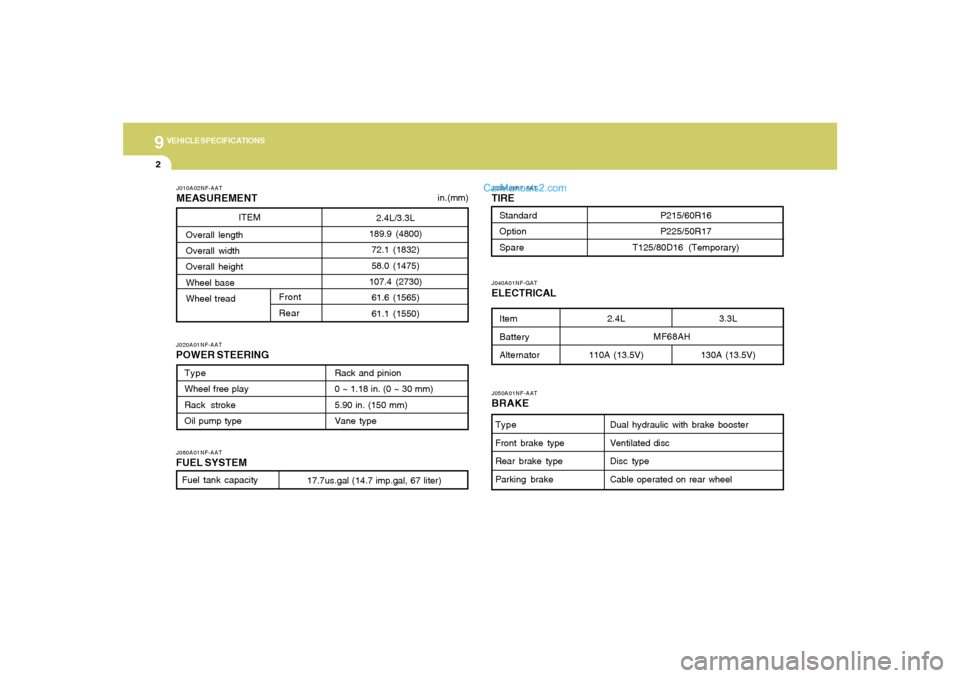
3.3L
130A (13.5V)
J010A02NF-AATMEASUREMENTJ060A01NF-AATFUEL SYSTEMJ020A01NF-AATPOWER STEERING
J030A01NF-AATTIREItem
Battery
AlternatorJ040A01NF-GATELECTRICAL
2.4L
110A (13.5V) in.(mm)
Fuel tank capacity
17.7us.gal (14.7 imp.gal, 67 liter)
ITEM
MF68AH
J050A01NF-AATBRAKE
Dual hydraulic with brake booster
Ventilated disc
Disc type
Cable operated on rear wheel Type
Front brake type
Rear brake type
Parking brake
Type
Wheel free play
Rack stroke
Oil pump typeRack and pinion
0 ~ 1.18 in. (0 ~ 30 mm)
5.90 in. (150 mm)
Vane type
2.4L/3.3L
189.9 (4800)
72.1 (1832)
58.0 (1475)
107.4 (2730)
61.6 (1565)
61.1 (1550) Overall length
Overall width
Overall height
Wheel base
Wheel tread
Front
Rear
Standard
Option
Spare
P215/60R16
P225/50R17
T125/80D16 (Temporary)
Page 265 of 271
10
INDEX
2
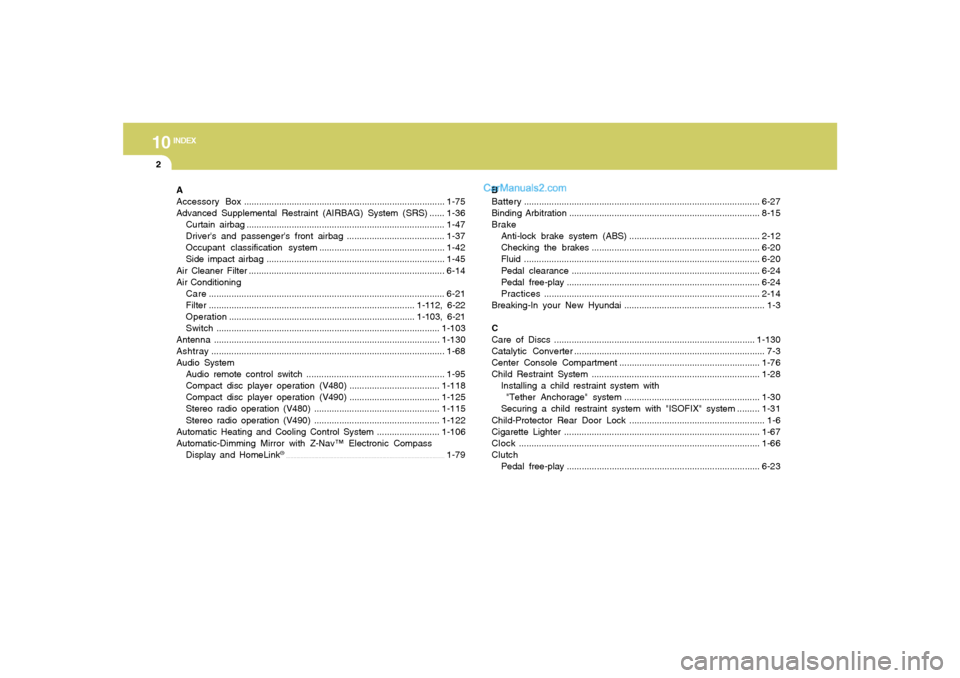
A
Accessory Box................................................................................1-75
Advanced Supplemental Restraint (AIRBAG) System (SRS) ......1-36
Curtain airbag...............................................................................1-47
Driver's and passenger's front airbag.......................................1-37
Occupant classification system..................................................1-42
Side impact airbag .......................................................................1-45
Air Cleaner Filter ..............................................................................6-14
Air Conditioning
Care..............................................................................................6-21
Filter.................................................................................. 1-112, 6-22
Operation.......................................................................... 1-103, 6-21
Switch.........................................................................................1-103
Antenna..........................................................................................1-130
Ashtray.............................................................................................1-68
Audio System
Audio remote control switch .......................................................1-95
Compact disc player operation (V480)....................................1-118
Compact disc player operation (V490)....................................1-125
Stereo radio operation (V480) ..................................................1-115
Stereo radio operation (V490) ..................................................1-122
Automatic Heating and Cooling Control System.........................1-106
Automatic-Dimming Mirror with Z-Nav™ Electronic Compass
Display and HomeLink
®
...........................................................................................................
1-79B
Battery..............................................................................................6-27
Binding Arbitration............................................................................8-15
Brake
Anti-lock brake system (ABS) ....................................................2-12
Checking the brakes...................................................................6-20
Fluid ..............................................................................................6-20
Pedal clearance...........................................................................6-24
Pedal free-play.............................................................................6-24
Practices......................................................................................2-14
Breaking-In your New Hyundai ........................................................ 1-3
C
Care of Discs ................................................................................1-130
Catalytic Converter............................................................................ 7-3
Center Console Compartment........................................................1-76
Child Restraint System ...................................................................1-28
Installing a child restraint system with
"Tether Anchorage" system ......................................................1-30
Securing a child restraint system with "ISOFIX" system .........1-31
Child-Protector Rear Door Lock ...................................................... 1-6
Cigarette Lighter..............................................................................1-67
Clock................................................................................................1-66
Clutch
Pedal free-play.............................................................................6-23