coolant temperature Hyundai Sonata
[x] Cancel search | Manufacturer: HYUNDAI, Model Year: , Model line: , Model:Pages: 205, PDF Size: 19.98 MB
Page 175 of 205
6- 20 DO-IT-YOURSELF MAINTENANCE
!
!
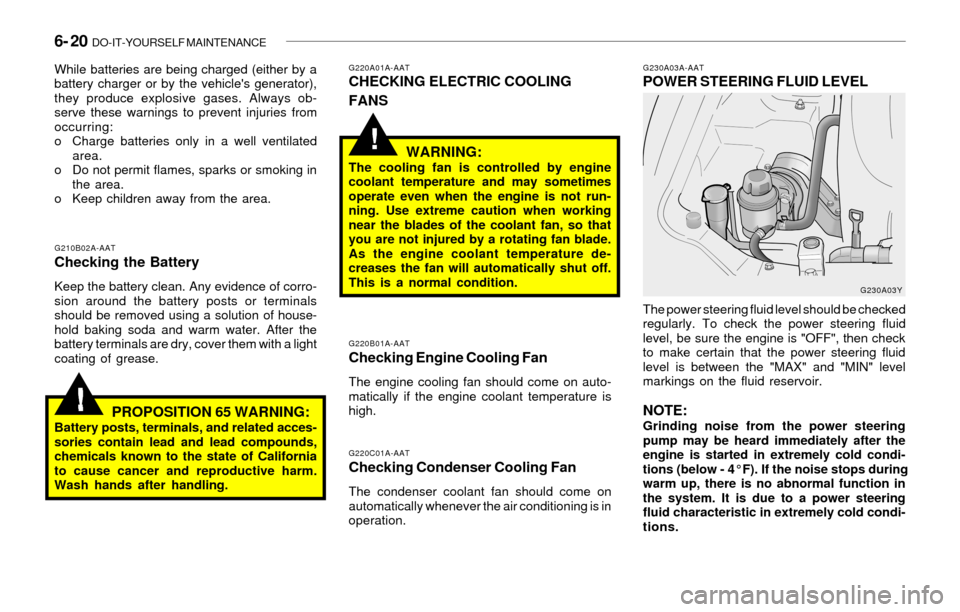
G230A03A-AATPOWER STEERING FLUID LEVEL
G220B01A-AATChecking Engine Cooling Fan
The engine cooling fan should come on auto-
matically if the engine coolant temperature is
high.
G220A01A-AATCHECKING ELECTRIC COOLING
FANS
G220C01A-AATChecking Condenser Cooling Fan
The condenser coolant fan should come on
automatically whenever the air conditioning is in
operation.
G210B02A-AATChecking the Battery
Keep the battery clean. Any evidence of corro-
sion around the battery posts or terminals
should be removed using a solution of house-
hold baking soda and warm water. After the
battery terminals are dry, cover them with a light
coating of grease. While batteries are being charged (either by a
battery charger or by the vehicle's generator),
they produce explosive gases. Always ob-
serve these warnings to prevent injuries from
occurring:
o Charge batteries only in a well ventilated
area.
o Do not permit flames, sparks or smoking in
the area.
o Keep children away from the area.
WARNING:The cooling fan is controlled by engine
coolant temperature and may sometimes
operate even when the engine is not run-
ning. Use extreme caution when working
near the blades of the coolant fan, so that
you are not injured by a rotating fan blade.
As the engine coolant temperature de-
creases the fan will automatically shut off.
This is a normal condition.
The power steering fluid level should be checked
regularly. To check the power steering fluid
level, be sure the engine is "OFF", then check
to make certain that the power steering fluid
level is between the "MAX" and "MIN" level
markings on the fluid reservoir.
NOTE:Grinding noise from the power steering
pump may be heard immediately after the
engine is started in extremely cold condi-
tions (below - 4°F). If the noise stops during
warm up, there is no abnormal function in
the system. It is due to a power steering
fluid characteristic in extremely cold condi-
tions.
G230A03Y
PROPOSITION 65 WARNING:Battery posts, terminals, and related acces-
sories contain lead and lead compounds,
chemicals known to the state of California
to cause cancer and reproductive harm.
Wash hands after handling.
!
Page 187 of 205

7- 2 EMISSION CONTROL SYSTEMS
H010E01Y-AATEGR System (If installed)
This system helps reduce nitrogen oxides by
recirculating a part of the exhaust gas into the
engine, thereby reducing cylinder combustion
temperature, which results in lower output of
oxides of nitrogen.
H010D01A-AAT3. Exhaust Emission Control System
The Exhaust Emission Control System is a
highly effective system which controls exhaust
emissions while maintaining good vehicle
performace.
H010B01A-AAT1. Crankcase Emission Control
System
The positive crankcase ventilation system is
employed to prevent air pollution caused by
blow-by gases being emitted from the crank-
case. This system supplies filtered air to the
crankcase through the air intake hose. Inside
the crankcase, the fresh air mixes with blow-by
gases, which then pass through the PCV valve
and into the induction system.
H010A01L-AATEMISSION CONTROL SYSTEM
Your Hyundai is equipped with an emission
control system to meet all requirements of the
U.S. Environmental Protection Agency or Cali-
fornia Air Resources Board.
There are three emission control systems which
are as follows.
(1) Crankcase emission control system
(2) Evaporative emission control system
(3) Exhaust emission control system
In order to assure the proper function of the
emission control systems, it is recommended
that you have your car inspected and main-
tained by an authorized Hyundai dealer in ac-
cordance with the maintenance schedule in this
manual.
Caution for Inspection and Maintenance
Test (2.7 V6 Vehicle with Traction Control
System)
o To prevent the vehicle from misfiring
during dynamometer testing, discon-
nect the ABS connector located on the
left side of the engine compartment.
o For more information, see shop manual
(BR-67, Wheel Speed Sensor)
H010C02S-AAT
2. Evaporative Emission Control
(Including ORVR: Onboard Refueling
Vapor Recovery) System
The Evaporative Emission Control System is
designed to prevent fuel vapors from escaping
into the atmosphere.
(The ORVR system is designed to allow the
vapors from the fuel tank to be loaded into a
canister while refueling at the gas station, pre-
venting the escape of fuel vapors into the
atmosphere.)
Canister
Fuel vapors generated inside the fuel tank are
absorbed and stored in the onboard canister.
When the engine is running, the fuel vapors
absorbed in the canister are drawn into the
surge tank through the purge control solenoid
valve.
Purge Control Solenoid Valve (PCSV)
The purge control solenoid valve is controlled
by the Engine Control Module (ECM); when the
engine coolant temperature is low during idling,
the PCSV closes so that evaporated fuel is not
taken into the engine. After the engine warms-
up during ordinary driving, the PCSV opens to
introduce evaporated fuel to the engine.
Page 202 of 205

INDEX 10- 3
E
Emission Control System ................................................................... 7-2
Engine
Before starting the engine .............................................................. 2-3
Compartment (2.4 DOHC) ............................................................ 6-2
Compartment (2.7 V6) ................................................................... 6-3
Coolant ........................................................................................... 6-7
Coolant temperature gauge .........................................................1-38
If the engine overheats .................................................................. 3-3
Number........................................................................................... 8-2
Oil .................................................................................................... 6-5
Starting ........................................................................................... 2-4
Engine Exhaust Can Be Dangerous .................................................. 2-2
F
Fan Speed Control ............................................................................1-66
Floor Mat Anchor ..............................................................................1-62
Fog Light
Front.............................................................................................1-42
Front Seats
Adjustable front seats ..................................................................1-10
Adjustable headrests ...................................................................1-11
Adjusting seat forward and rearward ..........................................1-10
Adjusting seatback angle .............................................................1-11
Fuel
Capacity......................................................................................... 9-2
Gauge...........................................................................................1-38
Unleaded gasoline .......................................................................... 1-2
Fuel Filler Lid
Remote release ............................................................................1-58
Fuses................................................................................................6-18G
General Everyday Checks ................................................................. 6-4
Glove Box ..........................................................................................1-50
H
Hazard Warning System ..................................................................1-44
Headlight .................................................................................. 1-41, 6-21
Heating and Cooling Control
Rotary and push Button type .......................................................1-65
Automatic type .............................................................................1-72
Heating and Ventilation
Air flow control ..............................................................................1-67
Temperature control ....................................................................1-66
High-Mounted Rear Stop Light .........................................................1-58
Homelink Mirror .................................................................................1-53
Hood Release ....................................................................................1-59
Horn...................................................................................................1-60
I
Ignition Switch ...................................................................................... 2-3
Instrument Cluster and Indicator Lights ...........................................1-34
Instrument Panel Light Control (Rheostat) .......................................1-45
Interior Light .......................................................................................1-49
Intermittent Wiper ..............................................................................1-43
J
Jump Starting ...................................................................................... 3-2
Junction Box Description ..................................................................6-29