recommended oil Hyundai Sonata
[x] Cancel search | Manufacturer: HYUNDAI, Model Year: , Model line: , Model:Pages: 380, PDF Size: 7.97 MB
Page 357 of 380
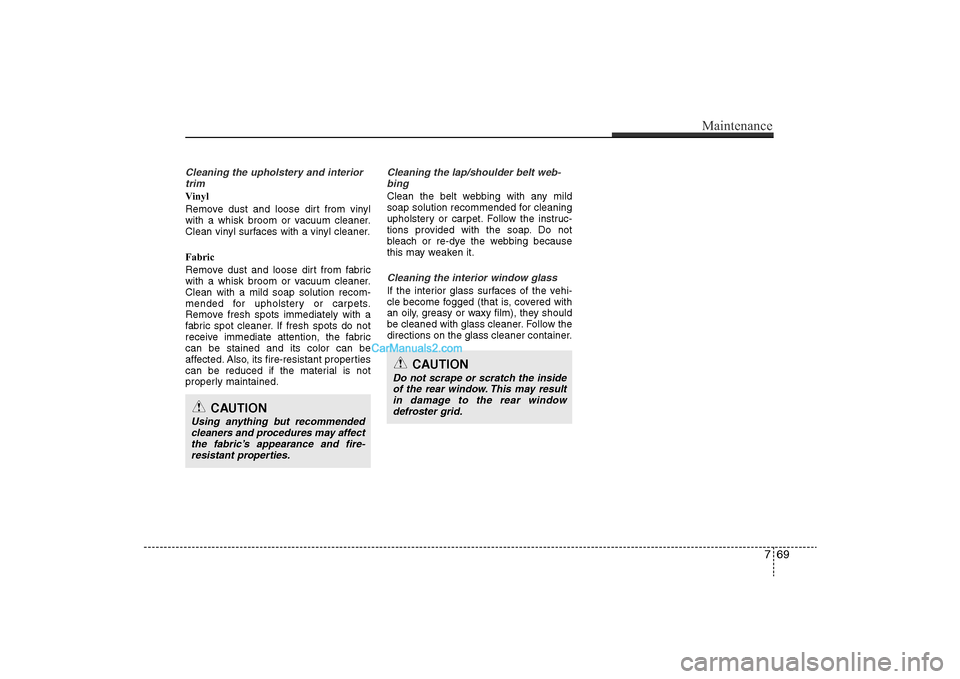
Cleaning the upholstery and interiortrimVinyl
Remove dust and loose dirt from vinyl
with a whisk broom or vacuum cleaner.
Clean vinyl surfaces with a vinyl cleaner.
Fabric
Remove dust and loose dirt from fabric
with a whisk broom or vacuum cleaner.
Clean with a mild soap solution recom-
mended for upholstery or carpets.
Remove fresh spots immediately with a
fabric spot cleaner. If fresh spots do not
receive immediate attention, the fabric
can be stained and its color can be
affected. Also, its fire-resistant properties
can be reduced if the material is not
properly maintained.
Cleaning the lap/shoulder belt web-bingClean the belt webbing with any mild
soap solution recommended for cleaning
upholstery or carpet. Follow the instruc-
tions provided with the soap. Do not
bleach or re-dye the webbing because
this may weaken it.Cleaning the interior window glass If the interior glass surfaces of the vehi-
cle become fogged (that is, covered with
an oily, greasy or waxy film), they should
be cleaned with glass cleaner. Follow the
directions on the glass cleaner container.
CAUTION
Using anything but recommended cleaners and procedures may affectthe fabric’s appearance and fire- resistant properties.
CAUTION
Do not scrape or scratch the insideof the rear window. This may resultin damage to the rear windowdefroster grid.
Maintenance
69
7
YF HMA 7.QXP 11/25/2009 1:54 PM Page 69
Page 365 of 380
Specifications, Consumer information, Reporting safety defeccts4
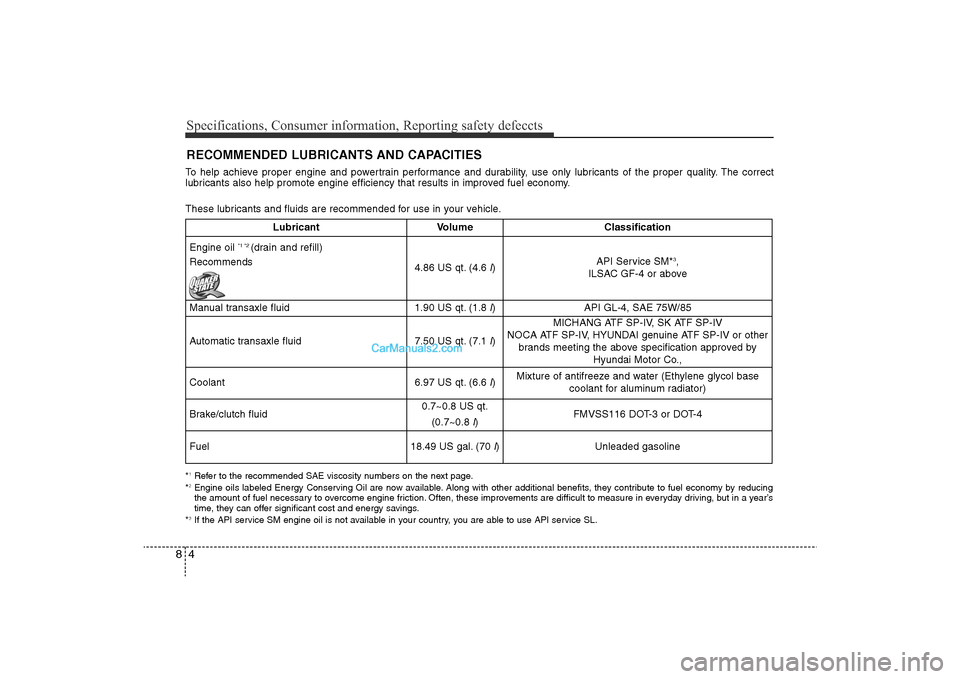
8RECOMMENDED LUBRICANTS AND CAPACITIES To help achieve proper engine and powertrain performance and durability, use only lubricants of the proper quality. The correct
lubricants also help promote engine efficiency that results in improved fuel economy.These lubricants and fluids are recommended for use in your vehicle.*1Refer to the recommended SAE viscosity numbers on the next page.
*2Engine oils labeled Energy Conserving Oil are now available. Along with other additional benefits, they contribute to fuel econo my by reducing
the amount of fuel necessary to overcome engine friction. Often, these improvements are difficult to measure in everyday driving , but in a year’s
time, they can offer significant cost and energy savings.
*3If the API service SM engine oil is not available in your country, you are able to use API service SL.
Lubricant
Volume
Classification
Engine oil
*1 *2
(drain and refill)
Recommends
4.86 US qt. (4.6
l)
API Service SM*
3,
ILSAC GF-4 or above
Manual transaxle fluid
1.90 US qt. (1.8
l)
API GL-4, SAE 75W/85
Automatic transaxle fluid
7.50 US qt. (7.1
l)
MICHANG ATF SP-IV, SK ATF SP-IV
NOCA ATF SP-IV, HYUNDAI genuine ATF SP-IV or other brands meeting the above specification approved by Hyundai Motor Co.,
Coolant
6.97 US qt. (6.6
l)
Mixture of antifreeze and water (Ethylene glycol basecoolant for aluminum radiator)
Brake/clutch fluid
0.7~0.8 US qt.
(0.7~0.8
l)
FMVSS116 DOT-3 or DOT-4
Fuel
18.49 US gal. (70
l)
Unleaded gasoline
YF HMA 8.QXP 12/24/2009 5:23 PM Page 4
Page 366 of 380
85
Specifications, Consumer information, Reporting safety defeccts
Recommended SAE viscosity
number
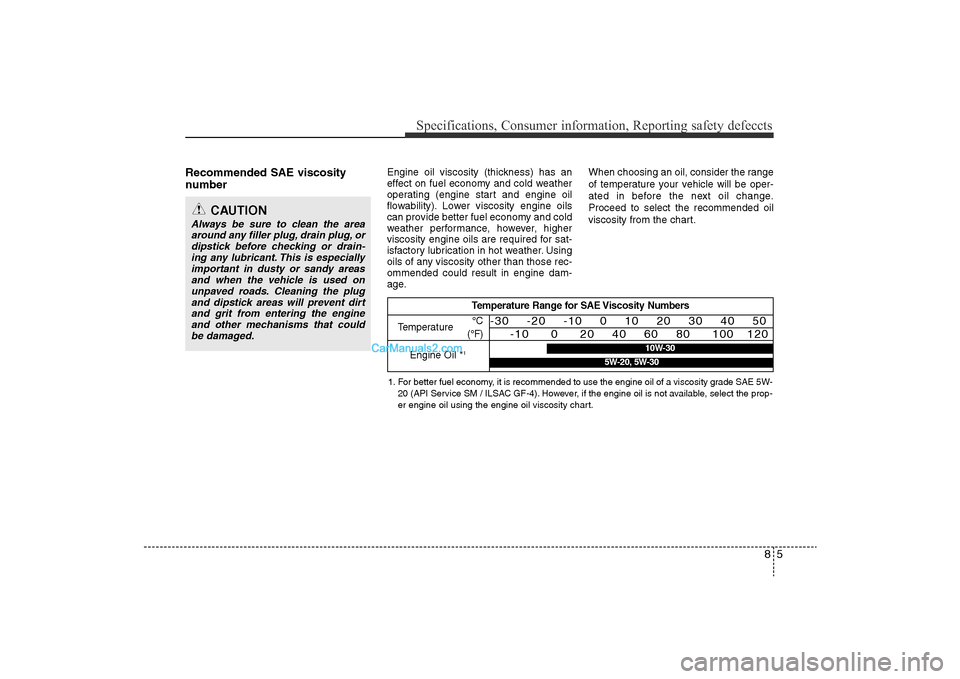
Engine oil viscosity (thickness) has an
effect on fuel economy and cold weather
operating (engine start and engine oil
flowability). Lower viscosity engine oils
can provide better fuel economy and cold
weather performance, however, higher
viscosity engine oils are required for sat-
isfactory lubrication in hot weather. Using
oils of any viscosity other than those rec-
ommended could result in engine dam-
age.When choosing an oil, consider the range
of temperature your vehicle will be oper-
ated in before the next oil change.
Proceed to select the recommended oil
viscosity from the chart.
CAUTION
Always be sure to clean the area
around any filler plug, drain plug, ordipstick before checking or drain- ing any lubricant. This is especiallyimportant in dusty or sandy areasand when the vehicle is used on unpaved roads. Cleaning the plugand dipstick areas will prevent dirt and grit from entering the engineand other mechanisms that could be damaged.
Temperature Range for SAE Viscosity Numbers
Temperature
Engine Oil *
1°C
(°F)
-30 -20 -10 0 10 20 30 40 50 -10 0 20 40 60 80 100 120
1. For better fuel economy, it is recommended to use the engine oil of a viscosity grade SAE 5W-
20 (API Service SM / ILSAC GF-4). However, if the engine oil is not available, select the prop-
er engine oil using the engine oil viscosity chart.
10W-30
5W-20, 5W-30
YF HMA 8.QXP 12/24/2009 5:23 PM Page 5