tow Hyundai Sonata
[x] Cancel search | Manufacturer: HYUNDAI, Model Year: , Model line: , Model:Pages: 380, PDF Size: 7.97 MB
Page 272 of 380
65
What to do in an emergency
Jump starting procedure 1. Make sure the booster battery is 12-volt and that its negative terminal is
grounded.
2. If the booster battery is in another vehicle, do not allow the vehicles to
touch.
3. Turn off all unnecessary electrical loads.
4. Connect the jumper cables in the exact sequence shown in the illustration.
First connect one end of a jumper
cable to the positive terminal of the
discharged battery (1), then connect
the other end to the positive terminal
on the booster battery (2). Proceed to
connect one end of the other jumper
cable to the negative terminal of the
booster battery (3), then the other end
to a solid, stationary, metallic point (for
example, the engine lifting bracket)
away from the battery (4). Do not con-
nect it to or near any part that moves
when the engine is cranked. Do not allow the jumper cables to con-
tact anything except the correct battery
terminals or the correct ground. Do not
lean over the battery when making
connections.
5. Start the engine of the vehicle with the booster battery and let it run at 2,000
rpm, then start the engine of the vehi-
cle with the discharged battery.
If the cause of your battery discharging isnot apparent, you should have your vehi-cle checked by an authorized HYUNDAI dealer.
Push-starting Your manual transaxle-equipped vehicle
should not be push-started because it
might damage the emission control sys-
tem.
Vehicles equipped with automatic
transaxle cannot be push-started.
Follow the directions in this section for
jump-starting.
CAUTION
-Battery cables
Do not connect the jumper cablefrom the negative terminal of thebooster battery to the negative ter-minal of the discharged battery.This can cause the discharged bat-tery to overheat and crack, releas-ing battery acid.
WARNING
Never tow a vehicle to start it
because the sudden surge forward
when the engine starts could cause
a collision with the tow vehicle.
YF HMA 6.QXP 11/25/2009 1:58 PM Page 5
Page 276 of 380
69
What to do in an emergency
TPMS (Tire Pressure
Monitoring System)
malfunction indicator
The TPMS malfunction indicator will
illuminate after it blinks for approxi-
mately one minute when there is a
problem with the Tire Pressure
Monitoring System. If the system is
able to correctly detect an under infla-
tion warning at the same time as sys-
tem failure then it will illuminate the
TPMS malfunction indicator.
Have the system checked by an
authorized HYUNDAI dealer as soon
as possible to determine the cause
of the problem.
WARNING
- Low pressure damage
Significantly low tire pressure
makes the vehicle unstable and
can contribute to loss of vehicle
control and increased braking
distances.
Continued driving on low pres-
sure tires can cause the tires to
overheat and fail.
CAUTION
• The TPMS malfunction indica- tor may be illuminated if thevehicle is moving around elec-tric power supply cables orradios transmitter such as atpolice stations, governmentand public offices, broadcast-ing stations, military installa-tions, airports, or transmittingtowers, etc. This can interferewith normal operation of theTire Pressure MonitoringSystem (TPMS).
• The TPMS malfunction indica- tor may illuminate if snowchains or some separatelypurchased devices such asnotebook computers, mobilecharger, remote starter, navi-gation etc. are used in thevehicle. This can interfere withnormal operation of the TirePressure Monitoring System(TPMS).
YF HMA 6.QXP 11/25/2009 1:58 PM Page 9
Page 279 of 380
What to do in an emergency12
6IF YOU HAVE A FLAT TIREJack and tools
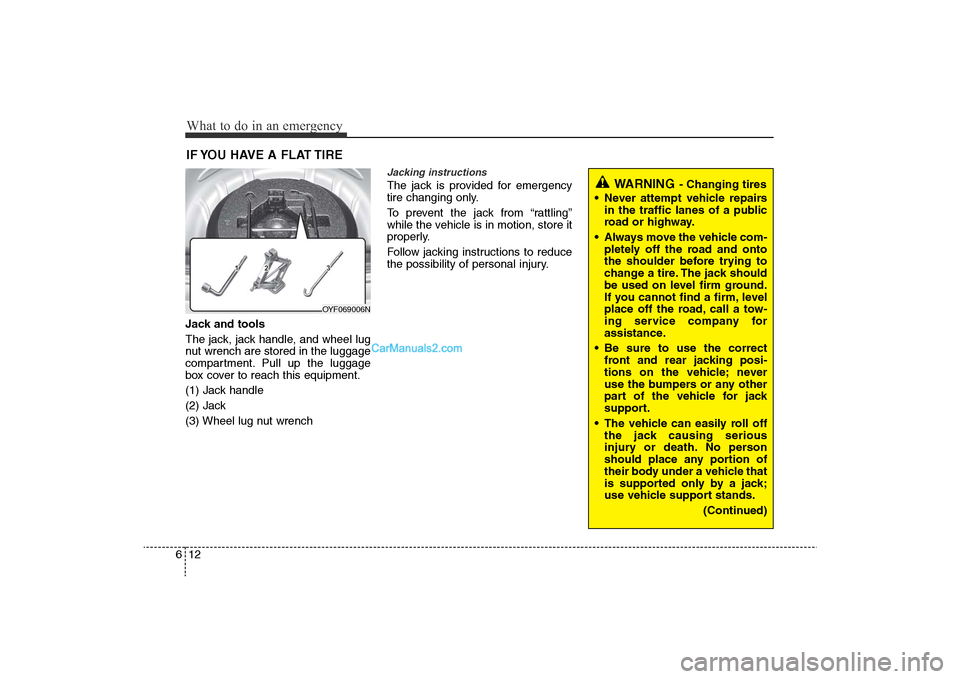
The jack, jack handle, and wheel lug
nut wrench are stored in the luggage
compartment. Pull up the luggage
box cover to reach this equipment.
(1) Jack handle
(2) Jack
(3) Wheel lug nut wrench
Jacking instructions The jack is provided for emergency
tire changing only.
To prevent the jack from “rattling”
while the vehicle is in motion, store it
properly.
Follow jacking instructions to reduce
the possibility of personal injury.
WARNING
- Changing tires
• Never attempt vehicle repairs in the traffic lanes of a public
road or highway.
• Always move the vehicle com- pletely off the road and onto
the shoulder before trying to
change a tire. The jack should
be used on level firm ground.
If you cannot find a firm, level
place off the road, call a tow-
ing service company for
assistance.
• Be sure to use the correct front and rear jacking posi-
tions on the vehicle; never
use the bumpers or any other
part of the vehicle for jack
support.
• The vehicle can easily roll off the jack causing serious
injury or death. No person
should place any portion of
their body under a vehicle that
is supported only by a jack;
use vehicle support stands.
(Continued)
OYF069006N
YF HMA 6.QXP 11/25/2009 1:58 PM Page 12
Page 286 of 380
619
What to do in an emergency
• Do not take this vehicle through anautomatic car wash while the com-
pact spare tire is installed.
• Do not use tire chains on the com- pact spare tire. Because of the
smaller size, a tire chain will not fit
properly. This could damage the
vehicle and result in loss of the
chain.
• Do not use the compact spare tire on any other vehicle because this
tire has been designed especially
for your vehicle.
• The compact spare tire’s tread life is shorter than a regular tire.
Inspect your compact spare tire
regularly and replace worn com-
pact spare tires with the same size
and design, mounted on the same
wheel. • The compact spare tire should not
be used on any other wheels, nor
should standard tires, snow tires,
wheel covers or trim rings be used
with the compact spare wheel. If
such use is attempted, damage to
these items or other car compo-
nents may occur.
• Do not use more than one compact spare tire at a time.
• Do not tow a trailer while the com- pact spare tire is installed.
YF HMA 6.QXP 11/25/2009 1:59 PM Page 19
Page 287 of 380
What to do in an emergency20
6
HXD02HXD03
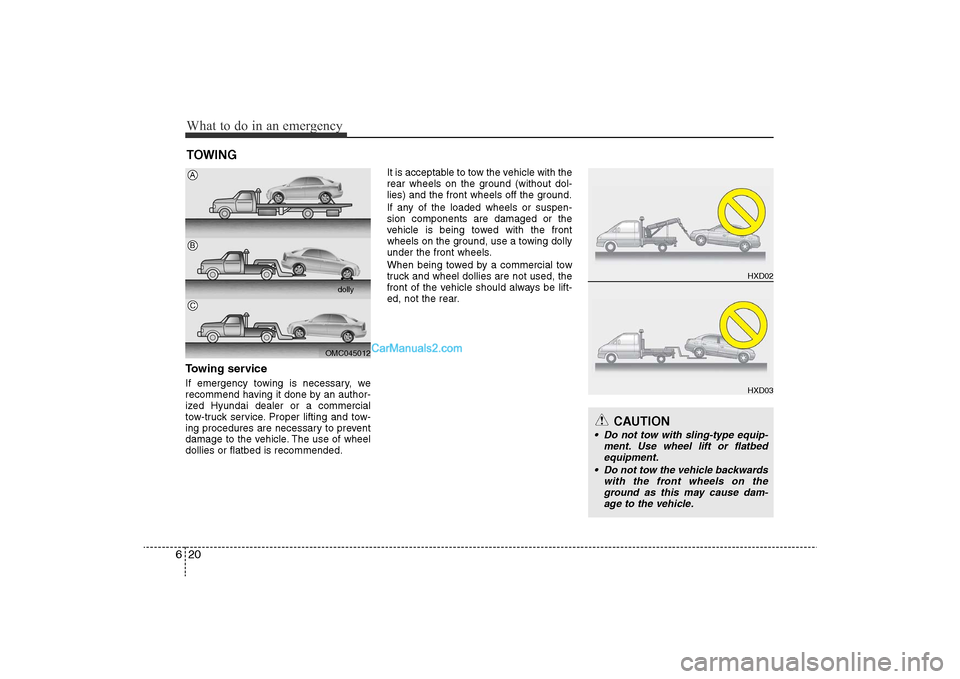
TOWINGTowing serviceIf emergency towing is necessary, we
recommend having it done by an author-
ized Hyundai dealer or a commercial
tow-truck service. Proper lifting and tow-
ing procedures are necessary to prevent
damage to the vehicle. The use of wheel
dollies or flatbed is recommended. It is acceptable to tow the vehicle with the
rear wheels on the ground (without dol-
lies) and the front wheels off the ground.
If any of the loaded wheels or suspen-
sion components are damaged or the
vehicle is being towed with the front
wheels on the ground, use a towing dolly
under the front wheels.
When being towed by a commercial tow
truck and wheel dollies are not used, the
front of the vehicle should always be lift-
ed, not the rear.
OMC045012
dolly
A
B
C
CAUTION
• Do not tow with sling-type equip-
ment. Use wheel lift or flatbedequipment.
• Do not tow the vehicle backwards with the front wheels on theground as this may cause dam-age to the vehicle.
YF HMA 6.QXP 11/25/2009 1:59 PM Page 20
Page 288 of 380
621
What to do in an emergency
When towing your vehicle in an emer-
gency without wheel dollies :
1. Set the ignition switch in the ACC posi-tion.
2. Place the shift lever in N (Neutral).
3. Release the parking brake.
CAUTION
Failure to place the transaxle shift lever in N (Neutral) may cause inter-nal damage to the transaxle.
YF HMA 6.QXP 11/25/2009 1:59 PM Page 21
Page 305 of 380
717
Maintenance
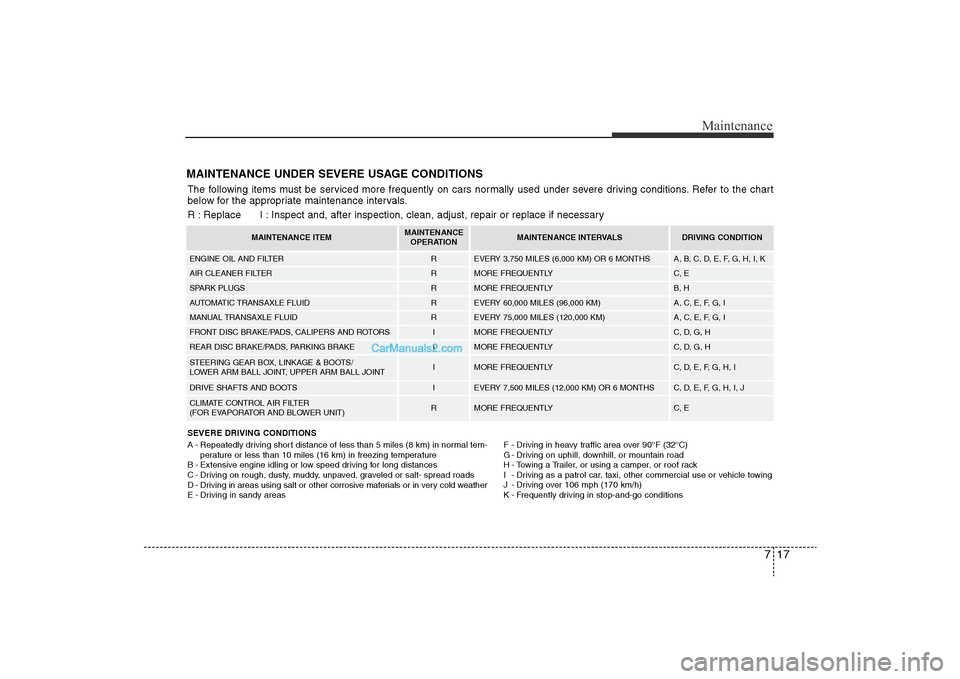
MAINTENANCE UNDER SEVERE USAGE CONDITIONSSEVERE DRIVING CONDITIONS
A - Repeatedly driving short distance of less than 5 miles (8 km) in normal tem-perature or less than 10 miles (16 km) in freezing temperature
B - Extensive engine idling or low speed driving for long distances
C - Driving on rough, dusty, muddy, unpaved, graveled or salt- spread roads
D - Driving in areas using salt or other corrosive materials or in very cold weather
E - Driving in sandy areas F - Driving in heavy traffic area over 90°F (32°C)
G - Driving on uphill, downhill, or mountain road
H - Towing a Trailer, or using a camper, or roof rack
I - Driving as a patrol car, taxi, other commercial use or vehicle towing
J - Driving over 106 mph (170 km/h)
K - Frequently driving in stop-and-go conditionsThe following items must be serviced more frequently on cars normally used under severe driving conditions. Refer to the chart
below for the appropriate maintenance intervals.
R : Replace I : Inspect and, after inspection, clean, adjust, repair or replace if neces\
sary
MAINTENANCE ITEM
MAINTENANCE
OPERATION
MAINTENANCE INTERVALS
DRIVING CONDITION
ENGINE OIL AND FILTER
R
EVERY 3,750 MILES (6,000 KM) OR 6 MONTHS
A, B, C, D, E, F, G, H, I, K
AIR CLEANER FILTER
R
MORE FREQUENTLY
C, E
SPARK PLUGS
R
MORE FREQUENTLY
B, H
AUTOMATIC TRANSAXLE FLUID
R
EVERY 60,000 MILES (96,000 KM)
A, C, E, F, G, I
MANUAL TRANSAXLE FLUID
R
EVERY 75,000 MILES (120,000 KM)
A, C, E, F, G, I
FRONT DISC BRAKE/PADS, CALIPERS AND ROTORS
I
MORE FREQUENTLY
C, D, G, H
REAR DISC BRAKE/PADS, PARKING BRAKE
I
MORE FREQUENTLY
C, D, G, H
STEERING GEAR BOX, LINKAGE & BOOTS/
LOWER ARM BALL JOINT, UPPER ARM BALL JOINT
I
MORE FREQUENTLY
C, D, E, F, G, H, I
DRIVE SHAFTS AND BOOTS
I
EVERY 7,500 MILES (12,000 KM) OR 6 MONTHS
C, D, E, F, G, H, I, J
CLIMATE CONTROL AIR FILTER
(FOR EVAPORATOR AND BLOWER UNIT)
R
MORE FREQUENTLY
C, E
YF HMA 7.QXP 11/25/2009 1:45 PM Page 17
Page 311 of 380
723
Maintenance
The high-pressure cooling system has a
reservoir filled with year-round antifreeze
coolant. The reservoir is filled at the fac-
tory.
Check the antifreeze protection and
coolant level at least once a year, at the
beginning of the winter season, and
before traveling to a colder climate.Checking the coolant level
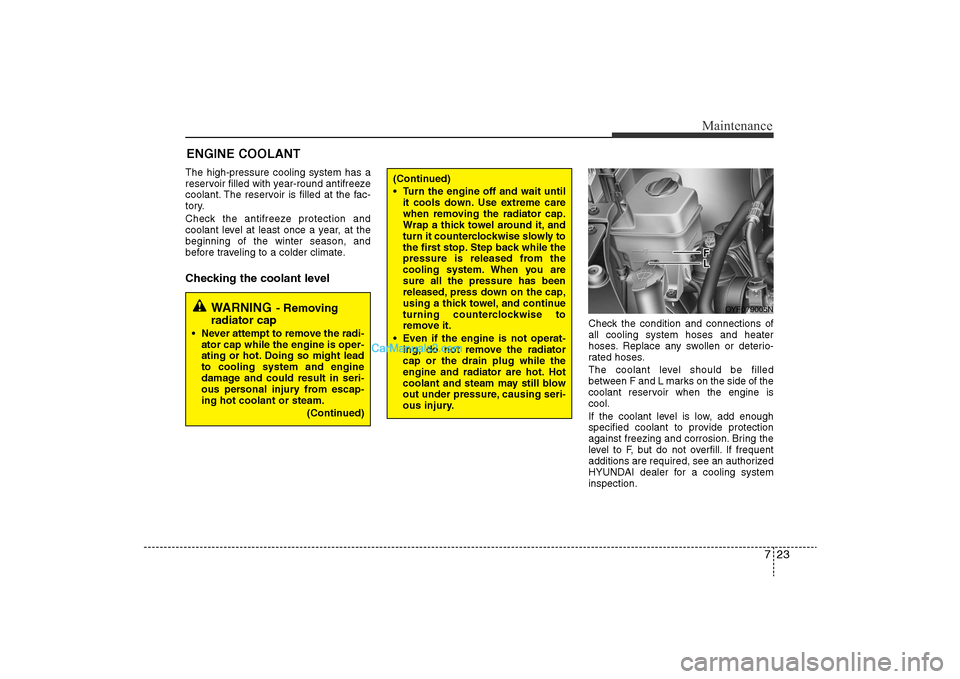
Check the condition and connections of
all cooling system hoses and heater
hoses. Replace any swollen or deterio-
rated hoses.
The coolant level should be filled
between F and L marks on the side of the
coolant reservoir when the engine is
cool.
If the coolant level is low, add enough
specified coolant to provide protection
against freezing and corrosion. Bring the
level to F, but do not overfill. If frequent
additions are required, see an authorized
HYUNDAI dealer for a cooling system
inspection.
OYF079005N
(Continued)
• Turn the engine off and wait untilit cools down. Use extreme care
when removing the radiator cap.
Wrap a thick towel around it, and
turn it counterclockwise slowly to
the first stop. Step back while the
pressure is released from the
cooling system. When you are
sure all the pressure has been
released, press down on the cap,
using a thick towel, and continue
turning counterclockwise to
remove it.
• Even if the engine is not operat- ing, do not remove the radiator
cap or the drain plug while the
engine and radiator are hot. Hot
coolant and steam may still blow
out under pressure, causing seri-
ous injury.
ENGINE COOLANT
WARNING
- Removing
radiator cap
• Never attempt to remove the radi-
ator cap while the engine is oper-
ating or hot. Doing so might lead
to cooling system and engine
damage and could result in seri-
ous personal injury from escap-
ing hot coolant or steam.
(Continued)
YF HMA 7.QXP 11/25/2009 1:45 PM Page 23
Page 379 of 380

I9
Index
Sports mode ··················\
··················\
··················\
·············5-17
Starting difficulties, see engine will not start ··················\
6-3
Starting the engine··················\
··················\
················5-6, 5-9\
Steering wheel···············\
··················\
··················\
·············4-35Horn··················\
··················\
··················\
··················\
···4-36
Electric power steering··················\
··················\
··········4-35
Tilt steering ··················\
··················\
··················\
·········4-35
Steering wheel audio control ··················\
··················\
···4-104
Storage compartment ··················\
··················\
·················4-98\
Center console storage ··················\
··················\
··········4-98
Glove box ··················\
··················\
··················\
············4-98
Multi box ··················\
··················\
··················\
·············4-99
Sunglass holder ··················\
··················\
··················\
···4-99
Sunglass holder ··················\
··················\
··················\
········4-99
Sunroof··················\
··················\
··················\
··················\
···4-32
Sunvisor ··················\
··················\
··················\
·················4-10\
0
Tachometer··················\
··················\
··················\
···············4-47
Tether anchor system ··················\
··················\
·················3-33\
Theft-alarm system ··················\
··················\
··················\
··4-14
Tilt steering ··················\
··················\
··················\
··············4-35
Tire specification and pressure label ··················\
·············8-7
Tire chains··················\
··················\
··················\
················5-42
Tire pressure monitoring system (TPMS) ··················\
·····6-7 Tires and wheels ··················\
··················\
·················7-36\
, 8-3
Checking tire inflation pressure ··················\
··············7-37
Compact spare tire replacement ··················\
··············7-41
Recommended cold tire inflation pressures ··············7-36
Tire care··················\
··················\
··················\
···············7-36
Tire maintenance ··················\
··················\
··················\
·7-41
Tire replacement ··················\
··················\
··················\
··7-40
Tire rotation ··················\
··················\
··················\
·········7-38
Tire sidewall labeling ··················\
··················\
············7-42
Tire traction ··················\
··················\
··················\
·········7-41
Wheel alignment and tire balance ··················\
···········7-39
Wheel replacement ··················\
··················\
················7-41
Towing ··················\
··················\
··················\
··················\
···6-20
Trailer towing ··················\
··················\
··················\
··········5-51
Transaxle Automatic transaxle ··················\
··················\
··············5-14
Manual transaxle ··················\
··················\
··················\
·5-11
Trip computer ··················\
··················\
··················\
··········4-49
Trunk ··················\
··················\
··················\
··················\
······4-22
Vehicle break-in process ··················\
··················\
··············1-5
Vehicle certification label··················\
··················\
···5-48, 8-6
Vehicle data collection and event data recorders (EDR) ··················\
··················\
··················\
····1-6
Vehicle identification number (VIN) ··················\
·············8-6
Vehicle load limit ··················\
··················\
··················\
·····5-45 Certification label ··················\
··················\
··················\
5-48T
V
YF HMA INDEX.QXP 1/13/2010 2:11 PM Page 9