power steering Hyundai Sonata
[x] Cancel search | Manufacturer: HYUNDAI, Model Year: , Model line: , Model:Pages: 358, PDF Size: 30.14 MB
Page 272 of 358
7
Engine compartment / 7-2
Maintenance services / 7-3
Owner maintenance / 7-4
Scheduled maintenance service / 7-6
Explanation of scheduled maintenance items / 7-13
Engine oil / 7-16
Engine coolant / 7-18
Brake/clutch fluid / 7-21
Power steering fluid / 7-22
Washer fluid / 7-23
Parking brake / 7-24
Air cleaner / 7-25
Climate control air filter / 7-27
Wiper blades / 7-29
Battery / 7-31
Tyres and wheels / 7-34
Fuses / 7-44
Light bulbs / 7-55
Appearance care / 7-62
Emission control system / 7-68
Maintenance
Page 273 of 358
Maintenance
2
7
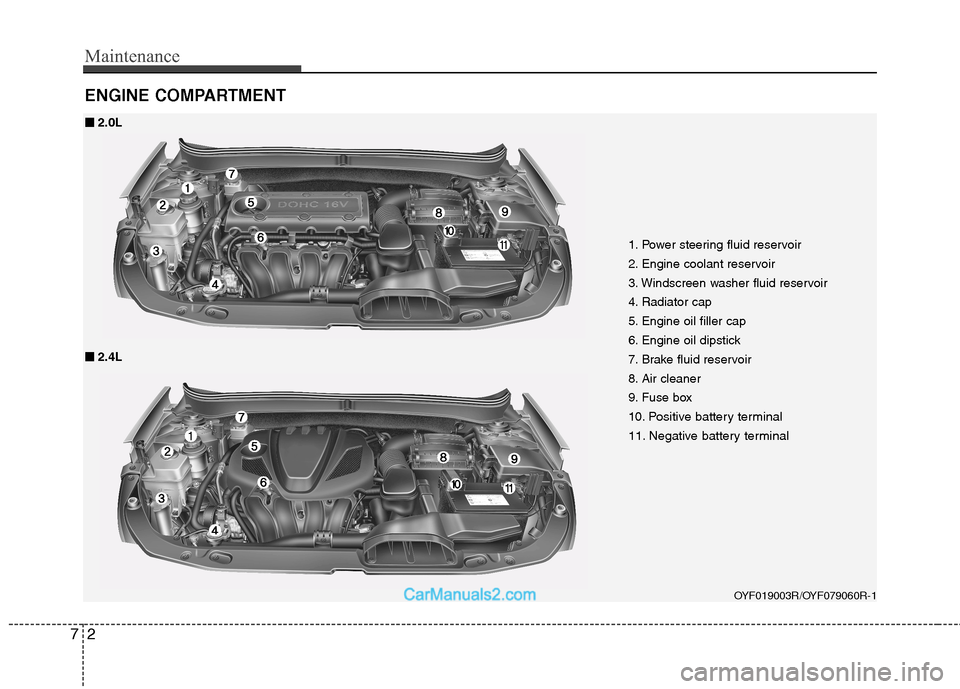
ENGINE COMPARTMENT
1. Power steering fluid reservoir
2. Engine coolant reservoir
3. Windscreen washer fluid reservoir
4. Radiator cap
5. Engine oil filler cap
6. Engine oil dipstick
7. Brake fluid reservoir
8. Air cleaner
9. Fuse box10.
Positive battery terminal
11. Negative battery terminal
OYF019003R/OYF079060R-1
■■ 2.0L
■
■ 2.4L
Page 277 of 358
Maintenance
6
7
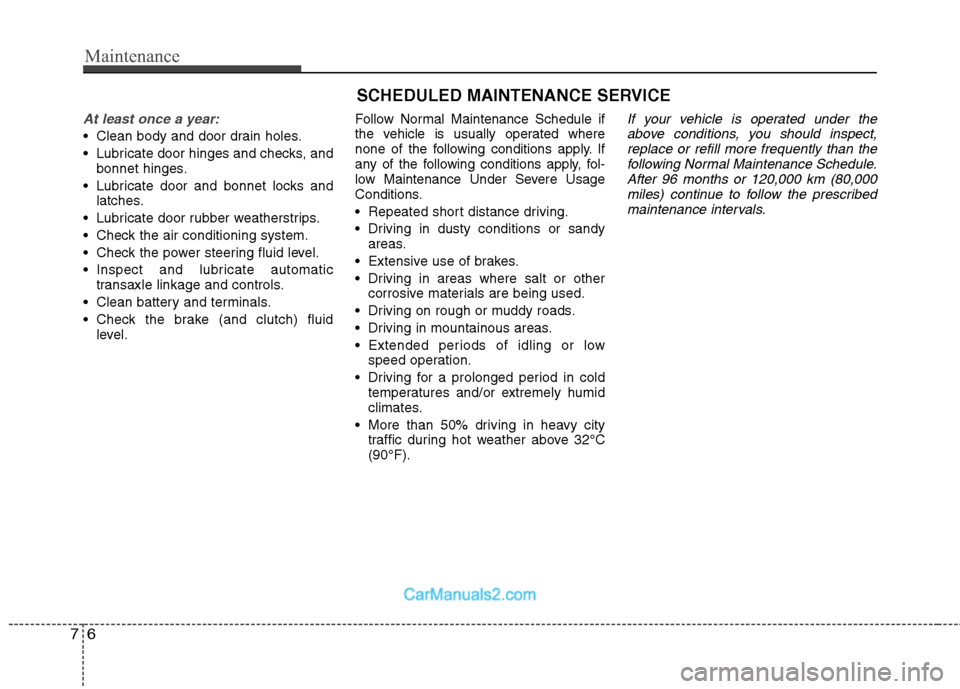
SCHEDULED MAINTENANCE SERVICE
At least once a year:
Clean body and door drain holes.
Lubricate door hinges and checks, and
bonnet hinges.
Lubricate door and bonnet locks and latches.
Lubricate door rubber weatherstrips.
Check the air conditioning system.
Check the power steering fluid level.
Inspect and lubricate automatic transaxle linkage and controls.
Clean battery and terminals.
Check the brake (and clutch) fluid level. Follow Normal Maintenance Schedule if
the vehicle is usually operated where
none of the following conditions apply. If
any of the following conditions apply, fol-
low Maintenance Under Severe Usage
Conditions.
Repeated short distance driving.
Driving in dusty conditions or sandy
areas.
Extensive use of brakes.
Driving in areas where salt or other corrosive materials are being used.
Driving on rough or muddy roads.
Driving in mountainous areas.
Extended periods of idling or low speed operation.
Driving for a prolonged period in cold temperatures and/or extremely humid
climates.
More than 50% driving in heavy city traffic during hot weather above 32°C(90°F).
If your vehicle is operated under the
above conditions, you should inspect, replace or refill more frequently than thefollowing Normal Maintenance Schedule.
After 96 months or 120,000 km (80,000miles) continue to follow the prescribedmaintenance intervals.
Page 278 of 358
77
Maintenance
I : Inspect and if necessary, adjust, correct, clean or replace.
R : Replace or change.*1
: Adjust alternator and power steering (and water pump drive belt) and air conditioner drive belt (if equipped).
Inspect and if necessary correct or replace.
* 2
: Check the engine oil level and leak every 500 km or before starting a long trip.
* 3
: For your convenience, it can be replaced prior to it's interval when you do maintenance of other items.
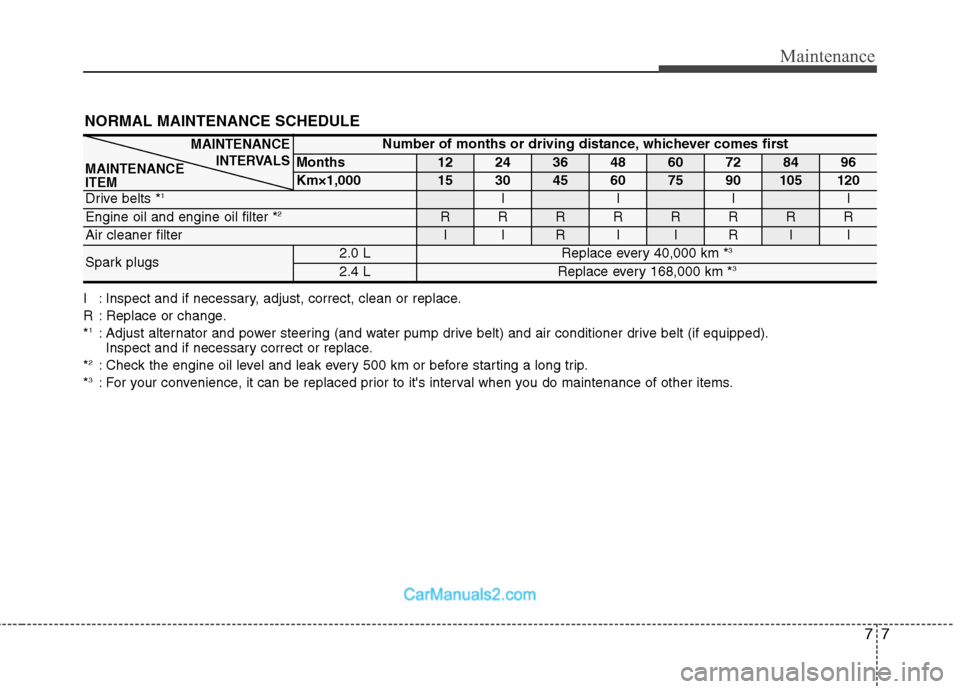
NORMAL MAINTENANCE SCHEDULE
Number of months or driving distance, whichever comes first
Months1224364860728496
Km×1,000153045607590105120
Drive belts *
1IIII
Engine oil and engine oil filter * 2RRRRRRRR
Air cleaner filterIIRIIRII
Spark plugs2.0 LReplace every 40,000 km *3
2.4 LReplace every 168,000 km * 3
MAINTENANCE
INTERVALS
MAINTENANCE ITEM
Page 280 of 358
79
Maintenance
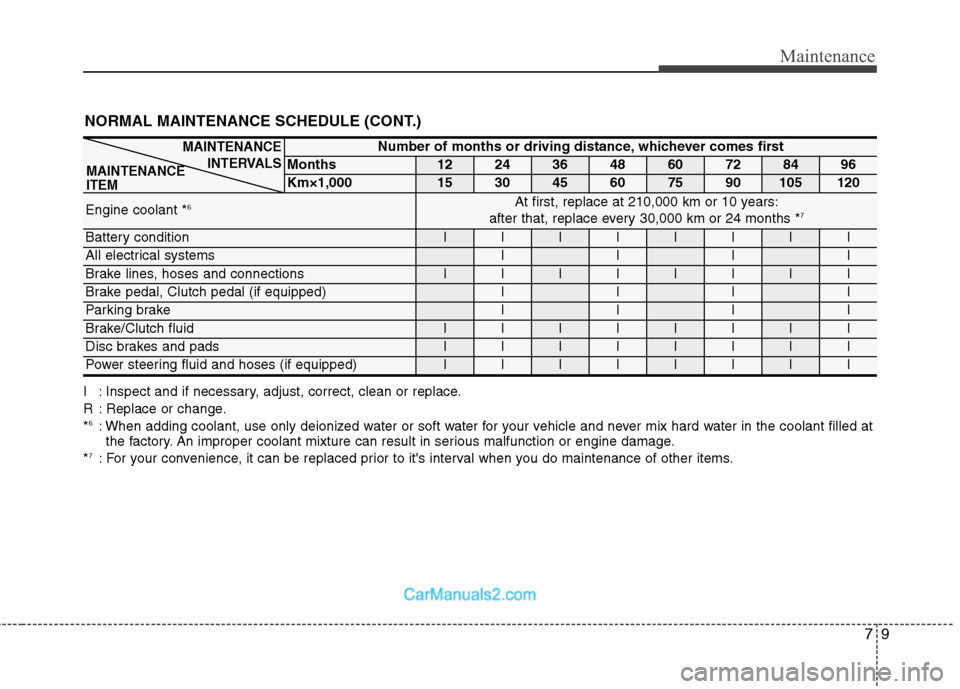
NORMAL MAINTENANCE SCHEDULE (CONT.)
I : Inspect and if necessary, adjust, correct, clean or replace.
R : Replace or change.*6
: When adding coolant, use only deionized water or soft water for your vehicle and never mix hard water in the coolant filled at
the factory. An improper coolant mixture can result in serious malfunction or engine damage.
* 7
: For your convenience, it can be replaced prior to it's interval when you do maintenance of other items.
Number of months or driving distance, whichever comes first
Months1224364860728496
Km×1,000153045607590105120
Engine coolant * 6At first, replace at 210,000 km or 10 years:
after that, replace every 30,000 km or 24 months * 7
Battery conditionIIIIIIII
All electrical systemsIIII
Brake lines, hoses and connectionsIIIIIIII
Brake pedal, Clutch pedal (if equipped)IIII
Parking brakeIIII
Brake/Clutch fluidIIIIIIII
Disc brakes and padsIIIIIIII
Power steering fluid and hoses (if equipped)IIIIIIII
MAINTENANCE
INTERVALS
MAINTENANCE ITEM
Page 286 of 358
715
Maintenance
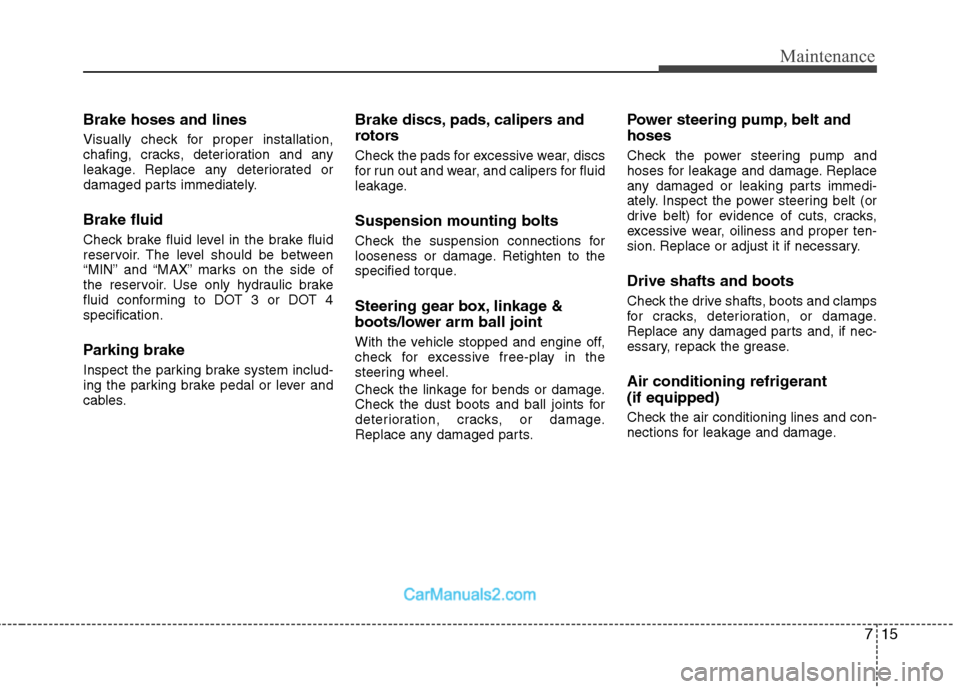
Brake hoses and lines
Visually check for proper installation,
chafing, cracks, deterioration and any
leakage. Replace any deteriorated or
damaged parts immediately. Brake fluid
Check brake fluid level in the brake fluid
reservoir. The level should be between
“MIN” and “MAX” marks on the side of
the reservoir. Use only hydraulic brake
fluid conforming to DOT 3 or DOT 4specification.
Parking brake
Inspect the parking brake system includ-
ing the parking brake pedal or lever and
cables.Brake discs, pads, calipers and
rotors
Check the pads for excessive wear, discs
for run out and wear, and calipers for fluid
leakage. Suspension mounting bolts
Check the suspension connections for
looseness or damage. Retighten to the
specified torque.
Steering gear box, linkage &
boots/lower arm ball joint
With the vehicle stopped and engine off,
check for excessive free-play in the
steering wheel.
Check the linkage for bends or damage.
Check the dust boots and ball joints for
deterioration, cracks, or damage.
Replace any damaged parts.Power steering pump, belt and hoses
Check the power steering pump and
hoses for leakage and damage. Replace
any damaged or leaking parts immedi-
ately. Inspect the power steering belt (or
drive belt) for evidence of cuts, cracks,
excessive wear, oiliness and proper ten-
sion. Replace or adjust it if necessary. Drive shafts and boots
Check the drive shafts, boots and clamps
for cracks, deterioration, or damage.
Replace any damaged parts and, if nec-
essary, repack the grease.
Air conditioning refrigerant (if equipped)
Check the air conditioning lines and con-
nections for leakage and damage.
Page 293 of 358
Maintenance
22
7
POWER STEERING FLUID (IF EQUIPPED)
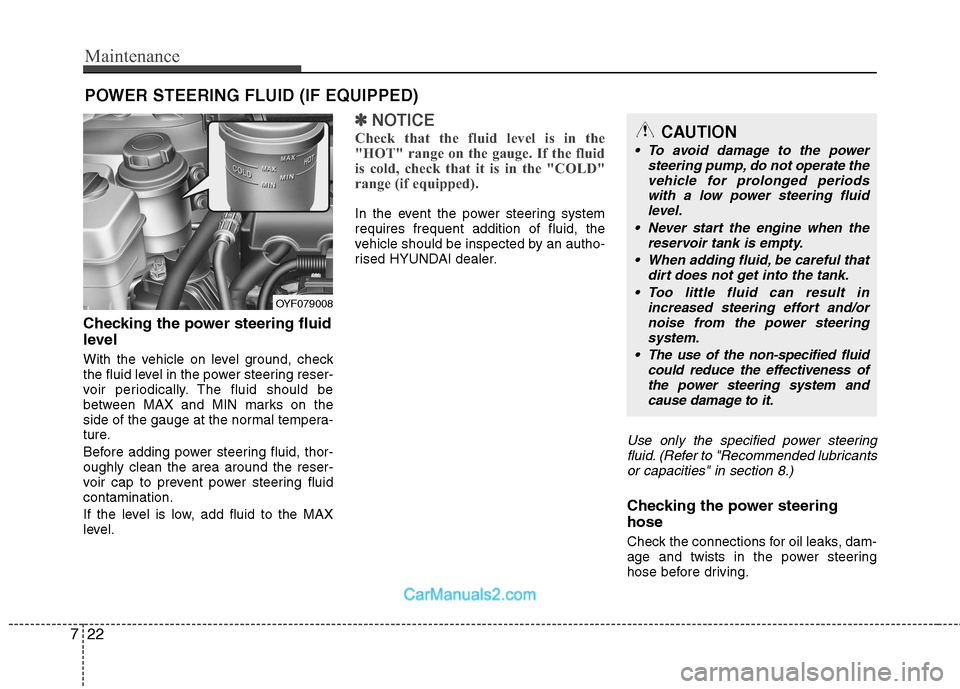
Checking the power steering fluid
level
With the vehicle on level ground, check
the fluid level in the power steering reser-
voir periodically. The fluid should be
between MAX and MIN marks on the
side of the gauge at the normal tempera-
ture.
Before adding power steering fluid, thor- oughly clean the area around the reser-
voir cap to prevent power steering fluidcontamination.
If the level is low, add fluid to the MAX
level.
✽✽ NOTICE
Check that the fluid level is in the
"HOT" range on the gauge. If the fluid
is cold, check that it is in the "COLD"
range (if equipped).
In the event the power steering system requires frequent addition of fluid, the
vehicle should be inspected by an autho-
rised HYUNDAI dealer.
Use only the specified power steering fluid. (Refer to "Recommended lubricants
or capacities" in section 8.)
Checking the power steering hose
Check the connections for oil leaks, dam-
age and twists in the power steering
hose before driving.
CAUTION
To avoid damage to the power steering pump, do not operate the
vehicle for prolonged periods with a low power steering fluidlevel.
Never start the engine when the reservoir tank is empty.
When adding fluid, be careful that dirt does not get into the tank.
Too little fluid can result in increased steering effort and/ornoise from the power steering
system.
The use of the non-specified fluid could reduce the effectiveness ofthe power steering system andcause damage to it.
OYF079008
Page 345 of 358
Specifications & Consumer information
4
8
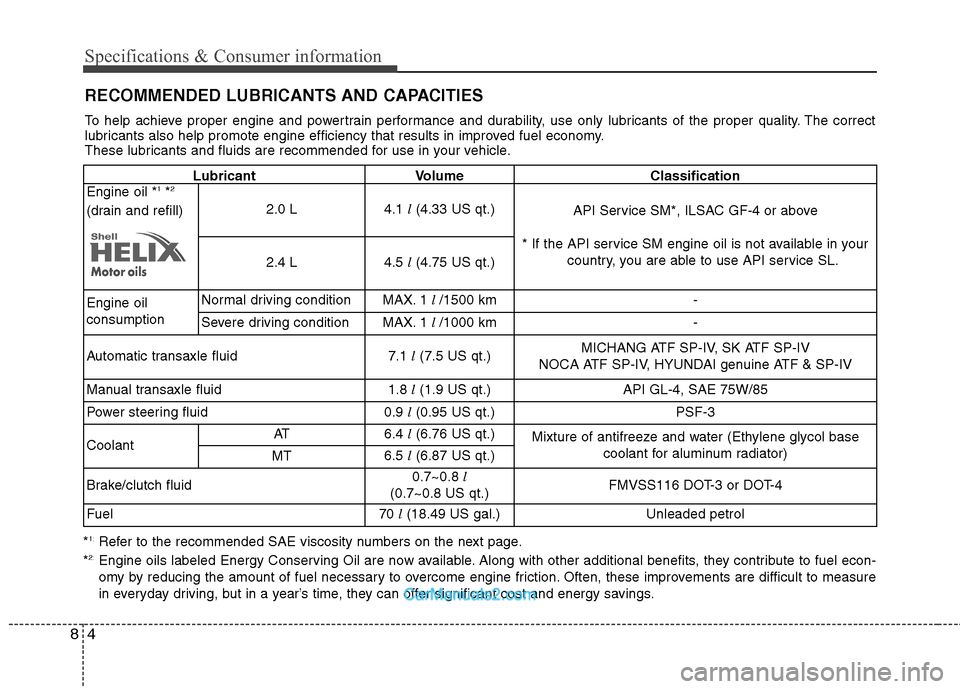
RECOMMENDED LUBRICANTS AND CAPACITIES
* 1:
Refer to the recommended SAE viscosity numbers on the next page.
* 2:
Engine oils labeled Energy Conserving Oil are now available. Along with other additional benefits, they contribute to fuel econ-
omy by reducing the amount of fuel necessary to overcome engine friction. Often, these improvements are difficult to measure
in everyday driving, but in a year’s time, they can offer significant cost and energy savings.
To help achieve proper engine and powertrain performance and durability, use only lubricants of the proper quality. The correct
lubricants also help promote engine efficiency that results in improved fuel economy.
These lubricants and fluids are recommended for use in your vehicle.
Lubricant Volume Classification
Engine oil * 1
*2
(drain and refill)
2.0 L 4.1
l(4.33 US qt.)
API Service SM*, ILSAC GF-4 or above
* If the API service SM engine oil is not available in your country, you are able to use API service SL.
2.4 L4.5 l(4.75 US qt.)
Engine oil consumptionNormal driving conditionMAX. 1 l /1500 km-
Severe driving conditionMAX. 1 l /1000 km-
Automatic transaxle fluid 7.1
l(7.5 US qt.) MICHANG ATF SP-IV, SK ATF SP-IV
NOCA ATF SP-IV, HYUNDAI genuine ATF & SP-IV
Manual transaxle fluid 1.8
l(1.9 US qt.)
API GL-4, SAE 75W/85
Power steering fluid 0.9
l(0.95 US qt.)
PSF-3
Coolant
AT 6.4
l(6.76 US qt.)
Mixture of antifreeze and water (Ethylene glycol base
coolant for aluminum radiator)
MT6.5 l(6.87 US qt.)
Brake/clutch fluid 0.7~0.8
l
(0.7~0.8 US qt.) FMVSS116 DOT-3 or DOT-4
Fuel 70
l(18.49 US gal.)
Unleaded petrol
Page 350 of 358
Index
2
I
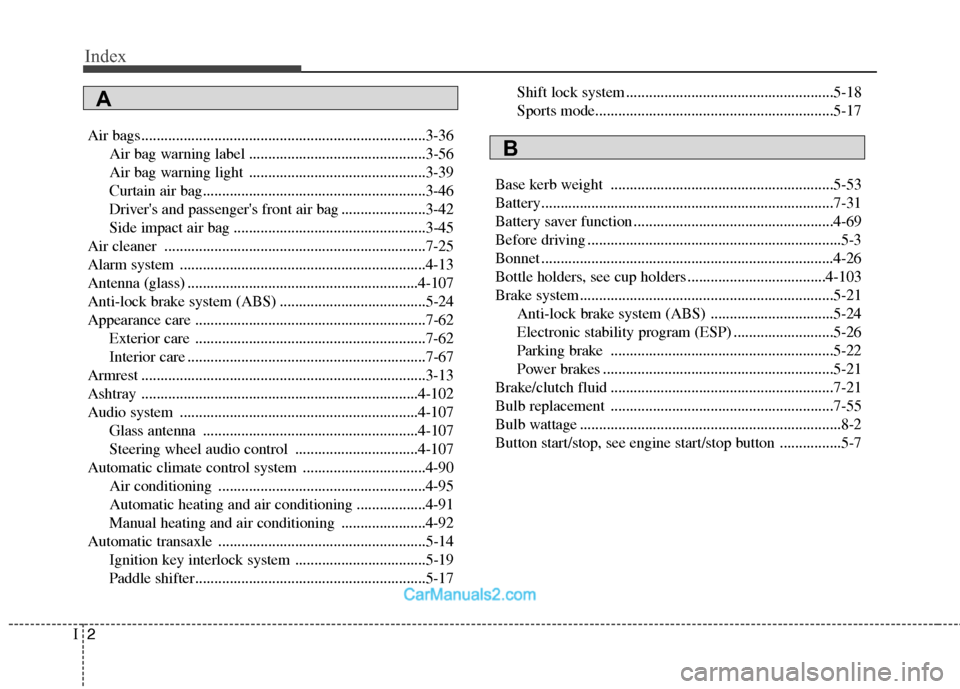
Air bags..........................................................................3-36
Air bag warning label ..............................................3-56
Air bag warning light ..............................................3-39
Curtain air bag..........................................................3-46
Driver's and passenger's front air bag ......................3-42
Side impact air bag ..................................................3-45
Air cleaner ....................................................................7-25
Alarm system ................................................................4-13
Antenna (glass) ............................................................4-107
Anti-lock brake system (ABS) ......................................5-24
Appearance care ............................................................7-62 Exterior care ............................................................7-62
Interior care ..............................................................7-67
Armrest ..........................................................................3-13
Ashtray ........................................................................4-102
Audio system ..............................................................4-107 Glass antenna ........................................................4-107
Steering wheel audio control ................................4-107
Automatic climate control system ................................4-90 Air conditioning ......................................................4-95
Automatic heating and air conditioning ..................4-91
Manual heating and air conditioning ......................4-92
Automatic transaxle ......................................................5-14 Ignition key interlock system ..................................5-19
Paddle shifter............................................................5-17 Shift lock system ......................................................5-18
Sports mode..............................................................5-17
Base kerb weight ..........................................................5-53
Battery............................................................................7-31
Battery saver function ....................................................4-69
Before driving ..................................................................5-3
Bonnet ............................................................................4-26
Bottle holders, see cup holders ....................................4-103
Brake system..................................................................5-21 Anti-lock brake system (ABS) ................................5-24
Electronic stability program (ESP) ..........................5-26
Parking brake ..........................................................5-22
Power brakes ............................................................5-21
Brake/clutch fluid ..........................................................7-21
Bulb replacement ..........................................................7-55
Bulb wattage ....................................................................8-2
Button start/stop, see engine start/stop button ................5-7
A
B
Page 352 of 358
Index
4
I
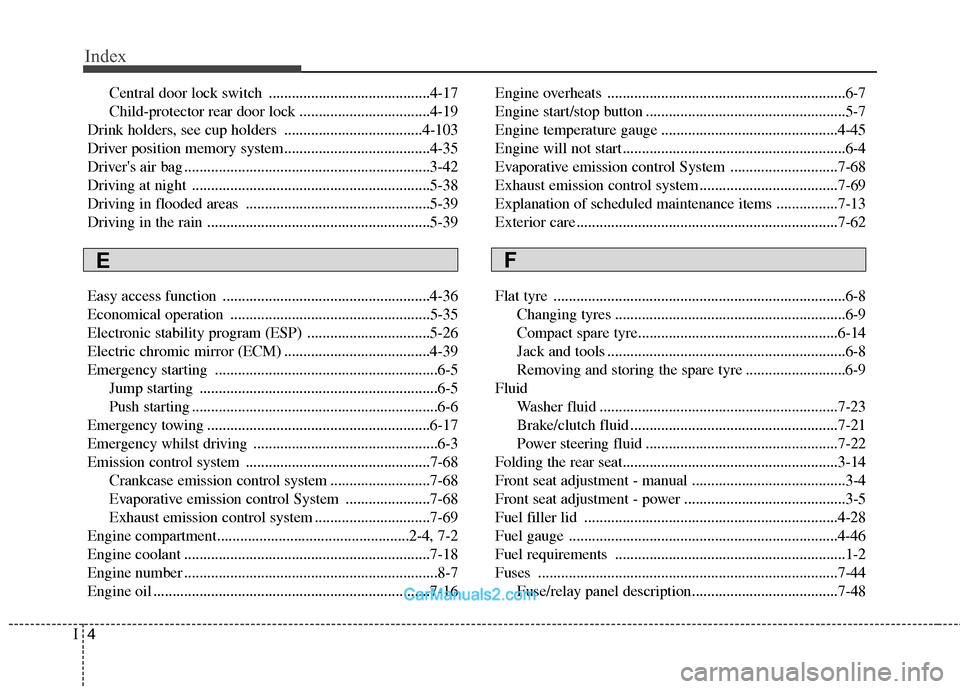
Central door lock switch ..........................................4-17
Child-protector rear door lock ..................................4-19
Drink holders, see cup holders ....................................4-103
Driver position memory system......................................4-35
Driver's air bag ................................................................3-42
Driving at night ..............................................................5-38
Driving in flooded areas ................................................5-39
Driving in the rain ..........................................................5-39
Easy access function ......................................................4-36
Economical operation ....................................................5-35
Electronic stability program (ESP) ................................5-26
Electric chromic mirror (ECM) ......................................4-39
Emergency starting ..........................................................6-5 Jump starting ..............................................................6-5
Push starting ................................................................6-6
Emergency towing ..........................................................6-17
Emergency whilst driving ................................................6-3
Emission control system ................................................7-68 Crankcase emission control system ..........................7-68
Evaporative emission control System ......................7-68
Exhaust emission control system ..............................7-69
Engine compartment..................................................2-4, 7-2
Engine coolant ................................................................7-18
Engine number ..................................................................8-7
Engine oil ........................................................................7-16 Engine overheats ..............................................................6-7
Engine start/stop button ....................................................5-7
Engine temperature gauge ..............................................4-45
Engine will not start..........................................................6-4
Evaporative emission control System ............................7-68
Exhaust emission control system ....................................7-69
Explanation of scheduled maintenance items ................7-13
Exterior care....................................................................7-62
Flat tyre ............................................................................6-8
Changing tyres ............................................................6-9
Compact spare tyre....................................................6-14
Jack and tools ..............................................................6-8
Removing and storing the spare tyre ..........................6-9
Fluid Washer fluid ..............................................................7-23
Brake/clutch fluid ......................................................7-21
Power steering fluid ..................................................7-22
Folding the rear seat........................................................3-14
Front seat adjustment - manual ........................................3-4
Front seat adjustment - power ..........................................3-5
Fuel filler lid ..................................................................4-28
Fuel gauge ......................................................................4-46
Fuel requirements ............................................................1-2
Fuses ..............................................................................7-44 Fuse/relay panel description......................................7-48
FE