check engine Hyundai Sonata
[x] Cancel search | Manufacturer: HYUNDAI, Model Year: , Model line: , Model:Pages: 358, PDF Size: 30.14 MB
Page 316 of 358
745
Maintenance
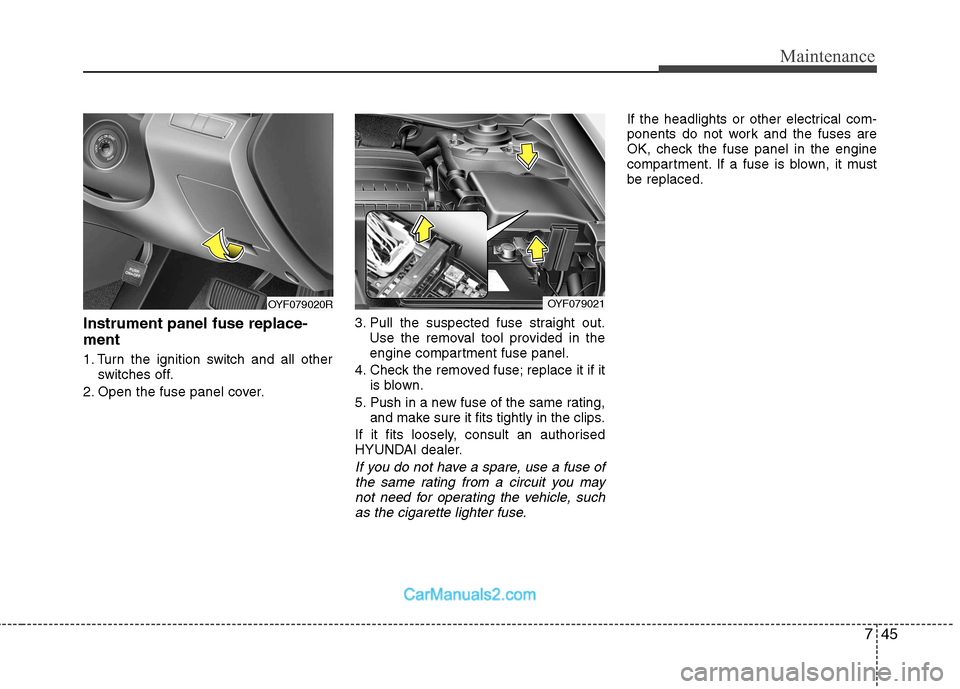
Instrument panel fuse replace- ment
1. Turn the ignition switch and all otherswitches off.
2. Open the fuse panel cover. 3. Pull the suspected fuse straight out.
Use the removal tool provided in the
engine compartment fuse panel.
4. Check the removed fuse; replace it if it is blown.
5. Push in a new fuse of the same rating, and make sure it fits tightly in the clips.
If it fits loosely, consult an authorised
HYUNDAI dealer.
If you do not have a spare, use a fuse of the same rating from a circuit you may
not need for operating the vehicle, such as the cigarette lighter fuse.
If the headlights or other electrical com-
ponents do not work and the fuses are
OK, check the fuse panel in the engine
compartment. If a fuse is blown, it mustbe replaced.
OYF079020ROYF079021
Page 317 of 358
Maintenance
46
7
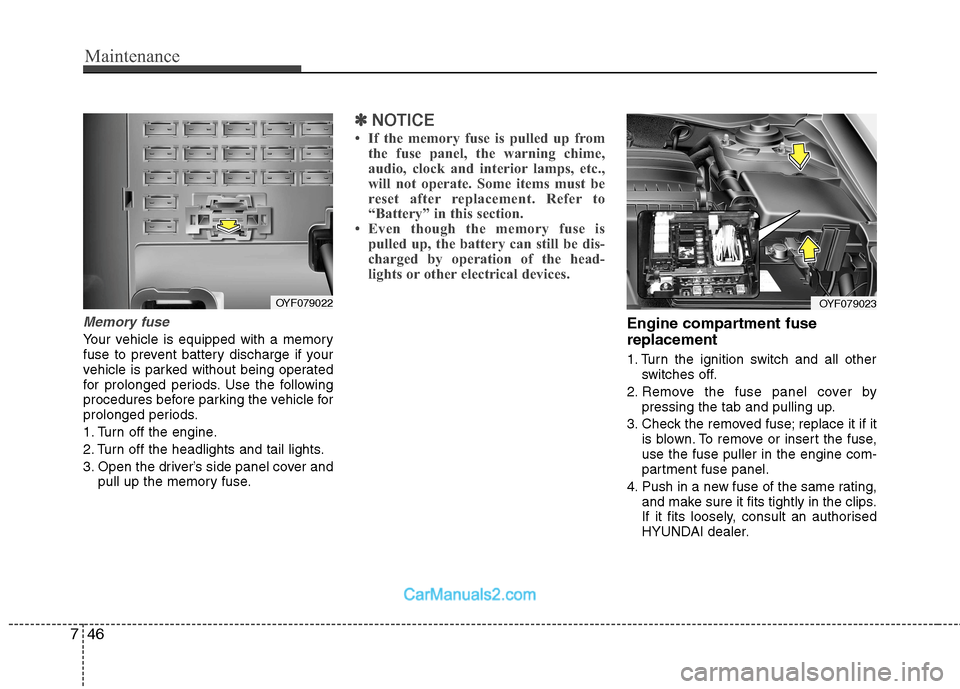
Memory fuse
Your vehicle is equipped with a memory
fuse to prevent battery discharge if your
vehicle is parked without being operated
for prolonged periods. Use the following
procedures before parking the vehicle for
prolonged periods.
1. Turn off the engine.
2. Turn off the headlights and tail lights.
3. Open the driver’s side panel cover and
pull up the memory fuse.
✽✽ NOTICE
If the memory fuse is pulled up from the fuse panel, the warning chime,
audio, clock and interior lamps, etc.,
will not operate. Some items must be
reset after replacement. Refer to
“Battery” in this section.
Even though the memory fuse is
pulled up, the battery can still be dis-
charged by operation of the head-
lights or other electrical devices.
Engine compartment fuse replacement
1. Turn the ignition switch and all other switches off.
2. Remove the fuse panel cover by pressing the tab and pulling up.
3. Check the removed fuse; replace it if it is blown. To remove or insert the fuse, use the fuse puller in the engine com-
partment fuse panel.
4. Push in a new fuse of the same rating, and make sure it fits tightly in the clips.
If it fits loosely, consult an authorised
HYUNDAI dealer.
OYF079022OYF079023
Page 318 of 358
747
Maintenance
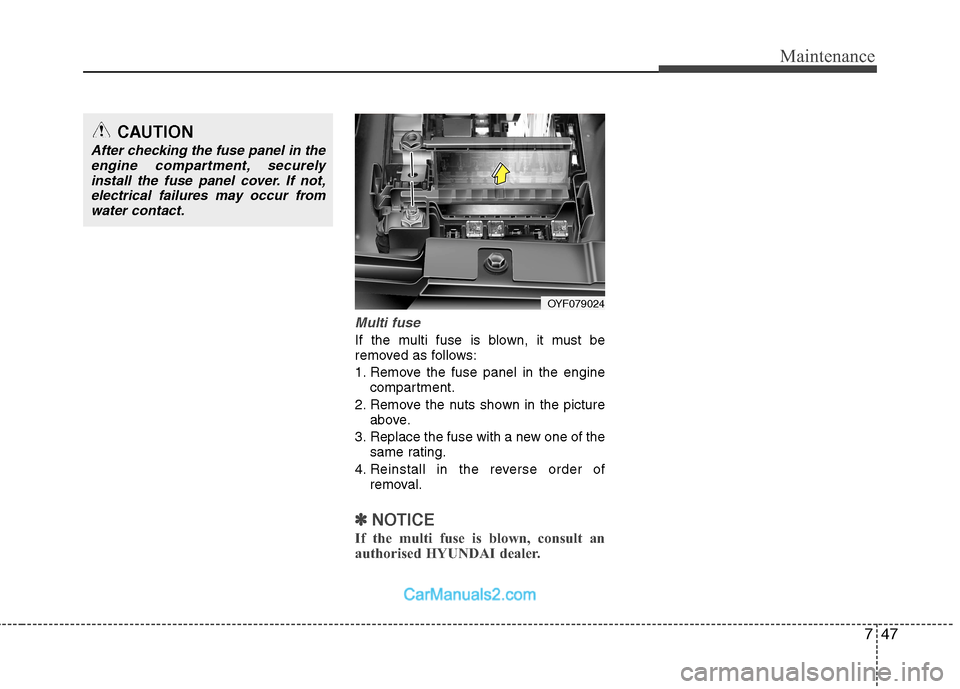
Multi fuse
If the multi fuse is blown, it must be
removed as follows:
1. Remove the fuse panel in the enginecompartment.
2. Remove the nuts shown in the picture above.
3. Replace the fuse with a new one of the same rating.
4. Reinstall in the reverse order of removal.
✽✽ NOTICE
If the multi fuse is blown, consult an
authorised HYUNDAI dealer.
CAUTION
After checking the fuse panel in the engine compartment, securely
install the fuse panel cover. If not,electrical failures may occur fromwater contact.
OYF079024
Page 340 of 358
769
Maintenance
Canister
Fuel vapours generated inside the fuel tank are absorbed and stored in the
onboard canister. When the engine is
running, the fuel vapours absorbed in the
canister are drawn into the surge tank
through the purge control solenoid valve.
Purge Control Solenoid Valve (PCSV)
The purge control solenoid valve is con-
trolled by the Engine Control Module
(ECM); when the engine coolant temper-
ature is low during idling, the PCSV clos-
es so that evaporated fuel is not taken
into the engine. After the engine warms-
up during ordinary driving, the PCSV
opens to introduce evaporated fuel to the
engine.3. Exhaust emission control
system
The Exhaust Emission Control System is
a highly effective system which controls
exhaust emissions whilst maintaining
good vehicle performance.
Vehicle modifications
This vehicle should not be modified.
Modification of your vehicle could affect
its performance, safety or durability and
may even violate governmental safety
and emissions regulations.
In addition, damage or performance
problems resulting from any modification
may not be covered under warranty.
Engine exhaust gas precautions (car- bon monoxide)
Carbon monoxide can be present with other exhaust fumes. Therefore, if you
smell exhaust fumes of any kind inside
your vehicle, have it inspected and
repaired immediately. If you ever sus-
pect exhaust fumes are coming into
your vehicle, drive it only with all the
windows fully open. Have your vehicle
checked and repaired immediately.
WARNING - Exhaust
Engine exhaust gases contain car-
bon monoxide (CO). Though
colourless and odourless, it is dan-
gerous and could be lethal if
inhaled. Follow the instructions on
this page to avoid CO poisoning.
Page 346 of 358
85
Specifications & Consumer information
Recommended SAE viscosity
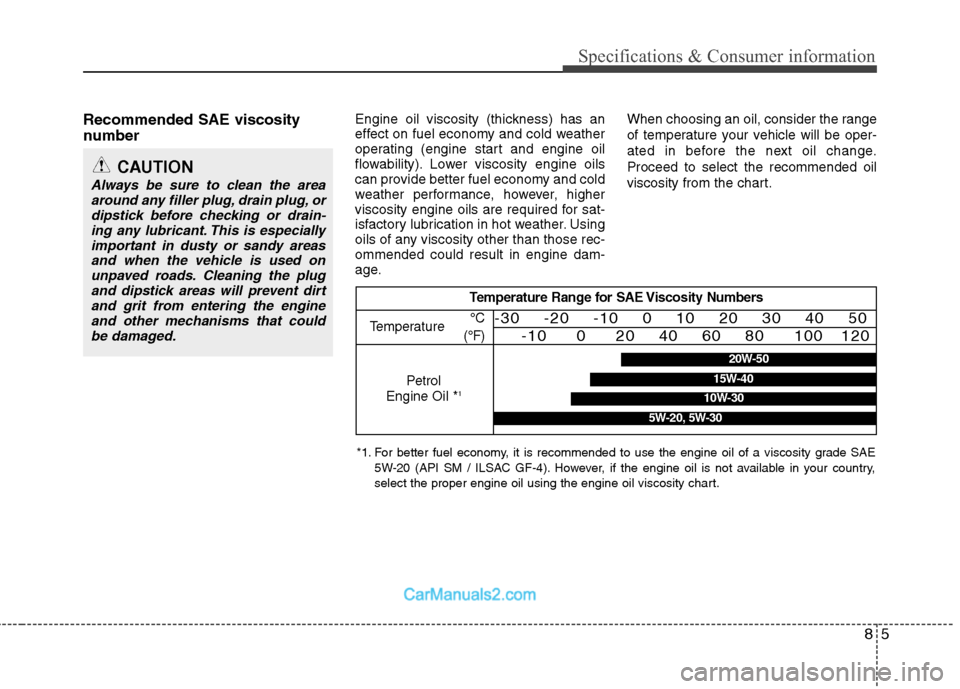
number Engine oil viscosity (thickness) has an
effect on fuel economy and cold weather
operating (engine start and engine oil
flowability). Lower viscosity engine oils
can provide better fuel economy and cold
weather performance, however, higher
viscosity engine oils are required for sat-
isfactory lubrication in hot weather. Using
oils of any viscosity other than those rec-ommended could result in engine dam-
age.When choosing an oil, consider the range
of temperature your vehicle will be oper-
ated in before the next oil change.Proceed to select the recommended oil
viscosity from the chart.
CAUTION
Always be sure to clean the area
around any filler plug, drain plug, ordipstick before checking or drain-ing any lubricant. This is especially
important in dusty or sandy areasand when the vehicle is used onunpaved roads. Cleaning the plugand dipstick areas will prevent dirt
and grit from entering the engine and other mechanisms that couldbe damaged.
Temperature Range for SAE Viscosity Numbers
Temperature
Petrol
Engine Oil * 1°C
(°F)-30 -20 -10 0 10 20 30 40 50 -10 0 20 40 60 80 100 120
*1. For better fuel economy, it is recommended to use the engine oil of a viscosity grade SAE5W-20 (API SM / ILSAC GF-4). However, if the engine oil is not available in your country,
select the proper engine oil using the engine oil viscosity chart.
20W-50
10W-30
15W-40
5W-20, 5W-30
Page 351 of 358
I3
Index
Capacities (Lubricants) ....................................................8-4 Care
Exterior care ..............................................................7-62
Interior care ..............................................................7-67
Tyre care ....................................................................7-34
Cargo weight ..................................................................5-53
Central door lock switch ................................................4-17
Centre console storage ..................................................4-100
Changing tyres ..................................................................6-9Chains Tyre chains ................................................................5-42
Checking tyre inflation pressure ....................................7-35
Child restraint system ....................................................3-30 Lap belt......................................................................3-33
Lap/shoulder belt ......................................................3-33
Child-protector rear door lock ........................................4-19
Climate control system (Automatic) ..............................4-90 Air conditioning ........................................................4-95
Automatic heating and air conditioning....................4-91
Manual heating and air conditioning ........................4-92
Climate control system (Manual) ..................................4-81 Air conditioning ........................................................4-86
Climate control air filter............................................4-88
Heating and air conditioning ....................................4-82
Cigarette lighter ............................................................4-102
Climate control air filter ................................................4-88 Climate control air filter ................................................7-27
Clock (Digital) ..............................................................4-105
Clothes hanger ..............................................................4-106
Combined instrument, see instrument cluster ................4-43
Compact spare tyre ........................................................6-14
Compact spare tyre replacement ....................................7-39
Coolant ............................................................................7-18
Cooling fluid, see engine coolant ..................................7-18
Crankcase emission control system ................................7-68
Cruise control system ....................................................5-31
Cup holder ....................................................................4-103
Curtain air bag ................................................................3-46
Dashboard, see instrument cluster ..................................4-43
Dashboard illumination, see instrument panel
illumination..................................................................4-44
Defogging (Windscreen) ................................................4-97
Defogging logic (Windscreen)........................................4-99
Defroster (Rear window) ................................................4-80
Defrosting (Windscreen) ................................................4-97
Digital clock..................................................................4-105
Dimensions ......................................................................8-2
Displays, see instrument cluster ....................................4-43
Display illumination, see instrument panel illumination..................................................................4-44
Door locks ......................................................................4-16
C
D