battery Hyundai Sonata Hybrid 2011 User Guide
[x] Cancel search | Manufacturer: HYUNDAI, Model Year: 2011, Model line: Sonata Hybrid, Model: Hyundai Sonata Hybrid 2011Pages: 404, PDF Size: 11.04 MB
Page 19 of 404
H12
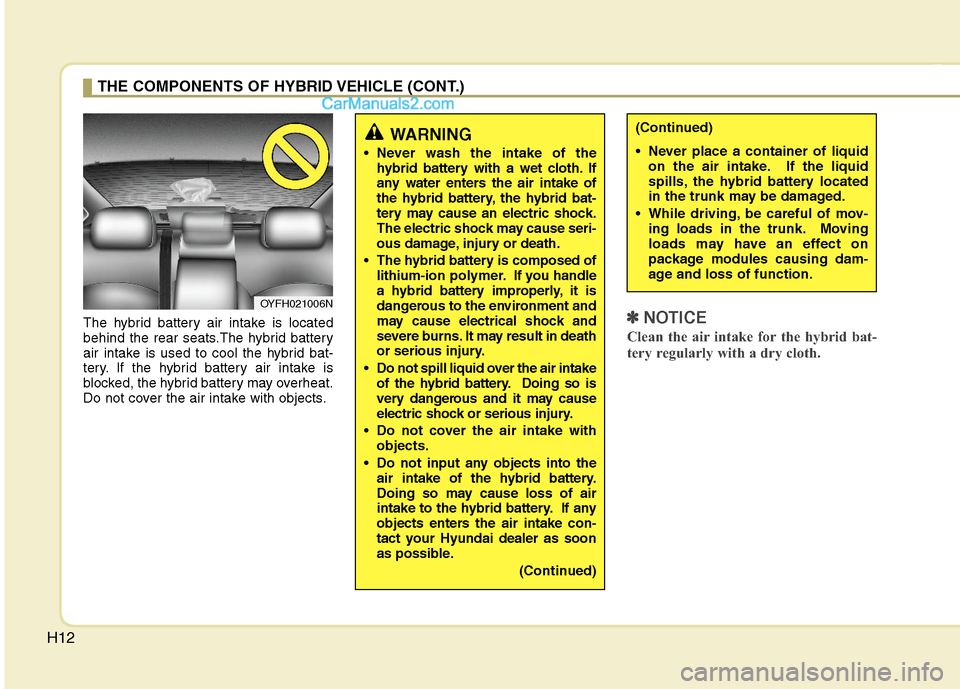
The hybrid battery air intake is located
behind the rear seats.The hybrid battery
air intake is used to cool the hybrid bat-
tery. If the hybrid battery air intake is
blocked, the hybrid battery may overheat.
Do not cover the air intake with objects.✽ ✽
NOTICE
Clean the air intake for the hybrid bat-
tery regularly with a dry cloth.
THE COMPONENTS OF HYBRID VEHICLE (CONT.)
WARNING
Never wash the intake of the
hybrid battery with a wet cloth. If
any water enters the air intake of
the hybrid battery, the hybrid bat-
tery may cause an electric shock.
The electric shock may cause seri-
ous damage, injury or death.
The hybrid battery is composed of
lithium-ion polymer. If you handle
a hybrid battery improperly, it is
dangerous to the environment and
may cause electrical shock and
severe burns. It may result in death
or serious injury.
Do not spill liquid over the air intake
of the hybrid battery. Doing so is
very dangerous and it may cause
electric shock or serious injury.
Do not cover the air intake with
objects.
Do not input any objects into the
air intake of the hybrid battery.
Doing so may cause loss of air
intake to the hybrid battery. If any
objects enters the air intake con-
tact your Hyundai dealer as soon
as possible.
(Continued)
(Continued)
Never place a container of liquid
on the air intake. If the liquid
spills, the hybrid battery located
in the trunk may be damaged.
While driving, be careful of mov-
ing loads in the trunk. Moving
loads may have an effect on
package modules causing dam-
age and loss of function.
OYFH021006N
Page 20 of 404

H13
If An Accident OccursWhen the hybrid vehicle shuts off
When the high voltage battery dis-
charged, 12-volt battery discharged, or
fuel tank is empty, the hybrid system may
not operate while driving. If the Hybrid
system is not operated, do the following;
1. Reduce the vehicle speed gradually.
Pull your vehicle off the road as safe
area.
2. Shift the transmission into "P" position.
3. Turn on the hazard warning flashers.
4. Set the start button at OFF, and try to
start the Hybrid system by applying the
brake pedal and pushing the start but-
ton.
5. If the Hybrid system will not operate,
refer to "EMERGENCY STARTING" in
chapter 6.
When you try to jump start the vehicle,
confirm the fuel level and exact proce-
dure of jump start. For details, see the
"EMERGENCY STARING" in chapter 6.
If the fuel level is low, do not try to drive
the vehicle on battery power. The high
voltage battery may be discharged and
the Hybrid system will turn off.
WARNING
After parking the vehicle, shift the
transmission into "P" position.
Turn off the hybrid system. Push
the button again to turn off.
For your safety, do not touch high
voltage cables, connectors and
package modules.
Exposed cables or wires maybe
visible inside or outside of the
vehicle. Never touch the wires or
cables, because an electrical
shock may occur causing injury or
death.
If a fire occurs, never use water to
put out a fire. For safety, use an
extinguisher for electrical fires
with proper chemicals and evacu-
ate immediately.
If you need towing, refer to chapter
6.
WARNING
When you pull your vehicle off the
road as safe area, open the door
when the vehicle completely stops.
Page 25 of 404

15
Introduction
No special break-in period is needed. By
following a few simple precautions for the
first 600 miles (1,000 km) you may add to
the performance, economy and life of
your vehicle.
Do not race the engine.
Avoid hard stops, except in emergen-
cies, to allow the brakes to seat prop-
erly.
Don't tow a trailer during the first 1,200
miles (2,000 km) of operation.
VEHICLE BREAK-IN PROCESS
CALIFORNIA PROPOSI-
TION 65 WARNING
Items contained in motor vehicles
or emitted from them are known to
the State of California to cause can-
cer and birth defects or reproduc-
tive harm. These include:
components and materials
ject to heat and wear
In addition, battery posts, terminals
and related accessories contain
lead, lead compounds and other
chemicals known to the State of
California to cause cancer and
reproductive harm.
Page 32 of 404
25
Your vehicle at a glance
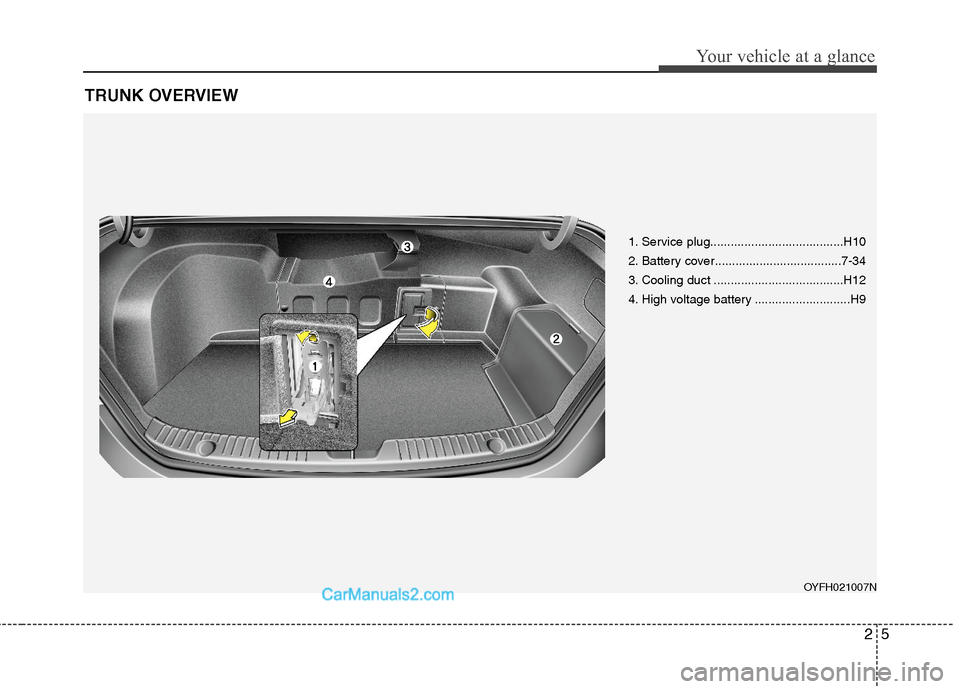
TRUNK OVERVIEW
OYFH021007N
1. Service plug.......................................H10
2. Battery cover.....................................7-34
3. Cooling duct ......................................H12
4. High voltage battery ............................H9
Page 46 of 404

Safety features of your vehicle
14 3
Carrying long/narrow cargo (if equipped)
Pull the armrest down using the strap
provided on the armrest. Pull the cover
down while pushing the release lever
down. Additional cargo space is provided
to accommodate long/narrow cargo
(skis, poles, lumber, etc.) not able to fit
properly in the trunk when closed.
OYFH031020N
CAUTION
Make sure the engine is off, the
shift lever is in P and the parking
brake is applied whenever load-
ing or unloading cargo. The vehi-
cle may move if the shift lever is
inadvertently moved to another
position.
(Continued)
(Continued)
Be careful when loading cargo
through the rear passenger seats
to prevent damage to the vehicle
interior.
When cargo is loaded through the
rear passenger seats, ensure the
cargo is properly secured to pre-
vent it from moving while driving.
Unsecured cargo in the passen-
ger compartment can cause dam-
age to the vehicle or injury to it’s
occupants.WARNING- Cargo
Cargo should always be secured to
prevent it from being thrown about
the vehicle in a collision and caus-
ing injury to the vehicle occupants.
Do not place objects on the rear
seats, since they cannot be proper-
ly secured and may hit the front
seat occupants in a collision.
WARNING - Cargo loading
Make sure the engine is off, the
shift lever is in P (Park) and the
parking brake is securely applied
whenever loading or unloading
cargo. Failure to take these steps
may allow the vehicle to move if the
shift lever is inadvertently moved to
another position.
WARNING
When you use the strap provided on
the armrest. Be careful not to dam-
age to the high voltage battery. Do
not take off the trim for the high
voltage battery when using the
strap. If not, the high voltage battery
is damaged. Further it may cause
electric shock or burns that can
result in a death or serious injury.
Page 47 of 404

315
Safety features of your vehicle
Seat belt restraint system
SEAT BELTS
WARNING
Seat belts are designed to bear
upon the bony structure of the
body, and should be worn low
across the front of the pelvis, chest
and shoulders, as applicable; wear-
ing the lap section of the belt
across the abdominal area must be
avoided.
Seat belts should be adjusted as
firmly as possible, consistent with
comfort, to provide the protection
for which they have been designed.
A slack belt will greatly reduce the
protection afforded to the occu-
pant.
(Continued)
(Continued)
Care should be taken to avoid con-
tamination of the webbing with pol-
ishes, oils and chemicals and par-
ticularly battery acid. Cleaning may
safely be carried out using mild
soap and water. The belt should be
replaced if webbing becomes
frayed, contaminated or damaged.
It is essential to replace the entire
assembly after it has been worn in
a severe impact even if damage to
the assembly is not obvious. Belts
should not be worn with straps
twisted. Each seat belt assembly
must only be used by one occu-
pant; it is dangerous to put a belt
around a child being carried on the
occupant's lap.
WARNING
No modifications or additions
should be made by the user which
will either prevent the seat belt
adjusting devices from operating to
remove slack, or prevent the seat
belt assembly from being adjusted
to remove slack.
(Continued)
Avoid wearing twisted seat belts.
A twisted belt can't do its job as
well. In a collision, it could even
cut into you. Be sure the belt
webbing is straight and not twist-
ed.
Be careful not to damage the belt
webbing or hardware. If the belt
webbing or hardware is dam-
aged, replace it.
WARNING
For maximum restraint system
protection, the seat belts must
always be used whenever the car
is moving.
Seat belts are most effective
when seatbacks are in the
upright position.
Children age 12 and younger
must always be properly
restrained in the rear seat. Never
allow children to ride in the front
passenger seat. If a child over 12
must be seated in the front seat,
he/she must be properly belted
and the seat should be moved as
far back as possible.
Never wear the shoulder belt
under your arm or behind your
back. An improperly positioned
shoulder belt can cause serious
injuries in a crash. The shoulder
belt should be positioned midway
over your shoulder across your
collarbone.
(Continued)
Page 74 of 404

Safety features of your vehicle
42 3
Occupant classification system
Your vehicle is equipped with an occu-
pant classification system in the front
passenger's seat.The occupant classification system is
designed to detect the presence of a
properly-seated front passenger and
determine if the passenger's front air bag
should be enabled (may inflate) or not.
The driver's front air bag is not affected
or controlled by the occupant classifica-
tion system.
(Continued)
Before you replace a fuse or dis-
connect a battery terminal, turn
the engine start/stop button to the
OFF position. Never remove or
replace the air bag related fuse(s)
when the engine start/stop button
is in the ON position. Failure to
heed this warning will cause the
SRS air bag warning light " " to
illuminate.
OYF039059N
OYF039053N
■Type A
■Type B
Page 100 of 404

Features of your vehicle
6 4
Restrictions in handling keys
When leaving keys with parking lot and
valet attendants, the following proce-
dures will ensure that your vehicle’s trunk
and glove box compartment can only be
opened with the mechanical key.
Lock
Remove the mechanical key from the
smart key and leave the smart key with
the attendant. In this manner the smart
key can only be used to start the hybrid
system and operate door locks.
Trunk
1. Open the trunk lid.
2. Set the trunk lid control switch to
LOCK position ( ).
3. Close the trunk lid.
Glove box
Lock the glove box using the mechanical
key.
Lock release
Trunk
1. Unlock doors by using the smart key
and unlock the trunk lid with the
mechanical key.
2. Set the trunk lid control switch to
UNLOCK ( ).
3. Close the trunk lid.
In this position the trunk will open with
the trunk lid release button or smart key.
Glove box
Unlock the glove box using the mechani-
cal key.
Battery replacement
A smart key battery should last for sever-
al years, but if the smart key is not work-
ing properly, try replacing the battery with
a new one. If you are unsure how to use
your smart key or replace the battery,
contact an authorized HYUNDAI dealer.
1. Insert a slim tool into the opening and
gently pry open the rear cover of the
smart key.
2. Replace the battery with a new battery
(CR2032). When replacing the battery,
make sure the battery positive “+” sym-
bol faces up as indicated in the illus-
tration.
3. Install the battery cover in the reverse
order of removal.
OYF049004
OYF049212
OBH048004
Page 101 of 404

47
Features of your vehicle
Immobilizer system
Your vehicle is equipped with an electron-
ic engine immobilizer system to reduce
the risk of unauthorized vehicle use.
Your immobilizer system is comprised of
a small transponder in the smart key and
electronic devices inside the vehicle.
With the immobilizer system, whenever
you turn the engine start/stop button to
the ON position by pressing the button
while carrying the smart key, it checks
and determines and verifies if the smart
key is valid or not.
If the key is determined to be valid, the
engine will start.
If the key is determined to be invalid, the
engine will not start.
To deactivate the immobilizer sys-
tem:
Turn the engine start/stop button to the
ON position by pressing the button while
carrying the smart key.
To activate the immobilizer system:
Turn the engine start/stop button to the
OFF position. The immobilizer system
activates automatically. Without a valid
smart key for your vehicle, the engine will
not start.
CAUTION
The smart key is designed to give
you years of trouble-free use,
however it can malfunction if
exposed to moisture or static
electricity. If you are unsure how
to use or replace the battery, con-
tact an authorized HYUNDAI deal-
er.
Using the wrong battery can
cause the smart key to malfunc-
tion. Be sure to use the correct
battery.
To avoid damaging the smart key,
don't drop it, get it wet, or expose
it to heat or sunlight.
An inappropriately disposed bat-
tery can be harmful to the envi-
ronment and human health.
Dispose the battery according to
your local law(s) or regulation.
WARNING
In order to prevent theft of your vehi-
cle, do not leave spare keys any-
where in your vehicle. Your
Immobilizer password is a customer
unique password and should be
kept confidential. Do not leave this
number anywhere in your vehicle.
Page 107 of 404
413
Features of your vehicle
If the smart key is in the vehicle and
any door is open, the doors will not
lock even though the front portion(1) of
central door lock switch is pressed.Impact sensing door unlock system
(if equipped)
All doors will be automatically unlocked
when a significant impact is sensed by
the impact sensors while the engine start
/stop button is ON. However, the doors
may not automatically unlock if mechani-
cal damage is sustained by the door lock
system or battery.
✽ ✽
NOTICE
You can activate or deactivate some auto
door lock/unlock features as follows:
• Speed sensing auto door lock
• Auto door unlock by unlocking the
driver's door
• Auto door unlock when the smart key
is removed from the smart key holder.
• Auto door lock/unlock by shifting the
transmission shift lever out of P
(Park) or into P (Park)
If you want to activate or deactivate a
door lock/unlock feature, refer to the
"vehicle setting" in this chapter.
WARNING- Unlocked
vehicles
Leaving your vehicle unlocked can
invite theft or possible harm to you
or others from someone hiding in
your vehicle while you are gone.
Always remove the smart key,
engage the parking brake, close all
windows and lock all doors when
leaving your vehicle unattended.
WARNING- Unattended
children
An enclosed vehicle can become
extremely hot, causing death or
severe injury to unattended chil-
dren or animals who cannot escape
the vehicle. Furthermore, children
might operate features of the vehi-
cle that could injure them, or they
could encounter other harm, possi-
bly from someone gaining entry to
the vehicle. Never leave children or
animals unattended in your vehicle.
WARNING - Doors
The doors should always be fully
closed and locked while the vehi-
cle is in motion to prevent acci-
dental opening of the door.
Locked doors will also discour-
age potential intruders when the
vehicle stops or slows.
Be careful when opening doors
and watch for vehicles, motorcy-
cles, bicycles or pedestrians
approaching the vehicle in the
path of the door. Opening a door
when something is approaching
can cause damage or injury.