lock Hyundai Sonata Hybrid 2011 Owner's Manual
[x] Cancel search | Manufacturer: HYUNDAI, Model Year: 2011, Model line: Sonata Hybrid, Model: Hyundai Sonata Hybrid 2011Pages: 404, PDF Size: 11.04 MB
Page 18 of 404
H11
The special features of hybrid
vehicle.
Hybrid vehicles sound different than
gasoline engine vehicles. When the
hybrid system operates, you may hear a
sound from the hybrid battery system
behind the rear seat. If you apply the
accelerator pedal rapidly, you may hear a
sound. when you apply the brake pedal,
you may hear a sound from the regener-
ative brake system. When the hybrid sys-
tem is turned off or on, you may hear a
sound in the engine compartment. If you
depress the brake pedal repeatedly
when the hybrid system is turned on, you
may hear a sound in the engine com-
partment. None of these sounds indicate
a problem. They are characteristics of
hybrid vehicles.
If any of following occur, it's not a unnor-
mal condition even if you may hear a
motor sound in the engine compartment.
- After turning off the hybrid system, the
brake pedal is released.
- When the hybrid system is turned off,
the brake pedal is applied.
- When the driver door is opened.When the hybrid system is turned on, the
engine may run or not. In this situation,
you may feel a vibration. This does not
indicate a malfunction. If the "READY"
symbol is turned on, the hybrid system
starts. Even if the engine is off, you can
operate the vehicle.
WARNING
The hybrid system contains many
electronic components. High volt-
age components like cables and
other parts may emit electromag-
netic waves. Even if the electro-
magnetic cover blocks electromag-
netic emissions, electromagnetic
waves may have an effect on elec-
tronic appliances. If you park the
vehicle for a long time, the hybrid
system will discharge. You need to
drive the vehicle several times per
month. We recommend driving at
least 1 hour or 10 miles when you
drive the vehicle. If the hybrid bat-
tery is discharged and if it is impos-
sible to jump start the vehicle con-
tact your Hyundai dealer.
WARNING
When you start the hybrid system
in the "P" transmission position,
the "READY" symbol is illuminat-
ed in the cluster. The driver can
drive the vehicle even if the
engine is stopped.
When you leave the vehicle, you
should turn off the hybrid system
or shift into the "P" position. If
you depress the accelerator
pedal by mistake and the vehicle
is not in the "P" position, the
vehicle will move abruptly. This
may result in serious injury or
death.
Page 19 of 404
H12
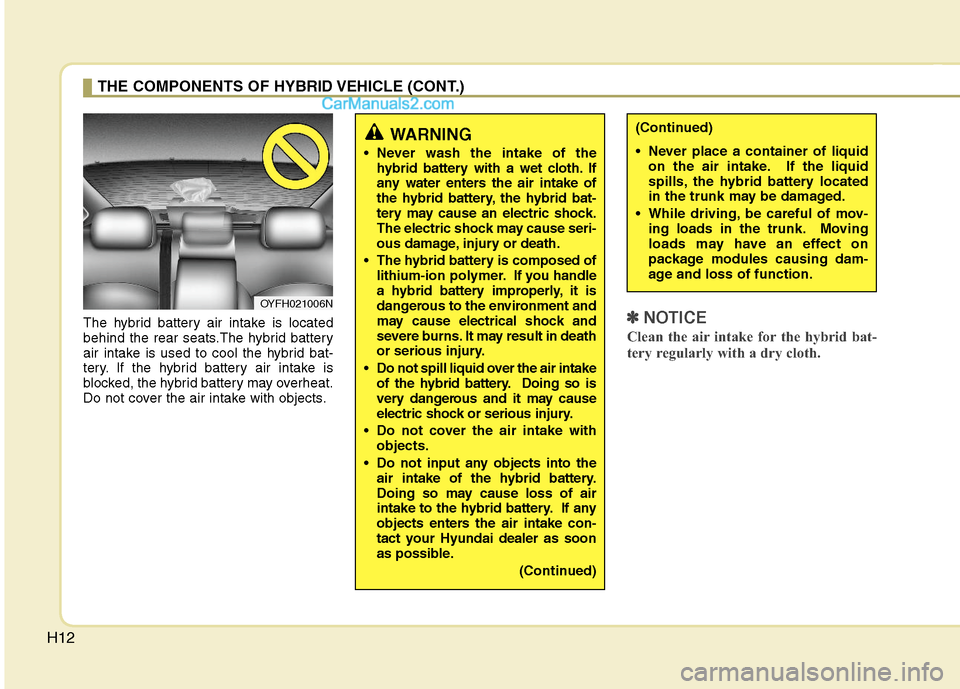
The hybrid battery air intake is located
behind the rear seats.The hybrid battery
air intake is used to cool the hybrid bat-
tery. If the hybrid battery air intake is
blocked, the hybrid battery may overheat.
Do not cover the air intake with objects.✽ ✽
NOTICE
Clean the air intake for the hybrid bat-
tery regularly with a dry cloth.
THE COMPONENTS OF HYBRID VEHICLE (CONT.)
WARNING
Never wash the intake of the
hybrid battery with a wet cloth. If
any water enters the air intake of
the hybrid battery, the hybrid bat-
tery may cause an electric shock.
The electric shock may cause seri-
ous damage, injury or death.
The hybrid battery is composed of
lithium-ion polymer. If you handle
a hybrid battery improperly, it is
dangerous to the environment and
may cause electrical shock and
severe burns. It may result in death
or serious injury.
Do not spill liquid over the air intake
of the hybrid battery. Doing so is
very dangerous and it may cause
electric shock or serious injury.
Do not cover the air intake with
objects.
Do not input any objects into the
air intake of the hybrid battery.
Doing so may cause loss of air
intake to the hybrid battery. If any
objects enters the air intake con-
tact your Hyundai dealer as soon
as possible.
(Continued)
(Continued)
Never place a container of liquid
on the air intake. If the liquid
spills, the hybrid battery located
in the trunk may be damaged.
While driving, be careful of mov-
ing loads in the trunk. Moving
loads may have an effect on
package modules causing dam-
age and loss of function.
OYFH021006N
Page 29 of 404
Your vehicle at a glance
2 2
INTERIOR OVERVIEW
OYFH019001N
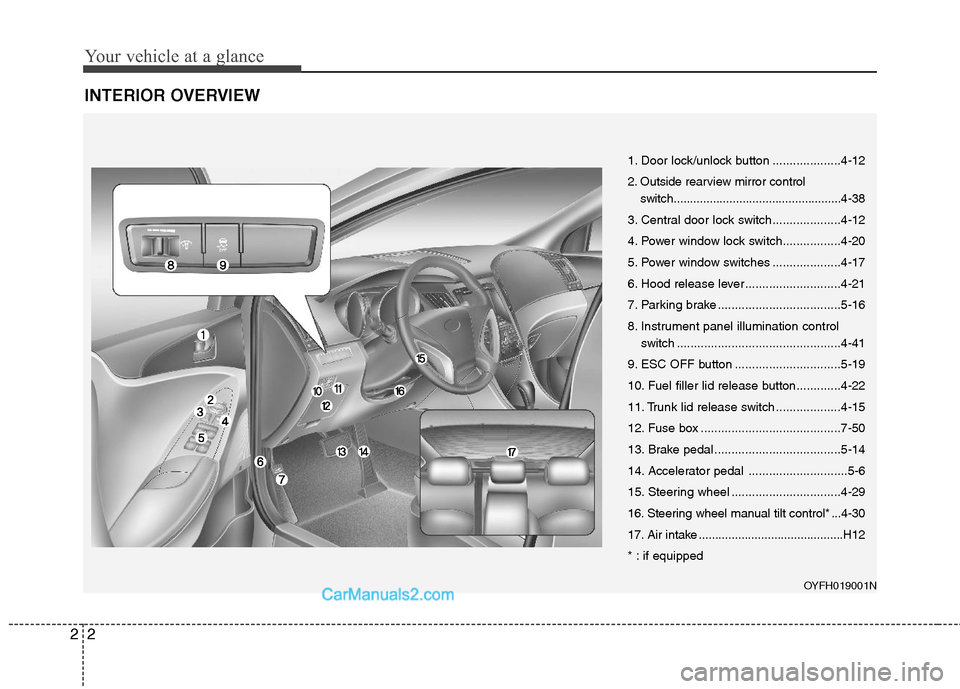
1. Door lock/unlock button ....................4-12
2. Outside rearview mirror control
switch...................................................4-38
3. Central door lock switch....................4-12
4. Power window lock switch.................4-20
5. Power window switches ....................4-17
6. Hood release lever ............................4-21
7. Parking brake ....................................5-16
8. Instrument panel illumination control
switch ................................................4-41
9. ESC OFF button ...............................5-19
10. Fuel filler lid release button.............4-22
11. Trunk lid release switch ...................4-15
12. Fuse box .........................................7-50
13. Brake pedal .....................................5-14
14. Accelerator pedal .............................5-6
15. Steering wheel ................................4-29
16. Steering wheel manual tilt control* ...4-30
17. Air intake ............................................H12
* : if equipped
Page 35 of 404
33
Safety features of your vehicle
WARNING- Driver’s seat
Never attempt to adjust the seat
while the vehicle is moving. This
could result in loss of control,
and an accident causing death,
serious injury, or property dam-
age.
Do not allow anything to interfere
with the normal position of the
seatback. Storing items against a
seatback or in any other way
interfering with proper locking of
a seatback could result in serious
or fatal injury in a sudden stop or
collision.
seatback upright and the lap por-
tion of the seat belt snug and low
across the hips. This is the best
position to protect you in case of
an accident.
In order to avoid unnecessary
and perhaps severe air bag
injuries, always sit as far back as
possible from the steering wheel
while maintaining comfortable
control of the vehicle. We recom-
mend that your chest be at least
10 inches (250 mm) away from
the steering wheel.
WARNING- Loose objects
Loose objects in the driver’s foot
area could interfere with the opera-
tion of the foot pedals, possibly
causing an accident. Do not place
anything under the front seats.
WARNING- Driver respon-
sibility for passengers
Riding in a vehicle with the seat-
back reclined could lead to serious
or fatal injury in an accident. If a
seat is reclined during an accident,
the occupant’s hips may slide
under the lap portion of the seat
belt, applying great force to the
unprotected abdomen. Serious or
fatal internal injuries could result.
The driver must advise the passen-
ger to keep the seatback in an
upright position whenever the vehi-
cle is in motion.
WARNING - Uprighting
seat
When you return the seatback to its
upright position, hold the seatback
and return it slowly and be sure
there are no other occupants
around the seat. If the seatback is
returned without being held and
controlled, the back of the seat
could spring forward resulting in
accidental injury to a person struck
by the seatback.
Page 36 of 404
Safety features of your vehicle
4 3
Front seat
Manual adjustment
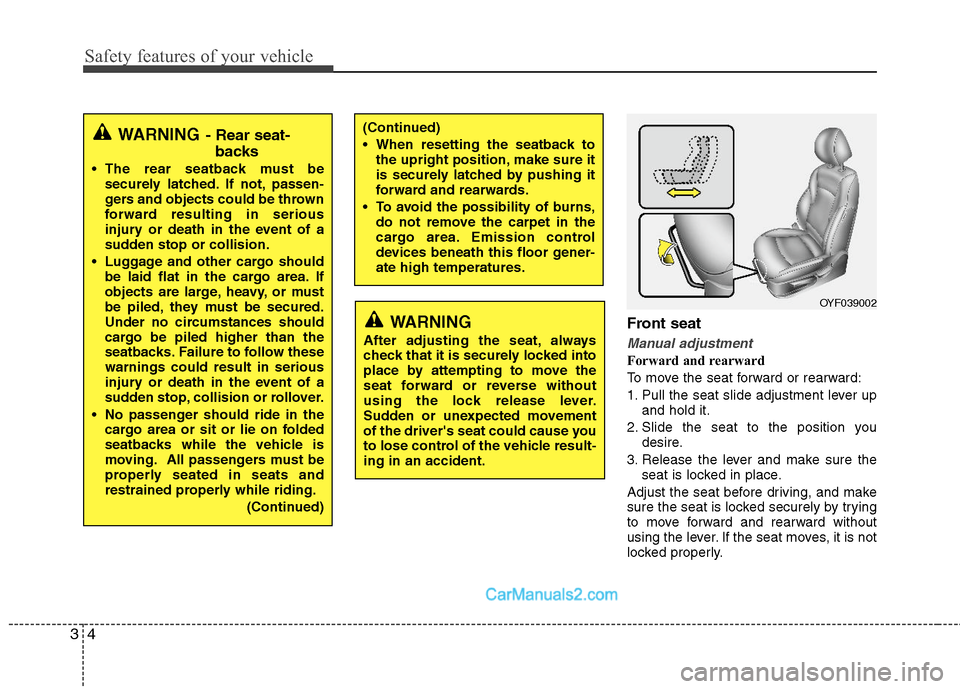
Forward and rearward
To move the seat forward or rearward:
1. Pull the seat slide adjustment lever up
and hold it.
2. Slide the seat to the position you
desire.
3. Release the lever and make sure the
seat is locked in place.
Adjust the seat before driving, and make
sure the seat is locked securely by trying
to move forward and rearward without
using the lever. If the seat moves, it is not
locked properly.
OYF039002
(Continued)
When resetting the seatback to
the upright position, make sure it
is securely latched by pushing it
forward and rearwards.
To avoid the possibility of burns,
do not remove the carpet in the
cargo area. Emission control
devices beneath this floor gener-
ate high temperatures.WARNING- Rear seat-
backs
The rear seatback must be
securely latched. If not, passen-
gers and objects could be thrown
forward resulting in serious
injury or death in the event of a
sudden stop or collision.
Luggage and other cargo should
be laid flat in the cargo area. If
objects are large, heavy, or must
be piled, they must be secured.
Under no circumstances should
cargo be piled higher than the
seatbacks. Failure to follow these
warnings could result in serious
injury or death in the event of a
sudden stop, collision or rollover.
No passenger should ride in the
cargo area or sit or lie on folded
seatbacks while the vehicle is
moving. All passengers must be
properly seated in seats and
restrained properly while riding.
(Continued)
WARNING
After adjusting the seat, always
check that it is securely locked into
place by attempting to move the
seat forward or reverse without
using the lock release lever.
Sudden or unexpected movement
of the driver's seat could cause you
to lose control of the vehicle result-
ing in an accident.
Page 37 of 404
35
Safety features of your vehicle
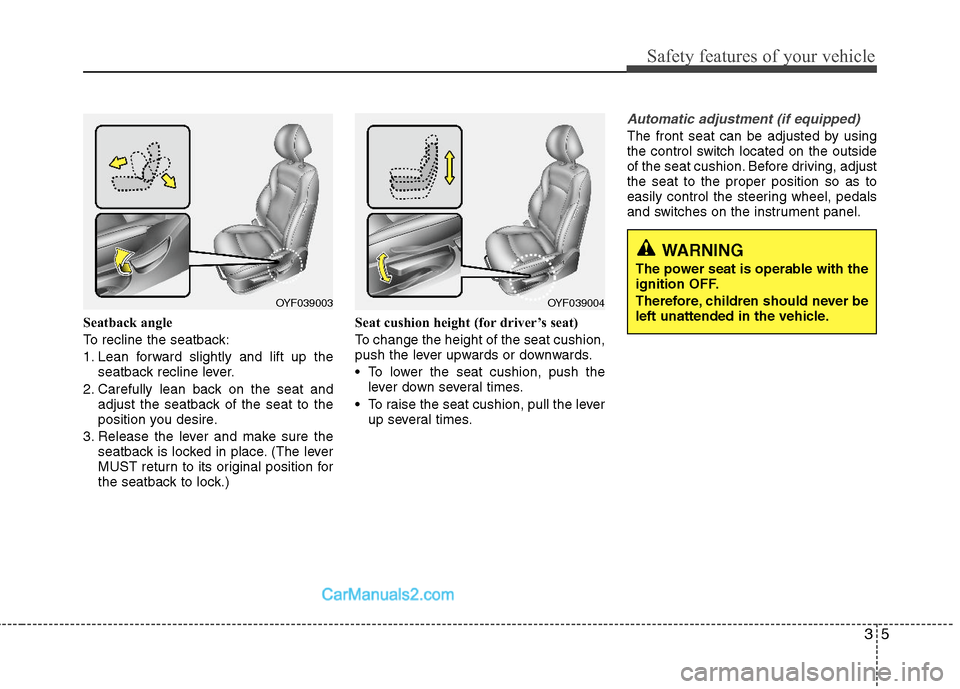
Seatback angle
To recline the seatback:
1. Lean forward slightly and lift up the
seatback recline lever.
2. Carefully lean back on the seat and
adjust the seatback of the seat to the
position you desire.
3. Release the lever and make sure the
seatback is locked in place. (The lever
MUST return to its original position for
the seatback to lock.)Seat cushion height (for driver’s seat)
To change the height of the seat cushion,
push the lever upwards or downwards.
• To lower the seat cushion, push the
lever down several times.
To raise the seat cushion, pull the lever
up several times.
Automatic adjustment (if equipped)
The front seat can be adjusted by using
the control switch located on the outside
of the seat cushion. Before driving, adjust
the seat to the proper position so as to
easily control the steering wheel, pedals
and switches on the instrument panel.
WARNING
The power seat is operable with the
ignition OFF.
Therefore, children should never be
left unattended in the vehicle.
OYF039003OYF039004
Page 40 of 404
Safety features of your vehicle
8 3
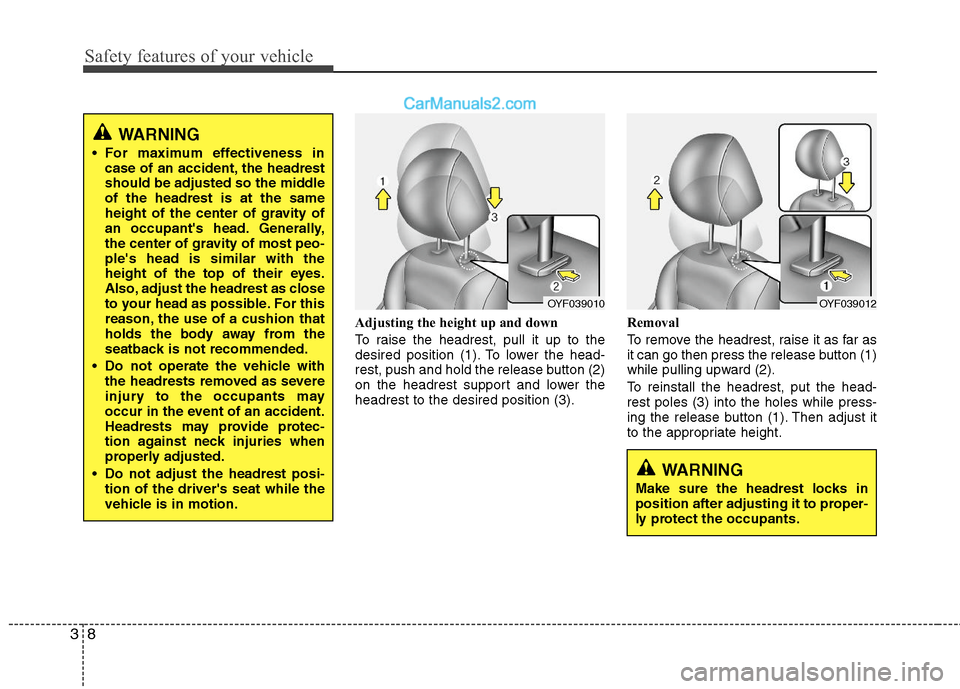
Adjusting the height up and down
To raise the headrest, pull it up to the
desired position (1). To lower the head-
rest, push and hold the release button (2)
on the headrest support and lower the
headrest to the desired position (3).Removal
To remove the headrest, raise it as far as
it can go then press the release button (1)
while pulling upward (2).
To reinstall the headrest, put the head-
rest poles (3) into the holes while press-
ing the release button (1). Then adjust it
to the appropriate height.
OYF039010
WARNING
For maximum effectiveness in
case of an accident, the headrest
should be adjusted so the middle
of the headrest is at the same
height of the center of gravity of
an occupant's head. Generally,
the center of gravity of most peo-
ple's head is similar with the
height of the top of their eyes.
Also, adjust the headrest as close
to your head as possible. For this
reason, the use of a cushion that
holds the body away from the
seatback is not recommended.
Do not operate the vehicle with
the headrests removed as severe
injury to the occupants may
occur in the event of an accident.
Headrests may provide protec-
tion against neck injuries when
properly adjusted.
Do not adjust the headrest posi-
tion of the driver's seat while the
vehicle is in motion.
OYF039012
WARNING
Make sure the headrest locks in
position after adjusting it to proper-
ly protect the occupants.
Page 44 of 404
Safety features of your vehicle
12 3
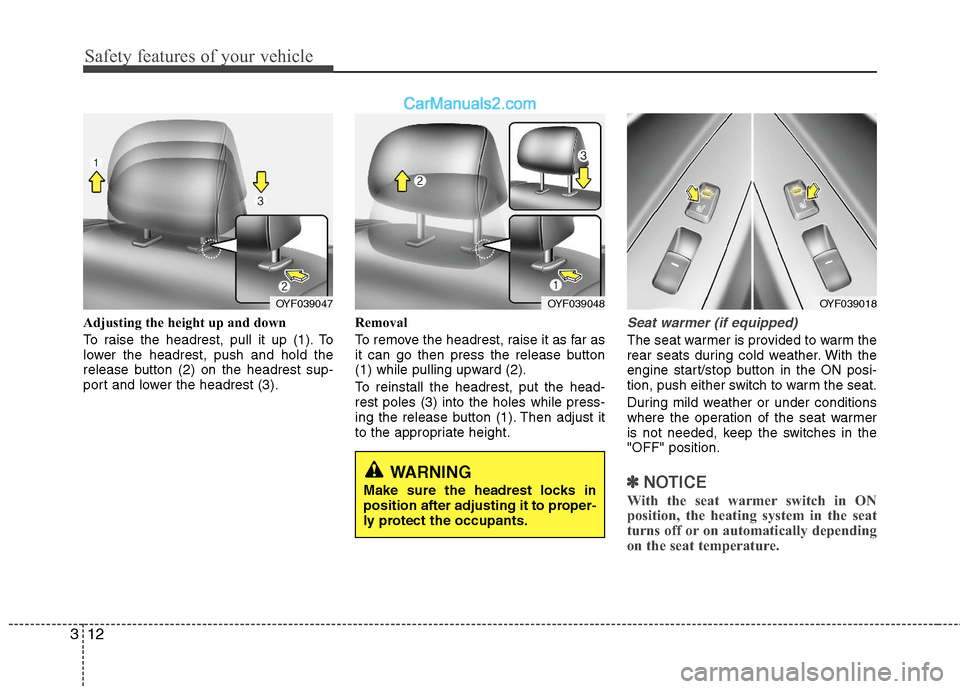
Adjusting the height up and down
To raise the headrest, pull it up (1). To
lower the headrest, push and hold the
release button (2) on the headrest sup-
port and lower the headrest (3).Removal
To remove the headrest, raise it as far as
it can go then press the release button
(1) while pulling upward (2).
To reinstall the headrest, put the head-
rest poles (3) into the holes while press-
ing the release button (1). Then adjust it
to the appropriate height.Seat warmer (if equipped)
The seat warmer is provided to warm the
rear seats during cold weather. With the
engine start/stop button in the ON posi-
tion, push either switch to warm the seat.
During mild weather or under conditions
where the operation of the seat warmer
is not needed, keep the switches in the
"OFF" position.
✽ ✽
NOTICE
With the seat warmer switch in ON
position, the heating system in the seat
turns off or on automatically depending
on the seat temperature.
OYF039047OYF039048
WARNING
Make sure the headrest locks in
position after adjusting it to proper-
ly protect the occupants.
OYF039018
Page 49 of 404
317
Safety features of your vehicle
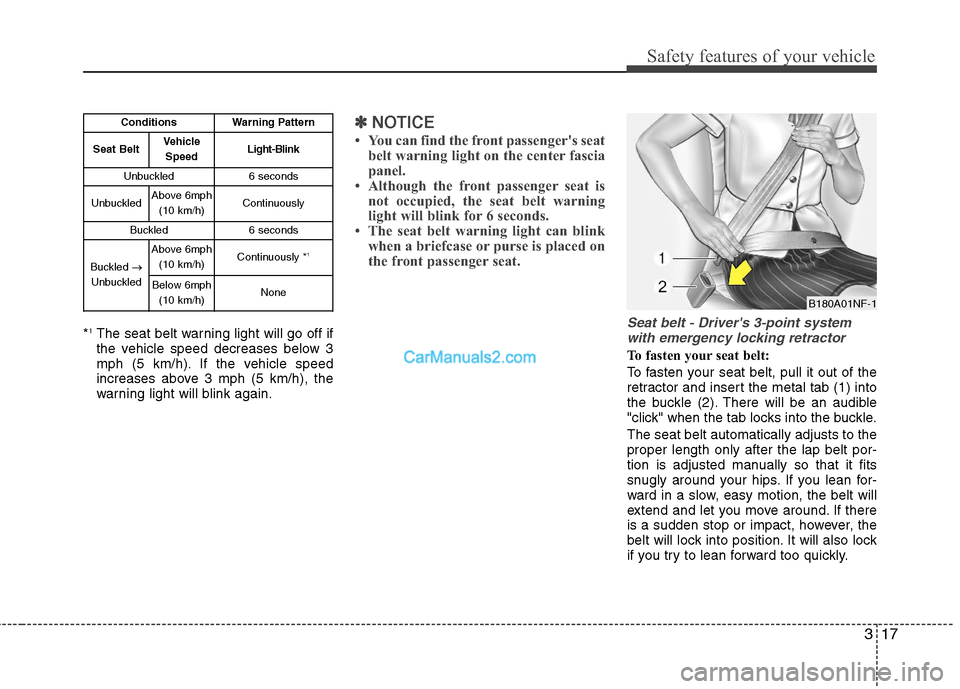
*1The seat belt warning light will go off if
the vehicle speed decreases below 3
mph (5 km/h). If the vehicle speed
increases above 3 mph (5 km/h), the
warning light will blink again.
✽ ✽
NOTICE
• You can find the front passenger's seat
belt warning light on the center fascia
panel.
• Although the front passenger seat is
not occupied, the seat belt warning
light will blink for 6 seconds.
• The seat belt warning light can blink
when a briefcase or purse is placed on
the front passenger seat.
Seat belt - Driver's 3-point system
with emergency locking retractor
To fasten your seat belt:
To fasten your seat belt, pull it out of the
retractor and insert the metal tab (1) into
the buckle (2). There will be an audible
"click" when the tab locks into the buckle.
The seat belt automatically adjusts to the
proper length only after the lap belt por-
tion is adjusted manually so that it fits
snugly around your hips. If you lean for-
ward in a slow, easy motion, the belt will
extend and let you move around. If there
is a sudden stop or impact, however, the
belt will lock into position. It will also lock
if you try to lean forward too quickly.
ConditionsWarning Pattern
Seat BeltVehicle
SpeedLight-Blink
Unbuckled6 seconds
UnbuckledAbove 6mph
(10 km/h)Continuously
Buckled6 seconds
Buckled →
Unbuckled
Above 6mph
(10 km/h)Continuously *1
Below 6mph
(10 km/h)NoneB180A01NF-1
Page 50 of 404
Safety features of your vehicle
18 3
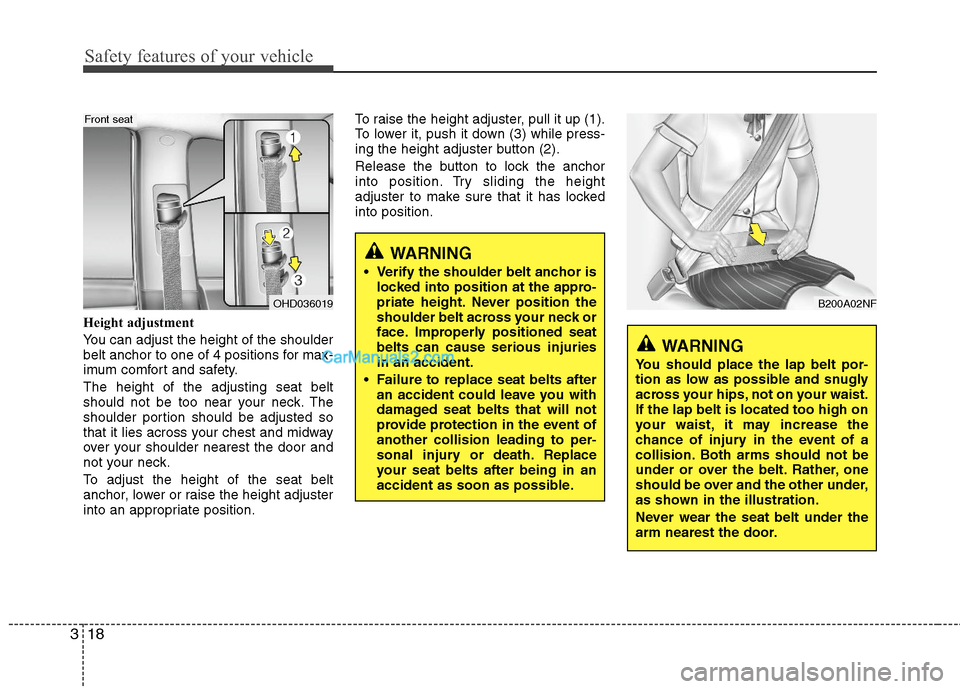
B200A02NF
WARNING
You should place the lap belt por-
tion as low as possible and snugly
across your hips, not on your waist.
If the lap belt is located too high on
your waist, it may increase the
chance of injury in the event of a
collision. Both arms should not be
under or over the belt. Rather, one
should be over and the other under,
as shown in the illustration.
Never wear the seat belt under the
arm nearest the door.
Height adjustment
You can adjust the height of the shoulder
belt anchor to one of 4 positions for max-
imum comfort and safety.
The height of the adjusting seat belt
should not be too near your neck. The
shoulder portion should be adjusted so
that it lies across your chest and midway
over your shoulder nearest the door and
not your neck.
To adjust the height of the seat belt
anchor, lower or raise the height adjuster
into an appropriate position.To raise the height adjuster, pull it up (1).
To lower it, push it down (3) while press-
ing the height adjuster button (2).
Release the button to lock the anchor
into position. Try sliding the height
adjuster to make sure that it has locked
into position.
WARNING
Verify the shoulder belt anchor is
locked into position at the appro-
priate height. Never position the
shoulder belt across your neck or
face. Improperly positioned seat
belts can cause serious injuries
in an accident.
Failure to replace seat belts after
an accident could leave you with
damaged seat belts that will not
provide protection in the event of
another collision leading to per-
sonal injury or death. Replace
your seat belts after being in an
accident as soon as possible.
OHD036019
Front seat