display Hyundai Sonata Hybrid 2012 Owner's Guide
[x] Cancel search | Manufacturer: HYUNDAI, Model Year: 2012, Model line: Sonata Hybrid, Model: Hyundai Sonata Hybrid 2012Pages: 403, PDF Size: 7.86 MB
Page 232 of 403
Driving your vehicle
10
5
For smooth operation, depress the brake
pedal when shifting from N (Neutral) to aforward or reverse gear. Transaxle ranges
The indicator in the instrument cluster
displays the shift lever position when the
engine start/stop button is in the ON
position.
P (Park)
Always come to a complete stop before
shifting into P (Park). This position locks
the transaxle and prevents the drive
wheels from rotating.
WARNING- Automatic
transaxle
Always check the surrounding
areas near your vehicle for peo-
ple, especially children, before
shifting a car into D (Drive) or R
(Reverse).
Before leaving the driver’s seat, always make sure the shift lever
is in the P (Park) position; then
set the parking brake fully and
shut the HEV system off.
Unexpected and sudden vehicle
movement can occur if these pre-
cautions are not followed in the
order identified.
CAUTION
To avoid damage to your transaxle, do not accelerate theengine in R (Reverse) or any for-ward gear position with thebrakes on.
When stopped on an incline, do not hold the vehicle stationarywith engine power. Use the serv-ice brake or the parking brake.
WARNING
Shifting into P (Park) while the vehi- cle is in motion will cause the drive
wheels to lock which will cause you
to lose control of the vehicle.
Do not use the P (Park) position in place of the parking brake.
Always make sure the shift lever
is latched in the P (Park) position
and set the parking brake fully.
Never leave a child unattended in a vehicle.
CAUTION
The transaxle may be damaged ifyou shift into P (Park) while thevehicle is in motion.
Page 289 of 403
623
What to do in an emergency
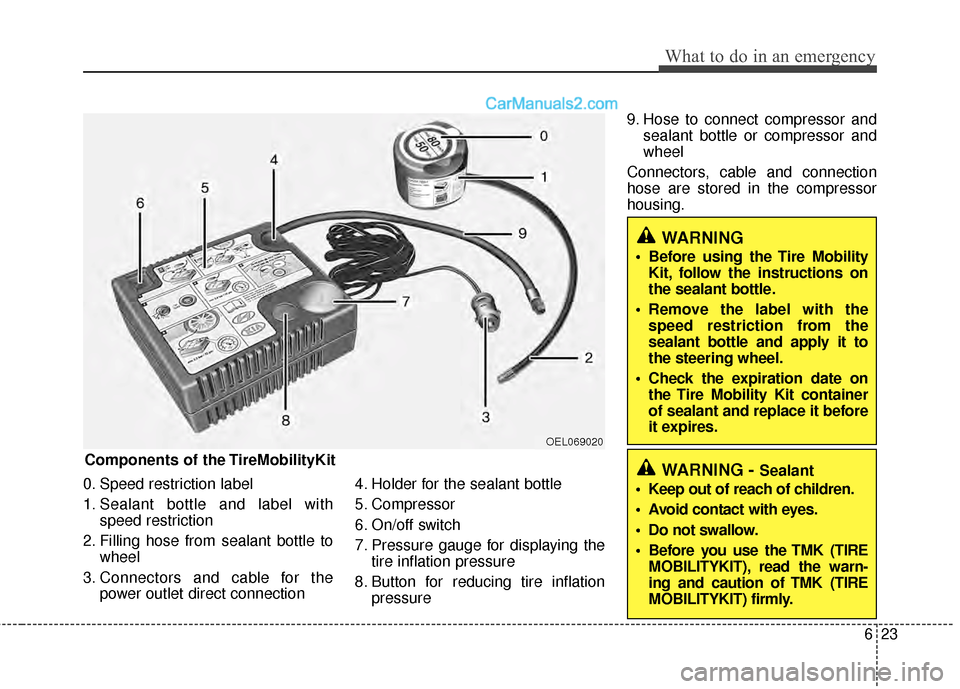
0. Speed restriction label
1. Sealant bottle and label withspeed restriction
2. Filling hose from sealant bottle to wheel
3. Connectors and cable for the power outlet direct connection 4. Holder for the sealant bottle
5. Compressor
6. On/off switch
7. Pressure gauge for displaying the
tire inflation pressure
8. Button for reducing tire inflation pressure 9. Hose to connect compressor and
sealant bottle or compressor and
wheel
Connectors, cable and connection
hose are stored in the compressor
housing.
Components of the TireMobilityKit
OEL069020
WARNING
Before using the Tire Mobility Kit, follow the instructions on
the sealant bottle.
Remove the label with the speed restriction from the
sealant bottle and apply it to
the steering wheel.
Check the expiration date on the Tire Mobility Kit container
of sealant and replace it before
it expires.
WARNING - Sealant
Keep out of reach of children.
Avoid contact with eyes.
Do not swallow.
Before you use the TMK (TIRE MOBILITYKIT), read the warn-
ing and caution of TMK (TIRE
MOBILITYKIT) firmly.
Page 337 of 403
Maintenance
44
7
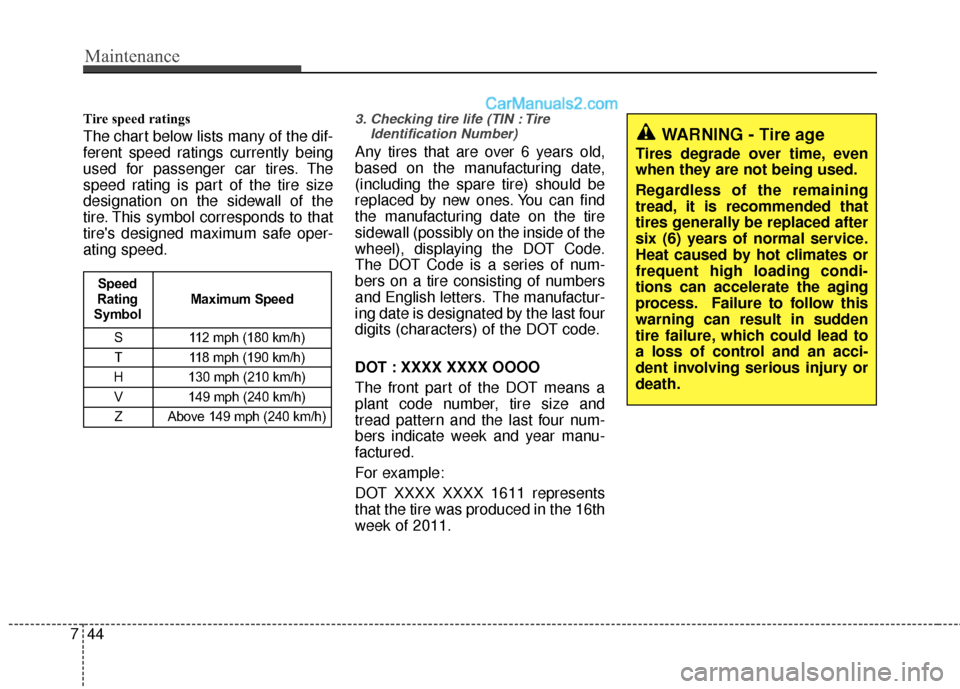
Tire speed ratings
The chart below lists many of the dif-
ferent speed ratings currently being
used for passenger car tires. The
speed rating is part of the tire size
designation on the sidewall of the
tire. This symbol corresponds to that
tire's designed maximum safe oper-
ating speed.
3. Checking tire life (TIN : Tire
Identification Number)
Any tires that are over 6 years old,
based on the manufacturing date,
(including the spare tire) should be
replaced by new ones. You can find
the manufacturing date on the tire
sidewall (possibly on the inside of the
wheel), displaying the DOT Code.
The DOT Code is a series of num-
bers on a tire consisting of numbers
and English letters. The manufactur-
ing date is designated by the last four
digits (characters) of the DOT code.
DOT : XXXX XXXX OOOO
The front part of the DOT means a
plant code number, tire size and
tread pattern and the last four num-
bers indicate week and year manu-
factured.
For example:
DOT XXXX XXXX 1611 represents
that the tire was produced in the 16th
week of 2011.
S 112 mph (180 km/h)
T 118 mph (190 km/h)
H 130 mph (210 km/h) V 149 mph (240 km/h)Z Above 149 mph (240 km/h)
Maximum Speed
Speed
Rating
Symbol
WARNING - Tire age
Tires degrade over time, even
when they are not being used.
Regardless of the remaining
tread, it is recommended that
tires generally be replaced after
six (6) years of normal service.
Heat caused by hot climates or
frequent high loading condi-
tions can accelerate the aging
process. Failure to follow this
warning can result in sudden
tire failure, which could lead to
a loss of control and an acci-
dent involving serious injury or
death.
Page 383 of 403
H2
Hyundai Hybrid Electric Vehicle (HEV)
uses a gasoline engine and an electric
motor for power. The electric motor is
run from a 280V high voltage HEV bat-
tery.
HEV computer decides according to
drive condition when to use engine
from when to use the electric motor or
even both at times.
Fuel is saved when the engine is not
running at idle at times or the vehicle
is driven by the electric motor from
the HEV battery.
The charge of the HEV battery has to
be maintained so at times the engine
becomes a generator which includes
when stopped at idle. Charging also
occurs when decelerating or by
regenerative braking.Display of Hybrid system
Many displays provide information about
the hybrid system, such as, ECO level
and ECO score.
Through the ECO LEVEL, the driver under-
stands the situation of economical driving.
If the driver drives the vehicle with eco-
nomical driving, the ECO LEVEL rises.
And it means the CO2 emission reduction.
In TOTAL ECO SCORE, when you get the
maximum step of ECO LEVEL, ECO sys-
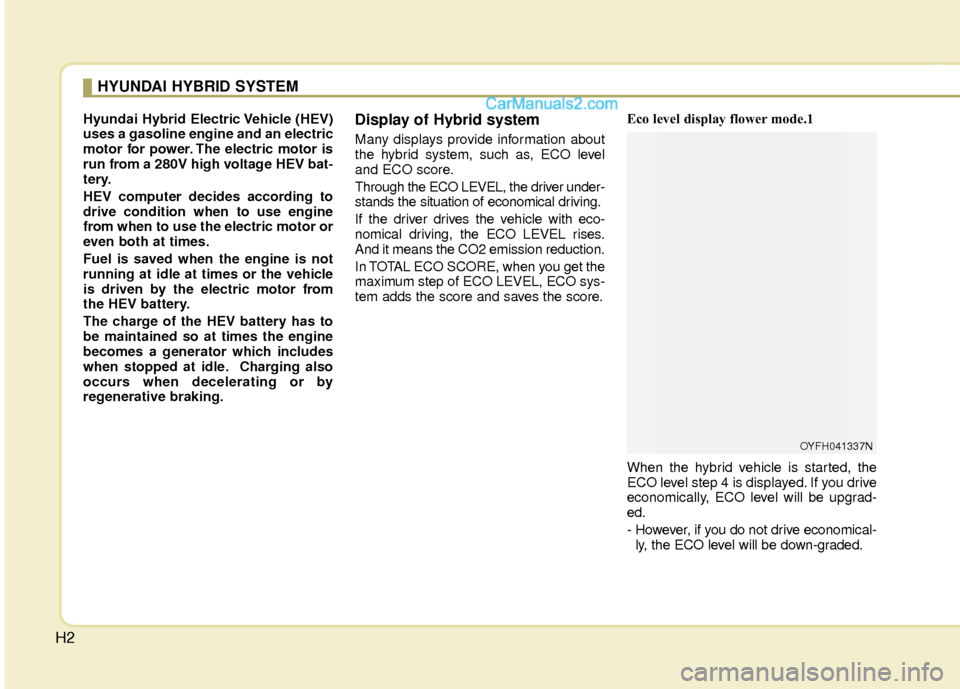
tem adds the score and saves the score.Eco level display flower mode.1
When the hybrid vehicle is started, the
ECO level step 4 is displayed. If you drive
economically, ECO level will be upgrad-
ed.
- However, if you do not drive economical-
ly, the ECO level will be down-graded.
HYUNDAI HYBRID SYSTEM
OYFH041337N
Page 384 of 403
H3
Eco level display flower mode.2
In the “vehicle setting”, if you change the
animation mode to "ON", the dynamic
image will be activated.
- This provides the driver with thedynamic ECO mode. Total eco score display
If your ECO level achieves the top step,
your ECO score automatically saves 1
point.
In the “vehicle setting”, if you change the
animation mode to “ON”, the dynamic
image will be on.SOC Gauge (State of charge)
This State of Charge(SOC) gauge indi-
cates the left Hybrid battery power. If the
SOC is near L level, the vehicle automat-
ically operates the engine to charge the
battery. However, if the service indicator
and MIL(Malfunction indicator lamp) turn
on when the State of Charge(SOC) is
near L(Low), the vehicle should be
towed. Refer to the chapter 6.
OYFH041338NOYFH041339N
OYFH041311N
Page 397 of 403

I3
Index
Care Exterior care ··················\
··················\
··················\
········7-69
Interior care ··················\
··················\
··················\
·········7-73
Tire care··················\
··················\
··················\
···············7-37
Cargo weight ··················\
··················\
··················\
············5-43
Center console storage ··················\
··················\
·············4-105
Central door lock switch··················\
··················\
············4-12
Certification label ··················\
··················\
··················\
····5-41
Certification label ··················\
··················\
··················\
······8-7
Chains Tire chains ··················\
··················\
··················\
···········5-35
Changing tires (with spare tire) ··················\
··················\
·6-14
Checking tire inflation pressure··················\
··················\
·7-38
Child restraint system ··················\
··················\
················3-27 Lower anchor system ··················\
··················\
············3-33
Seat belt ··················\
··················\
··················\
···············3-29
Tether anchor system··················\
··················\
·············3-31
Child-protector rear door lock ··················\
··················\
···4-14
Climate control air filter··················\
··················\
···4-90, 7-30
Clock (Digital) ··················\
··················\
··················\
·······4-108
Clothes hanger ··················\
··················\
··················\
·······4-109
Combined instrument, see instrument cluster ···············4-40
Compact spare tire (with spare tire) ··················\
············6-14
Compact spare tire replacement ··················\
··················\
7-42
Components of the tire mobility kit ··················\
············6-23
Consumer information ··················\
··················\
·················8-9
Coolant ··················\
··················\
··················\
··················\
···7-24
Cooling fluid, see engine coolant ··················\
················7-24 Crankcase emission control system ··················\
·············7-75
Cruise control system ··················\
··················\
················5-24
Cup holder ··················\
··················\
··················\
·············4-106
Curtain air bag ··················\
··················\
··················\
·········3-53
Dashboard illumination, see instrument panel illumination·4-41
Dashboard, see instrument cluster ··················\
···············4-40
Defogging (Windshield) ··················\
··················\
··········4-102
Defogging logic (Windshield) ··················\
··················\
·4-104
Defroster (Rear window) ··················\
··················\
···········4-79
Defrosting (Windshield) ··················\
··················\
··········4-102
Digital clock··················\
··················\
··················\
···········4-108
Dimensions ··················\
··················\
··················\
················8-3
Display illumination, see instrument panel illumination ··4-41
Displays, see instrument cluster ··················\
··················\
4-40
Door locks ··················\
··················\
··················\
················4-11 Central door lock switch ··················\
··················\
·······4-12
Child-protector rear door lock ··················\
················4-14
Drinks holders, see cup holders··················\
·················4-10\
6
Driver's 3-point system with emergency locking retractor3-17
Driver's air bag··············\
··················\
··················\
·············3-48
Driving at night··················\
··················\
··················\
········5-31
Driving in flooded areas ··················\
··················\
············5-32
Driving in the rain ··················\
··················\
··················\
···5-32
D