steering wheel Hyundai Sonata Hybrid 2012 Owner's Guide
[x] Cancel search | Manufacturer: HYUNDAI, Model Year: 2012, Model line: Sonata Hybrid, Model: Hyundai Sonata Hybrid 2012Pages: 403, PDF Size: 7.86 MB
Page 289 of 403
623
What to do in an emergency
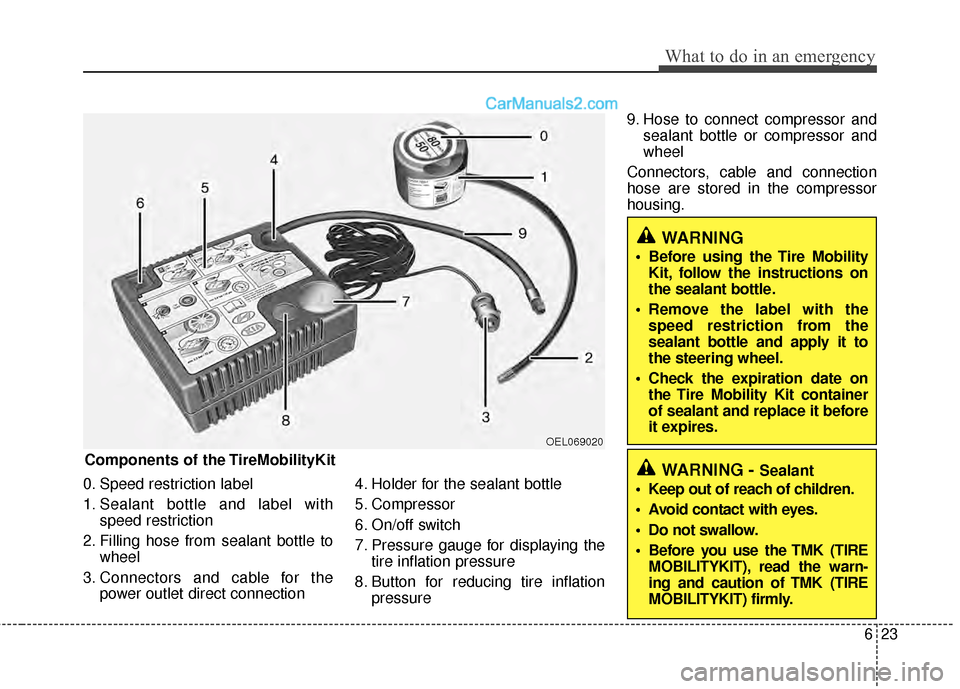
0. Speed restriction label
1. Sealant bottle and label withspeed restriction
2. Filling hose from sealant bottle to wheel
3. Connectors and cable for the power outlet direct connection 4. Holder for the sealant bottle
5. Compressor
6. On/off switch
7. Pressure gauge for displaying the
tire inflation pressure
8. Button for reducing tire inflation pressure 9. Hose to connect compressor and
sealant bottle or compressor and
wheel
Connectors, cable and connection
hose are stored in the compressor
housing.
Components of the TireMobilityKit
OEL069020
WARNING
Before using the Tire Mobility Kit, follow the instructions on
the sealant bottle.
Remove the label with the speed restriction from the
sealant bottle and apply it to
the steering wheel.
Check the expiration date on the Tire Mobility Kit container
of sealant and replace it before
it expires.
WARNING - Sealant
Keep out of reach of children.
Avoid contact with eyes.
Do not swallow.
Before you use the TMK (TIRE MOBILITYKIT), read the warn-
ing and caution of TMK (TIRE
MOBILITYKIT) firmly.
Page 291 of 403
625
What to do in an emergency
Distributing the sealant
11. Immediately drive approximately3 km (2 miles) to evenly distribute
the sealant in the tire. Producing the tire inflation pres-
sure
12. After driving approximately 3 km
(2 miles), stop at a suitable loca-
tion.
13. Connect connection hose 9 of the compressor directly to the tire
valve.
14. Connect between compressor and the vehicle power outlet
using the cable and connectors.
15. Adjust the tire inflation pressure to 230 kPa (33 psi). With the
engine start/stop button posi-
tioned on, proceed as follows.
- To increase the inflation pres- sure: Switch on the compressor,
position I. To check the current
inflation pressure setting, briefly
switch off the compressor.✽ ✽ NOTICE
The pressure gauge may show high-
er than actual reading when the
compressor is running. To get an
accurate tire reading, the compres-
sor needs to be turned off.
- To reduce the inflation pres-
sure: Press the button 8 on the
compressor.
16. Remove the speed restriction label(0) from the sealant bottle(1)
and place it in a highly visible
place in the vehicle such as on
the steering wheel to remind you
not to drive too fast.
WARNING
Do not let the compressor run for
more than 10 minutes, otherwise
the device will overheat and may
be damaged.
CAUTION
Do not exceed a speed of 60km/h (35 mph). If possible, donot fall below a speed of 20km/h (12 mph).
While driving, if you experienceany unusual vibration, ride dis-turbance or noise, reduce yourspeed and drive with cautionuntil you can safely pull off ofthe side of the road.
Call for road side service or tow-ing.
CAUTION
Be careful not to overinflate thetire and stay away from the tirewhen filling it.
Page 298 of 403
75
Maintenance
OWNER MAINTENANCE
The following lists are vehicle checks and
inspections that should be performed by
the owner or an authorized HYUNDAI
dealer at the frequencies indicated to
help ensure safe, dependable operation
of your vehicle.
Any adverse conditions should be
brought to the attention of your dealer as
soon as possible.
These Owner Maintenance Checks are
generally not covered by warranties and
you may be charged for labor, parts and
lubricants used.Owner maintenance schedule
When you stop for fuel:
Check the engine oil level.
Check coolant level in coolant reser-voirs (engine and inverter).
Check the windshield washer fluid level.
Look for low or under-inflated tires.
While operating your vehicle:
Note any changes in the sound of the exhaust or any smell of exhaust fumes
in the vehicle.
Check for vibrations in the steering wheel. Notice any increased steering
effort or looseness in the steering
wheel, or change in its straight-ahead
position.
Notice if your vehicle constantly turns slightly or “pulls” to one side when trav-
eling on smooth, level road.
When stopping, listen and check for unusual sounds, pulling to one side,
increased brake pedal travel or “hard-
to-push” brake pedal.
If any slipping or changes in the oper- ation of your transaxle occurs, check
the transaxle fluid level.
Check automatic transaxle P (Park) function.
Check parking brake.
Check for fluid leaks under your vehicle (water dripping from the air condition-
ing system during or after use is nor-
mal).
Check inverter coolant.
WARNING
Be careful when checking your
engine coolant level when the
engine is hot. Scalding hot coolant
and steam may blow out under
pressure. This could cause burns
or other serious injury.
Page 314 of 403
721
Maintenance
Parking brake
Inspect the parking brake system includ-
ing the parking brake pedal and cables.
Brake discs, pads, calipers and
rotors
Check the pads for excessive wear, discs
for run out and wear, and calipers for fluid
leakage.
Exhaust pipe and muffler
Visually inspect the exhaust pipes, muf-
fler and hangers for cracks, deterioration,
or damage. Start the engine and listen
carefully for any exhaust gas leakage.
Tighten connections or replace parts as
necessary.
Suspension mounting bolts
Check the suspension connections for
looseness or damage. Retighten to the
specified torque.
Steering gear box, linkage &
boots/lower arm ball joint
With the vehicle stopped and engine off,
check for excessive free-play in the
steering wheel.
Check the linkage for bends or damage.
Check the dust boots and ball joints for
deterioration, cracks, or damage.
Replace any damaged parts.
Drive shafts and boots
Check the drive shafts, boots and clamps
for cracks, deterioration, or damage.
Replace any damaged parts and, if nec-
essary, repack the grease.
Air conditioning refrigerant
Check the air conditioning lines and con-
nections for leakage and damage.
Page 334 of 403
741
Maintenance
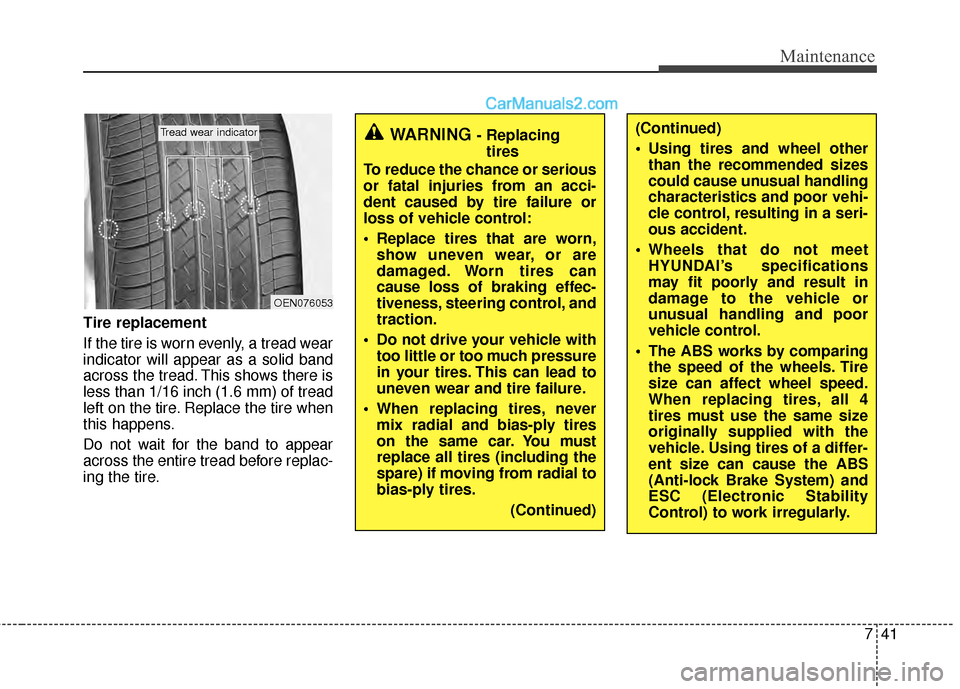
Tire replacement
If the tire is worn evenly, a tread wear
indicator will appear as a solid band
across the tread. This shows there is
less than 1/16 inch (1.6 mm) of tread
left on the tire. Replace the tire when
this happens.
Do not wait for the band to appear
across the entire tread before replac-
ing the tire.
OEN076053
Tread wear indicatorWARNING - Replacingtires
To reduce the chance or serious
or fatal injuries from an acci-
dent caused by tire failure or
loss of vehicle control:
Replace tires that are worn, show uneven wear, or are
damaged. Worn tires can
cause loss of braking effec-
tiveness, steering control, and
traction.
Do not drive your vehicle with too little or too much pressure
in your tires. This can lead to
uneven wear and tire failure.
When replacing tires, never mix radial and bias-ply tires
on the same car. You must
replace all tires (including the
spare) if moving from radial to
bias-ply tires.
(Continued)(Continued)
Using tires and wheel otherthan the recommended sizes
could cause unusual handling
characteristics and poor vehi-
cle control, resulting in a seri-
ous accident.
Wheels that do not meet HYUNDAI’s specifications
may fit poorly and result in
damage to the vehicle or
unusual handling and poor
vehicle control.
The ABS works by comparing the speed of the wheels. Tire
size can affect wheel speed.
When replacing tires, all 4
tires must use the same size
originally supplied with the
vehicle. Using tires of a differ-
ent size can cause the ABS
(Anti-lock Brake System) and
ESC (Electronic Stability
Control) to work irregularly.
Page 366 of 403
773
Maintenance
give particular attention to the compo-
nents under the fenders and other
areas that are hidden from view. Do a
thorough job; just dampening the accu-
mulated mud rather than washing it
away will accelerate corrosion rather
than prevent it. Water under high pres-
sure and steam are particularly effec-
tive in removing accumulated mud and
corrosive materials.
rocker panels and frame members, be
sure that drain holes are kept open so
that moisture can escape and not be
trapped inside to accelerate corrosion.
Keep your garage dry
Don't park your car in a damp, poorly
ventilated garage. This creates a favor-
able environment for corrosion. This is
particularly true if you wash your car in
the garage or drive it into the garage
when it is still wet or covered with snow,
ice or mud. Even a heated garage can
contribute to corrosion unless it is well
ventilated so moisture is dispersed. Keep paint and trim in good condition
Scratches or chips in the finish should be
covered with "touch-up" paint as soon as
possible to reduce the possibility of cor-
rosion. If bare metal is showing through,
the attention of a qualified body and paint
shop is recommended.
Bird droppings : Bird droppings are high-
ly corrosive and may damage painted
surfaces in just a few hours. Always
remove bird droppings as soon as possi-
ble.
Don't neglect the interior
Moisture can collect under the floor mats
and carpeting to cause corrosion. Check
under the mats periodically to be sure
the carpeting is dry. Use particular care if
you carry fertilizers, cleaning materials or
chemicals in the car.
These should be carried only in proper
containers and any spills or leaks should
be cleaned up, flushed with clean water
and thoroughly dried.Interior care
Interior general precautions
Prevent caustic solutions such as per-
fume and cosmetic oil from contacting
the dashboard because they may cause
damage or discoloration. If they do con-
tact the dashboard, wipe them off imme-
diately. See the instructions that follow for
the proper way to clean vinyl.
CAUTION
Never allow water or other liquids
to come in contact with electri-cal/electronic components insidethe vehicle as this may damage them.
When cleaning leather products (steering wheel, seats etc.), useneutral detergents or low alcoholcontent solutions. If you use high alcohol content solutions oracid/alkaline detergents, the colorof the leather may fade or the sur- face may get stripped off.
Page 396 of 403

Index
2I
Air bags··················\
··················\
··················\
··················\
··3-35Air bag warning label··················\
··················\
············3-62
Air bag warning light ··················\
··················\
············3-38
Curtain air bag··················\
··················\
··················\
·····3-53
Driver's and passenger's front air bag ··················\
·····3-48
Occupant classification system ··················\
···············3-42
Side impact air bag··················\
··················\
················3-52
SRS components and functions ··················\
··············3-39
Air cleaner ··················\
··················\
··················\
···············7-30
Antenna (glass) ··················\
··················\
··················\
······4-111
Anti-lock brake system (ABS) ··················\
··················\
··5-18
Appearance care··················\
··················\
··················\
·······7-69 Exterior care ··················\
··················\
··················\
········7-69
Interior care ··················\
··················\
··················\
·········7-73
Armrest ··················\
··················\
··················\
··················\
··3-13
Audio system ··················\
··················\
··················\
·········4-111 Glass antenna ··················\
··················\
··················\
·····4-111
Steering wheel audio control ··················\
·················4-111
Automatic climate control system (Type A)··················\
4-80 Air conditioning ··················\
··················\
··················\
··4-88
Climate control air filter··················\
··················\
········4-90
Economy air conditioning ··················\
··················\
·····4-87
Heating and air conditioning··················\
··················\
·4-81
Automatic climate control system (Type B)··················\
4-91 Air conditioning ··················\
··················\
··················\
··4-99
Automatic heating and air conditioning··················\
··4-92
Economy air conditioning ··················\
··················\
·····4-98 Manual heating and air conditioning ··················\
······4-93
Automatic transaxle ··················\
··················\
··················\
···5-9 Shift lock system ··················\
··················\
··················\
·5-12
Aux, USB and iPod port ··················\
··················\
··········4-110
Battery ··················\
··················\
··················\
··············7-34, 8-2
Battery saver function··················\
··················\
················4-69
Before driving ··················\
··················\
··················\
············5-3
Bottle holders, see cup holders ··················\
··················\
4-106
Brake system··················\
··················\
··················\
············5-14 Anti-lock brake system (ABS) ··················\
················5-18
Electronic stability control (ESC) ··················\
···········5-19
Hill-start assist control (HAC) ··················\
················5-22
Parking brake ··················\
··················\
··················\
······5-16
Power brakes ··················\
··················\
··················\
·······5-14
Brakes fluid··················\
··················\
··················\
··············7-27
Bulb replacement ··················\
··················\
··················\
·····7-60
Bulb wattage ··················\
··················\
··················\
·············8-3
Button start/stop, see engine start/stop button·················5-5
California perchlorate notice ··················\
··················\
·····7-78
Camera (Rear view) ··················\
··················\
··················\
·4-68
Capacities (Lubricants) ··················\
··················\
···············8-5
Capacity/Weight ·················\
··················\
··················\
·········8-2
A
B
C
Page 402 of 403

Index
8I
Seatback pocket··················\
··················\
··················\
···3-10
Shift lock system ··················\
··················\
··················\
·····5-12
Side impact air bag ··················\
··················\
··················\
··3-52
Smart key ··················\
··················\
··················\
··················\
·4-3
Smooth cornering··················\
··················\
··················\
·····5-31
Snow tires ··················\
··················\
··················\
················5-34
Spare tire Compact spare tire ··················\
··················\
················6-14
Compact spare tire replacement ··················\
··············7-42
Removing and storing the spare tire ··················\
·······6-14
Special driving conditions ··················\
··················\
·········5-30 Driving at night ··················\
··················\
··················\
···5-31
Driving in flooded areas··················\
··················\
········5-32
Driving in the rain ··················\
··················\
·················5-32\
Hazardous driving conditions ··················\
·················5-30\
Highway driving··················\
··················\
··················\
··5-33
Rocking the vehicle··················\
··················\
···············5-30
Smooth cornering ··················\
··················\
··················\
5-31
Speedometer··················\
··················\
··················\
·············4-42
Sports mode ··················\
··················\
··················\
·············5-11
Starting difficulties, see engine will not start ··················\
6-3
Starting the hybrid system ··················\
··················\
···········5-6
Steering wheel···············\
··················\
··················\
·············4-29 Electric power steering··················\
··················\
··········4-29
Horn··················\
··················\
··················\
··················\
···4-30
Tilt steering ··················\
··················\
··················\
·········4-30
Steering wheel audio control ··················\
··················\
···4-111
Storage compartment ··················\
··················\
···············4-105 Center console storage ··················\
··················\
········4-105
Glove box ··················\
··················\
··················\
··········4-105
Multi box ··················\
··················\
··················\
···········4-106
Sunglass holder ··················\
··················\
··················\
·4-106
Sunglass holder ··················\
··················\
··················\
······4-106
Sunvisor ··················\
··················\
··················\
·················4-10\
7
Technical data (tire mobility kit) ··················\
·················6-26\
Tether anchor system ··················\
··················\
·················3-31\
Theft-alarm system ··················\
··················\
··················\
····4-9
Tilt steering ··················\
··················\
··················\
··············4-30
Tire chains··················\
··················\
··················\
················5-35
Tire pressure monitoring system (TPMS) ··················\
·····6-8
Tire specification and pressure label ··················\
·············8-8
Tires and wheels ··················\
··················\
··················\
······7-37 Checking tire inflation pressure ··················\
··············7-38
Compact spare tire replacement ··················\
··············7-40
Recommended cold tire inflation pressures ··············7-37
Tire care··················\
··················\
··················\
···············7-37
Tire maintenance ··················\
··················\
··················\
·7-42
Tire replacement ··················\
··················\
··················\
··7-39
Tire rotation ··················\
··················\
··················\
·········7-38
Tire sidewall labeling ··················\
··················\
············7-43
Tire traction ··················\
··················\
··················\
·········7-43
Wheel alignment and tire balance ··················\
···········7-40
Wheel replacement ··················\
··················\
················7-42
T