cooling HYUNDAI SONATA HYBRID 2014 User Guide
[x] Cancel search | Manufacturer: HYUNDAI, Model Year: 2014, Model line: SONATA HYBRID, Model: HYUNDAI SONATA HYBRID 2014Pages: 410, PDF Size: 17.26 MB
Page 320 of 410
75
Maintenance
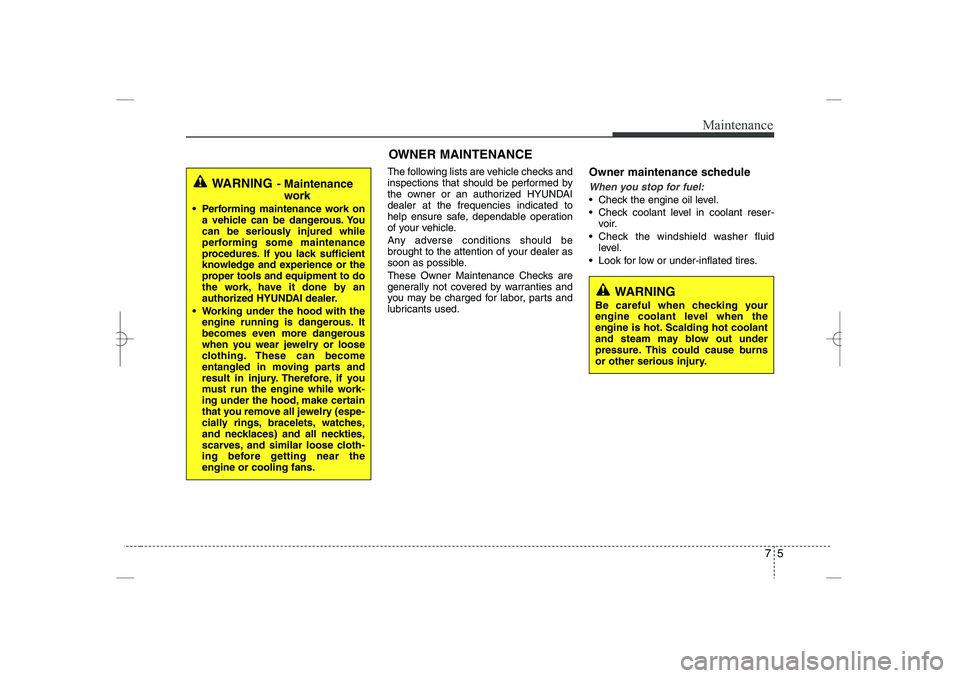
The following lists are vehicle checks and
inspections that should be performed by
the owner or an authorized HYUNDAI
dealer at the frequencies indicated to
help ensure safe, dependable operation
of your vehicle.
Any adverse conditions should be
brought to the attention of your dealer as
soon as possible.
These Owner Maintenance Checks are
generally not covered by warranties and
you may be charged for labor, parts and
lubricants used.
Owner maintenance schedule
When you stop for fuel:
Check the engine oil level.
Check coolant level in coolant reser-
voir.
Check the windshield washer fluid
level.
Look for low or under-inflated tires.
WARNING
- Maintenance
work
Performing maintenance work on
a vehicle can be dangerous. You
can be seriously injured while
performing some maintenance
procedures. If you lack sufficient
knowledge and experience or the
proper tools and equipment to do
the work, have it done by an
authorized HYUNDAI dealer.
Working under the hood with the
engine running is dangerous. It
becomes even more dangerous
when you wear jewelry or loose
clothing. These can become
entangled in moving parts and
result in injury. Therefore, if you
must run the engine while work-
ing under the hood, make certain
that you remove all jewelry (espe-
cially rings, bracelets, watches,
and necklaces) and all neckties,
scarves, and similar loose cloth-
ing before getting near the
engine or cooling fans.
OWNER MAINTENANCE
WARNING
Be careful when checking your
engine coolant level when the
engine is hot. Scalding hot coolant
and steam may blow out under
pressure. This could cause burns
or other serious injury.
YF HMA 7.qxp 1/16/2012 6:18 PM Page 5
Page 335 of 410
Maintenance
20
7
Air cleaner filter
A Genuine HYUNDAI air cleaner filter is
recommended when the filter is
replaced.
Spark plugs
Make sure to install new spark plugs of
the correct heat range.
Valve clearance
Inspect excessive valve noise and/or
engine vibration and adjust if necessary.
An authorized HYUNDAI dealer should
perform the operation.
Cooling system
Check cooling system components, such
as radiator, coolant reservoir, hoses and
connections for leakage and damage.
Replace any damaged parts.
Coolant
The coolant should be changed at the
intervals specified in the maintenance
schedule.
Manual transaxle fluid
(if equipped)
Inspect the manual transaxle fluid
according to the maintenance schedule.
Automatic transaxle fluid
(if equipped)
Automatic transaxle fluid should not be
checked under normal usage conditions.
But in severe conditions, the fluid should
be changed at an authorized HYUNDAI
dealer in accordance to the scheduled
maintenance at the beginning of this
chapter.
✽
✽
NOTICE
Automatic transaxle fluid color is basi-
cally red.
As the vehicle is driven, the automatic
transaxle fluid will begin to look darker.
It is normal condition and you should
not judge the need to replace the fluid
based upon the changed color.
Brake hoses and lines
Visually check for proper installation,
chafing, cracks, deterioration and any
leakage. Replace any deteriorated or
damaged parts immediately.
Brake/clutch fluid
Check brake fluid level in the brake fluid
reservoir. The level should be between
“MIN” and “MAX” marks on the side of
the reservoir. Use only hydraulic brake
fluid conforming to DOT 3 or DOT 4
specification.
CAUTION
The use of a non-specified fluid
could result in transaxle malfunc-
tion and failure.
Use only specified automatic trans
-
axle fluid. (Refer to “Recommended
lubricants and capacities” in sec-
tion 8.)
YF HMA 7.qxp 1/16/2012 6:18 PM Page 20
Page 339 of 410
Maintenance
24
7
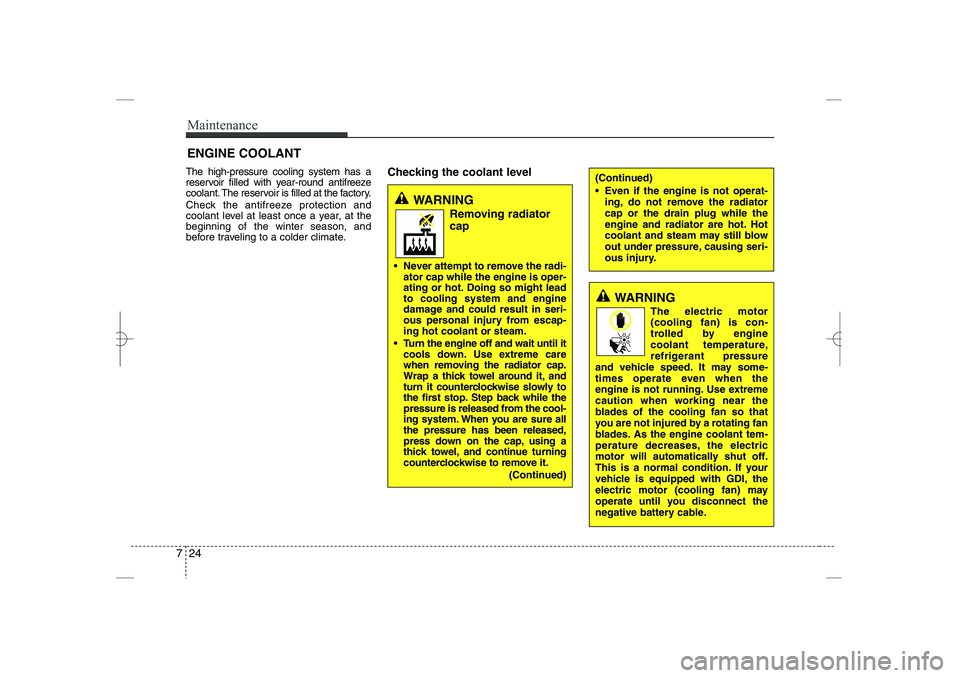
The high-pressure cooling system has a
reservoir filled with year-round antifreeze
coolant. The reservoir is filled at the factory.
Check the antifreeze protection and
coolant level at least once a year, at the
beginning of the winter season, and
before traveling to a colder climate.
Checking the coolant level
(Continued)
Even if the engine is not operat-
ing, do not remove the radiator
cap or the drain plug while the
engine and radiator are hot. Hot
coolant and steam may still blow
out under pressure, causing seri-
ous injury.
ENGINE COOLANT
WARNING
Removing radiator
cap
Never attempt to remove the radi-
ator cap while the engine is oper-
ating or hot. Doing so might lead
to cooling system and engine
damage and could result in seri-
ous personal injury from escap-
ing hot coolant or steam.
Turn the engine off and wait until it
cools down. Use extreme care
when removing the radiator cap.
Wrap a thick towel around it, and
turn it counterclockwise slowly to
the first stop. Step back while the
pressure is released from the cool-
ing system. When you are sure all
the pressure has been released,
press down on the cap, using a
thick towel, and continue turning
counterclockwise to remove it.
(Continued)
WARNING
The electric motor
(cooling fan) is con-
trolled by engine
coolant temperature,
refrigerant pressure
and vehicle speed. It may some-
times operate even when the
engine is not running. Use extreme
caution when working near the
blades of the cooling fan so that
you are not injured by a rotating fan
blades. As the engine coolant tem-
perature decreases, the electric
motor will automatically shut off.
This is a normal condition. If your
vehicle is equipped with GDI, the
electric motor (cooling fan) may
operate until you disconnect the
negative battery cable.
YF HMA 7.qxp 1/16/2012 6:18 PM Page 24
Page 340 of 410
725
Maintenance
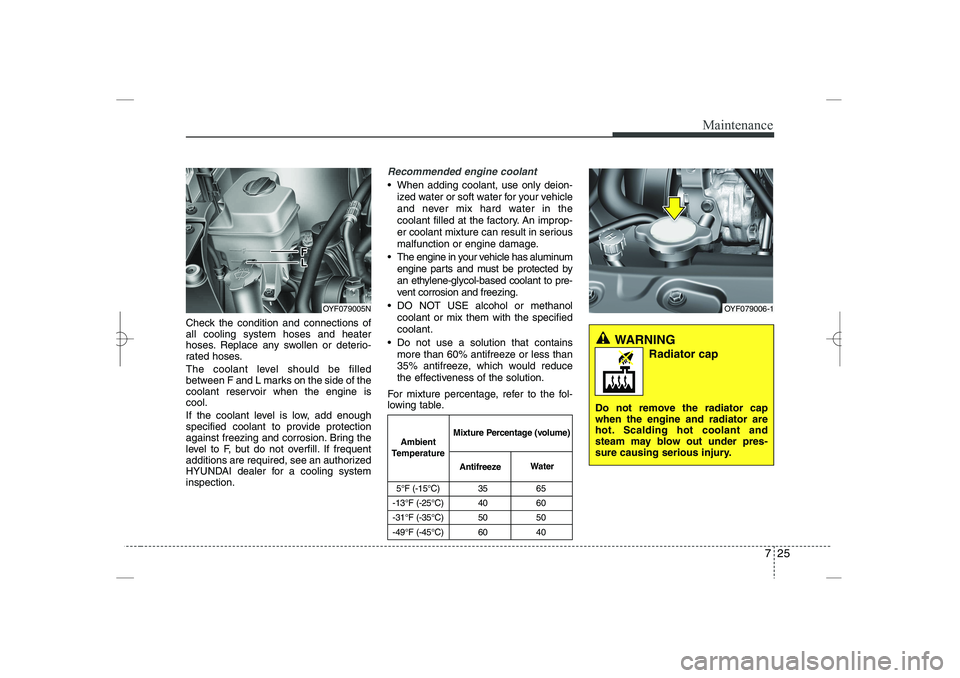
Check the condition and connections of
all cooling system hoses and heater
hoses. Replace any swollen or deterio-
rated hoses.
The coolant level should be filled
between F and L marks on the side of the
coolant reservoir when the engine is
cool.
If the coolant level is low, add enough
specified coolant to provide protection
against freezing and corrosion. Bring the
level to F, but do not overfill. If frequent
additions are required, see an authorized
HYUNDAI dealer for a cooling system
inspection.
Recommended engine coolant
When adding coolant, use only deion-
ized water or soft water for your vehicle
and never mix hard water in the
coolant filled at the factory. An improp-
er coolant mixture can result in serious
malfunction or engine damage.
The engine in your vehicle has aluminum
engine parts and must be protected by
an ethylene-glycol-based coolant to pre-
vent corrosion and freezing.
DO NOT USE alcohol or methanol
coolant or mix them with the specified
coolant.
Do not use a solution that contains
more than 60% antifreeze or less than
35% antifreeze, which would reduce
the effectiveness of the solution.
For mixture percentage, refer to the fol-
lowing table.
WARNING
Radiator cap
Do not remove the radiator cap
when the engine and radiator are
hot. Scalding hot coolant and
steam may blow out under pres-
sure causing serious injury.
5°F (-15°C) 35
65
-13°F (-25°C) 40
60
-31°F (-35°C) 50
50
-49°F (-45°C) 60
40
Ambient
Temperature
Mixture Percentage (volume)
Antifreeze
Water
OYF079006-1
OYF079005N
YF HMA 7.qxp 1/16/2012 6:18 PM Page 25
Page 341 of 410
Maintenance
26
7
Changing the coolant
Have coolant changed by an authorized
HYUNDAI dealer according to the
Maintenance Schedule at the beginning
of this section.
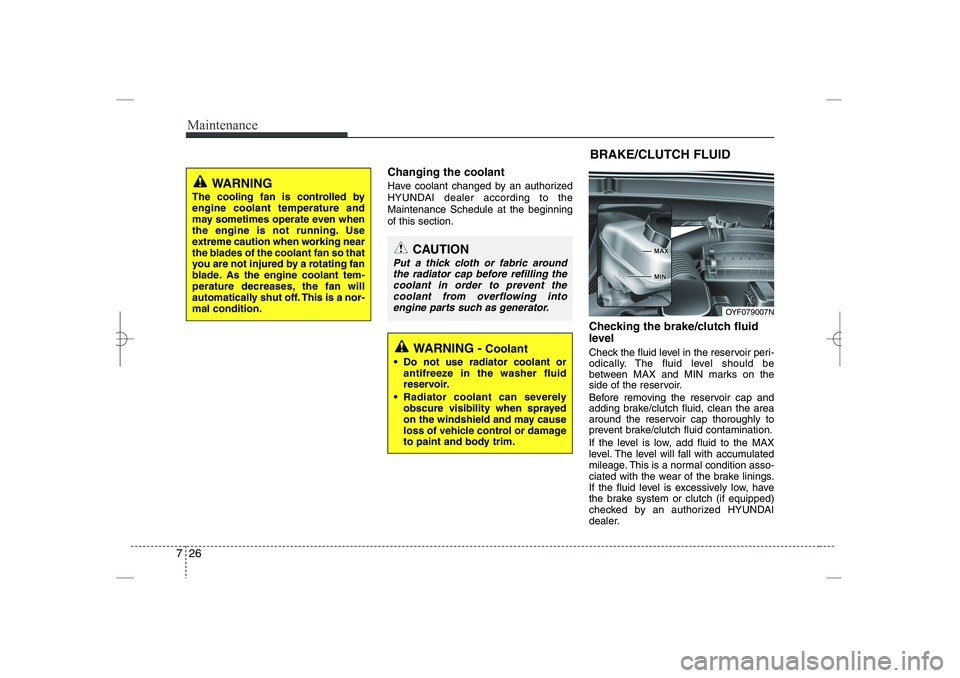
Checking the brake/clutch fluid
level
Check the fluid level in the reservoir peri-
odically. The fluid level should be
between MAX and MIN marks on the
side of the reservoir.
Before removing the reservoir cap and
adding brake/clutch fluid, clean the area
around the reservoir cap thoroughly to
prevent brake/clutch fluid contamination.
If the level is low, add fluid to the MAX
level. The level will fall with accumulated
mileage. This is a normal condition asso-
ciated with the wear of the brake linings.
If the fluid level is excessively low, have
the brake system or clutch (if equipped)
checked by an authorized HYUNDAI
dealer.
OYF079007N
BRAKE/CLUTCH FLUID
WARNING -
Coolant
Do not use radiator coolant or
antifreeze in the washer fluid
reservoir.
Radiator coolant can severely
obscure visibility when sprayed
on the windshield and may cause
loss of vehicle control or damage
to paint and body trim.
CAUTION
Put a thick cloth or fabric around
the radiator cap before refilling the
coolant in order to prevent the
coolant from overflowing into
engine parts such as generator.
WARNING
The cooling fan is controlled by
engine coolant temperature and
may sometimes operate even when
the engine is not running. Use
extreme caution when working near
the blades of the coolant fan so that
you are not injured by a rotating fan
blade. As the engine coolant tem-
perature decreases, the fan will
automatically shut off. This is a nor-
mal condition.
YF HMA 7.qxp 1/16/2012 6:18 PM Page 26
Page 403 of 410
I
3
Index
California perchlorate notice ·········································7-76
Capacities (Lubricants) ····················································8-4
Care
Exterior care ······························································7-67
Interior care ·······························································7-71
Tire care·····································································7-37
Cargo weight ··································································5-51
Center console storage ·················································4-105
Central door lock switch················································4-19
Certification label ···················································5-49, 8-6
Changing tires ································································6-13
Chains
Tire chains ·································································5-43
Checking tire inflation pressure·····································7-38
Child restraint system ····················································3-29
Passenger seat belt ····················································3-31
Tether anchor system·················································3-33
Lower anchor system ················································3-35
Child-protector rear door lock ·······································4-21
Climate control system (Automatic) ·····························4-97
Air conditioning ······················································4-100
Automatic heating and air conditioning····················4-94
Manual heating and air conditioning ························4-95
Climate control system (Manual) ··································4-83
Air conditioning ························································4-90
Climate control air filter············································4-92
Heating and air conditioning·····································4-84
Climate control air filter ················································4-94
Climate control air filter ················································7-30
Clock (Digital) ·····························································4-109
Clothes hanger ·····························································4-109
Combined instrument, see instrument cluster ···············4-50
Compact spare tire ·························································6-18
Compact spare tire replacement ····································7-42
Compass mirror, see the Electric chromic mirror (ECM)
with homeLink system and compass ························4-41
Consumer information ·····················································8-8
Coolant ···········································································7-24
Cooling fluid, see engine coolant ··································7-24
Crankcase emission control system ·······························7-73
Cruise control system ····················································5-31
Cup holder ···································································4-107
Curtain air bag ·······························································3-54
Dashboard, see instrument cluster ·································4-50
Dashboard illumination, see instrument panel
illumination ·······························································4-51
Daytime running light····················································4-73
Defogging (Windshield) ··············································4-101
Defogging logic (Windshield) ·····································4-103
Defroster (Rear window) ···············································4-82
Defrosting (Windshield) ··············································4-101
Digital clock·································································4-109
Dimensions ······································································8-2
C
D
YF HMA INDEX.QXP 5/16/2011 5:52 PM Page 3