Econ HYUNDAI SONATA HYBRID 2014 Owners Manual
[x] Cancel search | Manufacturer: HYUNDAI, Model Year: 2014, Model line: SONATA HYBRID, Model: HYUNDAI SONATA HYBRID 2014Pages: 410, PDF Size: 17.26 MB
Page 11 of 410
15
Introduction
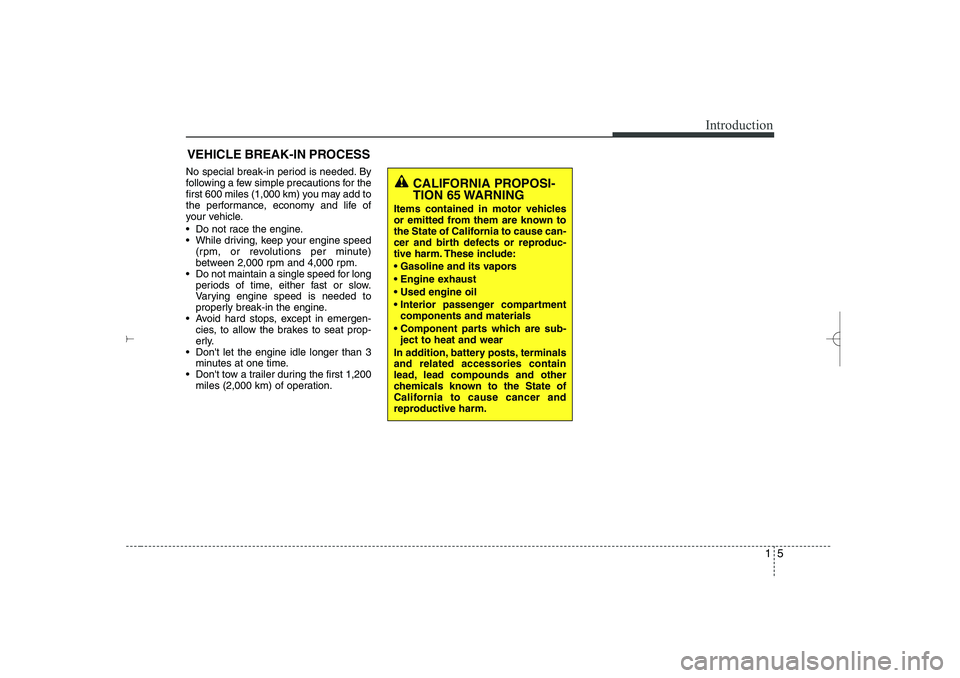
No special break-in period is needed. By
following a few simple precautions for the
first 600 miles (1,000 km) you may add to
the performance, economy and life of
your vehicle.
Do not race the engine.
While driving, keep your engine speed
(rpm, or revolutions per minute)
between 2,000 rpm and 4,000 rpm.
Do not maintain a single speed for long
periods of time, either fast or slow.
Varying engine speed is needed to
properly break-in the engine.
Avoid hard stops, except in emergen-
cies, to allow the brakes to seat prop-
erly.
Don't let the engine idle longer than 3
minutes at one time.
Don't tow a trailer during the first 1,200
miles (2,000 km) of operation.
VEHICLE BREAK-IN PROCESS
CALIFORNIA PROPOSI-
TION 65 WARNING
Items contained in motor vehicles
or emitted from them are known to
the State of California to cause can-
cer and birth defects or reproduc-
tive harm. These include:
Gasoline and its vapors
Engine exhaust
Used engine oil
Interior passenger compartment
components and materials
Component parts which are sub-
ject to heat and wear
In addition, battery posts, terminals
and related accessories contain
lead, lead compounds and other
chemicals known to the State of
California to cause cancer and
reproductive harm.
YF HMA 1.qxp 01.10.2010 16:22 Page 5
Page 12 of 410
Introduction
61
This vehicle is equipped with an event
data recorder (EDR). The main pur-
pose of an EDR is to record, in certain
crash or near crash-like situations,
such as an air bag deployment or hit-
ting a road obstacle, data that will
assist in understanding how a vehi-
cle's systems performed. The EDR is
designed to record data related to
vehicle dynamics and safety systems
for a short period of time, typically 30
seconds or less. The EDR in this vehi-
cle is designed to record such data
as:
* How various systems in your vehicle
were operating:
* Whether or not the driver and pas-
senger safety belts were
buckled/fastened;
* How far (if at all) the driver was
depressing the accelerator and/or
brake pedal; and,
* How fast the vehicle was traveling.
These data can help provide a better
understanding of the circumstances
in which crashes and injuries occur.
NOTE: EDR data are recorded by your
vehicle only if a nontrivial crash situa-
tion occurs; no data are recorded by
the EDR under normal driving condi-
tions and no personal data (e.g.,
name, gender, age, and crash loca-
tion) are recorded. However, other
parties, such as law enforcement,
could combine the EDR data with the
type of personally identifying data
routinely acquired during a crash
investigation.
To read data recorded by an EDR, spe-
cial equipment is required, and
access to the vehicle or the EDR is
needed.
In addition to the vehicle manufactur-
er, other parties, such as law enforce-
ment, that have the special equip-
ment, can read the information if they
have access to the vehicle or the EDR.
VEHICLE DATA COLLECTION AND EVENT DATA RECORDERS
YF HMA 1.qxp 01.10.2010 16:22 Page 6
Page 36 of 410
Safety features of your vehicle
18
3
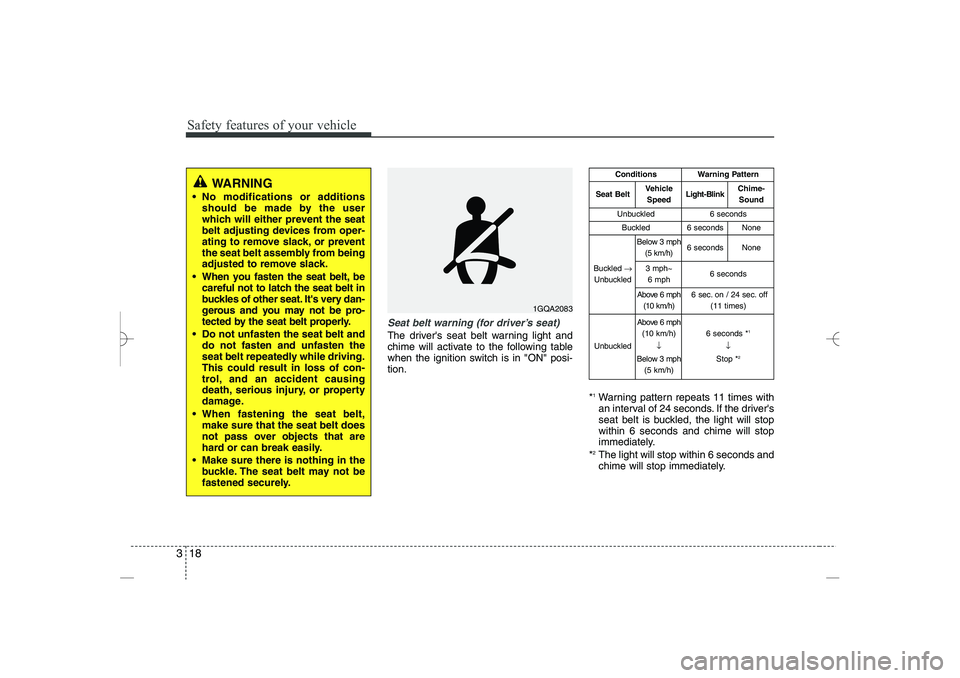
Seat belt warning (for driver’s seat)
The driver's seat belt warning light and
chime will activate to the following table
when the ignition switch is in "ON" posi-
tion.
*
1
Warning pattern repeats 11 times with
an interval of 24 seconds. If the driver's
seat belt is buckled, the light will stop
within 6 seconds and chime will stop
immediately.
*
2
The light will stop within 6 seconds and
chime will stop immediately.
1GQA2083
Conditions
Warning Pattern
Seat Belt
Vehicle
Speed
Light-Blink
Chime-
Sound
Unbuckled
6 seconds
Buckled
6 seconds
None
Buckled
→
Unbuckled
Below 3 mph
(5 km/h)
6 seconds
None
3 mph~
6 mph
6 seconds
Above 6 mph
(10 km/h)
6 sec. on / 24 sec. off
(11 times)
Unbuckled
Above 6 mph
(10 km/h)
↓
Below 3 mph
(5 km/h)
6 seconds *
1
↓
Stop *
2
WARNING
No modifications or additions
should be made by the user
which will either prevent the seat
belt adjusting devices from oper-
ating to remove slack, or prevent
the seat belt assembly from being
adjusted to remove slack.
When you fasten the seat belt, be
careful not to latch the seat belt in
buckles of other seat. It's very dan-
gerous and you may not be pro-
tected by the seat belt properly.
Do not unfasten the seat belt and
do not fasten and unfasten the
seat belt repeatedly while driving.
This could result in loss of con-
trol, and an accident causing
death, serious injury, or property
damage.
When fastening the seat belt,
make sure that the seat belt does
not pass over objects that are
hard or can break easily.
Make sure there is nothing in the
buckle. The seat belt may not be
fastened securely.
YF HMA 3.qxp 5/16/2011 4:14 PM Page 18
Page 37 of 410
319
Safety features of your vehicle
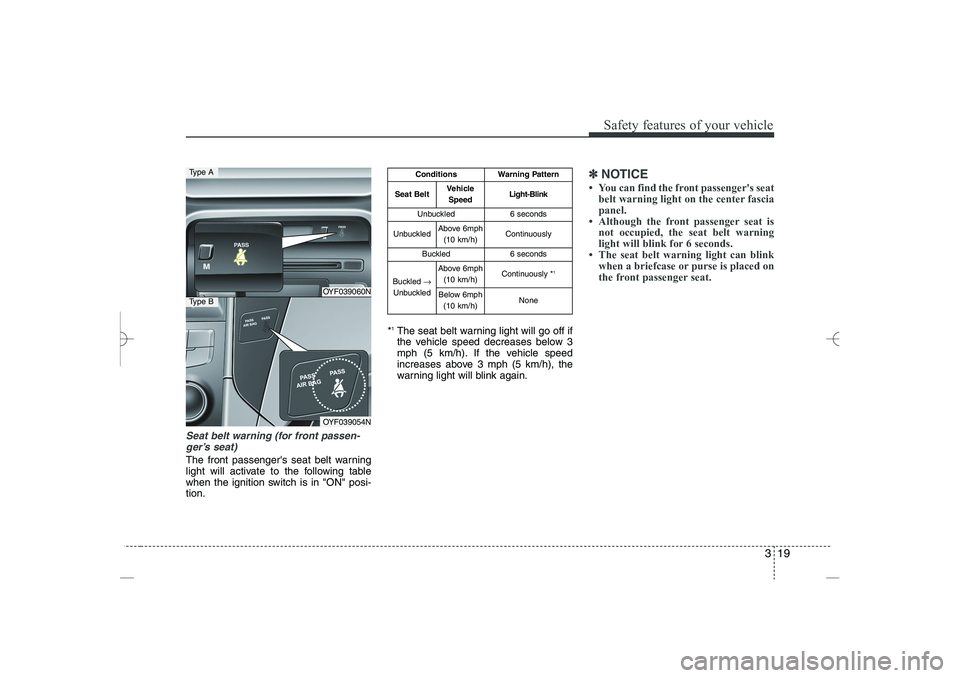
Seat belt warning (for front passen-
ger’s seat)
The front passenger's seat belt warning
light will activate to the following table
when the ignition switch is in "ON" posi-
tion.
*
1
The seat belt warning light will go off if
the vehicle speed decreases below 3
mph (5 km/h). If the vehicle speed
increases above 3 mph (5 km/h), the
warning light will blink again.
✽
✽
NOTICE
• You can find the front passenger's seat
belt warning light on the center fascia
panel.
• Although the front passenger seat is
not occupied, the seat belt warning
light will blink for 6 seconds.
• The seat belt warning light can blink
when a briefcase or purse is placed on
the front passenger seat.
Conditions
Warning Pattern
Seat Belt
Vehicle
Speed
Light-Blink
Unbuckled
6 seconds
Unbuckled
Above 6mph
(10 km/h)
Continuously
Buckled
6 seconds
Buckled
→
Unbuckled
Above 6mph
(10 km/h)
Continuously *
1
Below 6mph
(10 km/h)
None
OYF039060N
OYF039054N
Type A
Type B
YF HMA 3.qxp 5/16/2011 4:14 PM Page 19
Page 42 of 410
Safety features of your vehicle
24
3
✽
✽
NOTICE
• Both the driver's and front passen-
ger's pre-tensioner seat belts may be
activated in certain frontal collisions
(or side collisions).
The pre-tensioners will not be activat-
ed if the seat belts are not being worn
at the time of the collision.
• When the pre-tensioner seat belts are
activated, a loud noise may be heard
and fine dust, which may appear to be
smoke, may be visible in the passenger
compartment. These are normal oper-
ating conditions and are not haz-
ardous.
• Although it is harmless, the fine dust
may cause skin irritation and should
not be breathed for prolonged peri-
ods. Wash all exposed skin areas thor-
oughly after an accident in which the
pre-tensioner seat belts were activat-
ed.
• Because the sensor that activates the
SRS air bag is connected with the pre-
tensioner seat belt, the SRS air bag
warning light on the instrument
panel will illuminate for approximate-
ly 6 seconds after the ignition switch
has been turned to the ON position,
and then it should turn off.
CAUTION
If the pre-tensioner seat belt is not
working properly, this warning light
will illuminate even if there is no
malfunction of the SRS air bag. If
the SRS air bag warning light does
not illuminate when the ignition
switch is turned ON, or if it remains
illuminated after illuminating for
approximately 6 seconds, or if it
illuminates while the vehicle is
being driven, have an authorized
HYUNDAI dealer inspect the pre-
tensioner seat belt and SRS air bag
system as soon as possible.
WARNING
To obtain maximum benefit from a
pre-tensioner seat belt:
1. The seat belt must be worn cor-
rectly and adjusted to the proper
position. Please read and follow
all of the important information
and precautions about your vehi-
cle’s occupant safety features –
including seat belts and air bags
– that are provided in this manu-
al.
2. Be sure you and your passen-
gers always wear seat belts prop-
erly.
YF HMA 3.qxp 5/16/2011 4:14 PM Page 24
Page 58 of 410
Safety features of your vehicle
40
3
C041000AUN
Air bag warning light
The purpose of air bag warning light in
your instrument panel is to alert you of a
potential problem with your air bag -
Supplemental Restraint System (SRS).
When the ignition switch is turned ON,
the indicator light should illuminate for
approximately 6 seconds, then go off.
Have the system checked if:
The light does not turn on briefly when
you turn the ignition ON.
The light stays on after illuminating for
approximately 6 seconds.
The light comes on while the vehicle is
in motion.
The light blinks when the ignition
switch is in ON position.
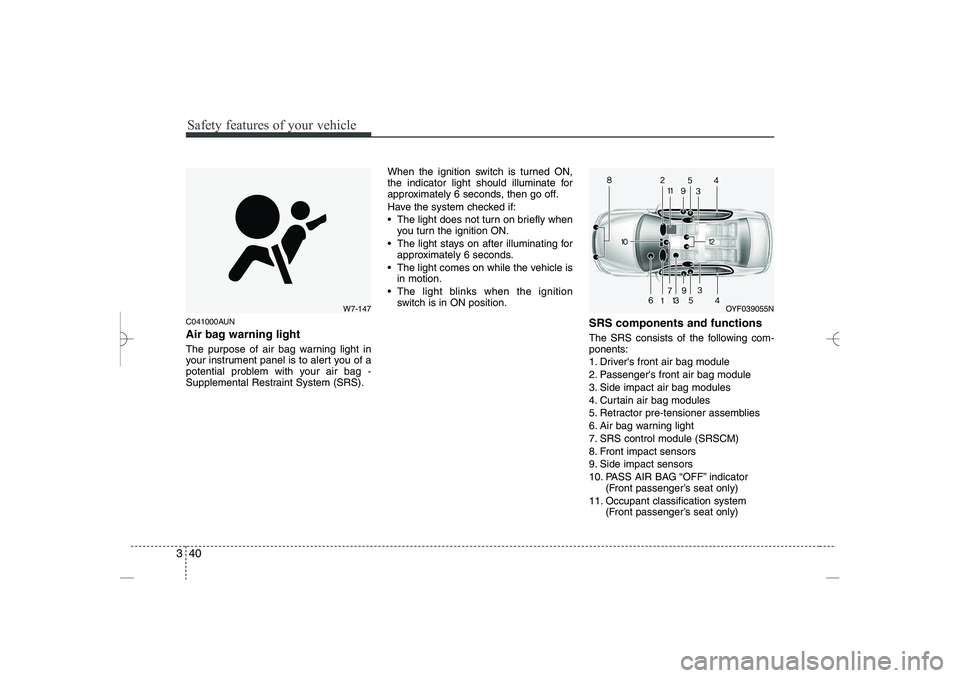
SRS components and functions
The SRS consists of the following com-
ponents:
1. Driver's front air bag module
2. Passenger's front air bag module
3. Side impact air bag modules
4. Curtain air bag modules
5. Retractor pre-tensioner assemblies
6. Air bag warning light
7. SRS control module (SRSCM)
8. Front impact sensors
9. Side impact sensors
10. PASS AIR BAG “OFF” indicator
(Front passenger’s seat only)
11. Occupant classification system
(Front passenger’s seat only)
W7-147
OYF039055N
YF HMA 3.qxp 5/16/2011 4:15 PM Page 40
Page 59 of 410
341
Safety features of your vehicle
12. Driver’s and front passenger’s seat
belt buckle sensors
13. Driver’s seat track position sensor
14. Anchor pre-tensioner
15. Side pressure sensor
The SRSCM continually monitors all
SRS components while the ignition
switch is ON to determine if a crash
impact is severe enough to require air
bag deployment or pre-tensioner seat
belt deployment.
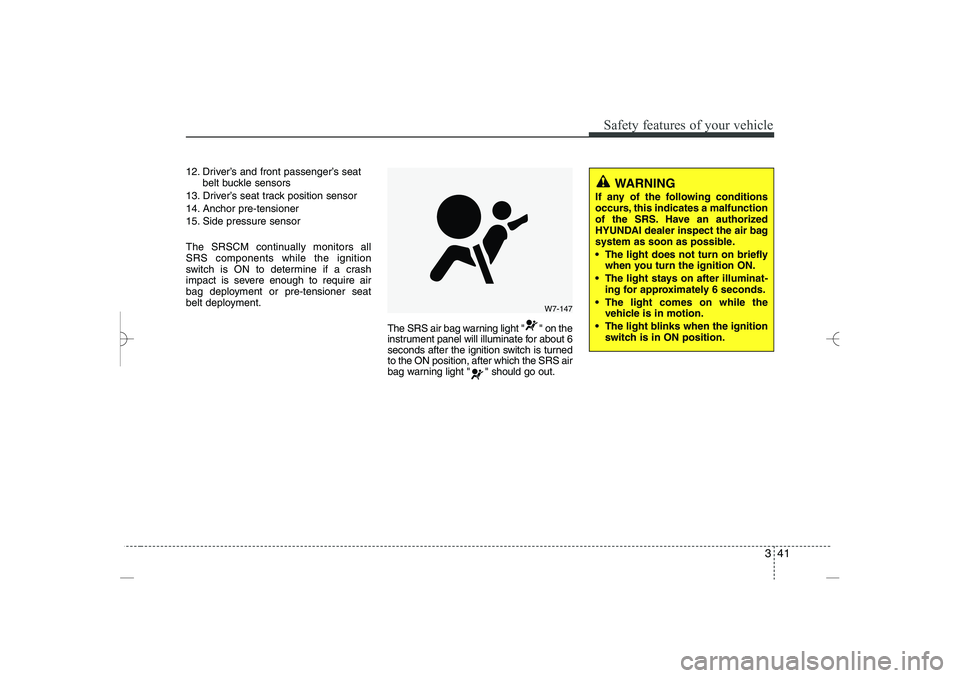
The SRS air bag warning light " " on the
instrument panel will illuminate for about 6
seconds after the ignition switch is turned
to the ON position, after which the SRS air
bag warning light " " should go out.
W7-147
WARNING
If any of the following conditions
occurs, this indicates a malfunction
of the SRS. Have an authorized
HYUNDAI dealer inspect the air bag
system as soon as possible.
The light does not turn on briefly
when you turn the ignition ON.
The light stays on after illuminat-
ing for approximately 6 seconds.
The light comes on while the
vehicle is in motion.
The light blinks when the ignition
switch is in ON position.
YF HMA 3.qxp 5/16/2011 4:15 PM Page 41
Page 65 of 410
347
Safety features of your vehicle
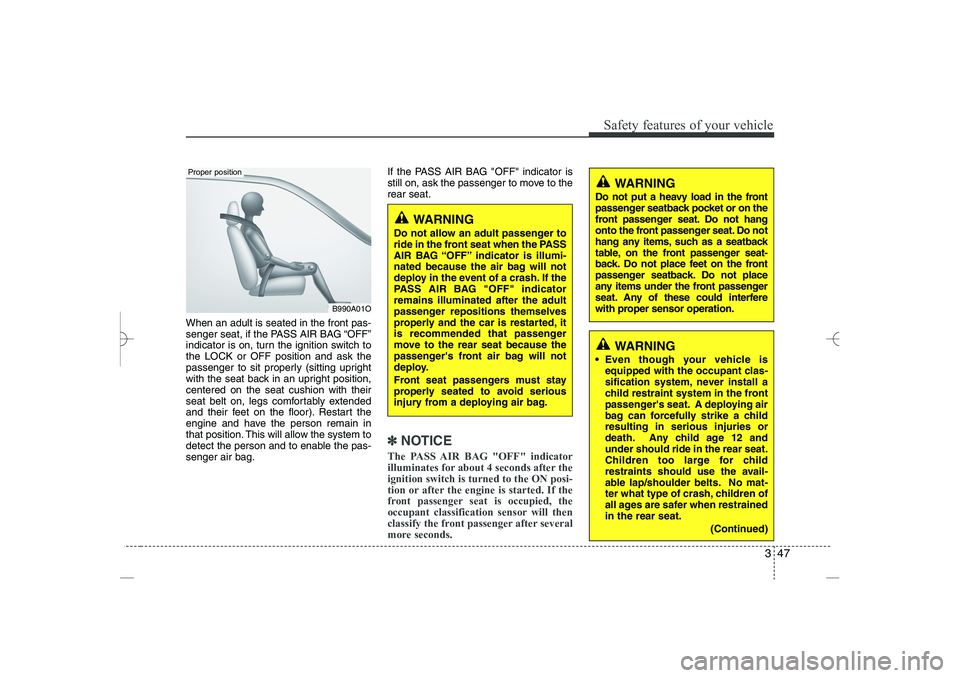
When an adult is seated in the front pas-
senger seat, if the PASS AIR BAG “OFF”
indicator is on, turn the ignition switch to
the LOCK or OFF position and ask the
passenger to sit properly (sitting upright
with the seat back in an upright position,
centered on the seat cushion with their
seat belt on, legs comfortably extended
and their feet on the floor). Restart the
engine and have the person remain in
that position. This will allow the system to
detect the person and to enable the pas-
senger air bag.
If the PASS AIR BAG "OFF" indicator is
still on, ask the passenger to move to the
rear seat.
✽
✽
NOTICE
The PASS AIR BAG "OFF" indicator
illuminates for about 4 seconds after the
ignition switch is turned to the ON posi-
tion or after the engine is started. If the
front passenger seat is occupied, the
occupant classification sensor will then
classify the front passenger after several
more seconds.
B990A01O
WARNING
Do not allow an adult passenger to
ride in the front seat when the PASS
AIR BAG “OFF” indicator is illumi-
nated because the air bag will not
deploy in the event of a crash. If the
PASS AIR BAG "OFF" indicator
remains illuminated after the adult
passenger repositions themselves
properly and the car is restarted, it
is recommended that passenger
move to the rear seat because the
passenger's front air bag will not
deploy.
Front seat passengers must stay
properly seated to avoid serious
injury from a deploying air bag.
Proper position
WARNING
Do not put a heavy load in the front
passenger seatback pocket or on the
front passenger seat. Do not hang
onto the front passenger seat. Do not
hang any items, such as a seatback
table, on the front passenger seat-
back. Do not place feet on the front
passenger seatback. Do not place
any items under the front passenger
seat. Any of these could interfere
with proper sensor operation.
WARNING
Even though your vehicle is
equipped with the occupant clas-
sification system, never install a
child restraint system in the front
passenger's seat. A deploying air
bag can forcefully strike a child
resulting in serious injuries or
death. Any child age 12 and
under should ride in the rear seat.
Children too large for child
restraints should use the avail-
able lap/shoulder belts. No mat-
ter what type of crash, children of
all ages are safer when restrained
in the rear seat.
(Continued)
YF HMA 3.qxp 5/16/2011 4:15 PM Page 47
Page 67 of 410
349
Safety features of your vehicle
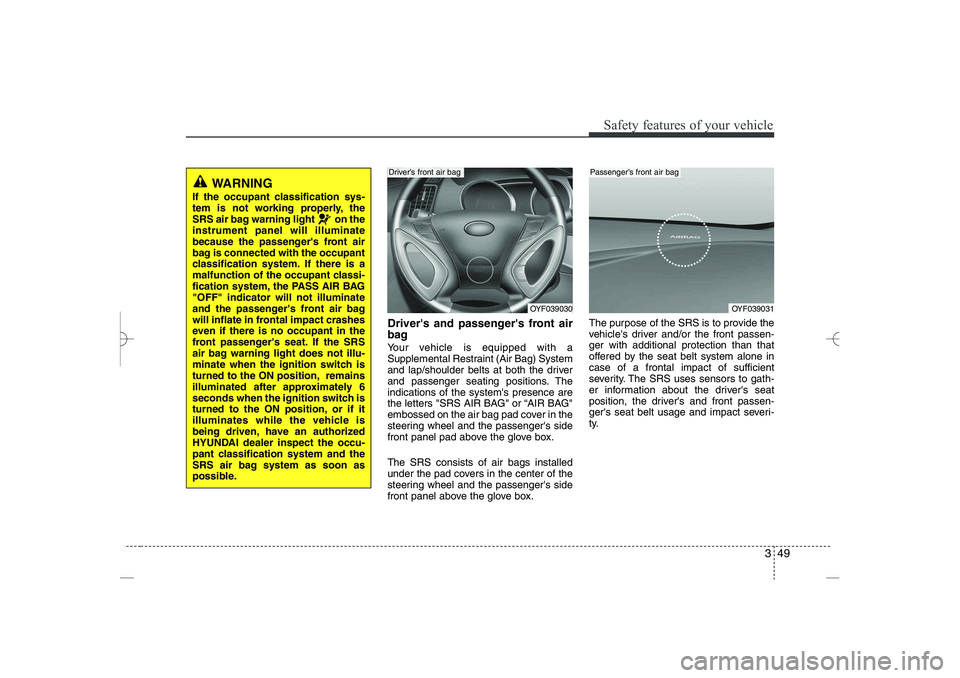
Driver's and passenger's front air
bag
Your vehicle is equipped with a
Supplemental Restraint (Air Bag) System
and lap/shoulder belts at both the driver
and passenger seating positions. The
indications of the system's presence are
the letters "SRS AIR BAG" or “AIR BAG"
embossed on the air bag pad cover in the
steering wheel and the passenger's side
front panel pad above the glove box.
The SRS consists of air bags installed
under the pad covers in the center of the
steering wheel and the passenger's side
front panel above the glove box.
The purpose of the SRS is to provide the
vehicle's driver and/or the front passen-
ger with additional protection than that
offered by the seat belt system alone in
case of a frontal impact of sufficient
severity. The SRS uses sensors to gath-
er information about the driver's seat
position, the driver's and front passen-
ger's seat belt usage and impact severi-
ty.
OYF039030
Driver’s front air bag
WARNING
If the occupant classification sys-
tem is not working properly, the
SRS air bag warning light on the
instrument panel will illuminate
because the passenger's front air
bag is connected with the occupant
classification system. If there is a
malfunction of the occupant classi-
fication system, the PASS AIR BAG
"OFF" indicator will not illuminate
and the passenger's front air bag
will inflate in frontal impact crashes
even if there is no occupant in the
front passenger's seat. If the SRS
air bag warning light does not illu-
minate when the ignition switch is
turned to the ON position, remains
illuminated after approximately 6
seconds when the ignition switch is
turned to the ON position, or if it
illuminates while the vehicle is
being driven, have an authorized
HYUNDAI dealer inspect the occu-
pant classification system and the
SRS air bag system as soon as
possible.
OYF039031
Passenger’s front air bag
YF HMA 3.qxp 5/16/2011 4:15 PM Page 49
Page 68 of 410
Safety features of your vehicle
50
3
The driver's seat track position sensor,
which is installed on the seat track, deter-
mines if the seat is fore or aft of a refer-
ence position. The seat belt buckle sen-
sors determine if the driver and front pas-
senger's seat belts are fastened. These
sensors provide the ability to control the
SRS deployment based on how close the
driver's seat is to the steering wheel,
whether or not the seat belts are fas-
tened, and how severe the impact is.
The advanced SRS offers the ability to
control the air bag inflation within two lev-
els. A first stage level is provided for mod-
erate-severity impacts. A second stage
level is provided for more severe impacts.
According to the impact severity, seating
position and seat belt usage, the SRSCM
(SRS Control Module) controls the air
bag inflation. Failure to properly wear
seat belts can increase the risk or sever-
ity of injury in an accident.
Additionally, your vehicle is equipped
with an occupant classification system in
the front passenger's seat. The occupant
classification system detects the pres-
ence of a passenger in the front passen-
ger's seat and will turn off the front pas-
senger's air bag under certain condi-
tions. For more detail, see "Occupant
classification system" in this section.
WARNING
If the occupant classification sys-
tem is not working properly, the
SRS air bag warning light on the
instrument panel will illuminate
because the SRS air bag warning
light is connected with the occu-
pant classification system. If the
SRS air bag warning light does not
illuminate when the ignition switch
is turned to the ON position,
remains illuminated after approxi-
mately 6 seconds when the ignition
switch is turned to the ON position,
or if it illuminates while the vehicle
is being driven, have an authorized
HYUNDAI dealer inspect the
advanced SRS air bag system as
soon as possible.
WARNING
Modification to the seat structure
can adversely affect the seat
track position sensor and cause
the air bag to deploy at a different
level than should be provided.
Do not place any objects under-
neath the front seats as they
could damage the seat track
position sensor or interfere with
the occupant classification sys-
tem.
Do not place any objects that may
cause magnetic fields near the
front seat. These may cause a
malfunction of the seat track
position sensor.
YF HMA 3.qxp 5/16/2011 4:15 PM Page 50