replacement Hyundai Sonata Hybrid 2015 User Guide
[x] Cancel search | Manufacturer: HYUNDAI, Model Year: 2015, Model line: Sonata Hybrid, Model: Hyundai Sonata Hybrid 2015Pages: 543, PDF Size: 25.53 MB
Page 471 of 543

Maintenance
42
7
Compact spare tire replacement
(if equipped)
A compact spare tire has a shorter
tread life than a regular size tire.
Replace it when you can see the
tread wear indicator bars on the tire.
The replacement compact spare tire
should be the same size and design
tire as the one provided with your
new vehicle and should be mounted
on the same compact spare tire
wheel. The compact spare tire is not
designed to be mounted on a regular
size wheel, and the compact spare
tire wheel is not designed for mount-
ing a regular size tire. Wheel replacement
When replacing the metal wheels for
any reason, make sure the new
wheels are equivalent to the original
factory units in diameter, rim width
and offset.
Tire traction
Tire traction can be reduced if you
drive on worn tires, tires that are
improperly inflated or on slippery
road surfaces. Tires should be
replaced when tread wear indicators
appear. To reduce the possibility of
losing control, slow down whenever
there is rain, snow or ice on the road.
Tire maintenance
In addition to proper inflation, correct
wheel alignment helps to decrease
tire wear. If you find a tire is worn
unevenly, have your dealer check the
wheel alignment.
When you have new tires installed,
make sure they are balanced. This
will increase vehicle ride comfort and
tire life. Additionally, a tire should
always be rebalanced if it is removed
from the wheel.
WARNING
A wheel that is not the correct
size may adversely affect wheel
and bearing life, braking and
stopping abilities, handling char-
acteristics, ground clearance,
body-to-tire clearance, snow
chain clearance, speedometer
and odometer calibration, head-
light aim and bumper height.
Page 480 of 543
751
Maintenance
FUSES
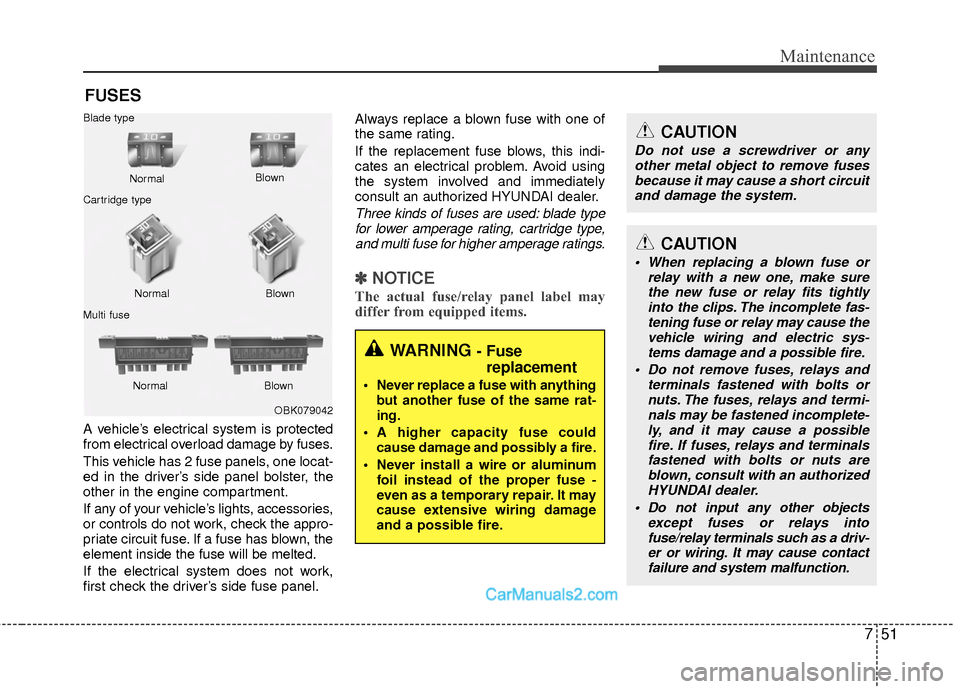
A vehicle’s electrical system is protected
from electrical overload damage by fuses.
This vehicle has 2 fuse panels, one locat-
ed in the driver’s side panel bolster, the
other in the engine compartment.
If any of your vehicle’s lights, accessories,
or controls do not work, check the appro-
priate circuit fuse. If a fuse has blown, the
element inside the fuse will be melted.
If the electrical system does not work,
first check the driver’s side fuse panel.Always replace a blown fuse with one of
the same rating.
If the replacement fuse blows, this indi-
cates an electrical problem. Avoid using
the system involved and immediately
consult an authorized HYUNDAI dealer.
Three kinds of fuses are used: blade type
for lower amperage rating, cartridge type,and multi fuse for higher amperage ratings.
✽ ✽ NOTICE
The actual fuse/relay panel label may
differ from equipped items.
WARNING - Fuse
replacement
Never replace a fuse with anything
but another fuse of the same rat-
ing.
A higher capacity fuse could cause damage and possibly a fire.
Never install a wire or aluminum foil instead of the proper fuse -
even as a temporary repair. It may
cause extensive wiring damage
and a possible fire.
CAUTION
Do not use a screwdriver or anyother metal object to remove fusesbecause it may cause a short circuit and damage the system.
CAUTION
When replacing a blown fuse or relay with a new one, make surethe new fuse or relay fits tightly into the clips. The incomplete fas-tening fuse or relay may cause the vehicle wiring and electric sys-tems damage and a possible fire.
Do not remove fuses, relays and terminals fastened with bolts ornuts. The fuses, relays and termi-nals may be fastened incomplete- ly, and it may cause a possiblefire. If fuses, relays and terminals fastened with bolts or nuts areblown, consult with an authorized HYUNDAI dealer.
Do not input any other objects except fuses or relays intofuse/relay terminals such as a driv-er or wiring. It may cause contact failure and system malfunction.
OBK079042
Normal
Normal
Blade type
Cartridge type
Multi fuse Blown
Blown
Normal Blown
Page 482 of 543
753
Maintenance
✽
✽NOTICE
• If the memory fuse is pulled up from
the fuse panel, the warning chime,
audio, clock and interior lamps, etc.,
will not operate. Some items must be
reset after replacement. Refer to
“Battery” in this section.
• Even though the memory fuse is pulled up, the battery can still be dis-
charged by operation of the head-
lights or other electrical devices.
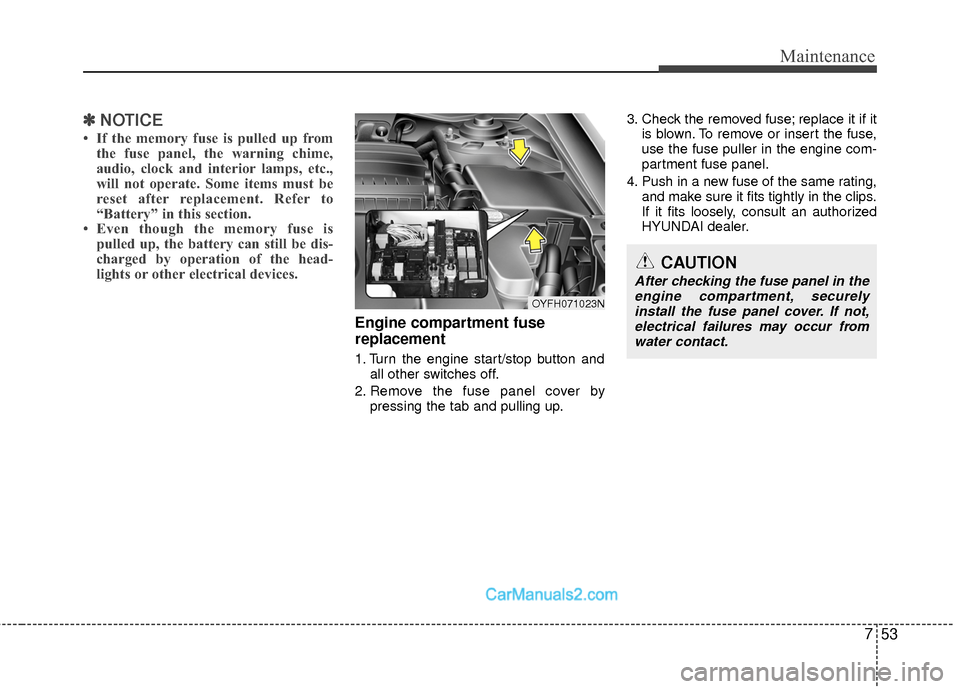
Engine compartment fuse
replacement
1. Turn the engine start/stop button and
all other switches off.
2. Remove the fuse panel cover by pressing the tab and pulling up. 3. Check the removed fuse; replace it if it
is blown. To remove or insert the fuse,
use the fuse puller in the engine com-
partment fuse panel.
4. Push in a new fuse of the same rating, and make sure it fits tightly in the clips.
If it fits loosely, consult an authorized
HYUNDAI dealer.
OYFH071023N
CAUTION
After checking the fuse panel in theengine compartment, securelyinstall the fuse panel cover. If not, electrical failures may occur fromwater contact.
Page 491 of 543

Maintenance
62
7
Headlight, position light, turn sig-
nal light, side marker light and
front fog light bulb replacement
(1) Headlight (High)
(2) Headlight (Low)
(3) Front turn signal light
(4) Front side marker
(5) Position light
(6) Front fog light (if equipped)
Headlight bulb
(Continued)
If a bulb becomes damaged or
cracked, replace it immediately
and carefully dispose of it.
Wear eye protection when chang- ing a bulb. Allow the bulb to cool
down before handling it.
OHD076046
WARNING- Halogen bulbs
Halogen bulbs contain pressur-ized gas that will produce flying
pieces of glass if broken.
Always handle them carefully, and avoid scratches and abra-
sions. If the bulbs are lit, avoid
contact with liquids. Never touch
the glass with bare hands.
Residual oil may cause the bulb
to overheat and burst when lit. A
bulb should be operated only
when installed in a headlight.
(Continued)
OYFH071027N-1
Page 494 of 543
765
Maintenance
Side repeater light bulb replace-
ment (if equipped)
If the light bulb is not operating, have the
vehicle checked by an authorized
HYUNDAI dealer.
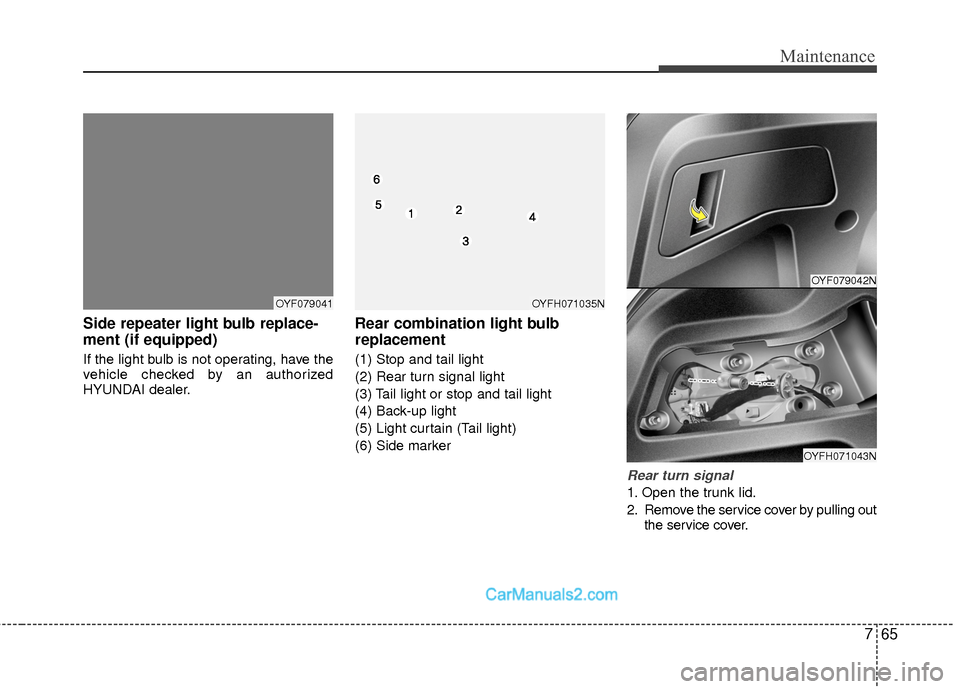
Rear combination light bulb
replacement
(1) Stop and tail light
(2) Rear turn signal light
(3) Tail light or stop and tail light
(4) Back-up light
(5) Light curtain (Tail light)
(6) Side marker
Rear turn signal
1. Open the trunk lid.
2. Remove the service cover by pulling outthe service cover.
OYF079042N
OYFH071043N
OYFH071035NOYF079041
Page 496 of 543
767
Maintenance
OYFH044150/OYFH071079N/OYFH071080N/OYFH071081N/OYFH071082N/OYFH071083N/OYFH071084N
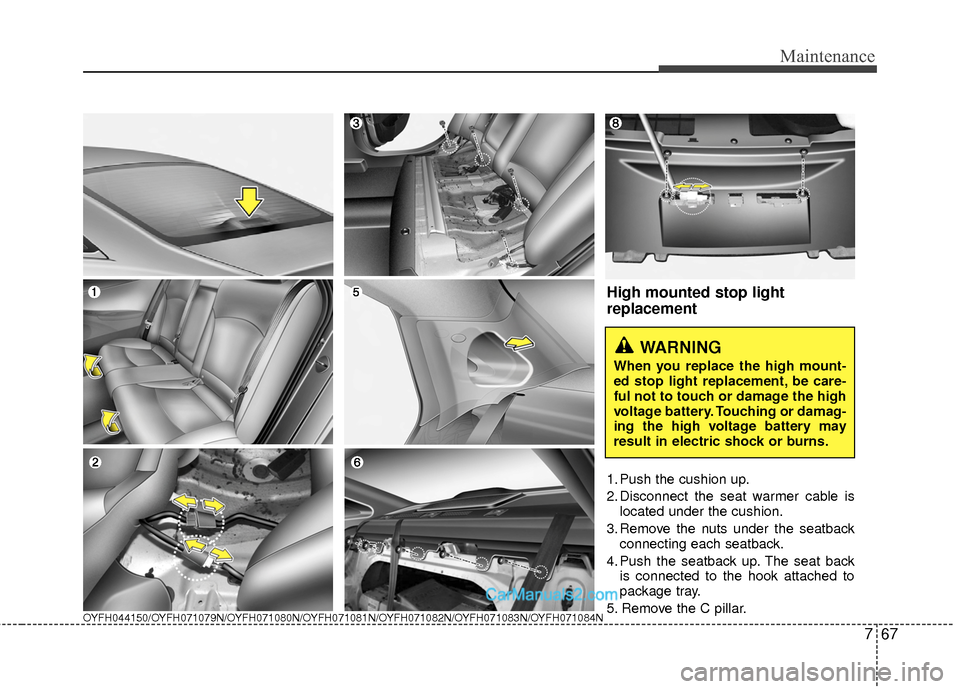
High mounted stop light
replacement
1. Push the cushion up.
2. Disconnect the seat warmer cable islocated under the cushion.
3. Remove the nuts under the seatback connecting each seatback.
4. Push the seatback up. The seat back is connected to the hook attached to
package tray.
5. Remove the C pillar.
WARNING
When you replace the high mount-
ed stop light replacement, be care-
ful not to touch or damage the high
voltage battery. Touching or damag-
ing the high voltage battery may
result in electric shock or burns.
Page 498 of 543
769
Maintenance
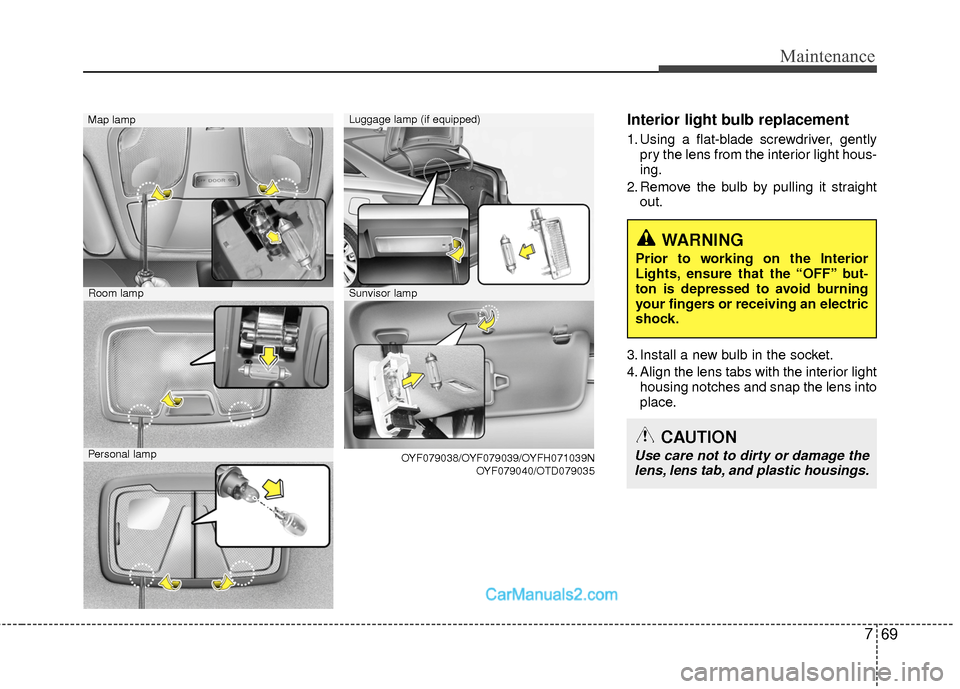
Interior light bulb replacement
1. Using a flat-blade screwdriver, gentlypry the lens from the interior light hous-
ing.
2. Remove the bulb by pulling it straight out.
3. Install a new bulb in the socket.
4. Align the lens tabs with the interior light housing notches and snap the lens into
place.
WARNING
Prior to working on the Interior
Lights, ensure that the “OFF” but-
ton is depressed to avoid burning
your fingers or receiving an electric
shock.
CAUTION
Use care not to dirty or damage thelens, lens tab, and plastic housings.
Map lampLuggage lamp (if equipped)
Room lamp
Personal lamp OYF079038/OYF079039/OYFH071039N
OYF079040/OTD079035
Sunvisor lamp
Page 501 of 543
Maintenance
72
7
Waxing
Wax the vehicle when water will no
longer bead on the paint.
Always wash and dry the vehicle before
waxing. Use a good quality liquid or
paste wax, and follow the manufacturer’s
instructions. Wax all metal trim to protect
it and to maintain its luster.
Removing oil, tar, and similar materials
with a spot remover will usually strip the
wax from the finish. Be sure to re-wax
these areas even if the rest of the vehicle
does not yet need waxing.Finish damage repair
Deep scratches or stone chips in the
painted surface must be repaired
promptly. Exposed metal will quickly rust
and may develop into a major repair
expense.
✽ ✽
NOTICE
If your vehicle is damaged and requires
any metal repair or replacement, be sure
the body shop applies anti-corrosion
materials to the parts repaired or
replaced.
Bright-metal maintenance
To remove road tar and insects, use a
tar remover, not a scraper or other
sharp object.
To protect the surfaces of bright-metal parts from corrosion, apply a coating of
wax or chrome preservative and rub to
a high luster.
During winter weather or in coastal areas, cover the bright metal parts with
a heavier coating of wax or preserva-
tive. If necessary, coat the parts with
non-corrosive petroleum jelly or other
protective compound.
Underbody maintenance
Corrosive materials used for ice and
snow removal and dust control may col-
lect on the underbody. If these materials
are not removed, accelerated rusting can
occur on underbody parts such as the
fuel lines, frame, floor pan and exhaust
system, even though they have been
treated with rust protection.
Thoroughly flush the vehicle underbody
and wheel openings with lukewarm or
cold water once a month, after off-road
driving and at the end of each winter. Pay
special attention to these areas because
it is difficult to see all the mud and dirt. It
will do more harm than good to wet down
the road grime without removing it. The
lower edges of doors, rocker panels, and
frame members have drain holes that
should not be allowed to clog with dirt;
trapped water in these areas can cause
rusting.
CAUTION
Wiping dust or dirt off the body with a dry cloth will scratch thefinish.
Do not use steel wool, abrasive cleaners, or strong detergentscontaining highly alkaline orcaustic agents on chrome-platedor anodized aluminum parts. Thismay result in damage to the pro-tective coating and cause discol-oration or paint deterioration.
Page 522 of 543

I3
Index
Brakes fluid··················\
··················\
·············· ·7-27
Bulb replacement ··················\
··················\
······· ·7-61
Bulb wattage ··················\
··················\
··············8-3
Button start/stop, see engine start/stop button ············5-5
California perchlorate notice ··················\
·············7-80
Camera (Rear view) ··················\
··················\
···· ·4-70
Capacities (Lubricants) ··················\
··················\
··8-5
Capacity/Weight ··················\
··················\
··········8-2
Care Exterior care ··················\
··················\
········· ·7-71
Interior care ··················\
··················\
·········· ·7-75
Tire care ··················\
··················\
·············· ·7-37
Cargo weight ··················\
··················\
············ ·5-43
Center console storage ··················\
··················\
·4-119
Central door lock switch ··················\
················· ·4-12
Certification label ··················\
··················\
······· ·5-41
Certification label ··················\
··················\
·········8-7
Chains Tire chains ··················\
··················\
············ ·5-35
Changing tires (with spare tire) ··················\
··········6-15
Checking tire inflation pressure ··················\
·········7-38
Child restraint system ··················\
··················\
·· ·3-27
Lower anchor system ··················\
················· ·3-33
Seat belt ··················\
··················\
··············· ·3-29
Tether anchor system ··················\
················· ·3-31Child-protector rear door lock
··················\
···········4-14
Climate control air filter ············4-93, 4-104, 4-115, 7-30
Clock (Digital) ··················\
··················\
········· ·4-123
Clothes hanger ··················\
··················\
········· ·4-123
Combined instrument, see instrument cluster ···········4-40
Compact spare tire (with spare tire) ··················\
·····6-15
Compact spare tire replacement ··················\
·········7-42
Components of the tire mobility kit ··················\
·····6-24
Consumer information ··················\
··················\
··· ·8-9
Coolant ··················\
··················\
··················\
· ·7-24
Cooling fluid, see engine coolant ··················\
·······7-24
Crankcase emission control system ··················\
·····7-77
Cruise control system ··················\
··················\
·· ·5-24
Cup holder ··················\
··················\
··············4-121
Curtain air bag ··················\
··················\
·········· ·3-53
Dashboard illumination,
see instrument panel illumination··················\
···· ·4-41
Dashboard, see instrument cluster ··················\
·······4-40
Defogging (Windshield) ··················\
················ ·4-116
Defogging logic (Windshield) ··················\
··········4-117
Defroster (Rear window) ··················\
················ ·4-81
Defrosting (Windshield) ··················\
················ ·4-116
Digital clock ··················\
··················\
··········· ·4-123
Dimensions ··················\
··················\
·················8-3
Display illumination, see instrument panel illumination · 4-41
C
D
Page 524 of 543

I5
Index
FluidBrakes fluid ··················\
··················\
·········· ·7-27
Washer fluid ··················\
··················\
·········· ·7-28
Front passenger and rear seat 3-point system with combination locking retractor ··················\
········3-19
Front seat adjustment ··················\
··················\
·····3-4
Fuel filler lid··················\
··················\
··············4-22
Fuel gauge ··················\
··················\
··············· ·4-43
Fuel requirements ··················\
··················\
·········1-3
Fuse/relay panel description ··················\
·············7-55
Fuses ··················\
··················\
··················\
···· ·7-51
Engine compartment fuse ··················\
·············7-53
Fuse/relay panel description ··················\
··········7-55
Instrument panel fuse ··················\
················· ·7-52
Memory fuse ··················\
··················\
········· ·7-52
Multi fuse ··················\
··················\
··············7-54
Gauge Engine temperature gauge ··················\
············4-42
Fuel gauge ··················\
··················\
············ ·4-43
Glass antenna ··················\
··················\
·········· ·4-125
Glove box ··················\
··················\
···············4-119 Hazard warning flasher
··················\
··················\
·4-70
Hazardous driving conditions ··················\
············5-30
Headlight bulb replacement ··················\
··············7-62
Headrest ··················\
··················\
············ ·3-7, 3-11
High voltage battery ··················\
··················\
···· ·7-80
Highway driving ··················\
··················\
·········5-33
Hill-start assist control (HAC) ··················\
···········5-22
Homelink mirror, see the Electric chromic mirror (ECM) with HomeLink system ··················\
······4-31
Hood ··················\
··················\
··················\
···· ·4-21
Horn ··················\
··················\
··················\
···· ·4-30
How to use this manual ··················\
··················\
· ·1-2
Hybrid HMC Hybrid system ··················\
··················\
···H2
Sonata hev energy flow ··················\
··········H4, 4-45
State of charge (SOC) ··················\
··················\
·H3
The air intake of hybrid battery ··················\
······H12
The componets of hybrid vehicle ··················\
······H7
The ECO GUIDE gauge ··················\
············· ·4-43
The ECO level ··················\
··················\
·· ·H2, 4-47
The EV
MODE ··················\
··················\
······ ·4-53
The READY indicator ··················\
················ ·4-41
The service indicator ··················\
··················\
·4-53
Hybrid electric vehicle ··················\
··················\
· ·4-45
G
H