parking brake Hyundai Sonata Hybrid 2015 Owner's Guide
[x] Cancel search | Manufacturer: HYUNDAI, Model Year: 2015, Model line: Sonata Hybrid, Model: Hyundai Sonata Hybrid 2015Pages: 543, PDF Size: 25.53 MB
Page 394 of 543
537
Driving your vehicle
To keep locks from freezing
To keep the locks from freezing, squirt an
approved de-icer fluid or glycerine into
the key opening. If a lock is covered with
ice, squirt it with an approved de-icing
fluid to remove the ice. If the lock is
frozen internally, you may be able to thaw
it out by using a heated key. Handle the
heated key with care to avoid injury.
Use approved window washer
anti-freeze in system
To keep the water in the window washer
system from freezing, add an approved
window washer anti-freeze solution in
accordance with instructions on the con-
tainer. Window washer anti-freeze is
available from an authorized HYUNDAI
dealer and most auto parts outlets. Do
not use engine coolant or other types of
anti-freeze as these may damage the
paint finish.
Don't let your parking brake
freeze
Under some conditions your parking
brake can freeze in the engaged position.
This is most likely to happen when there
is an accumulation of snow or ice around
or near the rear brakes or if the brakes
are wet. If there is a risk the parking
brake may freeze, apply it only temporar-
ily while you put the shift lever in P (auto-
matic transaxle) or in first and block the
rear wheels so the vehicle cannot roll.
Then release the parking brake.
Don't let ice and snow accumu-
late underneath
Under some conditions, snow and ice
can build up under the fenders and inter-
fere with the steering. When driving in
severe winter conditions where this may
happen, you should periodically check
underneath the car to be sure the move-
ment of the front wheels and the steering
components is not obstructed.
Carry emergency equipment
Depending on the severity of the weath-
er where you drive your car, you should
carry appropriate emergency equipment.
Some of the items you may want to carry
include tire chains, tow straps or chains,
flashlight, emergency flares, sand, a
shovel, jumper cables, a window scraper,
gloves, ground cloth, coveralls, a blanket,
etc.
Don't place foreign objects or
materials in the engine compart-
ment
Placement of foreign objects or
materials which prevent cooling of
the engine, in the engine compart-
ment, may cause a failure or com-
bustion. The manufacturer is not
responsible for the damage caused
by such placement.
Page 404 of 543
63
What to do in an emergency
2. When the vehicle is stopped, turn onyour emergency hazard flashers, set
the parking brake and put the transaxle
in P (automatic transaxle).
3. Have all passengers get out of the car. Be sure they all get out on the side of
the car that is away from traffic.
4. When changing a flat tire, follow the instruction provided later in this sec-
tion.
If vehicle stalls while driving
1. Reduce your speed gradually, keeping a straight line. Move cautiously off the
road to a safe place.
2. Turn on your emergency flashers.
3. Try to get vehicle moving in drive again. If your vehicle will not move,
contact an authorized HYUNDAI deal-
er or seek other qualified assistance.
If An Accident Occurs
WARNING
• After parking the vehicle, shift thetransmission into "P" position.
Turn off the hybrid system by
pushing the Engine Start/Stop
button.
For your safety, do not touch high voltage cables, connectors and
package modules. High Voltage
components are orange in color.
Exposed cables or wires may be visible inside or outside of the
vehicle. Never touch the wires or
cables, because an electrical
shock may occur causing injury
or death.
If a fire occurs, to extinguish a small high-voltage
battery fire, the following tech-
niques can be used:
- Dry chemical
- CO2
- Large amounts of water
- Regular foam
(Continued)
(Continued)
For a large high-voltage battery
fire, use these types of extinguish-
ing methods:
- Large amounts of water
- Fog
- Regular foam
If you need towing, refer to chapter 6.
Page 405 of 543
What to do in an emergency
46
WARNING
If a vehicle accident occurs:
1. Stop the vehicle and shift thetransmission into "P" position.
And then depress the parking
brake.
2. Turn off the Hybrid system by pushing the Engine Start/Stop
button.
3. Evacuate to the safety place.
4. Call emergency services for help and let them know the vehicle is a
Hybrid vehicle.
Do not touch high voltage cables,
connectors and package modules.
High voltage components are
orange in color.
Exposed cables or wires may be
visible inside or outside of the vehi-
cle. Never touch the wires or
cables, because an electrical shock
may occur causing injury or death.
WARNING
If a fire occurs:
1. Stop the vehicle and shift the transmission in to "P" position,
and then depress the parking
brake. To ventilate smoke from a
fire, open the windows if possible.
2. Turn off the Hybrid system by pushing the Engine Start/Stop
button.
3. Leave the vehicle and evacuate to a safety place.
4. Call emergency services for help and let them know the vehicle is a
Hybrid vehicle.
If you have an extinguisher, extin-
guish a fire carefully.
Do not touch high voltage cables,
connectors and package modules.
High voltage components are
orange in color.
Exposed cables or wires may be
visible inside or outside of the vehi-
cle. Never touch the wires or
cables, because an electrical shock
may occur causing injury or death.
WARNING
If a submersion in water occurs:
If your vehicle was flooded and has
soaked carpeting or water on the
flooring, you should not try to start
the Hybrid system. Turn off the
hybrid system and leave the vehicle
with possession of the key. Never
touch the high voltage cables, con-
nectors and package modules,
because an electrical shock may
occur causing injury or death. High
Voltage cables are orange in color.
Have the car towed to an author-
ized HYUNDAI dealer.
Page 409 of 543
What to do in an emergency
86
IF THE ENGINE OVERHEATS
If your temperature gauge indicates over-
heating, you experience a loss of power,
or hear loud pinging or knocking, the
engine is probably too hot. If this hap-
pens, you should:
1. Pull off the road and stop as soon as itis safe to do so.
2. Place the shift lever in P (automatic transaxle) and set the parking brake. If
the air conditioning is on, turn it off.
3. If engine coolant is running out under the car or steam is coming out from
the hood, stop the engine. Do not open
the hood until the coolant has stopped
running or the steaming has stopped.
If there is no visible loss of engine
coolant and no steam, leave the
engine running and check to be sure
the engine cooling fan is operating. If
the fan is not running, turn the engine
off. 4. Check to see if the water pump drive
belt is missing. If it is not missing,
check to see that it is tight. If the drive
belt seems to be satisfactory, check for
coolant leaking from the radiator,
hoses or under the car. (If the air con-
ditioning had been in use, it is normal
for cold water to be draining from it
when you stop.)
5. If the water pump drive belt is broken or engine coolant is leaking out, stop
the engine immediately and call the
nearest authorized HYUNDAI dealer
for assistance. 6. If you cannot find the cause of the
overheating, wait until the engine tem-
perature has returned to normal. Then,
if coolant has been lost, carefully add
coolant to the reservoir to bring the
fluid level in the reservoir up to the
halfway mark.
7. Proceed with caution, keeping alert for further signs of overheating. If over-
heating happens again, call an author-
ized HYUNDAI dealer for assistance.
WARNING
While the engine is running, keep
hair, hands and clothing away from
moving parts such as the fan and
drive belts to prevent injury.
CAUTION
Serious loss of coolant indicates
there is a leak in the cooling systemand this should be checked as soonas possible by an authorizedHYUNDAI dealer.
WARNING
Do not remove the radiator cap
when the engine is hot. This may
result in coolant being blown out of
the opening and cause serious
burns.
Page 416 of 543
615
What to do in an emergency
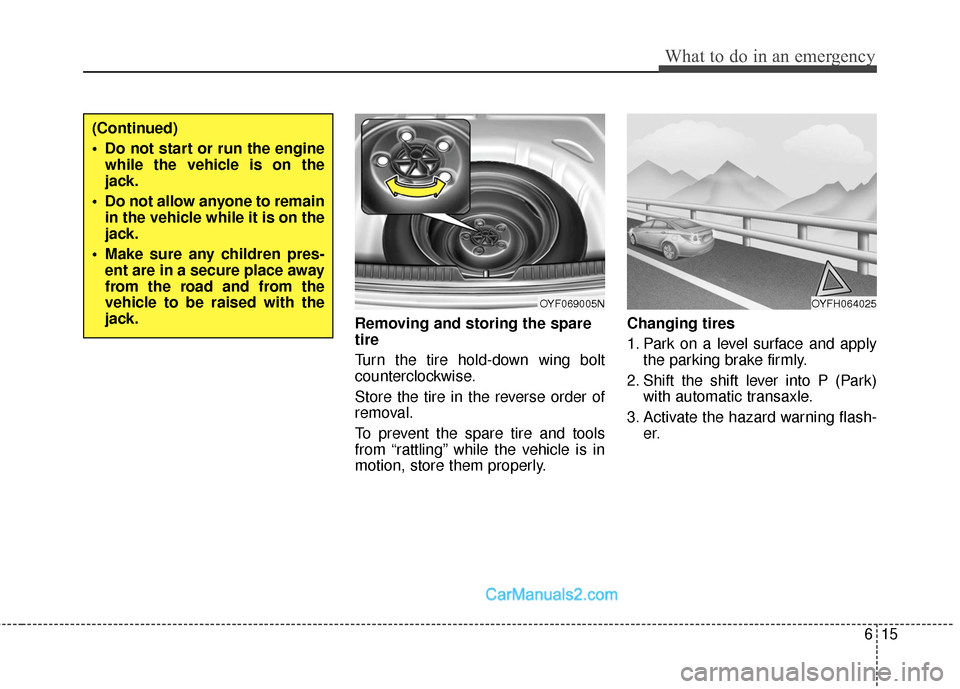
Removing and storing the spare
tire
Turn the tire hold-down wing bolt
counterclockwise.
Store the tire in the reverse order of
removal.
To prevent the spare tire and tools
from “rattling” while the vehicle is in
motion, store them properly.Changing tires
1. Park on a level surface and apply
the parking brake firmly.
2. Shift the shift lever into P (Park) with automatic transaxle.
3. Activate the hazard warning flash- er.
OYF069005N
(Continued)
Do not start or run the enginewhile the vehicle is on the
jack.
Do not allow anyone to remain in the vehicle while it is on the
jack.
Make sure any children pres- ent are in a secure place away
from the road and from the
vehicle to be raised with the
jack.
OYFH064025
Page 417 of 543

What to do in an emergency
16
6
4. Remove the wheel lug nut wrench,
jack, jack handle, and spare tire
from the vehicle.
5. Block both the front and rear of the wheel that is diagonally opposite
the jack position. 6. Loosen the wheel lug nuts coun-
terclockwise one turn each, but do
not remove any nut until the tire
has been raised off the ground.
OYFH064026
WARNING- Changing a tire
To prevent vehicle movementwhile changing a tire, always
set the parking brake fully,
and always block the wheel
diagonally opposite the wheel
being changed.
We recommend that the wheels of the vehicle be
blocked, and that no person
remain in a vehicle that is
being jacked.
ONF068002
Page 430 of 543
7
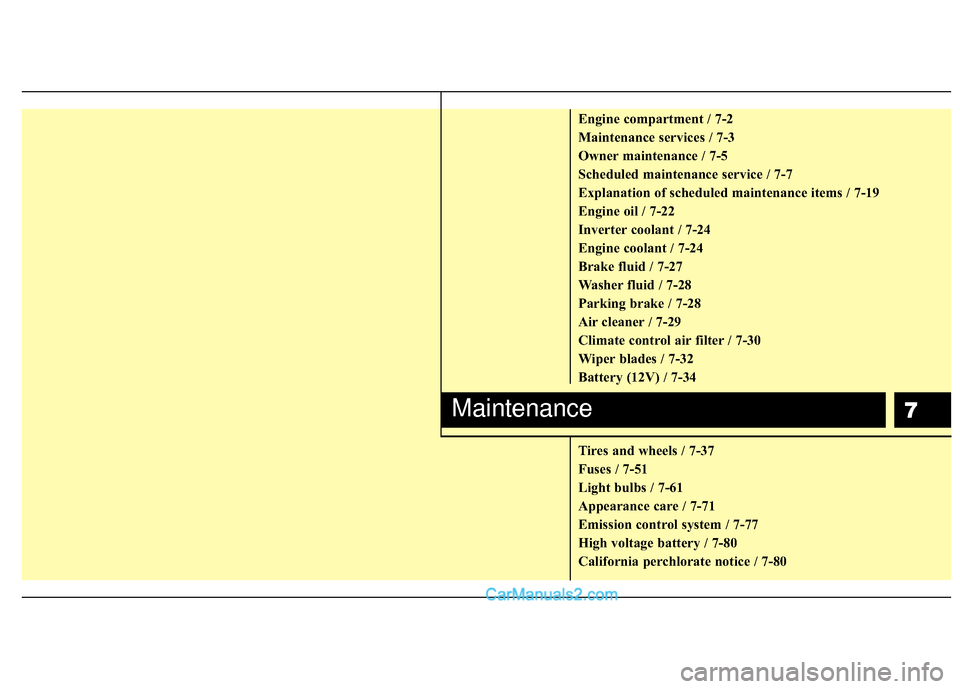
Engine compartment / 7-2
Maintenance services / 7-3
Owner maintenance / 7-5
Scheduled maintenance service / 7-7
Explanation of scheduled maintenance items / 7-19
Engine oil / 7-22
Inverter coolant / 7-24
Engine coolant / 7-24
Brake fluid / 7-27
Washer fluid / 7-28
Parking brake / 7-28
Air cleaner / 7-29
Climate control air filter / 7-30
Wiper blades / 7-32
Battery (12V) / 7-34
Tires and wheels / 7-37
Fuses / 7-51
Light bulbs / 7-61
Appearance care / 7-71
Emission control system / 7-77
High voltage battery / 7-80
California perchlorate notice / 7-80
Maintenance
Page 434 of 543
75
Maintenance
OWNER MAINTENANCE
The following lists are vehicle checks and
inspections that should be performed by
the owner or an authorized HYUNDAI
dealer at the frequencies indicated to
help ensure safe, dependable operation
of your vehicle.
Any adverse conditions should be
brought to the attention of your dealer as
soon as possible.
These Owner Maintenance Checks are
generally not covered by warranties and
you may be charged for labor, parts and
lubricants used.Owner maintenance schedule
When you stop for fuel:
Check the engine oil level.
Check coolant level in coolant reser-voirs (engine and inverter).
Check the windshield washer fluid level.
Look for low or under-inflated tires.
While operating your vehicle:
Note any changes in the sound of the exhaust or any smell of exhaust fumes
in the vehicle.
Check for vibrations in the steering wheel. Notice any increased steering
effort or looseness in the steering
wheel, or change in its straight-ahead
position.
Notice if your vehicle constantly turns slightly or “pulls” to one side when trav-
eling on smooth, level road.
When stopping, listen and check for unusual sounds, pulling to one side,
increased brake pedal travel or “hard-
to-push” brake pedal.
If any slipping or changes in the oper- ation of your transaxle occurs, check
the transaxle fluid level.
Check automatic transaxle P (Park) function.
Check parking brake.
Check for fluid leaks under your vehicle (water dripping from the air condition-
ing system during or after use is nor-
mal).
WARNING - Radiator cap &
Inverter coolant cap
Do not remove the radiator cap and
/or inverter coolant cap when the
engine and radiator are hot.
Scalding hot coolant and steam
may blow out under pressure caus-
ing serious injury.
Page 438 of 543
79
Maintenance
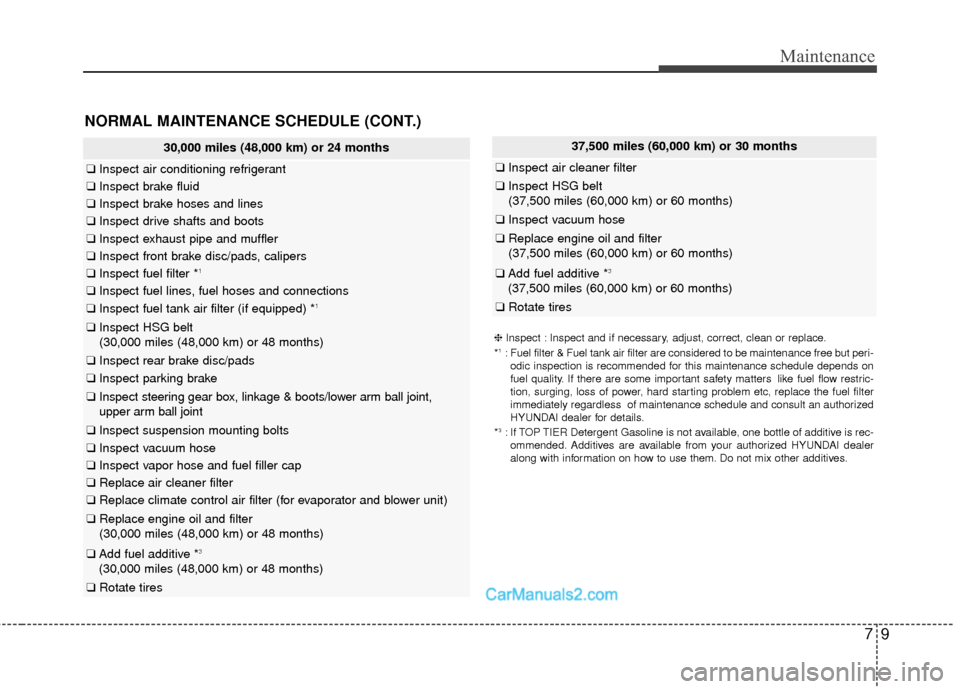
NORMAL MAINTENANCE SCHEDULE (CONT.)
37,500 miles (60,000 km) or 30 months
❑Inspect air cleaner filter
❑Inspect HSG belt
(37,500 miles (60,000 km) or 60 months)
❑Inspect vacuum hose
❑Replace engine oil and filter
(37,500 miles (60,000 km) or 60 months)
❑Add fuel additive *3
(37,500 miles (60,000 km) or 60 months)
❑ Rotate tires
❈ Inspect : Inspect and if necessary, adjust, correct, clean or replace.
*1: Fuel filter & Fuel tank air filter are considered to be maintenance free\
but peri- odic inspection is recommended for this maintenance schedule depends on
fuel quality. If there are some important safety matters like fuel flow restric-
tion, surging, loss of power, hard starting problem etc, replace the fuel filter
immediately regardless of maintenance schedule and consult an authorized
HYUNDAI dealer for details.
*
3: If TOP TIER Detergent Gasoline is not available, one bottle of additive is rec- ommended. Additives are available from your authorized HYUNDAI dealer
along with information on how to use them. Do not mix other additives.
30,000 miles (48,000 km) or 24 months
❑ Inspect air conditioning refrigerant
❑Inspect brake fluid
❑ Inspect brake hoses and lines
❑Inspect drive shafts and boots
❑Inspect exhaust pipe and muffler
❑Inspect front brake disc/pads, calipers
❑Inspect fuel filter *1
❑Inspect fuel lines, fuel hoses and connections
❑Inspect fuel tank air filter (if equipped) *1
❑Inspect HSG belt
(30,000 miles (48,000 km) or 48 months)
❑ Inspect rear brake disc/pads
❑Inspect parking brake
❑Inspect steering gear box, linkage & boots/lower arm ball joint,
upper arm ball joint
❑Inspect suspension mounting bolts
❑ Inspect vacuum hose
❑Inspect vapor hose and fuel filler cap
❑Replace air cleaner filter
❑ Replace climate control air filter (for evaporator and blower unit)
❑Replace engine oil and filter
(30,000 miles (48,000 km) or 48 months)
❑Add fuel additive *3
(30,000 miles (48,000 km) or 48 months)
❑ Rotate tires
Page 440 of 543

711
Maintenance
60,000 miles (96,000 km) or 48 months
❑Inspect vacuum hose
❑Inspect air conditioning refrigerant
❑Inspect brake hoses and lines
❑Inspect drive shafts and boots
❑Inspect exhaust pipe and muffler
❑Inspect front brake disc/pads, calipers
❑Inspect rear brake disc/pads
❑Inspect steering gear box, linkage & boots/lower arm ball joint,
upper arm ball joint
❑ Inspect suspension mounting bolts
❑Inspect brake fluid
❑Inspect fuel filter *1
❑Inspect fuel lines, fuel hoses and connections
❑Inspect fuel tank air filter (if equipped) *1
❑Inspect parking brake
❑Inspect vapor hose and fuel filler cap
❑Inspect valve clearance *2
(60,000 miles (96,000 km) or 72 months
❑Inspect W/pump belt (auto-tensioner, HSG, w/pump)
(First, 60,000 miles (96,000 km or 72 months
after every 15,000 miles (24,000 km) or 24 months)
❑ Replace air cleaner filter
❑Replace climate control air filter (for evaporator and blower unit)
❑Replace engine oil and filter
(60,000 miles (96,000 km) or 96 months)
(Continued)
(Continued)
❑Add fuel additive *3
(60,000 miles (96,000 km) or 48 months)
❑ Replace HSG belt
(60,000 miles (96,000 km) or 48 months)
❑ Rotate tires
67,500 miles (108,000 km) or 54 months
❑Inspect air cleaner filter
❑Inspect HSG belt
(67,500 miles (108,000 km) or 108 months)
❑ Inspect vacuum hose
❑Replace engine oil and filter
(67,500 miles (108,000 km) or 108 months)
❑Add fuel additive *3
(67,500 miles (108,000 km) or 108 months)
❑ Rotate tires
NORMAL MAINTENANCE SCHEDULE (CONT.)
❈ Inspect : Inspect and if necessary, adjust, correct, clean or replace.
*1: Fuel filter & Fuel tank air filter are considered to be maintenance free\
but periodic inspection is recommended for this maintenance schedule depends
on fuel quality. If there are some important safety matters like fuel flow
restriction, surging, loss of power, hard starting problem etc, replace the fuel
filter immediately regardless of maintenance schedule and consult an
authorized HYUNDAI dealer for details.
*
2: Inspect for excessive tappet noise and/or engine vibration and adjust if nec- essary.
*
3: If TOP TIER Detergent Gasoline is not available, one bottle of additive is rec- ommended. Additives are available from your authorized HYUNDAI dealer
along with information on how to use them. Do not mix other additives.