wheel HYUNDAI SONATA HYBRID 2019 Owners Manual
[x] Cancel search | Manufacturer: HYUNDAI, Model Year: 2019, Model line: SONATA HYBRID, Model: HYUNDAI SONATA HYBRID 2019Pages: 546, PDF Size: 78.75 MB
Page 49 of 546
H38
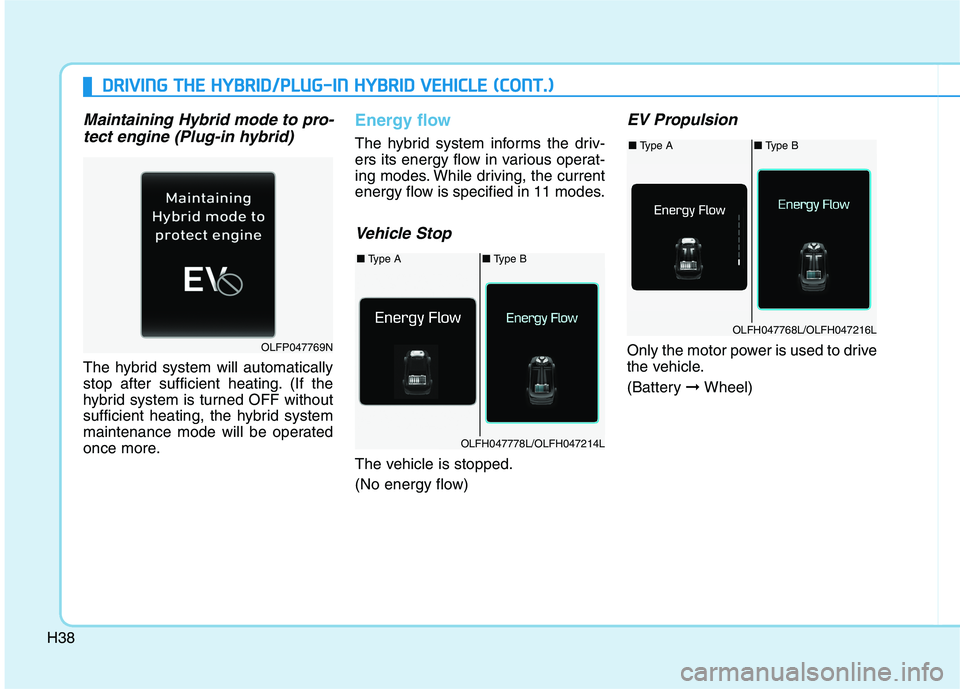
Maintaining Hybrid mode to pro-tect engine (Plug-in hybrid)
The hybrid system will automatically
stop after sufficient heating. (If the
hybrid system is turned OFF without
sufficient heating, the hybrid system
maintenance mode will be operated
once more.
Energy flow
The hybrid system informs the driv-
ers its energy flow in various operat-
ing modes. While driving, the current
energy flow is specified in 11 modes.
Vehicle Stop
The vehicle is stopped.
(No energy flow)
EV Propulsion
Only the motor power is used to drive
the vehicle.
(Battery ➞Wheel)
■ Type A■ Type B
OLFH047778L/OLFH047214L
OLFP047769N
DDRRIIVV IINN GG TT HH EE HH YY BBRRIIDD //PP LLUU GG--IINN HH YY BBRRIIDD VV EEHH IICC LLEE (( CC OO NNTT..))
■ Type A■ Type B
OLFH047768L/OLFH047216L
Page 50 of 546
H39
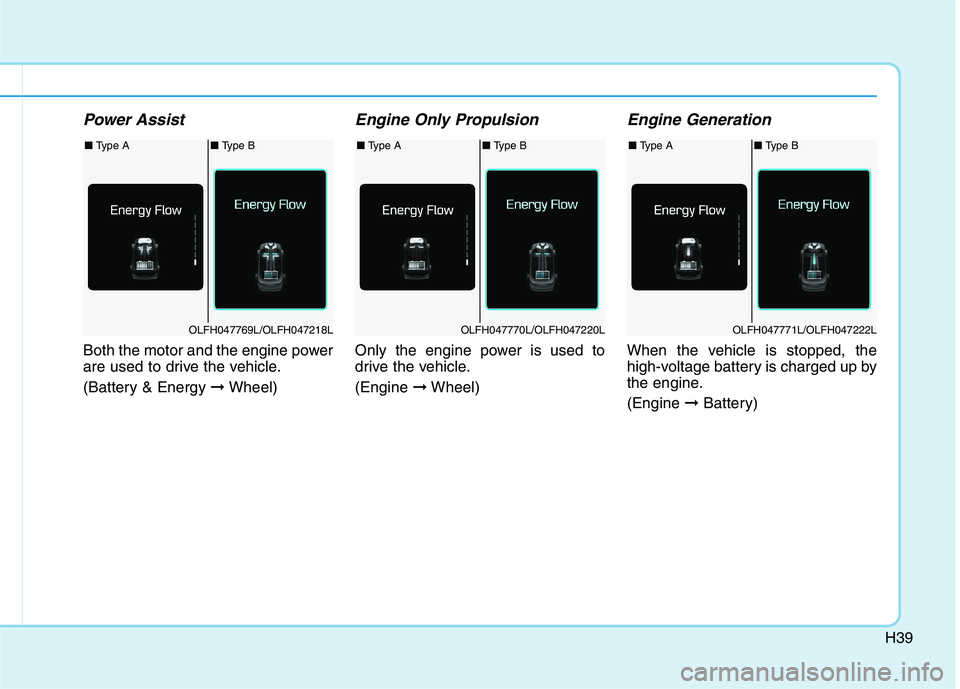
Power Assist
Both the motor and the engine power
are used to drive the vehicle.
(Battery & Energy ➞Wheel)
Engine Only Propulsion
Only the engine power is used to
drive the vehicle. (Engine ➞Wheel)
Engine Generation
When the vehicle is stopped, the
high-voltage battery is charged up by
the engine. (Engine ➞Battery)
■ Type A■ Type B
OLFH047769L/OLFH047218L
■ Type A■ Type B
OLFH047770L/OLFH047220L
■ Type A■ Type B
OLFH047771L/OLFH047222L
Page 51 of 546
H40
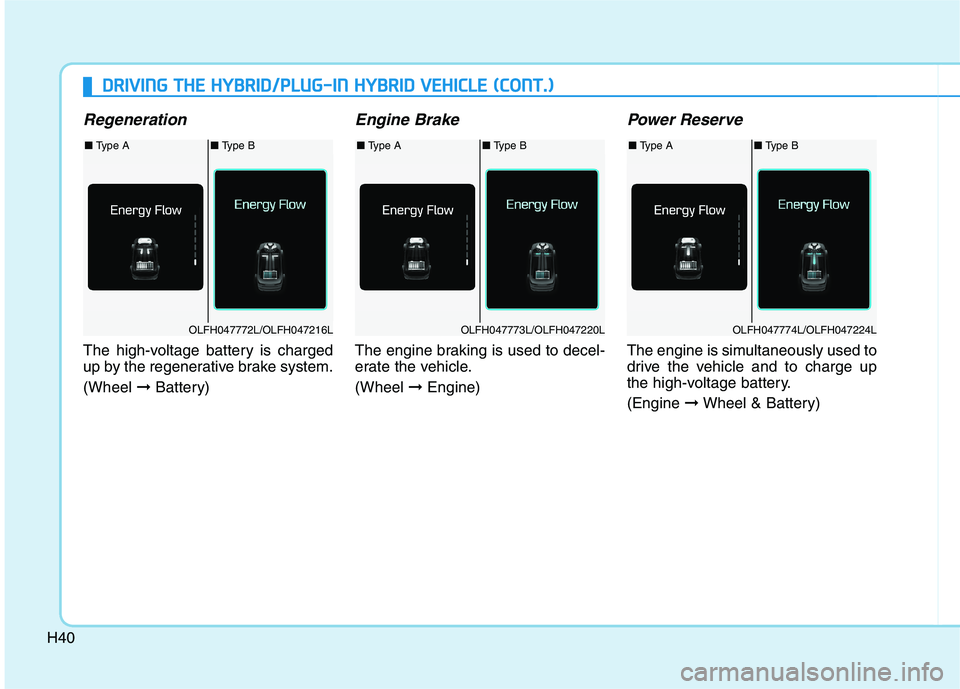
Regeneration
The high-voltage battery is charged
up by the regenerative brake system. (Wheel ➞Battery)
Engine Brake
The engine braking is used to decel-
erate the vehicle. (Wheel ➞Engine)
Power Reserve
The engine is simultaneously used to
drive the vehicle and to charge up
the high-voltage battery. (Engine ➞Wheel & Battery)
■ Type A■ Type B
OLFH047772L/OLFH047216L
■ Type A■ Type B
OLFH047773L/OLFH047220L
DDRRIIVV IINN GG TT HH EE HH YY BBRRIIDD //PP LLUU GG--IINN HH YY BBRRIIDD VV EEHH IICC LLEE (( CC OO NNTT..))
■ Type A■ Type B
OLFH047774L/OLFH047224L
Page 52 of 546
H41
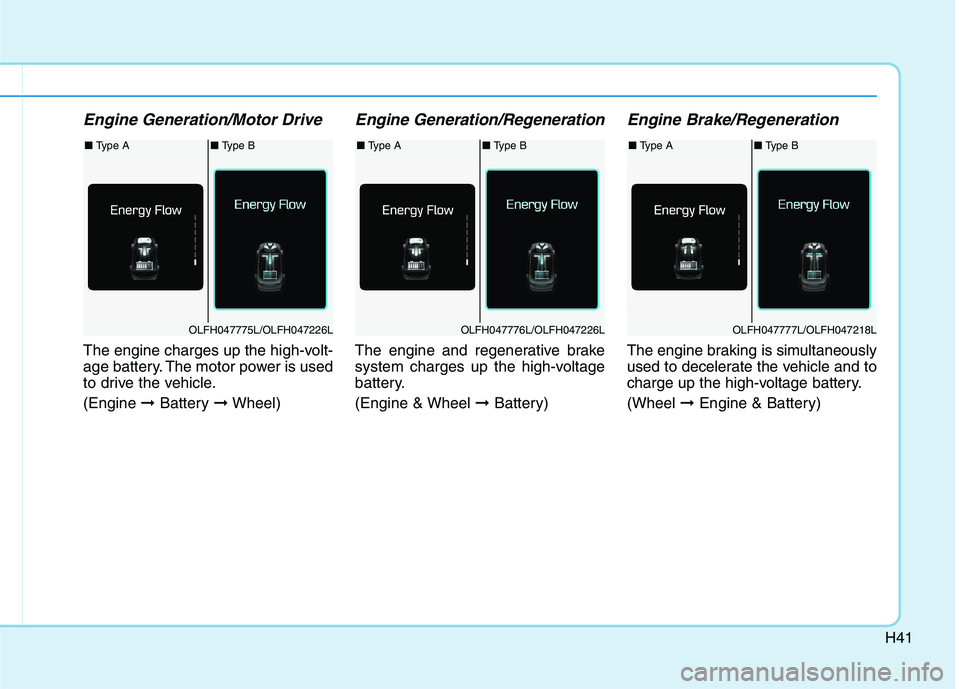
Engine Generation/Motor Drive
The engine charges up the high-volt-
age battery. The motor power is used
to drive the vehicle. (Engine ➞Battery ➞Wheel)
Engine Generation/Regeneration
The engine and regenerative brake
system charges up the high-voltage
battery.
(Engine & Wheel ➞Battery)
Engine Brake/Regeneration
The engine braking is simultaneously
used to decelerate the vehicle and to
charge up the high-voltage battery. (Wheel ➞Engine & Battery)
■ Type A■ Type B
OLFH047775L/OLFH047226L
■ Type A■ Type B
OLFH047776L/OLFH047226L
■ Type A■ Type B
OLFH047777L/OLFH047218L
Page 62 of 546
1-2
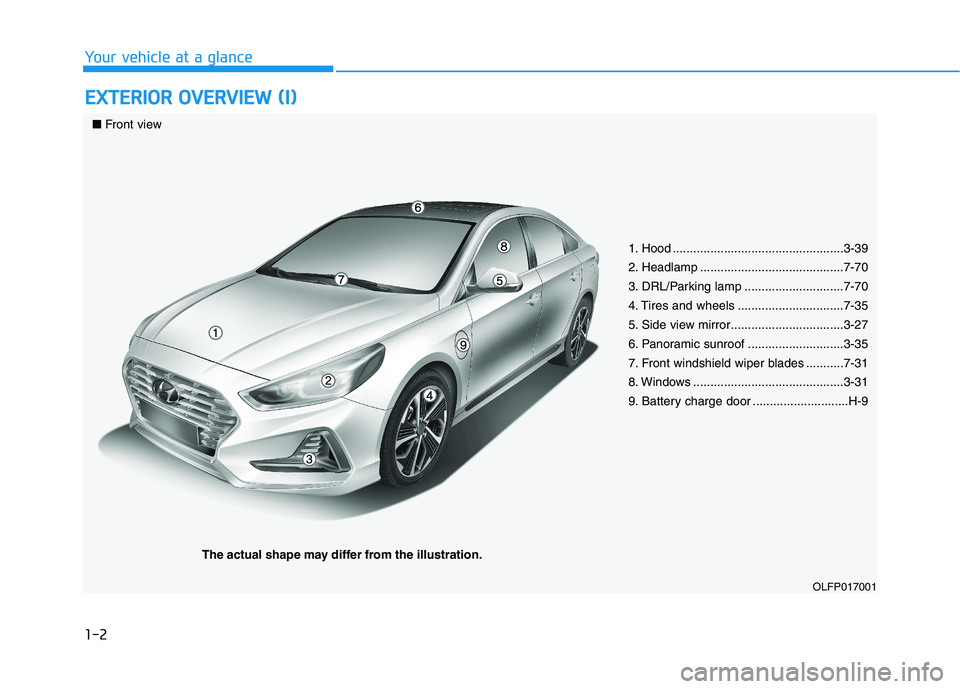
EEXX TTEERR IIOO RR OO VVEERR VV IIEE WW (( II))
Your vehicle at a glance
OLFP017001
■ Front view
1. Hood ..................................................3-39
2. Headlamp ..........................................7-70
3. DRL/Parking lamp .............................7-70
4. Tires and wheels ...............................7-35
5. Side view mirror.................................3-27
6. Panoramic sunroof ............................3-35
7. Front windshield wiper blades ...........7-31
8. Windows ............................................3-31
9. Battery charge door ............................H-9
The actual shape may differ from the illustration.
Page 64 of 546
1-4
Your vehicle at a glanceI
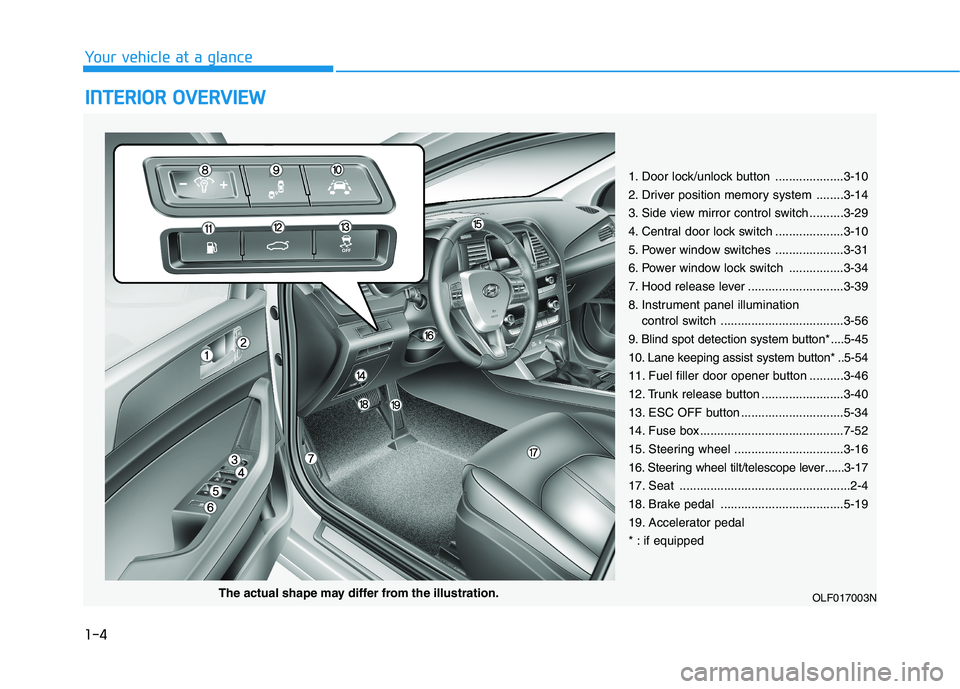
I NN TTEERR IIOO RR OO VVEERR VV IIEE WW
OLF017003N
1. Door lock/unlock button ....................3-10
2. Driver position memory system ........3-14
3. Side view mirror control switch ..........3-29
4. Central door lock switch ....................3-10
5. Power window switches ....................3-31
6. Power window lock switch ................3-34
7. Hood release lever ............................3-39
8. Instrument panel illumination
control switch ....................................3-56
9. Blind spot detection system button* ....5-45
10. Lane keeping assist system button* ..5-54
11. Fuel filler door opener button ..........3-46
12. Trunk release button ........................3-40
13. ESC OFF button ..............................5-34
14. Fuse box ..........................................7-52
15. Steering wheel ................................3-16
16. Steering wheel tilt/telescope lever ......3-17
17. Seat ..................................................2-4
18. Brake pedal ....................................5-19
19. Accelerator pedal
* : if equipped
The actual shape may differ from the illustration.
Page 65 of 546
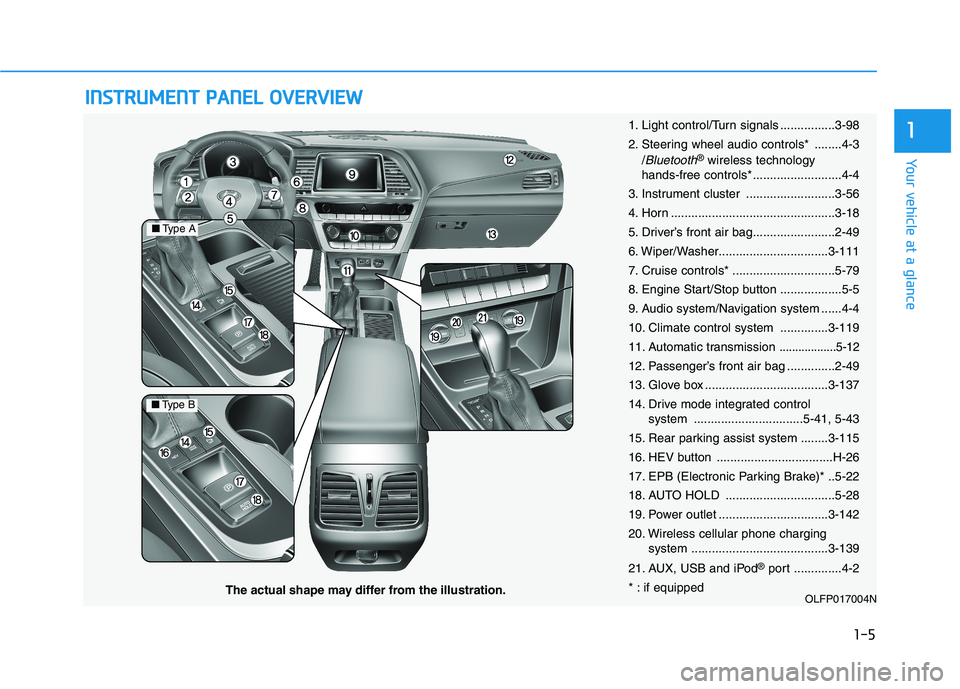
IINN SSTT RR UU MM EENN TT PP AA NN EELL OO VVEERR VV IIEE WW
1-5
Your vehicle at a glance
1
OLFP017004N
■Type A
■Type B
The actual shape may differ from the illustration. 1. Light control/Turn signals ................3-98
2. Steering wheel audio controls* ........4-3
/
Bluetooth®wireless technology
hands-free controls* ..........................4-4
3. Instrument cluster ..........................3-56
4. Horn ................................................3-18
5. Driver’s front air bag........................2-49
6. Wiper/Washer................................3-111
7. Cruise controls* ..............................5-79
8. Engine Start/Stop button ..................5-5
9. Audio system/Navigation system ......4-4
10. Climate control system ..............3-119
11. Automatic transmission
..................5-12
12. Passenger’s front air bag ..............2-49
13. Glove box ....................................3-137
14. Drive mode integrated control system ................................5-41, 5-43
15. Rear parking assist system ........3-115
16. HEV button ..................................H-26
17. EPB (Electronic Parking Brake)* ..5-22
18. AUTO HOLD ................................5-28
19. Power outlet ................................3-142
20. Wireless cellular phone charging system ........................................3-139
21. AUX, USB and iPod ®
port ..............4-2
* : if equipped
Page 68 of 546
2-2
You will find many safety precautions and recommendations throughoutthis section, and throughout this man-
ual. The safety precautions in this sec-
tion are among the most important.
Always Wear Your Seat Belt
A seat belt is your best protection in
all types of accidents. Air bags are
designed to supplement seat belts,
not replace them. So even though
your vehicle is equipped with air bags,
ALWAYS make sure you and your
passengers wear your seat belts, and
wear them properly.
Restrain All Children
All children under age 13 should ride
in your vehicle properly restrained in
a rear seat, not the front seat. Infantsand small children should be
restrained in an appropriate child
restraint. Larger children should usea booster seat with the lap/shoulder
belt until they can use the seat belt
properly without a booster seat.
Air Bag Hazards
While air bags can save lives, they
can also cause serious or fatal
injuries to occupants who sit tooclose to them, or who are not prop-
erly restrained. Infants, young chil-
dren, and shorter adults are at the
greatest risk of being injured by an
inflating air bag. Follow all instruc-
tions and warnings in this manual.
Driver Distraction
Driver distraction presents a serious
and potentially deadly danger, espe-
cially for inexperienced drivers. Safety
should be the first concern when
behind the wheel and drivers need to
be aware of the wide array of potential
distractions, such as drowsiness,
reaching for objects, eating, personal
grooming, other passengers, and
using cellular phones.
Drivers can become distracted when
they take their eyes and attention offthe road or their hands off the wheel
to focus on activities other than driv-
ing. To reduce your risk of distractionor getting into an accident:
II
MM PPOO RRTTAA NN TT SS AA FFEE TT YY PP RR EECCAA UU TTIIOO NNSS
Safety system of your vehicle
Page 69 of 546
2-3
Safety system of your vehicle
• ALWAYS set up your mobiledevices (i.e., MP3 players, phones,
navigation units, etc.) when your
vehicle is parked or safely stopped.
ONLY use your mobile device when allowed by laws and when
conditions permit safe use. NEVER
text or email while driving. Most
countries have laws prohibiting
drivers from texting. Some coun-
tries and cities also prohibit drivers
from using handheld phones.
NEVER let the use of a mobile device distract you from driving.
You have a responsibility to yourpassengers and others on the road
to always drive safely, with your
hands on the wheel as well as your
eyes and attention on the road.Control Your Speed
Excessive speed is a major factor in
crash injuries and deaths. Generally,
the higher the speed, the greater the
risk, but serious injuries can also
occur at lower speeds. Never drive
faster than is safe for current condi-
tions, regardless of the maximumspeed posted.
Keep Your Vehicle in Safe Condition
Having a tire blowout or a mechanical
failure can be extremely hazardous. Toreduce the possibility of such prob-
lems, check your tire pressures and
condition frequently, and perform all
regularly scheduled maintenance.
2
Page 71 of 546
Safety Precautions
Adjusting the seats so that you are sit-
ting in a safe, comfortable position
plays an important role in driver and
passenger safety together with theseat belts and air bags in an accident.
Air bags
You can take steps to reduce the risk
of being injured by an inflating air
bag. Sitting too close to an air bag
greatly increases the risk of injury in
the event the air bag inflates.
Move your seat as far back as possi-
ble from front air bags, while still
maintaining control of the vehicle.
Seat belts
Always fasten your seat belt before
starting any trip.
At all times, passengers should sit
upright and be properly restrained.
Infants and small children must be
restrained in appropriate child restraint
systems. Children who have outgrown
a booster seat and adults must be
restrained using the seat belts.
Do not use a cushion thatreduces friction between the seat
and the passenger. The passen-
ger's hips may slide under the
lap portion of the seat belt during
an accident or a sudden stop.Serious or fatal internal injuriescould result because the seat
belt cannot operate properly.
WARNING
To reduce the risk of serious
injury or death from an inflating
air bag, take the following pre-cautions:
•Adjust the driver’s seat as far
to the rear as possible whilemaintaining the ability to
maintain full control of the
vehicle.
Adjust the front passenger seat as far to the rear as pos-
sible.
Hold the steering wheel by the
rim with hands at the 9 o’clock
and 3 o’clock positions to
minimize the risk of injuries to
your hands and arms.
NEVER place anything or any- one between the steering
wheel and the air bag.
Do not allow the front passen-
ger to place feet or legs on the
dashboard to minimize therisk of leg injuries.
WARNING
2-5
Safety system of your vehicle
2