cooling HYUNDAI SONATA HYBRID 2020 User Guide
[x] Cancel search | Manufacturer: HYUNDAI, Model Year: 2020, Model line: SONATA HYBRID, Model: HYUNDAI SONATA HYBRID 2020Pages: 527, PDF Size: 64.14 MB
Page 428 of 527
Emergency situations
7-8
WARNING
Never remove the engine coolant cap and/or inverter
coolant cap or the drain plug
while the engine and radiator
are hot.
Hot coolant and steam may blow out
under pressure, causing serious injury.
Turn the hybrid system off and wait until
the engine cools down. Use extreme
care when removing the engine coolant
cap and/or inverter coolant cap. Wrap
a thick towel around it, and turn it
counterclockwise slowly to the first
stop. Step back while the pressure is
released from the cooling system. When
you are sure all the pressure has been
released, press down on the cap, using
a thick towel, and continue turning
counterclockwise to remove it.
CAUTION
• Serious loss of coolant indicates a
leak in the cooling system and should
be checked as soon as possible by an
authorized HYUNDAI dealer.
• When the engine overheats from
low engine coolant, suddenly adding
engine coolant may cause cracks
in the engine. To prevent damage,
add engine coolant slowly in small
quantities.
Page 462 of 527
08
8-13
Engine Oil and Filter
The engine oil and filter should be
changed at the intervals specified in the
maintenance schedule. If the vehicle
is being driven in severe conditions,
more frequent oil and filter changes are
required.
HSG (Hybrid Starter & Generator)
Belt
The HSG belt should be changed at the
intervals specified in the maintenance
schedule.
Fuel Lines, Fuel Hoses and
Connections
Check the fuel lines, fuel hoses and
connections for leakage and damage.
Have an authorized HYUNDAI dealer
replace any damaged or leaking parts
immediately.
Fuel Filter
A clogged filter can limit the speed
at which the vehicle may be driven,
damage the emission system and cause
multiple issues such as hard starting. If
an excessive amount of foreign matter
accumulates in the fuel tank, the
filter may require replacement more
frequently. After installing a new filter,
run the engine for several minutes,
and check for leaks at the connections.
Fuel filters should be installed by an
authorized HYUNDAI dealer.
Vapor Hose and Fuel Filler Cap
The vapor hose and fuel filler cap should
be inspected at those intervals specified
in the maintenance schedule. Make sure
a new vapor hose or fuel filler cap is
correctly replaced.
Air Cleaner Filter
A genuine HYUNDAI air cleaner filter
is recommended when the filter is
replaced.
Spark Plugs
Make sure to install new spark plugs of
the correct heat range.
Cooling System
Check cooling system components, such
as radiator, coolant reservoir, hoses and
connections for leakage and damage.
Replace any damaged parts.
Engine Coolant/Inverter Coolant
The coolant should be changed at the
intervals specified in the maintenance
schedule.
Automatic Transmission Fluid
Automatic transmission fluid should
not be checked under normal usage
conditions. But in severe conditions, the
fluid should be changed at an authorized
HYUNDAI dealer in accordance to the
scheduled maintenance at the beginning
of this chapter.
EXPLANATION OF SCHEDULED MAINTENANCE ITEMS
Page 466 of 527
08
8-17
The high-pressure cooling system has a
reservoir filled with year-round antifreeze
coolant. The reservoir is filled at the
factory.
Check the antifreeze protection and
coolant level at least once a year, at
the beginning of the winter season and
before traveling to a colder climate.
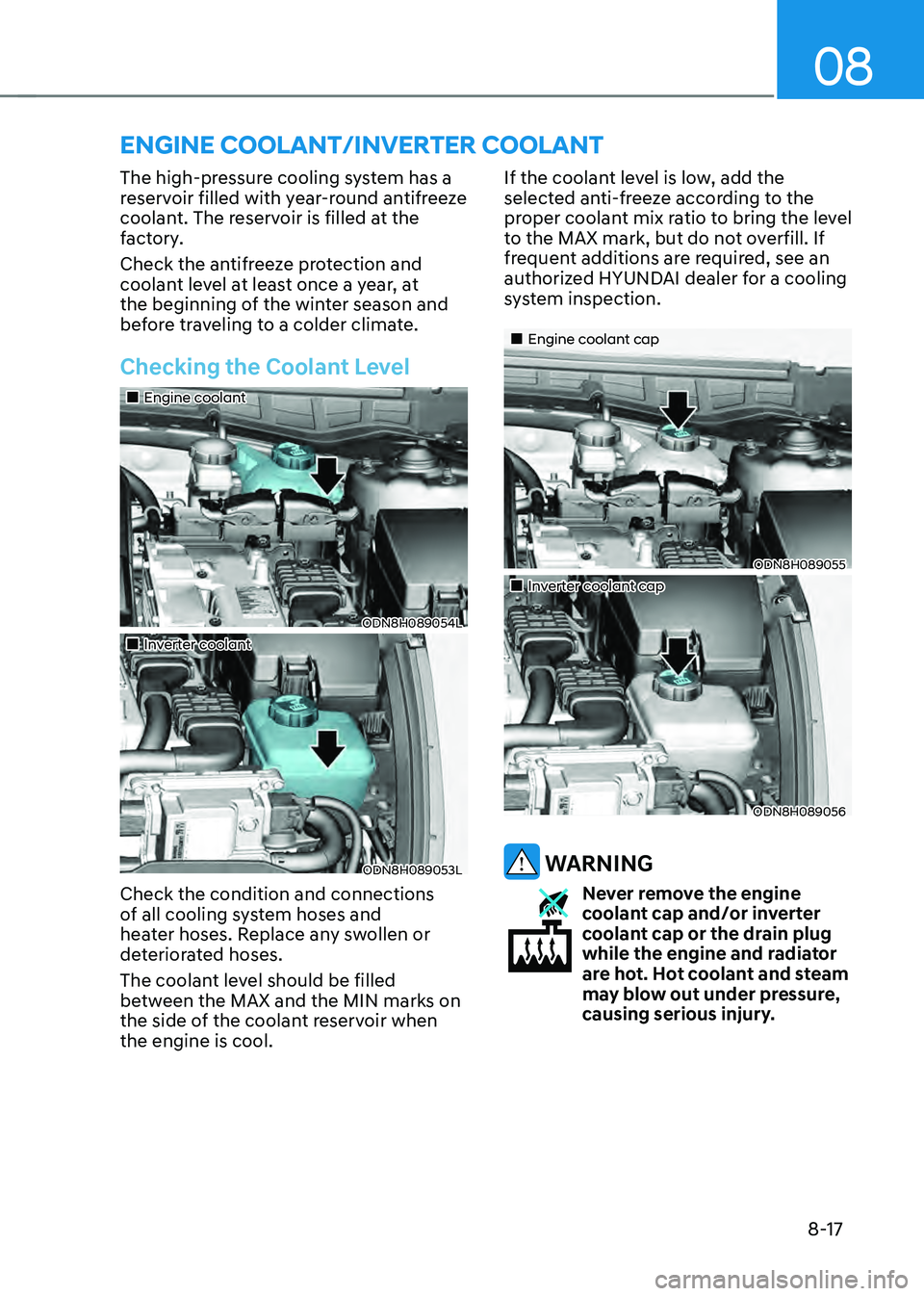
Checking the Coolant Level
„„Engine coolant
ODN8H089054L
„„Inverter coolant
ODN8H089053L
Check the condition and connections
of all cooling system hoses and
heater hoses. Replace any swollen or
deteriorated hoses.
The coolant level should be filled
between the MAX and the MIN marks on
the side of the coolant reservoir when
the engine is cool.If the coolant level is low, add the
selected anti-freeze according to the proper coolant mix ratio to bring the level to the MAX mark, but do not overfill. If
frequent additions are required, see an
authorized HYUNDAI dealer for a cooling
system inspection.
„„Engine coolant cap
ODN8H089055
„„Inverter coolant cap
ODN8H089056
WARNING
Never remove the engine coolant cap and/or inverter
coolant cap or the drain plug
while the engine and radiator
are hot. Hot coolant and steam
may blow out under pressure,
causing serious injury.
ENGINE COOLANT/INVERTER COOLANT
Page 467 of 527
Maintenance
8-18
Turn the vehicle off and wait until
the engine cools down. Use extreme
care when removing the engine
coolant cap and/or inverter coolant
cap. Wrap a thick towel around it,
and turn it counterclockwise slowly
while the pressure is released from
the cooling system. When you are sure
all the pressure has been released,
using a thick towel, continue turning
counterclockwise to remove it.
Information
The engine coolant and/or inverter coolant
level is influenced by the hybrid system
temperature. Before checking or refilling
the engine coolant and/or inverter coolant,
turn the hybrid vehicle off.
WARNING
The electric motor for the cooling fan may continue to
operate or start up when the
engine is not running and can
cause serious injury. Keep
hands, clothing and tools away
from the rotating fan blades of
the cooling fan.
Keep hands, clothing and tools away
from the rotating fan blades of the
cooling fan.
Always turn off the vehicle unless the
vehicle has to be inspected with the
engine on. Be cautious as the cooling
fan may operate if the negative (-)
battery terminal is not disconnected.
WARNING
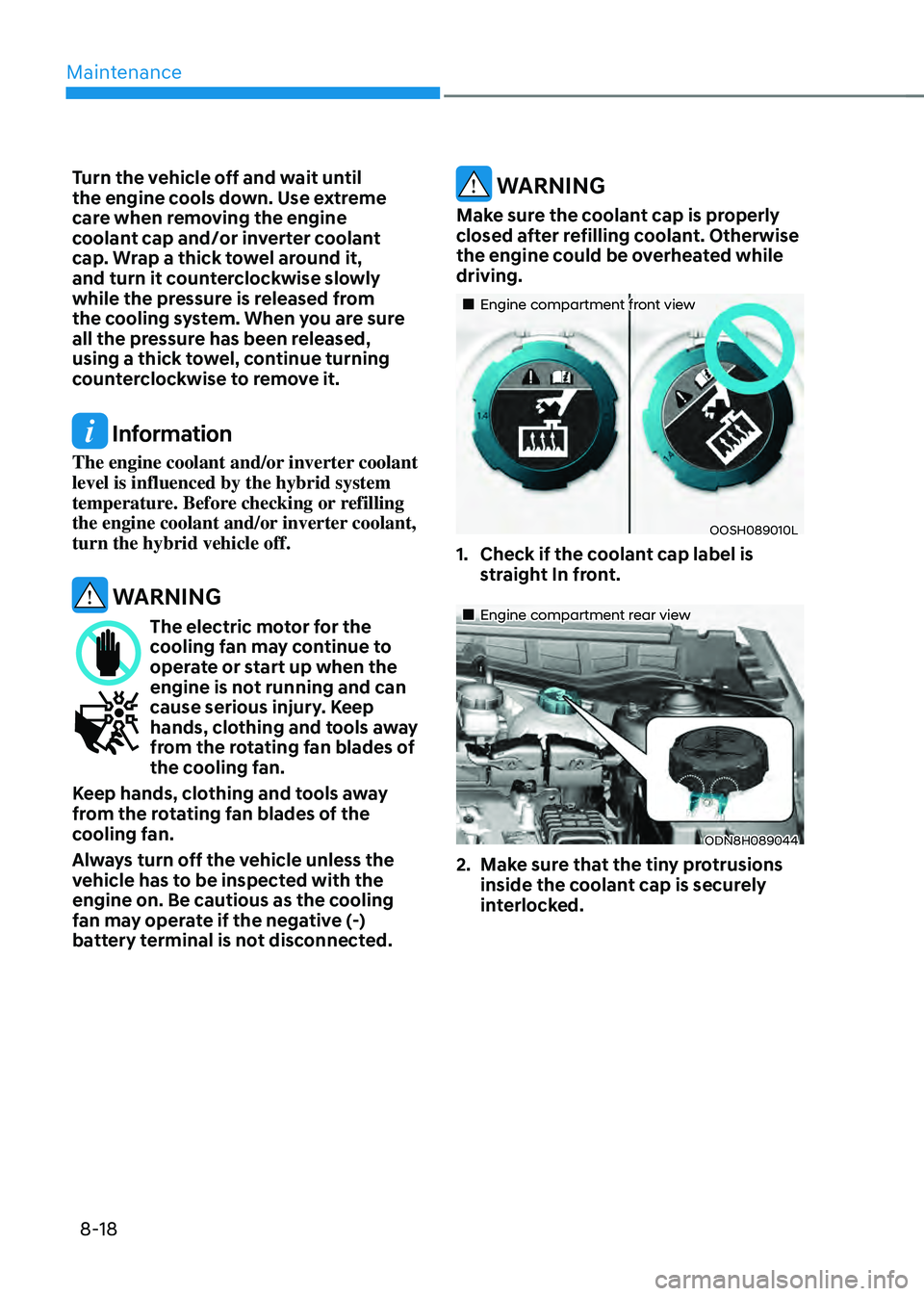
Make sure the coolant cap is properly
closed after refilling coolant. Otherwise
the engine could be overheated while
driving.
„„Engine compartment front view
OOSH089010L
1. Check if the coolant cap label is
straight In front.
„„Engine compartment rear view
ODN8H089044
2. Make sure that the tiny protrusions
inside the coolant cap is securely
interlocked.
Page 523 of 527

I
I-15
S
Safety messages
........................................................................\
............................1-4
Safety precautions for hybrid system
..................................................................1-23
High voltage battery system
........................................................................\
....1-23
Hybrid vehicle components ........................................................................\
..... 1-23
Service interlock connector
........................................................................\
.....1-25
Hybrid battery cooling duct
........................................................................\
...1-25
If an accident occurs ........................................................................\
................ 1-26
When the hybrid vehicle shuts off
.................................................................1-27
Scheduled maintenance services ........................................................................\
.... 8-7
Seat belt warning light
........................................................................\
.................3-20
Driver’s seat
........................................................................\
...........................3-20
Front passenger’s seat
........................................................................\
............3-20
Seat belts
........................................................................\
.....................................3-19
Seat belt safety precautions
........................................................................\
....3-19
Seat belt warning light
........................................................................\
...........3-20
Emergency locking retractor
........................................................................\
..3-21
Convertible locking retractor
........................................................................\
.3-22
Rear center seat belt
........................................................................\
...............3-23
Pre-tensioner seat belt
........................................................................\
............3-24
Additional seat belt safety precautions
..........................................................3-26
Seat belt use during pregnancy
......................................................................3-26
Seat belt use and children
........................................................................\
.......3-26
Transporting an injured person
......................................................................3-27
One person per belt
........................................................................\
................3-27
Do not lie down
........................................................................\
......................3-27
Care of seat belts
........................................................................\
....................3-28
Periodic inspection
........................................................................\
.................3-28
Keep belts clean and dry
........................................................................\
........3-28
When to replace seat belts
........................................................................\
......3-28
Seat warmers and air ventilation seats
.................................................................3-15
Front seat warmers
........................................................................\
.................3-15
Front air ventilation seat ........................................................................\
.......... 3-15
Seatback pocket
........................................................................\
............................3-9