HYUNDAI SONATA HYBRID 2023 Owners Manual
Manufacturer: HYUNDAI, Model Year: 2023, Model line: SONATA HYBRID, Model: HYUNDAI SONATA HYBRID 2023Pages: 549
Page 461 of 549
07
7-21
WARNING
Do not use the TMK if a tire is severely
damaged by driving while flat or with
insufficient air pressure.
Only punctured areas located within the
tread region of the tire can be sealed
using the TMK.
Notes on the Safe Use of the Tire
Mobility Kit
• Park your car at the side of the road
so that you can work with the Tire
Mobility Kit away from moving traffic.
• To be sure your vehicle will not move,
even when you’re on fairly level
ground, always set your parking brake.
• Only use the Tire Mobility Kit for
sealing/inflation passenger car tires.
Only punctured areas located within
the tread region of the tire can be
sealed using the tire mobility kit.
• Do not use on motorcycles, bicycles
or any other type of tires.
• When the tire and wheel are
damaged, do not use Tire Mobility Kit
for your safety.
• Use of the Tire Mobility Kit may not be
effective for tire damage larger than
approximately 0.24 inch (6 mm).
Please contact the nearest HYUNDAI
dealership if the tire cannot be made
roadworthy with the Tire Mobility Kit.
• Do not use the Tire Mobility Kit if a tire
is severely damaged by driving run flat
or with insufficient air pressure.
• Do not remove any foreign objects
such as nails or screws that have
penetrated the tire.
• Provided the car is outdoors, leave
the vehicle in the ready () mode.
Otherwise operating the compressor
may eventually drain the car battery.
• Never leave the Tire Mobility Kit
unattended while it is being used.
• Do not leave the compressor running
for more than 10 minutes at a time or
it may overheat.
• Do not use the Tire Mobility Kit if the
ambient temperature is below -22°F
(-30°C).
• In case of skin contact with the
sealant, wash the area thoroughly
with plenty of water. If the irritation
persists, seek medical attention.
• In case of eye contact with the
sealant, flush your eyes for at least 15
minutes. If the irritation persists, seek
medical attention.
• In case of swallowing the sealant,
rinse the mouth and drink plenty of
water. However, never give anything
to an unconscious person and seek
medical attention immediately.
• Long time exposure to the sealant
may cause damage to bodily tissue
such as kidney, etc.
Page 462 of 549
Emergency situations
7-22
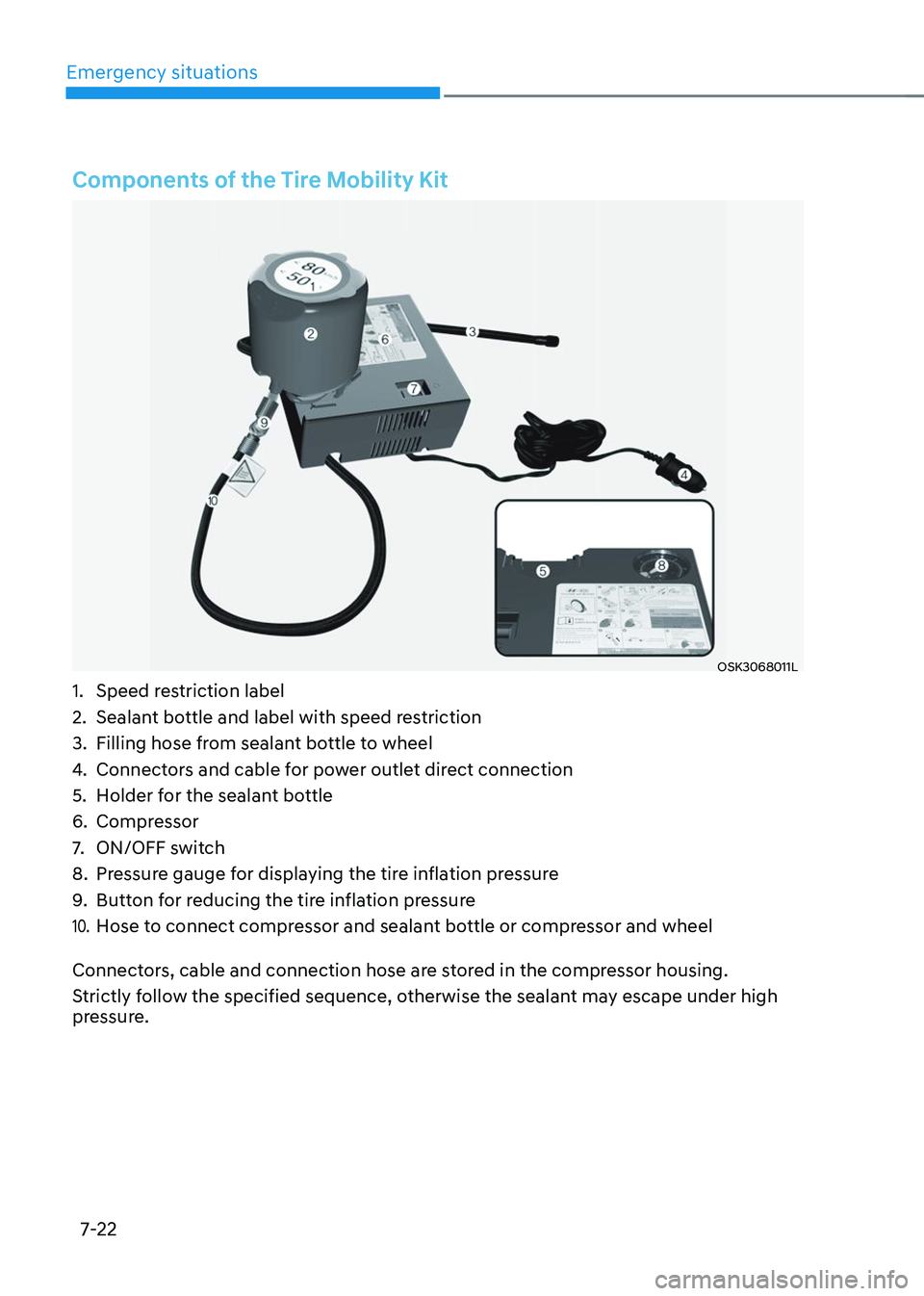
Components of the Tire Mobility Kit
OSK3068011LOSK3068011L
1. Speed restriction label
2. Sealant bottle and label with speed restriction
3. Filling hose from sealant bottle to wheel
4. Connectors and cable for power outlet direct connection
5. Holder for the sealant bottle
6. Compressor
7. ON/OFF switch
8. Pressure gauge for displaying the tire inflation pressure
9. Button for reducing the tire inflation pressure
10. Hose to connect compressor and sealant bottle or compressor and wheel
Connectors, cable and connection hose are stored in the compressor housing.
Strictly follow the specified sequence, otherwise the sealant may escape under high
pressure.
Page 463 of 549
07
7-23
WARNING
Do not use the tire sealant after the
sealant has expired (for example, past
the expiration date on the sealant
container). This can increase the risk of
tire failure.
WARNING
• Keep out of reach of children.
• Avoid contact with eyes.
• Do not swallow.
Using the Tire Mobility Kit
WARNING
ODN8079005ODN8079005
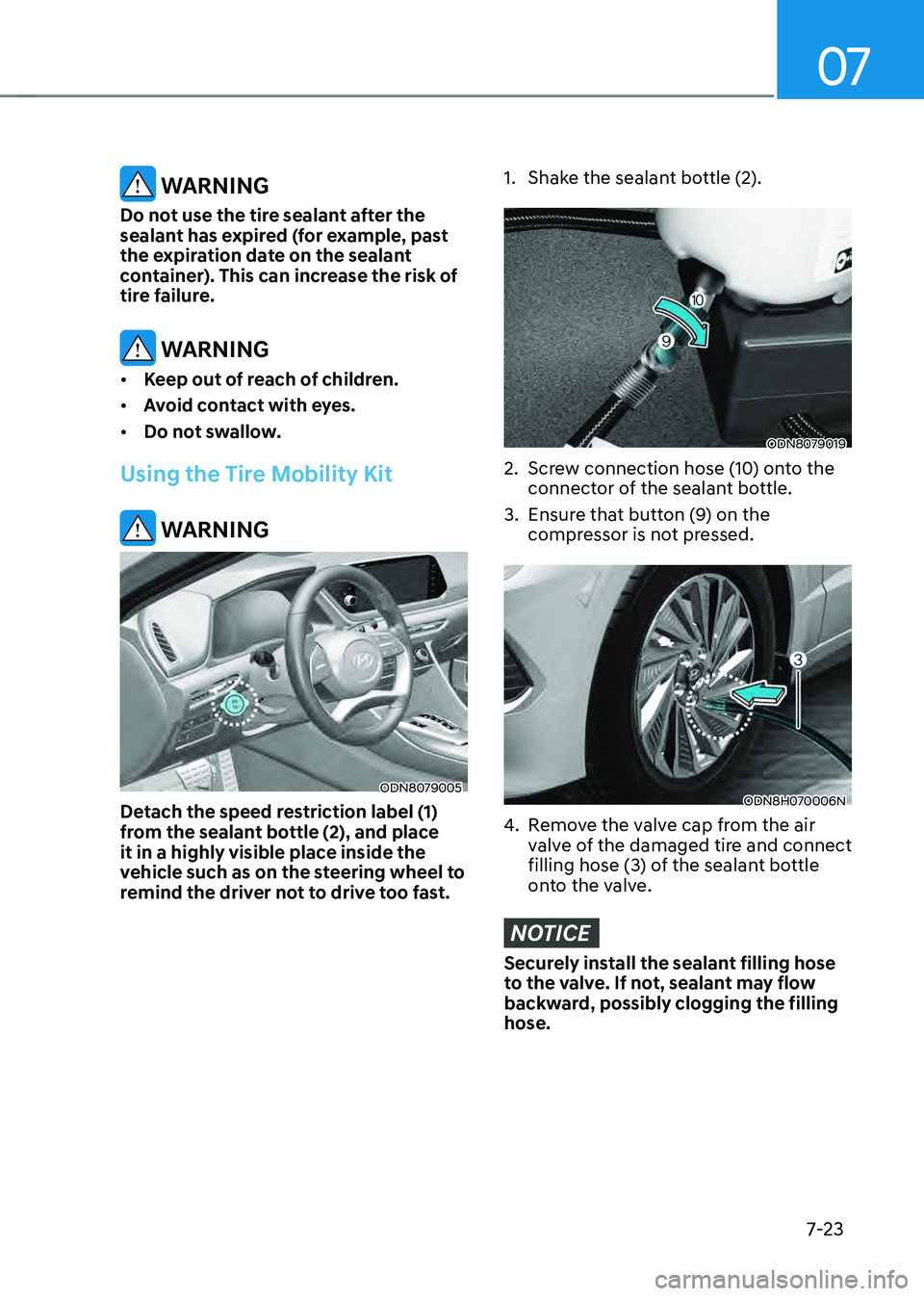
Detach the speed restriction label (1)
from the sealant bottle (2), and place
it in a highly visible place inside the
vehicle such as on the steering wheel to
remind the driver not to drive too fast.
1. Shake the sealant bottle (2).
ODN8079019ODN8079019
2. Screw connection hose (10) onto the
connector of the sealant bottle.
3. Ensure that button (9) on the
compressor is not pressed.
ODN8H070006NODN8H070006N
4. Remove the valve cap from the air
valve of the damaged tire and connect
filling hose (3) of the sealant bottle
onto the valve.
NOTICE
Securely install the sealant filling hose
to the valve. If not, sealant may flow
backward, possibly clogging the filling
hose.
Page 464 of 549
Emergency situations
7-24
ODN8079008ODN8079008
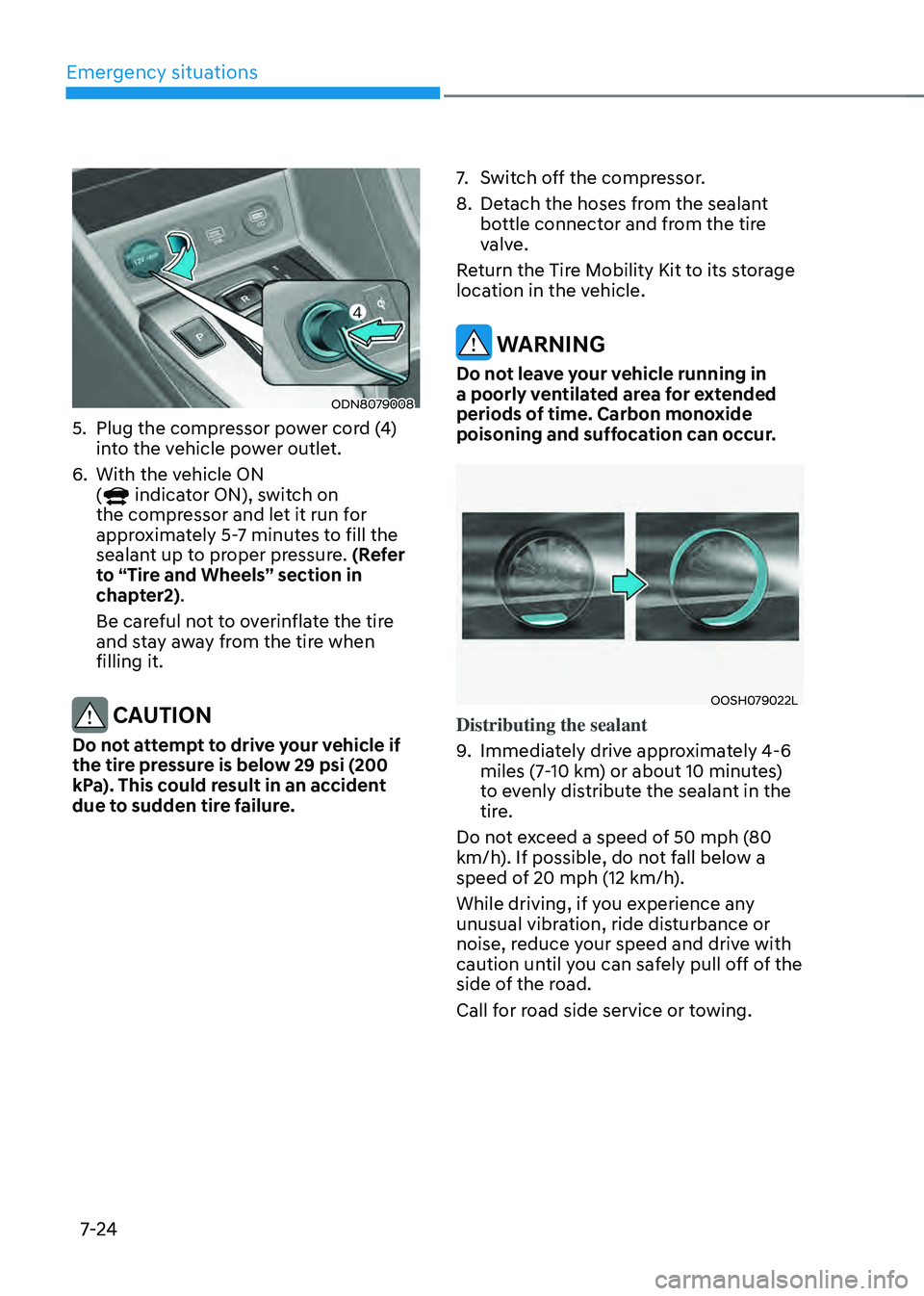
5. Plug the compressor power cord (4)
into the vehicle power outlet.
6. With the vehicle ON
( indicator ON), switch on
the compressor and let it run for
approximately 5-7 minutes to fill the
sealant up to proper pressure. (Refer
to “Tire and Wheels” section in
chapter2).
Be careful not to overinflate the tire
and stay away from the tire when
filling it.
CAUTION
Do not attempt to drive your vehicle if
the tire pressure is below 29 psi (200
kPa). This could result in an accident
due to sudden tire failure.
7. Switch off the compressor.
8. Detach the hoses from the sealant
bottle connector and from the tire
valve.
Return the Tire Mobility Kit to its storage
location in the vehicle.
WARNING
Do not leave your vehicle running in
a poorly ventilated area for extended
periods of time. Carbon monoxide
poisoning and suffocation can occur.
OOSH079022LOOSH079022L
Distributing the sealant
9. Immediately drive approximately 4-6
miles (7-10 km) or about 10 minutes)
to evenly distribute the sealant in the
tire.
Do not exceed a speed of 50 mph (80
km/h). If possible, do not fall below a
speed of 20 mph (12 km/h).
While driving, if you experience any
unusual vibration, ride disturbance or
noise, reduce your speed and drive with
caution until you can safely pull off of the
side of the road.
Call for road side service or towing.
Page 465 of 549
07
7-25
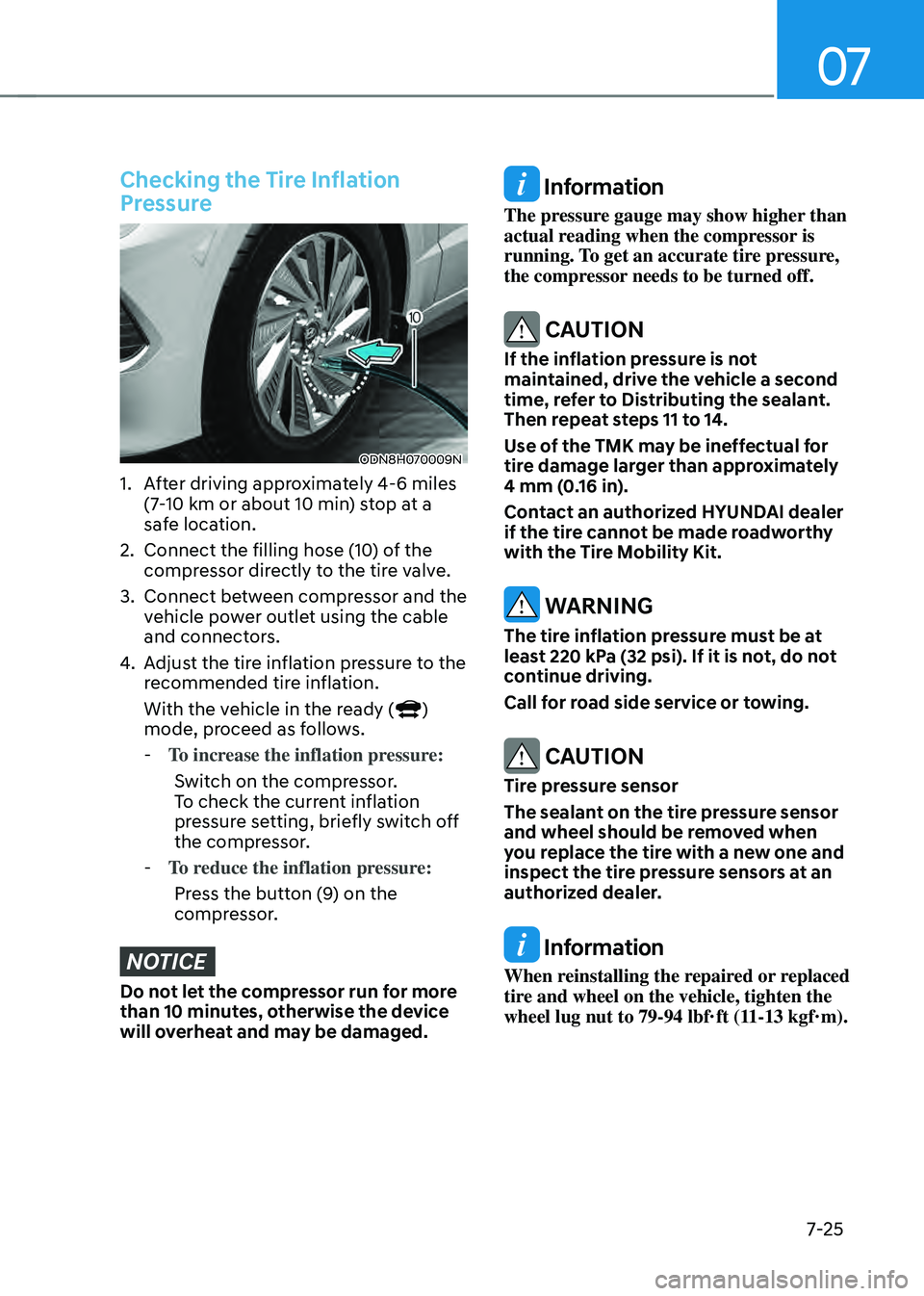
Checking the Tire Inflation
Pressure
ODN8H070009NODN8H070009N
1. After driving approximately 4-6 miles
(7-10 km or about 10 min) stop at a
safe location.
2. Connect the filling hose (10) of the
compressor directly to the tire valve.
3. Connect between compressor and the
vehicle power outlet using the cable
and connectors.
4. Adjust the tire inflation pressure to the
recommended tire inflation.
With the vehicle in the ready (
)
mode, proceed as follows.
- To increase the inflation pressure:
Switch on the compressor.
To check the current inflation
pressure setting, briefly switch off
the compressor.
- To reduce the inflation pressure:
Press the button (9) on the
compressor.
NOTICE
Do not let the compressor run for more
than 10 minutes, otherwise the device
will overheat and may be damaged.
Information
The pressure gauge may show higher than
actual reading when the compressor is
running. To get an accurate tire pressure,
the compressor needs to be turned off.
CAUTION
If the inflation pressure is not
maintained, drive the vehicle a second
time, refer to Distributing the sealant.
Then repeat steps 11 to 14.
Use of the TMK may be ineffectual for
tire damage larger than approximately
4 mm (0.16 in).
Contact an authorized HYUNDAI dealer
if the tire cannot be made roadworthy
with the Tire Mobility Kit.
WARNING
The tire inflation pressure must be at
least 220 kPa (32 psi). If it is not, do not
continue driving.
Call for road side service or towing.
CAUTION
Tire pressure sensor
The sealant on the tire pressure sensor
and wheel should be removed when
you replace the tire with a new one and
inspect the tire pressure sensors at an
authorized dealer.
Information
When reinstalling the repaired or replaced
tire and wheel on the vehicle, tighten the
wheel lug nut to 79-94 lbf·ft (11-13 kgf·m).
Page 466 of 549
Emergency situations
7-26
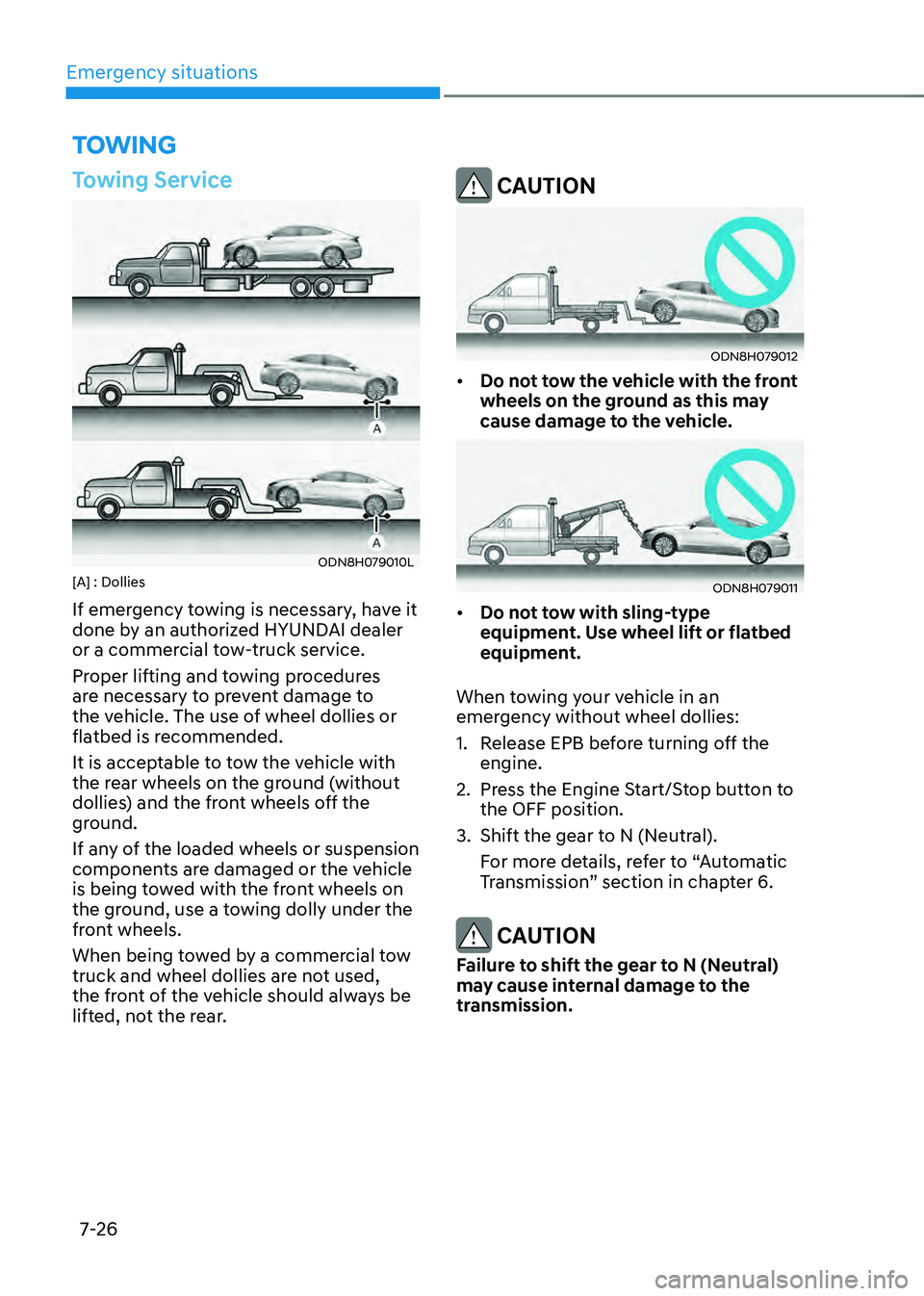
Towing Service
ODN8H079010LODN8H079010L[A] : Dollies
If emergency towing is necessary, have it
done by an authorized HYUNDAI dealer
or a commercial tow-truck service.
Proper lifting and towing procedures
are necessary to prevent damage to
the vehicle. The use of wheel dollies or
flatbed is recommended.
It is acceptable to tow the vehicle with
the rear wheels on the ground (without
dollies) and the front wheels off the
ground.
If any of the loaded wheels or suspension
components are damaged or the vehicle
is being towed with the front wheels on
the ground, use a towing dolly under the
front wheels.
When being towed by a commercial tow
truck and wheel dollies are not used,
the front of the vehicle should always be
lifted, not the rear.
CAUTION
ODN8H079012ODN8H079012
• Do not tow the vehicle with the front
wheels on the ground as this may
cause damage to the vehicle.
ODN8H079011ODN8H079011
• Do not tow with sling-type
equipment. Use wheel lift or flatbed
equipment.
When towing your vehicle in an
emergency without wheel dollies:
1. Release EPB before turning off the
engine.
2. Press the Engine Start/Stop button to
the OFF position.
3. Shift the gear to N (Neutral).
For more details, refer to “Automatic
Transmission” section in chapter 6.
CAUTION
Failure to shift the gear to N (Neutral)
may cause internal damage to the
transmission.
TOWING
Page 467 of 549
07
7-27
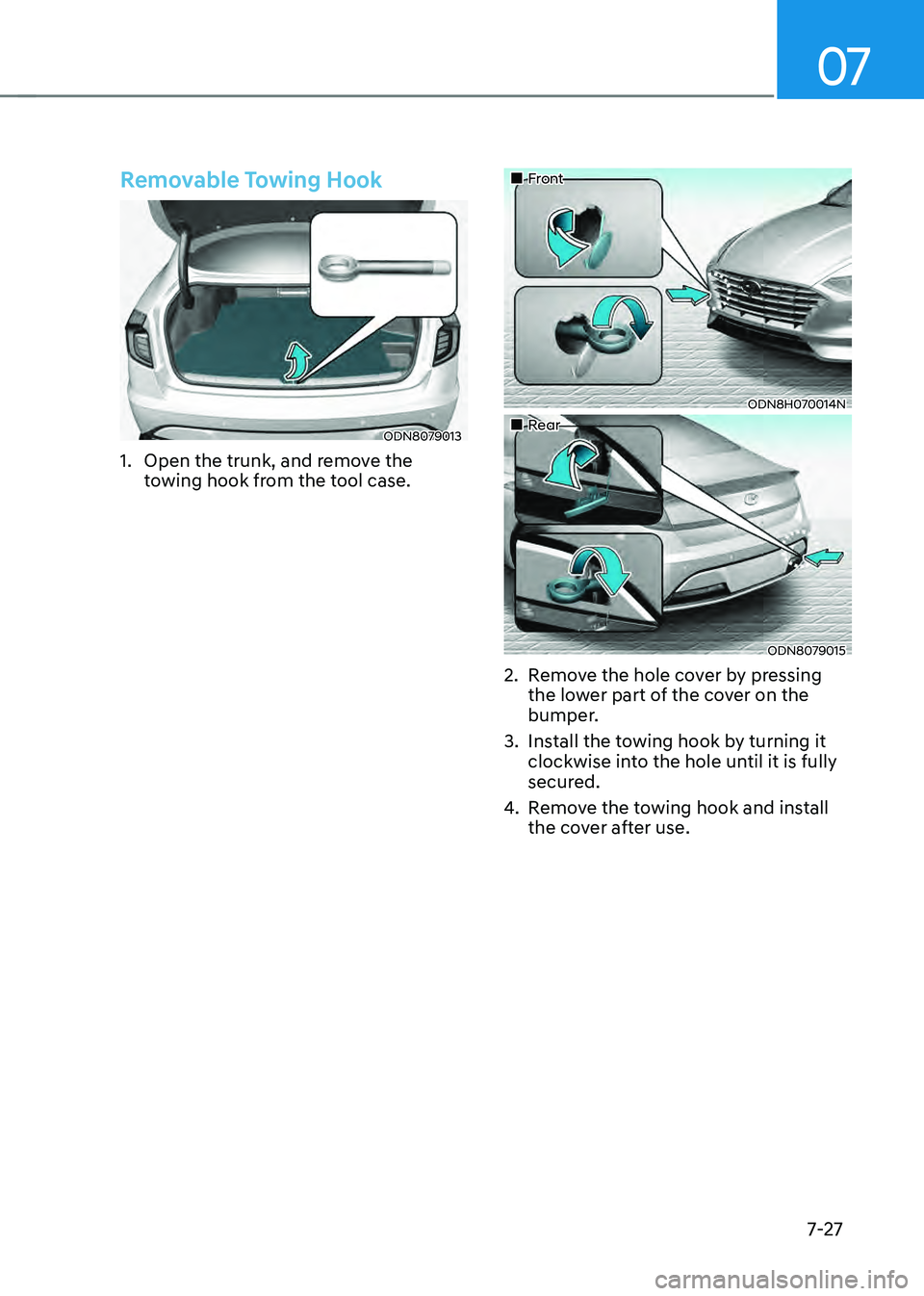
Removable Towing Hook
ODN8079013ODN8079013
1. Open the trunk, and remove the
towing hook from the tool case.
Page 468 of 549
Emergency situations
7-28
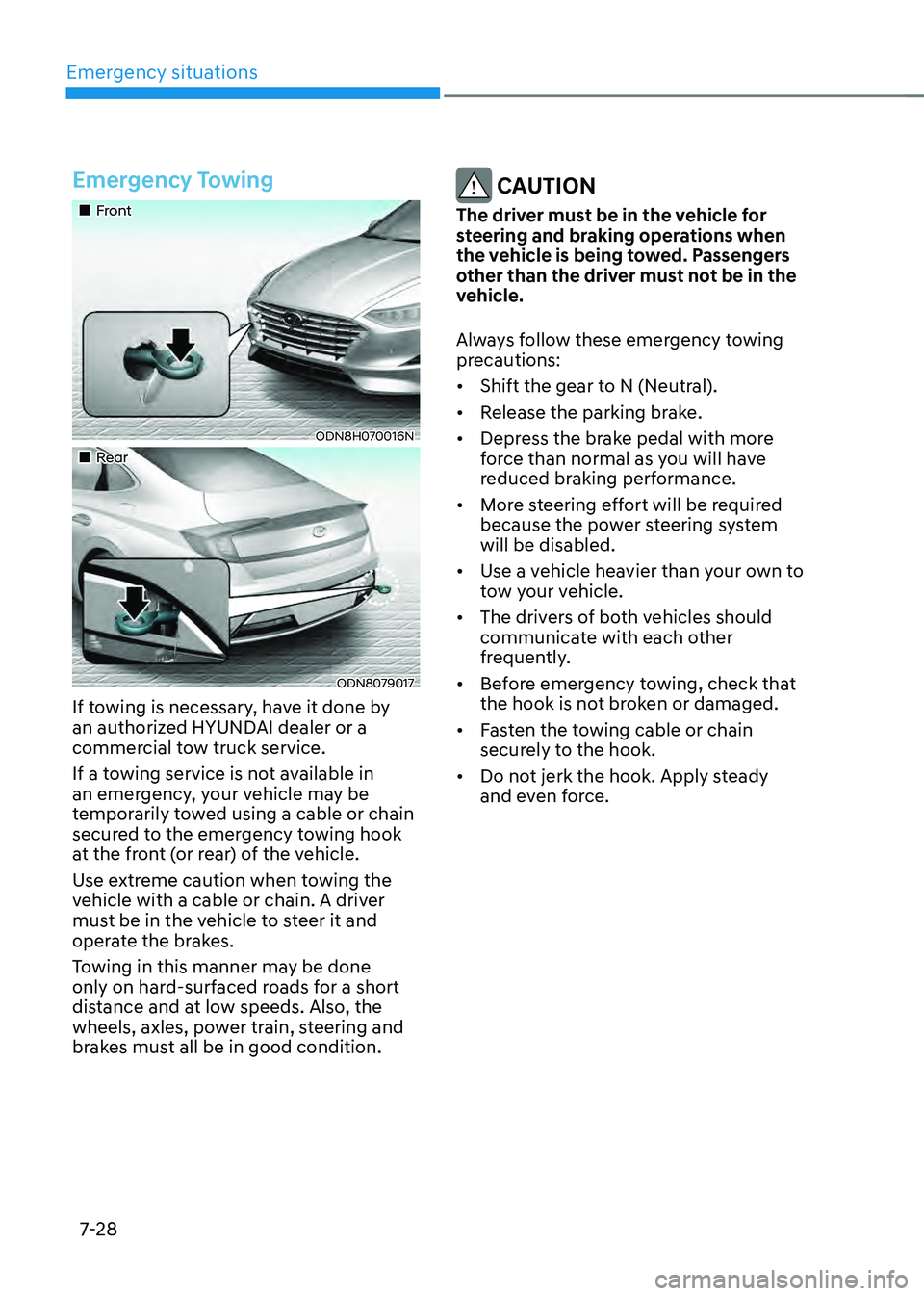
Emergency Towing
Page 469 of 549
07
7-29
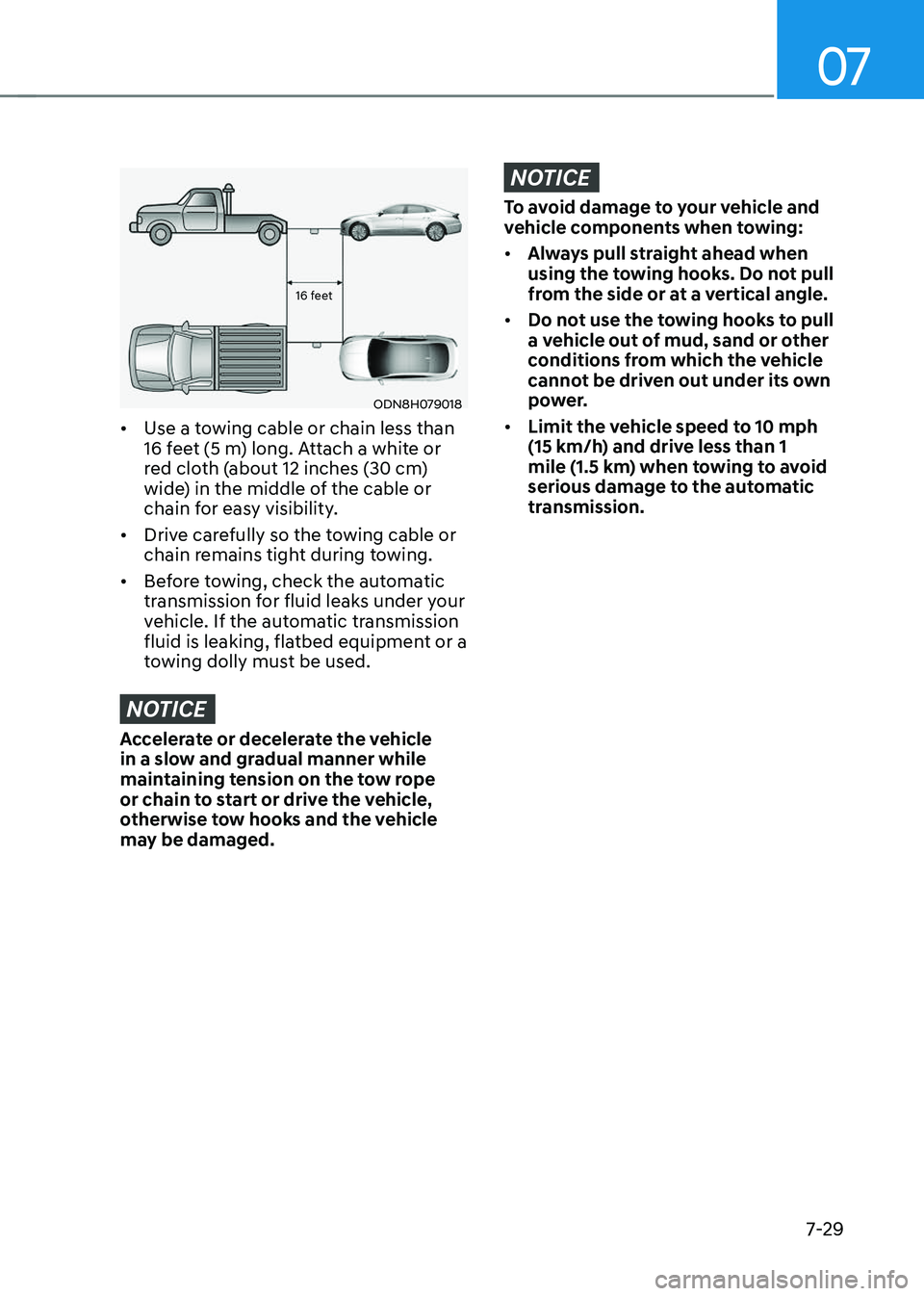
16 feet
ODN8H079018ODN8H079018
• Use a towing cable or chain less than
16 feet (5 m) long. Attach a white or
red cloth (about 12 inches (30 cm)
wide) in the middle of the cable or
chain for easy visibility.
• Drive carefully so the towing cable or
chain remains tight during towing.
• Before towing, check the automatic
transmission for fluid leaks under your
vehicle. If the automatic transmission
fluid is leaking, flatbed equipment or a
towing dolly must be used.
NOTICE
Accelerate or decelerate the vehicle
in a slow and gradual manner while
maintaining tension on the tow rope
or chain to start or drive the vehicle,
otherwise tow hooks and the vehicle
may be damaged.
NOTICE
To avoid damage to your vehicle and
vehicle components when towing:
• Always pull straight ahead when
using the towing hooks. Do not pull
from the side or at a vertical angle.
• Do not use the towing hooks to pull
a vehicle out of mud, sand or other
conditions from which the vehicle
cannot be driven out under its own
power.
• Limit the vehicle speed to 10 mph
(15 km/h) and drive less than 1
mile (1.5 km) when towing to avoid
serious damage to the automatic
transmission.
Page 470 of 549

8. Maintenance
Engine Compartment ........................................................................\
...............8-3
Maintenance Services
........................................................................\
..............8-4Owner’s Responsibility ........................................................................\
.......................8-4
Owner Maintenance Precautions ........................................................................\
.......8-4
Owner Maintenance ........................................................................\
.................8-5Owner Maintenance Schedule ........................................................................\
............8-5
Scheduled Maintenance Services ....................................................................8 -7Normal Maintenance Schedule ........................................................................\
..........8-8
Maintenance Under Severe Usage Conditions .........................................................8-11
Explanation of Scheduled Maintenance Items ..............................................8-13
Engine Oil
........................................................................\
.................................8-15Checking the Engine Oil Level ........................................................................\
...........8-15
Checking the Engine Oil and Filter ........................................................................\
...8-16
Engine Coolant/Inverter Coolant ....................................................................8-17Checking the Coolant Level ........................................................................\
................ 8-17
Changing Coolant ........................................................................\
..............................8-19
Hybrid Starter & Generator (HSG) Belt ..........................................................8-20Checking the Hybrid Starter & Generator (HSG) Belt .............................................8-20
Brake Fluid ........................................................................\
...............................8-20Checking the Brake Fluid Level ........................................................................\
........8-20
Washer Fluid ........................................................................\
.............................8-21Checking the Washer Fluid Level ........................................................................\
......8-21
Air Cleaner ........................................................................\
...............................8-22Filter Replacement ........................................................................\
.............................8-22
Cabin Air Filter ........................................................................\
.........................8-23Filter Inspection ........................................................................\
.................................. 8-23
Filter Replacement ........................................................................\
.............................8-23
Wiper Blades ........................................................................\
...........................8-24Blade Inspection ........................................................................\
................................8-24
Blade Replacement
........................................................................\
............................8-24
Maintenance
8