belt HYUNDAI SONATA LIMITED 2016 Workshop Manual
[x] Cancel search | Manufacturer: HYUNDAI, Model Year: 2016, Model line: SONATA LIMITED, Model: HYUNDAI SONATA LIMITED 2016Pages: 708, PDF Size: 25.96 MB
Page 464 of 708
5-18
Driving your vehicle
Information - KickdownMechanism
Use the kickdown mechanism on the
accelerator pedal for maximum accel-
eration. Depress the accelerator pedal
beyond the detent and the automatic
transaxle will shift to a lower gear
depending on the engine speed.i(Continued)
In the event your vehicle
leaves the roadway, do not
steer sharply. Instead, slow
down before pulling back into
the travel lanes.
HYUNDAI recommends you
follow all posted speed limits.
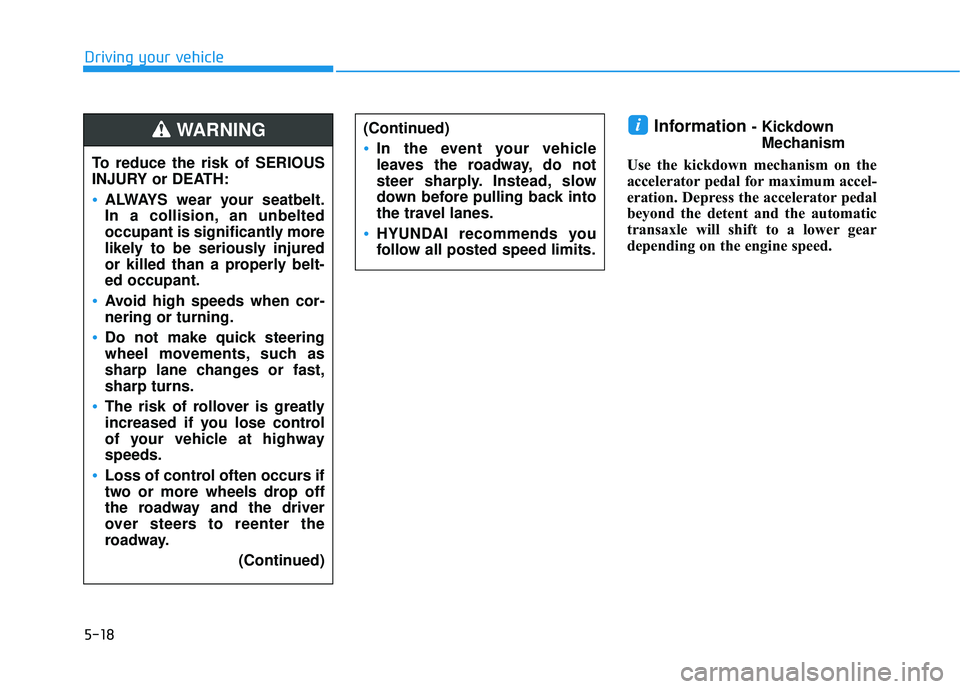
To reduce the risk of SERIOUS
INJURY or DEATH:
ALWAYS wear your seatbelt.
In a collision, an unbelted
occupant is significantly more
likely to be seriously injured
or killed than a properly belt-
ed occupant.
Avoid high speeds when cor-
nering or turning.
Do not make quick steering
wheel movements, such as
sharp lane changes or fast,
sharp turns.
The risk of rollover is greatly
increased if you lose control
of your vehicle at highway
speeds.
Loss of control often occurs if
two or more wheels drop off
the roadway and the driver
over steers to reenter the
roadway. (Continued)
WARNING
Page 469 of 708
5-23
Driving your vehicle
5
To release EPB (Electronic Parking
Brake) automatically:
Shift lever in P (Park)With the engine running depress
the brake pedal and shift out of P
(Park) to R (Reverse) or D (Drive).
Shift lever in N (Neutral) With the engine running depress
the brake pedal and shift out of N
(Neutral) to R (Reverse) or D
(Drive).
Automatic transaxle vehicle 1. Start the engine.
2. Fasten the driver's seat belt.
3. Close the driver's door, engine hood and tailgate/trunk.
4. Depress the accelerator pedal while the shift lever is in R
(Reverse), D (Drive) or Sports
mode.
Make sure the Parking Brake Warning
light ( , red color) goes off.
Information
• For your safety, you can engage the EPB even though the Engine
Stop/Start button is in the OFF posi-
tion, but you cannot release it.
• For your safety, depress the brake pedal and release the parking brake
manually with the EPB switch when
you drive downhill or when backing
up the vehicle.
If the parking brake warning light ( , red color) is still on even
though the EPB has been
released, have the system checked
by an authorized HYUNDAI dealer.
Do not drive your vehicle with the EPB applied. It may cause
excessive brake pad and brake
rotor wear.
When the EPB (Electronic Parking
Brake) does not release:
Contact an authorized HYUNDAI
dealer by loading the vehicle on a
flatbed tow truck and have the sys-
tem checked.
EPB (Electronic Parking Brake)
may be automatically applied
when:
The EPB is overheated
It is requested by other systems
The hybrid system is turned offwith the EPB applied
Information
If the driver turns the hybrid system
off while Auto Hold is operating, EPB
will be automatically applied.
However, if you press the EPB switch
within one second after the hybrid
system is turned off, the EPB will not
be applied.
i
NOTICE
i
Page 470 of 708
5-24
Driving your vehicle
Warning messages
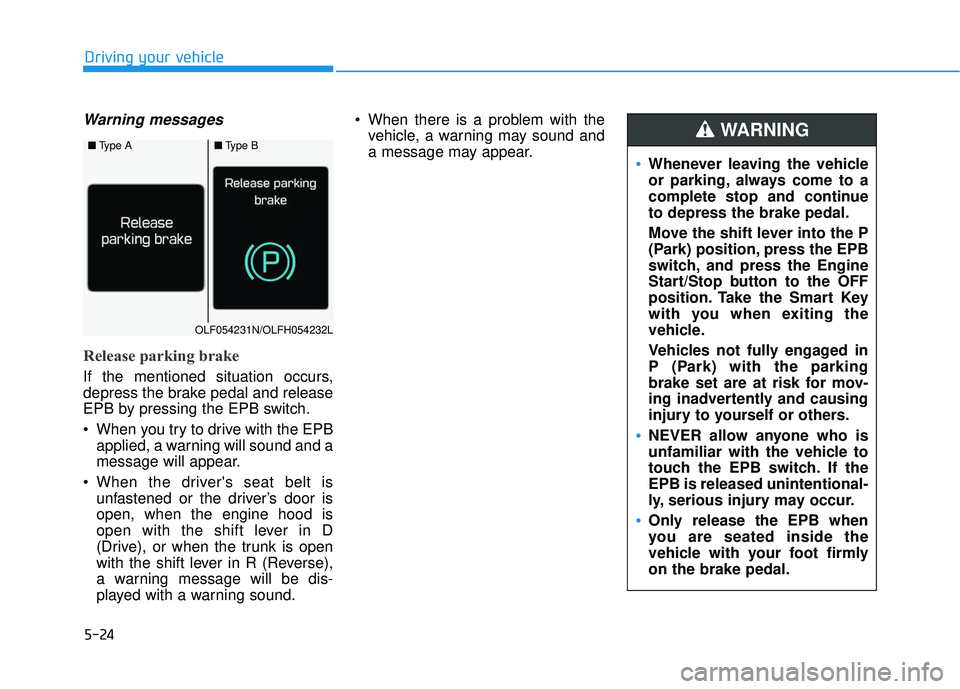
Release parking brake
If the mentioned situation occurs,
depress the brake pedal and release
EPB by pressing the EPB switch.
When you try to drive with the EPBapplied, a warning will sound and a
message will appear.
When the driver's seat belt is unfastened or the driver’s door is
open, when the engine hood is
open with the shift lever in D
(Drive), or when the trunk is open
with the shift lever in R (Reverse),
a warning message will be dis-
played with a warning sound. When there is a problem with the
vehicle, a warning may sound and
a message may appear.
■ Type A■Type B
OLF054231N/OLFH054232L
Whenever leaving the vehicle
or parking, always come to a
complete stop and continue
to depress the brake pedal.
Move the shift lever into the P
(Park) position, press the EPB
switch, and press the Engine
Start/Stop button to the OFF
position. Take the Smart Key
with you when exiting the
vehicle.
Vehicles not fully engaged in
P (Park) with the parking
brake set are at risk for mov-
ing inadvertently and causing
injury to yourself or others.
NEVER allow anyone who is
unfamiliar with the vehicle to
touch the EPB switch. If the
EPB is released unintentional-
ly, serious injury may occur.
Only release the EPB when
you are seated inside the
vehicle with your foot firmly
on the brake pedal.
WARNING
Page 474 of 708
5-28
Driving your vehicle
AUTO HOLD (if equipped)
This feature helps keep the brake
applied when the shift lever is in D
(Drive), R (Reverse), N (Neutral) or
Sports Mode with the feature
enabled and when the brake pedal
has been depressed to stop the vehi-
cle.
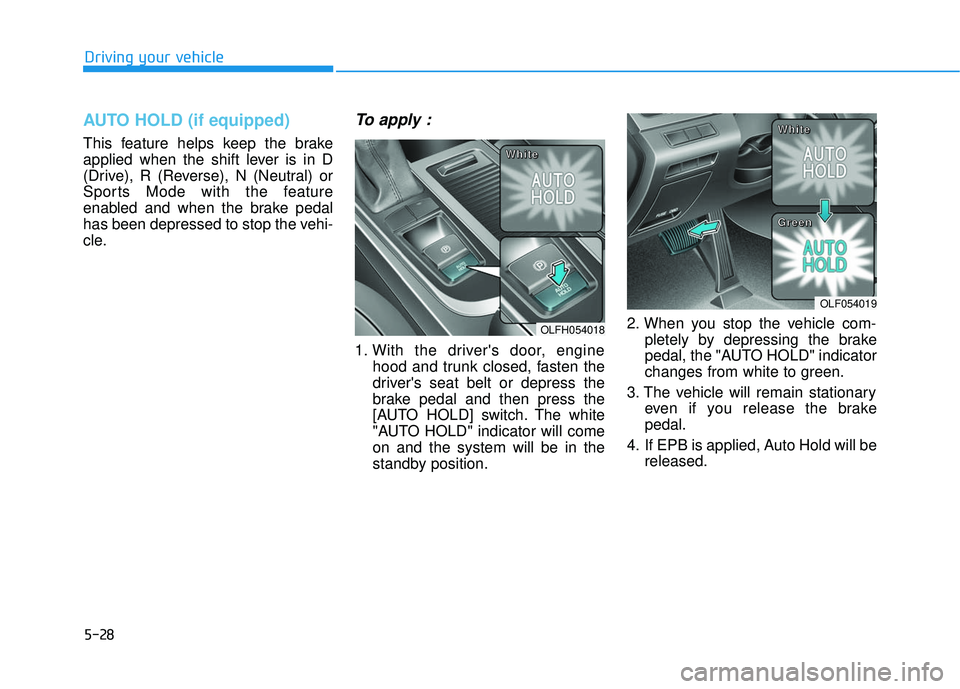
To apply :
1. With the driver's door, enginehood and trunk closed, fasten the
driver's seat belt or depress the
brake pedal and then press the
[AUTO HOLD] switch. The white
"AUTO HOLD" indicator will come
on and the system will be in the
standby position. 2. When you stop the vehicle com-
pletely by depressing the brake
pedal, the "AUTO HOLD" indicator
changes from white to green.
3. The vehicle will remain stationary even if you release the brake
pedal.
4. If EPB is applied, Auto Hold will be released.
OLFH054018
W
W
W
W
h
h
h
h
i
i
i
i
t
t
t
t
e
e
e
e
OLF054019
W
W
W
W
h
h
h
h
i
i
i
i
t
t
t
t
e
e
e
e
G
G
G
G
r
r
r
r
e
e
e
e
e
e
e
e
n
n
n
n
Page 476 of 708
5-30
Driving your vehicle
Information
• The Auto Hold does not operatewhen:
- The driver's seat belt is unfastenedand driver's door is opened
- The engine hood is opened
- The trunk is opened
- The shift lever is in P (Park)
- The EPB is applied
• For your safety, the Auto Hold auto- matically switches to EPB when:
- The driver's seat belt is unfastenedand driver's door is opened
- The engine hood is opened with the shift lever is in D (Drive)
- The trunk is opened with the shift lever is in R (Reverse)
- The vehicle stops for more than 10 minutes
- The vehicle stands on a steep slope
- The vehicle moves several times (Continued)(Continued)
In these cases, the parking brake
warning light ( , red color) illu-
minates, the “AUTO HOLD” indi-
cator color changes from green to
white, and a message will be dis-
played with warning sound to
inform you that EPB is automatical-
ly applied.
• If the "AUTO HOLD" indicator changes to yellow, the Auto Hold is
not working properly. Contact an
authorized HYUNDAI dealer.
• While operating Auto Hold, you may hear mechanical noise. However, it is
normal operating noise. If there is a malfunction with the
driver’s door, engine hood or
trunk open detection system, the
Auto Hold may not work properly.
Contact an authorized HYUNDAI
dealer.
NOTICE
i
Press the accelerator pedal
slowly when you start the
vehicle.
For your safety, cancel the
Auto Hold when you drive
downhill, back up the vehicle
or park the vehicle.
WARNING
Page 478 of 708
![HYUNDAI SONATA LIMITED 2016 Workshop Manual 5-32
Driving your vehicle
AUTO HOLD conditions not met.
Close door, hood, trunk, and fasten
seatbelt
When you press the [AUTO HOLD]
switch, if the driver’s door, engine
hood and trunk are not closed](/img/35/56186/w960_56186-477.png "HYUNDAI SONATA LIMITED 2016 Workshop Manual 5-32
Driving your vehicle
AUTO HOLD conditions not met.
Close door, hood, trunk, and fasten
seatbelt
When you press the [AUTO HOLD]
switch, if the driver’s door, engine
hood and trunk are not closed")
5-32
Driving your vehicle
AUTO HOLD conditions not met.
Close door, hood, trunk, and fasten
seatbelt
When you press the [AUTO HOLD]
switch, if the driver’s door, engine
hood and trunk are not closed or the
driver’s seat belt is unfastened, a
warning will sound and a message
will appear on the LCD display. Press
the [AUTO HOLD] button again after
closing the driver’s door, engine
hood and trunk and fastening the
seat belt.
Anti-lock Brake System (ABS)
ABS is an electronic braking system
that helps prevent a braking skid.
ABS allows the driver to steer and
brake at the same time.
An Anti-Lock Braking System
(ABS) or an Electronic Stability
Control (ESC) system will not
prevent accidents due to
improper or dangerous driving
maneuvers. Even though vehi-
cle control is improved during
emergency braking, always
maintain a safe distance
between you and objects ahead
of you. Vehicle speeds should
always be reduced during
extreme road conditions. The
braking distance for cars
equipped with ABS or ESC may
be longer than for those without
these systems in the following
road conditions.
Drive your vehicle at reduced
speeds during the following
conditions:
Rough, gravel or snow-cov-
ered roads.
(Continued)
WARNING
OLF054129N
(Continued)
On roads where the road sur-
face is pitted or has different
surface height.
Tire chains are installed on
your vehicle.
The safety features of an ABS
or ESC equipped vehicle should
not be tested by high speed
driving or cornering. This could
endanger the safety of yourself
or others.
Page 527 of 708
5-81
Driving your vehicle
5
Highway driving
Tires
Adjust the tire inflation, as specified.
Under-inflation may overheat or
damage the tires.
Do not install worn-out or damaged
tires, which may reduce traction or
fail the braking operation.
Information
Never over-inflate your tires above the
maximum inflation pressure, as speci-
fied on your tires.
Fuel, engine coolant and engineoil
Driving at a high speed consumes
more fuel than driving at a slow
speed, such as in an urban area. Do
not forget to check both the engine
coolant and engine oil.
Drive belt
A loose or damaged drive belt may
overheat the engine.i
Page 565 of 708
7
Maintenance
7
Maintenance
Engine compartment .............................................7-3
Maintenance services ...........................................7-4
Owner's responsibility ......................................................7-4
Owner maintenance precautions ..................................7-4
Owner maintenance ...............................................7-5
Owner maintenance schedule ........................................7-6
Scheduled maintenance services.........................7-8
Explanation of scheduled maintenance
items.......................................................................7\
-24
Engine oil ..............................................................7-27
Checking the engine oil level .......................................7-27
Checking the engine oil and filter ..............................7-28
Engine coolant/inverter coolant .......................7-29
Checking the engine/inverter coolant level .............7-29
Changing engine coolant...............................................7-32
Hybrid starter & generator (HSG) belt.............7-32
Checking the hybrid starter &
generator (HSG) belt ......................................................7-32
Brake fluid ............................................................7-33
Checking the brake fluid level .....................................7-33
Washer fluid .........................................................7-34
Checking the washer fluid level ..................................7-34
Parking brake .......................................................7-34
Checking the parking brake .........................................7-34
Air cleaner ............................................................7-35
Filter replacement ...........................................................7-35
Climate control air filter .....................................7-37
Filter inspection ...............................................................7-37
Wiper blades .........................................................7-39
Blade inspection ..............................................................7-39
Blade replacement ..........................................................7-39
Battery...................................................................7-41
For best battery service................................................7-42
Battery recharging .........................................................7-42
Reset features .................................................................7-43
Tires and wheels ..................................................7-44
Tire care ........................................................................\
....7-44
Recommended cold tire inflation pressures.............7-45
Check tire inflation pressure........................................7-46
Tire rotation .....................................................................7-4\
7
Wheel alignment and tire balance ..............................7-48
Tire replacement .............................................................7-48
Wheel replacement .........................................................7-49
Tire traction ......................................................................7-\
49
Tire maintenance ............................................................7-50
Tire sidewall labeling ......................................................7-50
Tire terminology and definitions.................................7-54
All season tires ................................................................7-57
Summer tires ....................................................................7-57\
7
Page 571 of 708
7-7
7
Maintenance
At least twice a year:(i.e., every Spring and Fall)
Check radiator, heater and air condi-
tioning hoses for leaks or damage.
Check windshield washer spray and wiper operation. Clean wiper
blades with clean cloth dampened
with washer fluid.
Check headlamp alignment.
Check muffler, exhaust pipes, shields and clamps.
Check the seat belts for wear and function.
At least once a year:
Clean body and door drain holes.
Lubricate door hinges and hoodhinges.
Lubricate door and hood locks and latches.
Lubricate door rubber weather strips.
Check the air conditioning system.
Inspect and lubricate automatic transaxle linkage and controls.
Clean the battery and terminals.
Check the brake fluid level.
Page 573 of 708
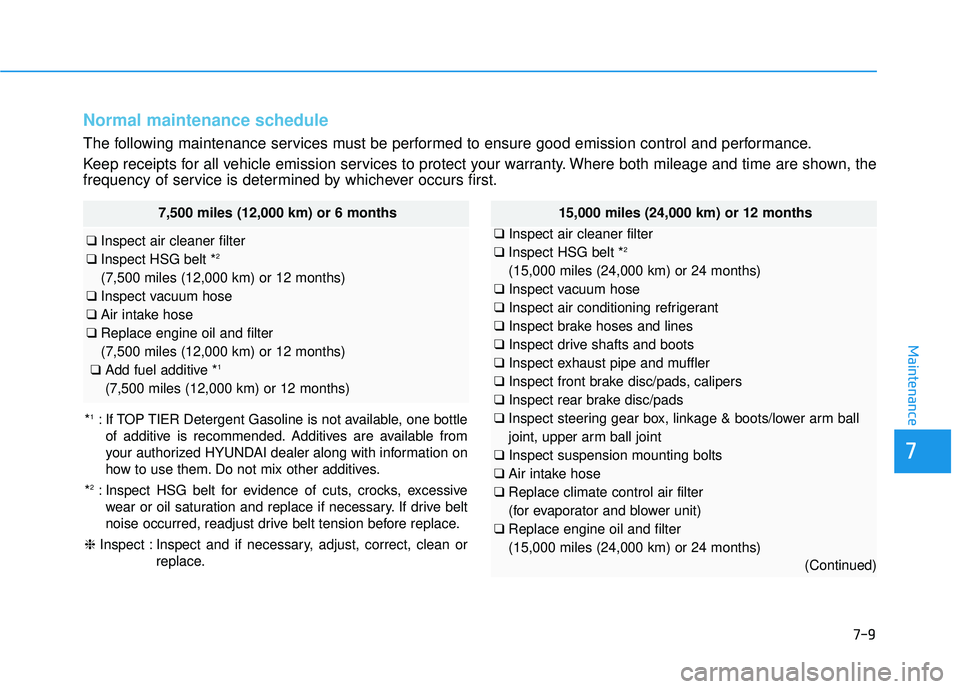
Normal maintenance schedule
The following maintenance services must be performed to ensure good emission control and performance.
Keep receipts for all vehicle emission services to protect your warranty. Where both mileage and time are shown, the
frequency of service is determined by whichever occurs first.
7
Maintenance
7-9
7,500 miles (12,000 km) or 6 months
❑Inspect air cleaner filter
❑ Inspect HSG belt *2
(7,500 miles (12,000 km) or 12 months)
❑ Inspect vacuum hose
❑ Air intake hose
❑ Replace engine oil and filter
(7,500 miles (12,000 km) or 12 months)
❑ Add fuel additive *
1
(7,500 miles (12,000 km) or 12 months)
*1: If TOP TIER Detergent Gasoline is not available, one bottle
of additive is recommended. Additives are available from
your authorized HYUNDAI dealer along with information on
how to use them. Do not mix other additives.
*
2: Inspect HSG belt for evidence of cuts, crocks, excessive wear or oil saturation and replace if necessary. If drive belt
noise occurred, readjust drive belt tension before replace.
❈ Inspect : Inspect and if necessary, adjust, correct, clean or
replace.
15,000 miles (24,000 km) or 12 months
❑Inspect air cleaner filter
❑ Inspect HSG belt *2
(15,000 miles (24,000 km) or 24 months)
❑ Inspect vacuum hose
❑ Inspect air conditioning refrigerant
❑ Inspect brake hoses and lines
❑ Inspect drive shafts and boots
❑ Inspect exhaust pipe and muffler
❑ Inspect front brake disc/pads, calipers
❑ Inspect rear brake disc/pads
❑ Inspect steering gear box, linkage & boots/lower arm ball
joint, upper arm ball joint
❑ Inspect suspension mounting bolts
❑ Air intake hose
❑ Replace climate control air filter
(for evaporator and blower unit)
❑ Replace engine oil and filter
(15,000 miles (24,000 km) or 24 months)
(Continued)