fuel pressure HYUNDAI SONATA LIMITED 2021 User Guide
[x] Cancel search | Manufacturer: HYUNDAI, Model Year: 2021, Model line: SONATA LIMITED, Model: HYUNDAI SONATA LIMITED 2021Pages: 546, PDF Size: 51.21 MB
Page 426 of 546
6-142
Driving in Flooded Areas
Avoid driving through flooded areas
unless you are sure the water is no
higher than the bottom of the wheel hub.
Drive through any water slowly. Allow
adequate stopping distance because
brake performance may be reduced.
After driving through water, dry the
brakes by gently applying them several
times while the vehicle is moving slowly.
Highway Driving
Tires
Adjust the tire inflation, as specified.
Under-inflation may overheat or damage
the tires.
Do not install worn-out or damaged tires,
which may reduce traction or adversely
affect vehicle handling. This could lead
to sudden tire failure that may cause
loss of vehicle control resulting in an
accident.
Information
Never over-inflate your tires above the
maximum inflation pressure, as specified
on your tires.
Fuel, engine coolant and engine oil
Driving at higher speeds on the highway
consumes more fuel and is less efficient
than driving at a slower, more moderate
speed. Maintain a moderate speed in
order to conserve fuel when driving on
the highway.
Be sure to check both the engine coolant
level and the engine oil before driving.
Drive belt
A loose or damaged drive belt may
overheat the engine.
While Driving
Page 443 of 546
Emergency Situations
7-8
Tire Pressure Monitoring System
WARNING
Over-inflation or under-inflation can
reduce tire life, adversely affect vehicle
handling, and lead to sudden tire failure
that may cause loss of vehicle control
resulting in an accident.
Each tire, including the spare (if
provided), should be checked monthly
when cold and inflated to the inflation
pressure recommended by the vehicle
manufacturer on the vehicle placard
or tire inflation pressure label. If your
vehicle has tires of a different size than
the size indicated on the vehicle placard
or tire inflation pressure label, you should
determine the proper tire inflation
pressure for those tires.
As an added safety feature, your
vehicle has been equipped with a tire
pressure monitoring system (TPMS)
that illuminates a low tire pressure
telltale when one or more of your tires is
significantly under-inflated. Accordingly,
when the low tire pressure telltale
illuminates, you should stop and check
your tires as soon as possible, and inflate
them to the proper pressure. Driving on
a significantly under-inflated tire causes
the tire to overheat and can lead to tire
failure.
Under-inflation also reduces fuel
efficiency and tire tread life, and may
affect the vehicle’s handling and
stopping ability.
Please note that the TPMS is not a
substitute for proper tire maintenance,
and it is the driver’s responsibility to
maintain correct tire pressure, even if
under-inflation has not reached the level
to trigger illumination of the TPMS low
tire pressure telltale.
Your vehicle has also been equipped with
a TPMS malfunction indicator to indicate
when the system is not operating
properly. The TPMS malfunction
indicator is combined with the low
tire pressure telltale. When the system
detects a malfunction, the telltale will
flash for approximately one minute and
then remain continuously illuminated.
This sequence will continue upon
subsequent vehicle start-ups as long as
the malfunction exists.
When the malfunction indicator is
illuminated, the system may not be able
to detect or signal low tire pressure as
intended. TPMS malfunctions may occur
for a variety of reasons, including the
installation of replacement or alternate
tires or wheels on the vehicle that
prevent the TPMS from functioning
properly.
Always check the TPMS malfunction
telltale after replacing one or more tires
or wheels on your vehicle to ensure that
the replacement or alternate tires and
wheels allow the TPMS to continue to
function properly.
NOTICE
If any of the below happens, have
the system checked by an authorized
HYUNDAI dealer.
1.
The L
ow Tire Pressure TPMS
Malfunction Indicator does not
illuminate for 3 seconds when the
ignition switch is placed to the ON
position or engine is running.
2.
The TPMS M
alfunction Indicator
remains illuminated after blinking for
approximately 1 minute.
3.
The L
ow Tire Pressure LCD display
remains illuminated
Page 488 of 546
Maintenance
8-34
WARNING
Tire failure may cause loss of
vehicle control resulting in an
accident. To reduce risk of SERIOUS
INJURY or DEATH, take the
following precautions:
• Inspect your tires monthly for
proper inflation as well as wear
and damage.
• The recommended cold tire
pressure for your vehicle can be
found in this manual and on the
tire label located on the driver’s
side center pillar. Always use a
tire pressure gauge to measure
tire pressure. Tires with too
much or too little pressure wear
unevenly causing poor handling.
• Check the pressure of the
spare every time you check the
pressure of the other tires on
your vehicle.
• Replace tires that are worn, show
uneven wear, or are damaged.
Worn tires can cause loss of
braking effectiveness, steering
control, or traction.
• ALWAYS replace tires with
the same type, size, brand,
construction and tread pattern
as each tire that was originally
supplied with this vehicle. Using
tires and wheels other than the
recommended sizes could cause
unusual handling characteristics,
poor vehicle control, or
negatively affect your vehicle’s
Anti-Lock Brake System (ABS)
resulting in a serious accident.
Tire Care
For proper maintenance, safety, and
maximum fuel economy, you must
always maintain recommended
tire inflation pressures and stay
within the load limits and weight
distribution recommended for your
vehicle.
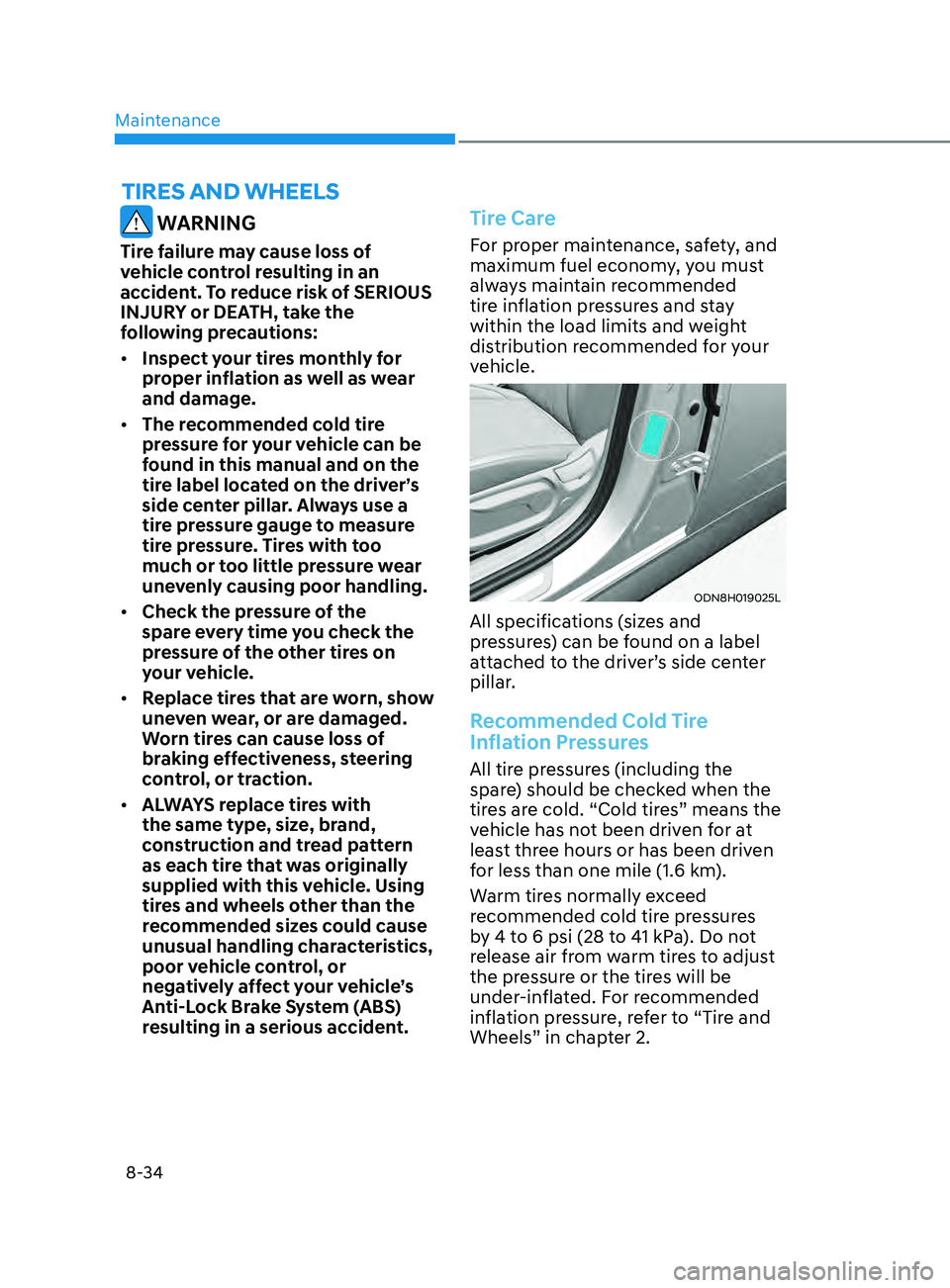
ODN8H019025L
All specifications (sizes and
pressures) can be found on a label
attached to the driver’s side center
pillar.
Recommended Cold Tire
Inflation Pressures
All tire pressures (including the
spare) should be checked when the
tires are cold. “Cold tires” means the
vehicle has not been driven for at
least three hours or has been driven
for less than one mile (1.6 km).
Warm tires normally exceed
recommended cold tire pressures
by 4 to 6 psi (28 to 41 kPa). Do not
release air from warm tires to adjust
the pressure or the tires will be
under-inflated. For recommended
inflation pressure, refer to “Tire and
Wheels” in chapter 2.
tirES and whEElS
Page 489 of 546
08
8-35
WARNING
Recommended pressures must be
maintained for the best ride, vehicle
handling, and minimum tire wear.
Over-inflation or under-inflation
can reduce tire life, adversely
affect vehicle handling, and lead to
sudden tire failure that could result
in loss of vehicle control resulting in
an accident.
Severe under-inflation can lead
to severe heat build-up, causing
blowouts, tread separation and
other tire failures that can result in
the loss of vehicle control resulting
in an accident. This risk is much
higher on hot days and when
driving for long periods at high
speeds.
CAUTION
• Under-inflation results in
excessive wear, poor handling
and reduced fuel economy.
Wheel deformation is also
possible. Keep your tire pressures
at the proper levels. If a tire
frequently needs refilling, have
it checked by an authorized
HYUNDAI dealer.
• Over-inflation produces a harsh
ride, excessive wear at the center
of the tire tread, and a greater
possibility of damage from road
hazards.
Check Tire Inflation Pressure
Check your tires, including the spare
tire, once a month or more.
How to check
Use a good quality tire pressure
gauge to check tire pressure. You
can not tell if your tires are properly
inflated simply by looking at them.
Radial tires may look properly
inflated when they are under-
inflated.
Remove the valve cap from the tire
valve stem. Press the tire gauge
firmly onto the valve to get a
pressure measurement. If the cold
tire inflation pressure matches the
recommended pressure on the tire
label located on the driver’s side
center pillar or in this manual. No
further adjustment is necessary. If
the pressure is low, add air until you
reach the recommended pressure.
Make sure to put the valve caps
back on the valve stems. Without
the valve cap, dirt or moisture could
get into the valve core and cause
air leakage. If a valve cap is missing,
install a new one as soon as possible.
If you overfill the tire, release air by
pushing on the metal stem in the
center of the tire valve. Recheck the
tire pressure with the tire gauge. Be
sure to put the valve caps back on
the valve stems. Without the valve
cap, dirt or moisture could get into
the valve core and cause air leakage.
If a valve cap is missing, install a new
one as soon as possible.
Page 497 of 546
08
8-43
Curb Weight
This means the weight of a motor
vehicle with standard and optional
equipment including the maximum
capacity of fuel, oil and coolant, but
without passengers and cargo.
DOT Markings
A code molded into the sidewall
of a tire signifying that the tire
is in compliance with the U.S.
Department of Transportation motor
vehicle safety standards. The DOT
code includes the Tire Identification
Number (TIN), an alphanumeric
designator which can also identify
the tire manufacturer, production
plant, brand and date of production.
GVWR
Gross Vehicle Weight Rating
GAWR FRT
Gross Axle Weight Rating for the
Front Axle.
GAWR RR
Gross Axle Weight Rating for the
Rear axle.
Intended Outboard Sidewall
The side of an asymmetrical tire,
that must always face outward when
mounted on a vehicle.
Kilopascal (kPa)
The metric unit for air pressure.
Light truck (LT) tire
A tire designated by its manufacturer
as primarily intended for use on
lightweight trucks or multipurpose
passenger vehicles.Tire Terminology and Definitions
Air Pressure
The amount of air inside the tire
pressing outward on the tire. Air
pressure is expressed in pounds per
square inch (psi) or kilopascal (kPa).
Accessory Weight
This means the combined weight
of optional accessories. Some
examples of optional accessories
are automatic transmission, power
seats, and air conditioning
.
Aspect Ratio
The relationship of a tire’s height to
its width.
Belt
A rubber coated layer of cords that
is located between the plies and the
tread. Cords may be made from steel
or other reinforcing materials.
Bead
The tire bead contains steel wires
wrapped by steel cords that hold the
tire onto the rim.
Bias Ply Tire
A pneumatic tire in which the plies
are laid at alternate angles less than
90 degrees to the centerline of the
tread.
Cold Tire Pressure
The amount of air pressure in a tire,
measured in pounds per square inch
(psi) or kilopascals (kPa) before a tire
has built up heat from driving.
Page 544 of 546

IndexI-16
Tires and wheels ........................................................................\
.................. 2-9, 8-34
Tire care
........................................................................\
................................... 8-34
Recommended cold tire inflation pressures
....................................................8-34
Check tire inflation pressure
........................................................................\
... 8-35
Tire rotation
........................................................................\
............................. 8-36
Wheel alignment and tire balance
................................................................... 8-37
Tire replacement
........................................................................\
...................... 8-38
Wheel replacement
........................................................................\
.................. 8-39
Tire maintenance
........................................................................\
..................... 8-39
Tire traction
........................................................................\
............................. 8-39
Tire sidewall labeling
........................................................................\
.............. 8-39
Tire terminology and definitions
..................................................................... 8-43
All
Season Tires ........................................................................\
...................... 8-46
Summer Tires
........................................................................\
.......................... 8-46
Snow Tires
........................................................................\
............................... 8-46
Radial-Ply Tires
........................................................................\
....................... 8-46
Low Aspect Ratio Tires
........................................................................\
........... 8-47
Towing
........................................................................\
......................................... 7-18
Trailer towing
........................................................................\
............................ 6-151
Trip computer
........................................................................\
.............................. 4-31
Average fuel economy
........................................................................\
............. 4-31
Instant fuel economy
........................................................................\
............... 4-31
Accumulated Info display
........................................................................\
....... 4-32
Driving Info display
........................................................................\
................ 4-32
Digital speedometer
........................................................................\
................ 4-33
Auto Stop accumulated time
........................................................................\
... 4-33
Smart shift
........................................................................\
............................... 4-33
Trunk
........................................................................\
............................................ 5-65
Turn signals........................................................................\
.................................. 5-79
U
USB charger
........................................................................\
............................... 5-147
Page 545 of 546

I
I-17
V
Vanity mirror lamp
........................................................................\
....................... 5-82
Vehicle break-in process
........................................................................\
................ 1-7
Vehicle certification label
........................................................................\
............ 2-13
Vehicle identification number (VIN)
................................................................... 2-13
Vehicle load limit
........................................................................\
....................... 6-146
Tire loading information label
....................................................................... 6-146
Vehicle modification
........................................................................\
...................... 1-7
Vehicle Stability Management (VSM)................................................................. 6-31
Vehicle weight and luggage volume
.................................................................... 2-10
W
Warning and indicator lights
........................................................................\
.......... 4-7
Air bag warning light
........................................................................\
................ 4-7
Seat belt warning light
........................................................................\
.............. 4-7
Parking brake & brake fluid warning light
.......................................................4-8
Anti-lock Brake System (ABS) warning light
.................................................. 4-9
Electronic brake force distribution (EBD) system warning light
...................... 4-9
Electric Power Steering (EPS) warning light
....................................................4-9
AUTO HOLD indicator light
........................................................................\
.. 4-10
Electric Power Steering (EPS) warning light
..................................................4-10
Malfunction Indicator lamp (MIL).................................................................. 4-10
Charging system warning light
...................................................................... 4-11
Engine oil pressure warning light
.................................................................. 4-11
Low fuel level warning light
........................................................................\
.. 4-11
Master warning light
........................................................................\
............... 4-11
Low tire pressure warning light
...................................................................... 4-11
Electronic stability control (ESC) indicator light............................................ 4-11
Electronic stability control (ESC) OFF indicator light
................................... 4-13
Immobilizer indicator light
........................................................................\
..... 4-13
Turn signal indicator light
........................................................................\
....... 4-14
Headlamp warning light
........................................................................\
.......... 4-14
High beam indicator light........................................................................\
........ 4-14
High Beam
Assist (HBA) indicator light
........................................................ 4-14
Light ON indicator light
........................................................................\
.......... 4-14
Forward Collision-Avoidance Assist warning light
........................................4-15
Lane Keeping Assist indicator light
................................................................ 4-15
Washer fluid
........................................................................\
................................. 8-25