brake light Hyundai Sonata Plug-in Hybrid 2017 Service Manual
[x] Cancel search | Manufacturer: HYUNDAI, Model Year: 2017, Model line: Sonata Plug-in Hybrid, Model: Hyundai Sonata Plug-in Hybrid 2017Pages: 744, PDF Size: 27.87 MB
Page 547 of 744
6-5
What to do in an emergency
6
Information
An inappropriately disposedbattery can be harmful to the
environment and human
health. Dispose the battery
according to your local law(s)
or regulations.
To prevent damage to your vehi-
cle:
Only use a 12-volt power supply (battery or jumper system) to
jump start your vehicle.
Do not attempt to jump start your vehicle by push-starting.
Jump starting procedure
1. Position the vehicles close enough that the jumper cables will reach,
but do not allow the vehicles to
touch.
2. Avoid fans or any moving parts in the engine compartment at all
times, even when the vehicles are
turned off.
3. Turn off all electrical devices such as radios, lights, air conditioning,
etc. Put the vehicles in P (Park)
and set the parking brakes. Turn
both vehicles OFF.
Information
Your vehicle has a battery in the trunk
compartment.
i
NOTICE
i
Pb
(Continued)
NEVER attempt to recharge
the battery when the vehicle’s
battery cables are connected
to the battery.
The electrical ignition system
works with high voltage.
NEVER touch these compo-
nents with the engine running
or when the ignition switch is
in the ON position.
Page 549 of 744
6-7
What to do in an emergency
6
If your engine coolant temperature
gauge indicates overheating, you
experience a loss of power, or hear
loud pinging or knocking, the engine
may be overheating. If this happens,
you should:
1. Turn ON the hazard warning flash-er, pull off the road and stop as
soon as it is safe to do so.
2. Place the shift lever in P (Park) and set the parking brake.
3. Make sure that there is no hotsteam gushing out of the engine
compartment. When it is safe to
do so, open the engine compart-
ment, and check the water-pump
connector. When the water-pump
connector is disconnected, stop
the engine, re-connect the water-
pump connector, and then re-start
the engine.
4. Set the temperature and the air flow to the maximum, and turn ON
the air conditioner. 5. When the Service warning light
( ) illuminates on the instru-
ment cluster, immediately stop the
engine, and contact an authorized
HYUNDAI dealer. When the
engine warning light ( ) illumi-
nates, or when the coolant or hot
steams gush out of the engine
compartment, leave the engine
compartment opened, while run-
ning the engine. This is to ventilate
the engine compartment and to
cool down the engine.
6. Check the coolant temperature gauge on the instrument cluster to
make sure the coolant temperature
is sufficiently cooled down. Check
the coolant level. When it is insuffi-
cient, check its connection with the
radiator, the heater hose, and the
water pump for any leakage. When
there is no leakage, add the
coolant. However, if the problems
persists, such as the illumination of
the warning lights, leakages, or the
cooling-fan malfunction, which may
overheat the engine, immediately
stop the engine, and have your
vehicle checked by an authorized
HYUNDAI dealer.
I
IF
F
T
T H
H E
E
E
E N
N G
GI
IN
N E
E
O
O V
VE
ER
R H
H E
EA
A T
TS
S
OLFH064029L
Page 556 of 744
6-14
What to do in an emergency
A cold tire means the vehicle has
been sitting for 3 hours and driven for
less than 1 mile (1.6 km) in that 3
hour period.
Allow the tire to cool before measur-
ing the inflation pressure. Always be
sure the tire is cold before inflating to
the recommended pressure.
Information
This device complies with Part 15 of
the FCC rules.
Operation is subject to the following
three conditions:
1. This device may not cause harmful interference, and
2. This device must accept any inter- ference received, including interfer-
ence that may cause undesired
operation.
3. Changes or modifications not expressly approved by the party
responsible for compliance could
void the user’s authority to operate
the equipment.
i
The TPMS cannot alert you to
severe and sudden tire dam-
age caused by external fac-
tors such as nails or road
debris.
If you feel any vehicle instabil-
ity, immediately take your foot
off the accelerator, apply the
brakes gradually with light
force, and slowly move to a
safe position off the road.
WARNING
Tampering with, modifying, or
disabling the Tire Pressure
Monitoring System (TPMS)
components may interfere with
the system's ability to warn the
driver of low tire pressure con-
ditions and/or TPMS malfunc-
tions. Tampering with, modify-
ing, or disabling the Tire
Pressure Monitoring System
(TPMS) components may void
the warranty for that portion of
the vehicle.
WARNING
Page 574 of 744

7-6
Maintenance
Owner maintenance schedule
When you stop for fuel:
Check the engine oil level.
Check coolant level in the enginecoolant reservoir.
Check the windshield washer fluid level.
Check for low or under-inflated tires.
While operating your vehicle:
Note any changes in the sound ofthe exhaust or any smell of
exhaust fumes in the vehicle.
Check for vibrations in the steering wheel. Notice if there is any
increased steering effort or loose-
ness in the steering wheel, or
change in its straight-ahead posi-
tion.
Notice if your vehicle constantly turns slightly or "pulls" to one side
when traveling on smooth, level
road.
When stopping, listen and check for unusual sounds, pulling to one
side, increased brake pedal travel
or "hard-to-push" brake pedal.
If any slipping or changes in the operation of your transmission
occurs, check the transmission
fluid level.
Check the automatic transmission P (Park) function.
Check the parking brake.
Check for fluid leaks under your vehicle (water dripping from the air
conditioning system during or after
use is normal).
At least monthly:
Check coolant level in the enginecoolant reservoir.
Check the operation of all exterior lights, including the stoplights, turn
signals and hazard warning flashers.
Check the inflation pressures of all tires including the spare for tires
that are worn, show uneven wear,
or are damaged.
Check for loose wheel lug nuts.
Be careful when checking your
engine coolant level when the
engine is hot. This may result in
coolant being blown out of the
opening and cause serious
burns and other injuries.
WARNING
Page 642 of 744
7-74
Maintenance
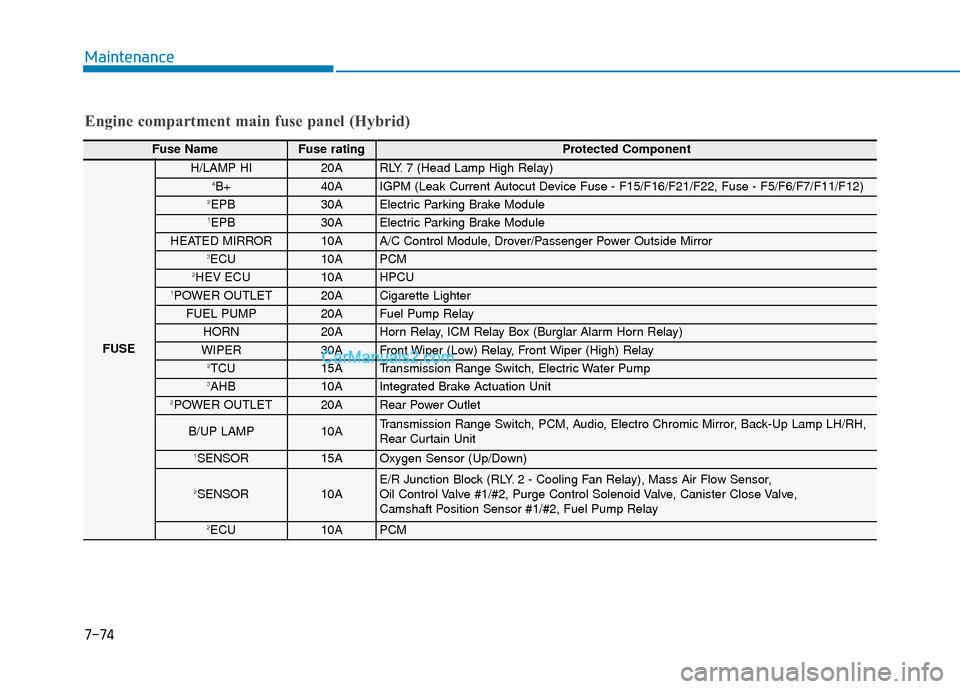
Fuse Name Fuse rating Protected Component
FUSE
H/LAMP HI20ARLY. 7 (Head Lamp High Relay)4B+40AIGPM (Leak Current Autocut Device Fuse - F15/F16/F21/F22, Fuse - F5/F6/F7/F11/F12)2EPB30AElectric Parking Brake Module1EPB30AElectric Parking Brake Module
HEATED MIRROR10AA/C Control Module, Drover/Passenger Power Outside Mirror3ECU10APCM2HEV ECU10AHPCU1POWER OUTLET20ACigarette Lighter
FUEL PUMP20AFuel Pump Relay
HORN20AHorn Relay, ICM Relay Box (Burglar Alarm Horn Relay)
WIPER30AFront Wiper (Low) Relay, Front Wiper (High) Relay2TCU15ATransmission Range Switch, Electric Water Pump3AHB10AIntegrated Brake Actuation Unit2POWER OUTLET20ARear Power Outlet
B/UP LAMP10ATransmission Range Switch, PCM, Audio, Electro Chromic Mirror, Back-Up Lamp LH/RH,
Rear Curtain Unit
1SENSOR15AOxygen Sensor (Up/Down)
2SENSOR10AE/R Junction Block (RLY. 2 - Cooling Fan Relay), Mass Air Flow Sensor,
Oil Control Valve #1/#2, Purge Control Solenoid Valve, Canister Close Valve,
Camshaft Position Sensor #1/#2, Fuel Pump Relay
2ECU10APCM
Engine compartment main fuse panel (Hybrid)
Page 648 of 744
7-80
Maintenance
L
LI
IG
G H
H T
T
B
B U
U L
LB
B S
S
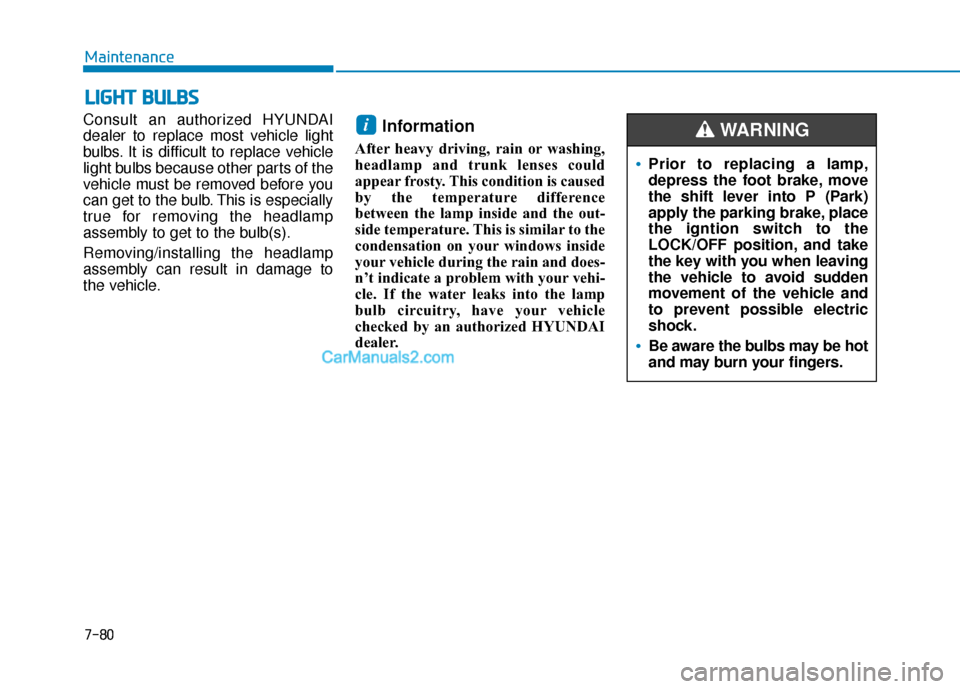
Consult an authorized HYUNDAI
dealer to replace most vehicle light
bulbs. It is difficult to replace vehicle
light bulbs because other parts of the
vehicle must be removed before you
can get to the bulb. This is especially
true for removing the headlamp
assembly to get to the bulb(s).
Removing/installing the headlamp
assembly can result in damage to
the vehicle.Information
After heavy driving, rain or washing,
headlamp and trunk lenses could
appear frosty. This condition is caused
by the temperature difference
between the lamp inside and the out-
side temperature. This is similar to the
condensation on your windows inside
your vehicle during the rain and does-
n’t indicate a problem with your vehi-
cle. If the water leaks into the lamp
bulb circuitry, have your vehicle
checked by an authorized HYUNDAI
dealer.
i
Prior to replacing a lamp,
depress the foot brake, move
the shift lever into P (Park)
apply the parking brake, place
the igntion switch to the
LOCK/OFF position, and take
the key with you when leaving
the vehicle to avoid sudden
movement of the vehicle and
to prevent possible electric
shock.
Be aware the bulbs may be hot
and may burn your fingers.
WARNING
Page 662 of 744
7-94
Maintenance
A
AP
PP
PE
EA
A R
RA
A N
N C
CE
E
C
C A
A R
RE
E
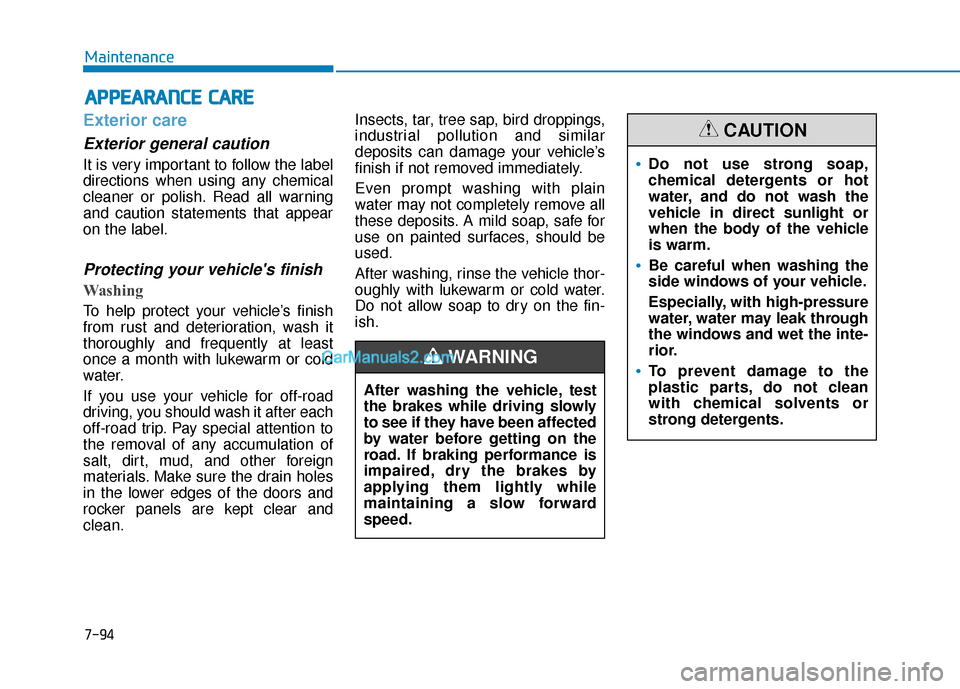
Exterior care
Exterior general caution
It is very important to follow the label
directions when using any chemical
cleaner or polish. Read all warning
and caution statements that appear
on the label.
Protecting your vehicle's finish
Washing
To help protect your vehicle’s finish
from rust and deterioration, wash it
thoroughly and frequently at least
once a month with lukewarm or cold
water.
If you use your vehicle for off-road
driving, you should wash it after each
off-road trip. Pay special attention to
the removal of any accumulation of
salt, dirt, mud, and other foreign
materials. Make sure the drain holes
in the lower edges of the doors and
rocker panels are kept clear and
clean. Insects, tar, tree sap, bird droppings,
industrial pollution and similar
deposits can damage your vehicle’s
finish if not removed immediately.
Even prompt washing with plain
water may not completely remove all
these deposits. A mild soap, safe for
use on painted surfaces, should be
used.
After washing, rinse the vehicle thor-
oughly with lukewarm or cold water.
Do not allow soap to dry on the fin-
ish.
Do not use strong soap,
chemical detergents or hot
water, and do not wash the
vehicle in direct sunlight or
when the body of the vehicle
is warm.
Be careful when washing the
side windows of your vehicle.
Especially, with high-pressure
water, water may leak through
the windows and wet the inte-
rior.
To prevent damage to the
plastic parts, do not clean
with chemical solvents or
strong detergents.
CAUTION
After washing the vehicle, test
the brakes while driving slowly
to see if they have been affected
by water before getting on the
road. If braking performance is
impaired, dry the brakes by
applying them lightly while
maintaining a slow forward
speed.
WARNING
Page 665 of 744
7-97
7
Maintenance
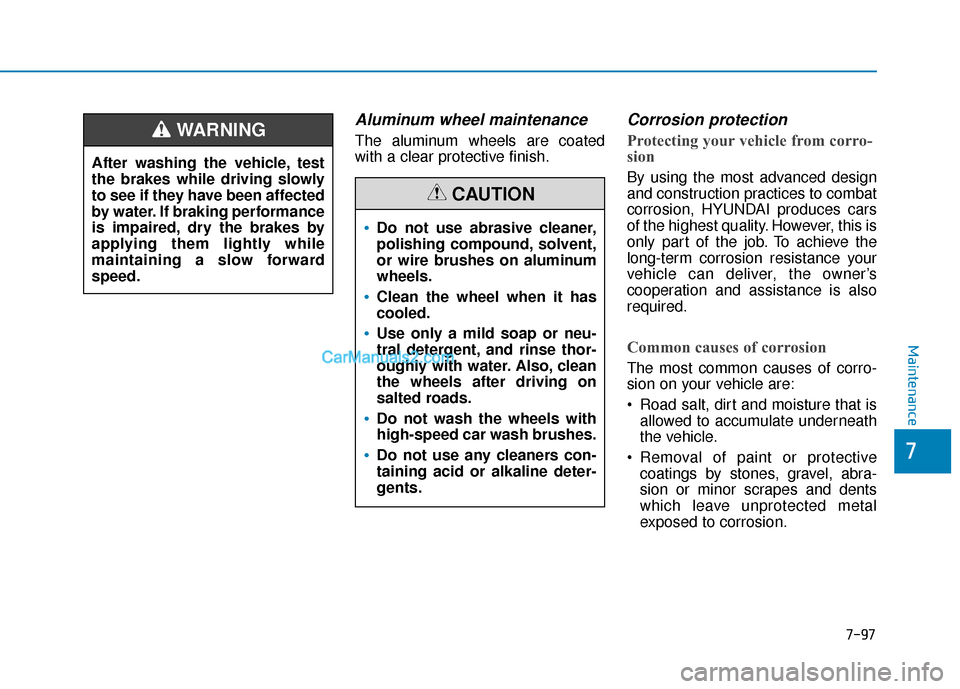
Aluminum wheel maintenance
The aluminum wheels are coated
with a clear protective finish.
Corrosion protection
Protecting your vehicle from corro-
sion
By using the most advanced design
and construction practices to combat
corrosion, HYUNDAI produces cars
of the highest quality. However, this is
only part of the job. To achieve the
long-term corrosion resistance your
vehicle can deliver, the owner’s
cooperation and assistance is also
required.
Common causes of corrosion
The most common causes of corro-
sion on your vehicle are:
Road salt, dirt and moisture that isallowed to accumulate underneath
the vehicle.
coatings by stones, gravel, abra-
sion or minor scrapes and dents
which leave unprotected metal
exposed to corrosion.
After washing the vehicle, test
the brakes while driving slowly
to see if they have been affected
by water. If braking performance
is impaired, dry the brakes by
applying them lightly while
maintaining a slow forward
speed.
WARNING
Do not use abrasive cleaner,
polishing compound, solvent,
or wire brushes on aluminum
wheels.
Clean the wheel when it has
cooled.
Use only a mild soap or neu-
tral detergent, and rinse thor-
oughly with water. Also, clean
the wheels after driving on
salted roads.
Do not wash the wheels with
high-speed car wash brushes.
Do not use any cleaners con-
taining acid or alkaline deter-
gents.
CAUTION
Page 687 of 744

I-2
A/V mode ........................................................................\
3-98
Air bag warning labels ....................................................2-70
Air bags ........................................................................\
...2-47Additional safety precautions .....................................2-69
Air bag collision sensors ............................................2-63
Air bag inflation conditions .......................................2-65
Air bag non-inflation conditions ................................2-66
Air bag warning labels ...............................................2-70
Curtain air bags ..........................................................2-51
Do not install a child restraint on the front passenger seat..........................................................2-58
Driver's front air bag ..................................................2-49
How does the air bag system operate? .......................2-53
Occupant Classification System (OCS) .....................2-58
Passenger's front air bag.............................................2-49
Side air bags ...............................................................2-50
SRS Care ....................................................................2-68\
SRS warning light ......................................................2-53
What to expect after an air bag inflates .....................2-57
Where are the air bags? ..............................................2-49
Why didn't my air bag go off in a collision ...............2-63
Air cleaner.......................................................................7\
-35
Air conditioning system (Refrigerant/Compressor) .........8-5
Air ventilation seats ........................................................2-22 Airconditioning system
Automatic climate control system............................3-138
Occupant Classification System (OCS) ...................3-137
Alarm system ..................................................................3-13
Antenna ........................................................................\
.....4-2
Anti-lock brake system (ABS) .......................................5-32
Appearance care..............................................................7-94 Exterior care ...............................................................7-94
Interior care ................................................................7-99
Armrest ........................................................................\
...2-14
Audio/Video/Navigation system (AVN) ...........................4-4
Auto door lock/unlock features ......................................3-12
Auto hold ........................................................................\
5-28
Auto light position ........................................................3-115
Automatic climate control system ................................3-136 Air conditioning .......................................................3-145
Automatic heating and air conditioning ...................3-137
Climate control air filter ...........................................3-148
Manual heating and air conditioning .......................3-138
Automatic transmission ..................................................5-12 Sports mode ................................................................5-15
Automtice transmission shift indicator ...........................3-75
AUX, USB and iPod
®port ...............................................4-2
Index
A
Page 689 of 744
I-4
Combined instrument, see instrument cluster ................3-60
Consumer information ......................................................8-9
Coolant ........................................................................\
....7-29
Cooling fluid, see engine coolant ...................................7-29
Cruise control..................................................................5-60
Cup holder.....................................................................3-1\
56
Curtain air bags ...............................................................2-51
Dashboard illumination, see instrument panel illumination..................................................................3-61
Dashboard, see instrument cluster ..................................3-60
Day/night rearview mirror ..............................................3-19
Daytime running light ...................................................3-122
Defogging (Windshield) ...............................................3-150
Defroster (Rear window) ..............................................3-135
Defrosting (Windshield) ...............................................3-150
Digital speedometer ......................................................3-109
Dimensions .......................................................................8\
-2
Disc brakes wear indicator .............................................5-20
Display illumination, see instrument panel illumination..................................................................3-61
Displays, see instrument cluster .....................................3-60
Do not install a child restraint on the front passenger seat ..............................................................2-62
Door courtesy lamp.......................................................3-126 Door locks ........................................................................\
.3-9
Auto door lock/unlock features ..................................3-12
Central door lock switch ............................................3-10
Child-protector rear door lock....................................3-12
Drinks holders, see cup holders ....................................3-156
Drive mode integrated control system (Hybrid).............5-41
Drive mode integrated control system (Plug-in hybrid) ...........................................................5-43
Driver assis system Rear parking assist system (RPAS) ..........................3-121
Rear view camera .....................................................3-130
Driver position memory system .....................................3-14
Driver's front air bag .......................................................2-49
Driving at night ...............................................................5-82
Driving in flooded areas .................................................5-83
Driving in the rain...........................................................5-83
Driving the hybrid/plug-in hybrid vehicle .....................H-22
Electric chromic mirror (ECM) ......................................3-20
Electric parking brake (EPB) ..........................................5-22
Electric power steering (EPS).........................................3-16
Electronic stability control (ESC)...................................5-34
Emergency fuel filler door release..................................3-53
Emission control system ...............................................7-102
Engine specification..........................................................8-2
Index
D
E