check engine Hyundai Sonata Plug-in Hybrid 2017 Repair Manual
[x] Cancel search | Manufacturer: HYUNDAI, Model Year: 2017, Model line: Sonata Plug-in Hybrid, Model: Hyundai Sonata Plug-in Hybrid 2017Pages: 744, PDF Size: 27.87 MB
Page 647 of 744
7-79
7
Maintenance
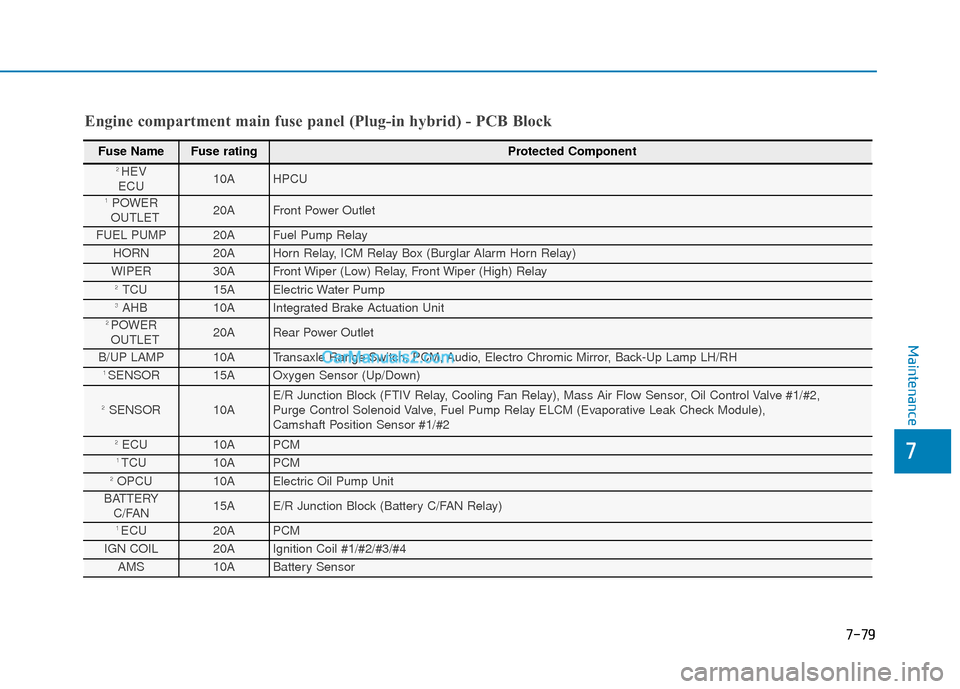
Engine compartment main fuse panel (Plug-in hybrid) - PCB Block
Fuse NameFuse rating Protected Component
2 HEV
ECU10A HPCU
1 POWER
OUTLET20A Front Power Outlet
FUEL PUMP 20A Fuel Pump Relay
HORN 20A Horn Relay, ICM Relay Box (Burglar Alarm Horn Relay)
WIPER 30A Front Wiper (Low) Relay, Front Wiper (High) Relay 2 TCU15A Electric Water Pump 3 AHB10A Integrated Brake Actuation Unit 2 POWER
OUTLET20A Rear Power Outlet
B/UP LAMP 10A Transaxle Range Switch, PCM, Audio, Electro Chromic Mirror, Back-Up Lamp LH/RH 1 SENSOR 15A Oxygen Sensor (Up/Down)
2 SENSOR10A E/R Junction Block (FTIV Relay, Cooling Fan Relay), Mass Air Flow Sensor, Oil Control Valve #1/#2,
Purge Control Solenoid Valve, Fuel Pump Relay ELCM (Evaporative Leak Check Module),
Camshaft Position Sensor #1/#2
2 ECU10A PCM 1 TCU10A PCM 2 OPCU10A Electric Oil Pump Unit
BATTERY C/FAN 15A E/R Junction Block (Battery C/FAN Relay)
1 ECU20A PCM
IGN COIL 20A Ignition Coil #1/#2/#3/#4
AMS 10A Battery Sensor
Page 671 of 744
7-103
7
Maintenance
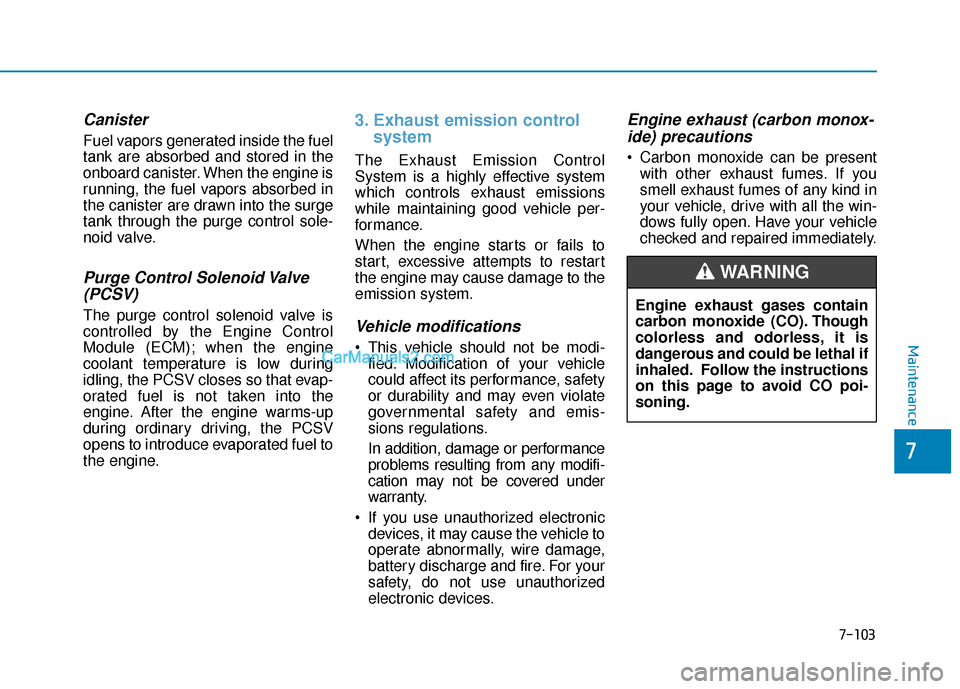
Canister
Fuel vapors generated inside the fuel
tank are absorbed and stored in the
onboard canister. When the engine is
running, the fuel vapors absorbed in
the canister are drawn into the surge
tank through the purge control sole-
noid valve.
Purge Control Solenoid Valve(PCSV)
The purge control solenoid valve is
controlled by the Engine Control
Module (ECM); when the engine
coolant temperature is low during
idling, the PCSV closes so that evap-
orated fuel is not taken into the
engine. After the engine warms-up
during ordinary driving, the PCSV
opens to introduce evaporated fuel to
the engine.
3. Exhaust emission control system
The Exhaust Emission Control
System is a highly effective system
which controls exhaust emissions
while maintaining good vehicle per-
formance.
When the engine starts or fails to
start, excessive attempts to restart
the engine may cause damage to the
emission system.
Vehicle modifications
This vehicle should not be modi-
fied. Modification of your vehicle
could affect its performance, safety
or durability and may even violate
governmental safety and emis-
sions regulations.
In addition, damage or performance
problems resulting from any modifi-
cation may not be covered under
warranty.
If you use unauthorized electronic devices, it may cause the vehicle to
operate abnormally, wire damage,
battery discharge and fire. For your
safety, do not use unauthorized
electronic devices.
Engine exhaust (carbon monox-ide) precautions
Carbon monoxide can be present
with other exhaust fumes. If you
smell exhaust fumes of any kind in
your vehicle, drive with all the win-
dows fully open. Have your vehicle
checked and repaired immediately.
Engine exhaust gases contain
carbon monoxide (CO). Though
colorless and odorless, it is
dangerous and could be lethal if
inhaled. Follow the instructions
on this page to avoid CO poi-
soning.
WARNING
Page 681 of 744
8-7
88
Specifications, Consumer information and Reporting safety defects
Recommended SAE viscosity
number
Always be sure to clean the area
around any filler plug, drain
plug, or dipstick before check-
ing or draining any lubricant.
This is especially important in
dusty or sandy areas and when
the vehicle is used on unpaved
roads. Cleaning the plug and
dipstick areas will prevent dirt
and grit from entering the
engine and other mechanisms
that could be damaged.
CAUTION
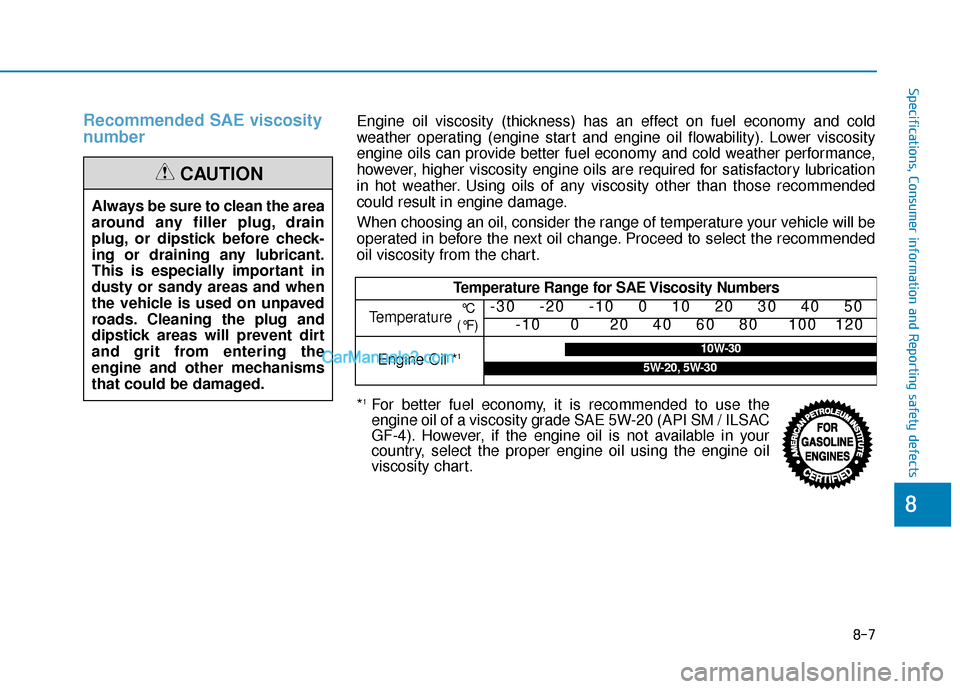
Engine oil viscosity (thickness) has an effect on fuel economy and cold
weather operating (engine start and engine oil flowability). Lower viscosity
engine oils can provide better fuel economy and cold weather performance,
however, higher viscosity engine oils are required for satisfactory lubrication
in hot weather. Using oils of any viscosity other than those recommended
could result in engine damage.
When choosing an oil, consider the range of temperature your vehicle will be
operated in before the next oil change. Proceed to select the recommended
oil viscosity from the chart.
Temperature Range for SAE Viscosity Numbers
Temperature -30 -20 -10 0 10 20 30 40 50
-10 0 20 40 60 80 100 120
Engine Oil *110W-30
5W-20, 5W-30
°C
(°F)
*1For better fuel economy, it is recommended to use the
engine oil of a viscosity grade SAE 5W-20 (API SM / ILSAC
GF-4). However, if the engine oil is not available in your
country, select the proper engine oil using the engine oil
viscosity chart.
Page 688 of 744
I-3
Backseat pocket ..............................................................2-11
Back-up lamp ..................................................................7-91
Battery ........................................................................\
.....7-41
Battery saver function ...................................................3-121
Before driving ...................................................................5-4
Blind spot detection system (BSD) ................................5-48
Bluetooth
®Wireless Technology Hands-Free ..................4-4
Brake fluid ......................................................................7-\
33
Brake system ...................................................................5-19 Anti-lock brake system (ABS) ...................................5-32
Auto hold ....................................................................5-28\
Disc brakes wear indicator .........................................5-20
Electric parking brake (EPB) .....................................5-22
Braking system Electronic stability control (ESC) ..............................5-34
Foot parking brake .....................................................5-20
Hill-start assist control (HAC) ...................................5-39
Power brakes ..............................................................5-19
Vehicle Stability Management ...................................5-38
Bulb replacement ............................................................7-80
Bulb wattage .....................................................................8-3\
Button start/stop, see engine start/stop button ..................5-5 California perchlorate notice ........................................7-106
Capacities (Lubricants) .....................................................8-6
Care
Exterior care ...............................................................7-94
Interior care ................................................................7-99
Tire care ......................................................................7-\
44
Center console storage ..................................................3-154
Central door lock switch .................................................3-10
Certification label .............................................................8-8
Chains Tire chains ..................................................................5-86
Charging the plug-in hybrid vehicle ................................H-4
Checking tire inflation pressure ......................................7-46
Child restraint system (CRS) ..........................................2-36 Children always in the rear ........................................2-36
Installing a Child Restraint System (CRS) ................2-39
Lower anchors and tether for children (LATCH) system......................................................................2-\
40
Securing with lap/shoulder belt..................................2-44
Securing with Tether anchors .....................................2-43
Selecting a Child Restraint System (CRS).................2-37
Child-protector rear door lock ........................................3-12
Climate control air filter ......................................3-148, 7-37
Clock ........................................................................\
.....3-159
Clothes hanger ..............................................................3-160
I
Index
BC
Page 707 of 744
H10
C
CH
H A
AR
RG
G I
IN
N G
G
T
T H
H E
E
P
P L
LU
U G
G-
-I
IN
N
H
H Y
Y B
BR
RI
ID
D
V
V E
EH
H I
IC
C L
LE
E
(
( C
C O
O N
NT
T.
.)
)
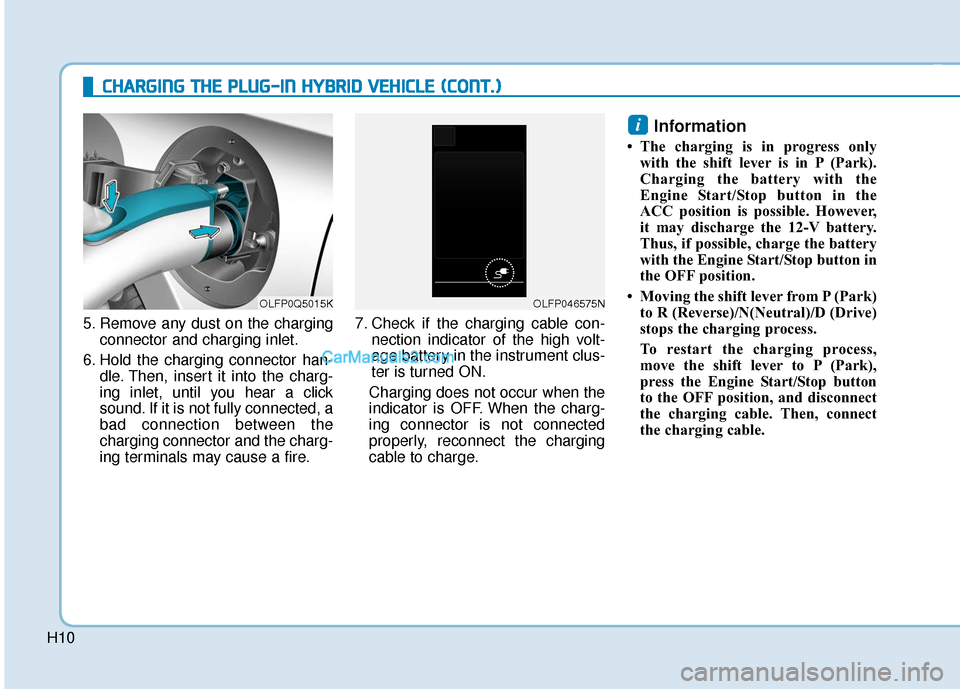
5. Remove any dust on the charging
connector and charging inlet.
6. Hold the charging connector han- dle. Then, insert it into the charg-
ing inlet, until you hear a click
sound. If it is not fully connected, a
bad connection between the
charging connector and the charg-
ing terminals may cause a fire. 7. Check if the charging cable con-
nection indicator of the high volt-
age battery in the instrument clus-
ter is turned ON.
Charging does not occur when the
indicator is OFF. When the charg-
ing connector is not connected
properly, reconnect the charging
cable to charge.
Information
• The charging is in progress only with the shift lever is in P (Park).
Charging the battery with the
Engine Start/Stop button in the
ACC position is possible. However,
it may discharge the 12-V battery.
Thus, if possible, charge the battery
with the Engine Start/Stop button in
the OFF position.
• Moving the shift lever from P (Park) to R (Reverse)/N(Neutral)/D (Drive)
stops the charging process.
To restart the charging process,
move the shift lever to P (Park),
press the Engine Start/Stop button
to the OFF position, and disconnect
the charging cable. Then, connect
the charging cable.
i
OLFP0Q5015KOLFP046575N
Page 713 of 744
H16
C
CH
H A
AR
RG
G I
IN
N G
G
T
T H
H E
E
P
P L
LU
U G
G-
-I
IN
N
H
H Y
Y B
BR
RI
ID
D
V
V E
EH
H I
IC
C L
LE
E
(
( C
C O
O N
NT
T.
.)
)
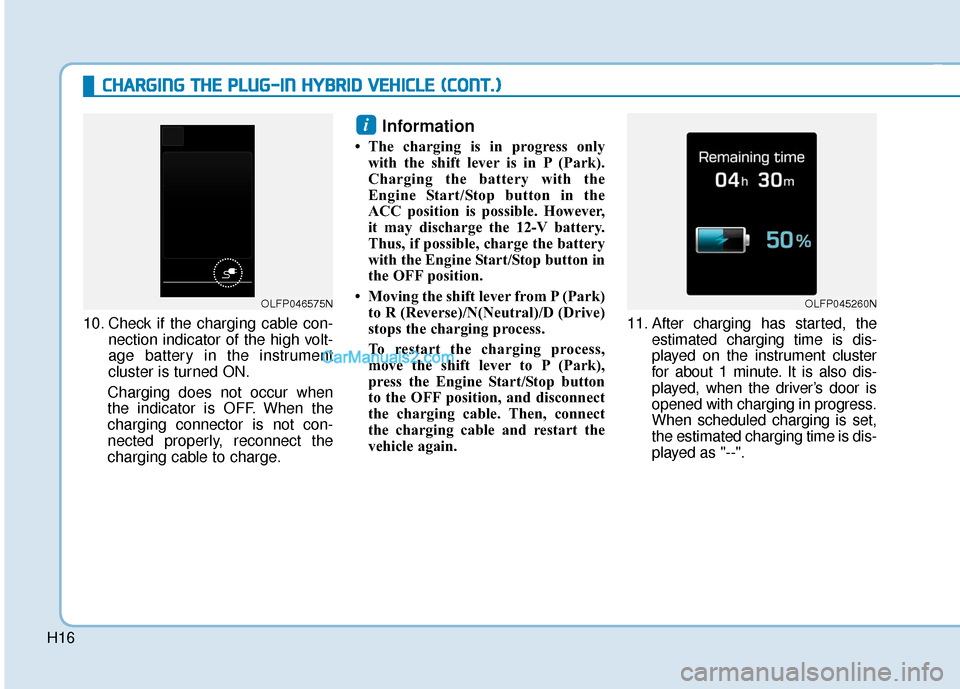
10. Check if the charging cable con-
nection indicator of the high volt-
age battery in the instrument
cluster is turned ON.
Charging does not occur when
the indicator is OFF. When the
charging connector is not con-
nected properly, reconnect the
charging cable to charge.
Information
• The charging is in progress only with the shift lever is in P (Park).
Charging the battery with the
Engine Start/Stop button in the
ACC position is possible. However,
it may discharge the 12-V battery.
Thus, if possible, charge the battery
with the Engine Start/Stop button in
the OFF position.
• Moving the shift lever from P (Park) to R (Reverse)/N(Neutral)/D (Drive)
stops the charging process.
To restart the charging process,
move the shift lever to P (Park),
press the Engine Start/Stop button
to the OFF position, and disconnect
the charging cable. Then, connect
the charging cable and restart the
vehicle again. 11. After charging has started, the
estimated charging time is dis-
played on the instrument cluster
for about 1 minute. It is also dis-
played, when the driver’s door is
opened with charging in progress.
When scheduled charging is set,
the estimated charging time is dis-
played as "--".
i
OLFP045260NOLFP046575N
Page 719 of 744
H22
D
DR
RI
IV
V I
IN
N G
G
T
T H
H E
E
H
H Y
Y B
BR
RI
ID
D /
/P
P L
LU
U G
G-
-I
IN
N
H
H Y
Y B
BR
RI
ID
D
V
V E
EH
H I
IC
C L
LE
E
Starting the vehicle
1. Carry the smart key or leave it
inside the vehicle.
2. Make sure the parking brake is firmly applied.
3. Place the shift lever in P (Park). With the shift lever in N (Neutral),
you cannot start the vehicle.
4. Depress the brake pedal.
5. Press the Engine Start/Stop but- ton. If the hybrid system starts, the
" " indicator will come on and a
double chime can be heard.
Whether the engine is cold or warm, it should be started without
depressing the accelerator.
After following the start proce-
dures, " " indicator on the
instrument cluster will turn on.
For more information, please
check Chapter 5. ECONOMICAL and SAFE OPERA-
TION of Hybrid system
Drive smoothly. Accelerate at a
moderate rate and maintain a
steady cruising speed. Do not
make "jack-rabbit" starts. Do not
race between stoplights.
Avoid heavy traffic whenever pos-
sible. Always maintain a safe dis-
tance from other vehicles so you
can avoid unnecessary braking.
This also reduces brake wear out.
The regenerative brake generates energy when the vehicle deceler-
ates.
When the hybrid battery power is low, the hybrid system automatical-
ly recharges the hybrid battery.
When the engine is running with the shift lever in N (Neutral), the
hybrid system cannot generate
electricity. The hybrid battery can-
not recharge with the shift lever in N
(Neutral).
Information
In the hybrid system, the engine auto-
matically runs and stops. When the
hybrid system operates, the " "
indicator is illuminated.
In the following situation, the engine
may operate automatically.
- When the engine is ready to run
- When the hybrid battery is beingcharged
- Depending on the temperature con- dition of the hybrid battery
i
To avoid serious injury, turn off
hybrid system and be sure " "
indicator is off before working
under hood. Engine may start
unexpectedly.
WARNING
Page 722 of 744
H25
According to the hybrid system
gauge area, the "EV" indicator comes
on or off.
- "EV" indicator ON : Vehicle is drivenusing the electric motor or the
gasoline engine is stopped.
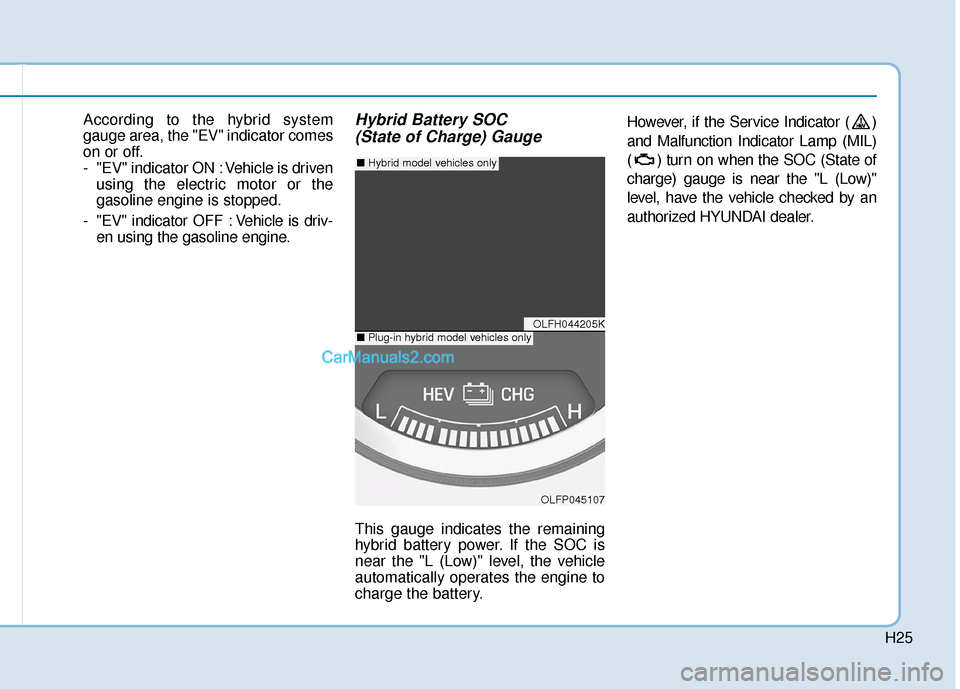
- "EV" indicator OFF : Vehicle is driv- en using the gasoline engine.Hybrid Battery SOC (State of Charge) Gauge
This gauge indicates the remaining
hybrid battery power. If the SOC is
near the "L (Low)" level, the vehicle
automatically operates the engine to
charge the battery. However, if the Service Indicator ( )
and Malfunction Indicator Lamp (MIL)
( ) turn on when the SOC (State of
charge) gauge is near the "L (Low)"
level, have the vehicle checked by an
authorized HYUNDAI dealer.
OLFH044205K
OLFP045107
■
Plug-in hybrid model vehicles only
■Hybrid model vehicles only
Page 725 of 744
H28
D
DR
RI
IV
V I
IN
N G
G
T
T H
H E
E
H
H Y
Y B
BR
RI
ID
D /
/P
P L
LU
U G
G-
-I
IN
N
H
H Y
Y B
BR
RI
ID
D
V
V E
EH
H I
IC
C L
LE
E
(
( C
C O
O N
NT
T.
.)
)
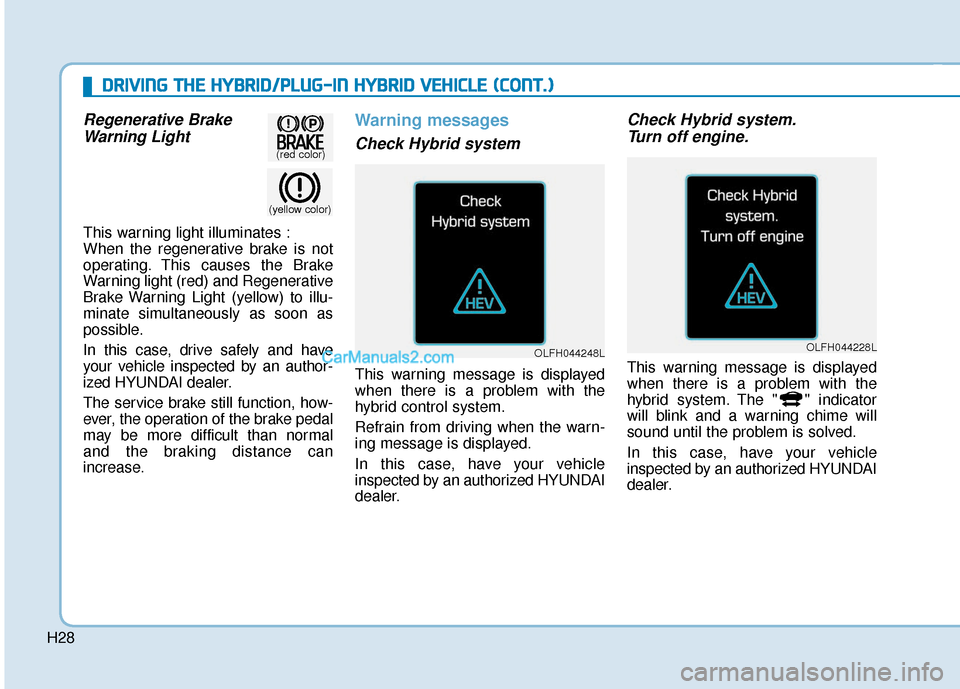
Regenerative Brake
Warning Light
This warning light illuminates :
When the regenerative brake is not
operating. This causes the Brake
Warning light (red) and Regenerative
Brake Warning Light (yellow) to illu-
minate simultaneously as soon as
possible.
In this case, drive safely and have
your vehicle inspected by an author-
ized HYUNDAI dealer.
The service brake still function, how-
ever, the operation of the brake pedal
may be more difficult than normal
and the braking distance can
increase.
Warning messages
Check Hybrid system
This warning message is displayed
when there is a problem with the
hybrid control system.
Refrain from driving when the warn-
ing message is displayed.
In this case, have your vehicle
inspected by an authorized HYUNDAI
dealer.
Check Hybrid system.Turn off engine.
This warning message is displayed
when there is a problem with the
hybrid system. The " " indicator
will blink and a warning chime will
sound until the problem is solved.
In this case, have your vehicle
inspected by an authorized HYUNDAI
dealer.
(yellow color)
(red color)
OLFH044228LOLFH044248L
Page 726 of 744
H29
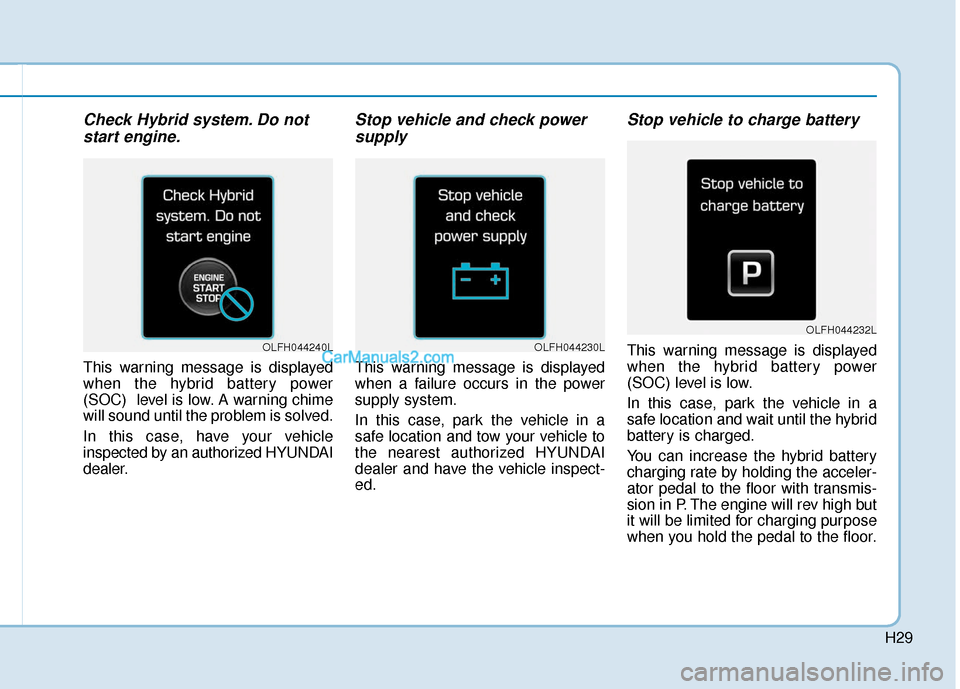
Check Hybrid system. Do notstart engine.
This warning message is displayed
when the hybrid battery power
(SOC) level is low. A warning chime
will sound until the problem is solved.
In this case, have your vehicle
inspected by an authorized HYUNDAI
dealer.
Stop vehicle and check powersupply
This warning message is displayed
when a failure occurs in the power
supply system.
In this case, park the vehicle in a
safe location and tow your vehicle to
the nearest authorized HYUNDAI
dealer and have the vehicle inspect-
ed.
Stop vehicle to charge battery
This warning message is displayed
when the hybrid battery power
(SOC) level is low.
In this case, park the vehicle in a
safe location and wait until the hybrid
battery is charged.
You can increase the hybrid battery
charging rate by holding the acceler-
ator pedal to the floor with transmis-
sion in P. The engine will rev high but
it will be limited for charging purpose
when you hold the pedal to the floor.OLFH044240LOLFH044230L
OLFH044232L