air condition Hyundai Sonata
[x] Cancel search | Manufacturer: HYUNDAI, Model Year: , Model line: , Model:Pages: 411, PDF Size: 8.68 MB
Page 227 of 411
4 145
Features of your vehicle
CAUTION IN USING
BLUETOOTH
®CELLULAR
PHONE
Do not use a cellular phone or
perform Bluetooth
®settings (e.g.
pairing a phone) while driving.
Some Bluetooth
®-enabled phones
may not be recognized by the system or fully compatible withthe system.
Before using Bluetooth
®related
features of the audio system, refer your phone’s User’s Manual for phone-side Bluetooth®opera-
tions.
The phone must be paired to the audio system to use Bluetooth
®
related features. You will not be able to use the hands-free feature when yourphone (in the car) is outside ofthe cellular service area (e.g. in atunnel, in a underground, in a mountainous area, etc.).
If the cellular phone signal is poor or the vehicles interior noise istoo loud, it may be difficult to hearthe other person’s voice during a call.
(Continued)
(Continued) Do not place the phone near or inside metallic objects, otherwise
communications with Bluetooth
®
system or cellular service sta-tions can be disturbed.
While a phone is connected through Bluetooth
®
your phone may dis-
charge quicker than usual for addi- tional Bluetooth
®-related operations.
Some cellular phones or other devices may cause interferencenoise or malfunction to audio system. In this case, store thedevice in a different location mayresolve the condition.
Phone contact names should be saved in English or they may notbe displayed correctly.
If Priority is set upon vehicle igni- tion(IGN/ACC ON), the Bluetooth
®
phone will be automatically con-nected. Even if you are outside, theBluetooth
®
phone will be auto-
matically connected once you are in the vicinity of the vehicle.
If you do not want automaticBluetooth
®
connection, turn the
Bluetooth
®feature off.
(Continued)
(Continued) The hands-free call volume and quality may differ depending onthe mobile phone type.
Page 267 of 411
Driving your vehicle24
5
WARNING
To prevent unintentional move-
ment when stopped and leaving
the vehicle, do not use the
gearshift lever in place of the
parking brake. Set the parking
brake AND make sure the
gearshift lever is securely posi-
tioned in 1st (First) gear or R
(Reverse) for manual transaxle
equipped vehicles and in P (Park)
for automatic transaxle equipped
vehicles.
Never allow anyone who is unfa- miliar with the vehicle to touch
the parking brake. If the parking
brake is released unintentionally,
serious injury may occur.
All vehicles should always have the parking brake fully engaged
when parking to avoid inadver-
tent movement of the vehicle
which can injure occupants or
pedestrians.If the parking brake does not release or
does not release all the way, have the
system checked by an authorized
HYUNDAI dealer.
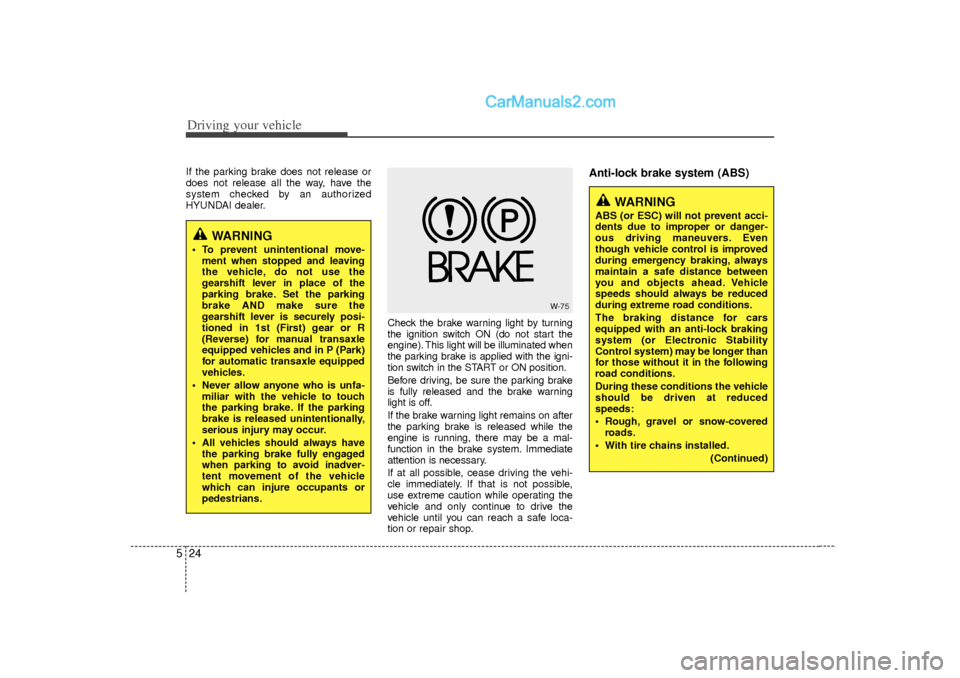
Check the brake warning light by turning
the ignition switch ON (do not start the
engine). This light will be illuminated when
the parking brake is applied with the igni-
tion switch in the START or ON position.
Before driving, be sure the parking brake
is fully released and the brake warning
light is off.
If the brake warning light remains on after
the parking brake is released while the
engine is running, there may be a mal-
function in the brake system. Immediate
attention is necessary.
If at all possible, cease driving the vehi-
cle immediately. If that is not possible,
use extreme caution while operating the
vehicle and only continue to drive the
vehicle until you can reach a safe loca-
tion or repair shop.
Anti-lock brake system (ABS)
W-75
WARNING
ABS (or ESC) will not prevent acci-
dents due to improper or danger-
ous driving maneuvers. Even
though vehicle control is improved
during emergency braking, always
maintain a safe distance between
you and objects ahead. Vehicle
speeds should always be reduced
during extreme road conditions.
The braking distance for cars
equipped with an anti-lock braking
system (or Electronic Stability
Control system) may be longer than
for those without it in the following
road conditions.
During these conditions the vehicle
should be driven at reduced
speeds:
Rough, gravel or snow-coveredroads.
With tire chains installed. (Continued)
Page 279 of 411
Driving your vehicle36
5Your vehicle's fuel economy depends
mainly on your style of driving, where you
drive and when you drive.
Each of these factors affects how many
miles (kilometers) you can get from a gal-
lon (liter) of fuel. To operate your vehicle
as economically as possible, use the fol-
lowing driving suggestions to help save
money in both fuel and repairs:
Drive smoothly. Accelerate at a moder-
ate rate. Don't make "jack-rabbit" starts
or full-throttle shifts and maintain a
steady cruising speed. Don't race
between stoplights. Try to adjust your
speed to that of the other traffic so you
don't have to change speeds unneces-
sarily. Avoid heavy traffic whenever
possible. Always maintain a safe dis-
tance from other vehicles so you can
avoid unnecessary braking. This also
reduces brake wear.
Drive at a moderate speed. The faster you drive, the more fuel your car uses.
Driving at a moderate speed, especial-
ly on the highway, is one of the most
effective ways to reduce fuel consump-
tion. Don't "ride" the brake pedal. This can
increase fuel consumption and also
increase wear on these components.
In addition, driving with your foot rest-
ing on the brake pedal may cause the
brakes to overheat, which reduces
their effectiveness and may lead to
more serious consequences.
Take care of your tires. Keep them inflated to the recommended pressure.
Incorrect inflation, either too much or
too little, results in unnecessary tire
wear. Check the tire pressures at least
once a month.
Be sure that the wheels are aligned correctly. Improper alignment can
result from hitting curbs or driving too
fast over irregular surfaces. Poor align-
ment causes faster tire wear and may
also result in other problems as well as
greater fuel consumption. Keep your car in good condition. For
better fuel economy and reduced
maintenance costs, maintain your car
in accordance with the maintenance
schedule in section 7. If you drive your
car in severe conditions, more frequent
maintenance is required (see section 7
for details).
Keep your car clean. For maximum service, your vehicle should be kept
clean and free of corrosive materials. It
is especially important that mud, dirt,
ice, etc. not be allowed to accumulate
on the underside of the car. This extra
weight can result in increased fuel con-
sumption and also contribute to corro-
sion.
Travel lightly. Don't carry unnecessary weight in your car. Weight reduces fuel
economy.
Don't let the engine idle longer than necessary. If you are waiting (and not
in traffic), turn off your engine and
restart only when you're ready to go.ECONOMICAL OPERATION
Page 280 of 411
537
Driving your vehicle
Remember, your vehicle does notrequire extended warm-up. After the
engine has started, allow the engine to
run for 10 to 20 seconds prior to plac-
ing the vehicle in gear. In very cold
weather, however, give your engine a
slightly longer warm-up period.
Don't "lug" or "over-rev" the engine. Lugging is driving too slowly in too high
a gear resulting in the engine bucking.
If this happens, shift to a lower gear.
Over-revving is racing the engine
beyond its safe limit. This can be avoid-
ed by shifting at the recommended
speeds. Use your air conditioning sparingly.
The air conditioning system is operat-
ed by engine power so your fuel econ-
omy is reduced when you use it.
Open windows at high speeds can reduce fuel economy.
Fuel economy is less in crosswinds and headwinds. To help offset some of
this loss, slow down when driving in
these conditions.
Keeping a vehicle in good operating con-
dition is important both for economy and
safety. Therefore, have an authorized
HYUNDAI dealer perform scheduled
inspections and maintenance.
WARNING
- Engine off dur- ing motion
Never turn the engine off to coast
down hills or anytime the vehicle is
in motion. The power steering and
power brakes will not function
properly without the engine run-
ning. Instead, keep the engine on
and downshift to an appropriate
gear for engine braking effect. In
addition, turning off the ignition
while driving could engage the
steering wheel lock resulting in
loss of vehicle steering which
could cause serious injury or
death.
Page 313 of 411
What to do in an emergency18
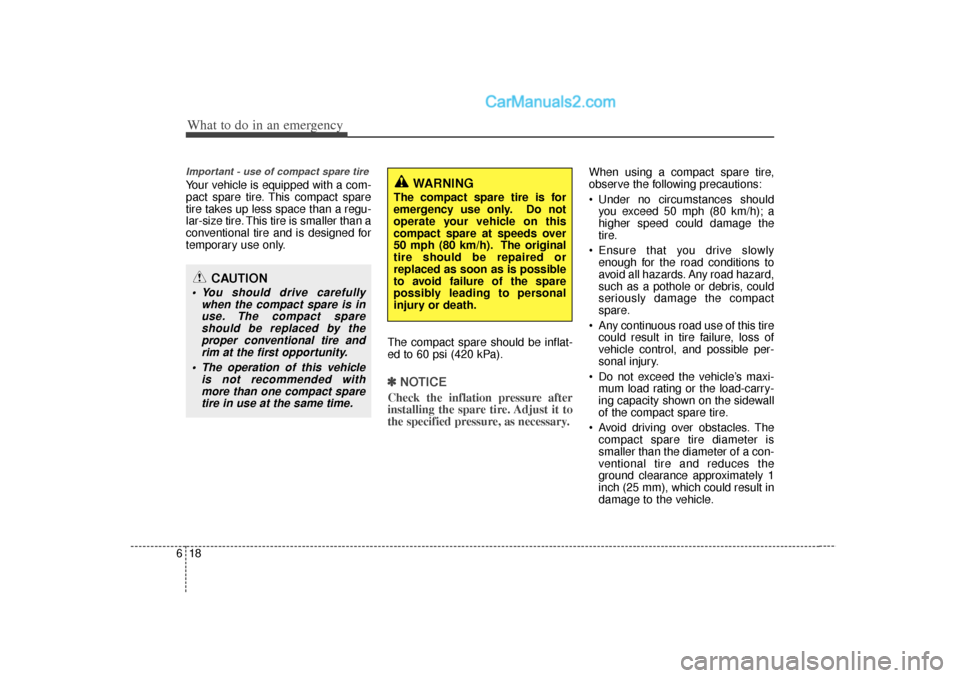
6Important - use of compact spare tireYour vehicle is equipped with a com-
pact spare tire. This compact spare
tire takes up less space than a regu-
lar-size tire. This tire is smaller than a
conventional tire and is designed for
temporary use only.
The compact spare should be inflat-
ed to 60 psi (420 kPa).
✽ ✽NOTICECheck the inflation pressure after
installing the spare tire. Adjust it to
the specified pressure, as necessary.
When using a compact spare tire,
observe the following precautions:
Under no circumstances should
you exceed 50 mph (80 km/h); a
higher speed could damage the
tire.
Ensure that you drive slowly enough for the road conditions to
avoid all hazards. Any road hazard,
such as a pothole or debris, could
seriously damage the compact
spare.
Any continuous road use of this tire could result in tire failure, loss of
vehicle control, and possible per-
sonal injury.
Do not exceed the vehicle’s maxi- mum load rating or the load-carry-
ing capacity shown on the sidewall
of the compact spare tire.
Avoid driving over obstacles. The compact spare tire diameter is
smaller than the diameter of a con-
ventional tire and reduces the
ground clearance approximately 1
inch (25 mm), which could result in
damage to the vehicle.
WARNING
The compact spare tire is for
emergency use only. Do not
operate your vehicle on this
compact spare at speeds over
50 mph (80 km/h). The original
tire should be repaired or
replaced as soon as is possible
to avoid failure of the spare
possibly leading to personal
injury or death.
CAUTION
You should drive carefully when the compact spare is inuse. The compact spareshould be replaced by theproper conventional tire andrim at the first opportunity.
The operation of this vehicle is not recommended withmore than one compact sparetire in use at the same time.
Page 322 of 411
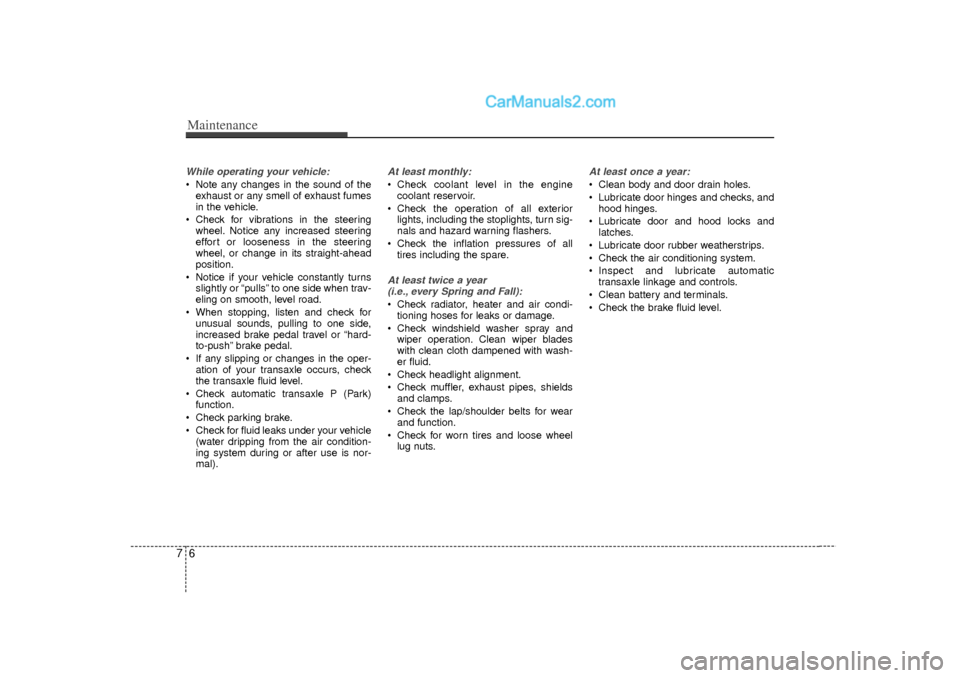
Maintenance67While operating your vehicle: Note any changes in the sound of theexhaust or any smell of exhaust fumes
in the vehicle.
Check for vibrations in the steering wheel. Notice any increased steering
effort or looseness in the steering
wheel, or change in its straight-ahead
position.
Notice if your vehicle constantly turns slightly or “pulls” to one side when trav-
eling on smooth, level road.
When stopping, listen and check for unusual sounds, pulling to one side,
increased brake pedal travel or “hard-
to-push” brake pedal.
If any slipping or changes in the oper- ation of your transaxle occurs, check
the transaxle fluid level.
Check automatic transaxle P (Park) function.
Check parking brake.
Check for fluid leaks under your vehicle (water dripping from the air condition-
ing system during or after use is nor-
mal).
At least monthly: Check coolant level in the enginecoolant reservoir.
Check the operation of all exterior lights, including the stoplights, turn sig-
nals and hazard warning flashers.
Check the inflation pressures of all tires including the spare.At least twice a year (i.e., every Spring and Fall): Check radiator, heater and air condi- tioning hoses for leaks or damage.
Check windshield washer spray and wiper operation. Clean wiper blades
with clean cloth dampened with wash-
er fluid.
Check headlight alignment.
Check muffler, exhaust pipes, shields and clamps.
Check the lap/shoulder belts for wear and function.
Check for worn tires and loose wheel lug nuts.
At least once a year: Clean body and door drain holes.
Lubricate door hinges and checks, andhood hinges.
Lubricate door and hood locks and latches.
Lubricate door rubber weatherstrips.
Check the air conditioning system.
Inspect and lubricate automatic transaxle linkage and controls.
Clean battery and terminals.
Check the brake fluid level.
Page 324 of 411
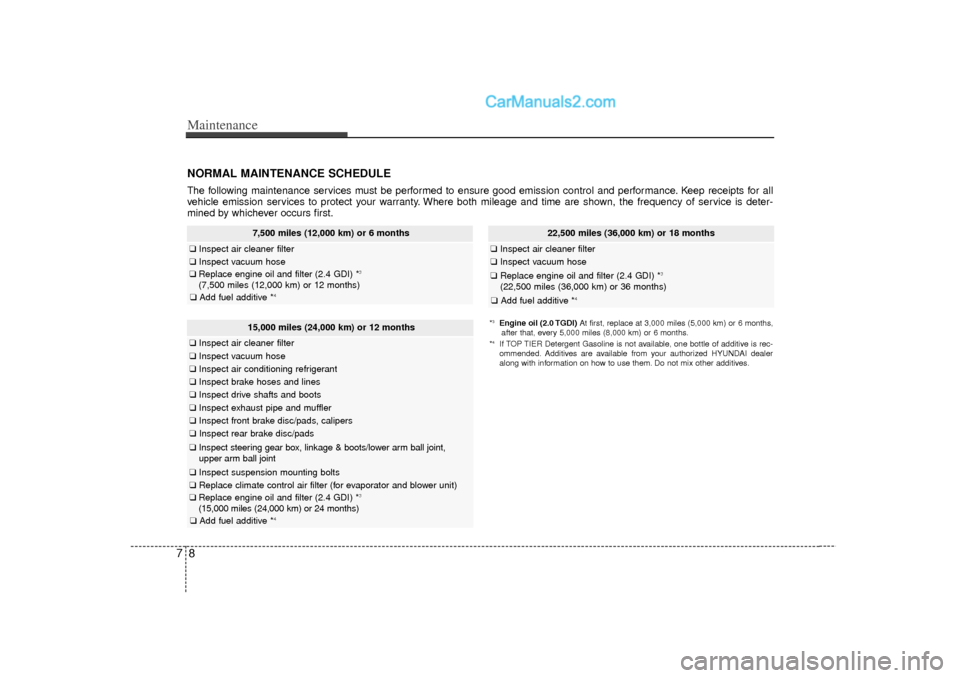
Maintenance87NORMAL MAINTENANCE SCHEDULEThe following maintenance services must be performed to ensure good emission control and performance. Keep receipts for all
vehicle emission services to protect your warranty. Where both mileage and time are shown, the frequency of service is deter-
mined by whichever occurs first.
15,000 miles (24,000 km) or 12 months
❑Inspect air cleaner filter❑Inspect vacuum hose❑Inspect air conditioning refrigerant❑Inspect brake hoses and lines❑Inspect drive shafts and boots❑Inspect exhaust pipe and muffler❑Inspect front brake disc/pads, calipers❑Inspect rear brake disc/pads❑Inspect steering gear box, linkage & boots/lower arm ball joint,
upper arm ball joint❑ Inspect suspension mounting bolts❑Replace climate control air filter (for evaporator and blower unit)❑Replace engine oil and filter (2.4 GDI) *
3
(15,000 miles (24,000 km) or 24 months)❑ Add fuel additive *
4
7,500 miles (12,000 km) or 6 months
❑Inspect air cleaner filter❑Inspect vacuum hose❑Replace engine oil and filter (2.4 GDI) *
3
(7,500 miles (12,000 km) or 12 months)❑ Add fuel additive *
4
*3Engine oil (2.0 TGDI) At first, replace at 3,000 miles (5,000 km) or 6 months,
after that, every 5,000 miles (8,000 km) or 6 months.
*4If TOP TIER Detergent Gasoline is not available, one bottle of additive is rec-
ommended. Additives are available from your authorized HYUNDAI dealer
along with information on how to use them. Do not mix other additives.
22,500 miles (36,000 km) or 18 months
❑ Inspect air cleaner filter❑Inspect vacuum hose❑Replace engine oil and filter (2.4 GDI) *
3
(22,500 miles (36,000 km) or 36 months)❑ Add fuel additive *
4
Page 325 of 411
79
Maintenance
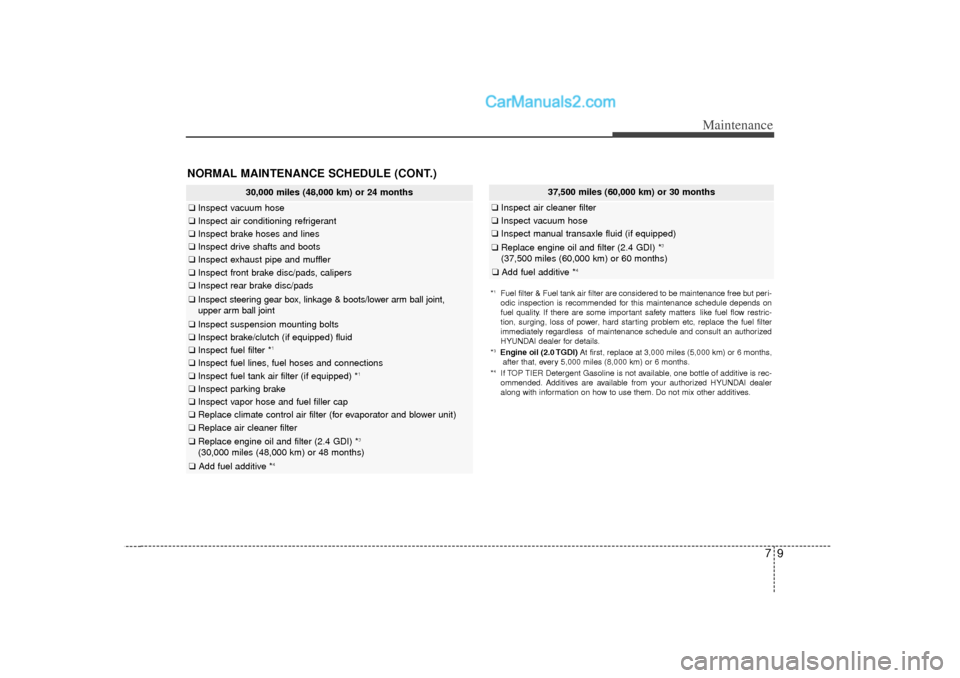
NORMAL MAINTENANCE SCHEDULE (CONT.)
37,500 miles (60,000 km) or 30 months
❑Inspect air cleaner filter❑Inspect vacuum hose❑Inspect manual transaxle fluid (if equipped)❑Replace engine oil and filter (2.4 GDI) *
3
(37,500 miles (60,000 km) or 60 months)❑ Add fuel additive *
4
*1Fuel filter & Fuel tank air filter are considered to be maintenance free\
but peri-
odic inspection is recommended for this maintenance schedule depends on
fuel quality. If there are some important safety matters like fuel flow restric-
tion, surging, loss of power, hard starting problem etc, replace the fuel filter
immediately regardless of maintenance schedule and consult an authorized
HYUNDAI dealer for details.
*3Engine oil (2.0 TGDI) At first, replace at 3,000 miles (5,000 km) or 6 months,
after that, every 5,000 miles (8,000 km) or 6 months.
*4If TOP TIER Detergent Gasoline is not available, one bottle of additive is rec-
ommended. Additives are available from your authorized HYUNDAI dealer
along with information on how to use them. Do not mix other additives.
30,000 miles (48,000 km) or 24 months
❑ Inspect vacuum hose❑Inspect air conditioning refrigerant❑Inspect brake hoses and lines❑Inspect drive shafts and boots❑Inspect exhaust pipe and muffler❑Inspect front brake disc/pads, calipers❑Inspect rear brake disc/pads❑Inspect steering gear box, linkage & boots/lower arm ball joint,
upper arm ball joint❑Inspect suspension mounting bolts❑Inspect brake/clutch (if equipped) fluid ❑Inspect fuel filter *
1
❑Inspect fuel lines, fuel hoses and connections❑Inspect fuel tank air filter (if equipped) *
1
❑Inspect parking brake❑Inspect vapor hose and fuel filler cap❑ Replace climate control air filter (for evaporator and blower unit)❑Replace air cleaner filter❑Replace engine oil and filter (2.4 GDI) *
3
(30,000 miles (48,000 km) or 48 months)❑ Add fuel additive *
4
Page 326 of 411
Maintenance10
7
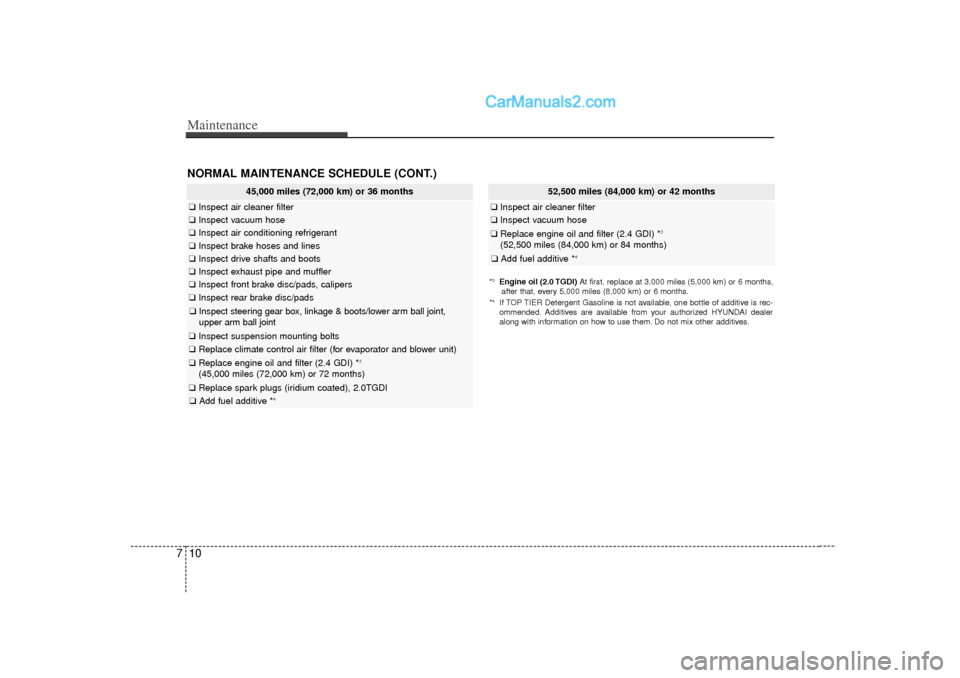
45,000 miles (72,000 km) or 36 months
❑ Inspect air cleaner filter❑Inspect vacuum hose❑Inspect air conditioning refrigerant❑Inspect brake hoses and lines❑Inspect drive shafts and boots❑Inspect exhaust pipe and muffler❑Inspect front brake disc/pads, calipers❑Inspect rear brake disc/pads❑Inspect steering gear box, linkage & boots/lower arm ball joint,
upper arm ball joint❑ Inspect suspension mounting bolts❑Replace climate control air filter (for evaporator and blower unit)❑Replace engine oil and filter (2.4 GDI) *
3
(45,000 miles (72,000 km) or 72 months)❑Replace spark plugs (iridium coated), 2.0TGDI❑ Add fuel additive *
4
NORMAL MAINTENANCE SCHEDULE (CONT.)
52,500 miles (84,000 km) or 42 months
❑Inspect air cleaner filter❑Inspect vacuum hose❑Replace engine oil and filter (2.4 GDI) *
3
(52,500 miles (84,000 km) or 84 months)❑ Add fuel additive *
4
*3Engine oil (2.0 TGDI) At first, replace at 3,000 miles (5,000 km) or 6 months,
after that, every 5,000 miles (8,000 km) or 6 months.
*4If TOP TIER Detergent Gasoline is not available, one bottle of additive is rec-
ommended. Additives are available from your authorized HYUNDAI dealer
along with information on how to use them. Do not mix other additives.
Page 327 of 411
711
Maintenance
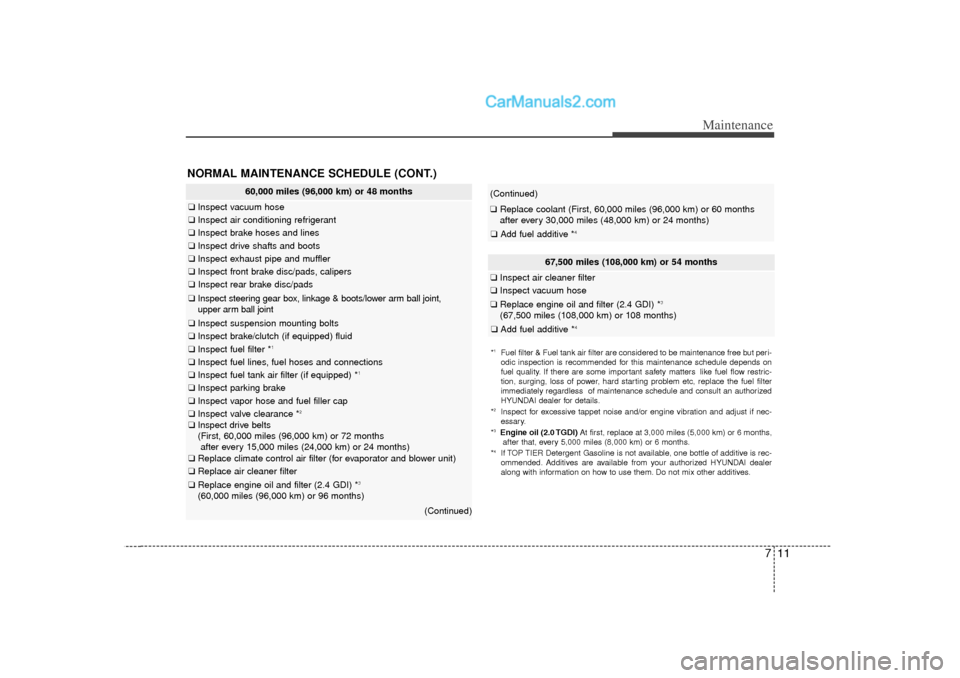
60,000 miles (96,000 km) or 48 months
❑Inspect vacuum hose❑Inspect air conditioning refrigerant❑Inspect brake hoses and lines❑Inspect drive shafts and boots❑Inspect exhaust pipe and muffler❑Inspect front brake disc/pads, calipers❑Inspect rear brake disc/pads❑Inspect steering gear box, linkage & boots/lower arm ball joint,
upper arm ball joint❑ Inspect suspension mounting bolts❑Inspect brake/clutch (if equipped) fluid ❑Inspect fuel filter *
1
❑Inspect fuel lines, fuel hoses and connections❑Inspect fuel tank air filter (if equipped) *
1
❑Inspect parking brake❑Inspect vapor hose and fuel filler cap❑Inspect valve clearance *
2
❑Inspect drive belts
(First, 60,000 miles (96,000 km) or 72 months
after every 15,000 miles (24,000 km) or 24 months)❑ Replace climate control air filter (for evaporator and blower unit)❑Replace air cleaner filter❑Replace engine oil and filter (2.4 GDI) *
3
(60,000 miles (96,000 km) or 96 months)
(Continued)
67,500 miles (108,000 km) or 54 months
❑ Inspect air cleaner filter❑Inspect vacuum hose❑Replace engine oil and filter (2.4 GDI) *
3
(67,500 miles (108,000 km) or 108 months)❑ Add fuel additive *
4
NORMAL MAINTENANCE SCHEDULE (CONT.)
*1Fuel filter & Fuel tank air filter are considered to be maintenance free\
but peri-
odic inspection is recommended for this maintenance schedule depends on
fuel quality. If there are some important safety matters like fuel flow restric-
tion, surging, loss of power, hard starting problem etc, replace the fuel filter
immediately regardless of maintenance schedule and consult an authorized
HYUNDAI dealer for details.
*2Inspect for excessive tappet noise and/or engine vibration and adjust if nec-
essary.
*3Engine oil (2.0 TGDI) At first, replace at 3,000 miles (5,000 km) or 6 months,
after that, every 5,000 miles (8,000 km) or 6 months.
*4If TOP TIER Detergent Gasoline is not available, one bottle of additive is rec-
ommended. Additives are available from your authorized HYUNDAI dealer
along with information on how to use them. Do not mix other additives.(Continued)❑ Replace coolant (First, 60,000 miles (96,000 km) or 60 months
after every 30,000 miles (48,000 km) or 24 months)❑ Add fuel additive *
4