mirror Hyundai Terracan 2003 User Guide
[x] Cancel search | Manufacturer: HYUNDAI, Model Year: 2003, Model line: Terracan, Model: Hyundai Terracan 2003Pages: 349, PDF Size: 4.56 MB
Page 196 of 349
CONTROLS AND EQUIPMENT
1- 2 YB020A1-E BEFORE ENTERING THE VEHICLE
o Ensure that all windows, mirrors and lamps are clean.
o Check condition of all tyres.
o Ensure that no fluid leaks are evident.
o Ensure that the area around the vehicle is clear before driving off.
YB020B1-E AFTER ENTERING THE VEHICLE
o Ensure that all occupants fasten and cor- rectly adjust seat belts.
o Ensure that seat and headrestraint positions are adjusted for optimum safety, control and comfort.
o Adjust interior and exterior rear view mir- rors.
o Verify correct operation of lamps, horn and other electrical equipment.
o Ensure that warning lamps illuminate when ignition is turned on.
NOTE: Fluid levels such as engine oil, engine cool- ant, brake and windscreen washer fluidshould be checked daily or at each refuel-ling, whichever occurs sooner. B020A01FC-EAT RUNNING IN YOUR NEW HYUNDAIThe longevity and performance of the vehicle are greatly affected by the care exercised dur-ing the first 1000 miles of motoring. Because ofmodern manufacturing techniques, rigid guide-lines regarding maximum road speeds havebecome unnecessary. However, certain pre-cautions should be observed in order to obtainthe best possible performance and useful lifefrom the vehicle.
1) Do not race the engine without a load (i.e revving the engine in neutral).
2) During the first 500 miles the maximum engine speed should be restricted to 3000rpm and gradually increased thereafter.
3) Avoid prolonged constant speed operation. The internal components of the engine willbecome run-in more quickly if the operation
speed is varied during the running in period.
4) Never allow the engine to labour. Use the gearbox freely and avoid large throttle open-ings when the engine speed is below 1500rpm.
5) Avoid rapid acceleration and maximum throttle openings.
6) Avoid harsh braking during the first 100 miles of urban motoring or 1000 miles ofmotorway driving to allow the friction facingsof the brake pads and shoes to bed againstthe discs and drums properly.
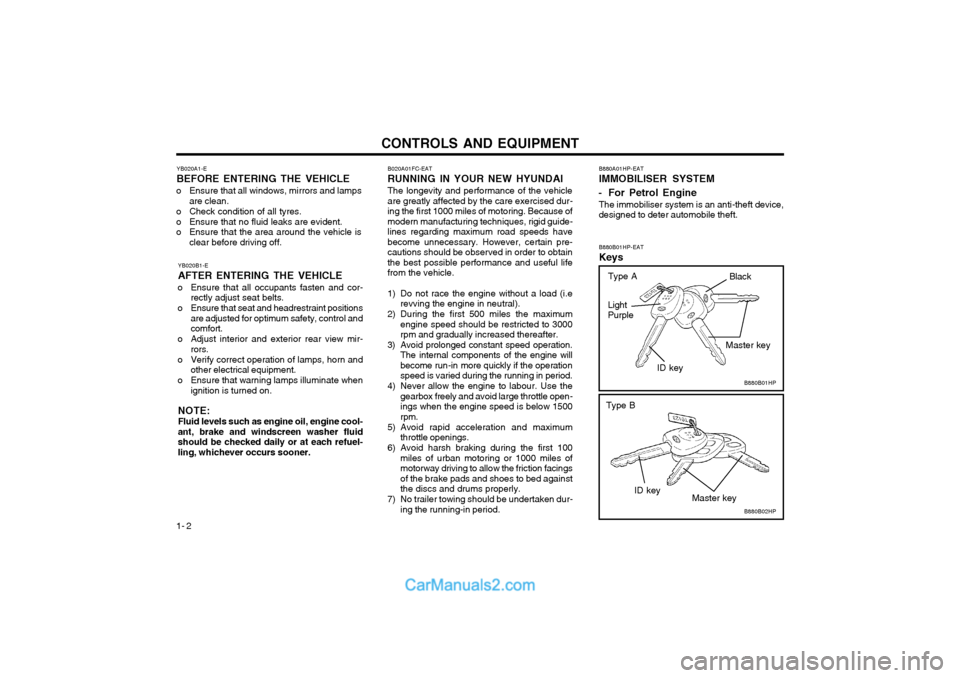
7) No trailer towing should be undertaken dur- ing the running-in period. B880A01HP-EAT IMMOBILISER SYSTEM
- For Petrol Engine The immobiliser system is an anti-theft device, designed to deter automobile theft. B880B01HP-EAT Keys
B880B01HP
B880B02HP
Light Purple
ID key
ID key Master key
Master key
Type B
Black
Type A
Page 245 of 349
CONTROLS AND EQUIPMENT1- 51
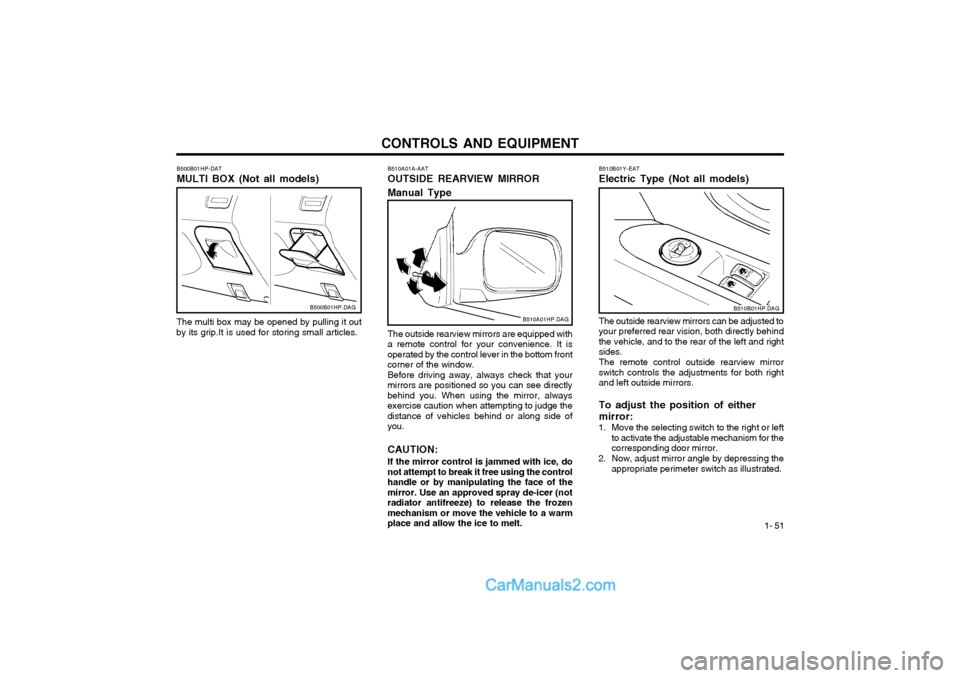
The outside rearview mirrors are equipped with
a remote control for your convenience. It is operated by the control lever in the bottom frontcorner of the window. Before driving away, always check that your
mirrors are positioned so you can see directlybehind you. When using the mirror, alwaysexercise caution when attempting to judge thedistance of vehicles behind or along side ofyou. CAUTION:
If the mirror control is jammed with ice, do
not attempt to break it free using the control handle or by manipulating the face of themirror. Use an approved spray de-icer (notradiator antifreeze) to release the frozenmechanism or move the vehicle to a warmplace and allow the ice to melt. B510A01A-AAT OUTSIDE REARVIEW MIRROR Manual Type
B510A01HP.DAG
B510B01Y-EAT Electric Type (Not all models)B510B01HP.DAG
The outside rearview mirrors can be adjusted to your preferred rear vision, both directly behindthe vehicle, and to the rear of the left and rightsides. The remote control outside rearview mirror switch controls the adjustments for both rightand left outside mirrors. To adjust the position of either mirror:
1. Move the selecting switch to the right or left to activate the adjustable mechanism for the corresponding door mirror.
2. Now, adjust mirror angle by depressing the appropriate perimeter switch as illustrated.B500B01HP.DAG
The multi box may be opened by pulling it out
by its grip.It is used for storing small articles. B500B01HP-DAT MULTI BOX (Not all models)
Page 246 of 349
CONTROLS AND EQUIPMENT
1- 52 B510C01HP.DAG
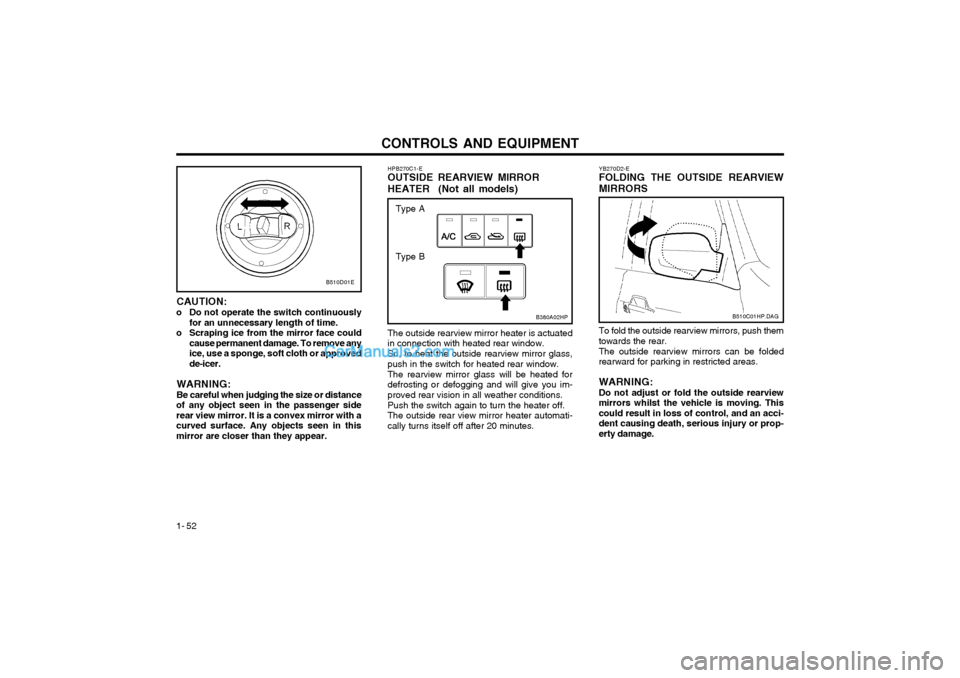
YB270D2-E FOLDING THE OUTSIDE REARVIEW MIRRORS To fold the outside rearview mirrors, push them towards the rear. The outside rearview mirrors can be folded rearward for parking in restricted areas. WARNING: Do not adjust or fold the outside rearviewmirrors whilst the vehicle is moving. Thiscould result in loss of control, and an acci-dent causing death, serious injury or prop-erty damage.
CAUTION:
o Do not operate the switch continuously for an unnecessary length of time.
o Scraping ice from the mirror face could cause permanent damage. To remove anyice, use a sponge, soft cloth or approvedde-icer.
WARNING: Be careful when judging the size or distance
of any object seen in the passenger side rear view mirror. It is a convex mirror with acurved surface. Any objects seen in thismirror are closer than they appear. HPB270C1-E OUTSIDE REARVIEW MIRROR HEATER (Not all models) The outside rearview mirror heater is actuated in connection with heated rear window. So, to heat the outside rearview mirror glass, push in the switch for heated rear window. The rearview mirror glass will be heated for defrosting or defogging and will give you im-proved rear vision in all weather conditions. Push the switch again to turn the heater off. The outside rear view mirror heater automati-cally turns itself off after 20 minutes.
B510D01E
B380A02HP
Type A
Type B
Page 247 of 349
CONTROLS AND EQUIPMENT1- 53
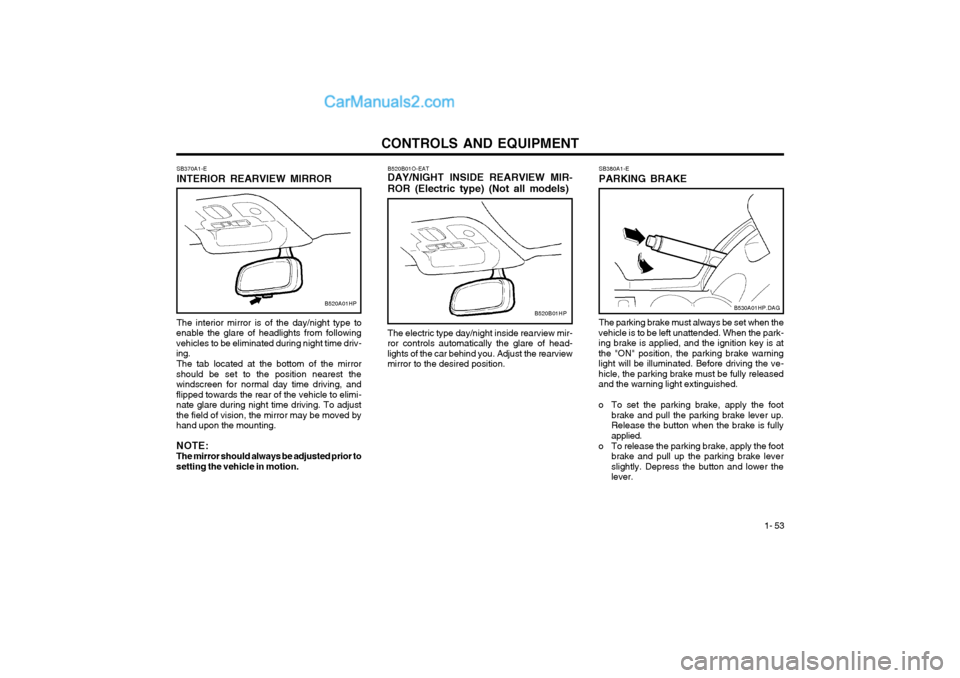
B520B01O-EAT DAY/NIGHT INSIDE REARVIEW MIR- ROR (Electric type) (Not all models) The electric type day/night inside rearview mir-
ror controls automatically the glare of head- lights of the car behind you. Adjust the rearviewmirror to the desired position.
SB370A1-E INTERIOR REARVIEW MIRROR The interior mirror is of the day/night type to
enable the glare of headlights from following vehicles to be eliminated during night time driv-ing.
The tab located at the bottom of the mirror
should be set to the position nearest thewindscreen for normal day time driving, andflipped towards the rear of the vehicle to elimi-nate glare during night time driving. To adjustthe field of vision, the mirror may be moved byhand upon the mounting. NOTE: The mirror should always be adjusted prior tosetting the vehicle in motion.
B520A01HPB520B01HP
SB380A1-E PARKING BRAKE The parking brake must always be set when the
vehicle is to be left unattended. When the park- ing brake is applied, and the ignition key is atthe "ON" position, the parking brake warninglight will be illuminated. Before driving the ve-hicle, the parking brake must be fully releasedand the warning light extinguished.
o To set the parking brake, apply the foot brake and pull the parking brake lever up. Release the button when the brake is fullyapplied.
o To release the parking brake, apply the foot brake and pull up the parking brake leverslightly. Depress the button and lower thelever.
B530A01HP.DAG
Page 251 of 349
CONTROLS AND EQUIPMENT1- 57
B570A02HP
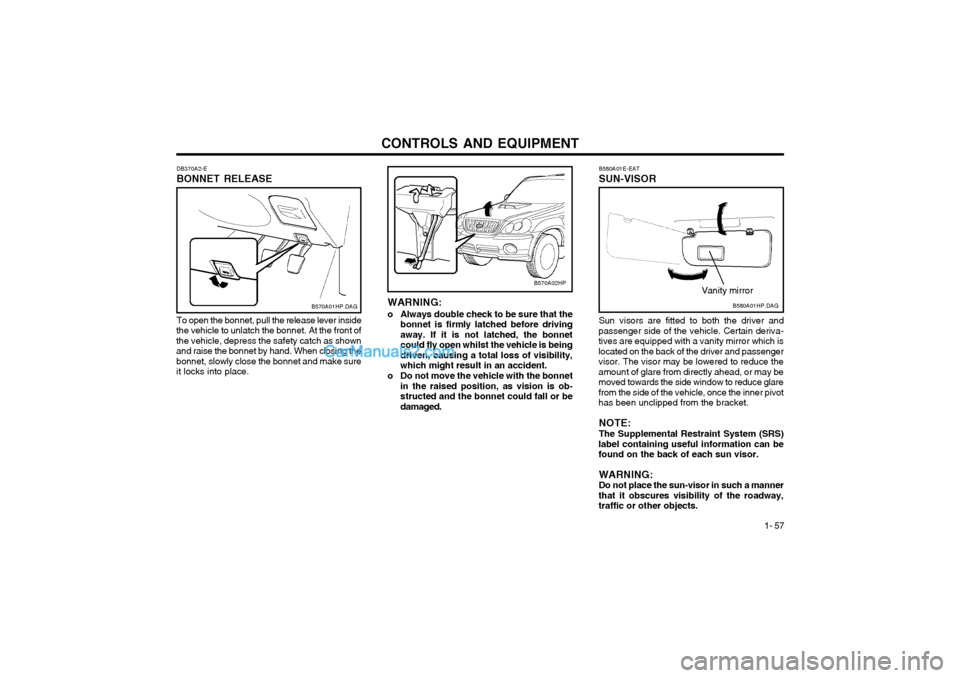
DB370A2-E BONNET RELEASE
B570A01HP.DAG
To open the bonnet, pull the release lever inside
the vehicle to unlatch the bonnet. At the front of the vehicle, depress the safety catch as shownand raise the bonnet by hand. When closing thebonnet, slowly close the bonnet and make sureit locks into place. WARNING:
o Always double check to be sure that the bonnet is firmly latched before drivingaway. If it is not latched, the bonnetcould fly open whilst the vehicle is beingdriven, causing a total loss of visibility,which might result in an accident.
o Do not move the vehicle with the bonnet in the raised position, as vision is ob-structed and the bonnet could fall or bedamaged. B580A01E-EAT SUN-VISORB580A01HP.DAG
Vanity mirror
Sun visors are fitted to both the driver and
passenger side of the vehicle. Certain deriva- tives are equipped with a vanity mirror which islocated on the back of the driver and passengervisor. The visor may be lowered to reduce theamount of glare from directly ahead, or may bemoved towards the side window to reduce glarefrom the side of the vehicle, once the inner pivothas been unclipped from the bracket.
NOTE: The Supplemental Restraint System (SRS)
label containing useful information can be found on the back of each sun visor.
WARNING:Do not place the sun-visor in such a manner
that it obscures visibility of the roadway,traffic or other objects.
Page 273 of 349
DRIVING YOUR HYUNDAI
2- 2 C020A01A-EAT
BEFORE STARTING THE ENGINE
Before you start the engine, you should always:
1. Look around the vehicle to be sure there are no flat tyres, puddles of oil or water or other indications of possible trouble.
2. After entering the car, check to be sure the parking brake is engaged.
3. Check that all windows, and lights are clean.
4. Check that the interior and exterior mirrors are clean and in position.
5. Check your seat, seatback and headrest to be sure they are in their proper positions.
6. Close all the doors.
7. Fasten your seat belt and be sure that all other occupants have fastened theirs.
8. Turn off all lights and accessories that are not needed.
9. When you turn the ignition switch to "ON" check that all appropriate warning lights are operating and that you have sufficient fuel.
10.Check the operation of warning lights and all bulbs when key is in the "ON" position. C030A01HP-EAT COMBINATION IGNITION SWITCH AND STEERING LOCK To Start the Engine
o If your Hyundai is equipped with a manual
transmission, place the shift lever in neutral and depress the clutch pedal fully.
o If your Hyundai has an automatic transmis- sion, place the shift lever in "P" (park).
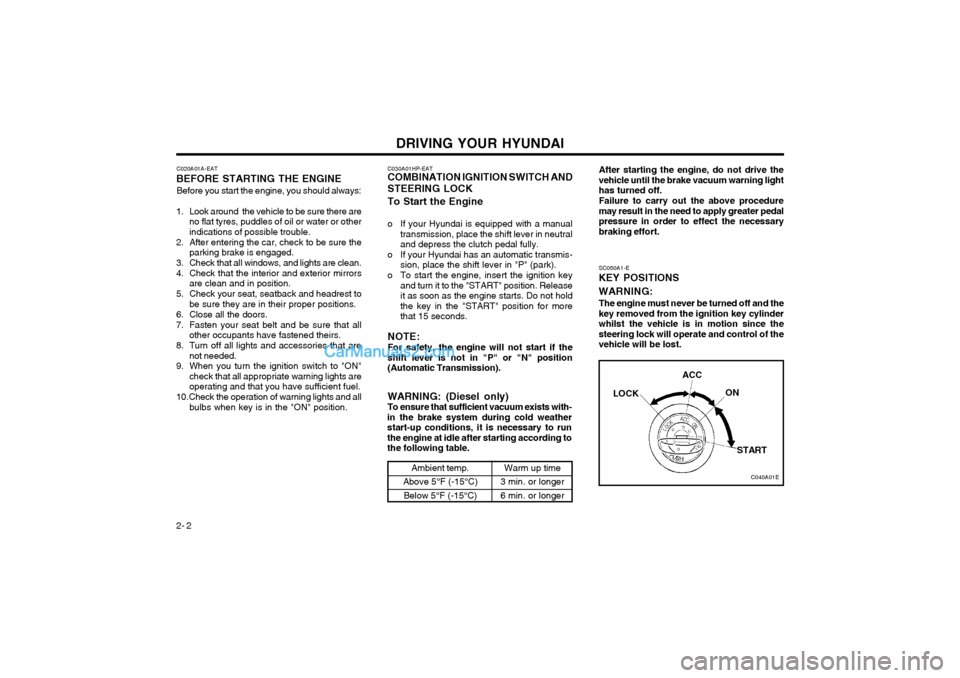
o To start the engine, insert the ignition key and turn it to the "START" position. Releaseit as soon as the engine starts. Do not holdthe key in the "START" position for morethat 15 seconds.
NOTE: For safety, the engine will not start if the shift lever is not in "P" or "N" position(Automatic Transmission). SC050A1-E
KEY POSITIONS WARNING:
The engine must never be turned off and the key removed from the ignition key cylinderwhilst the vehicle is in motion since thesteering lock will operate and control of thevehicle will be lost.
C040A01E
LOCK
ACC
ON
START
WARNING: (Diesel only) To ensure that sufficient vacuum exists with-
in the brake system during cold weatherstart-up conditions, it is necessary to runthe engine at idle after starting according tothe following table.
Ambient temp.
Above 5°F (-15°C) Below 5°F (-15°C)Warm up time
3 min. or longer 6 min. or longer After starting the engine, do not drive the vehicle until the brake vacuum warning lighthas turned off. Failure to carry out the above procedure may result in the need to apply greater pedalpressure in order to effect the necessarybraking effort.
Page 287 of 349
DRIVING YOUR HYUNDAI
2- 16 ZC170E1-E
Windscreen Washers & Wipers
The windscreen washer bottle should be filled with a solution of water and a proprietary winterscreen wash additive. The windscreen wipersshould not be used if the blades are frozen tothe windscreen or if they are covered withsnow, before this is removed. NOTE: Never allow undiluted screen washer fluid additive to spill upon the paintwork or useengine coolant anti-freeze since damage tothe paintwork may result.
o When driving in extreme conditions, the windscreen wiper blades may fail to clearthe screen properly due to the formation ofice upon the blade edge. It will therefore benecessary to periodically remove such iceto restore their efficiency.
o If the power operated door mirrors become frozen, attempts to adjust these may dam-age the mechanism.
o The formation of snow or ice build up inside the wheel arches may interfere with theroadwheels or steering mechanism. In suchinstances, unusual noises or an increase insteering effort may result. Therefore, ensurethat the wheelarches are checked periodi-cally and any accumulated snow or ice re-moved.
ZC170B1-E
Electrical System
Winter conditions impose severe demands upon
vehicle electrical systems, particularly the charg-ing circuit. The battery condition and perfor-mance along with the alternator performanceand drive belt condition should be checked priorto the onset of winter.
YC170C1-E
Anti-freeze/Corrosion inhibitor The cooling system must always contain anEthylene-Glycol based anti-freeze solution. Thesystem is filled during manufacture with solu-tion of the correct strength which should bechecked before the onset of winter and adjust-ed or changed as required. NOTE: The anti-freeze solution contains a corro- sion inhibitor to prevent degradation of thealuminium castings contained within theengine. Therefore, never, drain the systemand refill with water only. In addition, anti-freeze solution must ALWAYS be used in vehicles fitted with air conditioning,to prevent the heater matrix from freezing andsubsequently bursting with the refrigeration sys-tem in use. ZC170D1-E
Door Locks
Should the door lock mechanism become fro-zen, a proprietary lock de-icer should be used.Alternatively, warming the door key may thawthe door lock. However, the key should behandled carefully to avoid burning the fingers. Never attempt to thaw a frozen door lock using hot water, since the water will eventually freezeand compound the problem. NOTE: The proper temperature for using the immo-bilizer key is from -40°F to 176°F (-40°C to80°C). If you heat the immobilizer key over176°F to open the frozen lock, it may causedamage to the transponder in its head.
Page 315 of 349
OWNER MAINTENANCE 6-3
G030A01FC-EAT
ENGINE OIL
The correct engine oil level is of paramount
importance. An excessively high or low oil level may result in irreparable damage being sus-tained by the engine. The engine oil level mustbe checked on a daily basis, whenever thevehicle is refuelled or before starting a long trip,whichever occurs sooner.
In addition, it is imperative that only an ap-
proved grade and specification of oil is used toavoid the possibility of serious engine damageand premature wear. The use of "budget price"oil is a false economy that must be avoided ifthe maximum reliability and useful life is to beobtained from the vehicle.
SG020B1-E
DAILY OPERATING CHECKS The following items should be checked on a
daily basis or whenever the vehicle is refuelled,whichever occurs sooner.
o Engine oil level.
o Coolant level.
o Power steering fluid level.
o Brake fluid level.
o Windscreen washer fluid level.
o Battery condition.
o Tyre condition and pressures.
o Operation and cleanliness of all lighting equipment.
o Windscreen wiper and washer operation.
o Horn operation.
o Warning light operation.
o Adjustment and cleanliness of mirrors.
o Seat and seat belt adjustment and opera- tion.
o Fluid leakage.
The vehicle must not be driven if the daily
operating checks indicate that any item of equip-ment related to the safety or roadworthiness ofthe vehicle is not functioning correctly. G030B01HP-EAT
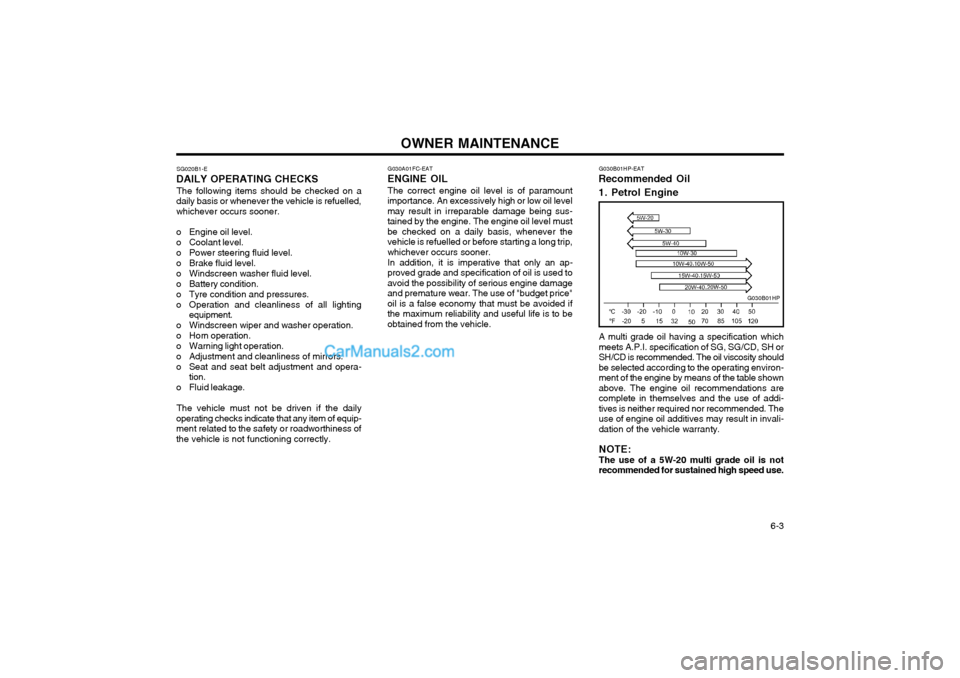
Recommended Oil
1. Petrol Engine
A multi grade oil having a specification which
meets A.P.I. specification of SG, SG/CD, SH or SH/CD is recommended. The oil viscosity shouldbe selected according to the operating environ-ment of the engine by means of the table shownabove. The engine oil recommendations arecomplete in themselves and the use of addi-tives is neither required nor recommended. Theuse of engine oil additives may result in invali-dation of the vehicle warranty.
NOTE:The use of a 5W-20 multi grade oil is not
recommended for sustained high speed use.
G030B01HP
Page 347 of 349
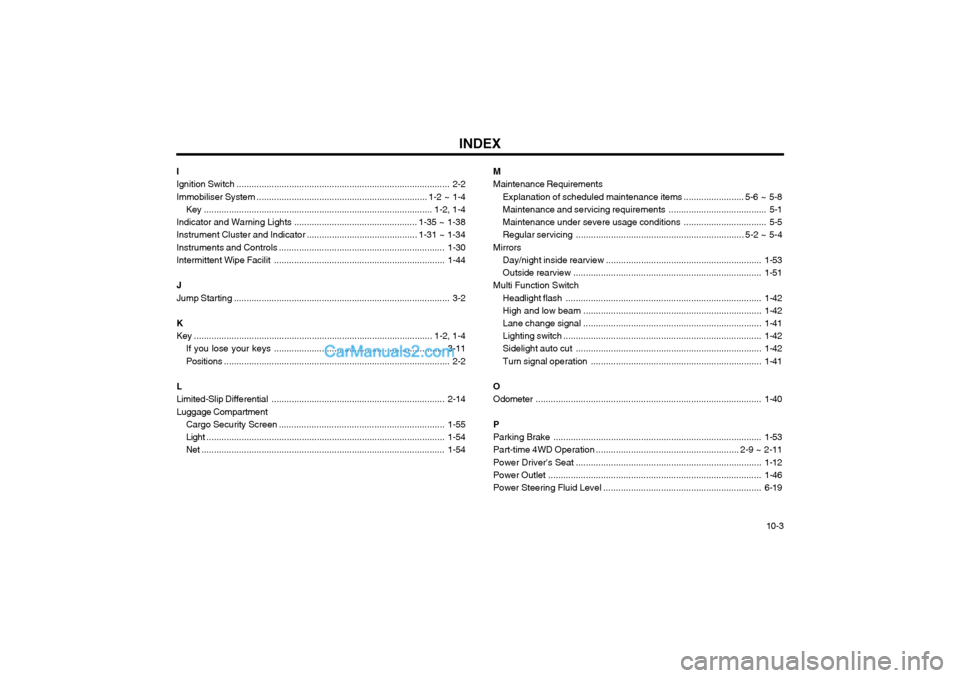
INDEX10-3
M Maintenance Requirements
Explanation of scheduled maintenance items ........................ 5-6 ~ 5-8
Maintenance and servicing requirements ....................................... 5-1
Maintenance under severe usage conditions ................................. 5-5
Regular servicing ................................................................... 5-2 ~ 5-4
Mirrors Day/night inside rearview .............................................................. 1-53
Outside rearview ........................................................................... 1-51
Multi Function Switch
Headlight flash .............................................................................. 1-42
High and low beam ....................................................................... 1-42
Lane change signal ....................................................................... 1-41
Lighting switch ............................................................................... 1-42
Sidelight auto cut .......................................................................... 1-42
Turn signal operation .................................................................... 1-41
OOdometer .......................................................................................... 1-40
P Parking Brake ................................................................................... 1-53
Part-time 4WD Operation ......................................................... 2-9 ~ 2-11
Power Driver's Seat .......................................................................... 1-12
Power Outlet ..................................................................................... 1-46
Power Steering Fluid Level ............. ..................................................6-19
I Ignition Switch
..................................................................................... 2-2
Immobiliser System .................................................................... 1-2 ~ 1-4
Key ........................................................................................... 1-2, 1-4
Indicator and Warning Lights ................................................. 1-35 ~ 1-38
Instrument Cluster and Indicator ............................................ 1-31 ~ 1-34
Instruments and Controls ................ ..................................................1-30
Intermittent Wipe Facilit .................................................................... 1-44
J Jump Starting ...................................................................................... 3-2
K
Key ............................................................................................... 1-2, 1-4 If you lose your keys .................................................................... 3-11
Positions .......................................................................................... 2-2
LLimited-Slip Differential ..................................................................... 2-14
Luggage Compartment Cargo Security Screen .................................................................. 1-55
Light ............................................................................................... 1-54
Net ................................................................................................. 1-54