engine coolant Hyundai Terracan 2003 Owner's Guide
[x] Cancel search | Manufacturer: HYUNDAI, Model Year: 2003, Model line: Terracan, Model: Hyundai Terracan 2003Pages: 349, PDF Size: 4.56 MB
Page 166 of 349
DO-IT-YOURSELF MAINTENANCE
6-20
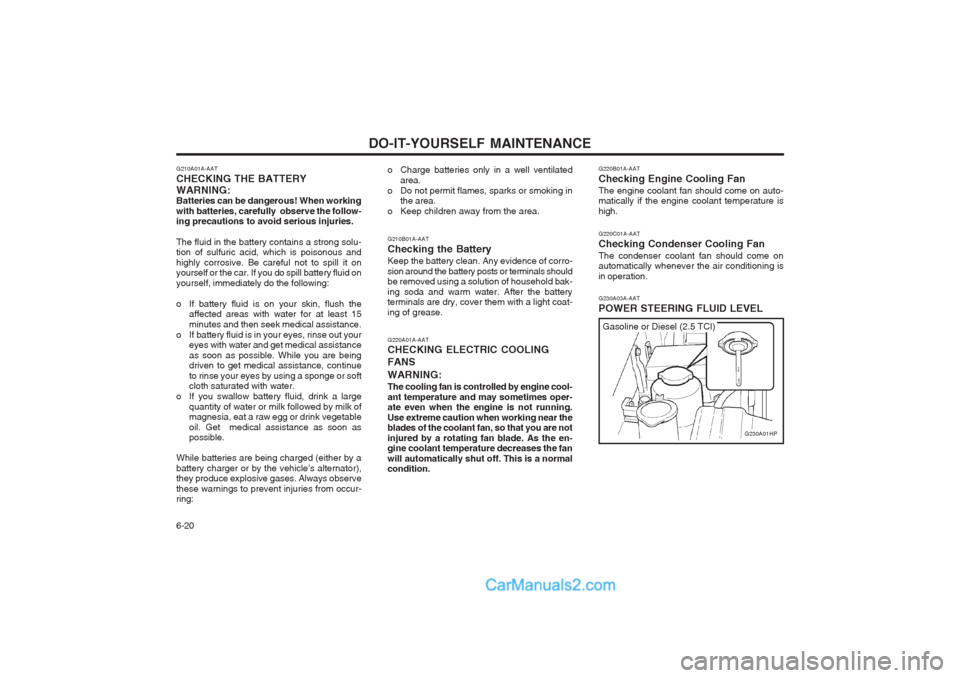
G220B01A-AAT Checking Engine Cooling FanThe engine coolant fan should come on auto- matically if the engine coolant temperature is high. G220C01A-AAT Checking Condenser Cooling FanThe condenser coolant fan should come on automatically whenever the air conditioning is in operation. G230A03A-AAT POWER STEERING FLUID LEVEL
G230A01HP
Gasoline or Diesel (2.5 TCI)
o Charge batteries only in a well ventilated
area.
o Do not permit flames, sparks or smoking in the area.
o Keep children away from the area. G210B01A-AAT Checking the BatteryKeep the battery clean. Any evidence of corro- sion around the battery posts or terminals should be removed using a solution of household bak- ing soda and warm water. After the battery terminals are dry, cover them with a light coat- ing of grease. G220A01A-AAT CHECKING ELECTRIC COOLING FANS WARNING: The cooling fan is controlled by engine cool- ant temperature and may sometimes oper- ate even when the engine is not running. Use extreme caution when working near the blades of the coolant fan, so that you are not injured by a rotating fan blade. As the en- gine coolant temperature decreases the fan will automatically shut off. This is a normal condition.
G210A01A-AAT CHECKING THE BATTERYWARNING: Batteries can be dangerous! When working with batteries, carefully observe the follow- ing precautions to avoid serious injuries. The fluid in the battery contains a strong solu- tion of sulfuric acid, which is poisonous and highly corrosive. Be careful not to spill it on yourself or the car. If you do spill battery fluid on yourself, immediately do the following:
o If battery fluid is on your skin, flush the
affected areas with water for at least 15 minutes and then seek medical assistance.
o If battery fluid is in your eyes, rinse out your eyes with water and get medical assistanceas soon as possible. While you are being driven to get medical assistance, continue to rinse your eyes by using a sponge or soft cloth saturated with water.
o If you swallow battery fluid, drink a large quantity of water or milk followed by milk ofmagnesia, eat a raw egg or drink vegetable oil. Get medical assistance as soon as possible.
While batteries are being charged (either by a battery charger or by the vehicle’s alternator), they produce explosive gases. Always observe these warnings to prevent injuries from occur- ring:
Page 169 of 349
DO-IT-YOURSELF MAINTENANCE 6-23
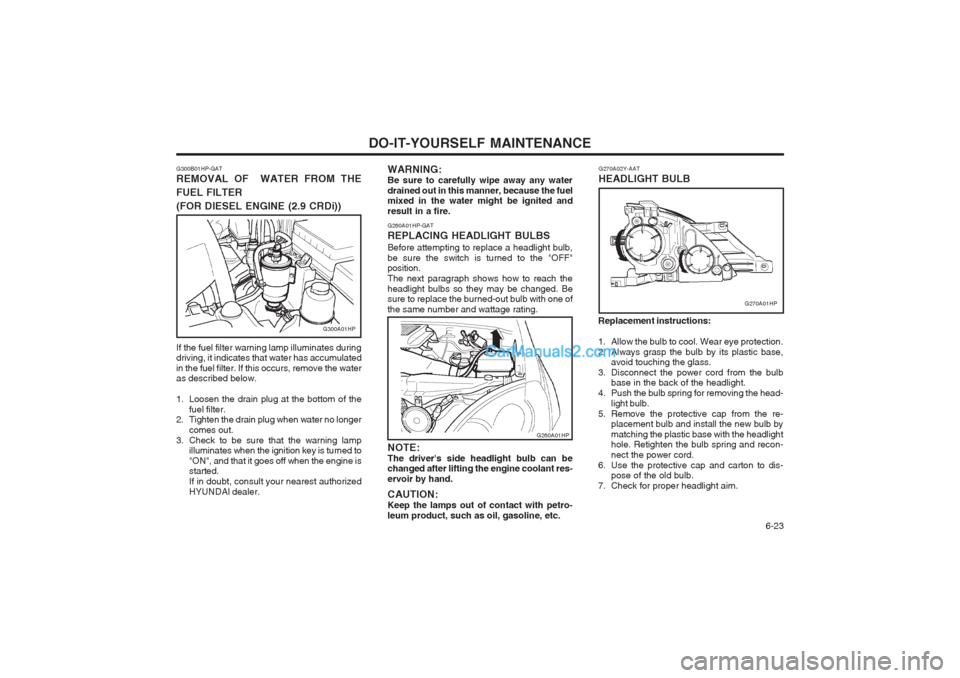
G260A01HP-GAT REPLACING HEADLIGHT BULBSBefore attempting to replace a headlight bulb, be sure the switch is turned to the "OFF" position. The next paragraph shows how to reach theheadlight bulbs so they may be changed. Be sure to replace the burned-out bulb with one of the same number and wattage rating.
WARNING:Be sure to carefully wipe away any waterdrained out in this manner, because the fuel mixed in the water might be ignited and result in a fire. NOTE: The driver's side headlight bulb can be changed after lifting the engine coolant res- ervoir by hand. CAUTION: Keep the lamps out of contact with petro-leum product, such as oil, gasoline, etc.
G260A01HP
Replacement instructions:
1. Allow the bulb to cool. Wear eye protection.
2. Always grasp the bulb by its plastic base,
avoid touching the glass.
3. Disconnect the power cord from the bulb base in the back of the headlight.
4. Push the bulb spring for removing the head-
light bulb.
5. Remove the protective cap from the re- placement bulb and install the new bulb bymatching the plastic base with the headlight hole. Retighten the bulb spring and recon- nect the power cord.
6. Use the protective cap and carton to dis- pose of the old bulb.
7. Check for proper headlight aim. G270A02Y-AAT HEADLIGHT BULB
G270A01HP
G300B01HP-GAT REMOVAL OF WATER FROM THE FUEL FILTER
(FOR DIESEL ENGINE (2.9 CRDi))
G300A01HP
If the fuel filter warning lamp illuminates during driving, it indicates that water has accumulated in the fuel filter. If this occurs, remove the water as described below.
1. Loosen the drain plug at the bottom of the fuel filter.
2. Tighten the drain plug when water no longer
comes out.
3. Check to be sure that the warning lamp illuminates when the ignition key is turned to "ON", and that it goes off when the engine is started. If in doubt, consult your nearest authorizedHYUNDAI dealer.
Page 170 of 349
DO-IT-YOURSELF MAINTENANCE
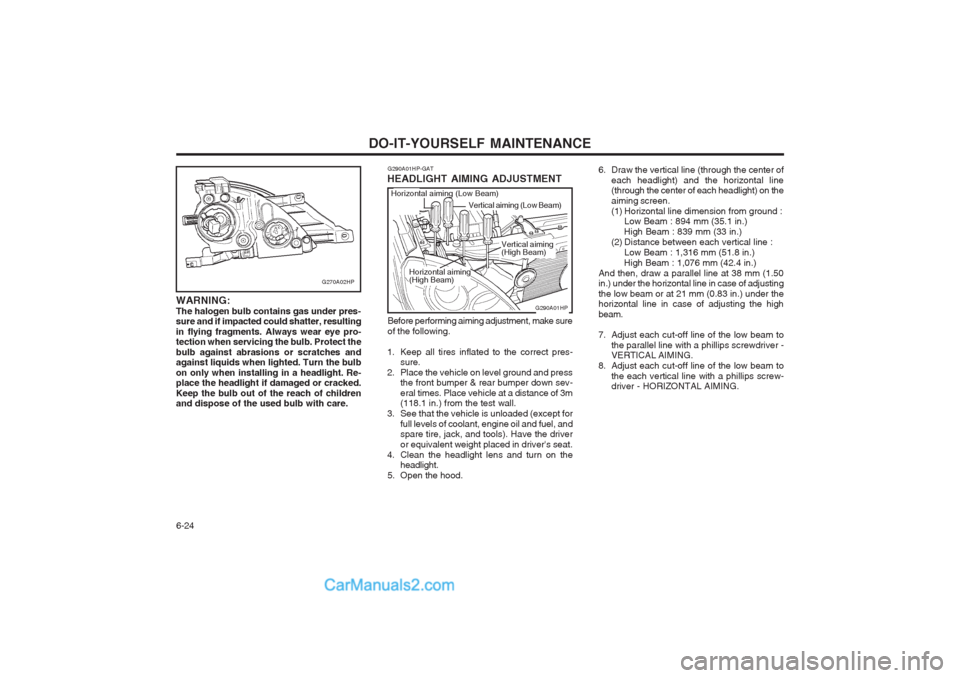
6-24 6. Draw the vertical line (through the center of
each headlight) and the horizontal line (through the center of each headlight) on the aiming screen.
(1) Horizontal line dimension from ground :Low Beam : 894 mm (35.1 in.)
High Beam : 839 mm (33 in.)
(2) Distance between each vertical line : Low Beam : 1,316 mm (51.8 in.)
High Beam : 1,076 mm (42.4 in.)
And then, draw a parallel line at 38 mm (1.50 in.) under the horizontal line in case of adjusting the low beam or at 21 mm (0.83 in.) under the horizontal line in case of adjusting the high beam.
7. Adjust each cut-off line of the low beam to the parallel line with a phillips screwdriver - VERTICAL AIMING.
8. Adjust each cut-off line of the low beam to
the each vertical line with a phillips screw-driver - HORIZONTAL AIMING.
G290A01HP-GAT
HEADLIGHT AIMING ADJUSTMENT
G290A01HP
Horizontal aiming (Low Beam)
Vertical aiming (Low Beam)
Before performing aiming adjustment, make sure of the following.
1. Keep all tires inflated to the correct pres- sure.
2. Place the vehicle on level ground and press the front bumper & rear bumper down sev-eral times. Place vehicle at a distance of 3m (118.1 in.) from the test wall.
3. See that the vehicle is unloaded (except for
full levels of coolant, engine oil and fuel, andspare tire, jack, and tools). Have the driver or equivalent weight placed in driver's seat.
4. Clean the headlight lens and turn on the headlight.
5. Open the hood. Vertical aiming (High Beam)
Horizontal aiming(High Beam)
G270A02HP
WARNING: The halogen bulb contains gas under pres- sure and if impacted could shatter, resulting in flying fragments. Always wear eye pro- tection when servicing the bulb. Protect the bulb against abrasions or scratches and against liquids when lighted. Turn the bulb on only when installing in a headlight. Re- place the headlight if damaged or cracked. Keep the bulb out of the reach of children and dispose of the used bulb with care.
Page 173 of 349
EMISSION CONTROL SYSTEMS 7-1
7. EMISSION
CONTROL SYSTEMS
H010A01A-GAT EMISSION CONTROL SYSTEMS (If installed) Your Hyundai is equipped with an emission control system to meet all requirements of the Emission prohibition rules of your province. There are three emission control systems which are as follows. (1) Crankcase emission control system (For a Gasoline Engine)
(2) Evaporative emission control system (For a Gasoline Engine)
(3) Exhaust emission control system In order to assure the proper function of the emission control systems, it is recommended that you have your car inspected and main- tained by an authorized Hyundai dealer in ac- cordance with the maintenance schedule in this manual. H010C02Y-GAT 2. Evaporative Emission Control
System; For a Gasoline Engine
The Evaporative Emission Control System is
designed to prevent fuel vapors from escaping into the atmosphere. Canister While the engine is inoperative, fuel vapors
generated inside the fuel tank are absorbed and stored in the canister. When the engine is
running, the fuel vapors absorbed in the canis- ter are drawn into the induction system through the purge control solenoid valve. Purge Control Solenoid Valve The purge control solenoid valve is controlled
by the ECM; when the engine coolant tempera- ture is low, and during idling, it closes, so that evaporated fuel is not taken into the surge tank.
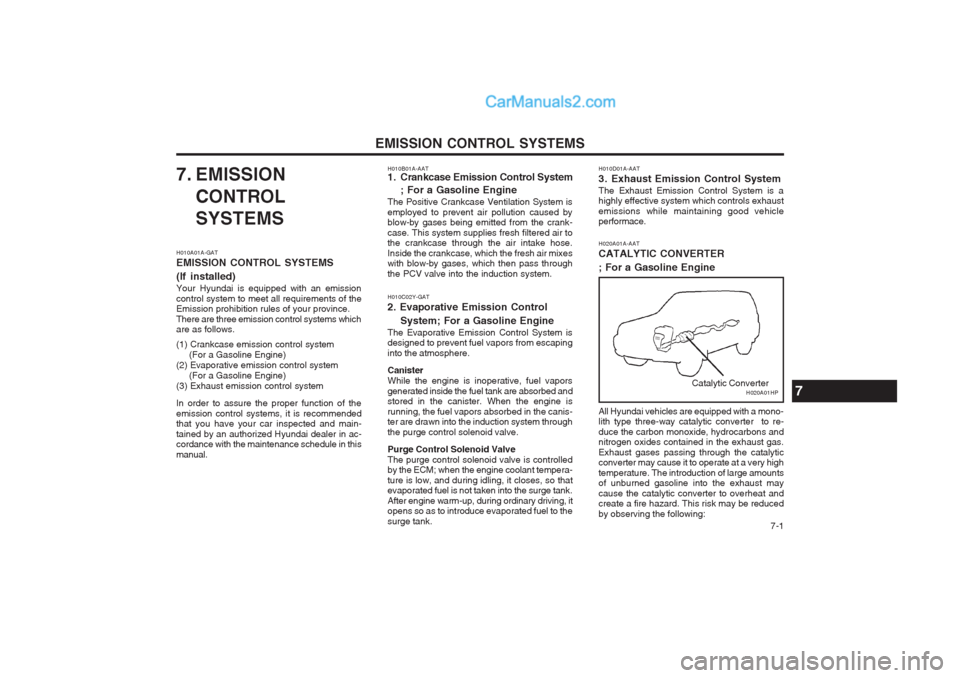
After engine warm-up, during ordinary driving, it opens so as to introduce evaporated fuel to the surge tank. H020A01A-AAT CATALYTIC CONVERTER ; For a Gasoline Engine
H020A01HP
Catalytic Converter
All Hyundai vehicles are equipped with a mono- lith type three-way catalytic converter to re- duce the carbon monoxide, hydrocarbons and nitrogen oxides contained in the exhaust gas. Exhaust gases passing through the catalytic converter may cause it to operate at a very high temperature. The introduction of large amounts of unburned gasoline into the exhaust may cause the catalytic converter to overheat and create a fire hazard. This risk may be reduced by observing the following:
H010B01A-AAT
1. Crankcase Emission Control System
; For a Gasoline Engine
The Positive Crankcase Ventilation System is employed to prevent air pollution caused by blow-by gases being emitted from the crank- case. This system supplies fresh filtered air to the crankcase through the air intake hose. Inside the crankcase, which the fresh air mixes with blow-by gases, which then pass through the PCV valve into the induction system.7
H010D01A-AAT
3. Exhaust Emission Control SystemThe Exhaust Emission Control System is a highly effective system which controls exhaust emissions while maintaining good vehicle performace.
Page 183 of 349
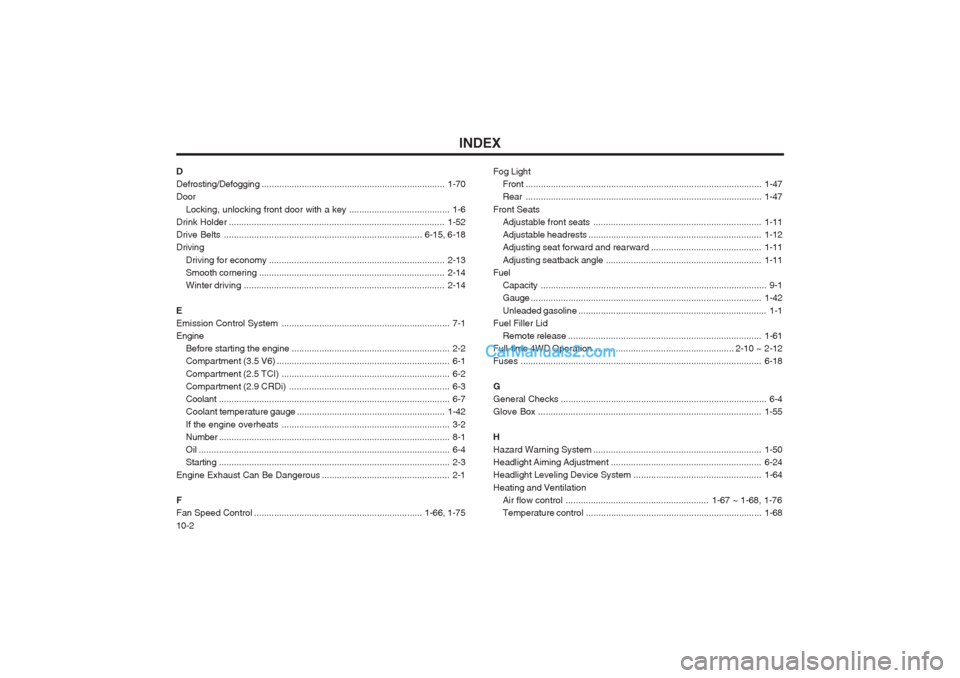
INDEX
10-2
D Defrosting/Defogging
......................................................................... 1-70
Door
Locking, unlocking front door with a key ........................................ 1-6
Drink Holder ...................................................................................... 1-52
Drive Belts ............................................................................... 6-15, 6-18
Driving
Driving for economy ...................................................................... 2-13
Smooth cornering .......................................................................... 2-14
Winter driving ................................................................................ 2-14
E
Emission Control System ................................................................... 7-1
Engine
Before starting the engine ............................................................... 2-2
Compartment (3.5 V6) ..................................................................... 6-1
Compartment (2.5 TCI) ................................................................... 6-2
Compartment (2.9 CRDi) ................................................................ 6-3
Coolant ............................................................................................ 6-7
Coolant temperature gauge ........................................................... 1-42
If the engine overheats ................................................................... 3-2
Number ............................................................................................ 8-1
Oil .................................................................................................... 6-4Starting ............................................................................................ 2-3
Engine Exhaust Can Be Dangerous ................................................... 2-1
FFan Speed Control ................................................................... 1-66, 1-75 Fog Light
Front .............................................................................................. 1-47
Rear .............................................................................................. 1-47
Front Seats Adjustable front seats ................................................................... 1-11
Adjustable headrests ..................................................................... 1-12
Adjusting seat forward and rearward ............................................1-11
Adjusting seatback angle .............................................................. 1-11
Fuel Capacity .......................................................................................... 9-1
Gauge ............................................................................................ 1-42
Unleaded gasoline ........................................................................... 1-1
Fuel Filler Lid Remote release ............................................................................. 1-61
Full-time 4WD Operation ....................................................... 2-10 ~ 2-12
Fuses ................................................................................................ 6-18
GGeneral Checks .................................................................................. 6-4
Glove Box ......................................................................................... 1-55
HHazard Warning System ................................................................... 1-50
Headlight Aiming Adjustment ............................................................ 6-24
Headlight Leveling Device System ...................................................1-64
Heating and Ventilation Air flow control ......................................................... 1-67 ~ 1-68, 1-76
Temperature control ...................................................................... 1-68
Page 225 of 349
CONTROLS AND EQUIPMENT1- 31
B260A01HP-E
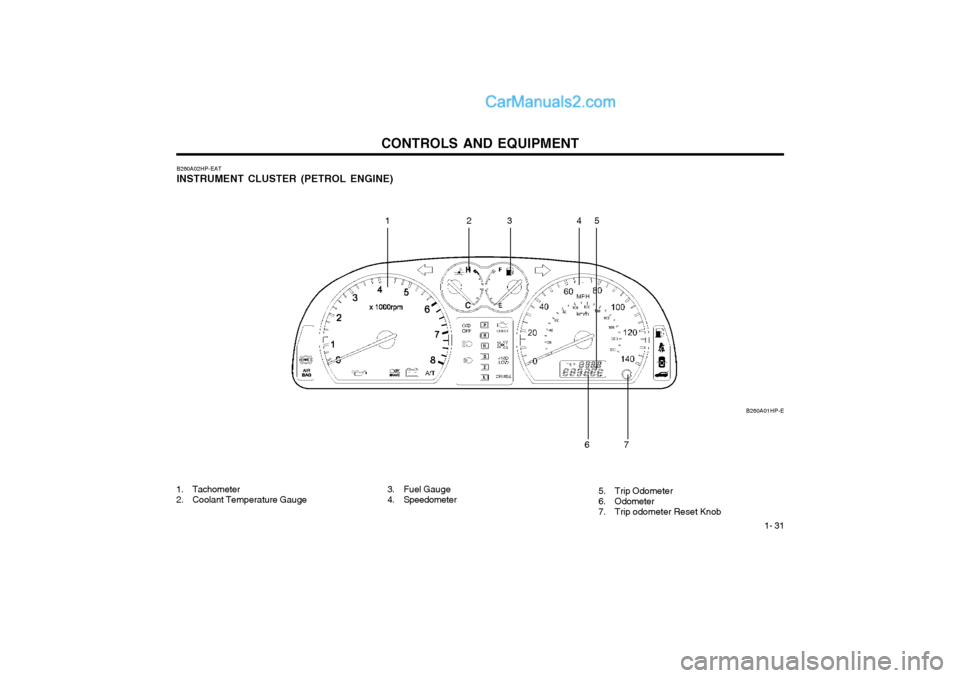
B260A02HP-EAT INSTRUMENT CLUSTER (PETROL ENGINE)
1. Tachometer
2. Coolant Temperature Gauge
12 345
7
6
3. Fuel Gauge
4. Speedometer 5. Trip Odometer
6. Odometer
7. Trip odometer Reset Knob
Page 227 of 349
CONTROLS AND EQUIPMENT1- 33
B260A03HP-E
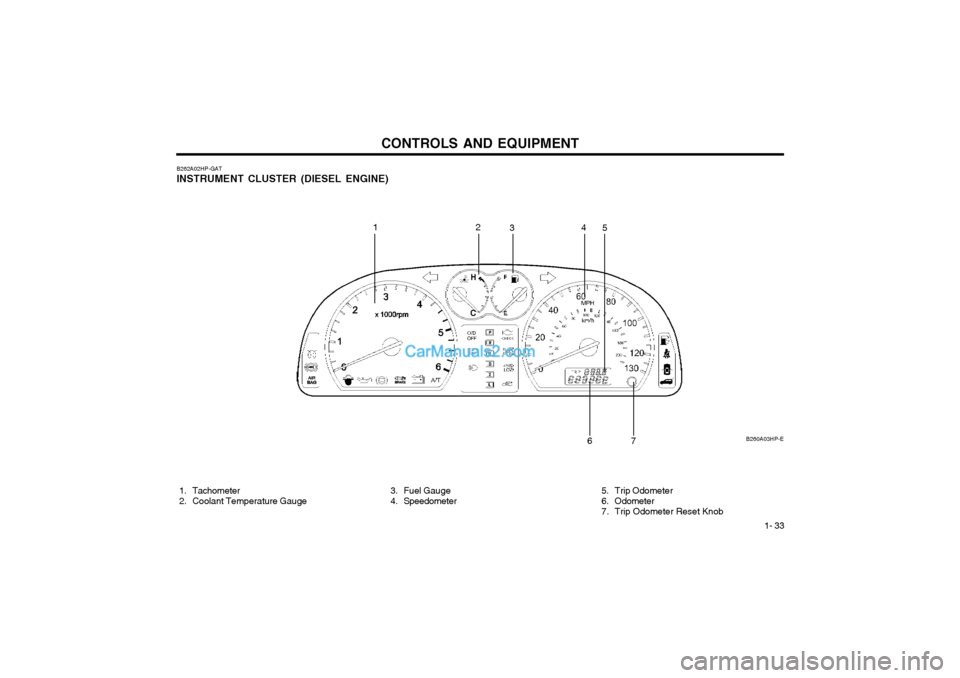
B262A02HP-GAT INSTRUMENT CLUSTER (DIESEL ENGINE)
1. Tachometer
2. Coolant Temperature Gauge 3. Fuel Gauge
4. Speedometer
12
34
5
6
7
5. Trip Odometer
6. Odometer
7. Trip Odometer Reset Knob
Page 233 of 349
CONTROLS AND EQUIPMENT1- 39
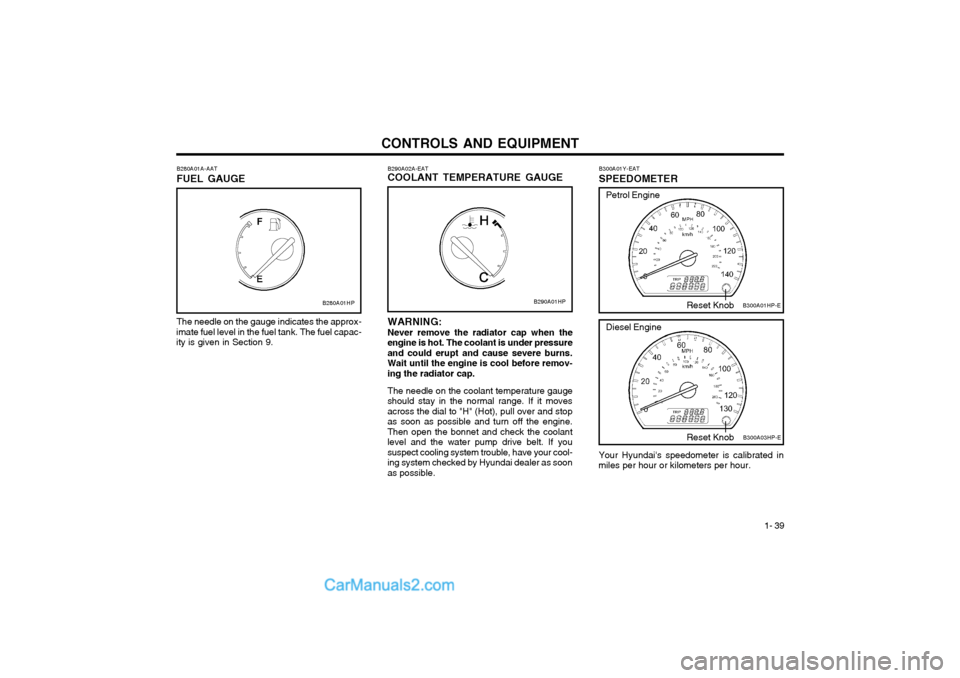
B300A01Y-EAT SPEEDOMETER Your Hyundai's speedometer is calibrated in
miles per hour or kilometers per hour. B300A03HP-EB290A02A-EAT COOLANT TEMPERATURE GAUGE WARNING: Never remove the radiator cap when the
engine is hot. The coolant is under pressure and could erupt and cause severe burns.Wait until the engine is cool before remov-ing the radiator cap.
The needle on the coolant temperature gauge
should stay in the normal range. If it movesacross the dial to "H" (Hot), pull over and stopas soon as possible and turn off the engine.Then open the bonnet and check the coolantlevel and the water pump drive belt. If yoususpect cooling system trouble, have your cool-ing system checked by Hyundai dealer as soonas possible.
B280A01A-AAT FUEL GAUGE The needle on the gauge indicates the approx-
imate fuel level in the fuel tank. The fuel capac- ity is given in Section 9.
B280A01HPB290A01HP
Petrol Engine
Reset Knob
B300A01HP-E
Diesel EngineReset Knob
Page 237 of 349
CONTROLS AND EQUIPMENT1- 43
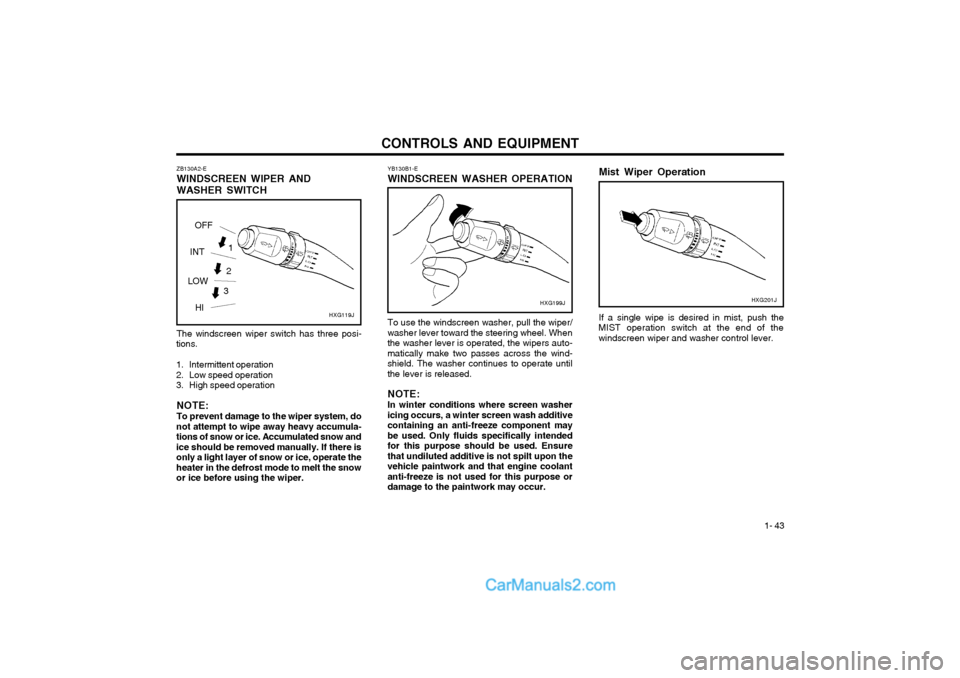
ZB130A2-E WINDSCREEN WIPER ANDWASHER SWITCH The windscreen wiper switch has three posi-
tions.
1. Intermittent operation
2. Low speed operation
3. High speed operation
NOTE: To prevent damage to the wiper system, do
not attempt to wipe away heavy accumula- tions of snow or ice. Accumulated snow andice should be removed manually. If there isonly a light layer of snow or ice, operate theheater in the defrost mode to melt the snowor ice before using the wiper. YB130B1-E WINDSCREEN WASHER OPERATION
To use the windscreen washer, pull the wiper/
washer lever toward the steering wheel. When the washer lever is operated, the wipers auto-matically make two passes across the wind-shield. The washer continues to operate untilthe lever is released.
NOTE: In winter conditions where screen washer
icing occurs, a winter screen wash additive containing an anti-freeze component maybe used. Only fluids specifically intendedfor this purpose should be used. Ensurethat undiluted additive is not spilt upon thevehicle paintwork and that engine coolantanti-freeze is not used for this purpose ordamage to the paintwork may occur. HXG199J
3
2
HXG119J
1
OFF
INT
LOW HI Mist Wiper Operation If a single wipe is desired in mist, push the
MIST operation switch at the end of the windscreen wiper and washer control lever. HXG201J
Page 287 of 349
DRIVING YOUR HYUNDAI
2- 16 ZC170E1-E
Windscreen Washers & Wipers
The windscreen washer bottle should be filled with a solution of water and a proprietary winterscreen wash additive. The windscreen wipersshould not be used if the blades are frozen tothe windscreen or if they are covered withsnow, before this is removed. NOTE: Never allow undiluted screen washer fluid additive to spill upon the paintwork or useengine coolant anti-freeze since damage tothe paintwork may result.
o When driving in extreme conditions, the windscreen wiper blades may fail to clearthe screen properly due to the formation ofice upon the blade edge. It will therefore benecessary to periodically remove such iceto restore their efficiency.
o If the power operated door mirrors become frozen, attempts to adjust these may dam-age the mechanism.
o The formation of snow or ice build up inside the wheel arches may interfere with theroadwheels or steering mechanism. In suchinstances, unusual noises or an increase insteering effort may result. Therefore, ensurethat the wheelarches are checked periodi-cally and any accumulated snow or ice re-moved.
ZC170B1-E
Electrical System
Winter conditions impose severe demands upon
vehicle electrical systems, particularly the charg-ing circuit. The battery condition and perfor-mance along with the alternator performanceand drive belt condition should be checked priorto the onset of winter.
YC170C1-E
Anti-freeze/Corrosion inhibitor The cooling system must always contain anEthylene-Glycol based anti-freeze solution. Thesystem is filled during manufacture with solu-tion of the correct strength which should bechecked before the onset of winter and adjust-ed or changed as required. NOTE: The anti-freeze solution contains a corro- sion inhibitor to prevent degradation of thealuminium castings contained within theengine. Therefore, never, drain the systemand refill with water only. In addition, anti-freeze solution must ALWAYS be used in vehicles fitted with air conditioning,to prevent the heater matrix from freezing andsubsequently bursting with the refrigeration sys-tem in use. ZC170D1-E
Door Locks
Should the door lock mechanism become fro-zen, a proprietary lock de-icer should be used.Alternatively, warming the door key may thawthe door lock. However, the key should behandled carefully to avoid burning the fingers. Never attempt to thaw a frozen door lock using hot water, since the water will eventually freezeand compound the problem. NOTE: The proper temperature for using the immo-bilizer key is from -40°F to 176°F (-40°C to80°C). If you heat the immobilizer key over176°F to open the frozen lock, it may causedamage to the transponder in its head.