maintenance Hyundai Terracan 2003 Owner's Manual
[x] Cancel search | Manufacturer: HYUNDAI, Model Year: 2003, Model line: Terracan, Model: Hyundai Terracan 2003Pages: 349, PDF Size: 4.56 MB
Page 2 of 349
A020A01A-AATRESPONSIBILITY FOR MAINTENANCE
The maintenance requirements for your new Hyundai are found in Section 5. As the owner, it is your responsibility to see that all maintenance operations specified by the manufacturer arecarried out at the appropriate intervals. When the vehicle is used in severe driving conditions,more frequent maintenance is required for some operations. Maintenance requirements forsevere operating conditions are also included in Section 5.
Page 3 of 349
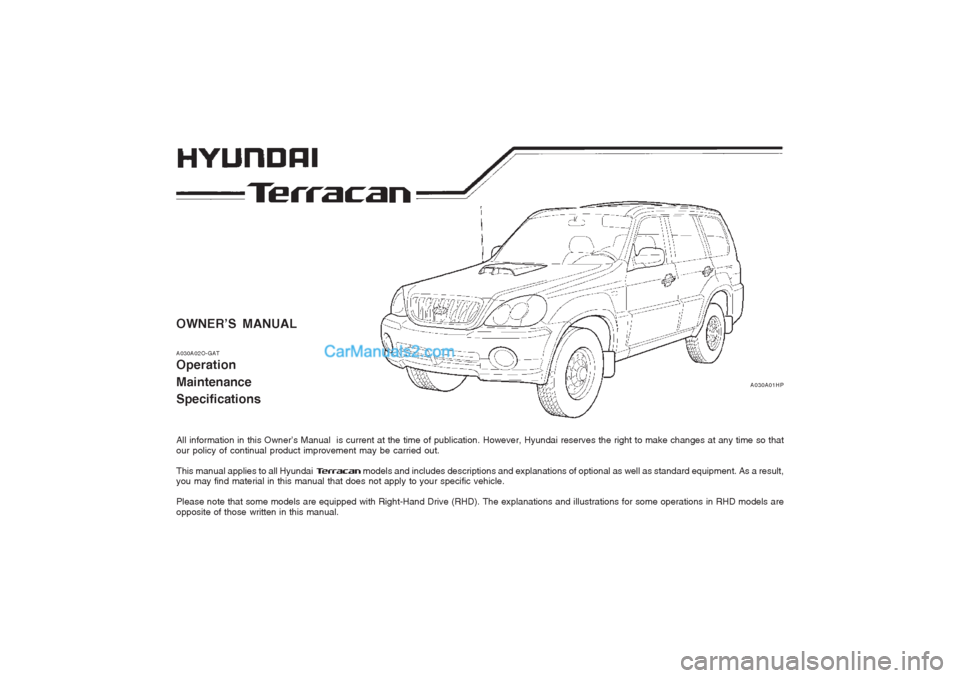
OWNER’S MANUAL A030A02O-GAT Operation Maintenance Specifications
All information in this Owner’s Manual is current at the time of publication. However, Hyundai reserves the right to make changes at any time so that our policy of continual product improvement may be carried out.
This manual applies to all Hyundai models and includes descriptions and explanations of optional as well as standard equipment. As a result, you may find material in this manual that does not apply to your specific vehicle.
Please note that some models are equipped with Right-Hand Drive (RHD). The explanations and illustrations for some operations in RHD models are opposite of those written in this manual.
A030A01HP
Page 4 of 349
A050A04A-AATHYUNDAI MOTOR COMPANY
Note: Because future owners will also need the information included in this manual, if you sell this Hyundai,
please leave the manual in the vehicle for their use. Thank you. CAUTION: Severe engine and transmission damage may result from the use of poor quality fuels and lubricants that do not meet Hyundai specifications. You must always use high quality fuels and lubricantsthat meet the specifications listed on Page 9-3 in the Vehicle Specifications section of the Owner'sManual. Copyright 2003 Hyundai Motor Company. All rights reserved. No part of this publication may be reproduced, stored in any retrieval system or transmitted in any form or by any means without the prior written permission of Hyundai Motor Company.
A040A01A-GAT
FOREWORD
Thank you for choosing Hyundai. We are pleased to welcome you to the growing number of discriminatingpeople who drive Hyundai. The advanced engineering and high-quality construction of each Hyundai webuild is something of which we’re very proud. Your Owner’s Manual will introduce you to the features and operation of your new Hyundai. It is suggested that you read it carefully because the information it contains can contribute greatly to the satisfaction you receive from your new car. The manufacturer also recommends that all service and maintenance on your car be performed by an authorized Hyundai dealer. Hyundai dealers are prepared to provide high-quality service, maintenance andany other assistance that may be required.
Page 5 of 349
TABLE OF CONTENTS
SECTION PAGE
1. FEATURES OF YOUR HYUNDAI .......................................................................... 1-1
2. DRIVING YOUR HYUNDAI ................................................................................... 2-1
3. WHAT TO DO IN AN EMERGENCY ...................................................................... 3-1
4. CORROSION PREVENTION & APPEARANCE CARE ............................................ 4-1
5. VEHICLE MAINTENANCE REQUIREMENTS ........................................................ 5-1
6. DO-IT-YOURSELF MAINTENANCE ...................................................................... 6-1
7. EMISSION CONTROL SYSTEMS ....................................................................... 7-1
8. CONSUMER INFORMATION ................................................................................ 8-1
9. VEHICLE SPECIFICATIONS ............................................................................... 9-1
10. INDEX .............................................................................................................. 10-1
1
2
3
4
5
6
7
10
8 9
Page 9 of 349
FEATURES OF YOUR HYUNDAI 1- 1
1. FEATURES OF
YOUR HYUNDAI
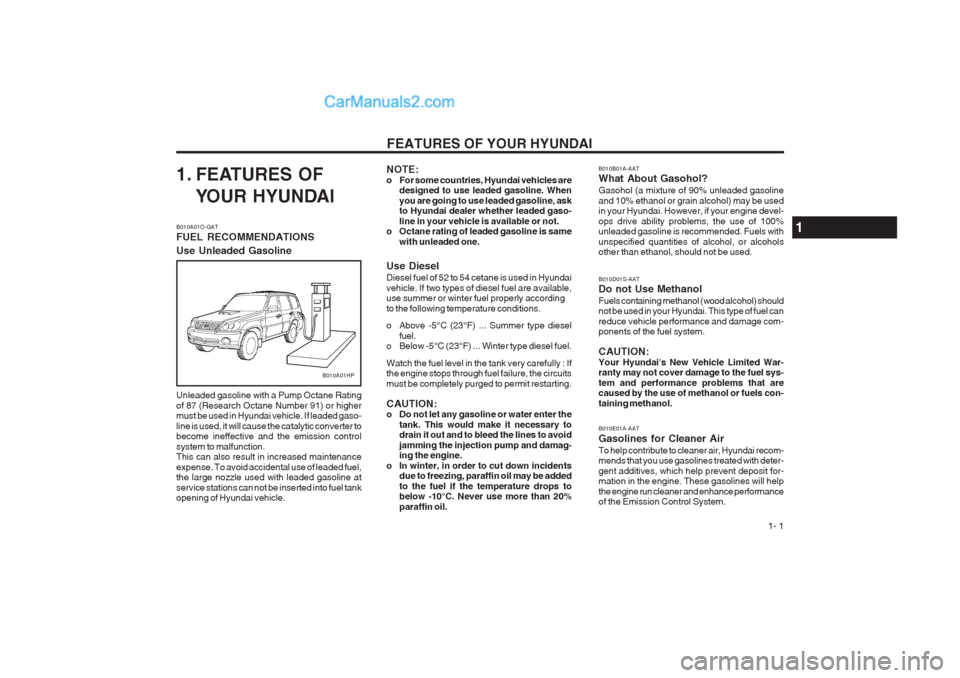
B010A01O-GAT FUEL RECOMMENDATIONS Use Unleaded Gasoline Unleaded gasoline with a Pump Octane Rating of 87 (Research Octane Number 91) or higher must be used in Hyundai vehicle. If leaded gaso- line is used, it will cause the catalytic converter to become ineffective and the emission control system to malfunction. This can also result in increased maintenance expense. To avoid accidental use of leaded fuel, the large nozzle used with leaded gasoline at service stations can not be inserted into fuel tank opening of Hyundai vehicle. NOTE:
o For some countries, Hyundai vehicles are
designed to use leaded gasoline. Whenyou are going to use leaded gasoline, ask to Hyundai dealer whether leaded gaso- line in your vehicle is available or not.
o Octane rating of leaded gasoline is same
with unleaded one. B010B01A-AAT What About Gasohol? Gasohol (a mixture of 90% unleaded gasoline and 10% ethanol or grain alcohol) may be used in your Hyundai. However, if your engine devel- ops drive ability problems, the use of 100% unleaded gasoline is recommended. Fuels with unspecified quantities of alcohol, or alcohols other than ethanol, should not be used. B010D01S-AAT Do not Use Methanol Fuels containing methanol (wood alcohol) should
not be used in your Hyundai. This type of fuel can reduce vehicle performance and damage com- ponents of the fuel system. CAUTION: Your Hyundai's New Vehicle Limited War- ranty may not cover damage to the fuel sys- tem and performance problems that are caused by the use of methanol or fuels con- taining methanol.
B010A01HP
B010E01A-AAT Gasolines for Cleaner AirTo help contribute to cleaner air, Hyundai recom- mends that you use gasolines treated with deter- gent additives, which help prevent deposit for- mation in the engine. These gasolines will help the engine run cleaner and enhance performance of the Emission Control System.
Use Diesel Diesel fuel of 52 to 54 cetane is used in Hyundai vehicle. If two types of diesel fuel are available, use summer or winter fuel properly according to the following temperature conditions.
o Above -5°C (23°F) ... Summer type diesel
fuel.
o Below -5°C (23°F) ... Winter type diesel fuel. Watch the fuel level in the tank very carefully : If the engine stops through fuel failure, the circuits must be completely purged to permit restarting. CAUTION:
o Do not let any gasoline or water enter the
tank. This would make it necessary todrain it out and to bleed the lines to avoid jamming the injection pump and damag- ing the engine.
o In winter, in order to cut down incidents due to freezing, paraffin oil may be added to the fuel if the temperature drops to below -10°C. Never use more than 20% paraffin oil.
1
Page 39 of 349
FEATURES OF YOUR HYUNDAI 1- 31
B240B05L
may damage these parts. If the liquid from the air freshener does leak onto these areas, wash them with water immediately. WARNING:
o When the SRS is activated, there may be a
loud noise and fine dust will be releasedthrough the vehicle. These conditions are normal and are not hazardous. However, the fine dust generated during airbag de- ployment may cause skin irritation. Wash your hands and face thoroughly with luke- warm water and a mild soap after an acci- dent in which the airbags were deployed.
o The SRS can function only when the igni- tion key is in the "ON" position. If the SRS SRI does not come on, or continuously remains on after flashing for about 6 sec- onds when the ignition key is turned to the "ON" position, or after the engine is started, comes on while driving, the SRS
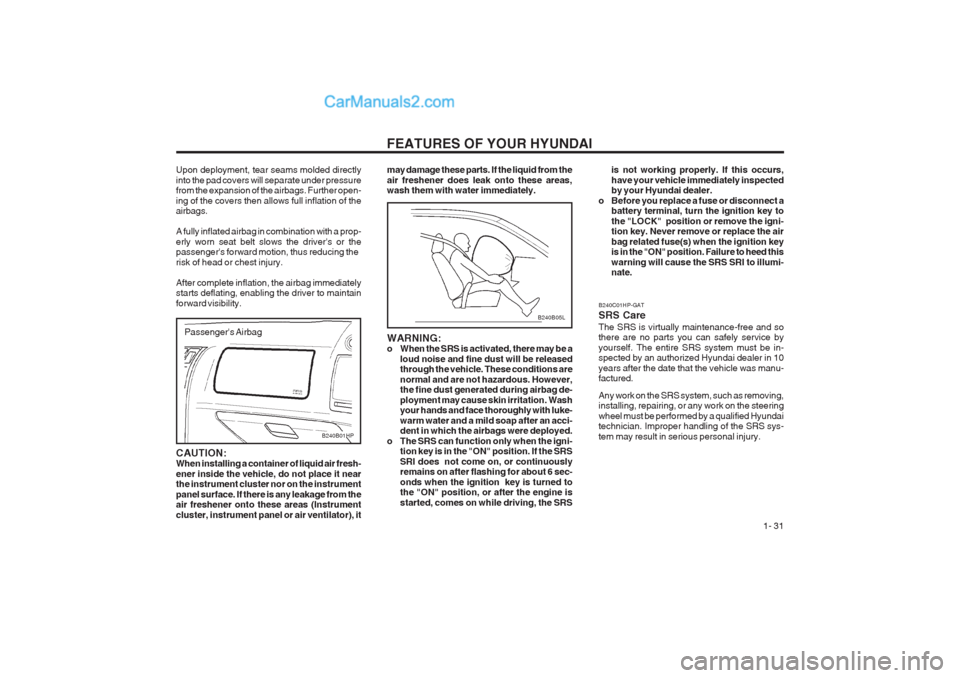
Passenger's Airbag
Upon deployment, tear seams molded directly into the pad covers will separate under pressure from the expansion of the airbags. Further open- ing of the covers then allows full inflation of the airbags. A fully inflated airbag in combination with a prop- erly worn seat belt slows the driver's or the passenger's forward motion, thus reducing the risk of head or chest injury. After complete inflation, the airbag immediately starts deflating, enabling the driver to maintain forward visibility.
B240B01HP
CAUTION: When installing a container of liquid air fresh- ener inside the vehicle, do not place it near the instrument cluster nor on the instrument panel surface. If there is any leakage from the air freshener onto these areas (Instrument cluster, instrument panel or air ventilator), it B240C01HP-GAT SRS CareThe SRS is virtually maintenance-free and so there are no parts you can safely service by yourself. The entire SRS system must be in- spected by an authorized Hyundai dealer in 10 years after the date that the vehicle was manu- factured. Any work on the SRS system, such as removing, installing, repairing, or any work on the steering wheel must be performed by a qualified Hyundai technician. Improper handling of the SRS sys- tem may result in serious personal injury.is not working properly. If this occurs,have your vehicle immediately inspected by your Hyundai dealer.
o Before you replace a fuse or disconnect a battery terminal, turn the ignition key to the "LOCK" position or remove the igni- tion key. Never remove or replace the air bag related fuse(s) when the ignition key is in the "ON" position. Failure to heed this warning will cause the SRS SRI to illumi- nate.
Page 49 of 349
FEATURES OF YOUR HYUNDAI 1- 41
NOTE: If the engine were not started within 2 sec- onds after the preheating is completed, turn the ignition key once more to the "LOCK" position during 10 seconds, and then to the "ON" position, in order to preheat again.
After starting the engine, do not drive the vehicle until the vacuum level is above 275 mmHg below atmosphere and warning light has turned off. If further trouble is experienced, the vehicle should not be driven at all but taken to a dealer by a professional towing service. B265C02HP-GAT
Diesel Preheat Indication Light-amber
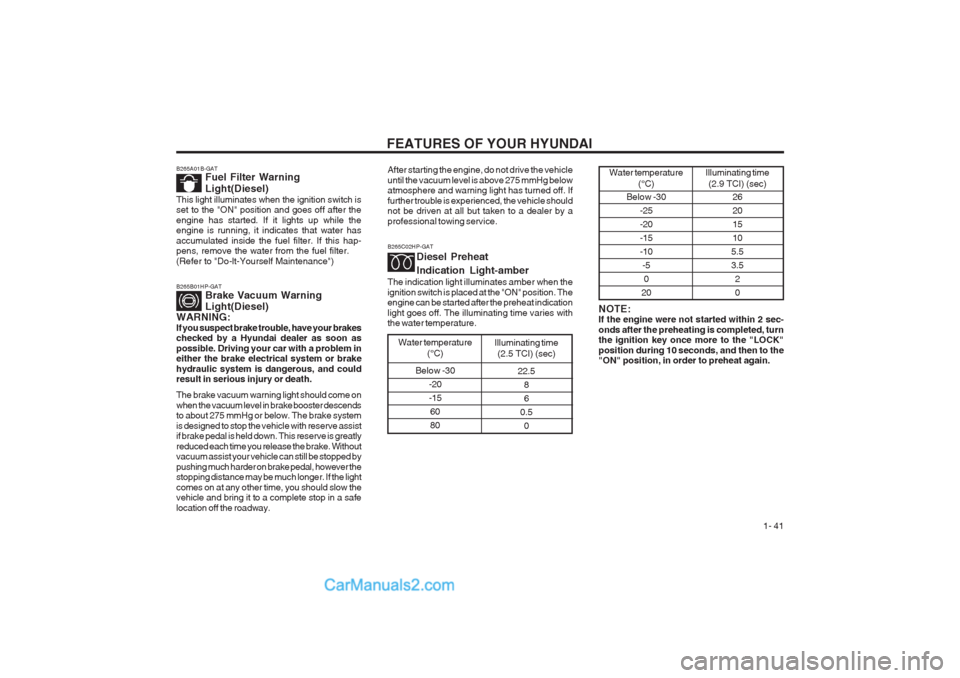
The indication light illuminates amber when the ignition switch is placed at the "ON" position. The engine can be started after the preheat indication light goes off. The illuminating time varies with the water temperature.
Water temperature (°C)
Below -30 -20 -156080 Illuminating time
(2.5 TCI) (sec)
22.586
0.5 0
B265A01B-GAT Fuel Filter Warning Light(Diesel)
This light illuminates when the ignition switch is set to the "ON" position and goes off after the engine has started. If it lights up while the engine is running, it indicates that water has accumulated inside the fuel filter. If this hap- pens, remove the water from the fuel filter. (Refer to "Do-lt-Yourself Maintenance") B265B01HP-GAT Brake Vacuum Warning Light(Diesel)
WARNING: If you suspect brake trouble, have your brakes checked by a Hyundai dealer as soon as possible. Driving your car with a problem in either the brake electrical system or brake hydraulic system is dangerous, and could result in serious injury or death. The brake vacuum warning light should come on when the vacuum level in brake booster descends to about 275 mmHg or below. The brake system is designed to stop the vehicle with reserve assist if brake pedal is held down. This reserve is greatly reduced each time you release the brake. Without vacuum assist your vehicle can still be stopped by pushing much harder on brake pedal, however the stopping distance may be much longer. If the light comes on at any other time, you should slow the vehicle and bring it to a complete stop in a safe location off the roadway.Water temperature
(°C)
Below -30
-25 -20-15-10-50
20 Illuminating time
(2.9 TCI) (sec)
26201510
5.53.5 20
Page 51 of 349
FEATURES OF YOUR HYUNDAI 1- 43
B330A01HP
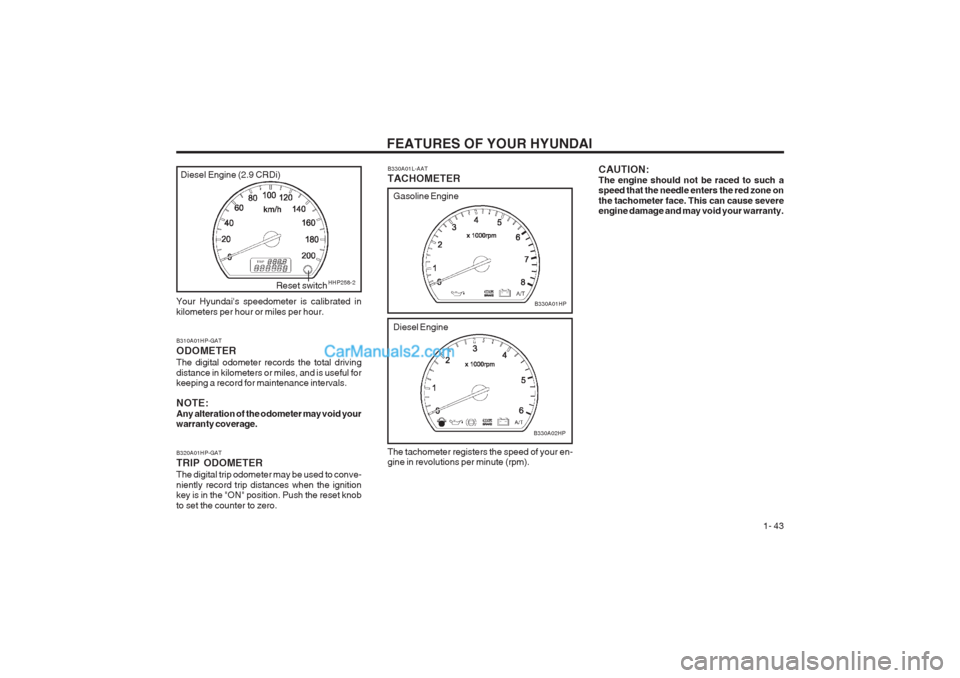
Gasoline Engine
B310A01HP-GAT ODOMETER The digital odometer records the total driving distance in kilometers or miles, and is useful for keeping a record for maintenance intervals. NOTE: Any alteration of the odometer may void your warranty coverage. B320A01HP-GAT TRIP ODOMETER The digital trip odometer may be used to conve- niently record trip distances when the ignition key is in the "ON" position. Push the reset knob to set the counter to zero.
Diesel Engine
B330A02HP
Your Hyundai's speedometer is calibrated in kilometers per hour or miles per hour.
HHP258-2Reset switch B330A01L-AAT TACHOMETER The tachometer registers the speed of your en- gine in revolutions per minute (rpm). CAUTION: The engine should not be raced to such a speed that the needle enters the red zone on the tachometer face. This can cause severe engine damage and may void your warranty.
Diesel Engine (2.9 CRDi)
Page 119 of 349
DRIVING YOUR HYUNDAI 2- 13
o Don’t "ride" the brake pedal. Resting your foot
on the brake pedal while driving can be dan- gerous because it can result in the brakes overheating and losing their effectiveness. It also increases the wear of the brake com- ponents.
o If a tire goes flat while you are driving, apply
the brakes gently and keep the car pointed straight ahead while you slow down. When you are moving slowly enough for it to be safe to do so, pull off the road and stop in a safe place.
o If your car is equipped with an automatic
transmission, don’t let your car creep for- ward. To avoid creeping forward, keep your foot firmly on the brake pedal when the car is stopped.
o Use caution when parking on a hill. Engage the parking brake and place the gear selector lever in "P" (automatic transmission) or in first or reverse gear (manual transmission). If your car is facing downhill, turn the front wheels into the curb to help keep the car from rolling. If your car is facing uphill, turn the front wheels away from the curb to help keep the car from rolling. If there is no curb or if it is required by other conditions to keep the car from rolling, block the wheels.
o Under some conditions your parking brake
can freeze in the engaged position. This is most likely to happen when there is an ac- cumulation of snow or ice around or near the rear brakes or if the brakes are wet. If there is a risk that the parking brake may freeze, apply it only temporarily while you put thegear selector lever in "P" (automatic) or in first or reverse gear (manual transmission) and block the rear wheels so the car cannot roll. Then release the parking brake.
o Do not hold the vehicle on the upgrade with the accelerator pedal. This can cause the transmission to overheat. Always use the brake pedal or parking brake.
C140A01A-AAT DRIVING FOR ECONOMY You can save fuel and get more miles from your car if you follow these suggestions:
o Drive smoothly. Accelerate at a moderate rate. Don't make "jack-rabbit" starts or full- throttle shifts and maintain a steady cruising speed. Don't race between stoplights. Try to adjust your speed to that of the other traffic so you don't have to change speeds unneces- sarily. Avoid heavy traffic whenever possible. Always maintain a safe distance from other vehicles so you can avoid unnecessary brak- ing. This also reduces brake wear.
o Drive at a moderate speed. The faster you drive, the more fuel your car uses. Driving at a moderate speed, especially on the high- way, is one of the most effective ways to reduce fuel consumption.
o Don't "ride" the brake or clutch pedal. This
can increase fuel consumption and also in- crease wear on these components. In addi- tion, driving with your foot resting on the brake pedal may cause the brakes to overheat,which reduces their effectiveness and may lead to more serious consequences.
o Take care of your tires. Keep them inflated to the recommended pressure. Incorrect infla- tion, either too much or too little, results in unnecessary tire wear. Check the tire pres- sures at least once a month.
o Be sure that the wheels are aligned correctly.
Improper alignment can result from hitting curbs or driving too fast over irregular surfac- es. Poor alignment causes faster tire wear and may also result in other problems as well as greater fuel consumption.
o Keep your car in good condition. For better
fuel economy and reduced maintenance costs, maintain your car in accordance with the maintenance schedule in Section 5. If you drive your car in severe conditions, more frequent maintenance is required (see Sec- tion 5 for details).
o Keep your car clean. For maximum service, your Hyundai should be kept clean and free of corrosive materials. It is especially important that mud, dirt, ice, etc. not be allowed to accumulate on the underside of the car. This extra weight can result in increased fuel con- sumption and also contribute to corrosion.
o Travel lightly. Don't carry unnecessary weight
in your car. Weight reduces fuel economy.
o Don't let the engine idle longer than neces-
sary. If you are waiting (and not in traffic), turn off your engine and restart only when you're ready to go.
Page 120 of 349
DRIVING YOUR HYUNDAI
2- 14 C160C01A-AAT Use High Quality Ethylene Glycol Coolant Your Hyundai is delivered with high quality ethyl- ene glycol coolant in the cooling system. It is the only type of coolant that should be used because it helps prevent corrosion in the cooling system, lubricates the water pump and prevents freezing. Be sure to replace or replenish your coolant in accordance with the maintenance schedule in Section 5. Before winter, have your coolant test- ed to assure that its freezing point is sufficient for the temperatures anticipated during the winter. C160D01A-AAT Check Battery and Cables Winter puts additional burdens on the battery system. Visually inspect the battery and cables as described in Section 6. The level of charge in your battery can be checked by your Hyundai dealer or a service station. C160E01A-AAT Change to "Winter Weight" Oil if Necessary In some climates it is recommended that a lower viscosity "winter weight" oil be used during cold weather. See Section 9 for recommendations. If you aren’t sure what weight oil you should use, consult your Hyundai dealer.
o Remember, your Hyundai does not require
extended warm-up. As soon as the engine is running smoothly, you can drive away. In very cold weather, however, give your engine a slightly longer warm-up period.
o Don't "lug" or "over-rev" the engine. Lugging is driving too slowly in too high a gear result- ing in the engine bucking. If this happens, shift to a lower gear. Over-revving is racing the engine beyond its safe limit. This can be avoided by shifting at the recommended speeds.
o Use your air conditioning sparingly. The air
conditioning system is operated by engine power so your fuel economy is reduced when you use it.
C160A01A-AAT WINTER DRIVING The more severe weather conditions of winter result in greater wear and other problems. To minimize the problems of winter driving, you should follow these suggestions:
C150A01A-AAT SMOOTH CORNERING Avoid braking or gear changing in corners, espe- cially when roads are wet. Ideally, corners should always be taken under gentle acceleration. If you follow these suggestions, tire wear will be held to a minimum. C160B01A-GAT Snowy or Icy Conditions To drive your vehicle in deep snow, it may be necessary to use snow tires or to install tire chains on your tires. If snow tires are needed, it is necessary to select tires equivalent in size and type of the original equipment tires. Failure to do so may adversely affect the safety and handling of your car. Furthermore, speeding, rapid accel- eration, sudden brake applications, and sharp turns are potentially very hazardous practices. During deceleration, use engine braking to the fullest extent. Sudden brake applications on snowy or icy roads may cause skids to occur. You need to keep sufficient distance between the vehicle in operation in front and your vehicle. Also, apply the brake gently. It should be noted that installing tire chains on the tire will provide a greater driving force, but will not prevent side skids. NOTE: Tire chains are not legal in all provinces. Check province laws before fitting tire chains.