towing Hyundai Terracan 2005 User Guide
[x] Cancel search | Manufacturer: HYUNDAI, Model Year: 2005, Model line: Terracan, Model: Hyundai Terracan 2005Pages: 539, PDF Size: 18.03 MB
Page 187 of 539
2 DRIVING YOUR HYUNDAI
32
!
CAUTION:
If overheating should occur when towing, (temperature gauge readsnear red zone), taking the following action may reduce or eliminate the problem.
1. Turn off the air conditioner.
2. Reduce highway speed.
3. Select a lower gear when going uphill.
4. While in stop and go traffic, place
the gear selector in park or neu- tral and idle the engine at a higher speed.
11. Avoid jerky starts, sudden accel-
eration or sudden stops.
12. Avoid sharp turns and rapid lane changes.
13. Avoid holding the brake pedal down too long or too frequently. This could cause the brakes to over- heat, resulting in reduced brakingefficiency.
14. When going down a hill, shift into a
lower gear and use the engine brak-ing effect. When ascending a long grade, downshift the transmission to a lower gear and reduce speedto reduce chances of engine over- loading and/or overheating.
15. If you have to stop while going uphill, do not hold the vehicle inplace by pressing on the accelera- tor. This can cause the automatictransmission to overheat. Use the parking brake or footbrake.
NOTE: When towing, check transmission fluid more frequently.
Page 188 of 539
3
If the Engine Will not Start .......................................... 3-2
Jump Starting .............................................................. 3-3
If the Engine Overheats .............................................. 3-4
Spare Tire .................................................................... 3-5
If You Have a Flat Tire ................................................ 3-7
Changing A Flat Tire ................................................... 3-7
If Your Vehicle Must Be Towed .................................3-14
Emergency Towing .................................................... 3-15
If You Lose Your Keys .............................................. 3-16
WHAT TO DO IN AN EMERGENCY
3
Page 201 of 539
3 WHAT TO DO IN AN EMERGENCY
14IF YOUR VEHICLE MUST BE TOWED
D080A02HR-GAT If your vehicle has to be towed, it should be done by your Hyundai dealeror a commercial tow truck service. This will help assure that your vehicle is not damaged in towing. Also, profes-sionals are generally aware of local laws governing towing. In any case, rather than risk damage to your car, itis suggested that you show this infor- mation to the tow truck operator. Be sure that a safety chain system is usedand that all local laws are observed. It is recommended that your vehicle be towed with a wheel lift and dollies orflatbed equipment with all the wheels off the ground.
! CAUTION:
o Your vehicle can be damaged if towed incorrectly!
o Be sure the transmission is in
neutral.
o When the engine will not start, be
sure the steering is unlocked by placing the key in the "ACC" po- sition. CAUTION:
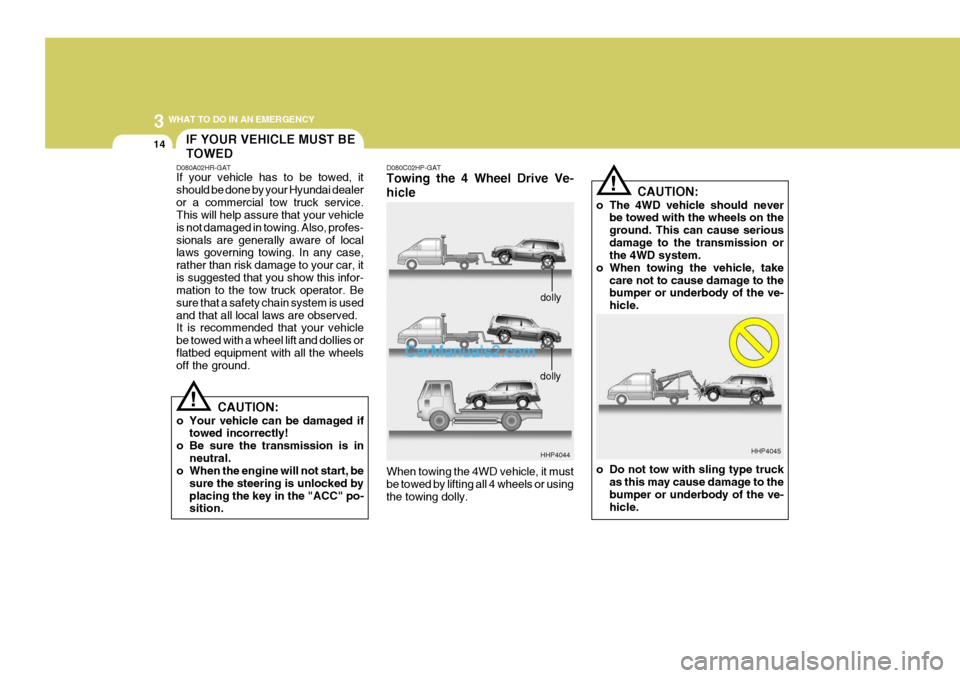
o The 4WD vehicle should never be towed with the wheels on the ground. This can cause seriousdamage to the transmission or the 4WD system.
o When towing the vehicle, take
care not to cause damage to thebumper or underbody of the ve- hicle.
!
HHP4045
o Do not tow with sling type truck as this may cause damage to the bumper or underbody of the ve- hicle.
D080C02HP-GAT Towing the 4 Wheel Drive Ve- hicle
HHP4044
When towing the 4WD vehicle, it must be towed by lifting all 4 wheels or usingthe towing dolly. dolly
dolly
Page 202 of 539
3
WHAT TO DO IN AN EMERGENCY
15
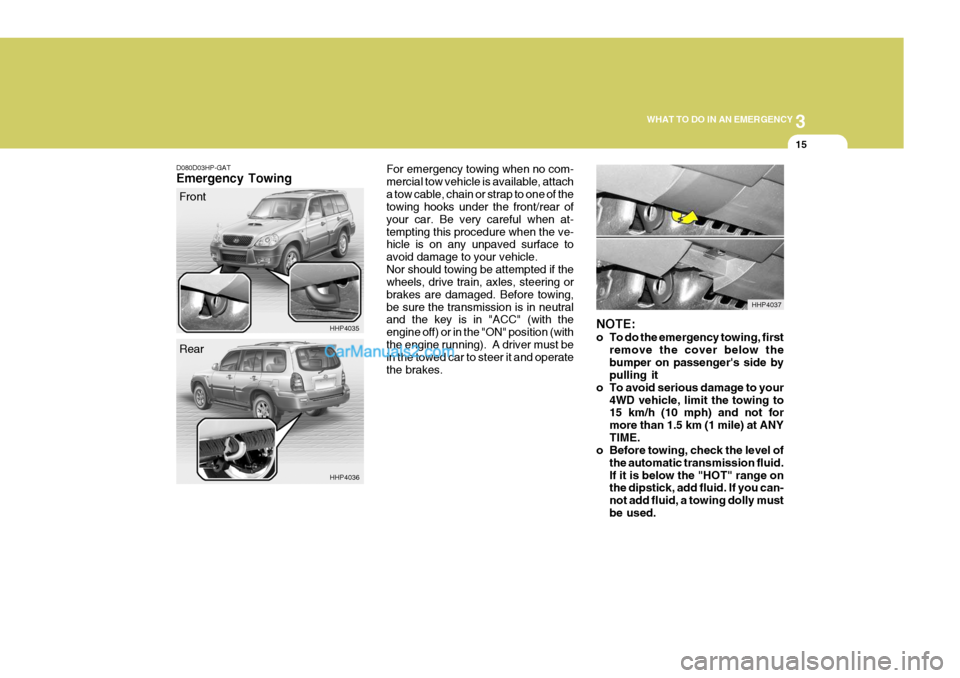
NOTE:
o To do the emergency towing, first
remove the cover below the bumper on passenger's side by pulling it
o To avoid serious damage to your
4WD vehicle, limit the towing to15 km/h (10 mph) and not for more than 1.5 km (1 mile) at ANYTIME.
o Before towing, check the level of
the automatic transmission fluid.If it is below the "HOT" range on the dipstick, add fluid. If you can- not add fluid, a towing dolly mustbe used. HHP4037
For emergency towing when no com-mercial tow vehicle is available, attacha tow cable, chain or strap to one of the towing hooks under the front/rear of your car. Be very careful when at-tempting this procedure when the ve- hicle is on any unpaved surface to avoid damage to your vehicle.Nor should towing be attempted if the wheels, drive train, axles, steering or brakes are damaged. Before towing,be sure the transmission is in neutral and the key is in "ACC" (with the engine off) or in the "ON" position (withthe engine running). A driver must be in the towed car to steer it and operate the brakes.
D080D03HP-GAT Emergency Towing
Front
HHP4035
HHP4036
Rear
Page 218 of 539
5VEHICLE MAINTENANCE REQUIREMENTS
8
A, B, C, D, E, F, G, H, I, K A, B, F, G, H, I, JC, E G, H, I, JD, E, F, GC, D, E, G, H, I C, D, E, G, H, I C, D, E, F C, D, E, F A, C, D, E, F, G, H, I, J A, C, E, F, G, H, I C, E, G, H, I C, E, G, H, I C,E
ENGINE OIL AND FILTER (Gasoline Engine) ENGINE OIL AND FILTER (Diesel Engine (2.5 TCI))ENGINE OIL AND FILTER(Diesel Engine (2.9 CRDi))AIR CLEANER FILTERSPARK PLUGS (For Gasoline Engine) TIMING BELT BRAKE PADS, CALIPERS AND ROTORSREAR BRAKE DRUMS/LININGS, PARKING BRAKESTEERING GEAR BOX, LINKAGE AND BOOTS/LOWER ARM BALL JOINT, UPPER ARM BALL JOINTDRIVE SHAFTS AND BOOTS MANUAL TRANSMISSION OIL AUTOMATIC TRANSMISSIONFLUIDTRANSFER CASE OIL *
1
AXLE GEAR OIL * 1
AIR CONDITIONER FILTER (For Evaporator and Blower Unit)
European Community Only Except European Community
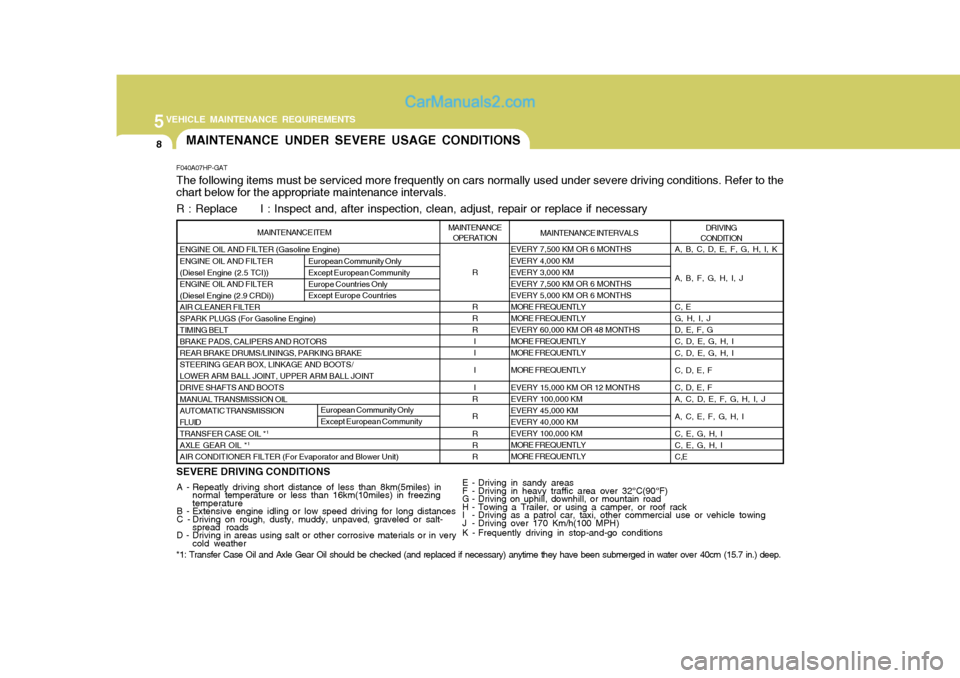
F040A07HP-GAT The following items must be serviced more frequently on cars normally used under severe driving conditions. Refer to the chart below for the appropriate maintenance intervals. R : Replace I : Inspect and, after inspection, clean, adjust, repair or replace if necessary
R R R R
I I I I
RRR RR
EVERY 7,500 KM OR 6 MONTHS EVERY 4,000 KM EVERY 3,000 KMEVERY 7,500 KM OR 6 MONTHSEVERY 5,000 KM OR 6 MONTHSMORE FREQUENTLYMORE FREQUENTLY EVERY 60,000 KM OR 48 MONTHS MORE FREQUENTLYMORE FREQUENTLY MORE FREQUENTLY EVERY 15,000 KM OR 12 MONTHS EVERY 100,000 KMEVERY 45,000 KM EVERY 40,000 KM EVERY 100,000 KMMORE FREQUENTLYMORE FREQUENTLY
SEVERE DRIVING CONDITIONS
A - Repeatly driving short distance of less than 8km(5miles) in normal temperature or less than 16km(10miles) in freezing temperature
B - Extensive engine idling or low speed driving for long distances
C - Driving on rough, dusty, muddy, unpaved, graveled or salt- spread roads
D - Driving in areas using salt or other corrosive materials or in very
cold weather
DRIVING
CONDITION
MAINTENANCE INTERVALS
MAINTENANCE
OPERATION
MAINTENANCE ITEM
E - Driving in sandy areas
F - Driving in heavy traffic area over 32°C(90°F)
G - Driving on uphill, downhill, or mountain road
H - Towing a Trailer, or using a camper, or roof rack
I - Driving as a patrol car, taxi, other commercial use or vehicle towing
J - Driving over 170 Km/h(100 MPH)
K - Frequently driving in stop-and-go conditions
MAINTENANCE UNDER SEVERE USAGE CONDITIONS
European Community Only Except European Community Europe Countries Only Except Europe Countries
*1: Transfer Case Oil and Axle Gear Oil should be checked (and replaced if necessary) anytime they have been submerged in water
over 40cm (15.7 in.) deep.
Page 293 of 539
10INDEX
6
Pressure ................................................................... 8-3
Replacement ............................................................ 8-6
Rotation .................................................................... 8-5
Snow tires ................................................................ 8-4
Spare tire ................................................................. 3-5
Traction .................................................................... 8-5
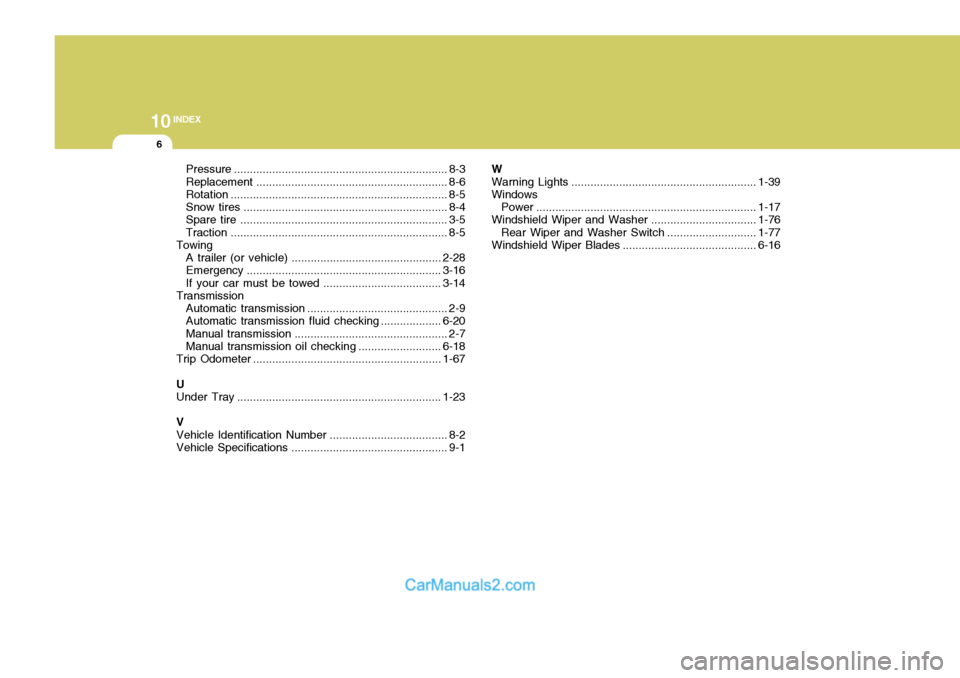
Towing
A trailer (or vehicle) ............................................... 2-28
Emergency ............................................................. 3-16
If your car must be towed .....................................3-14
Transmission
Automatic transmission ............................................ 2-9
Automatic transmission fluid checking ...................6-20
Manual transmission ................................................ 2-7
Manual transmission oil checking .......................... 6-18
Trip Odometer ........................................................... 1-67
U Under T ray ................................................................ 1-23
V Vehicle Identification Number ..................................... 8-2
Vehicle Specifications ................................................. 9-1 WWarning Lights
.......................................................... 1-39
Windows
Power ..................................................................... 1-17
Windshield Wiper and Washer................................. 1-76
Rear Wiper and Washer Switch ............................1-77
Windshield Wiper Blades ..................... ..................... 6-16
Page 309 of 539
1CONTROLS AND EQUIPMENT
4 RUNNING IN YOUR NEW HYUNDAI
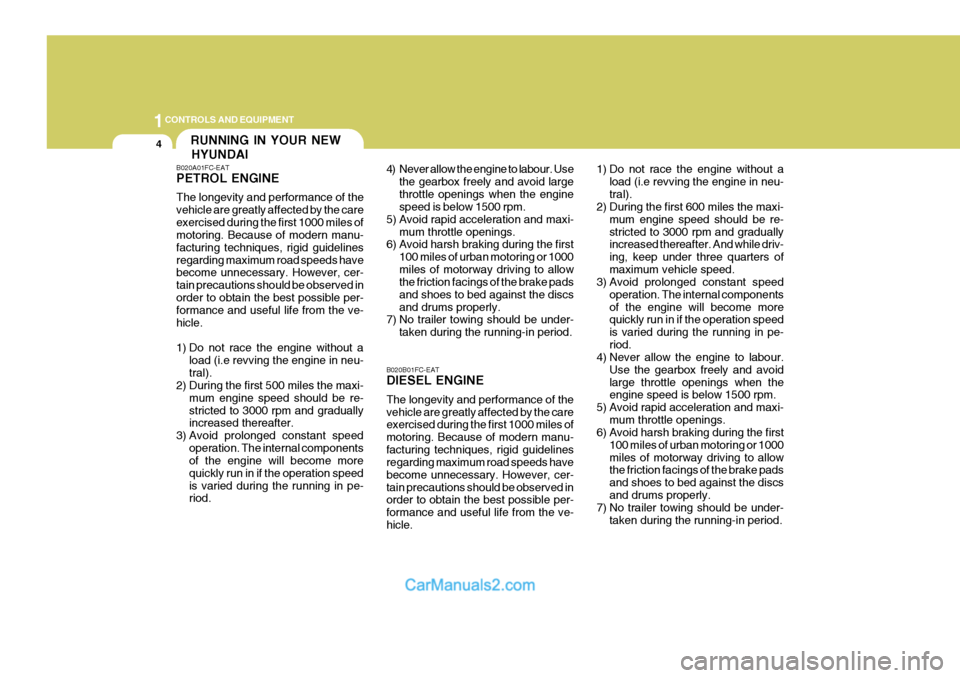
B020A01FC-EAT PETROL ENGINE The longevity and performance of the vehicle are greatly affected by the careexercised during the first 1000 miles of motoring. Because of modern manu- facturing techniques, rigid guidelinesregarding maximum road speeds have become unnecessary. However, cer- tain precautions should be observed inorder to obtain the best possible per- formance and useful life from the ve- hicle.
1) Do not race the engine without a
load (i.e revving the engine in neu- tral).
2) During the first 500 miles the maxi-
mum engine speed should be re-stricted to 3000 rpm and gradually increased thereafter.
3) Avoid prolonged constant speed operation. The internal componentsof the engine will become more quickly run in if the operation speedis varied during the running in pe- riod. 4) Never allow the engine to labour. Use
the gearbox freely and avoid large throttle openings when the engine speed is below 1500 rpm.
5) Avoid rapid acceleration and maxi- mum throttle openings.
6) Avoid harsh braking during the first
100 miles of urban motoring or 1000 miles of motorway driving to allow the friction facings of the brake pads and shoes to bed against the discsand drums properly.
7) No trailer towing should be under-
taken during the running-in period. 1) Do not race the engine without a
load (i.e revving the engine in neu-tral).
2) During the first 600 miles the maxi-
mum engine speed should be re-stricted to 3000 rpm and gradually increased thereafter. And while driv- ing, keep under three quarters ofmaximum vehicle speed.
3) Avoid prolonged constant speed
operation. The internal componentsof the engine will become more quickly run in if the operation speed is varied during the running in pe-riod.
4) Never allow the engine to labour.
Use the gearbox freely and avoidlarge throttle openings when the engine speed is below 1500 rpm.
5) Avoid rapid acceleration and maxi-
mum throttle openings.
6) Avoid harsh braking during the first
100 miles of urban motoring or 1000 miles of motorway driving to allow the friction facings of the brake pads and shoes to bed against the discsand drums properly.
7) No trailer towing should be under-
taken during the running-in period.
B020B01FC-EAT DIESEL ENGINE The longevity and performance of the vehicle are greatly affected by the care exercised during the first 1000 miles of motoring. Because of modern manu-facturing techniques, rigid guidelines regarding maximum road speeds have become unnecessary. However, cer-tain precautions should be observed in order to obtain the best possible per- formance and useful life from the ve-hicle.
Page 361 of 539
1CONTROLS AND EQUIPMENT
56
!
B265B01HP-GAT
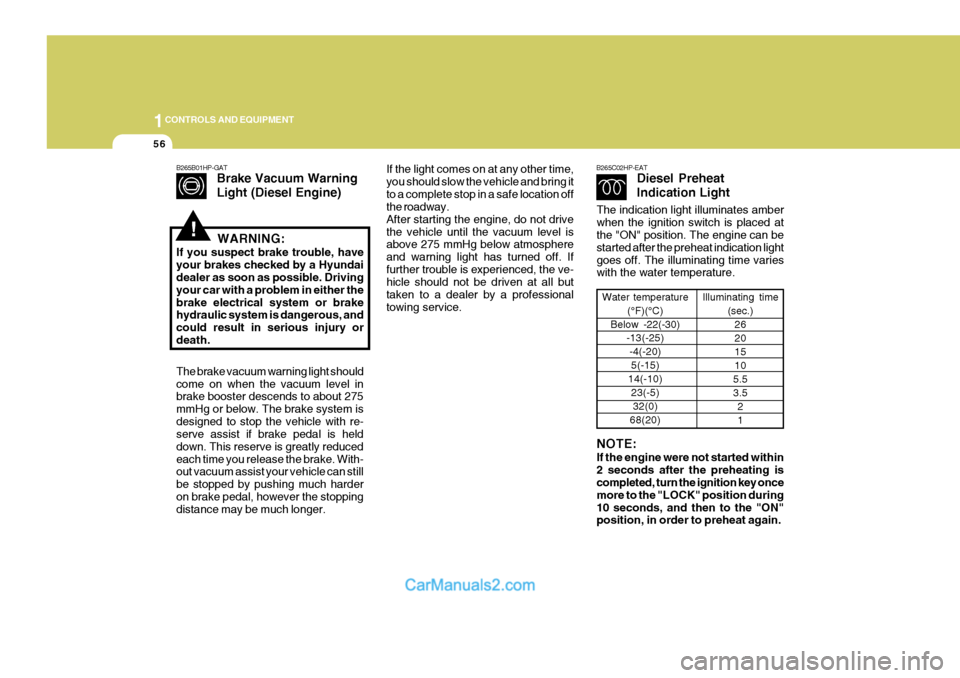
Brake Vacuum Warning Light (Diesel Engine)
The brake vacuum warning light should come on when the vacuum level in brake booster descends to about 275 mmHg or below. The brake system isdesigned to stop the vehicle with re- serve assist if brake pedal is held down. This reserve is greatly reducedeach time you release the brake. With- out vacuum assist your vehicle can still be stopped by pushing much harderon brake pedal, however the stopping distance may be much longer. WARNING:
If you suspect brake trouble, have your brakes checked by a Hyundai dealer as soon as possible. Driving your car with a problem in either thebrake electrical system or brake hydraulic system is dangerous, and could result in serious injury ordeath.If the light comes on at any other time, you should slow the vehicle and bring itto a complete stop in a safe location off the roadway. After starting the engine, do not drivethe vehicle until the vacuum level is above 275 mmHg below atmosphere and warning light has turned off. Iffurther trouble is experienced, the ve- hicle should not be driven at all but taken to a dealer by a professionaltowing service. B265C02HP-EAT
Diesel Preheat Indication Light
Water temperature
(°F)(°C)
Below -22(-30) -13(-25)
-4(-20)5(-15)
14(-10) 23(-5)32(0)
68(20) Illuminating time
(sec.)26 201510
5.53.5 21
NOTE: If the engine were not started within 2 seconds after the preheating is completed, turn the ignition key once more to the "LOCK" position during10 seconds, and then to the "ON" position, in order to preheat again.
The indication light illuminates amber when the ignition switch is placed at the "ON" position. The engine can be started after the preheat indication lightgoes off. The illuminating time varies with the water temperature.
Page 427 of 539
2 DRIVING YOUR HYUNDAI
14FOUR-WHEEL DRIVE (4WD)
D090A01P-GAT You can send your engine power to all front and rear wheels for maximum power. 4WD is useful when you drive in snow, mud, ice, mountainous orsandy areas where good traction is required, or when your wheels lose traction using two-wheel drive.
proximately 1,000rpm by means ofthe accelerator pedal and the selec-tor lever moved between the "D" and "R" positions to induce a rocking motion.
o Do not depress the accelerator pedal with the brakes applied and the se-lector at the "R", "D", "2" or "L"position.
o Turn the overdrive switch on for good
fuel economy and smooth driving.But if engine braking is needed in the "D" range or if repeated upshifting and downshifting between the 3rdand 4th gear is needed when climb- ing a gentle slope, it is recommended that the overdrive switch be turnedoff. Turn the overdrive switch back on immediately afterward.
!WARNING:
o Avoid high cornering speeds.
o Do not make quick steering wheel movements, such as sharp lane changes or fast, sharp turns. o Always wear your seat belts.
In a collision crash, an unbelted person is significantly more likely to die than a person wearing a seatbelt.
o The risk of rollover is greatly in- creased if you lose control of yourvehicle at highway speeds.
o Loss of control often occurs if two or more wheels drop off the road-way and the driver oversteers toreenter the roadway.
o In the event your vehicle leaves
the roadway, do not steer sharply.Instead, slow down before pulling back into the travel lanes.
o Never exceed posted speed limits.
o Excessive depressing of the accelerater pedal under the tyreslip condition such as moving outof the mud or fresh snow etc, may cause severe damage to the trans- mission. At this time, take otherway such as towing.
Page 428 of 539
2
DRIVING YOUR HYUNDAI
15
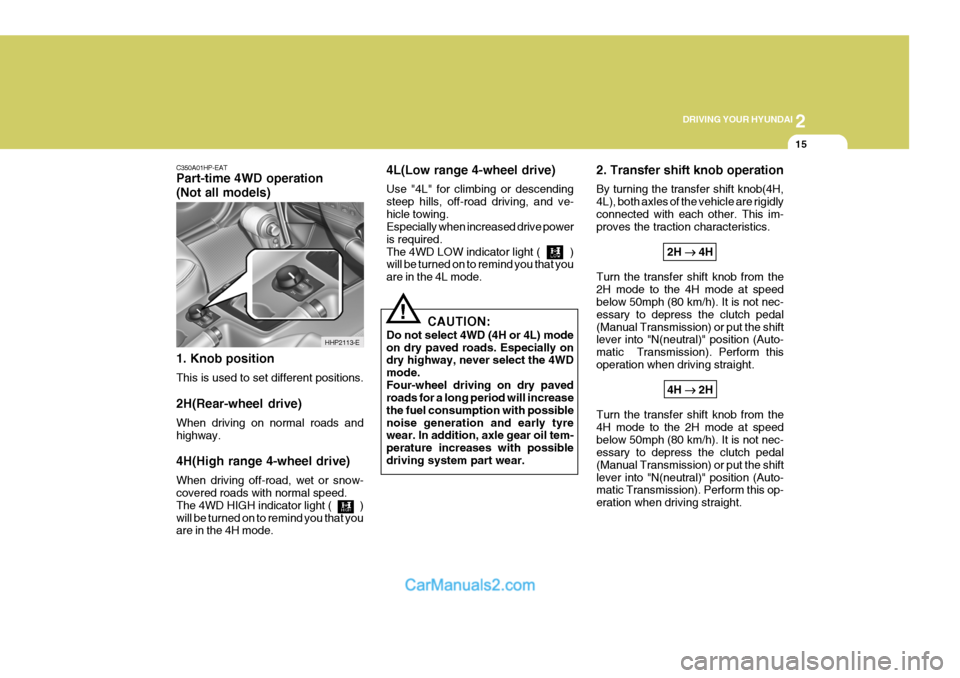
C350A01HP-EAT Part-time 4WD operation (Not all models) 1. Knob position This is used to set different positions. 2H(Rear-wheel drive) When driving on normal roads and highway. 4H(High range 4-wheel drive) When driving off-road, wet or snow- covered roads with normal speed. The 4WD HIGH indicator light ( )will be turned on to remind you that you are in the 4H mode.
!
4L(Low range 4-wheel drive) Use "4L" for climbing or descending steep hills, off-road driving, and ve-hicle towing. Especially when increased drive power is required.The 4WD LOW indicator light ( ) will be turned on to remind you that you are in the 4L mode.
2. Transfer shift knob operation By turning the transfer shift knob(4H, 4L), both axles of the vehicle are rigidlyconnected with each other. This im- proves the traction characteristics.
2H
4H
Turn the transfer shift knob from the 2H mode to the 4H mode at speed below 50mph (80 km/h). It is not nec- essary to depress the clutch pedal(Manual Transmission) or put the shift lever into "N(neutral)" position (Auto- matic Transmission). Perform thisoperation when driving straight. 4H
2H
Turn the transfer shift knob from the4H mode to the 2H mode at speedbelow 50mph (80 km/h). It is not nec- essary to depress the clutch pedal (Manual Transmission) or put the shiftlever into "N(neutral)" position (Auto- matic Transmission). Perform this op- eration when driving straight.
CAUTION:
Do not select 4WD (4H or 4L) modeon dry paved roads. Especially on dry highway, never select the 4WD mode.Four-wheel driving on dry paved roads for a long period will increase the fuel consumption with possiblenoise generation and early tyre wear. In addition, axle gear oil tem- perature increases with possibledriving system part wear.
HHP2113-E