Esc Hyundai Terracan 2007 User Guide
[x] Cancel search | Manufacturer: HYUNDAI, Model Year: 2007, Model line: Terracan, Model: Hyundai Terracan 2007Pages: 291, PDF Size: 12.79 MB
Page 176 of 291
2 DRIVING YOUR HYUNDAI
20
Water can wash the grease from wheel bearings, causing rusting and prema-ture failure, and may also enter the axles, transmission and transfer case, reducing the gear oil's lubricating quali-ties.
!
CAUTION:
o While the full-time 4WD vehicle is being raised on a jack, never start the engine or cause the tires to rotate. There is the danger that rotatingtires touching the ground could cause the vehicle to go off the jack and to jump forward.
o If one of the front or rear wheels begins to spin in mud, snow,etc., the vehicle can sometimesbe driven out by depressing the accelerator pedal further; how- ever, avoid running the enginecontinuously at high rpm be- cause doing so could damage the 4WD system.
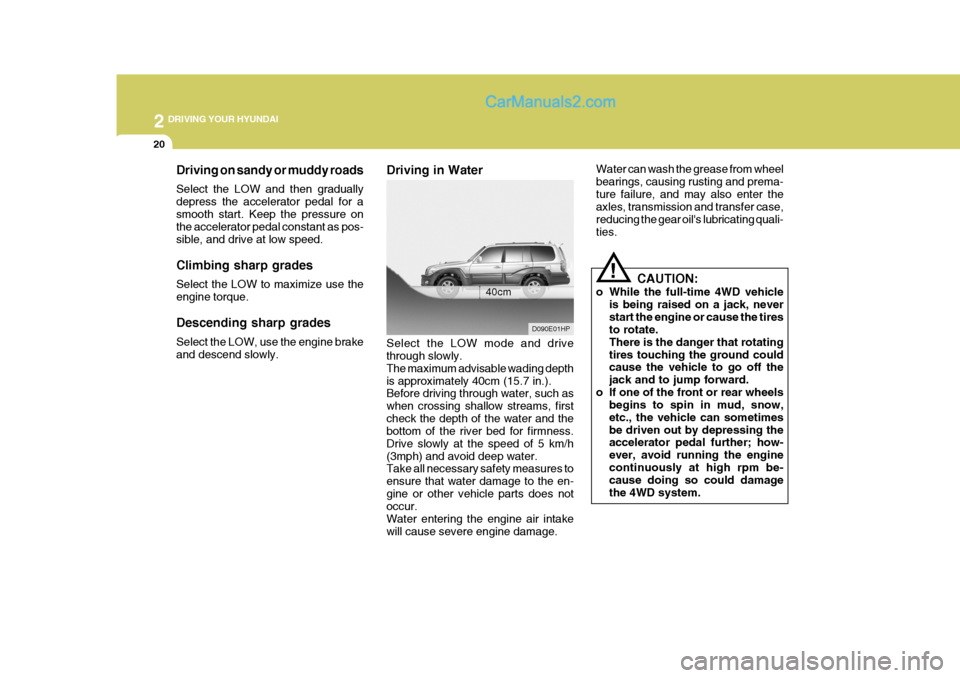
Driving in Water Select the LOW mode and drive through slowly. The maximum advisable wading depthis approximately 40cm (15.7 in.). Before driving through water, such as when crossing shallow streams, firstcheck the depth of the water and the bottom of the river bed for firmness. Drive slowly at the speed of 5 km/h(3mph) and avoid deep water. Take all necessary safety measures to ensure that water damage to the en-gine or other vehicle parts does not occur. Water entering the engine air intakewill cause severe engine damage.
D090E01HP
40cm
Driving on sandy or muddy roads Select the LOW and then gradually depress the accelerator pedal for asmooth start. Keep the pressure on the accelerator pedal constant as pos- sible, and drive at low speed. Climbing sharp grades Select the LOW to maximize use the engine torque. Descending sharp grades Select the LOW, use the engine brake and descend slowly.
Page 178 of 291
2 DRIVING YOUR HYUNDAI
22
!
C130A01HP-GAT
WARNING:
Nothing should be carried on top of the cargo area cover behind the rear seat. If there were an accident or a sudden stop, such objectscould move forward and cause dam- age to the vehicle or injure the oc- cupants.
o After being parked, check to be sure the parking brake is not engaged and that the parking brake indicator light is out before driving away.
o Driving through water may get the brakes wet. They can also get wetwhen the car is washed. Wet brakes can be dangerous! Your car will notstop as quickly if the brakes are wet. Wet brakes cause the car to pull to one side. To dry the brakes, applythe brakes lightly until the braking action returns to normal, taking care to keep the car under control at alltimes. If the braking action does not return to normal, stop as soon as it is safe to do so and call your Hyundaidealer for assistance.
GOOD BRAKING PRAC- TICES
LIMITED-SLIP DIFFEREN- TIAL (LSD)
D190A01HP-GAT (If Installed) A limited-slip differential, if equipped, is for the rear wheel differential only.The features of this limited-slip differ- ential are described below: Just as with a conventional differential,the wheel on one side is allowed to turn at a different speed from the wheel on the other side when the vehicle iscornering. The difference between the limited-slip differential and a conven- tional differential is that if the wheel onone side of the vehicle loses traction, a greater amount of torque is applied to the rear wheel on the other side toimprove traction. CAUTION:
o Never start the engine with the gearshift lever placed in the for-ward or reverse while one of therear wheels is jacked up and the other in contact with the ground; doing so may cause the vehicleto jump forward.
o Use only recommended oil for
LSD in the rear axle.See page 9-5 for the recom- mended oil descriptions.
!
Page 182 of 291
2 DRIVING YOUR HYUNDAI
26
C160F01A-AAT Check Spark Plugs and Ignition System Inspect your spark plugs as described in Section 6 and replace them if neces-sary. Also check all ignition wiring and components to be sure they are not cracked, worn or damaged in any way. C160G02A-GAT To Keep Locks from Freezing To keep the locks from freezing, squirt an approved de-icer fluid or glycerine into the key opening. If a lock is cov-ered with ice, squirt it with an approved de-icing fluid to remove the ice. If the lock is frozen internally, you may beable to thaw it out by using a heated key. Handle the heated key with care to avoid injury. NOTE: The proper temperature for using the immobilizer key is from -40°C (-40°F) to 80°C (176°F). If you heatthe immobilizer key over 80°C (176°F) to open the frozen lock, it may cause damage to the transpon-der in its head.
C160D01A-AAT Check Battery and Cables Winter puts additional burdens on the battery system. Visually inspect thebattery and cables as described in Section 6. The level of charge in your battery can be checked by your Hyundaidealer or a service station. C160E01A-AAT Change to "Winter Weight" Oil if Necessary In some climates it is recommended that a lower viscosity "winter weight" oil be used during cold weather. See Section 9 for recommendations. If youaren't sure what weight oil you should use, consult your Hyundai dealer.
C160C01A-AAT Use High Quality Ethylene Gly- col Coolant Your Hyundai is delivered with high quality ethylene glycol coolant in thecooling system. It is the only type of coolant that should be used because it helps prevent corrosion in the coolingsystem, lubricates the water pump and prevents freezing. Be sure to replace or replenish your coolant in accor-dance with the maintenance schedule in Section 5. Before winter, have your coolant tested to assure that its freez-ing point is sufficient for the tempera- tures anticipated during the winter.
Page 195 of 291
3
WHAT TO DO IN AN EMERGENCY
7
!
CHANGING A FLAT TIREIF YOU HAVE A FLAT TIRE
D050A01HP-GAT If a tire goes flat while you are driving:
1. Take your foot off the accelerator pedal and let the car slow down while driving straight ahead. Do not apply the brakes immediately or at- tempt to pull off the road as this maycause a loss of control. When the car has slowed to such a speed that it is safe to do so, brake carefullyand pull off the road. Drive off the road as far as possible and park on firm, level ground. If you are on adivided highway, do not park in the median area between the two traffic lanes.
2. When the car is stopped, turn on your emergency hazard flashers,set the parking brake and put thetransmission in "P" (automatic trans- mission) or reverse (manual trans- mission).
3. Have all passengers get out of the car. Be sure they all get out on theside of the car that is away fromtraffic.
4. Change the tire according to the
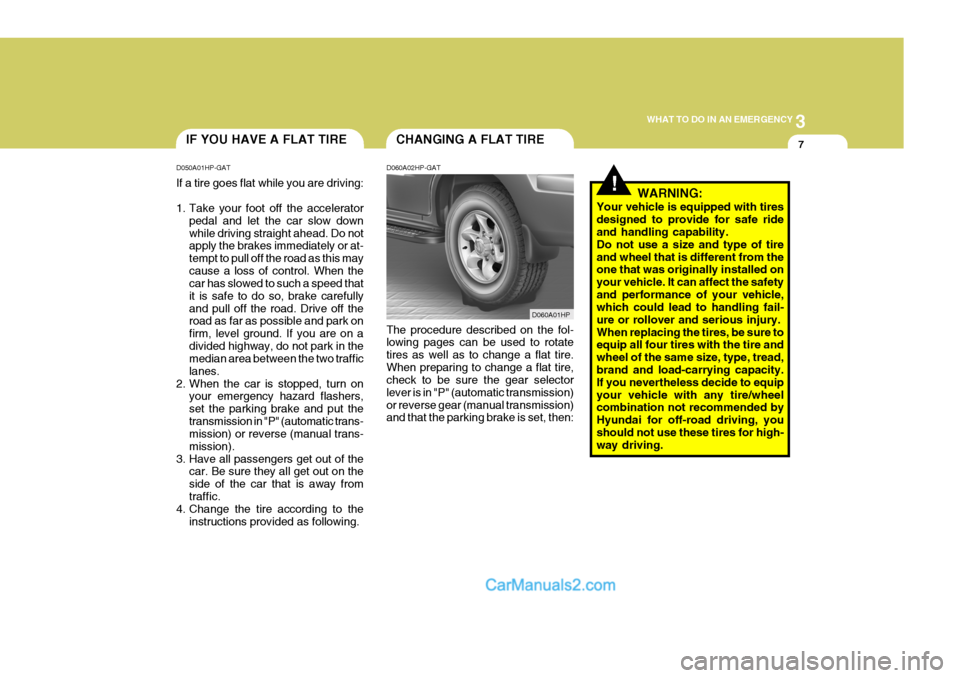
instructions provided as following. D060A02HP-GAT The procedure described on the fol- lowing pages can be used to rotate tires as well as to change a flat tire.When preparing to change a flat tire, check to be sure the gear selector lever is in "P" (automatic transmission)or reverse gear (manual transmission) and that the parking brake is set, then:
D060A01HPWARNING:
Your vehicle is equipped with tires designed to provide for safe ride and handling capability. Do not use a size and type of tireand wheel that is different from the one that was originally installed on your vehicle. It can affect the safetyand performance of your vehicle, which could lead to handling fail- ure or rollover and serious injury.When replacing the tires, be sure to equip all four tires with the tire and wheel of the same size, type, tread, brand and load-carrying capacity. If you nevertheless decide to equipyour vehicle with any tire/wheel combination not recommended by Hyundai for off-road driving, youshould not use these tires for high- way driving.
Page 207 of 291
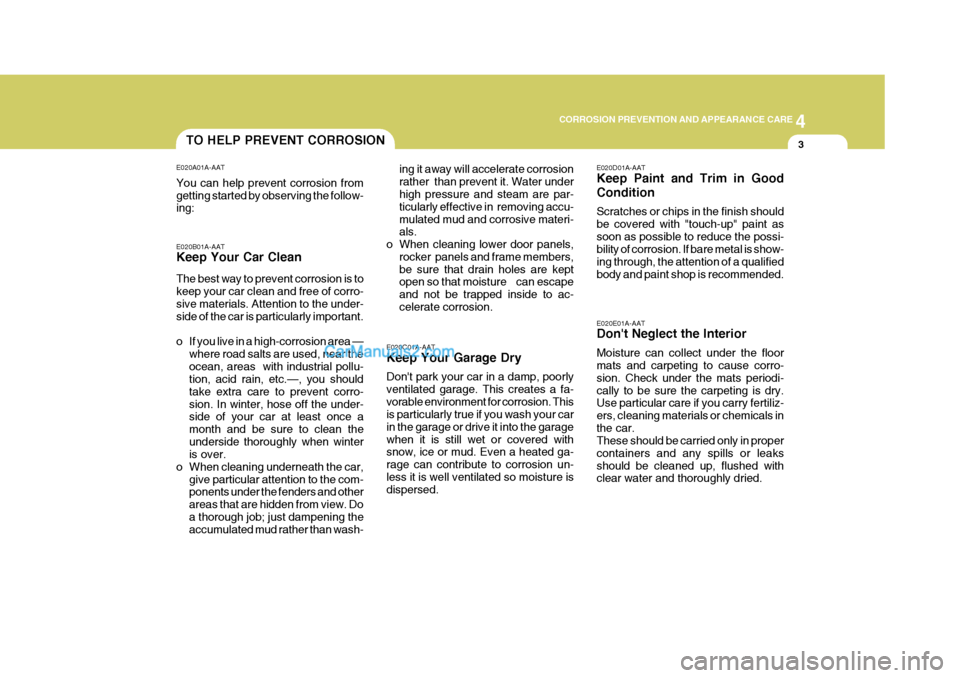
4
CORROSION PREVENTION AND APPEARANCE CARE
3
4
CORROSION PREVENTION AND APPEARANCE CARE
3TO HELP PREVENT CORROSION
E020C01A-AAT Keep Your Garage Dry Don't park your car in a damp, poorly ventilated garage. This creates a fa-vorable environment for corrosion. This is particularly true if you wash your car in the garage or drive it into the garagewhen it is still wet or covered with snow, ice or mud. Even a heated ga- rage can contribute to corrosion un-less it is well ventilated so moisture is dispersed. E020D01A-AAT Keep Paint and Trim in Good Condition Scratches or chips in the finish should be covered with "touch-up" paint assoon as possible to reduce the possi- bility of corrosion. If bare metal is show- ing through, the attention of a qualifiedbody and paint shop is recommended. E020E01A-AAT Don't Neglect the Interior Moisture can collect under the floor mats and carpeting to cause corro- sion. Check under the mats periodi-cally to be sure the carpeting is dry. Use particular care if you carry fertiliz- ers, cleaning materials or chemicals inthe car. These should be carried only in proper containers and any spills or leaksshould be cleaned up, flushed with clear water and thoroughly dried.
E020B01A-AAT Keep Your Car Clean The best way to prevent corrosion is to keep your car clean and free of corro- sive materials. Attention to the under- side of the car is particularly important.
o If you live in a high-corrosion area —
where road salts are used, near the ocean, areas with industrial pollu- tion, acid rain, etc.—, you should take extra care to prevent corro-sion. In winter, hose off the under- side of your car at least once a month and be sure to clean theunderside thoroughly when winter is over.
o When cleaning underneath the car,
give particular attention to the com-ponents under the fenders and other areas that are hidden from view. Doa thorough job; just dampening the accumulated mud rather than wash- ing it away will accelerate corrosion rather than prevent it. Water underhigh pressure and steam are par- ticularly effective in removing accu- mulated mud and corrosive materi-als.
o When cleaning lower door panels,
rocker panels and frame members,be sure that drain holes are kept open so that moisture can escape and not be trapped inside to ac-celerate corrosion.
E020A01A-AAT You can help prevent corrosion from getting started by observing the follow- ing:
Page 215 of 291
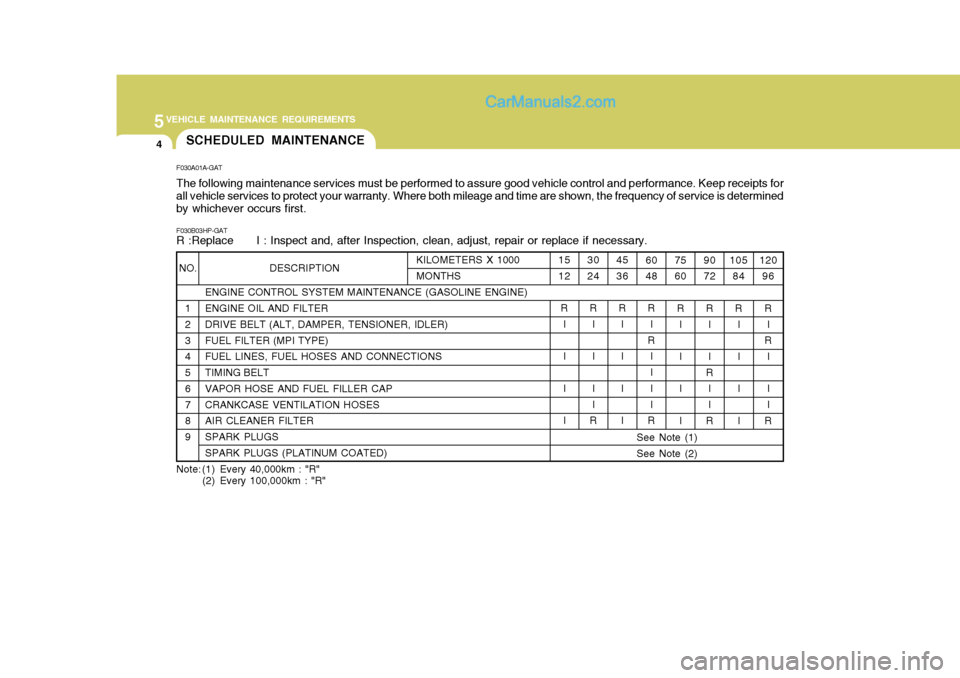
5VEHICLE MAINTENANCE REQUIREMENTS
4
NO.
1 2 3 4 5 6 7 8 9 DESCRIPTION
ENGINE CONTROL SYSTEM MAINTENANCE (GASOLINE ENGINE)ENGINE OIL AND FILTER DRIVE BELT (ALT, DAMPER, TENSIONER, IDLER) FUEL FILTER (MPI TYPE) FUEL LINES, FUEL HOSES AND CONNECTIONS TIMING BELT VAPOR HOSE AND FUEL FILLER CAP CRANKCASE VENTILATION HOSES AIR CLEANER FILTER SPARK PLUGS SPARK PLUGS (PLATINUM COATED)
F030A01A-GAT The following maintenance services must be performed to assure good vehicle control and performance. Keep receipts for all vehicle services to protect your warranty. Where both mileage and time are shown, the frequency of service is determined by whichever occurs first. F030B03HP-GAT R :Replace I : Inspect and, after Inspection, clean, adjust, repair or replace if necessary.105
84
R I I II 120
96
R I
R
II I
R
90 72
R I I
R I I
R
75 60
R I I II
60 48
R I
R
I I I I
R
45 36
R I I II
30 24
R I I I I
R
15 12
R I I II
KILOMETERS X 1000 MONTHS
Note: (1) Every
40,000km : "R"
(2) Every 100,000km : "R"
SCHEDULED MAINTENANCE
See Note (1) See Note (2)
Page 216 of 291
5
VEHICLE MAINTENANCE REQUIREMENTS
5
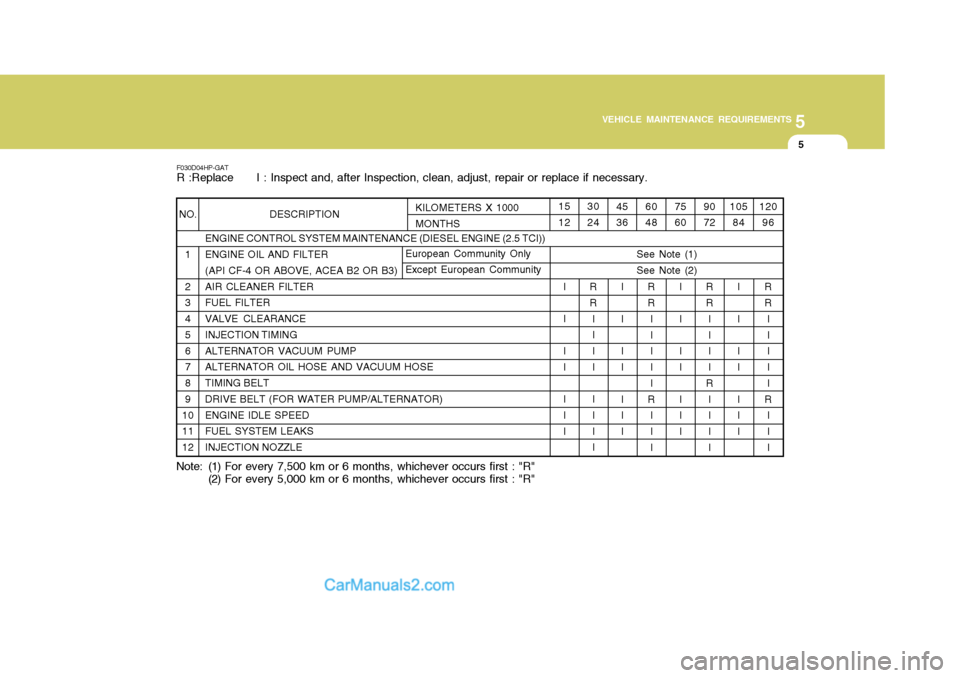
Note: (1) For every 7,500 km or 6 months, whichever occurs first : "R"
(2) For every 5,000 km or 6 months, whichever occurs first : "R"
F030D04HP-GAT R :Replace I : Inspect and, after Inspection, clean, adjust, repair or replace if necessary.
NO.
1 2 3 4 5 6 7 8 9
1011 12 DESCRIPTION
ENGINE CONTROL SYSTEM MAINTENANCE (DIESEL ENGINE (2.5 TCI))ENGINE OIL AND FILTER (API CF-4 OR ABOVE, ACEA B2 OR B3) AIR CLEANER FILTER FUEL FILTER VALVE CLEARANCE INJECTION TIMING ALTERNATOR VACUUM PUMP ALTERNATOR OIL HOSE AND VACUUM HOSE TIMING BELT DRIVE BELT (FOR WATER PUMP/ALTERNATOR) ENGINE IDLE SPEED FUEL SYSTEM LEAKS INJECTION NOZZLE
105 84
I II I I I I 120
96
RR II I I I
R I I I
9072
R R II I I
R
I I I I
7560
I II I I I I
60 48
R R II I I I
R I I I
4536
I II I I I I
30 24
R R II I I I I I I
1512
I II I I I I
KILOMETERS X 1000MONTHS
See Note (1) See Note (2)
European Community Only Except European Community
Page 217 of 291
5VEHICLE MAINTENANCE REQUIREMENTS
6
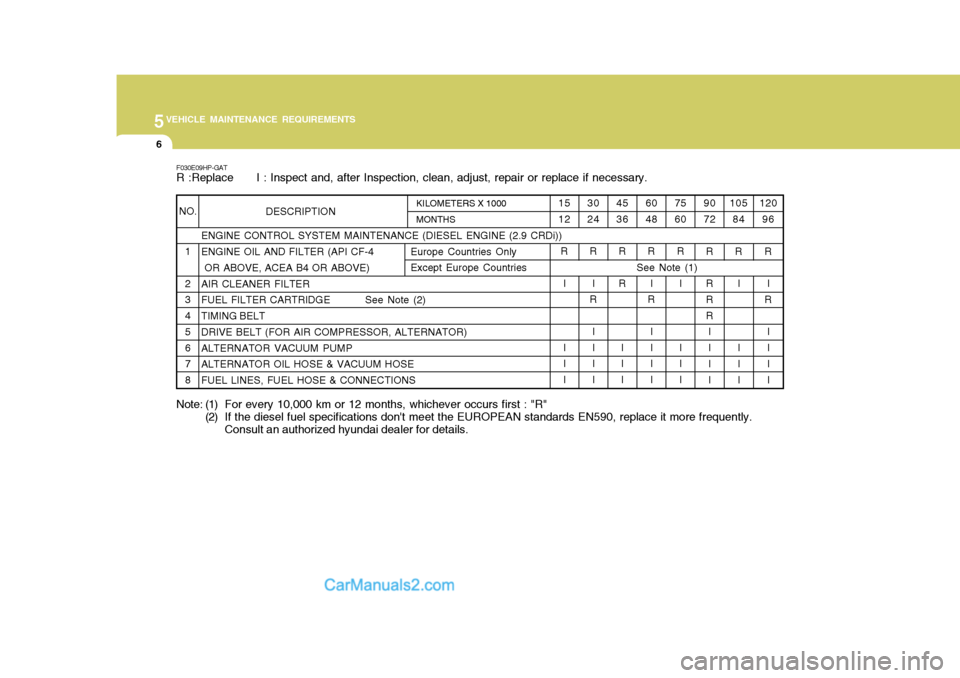
DESCRIPTION
ENGINE CONTROL SYSTEM MAINTENANCE (DIESEL ENGINE (2.9 CRDi)) ENGINE OIL AND FILTER (API CF-4 OR ABOVE, ACEA B4 OR ABOVE) AIR CLEANER FILTER
FUEL FILTER CARTRIDGE See Note (2) TIMING BELT DRIVE BELT (FOR AIR COMPRESSOR, ALTERNATOR) ALTERNATOR VACUUM PUMP ALTERNATOR OIL HOSE & VACUUM HOSE FUEL LINES, FUEL HOSE & CONNECTIONS See Note (1)
Europe Countries Only Except Europe Countries
F030E09HP-GAT R :Replace I : Inspect and, after Inspection, clean, adjust, repair or replace if necessary.
Note: (1)
For every 10,000 km or 12 months, whichever occurs first : "R"
(2) If the diesel fuel specifications don't meet the EUROPEAN standards EN590, replace it more frequently. Consult an authorized hyundai dealer for details.
NO.
1 2 3 4 5 6 7 8
10584
R I I I I 120
96
R I
R
II I I
9072
R R R R II I I
7560
R I I I I
6048
R I
R
II I I
4536
R R
I I I
3024
R I
R
II I I
1512
R
I I I I
KILOMETERS X 1000MONTHS
Page 218 of 291
5
VEHICLE MAINTENANCE REQUIREMENTS
7
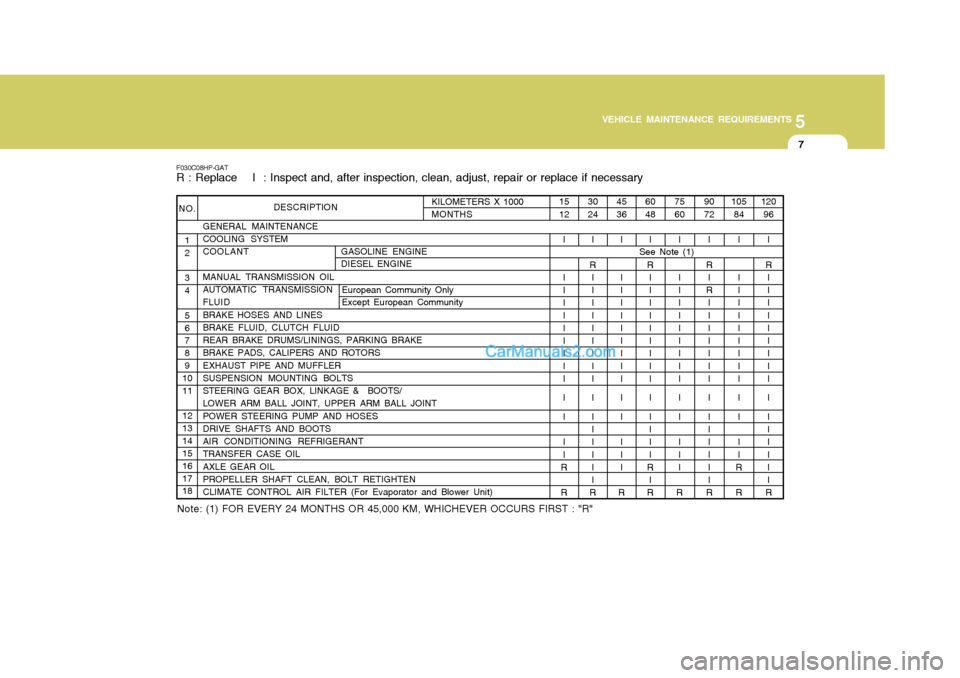
F030C08HP-GAT R : Replace I : Inspect and, after inspection, clean, adjust, repair or replace if necessary
Note: (1) FOR EVERY 24 MONTHS OR 45,000 KM, WHICHEVER OCCURS FIRST : "R" DESCRIPTION
GENERAL MAINTENANCE COOLING SYSTEM COOLANT MANUAL TRANSMISSION OIL AUTOMATIC TRANSMISSION FLUID BRAKE HOSES AND LINES BRAKE FLUID, CLUTCH FLUID REAR BRAKE DRUMS/LININGS, PARKING BRAKE BRAKE PADS, CALIPERS AND ROTORS EXHAUST PIPE AND MUFFLER SUSPENSION MOUNTING BOLTS STEERING GEAR BOX, LINKAGE & BOOTS/ LOWER ARM BALL JOINT, UPPER ARM BALL JOINT POWER STEERING PUMP AND HOSES DRIVE SHAFTS AND BOOTS AIR CONDITIONING REFRIGERANT TRANSFER CASE OIL AXLE GEAR OIL PROPELLER SHAFT CLEAN, BOLT RETIGHTEN CLIMATE CONTROL AIR FILTER (For Evaporator and Blower Unit)
NO.
1
2 3 4 5 6 7 89
1011 12 1314 15 1617 18
120
96
I
R I I I I I I I I I II I I I I I
R
105
84
I I I I I I I I I I II I I
R R
90 72
I
R I
R II I I I I I II I I I I I
R
7560
I I I I I I I I I I II I I I
R
60 48
I
R II I I I I I I I II I I I
R
I
R
4536
I I I I I I I I I I II I I I
R
30 24
I
R II I I I I I I I II I I I I I
R
1512
I I I I I I I I I I II I I
R R
KILOMETERS X 1000 MONTHS
European Community Only Except European Community
See Note (1)GASOLINE ENGINE DIESEL ENGINE
Page 224 of 291
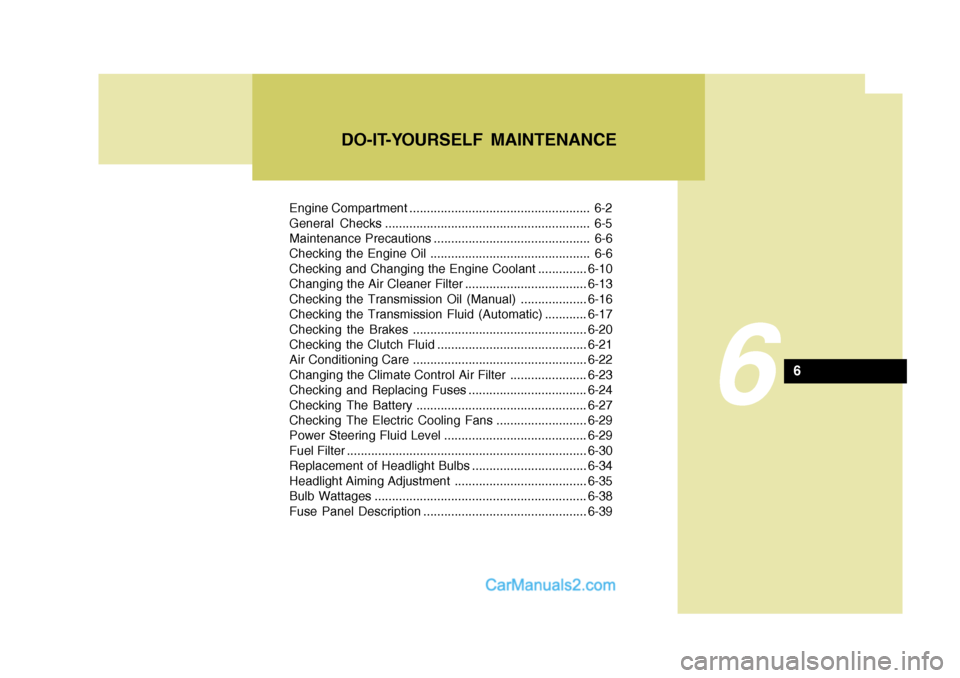
Engine Compartment .................................................... 6-2
General Checks ........................................................... 6-5
Maintenance Precautions ............................................. 6-6
Checking the Engine Oil .............................................. 6-6
Checking and Changing the Engine Coolant..............6-10
Changing the Air Cleaner Filte r ...................................6-13
Checking the Transmission Oil (Manual)................... 6-16
Checking the Transmission Fluid (Automatic)............6-17
Checking the Brakes .................................................. 6-20
Checking the Clutch Fluid ........................................... 6-21
Air Conditioning Care .................................................. 6-22
Changing the Climate Control Air Filter .. ....................6-23
Checking and Replacing Fuses ..................................6-24
Checking The Battery ................................................. 6-27
Checking The Electric Cooling Fans ..........................6-29
Power Steering Fluid Level ......................................... 6-29
Fuel Filter ..................................................................... 6-30
Replacement of Headlight Bulbs ................................. 6-34
Headlight Aiming Adjustment ...................................... 6-35
Bulb Wattages ............................................................. 6-38
Fuse Panel D escription ............................................... 6-39
DO-IT-YOURSELF MAINTENANCE
6
6