coolant Hyundai Tiburon 2003 Owner's Guide
[x] Cancel search | Manufacturer: HYUNDAI, Model Year: 2003, Model line: Tiburon, Model: Hyundai Tiburon 2003Pages: 169, PDF Size: 3.04 MB
Page 149 of 169
DO-IT-YOURSELF MAINTENANCE
6-18
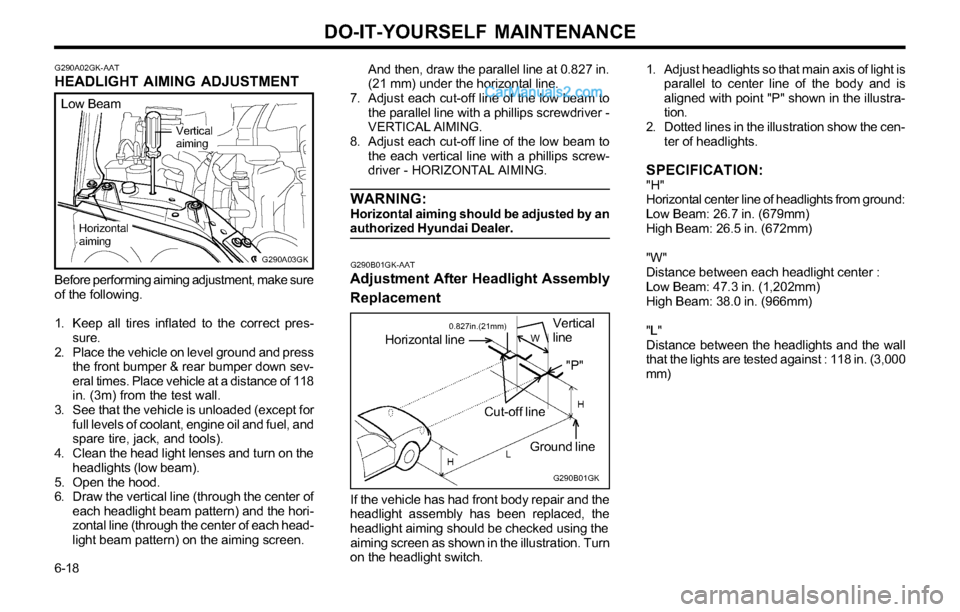
G290A02GK-AATHEADLIGHT AIMING ADJUSTMENT
Before performing aiming adjustment, make sure
of the following.
1. Keep all tires inflated to the correct pres-
sure.
2. Place the vehicle on level ground and press
the front bumper & rear bumper down sev-
eral times. Place vehicle at a distance of 118
in. (3m) from the test wall.
3. See that the vehicle is unloaded (except for
full levels of coolant, engine oil and fuel, and
spare tire, jack, and tools).
4. Clean the head light lenses and turn on the
headlights (low beam).
5. Open the hood.
6. Draw the vertical line (through the center of
each headlight beam pattern) and the hori-
zontal line (through the center of each head-
light beam pattern) on the aiming screen.And then, draw the parallel line at 0.827 in.
(21 mm) under the horizontal line.
7. Adjust each cut-off line of the low beam to
the parallel line with a phillips screwdriver -
VERTICAL AIMING.
8. Adjust each cut-off line of the low beam to
the each vertical line with a phillips screw-
driver - HORIZONTAL AIMING.
WARNING:Horizontal aiming should be adjusted by an
authorized Hyundai Dealer.
G290B01GK-AATAdjustment After Headlight Assembly
Replacement
G290B01GK
Vertical
line
Cut-off line
Ground line Horizontal line
LW
H
H
"P"
0.827in.(21mm)
If the vehicle has had front body repair and the
headlight assembly has been replaced, the
headlight aiming should be checked using the
aiming screen as shown in the illustration. Turn
on the headlight switch.
Horizontal
aiming
G290A03GK
Vertical
aiming
Low Beam1. Adjust headlights so that main axis of light is
parallel to center line of the body and is
aligned with point "P" shown in the illustra-
tion.
2. Dotted lines in the illustration show the cen-
ter of headlights.
SPECIFICATION:"H"
Horizontal center line of headlights from ground:
Low Beam: 26.7 in. (679mm)
High Beam: 26.5 in. (672mm)
"W"
Distance between each headlight center :
Low Beam: 47.3 in. (1,202mm)
High Beam: 38.0 in. (966mm)
"L"
Distance between the headlights and the wall
that the lights are tested against : 118 in. (3,000
mm)
Page 153 of 169
EMISSION CONTROL SYSTEMS
7-1
7. EMISSION CON-
TROL SYSTEMSH010B01A-AAT1. Crankcase Emission Control
System
The Positive Crankcase Ventilation System is
employed to prevent air pollution caused by
blow-by gases being emitted from the crank-
case. This system supplies fresh filtered air to
the crankcase through the air intake hose.
Inside the crankcase, the fresh air mixes with
blow-by gases, which then pass through the
PCV valve and into the induction system.
H010C01S-AAT2. Evaporative Emission Control (In-
cluding ORVR: Onboard Refueling
Vapor Recovery) System
The Evaporative Emission Control System is
designed to prevent fuel vapors from escaping
into the atmosphere.
(The ORVR system is designed to allow the
vapors from the fuel tank to be loaded into
a canister while refueling at the gas station,
preventing the escape of fuel vapors into
the atmosphere.)
Canister
Fuel vapors generated inside the fuel tank are
absorbed and stored in the onboard canister.
When the engine is running, the fuel vapors
absorbed in the canister are drawn into the
induction system through the purge control so-
lenoid valve.
Purge Control Solenoid Valve (PCSV)
The purge control solenoid valve is controlled
by the Engine Control Module (ECM); when the
engine coolant temperature is low during idling,
the PCSV closes so that evaporated fuel is not
taken into the engine. After the engine warms-
up during ordinary driving, the PCSV opens to
introduce evaporated fuel to the engine.
H010D01A-AAT
3. Exhaust Emission Control System
The Exhaust Emission Control System is a
highly effective system which controls exhaust
emissions while maintaining good vehicle per-
formance.
H010A01GK-AAT
EMISSION CONTROL SYSTEM
Your Hyundai is equipped with an emission
control system to meet all requirements of the
U.S. Environmental Protection Agency or Cali-
fornia Air Resources Board.
There are three emission control systems which
are as follows.
1) Crankcase Emission Control System
2) Evaporative Emission Control System
3) Exhaust Emission Control System
In order to ensure the proper function of the
emission control systems, it is recommended
that you have your car inspected and main-
tained by an authorized Hyundai dealer in ac-
cordance with the maintenance schedule in this
manual.
Caution for Inspection and Maintenance Test
(Vehicle with Traction Control System)
o To prevent the vehicle from misfiring
during dynamometer testing, disconnect
the ABS connector located inside of the
wheel guard (driver side).
o For more information, see shop manual
(BR Group, Wheel Speed Sensor).
H020A01S-AAT
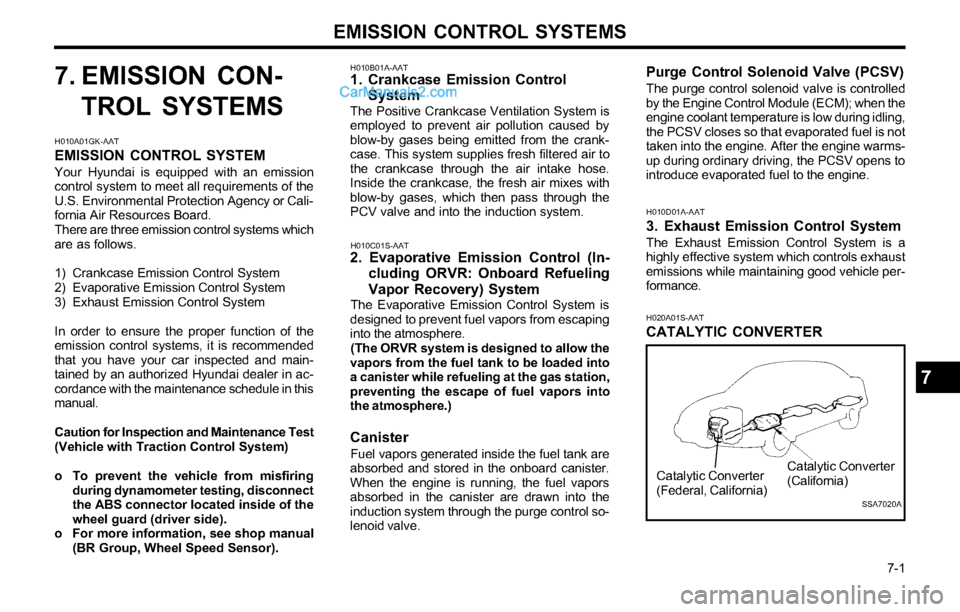
CATALYTIC CONVERTER
Catalytic Converter
(California)
SSA7020A
Catalytic Converter
(Federal, California)
7
Page 163 of 169
VEHICLE SPECIFICATIONS
9-3 4.2(4.5)
J080A02GK-AAT
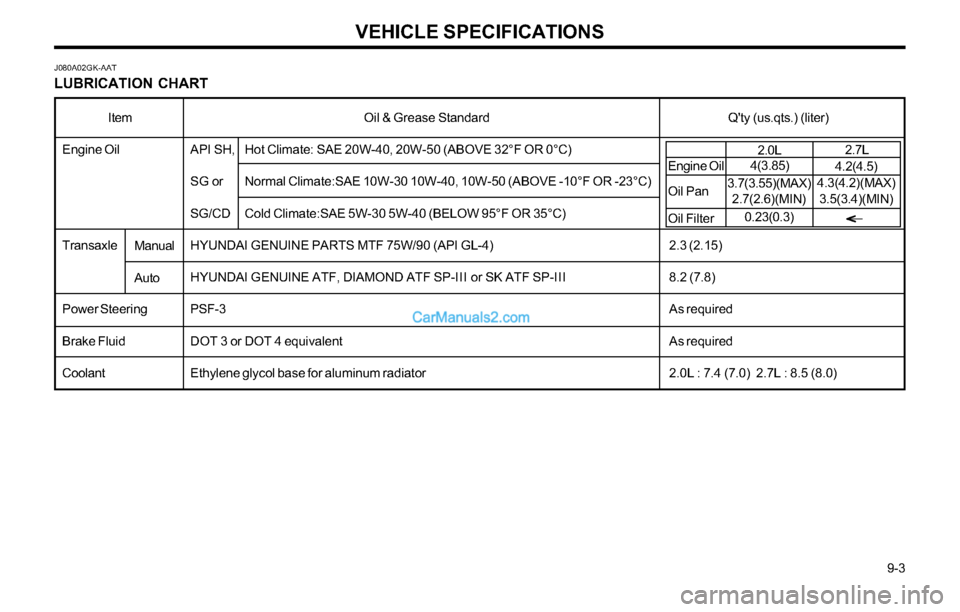
LUBRICATION CHART
Oil & Grease Standard
API SH, Hot Climate: SAE 20W-40, 20W-50 (ABOVE 32°F OR 0°C)
SG or Normal Climate:SAE 10W-30 10W-40, 10W-50 (ABOVE -10°F OR -23°C)
SG/CD Cold Climate:SAE 5W-30 5W-40 (BELOW 95°F OR 35°C)
HYUNDAI GENUINE PARTS MTF 75W/90 (API GL-4)
HYUNDAI GENUINE ATF, DIAMOND ATF SP-III or SK ATF SP-III
PSF-3
DOT 3 or DOT 4 equivalent
Ethylene glycol base for aluminum radiatorItem
Engine Oil
Transaxle
Power Steering
Brake Fluid
CoolantQ'ty (us.qts.) (liter)
2.3 (2.15)
8.2 (7.8)
As required
As required
2.0L : 7.4 (7.0) 2.7L : 8.5 (8.0)
Manual
Auto
Engine Oil
Oil Pan
Oil Filter2.0L2.7L
3.7(3.55)(MAX)
2.7(2.6)(MIN)
0.23(0.3)4(3.85)
4.3(4.2)(MAX)
3.5(3.4)(MIN)
Page 165 of 169
INDEX
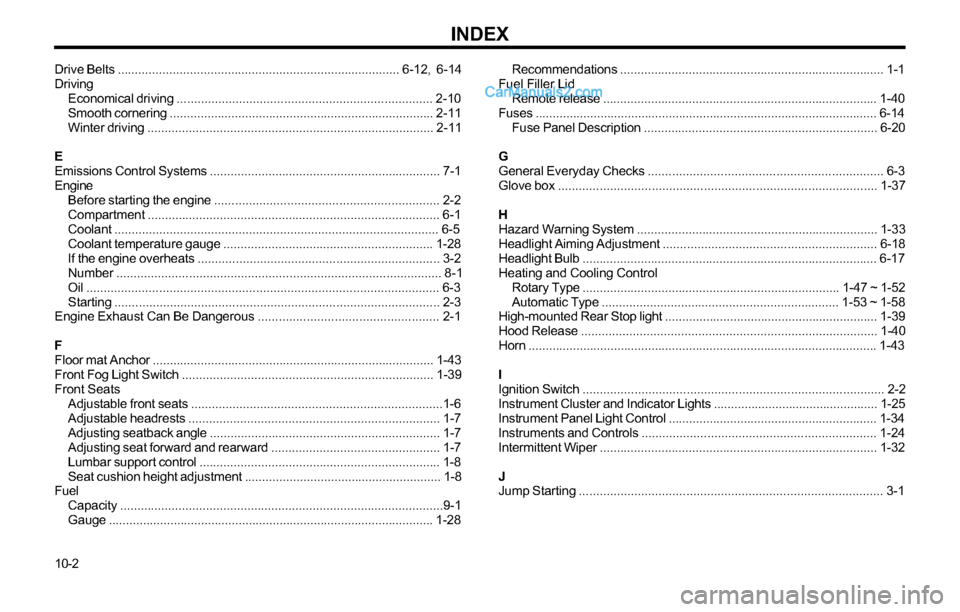
10-2Drive Belts .................................................................................. 6-12, 6-14
Driving
Economical driving .......................................................................... 2-10
Smooth cornering ............................................................................. 2-11
Winter driving ................................................................................... 2-11
E
Emissions Control Systems ................................................................... 7-1
Engine
Before starting the engine ................................................................. 2-2
Compartment ..................................................................................... 6-1
Coolant .............................................................................................. 6-5
Coolant temperature gauge ............................................................. 1-28
If the engine overheats ...................................................................... 3-2
Number .............................................................................................. 8-1
Oil ...................................................................................................... 6-3
Starting .............................................................................................. 2-3
Engine Exhaust Can Be Dangerous .................................................... 2-1
F
Floor mat Anchor .................................................................................. 1-43
Front Fog Light Switch ......................................................................... 1-39
Front Seats
Adjustable front seats .........................................................................1-6
Adjustable headrests ......................................................................... 1-7
Adjusting seatback angle ................................................................... 1-7
Adjusting seat forward and rearward ................................................. 1-7
Lumbar support control ...................................................................... 1-8
Seat cushion height adjustment ......................................................... 1-8
Fuel
Capacity ..............................................................................................9-1
Gauge ............................................................................................... 1-28Recommendations ............................................................................. 1-1
Fuel Filler Lid
Remote release ................................................................................ 1-40
Fuses .................................................................................................... 6-14
Fuse Panel Description .................................................................... 6-20
G
General Everyday Checks .................................................................... 6-3
Glove box ............................................................................................ 1-37
H
Hazard Warning System ...................................................................... 1-33
Headlight Aiming Adjustment .............................................................. 6-18
Headlight Bulb ...................................................................................... 6-17
Heating and Cooling Control
Rotary Type ........................................................................... 1-47 ~ 1-52
Automatic Type ..................................................................... 1-53 ~ 1-58
High-mounted Rear Stop light .............................................................. 1-39
Hood Release ...................................................................................... 1-40
Horn ...................................................................................................... 1-43
I
Ignition Switch ....................................................................................... 2-2
Instrument Cluster and Indicator Lights ................................................ 1-25
Instrument Panel Light Control ............................................................. 1-34
Instruments and Controls .................................................................... 1-24
Intermittent Wiper ................................................................................. 1-32
J
Jump Starting ........................................................................................ 3-1