ABS Hyundai Tiburon 2003 Owner's Manual
[x] Cancel search | Manufacturer: HYUNDAI, Model Year: 2003, Model line: Tiburon, Model: Hyundai Tiburon 2003Pages: 169, PDF Size: 3.04 MB
Page 34 of 169
FEATURES OF YOUR HYUNDAI
1- 26
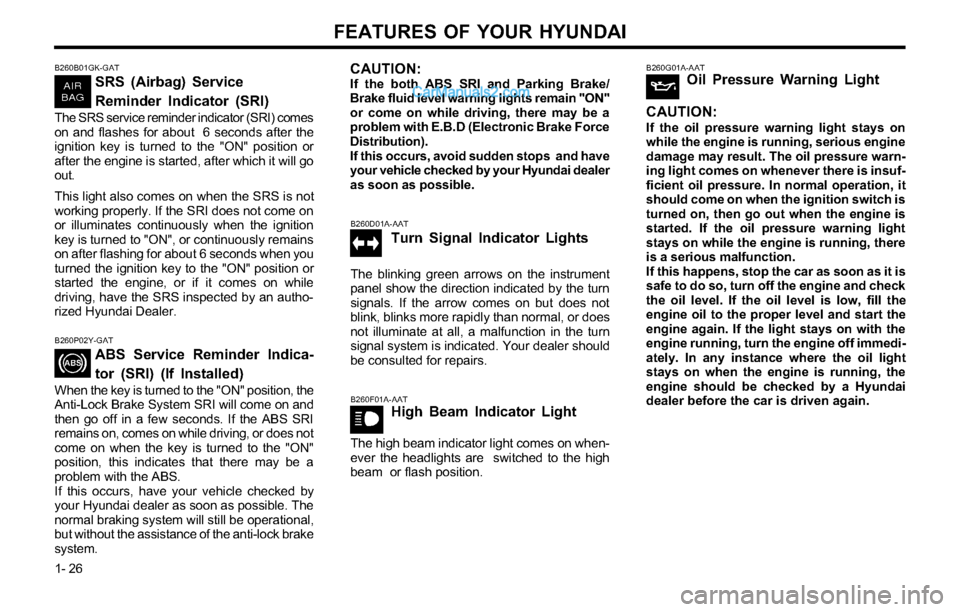
B260G01A-AATOil Pressure Warning Light
CAUTION:
If the oil pressure warning light stays on
while the engine is running, serious engine
damage may result. The oil pressure warn-
ing light comes on whenever there is insuf-
ficient oil pressure. In normal operation, it
should come on when the ignition switch is
turned on, then go out when the engine is
started. If the oil pressure warning light
stays on while the engine is running, there
is a serious malfunction.
If this happens, stop the car as soon as it is
safe to do so, turn off the engine and check
the oil level. If the oil level is low, fill the
engine oil to the proper level and start the
engine again. If the light stays on with the
engine running, turn the engine off immedi-
ately. In any instance where the oil light
stays on when the engine is running, the
engine should be checked by a Hyundai
dealer before the car is driven again.
B260F01A-AATHigh Beam Indicator Light
The high beam indicator light comes on when-
ever the headlights are switched to the high
beam or flash position.
B260D01A-AAT
Turn Signal Indicator Lights
The blinking green arrows on the instrument
panel show the direction indicated by the turn
signals. If the arrow comes on but does not
blink, blinks more rapidly than normal, or does
not illuminate at all, a malfunction in the turn
signal system is indicated. Your dealer should
be consulted for repairs.
B260P02Y-GAT
ABS Service Reminder Indica-
tor (SRI) (If Installed)
When the key is turned to the "ON" position, the
Anti-Lock Brake System SRI will come on and
then go off in a few seconds. If the ABS SRI
remains on, comes on while driving, or does not
come on when the key is turned to the "ON"
position, this indicates that there may be a
problem with the ABS.
If this occurs, have your vehicle checked by
your Hyundai dealer as soon as possible. The
normal braking system will still be operational,
but without the assistance of the anti-lock brake
system.
CAUTION:If the both ABS SRI and Parking Brake/
Brake fluid level warning lights remain "ON"
or come on while driving, there may be a
problem with E.B.D (Electronic Brake Force
Distribution).
If this occurs, avoid sudden stops and have
your vehicle checked by your Hyundai dealer
as soon as possible.
B260B01GK-GAT
SRS (Airbag) Service
Reminder Indicator (SRI)
The SRS service reminder indicator (SRI) comes
on and flashes for about 6 seconds after the
ignition key is turned to the "ON" position or
after the engine is started, after which it will go
out.
This light also comes on when the SRS is not
working properly. If the SRI does not come on
or illuminates continuously when the ignition
key is turned to "ON", or continuously remains
on after flashing for about 6 seconds when you
turned the ignition key to the "ON" position or
started the engine, or if it comes on while
driving, have the SRS inspected by an autho-
rized Hyundai Dealer.
Page 104 of 169
DRIVING YOUR HYUNDAI
2- 9
C120A02A-AATANTI-LOCK BRAKE SYSTEM
(If installed)
The Anti-Lock Brake System (ABS) is designed
to prevent wheel lock-up during sudden braking
or on hazardous road surfaces. The ABS con-
trol module monitors the wheel speed and con-
trols the pressure applied to each brake. Thus,
in emergency situations or on slick roads, ABS
will increase vehicle control during braking.
NOTE:During ABS operation, a slight pulsation
may be felt in the brake pedal when the
brakes are applied. Also, a noise may be
heard in the engine compartment while brak-
ing. These conditions are normal and indi-
cate that the anti-lock brake system is func-
tioning properly.
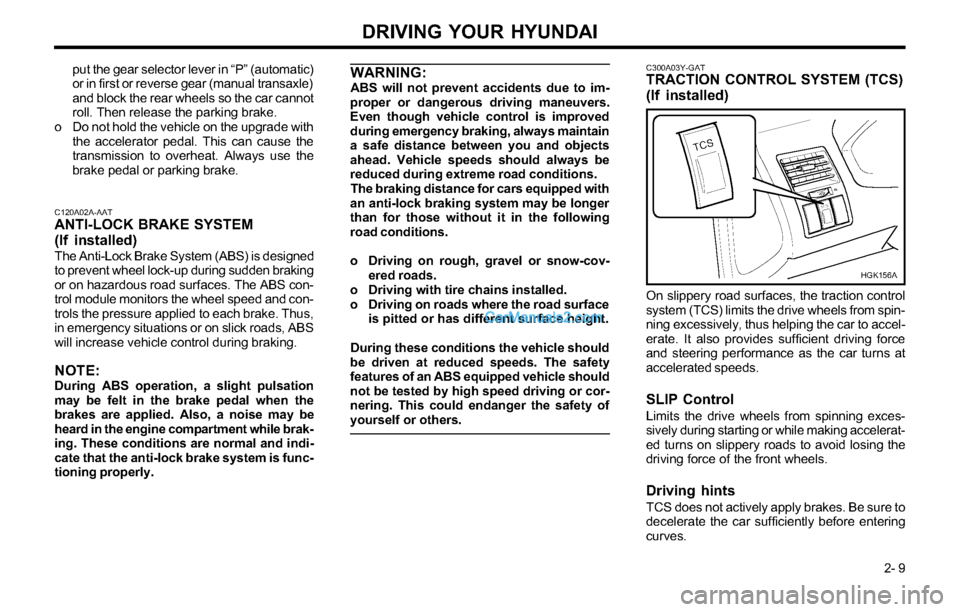
C300A03Y-GATTRACTION CONTROL SYSTEM (TCS)
(If installed)
HGK156A
put the gear selector lever in “P” (automatic)
or in first or reverse gear (manual transaxle)
and block the rear wheels so the car cannot
roll. Then release the parking brake.
o Do not hold the vehicle on the upgrade with
the accelerator pedal. This can cause the
transmission to overheat. Always use the
brake pedal or parking brake.WARNING:ABS will not prevent accidents due to im-
proper or dangerous driving maneuvers.
Even though vehicle control is improved
during emergency braking, always maintain
a safe distance between you and objects
ahead. Vehicle speeds should always be
reduced during extreme road conditions.
The braking distance for cars equipped with
an anti-lock braking system may be longer
than for those without it in the following
road conditions.
o Driving on rough, gravel or snow-cov-
ered roads.
o Driving with tire chains installed.
o Driving on roads where the road surface
is pitted or has different surface height.
During these conditions the vehicle should
be driven at reduced speeds. The safety
features of an ABS equipped vehicle should
not be tested by high speed driving or cor-
nering. This could endanger the safety of
yourself or others.On slippery road surfaces, the traction control
system (TCS) limits the drive wheels from spin-
ning excessively, thus helping the car to accel-
erate. It also provides sufficient driving force
and steering performance as the car turns at
accelerated speeds.
SLIP Control
Limits the drive wheels from spinning exces-
sively during starting or while making accelerat-
ed turns on slippery roads to avoid losing the
driving force of the front wheels.
Driving hintsTCS does not actively apply brakes. Be sure to
decelerate the car sufficiently before entering
curves.
Page 122 of 169
CORROSION PREVENTION AND APPEARANCE CARE
4-2
E020C01A-AATKeep Your Garage Dry
Don’t park your car in a damp, poorly ventilated
garage. This creates a favorable environment
for corrosion. This is particularly true if you
wash your car in the garage or drive it into the
garage when it is still wet or covered with snow,
ice or mud. Even a heated garage can contrib-
ute to corrosion unless it is well ventilated so
moisture is dispersed.
E020D01A-AATKeep Paint and Trim in Good Condi-
tion
Scratches or chips in the finish should be cov-
ered with "touch-up" paint as soon as possible
to reduce the possibility of corrosion. If bare
metal is showing through, the attention of a
qualified body and paint shop is recommended.
E020E01A-AAT
Don’t Neglect the Interior
Moisture can collect under the floor mats and
carpeting to cause corrosion. Check under the
mats periodically to be sure the carpeting is dry.
Use particular care if you carry fertilizers, clean-
ing materials or chemicals in the car.
These should be carried only in proper contain-
ers and any spills or leaks should be cleaned
up, flushed with clear water and thoroughly
dried.
E030A01A-AATWASHING AND WAXING
Washing Your Hyundai
Never wash your car when the surface is hot
from being in the sun. Always wash your car in
the shade.
Wash your car frequently. Dirt is abrasive and
can scratch the paint if it is not removed. Air
pollution or acid rain may damage the paint and
trim through chemical action if pollutants are
allowed to remain in contact with the surface. If
you live near the ocean or in an area where
road salts or dust control chemicals are used,
you should pay particular attention to the under-
side of the car. Start by rinsing the car to
remove dust and loose dirt. In winter, or if you
have driven through mud or muddy water, be
sure to thoroughly clean the underside as well.
Use a hard direct stream of water to remove
accumulations of mud or corrosive materials.
Use a good quality car-washing solution and
follow the manufacturer’s directions on the pack-
age. These are available at your Hyundai dealer
or auto parts outlet. Don’t use strong household
detergents, gasoline, strong solvents or abra-
sive cleaning powders as these may damage
the finish.
Use a clean sponge or cloth, rinse it frequently
and don’t damage the finish by rubbing too
hard. For stubborn spots, dampen them fre-
quently and remove them a little at a time.To clean whitewall tires, use a stiff brush or
soapy steel-wool scouring pad.
To clean plastic wheel covers, use a clean
sponge or soft cloth and water.
To clean cast aluminum alloy wheels, use a
mild soap or neutral detergent. Do not use
abrasive cleaners. Protect the bare-metal sur-
faces by cleaning, polishing and waxing. Be-
cause aluminum is subject to corrosion, be sure
to give aluminum alloy wheels special attention
in winter. If you drive on salted roads, clean the
wheels thoroughly afterwards.
After washing, be sure to rinse thoroughly. If
soapy water dries on the finish, streaking will
result.
When the weather is warm and the humidity
low, you may find it necessary to rinse each
section immediately after washing to avoid
streaking.
After rinsing, dry the car using a damp chamois
or soft, absorbent cloth. The reason for drying
the car is to remove water from the car so it will
dry without water spots. Don’t rub, this can
damage the finish.
If you find any nicks or scratches in the paint,
use touch-up paint to cover them to prevent
corrosion. To protect the paintwork of the car
against corrosion, you must clean your Hyundai
(at least once a month). Give special attention
to the removal of salt, mud and other substanc-
Page 151 of 169
DO-IT-YOURSELF MAINTENANCE
6-20
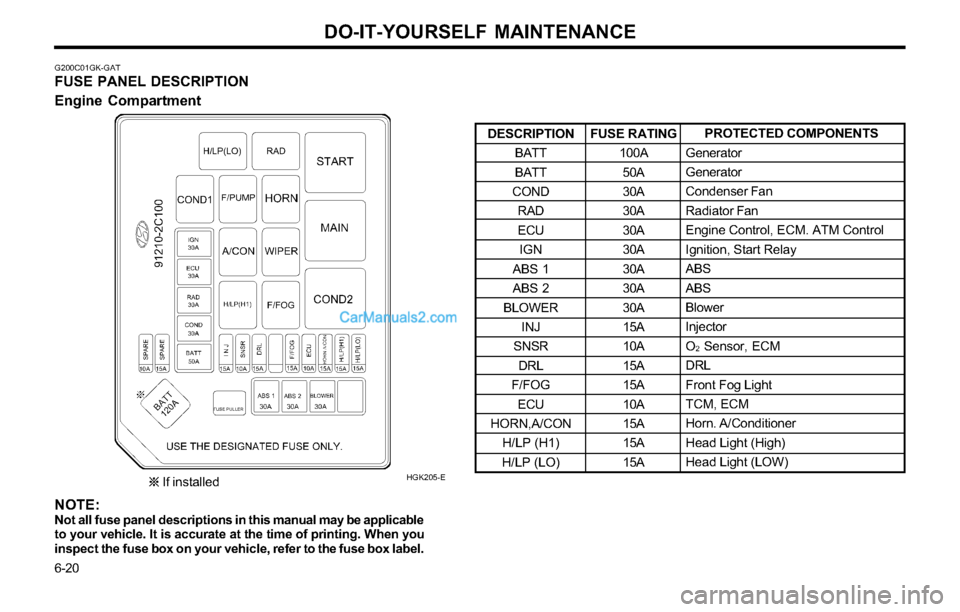
G200C01GK-GATFUSE PANEL DESCRIPTION
Engine Compartment
HGK205-E
PROTECTED COMPONENTS
Generator
Generator
Condenser Fan
Radiator Fan
Engine Control, ECM. ATM Control
Ignition, Start Relay
ABS
ABS
Blower
Injector
O
2 Sensor, ECM
DRL
Front Fog Light
TCM, ECM
Horn. A/Conditioner
Head Light (High)
Head Light (LOW) FUSE RATING
100A
50A
30A
30A
30A
30A
30A
30A
30A
15A
10A
15A
15A
10A
15A
15A
15A DESCRIPTION
BATT
BATT
COND
RAD
ECU
IGN
ABS 1
ABS 2
BLOWER
INJ
SNSR
DRL
F/FOG
ECU
HORN,A/CON
H/LP (H1)
H/LP (LO)
NOTE:Not all fuse panel descriptions in this manual may be applicable
to your vehicle. It is accurate at the time of printing. When you
inspect the fuse box on your vehicle, refer to the fuse box label.
If installed
Page 152 of 169
DO-IT-YOURSELF MAINTENANCE
6-21
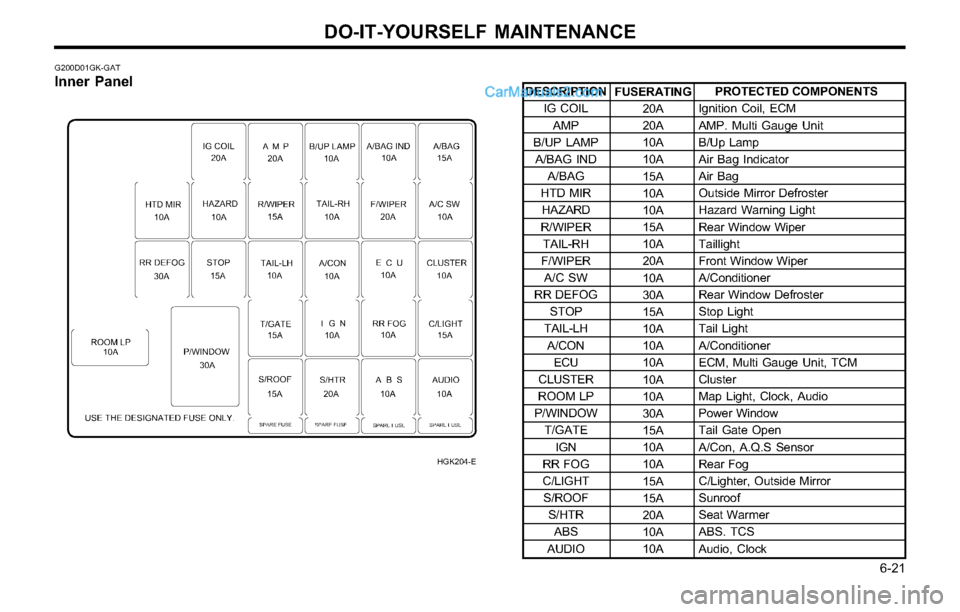
DESCRIPTION
IG COIL
AMP
B/UP LAMP
A/BAG IND
A/BAG
HTD MIR
HAZARD
R/WIPER
TAIL-RH
F/WIPER
A/C SW
RR DEFOG
STOP
TAIL-LH
A/CON
ECU
CLUSTER
ROOM LP
P/WINDOW
T/GATE
IGN
RR FOG
C/LIGHT
S/ROOF
S/HTR
ABS
AUDIO
G200D01GK-GATInner Panel
HGK204-E
PROTECTED COMPONENTS
Ignition Coil, ECM
AMP. Multi Gauge Unit
B/Up Lamp
Air Bag Indicator
Air Bag
Outside Mirror Defroster
Hazard Warning Light
Rear Window Wiper
Taillight
Front Window Wiper
A/Conditioner
Rear Window Defroster
Stop Light
Tail Light
A/Conditioner
ECM, Multi Gauge Unit, TCM
Cluster
Map Light, Clock, Audio
Power Window
Tail Gate Open
A/Con, A.Q.S Sensor
Rear Fog
C/Lighter, Outside Mirror
Sunroof
Seat Warmer
ABS. TCS
Audio, Clock FUSERATING
20A
20A
10A
10A
15A
10A
10A
15A
10A
20A
10A
30A
15A
10A
10A
10A
10A
10A
30A
15A
10A
10A
15A
15A
20A
10A
10A
Page 153 of 169
EMISSION CONTROL SYSTEMS
7-1
7. EMISSION CON-
TROL SYSTEMSH010B01A-AAT1. Crankcase Emission Control
System
The Positive Crankcase Ventilation System is
employed to prevent air pollution caused by
blow-by gases being emitted from the crank-
case. This system supplies fresh filtered air to
the crankcase through the air intake hose.
Inside the crankcase, the fresh air mixes with
blow-by gases, which then pass through the
PCV valve and into the induction system.
H010C01S-AAT2. Evaporative Emission Control (In-
cluding ORVR: Onboard Refueling
Vapor Recovery) System
The Evaporative Emission Control System is
designed to prevent fuel vapors from escaping
into the atmosphere.
(The ORVR system is designed to allow the
vapors from the fuel tank to be loaded into
a canister while refueling at the gas station,
preventing the escape of fuel vapors into
the atmosphere.)
Canister
Fuel vapors generated inside the fuel tank are
absorbed and stored in the onboard canister.
When the engine is running, the fuel vapors
absorbed in the canister are drawn into the
induction system through the purge control so-
lenoid valve.
Purge Control Solenoid Valve (PCSV)
The purge control solenoid valve is controlled
by the Engine Control Module (ECM); when the
engine coolant temperature is low during idling,
the PCSV closes so that evaporated fuel is not
taken into the engine. After the engine warms-
up during ordinary driving, the PCSV opens to
introduce evaporated fuel to the engine.
H010D01A-AAT
3. Exhaust Emission Control System
The Exhaust Emission Control System is a
highly effective system which controls exhaust
emissions while maintaining good vehicle per-
formance.
H010A01GK-AAT
EMISSION CONTROL SYSTEM
Your Hyundai is equipped with an emission
control system to meet all requirements of the
U.S. Environmental Protection Agency or Cali-
fornia Air Resources Board.
There are three emission control systems which
are as follows.
1) Crankcase Emission Control System
2) Evaporative Emission Control System
3) Exhaust Emission Control System
In order to ensure the proper function of the
emission control systems, it is recommended
that you have your car inspected and main-
tained by an authorized Hyundai dealer in ac-
cordance with the maintenance schedule in this
manual.
Caution for Inspection and Maintenance Test
(Vehicle with Traction Control System)
o To prevent the vehicle from misfiring
during dynamometer testing, disconnect
the ABS connector located inside of the
wheel guard (driver side).
o For more information, see shop manual
(BR Group, Wheel Speed Sensor).
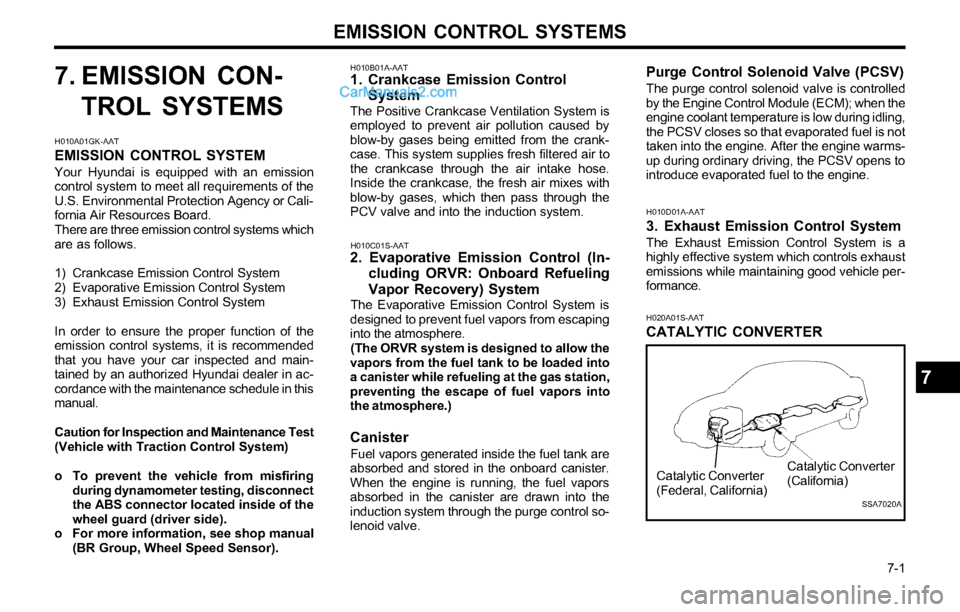
H020A01S-AAT
CATALYTIC CONVERTER
Catalytic Converter
(California)
SSA7020A
Catalytic Converter
(Federal, California)
7