cooling Hyundai Tiburon 2003 Owner's Manual
[x] Cancel search | Manufacturer: HYUNDAI, Model Year: 2003, Model line: Tiburon, Model: Hyundai Tiburon 2003Pages: 169, PDF Size: 3.04 MB
Page 32 of 169
FEATURES OF YOUR HYUNDAI
1- 24
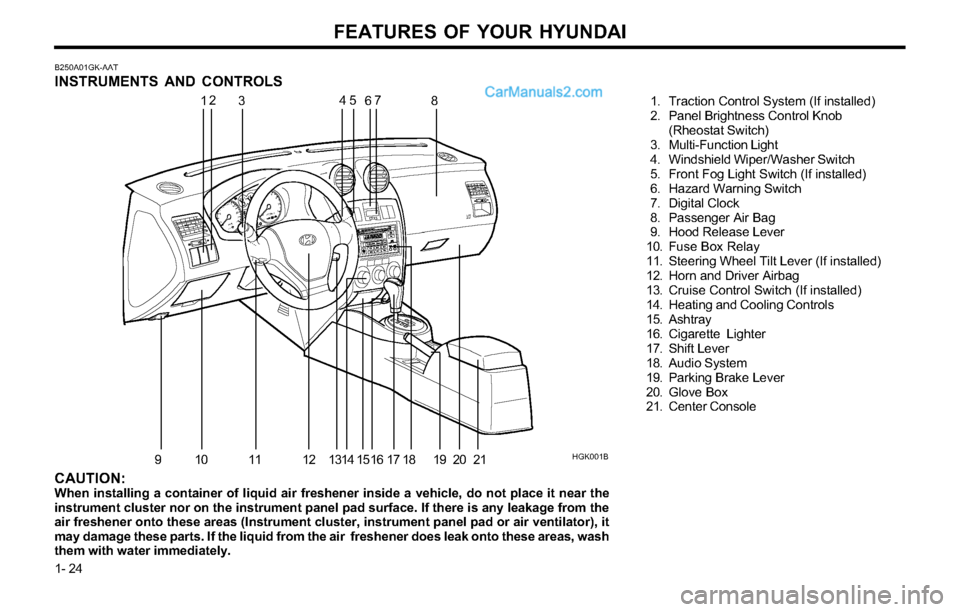
B250A01GK-AAT
INSTRUMENTS AND CONTROLS
1. Traction Control System (If installed)
2. Panel Brightness Control Knob
(Rheostat Switch)
3. Multi-Function Light
4. Windshield Wiper/Washer Switch
5. Front Fog Light Switch (If installed)
6. Hazard Warning Switch
7. Digital Clock
8. Passenger Air Bag
9. Hood Release Lever
10. Fuse Box Relay
11. Steering Wheel Tilt Lever (If installed)
12. Horn and Driver Airbag
13. Cruise Control Switch (If installed)
14. Heating and Cooling Controls
15. Ashtray
16. Cigarette Lighter
17. Shift Lever
18. Audio System
19. Parking Brake Lever
20. Glove Box
21. Center Console
CAUTION:When installing a container of liquid air freshener inside a vehicle, do not place it near the
instrument cluster nor on the instrument panel pad surface. If there is any leakage from the
air freshener onto these areas (Instrument cluster, instrument panel pad or air ventilator), it
may damage these parts. If the liquid from the air freshener does leak onto these areas, wash
them with water immediately.
HGK001B
12
34
5
67
8
910 11 12131415161718192021
Page 37 of 169
FEATURES OF YOUR HYUNDAI
1- 29
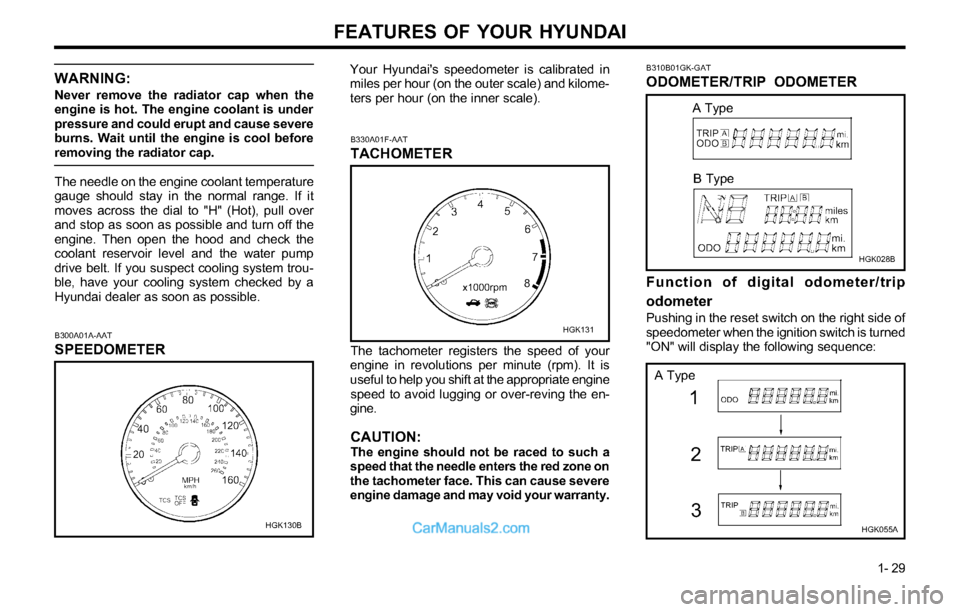
B300A01A-AAT
SPEEDOMETER
HGK130B
Your Hyundai's speedometer is calibrated in
miles per hour (on the outer scale) and kilome-
ters per hour (on the inner scale).
B330A01F-AAT
TACHOMETER
The tachometer registers the speed of your
engine in revolutions per minute (rpm). It is
useful to help you shift at the appropriate engine
speed to avoid lugging or over-reving the en-
gine.
CAUTION:The engine should not be raced to such a
speed that the needle enters the red zone on
the tachometer face. This can cause severe
engine damage and may void your warranty.
HGK131
WARNING:
Never remove the radiator cap when the
engine is hot. The engine coolant is under
pressure and could erupt and cause severe
burns. Wait until the engine is cool before
removing the radiator cap.
The needle on the engine coolant temperature
gauge should stay in the normal range. If it
moves across the dial to "H" (Hot), pull over
and stop as soon as possible and turn off the
engine. Then open the hood and check the
coolant reservoir level and the water pump
drive belt. If you suspect cooling system trou-
ble, have your cooling system checked by a
Hyundai dealer as soon as possible.
B310B01GK-GAT
ODOMETER/TRIP ODOMETER
HGK028B
Function of digital odometer/trip
odometer
Pushing in the reset switch on the right side of
speedometer when the ignition switch is turned
"ON" will display the following sequence:
HGK055A
1
3 2
A Type
B Type
A Type
Page 54 of 169
FEATURES OF YOUR HYUNDAI
1- 46
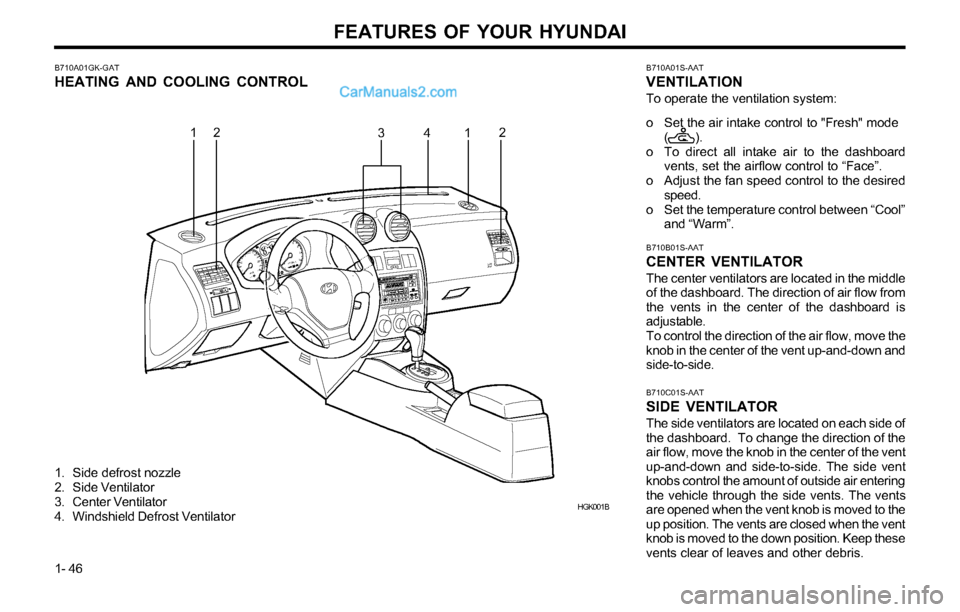
B710A01GK-GAT
HEATING AND COOLING CONTROL
1. Side defrost nozzle
2. Side Ventilator
3. Center Ventilator
4. Windshield Defrost Ventilator
HGK001B
12
312
B710A01S-AAT
VENTILATION
To operate the ventilation system:
o Set the air intake control to "Fresh" mode
( ).
o To direct all intake air to the dashboard
vents, set the airflow control to “Face”.
o Adjust the fan speed control to the desired
speed.
o Set the temperature control between “Cool”
and “Warm”.
B710C01S-AAT
SIDE VENTILATOR
The side ventilators are located on each side of
the dashboard. To change the direction of the
air flow, move the knob in the center of the vent
up-and-down and side-to-side. The side vent
knobs control the amount of outside air entering
the vehicle through the side vents. The vents
are opened when the vent knob is moved to the
up position. The vents are closed when the vent
knob is moved to the down position. Keep these
vents clear of leaves and other debris.
B710B01S-AAT
CENTER VENTILATOR
The center ventilators are located in the middle
of the dashboard. The direction of air flow from
the vents in the center of the dashboard is
adjustable.
To control the direction of the air flow, move the
knob in the center of the vent up-and-down and
side-to-side.
4
Page 58 of 169
FEATURES OF YOUR HYUNDAI
1- 50
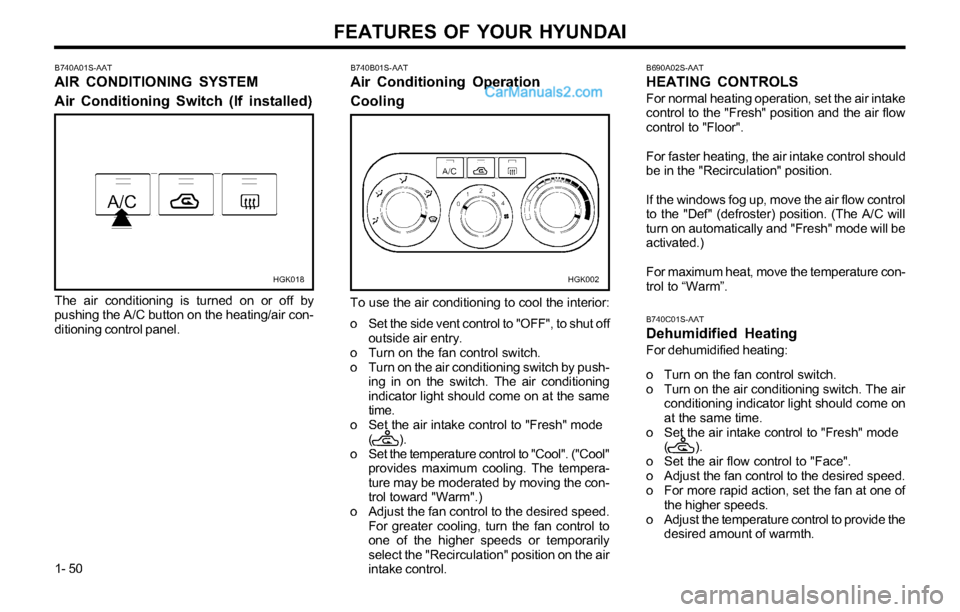
B740A01S-AAT
AIR CONDITIONING SYSTEM
Air Conditioning Switch (If installed)
HGK018
The air conditioning is turned on or off by
pushing the A/C button on the heating/air con-
ditioning control panel.
HGK002
B740B01S-AAT
Air Conditioning Operation
Cooling
To use the air conditioning to cool the interior:
o Set the side vent control to "OFF", to shut off
outside air entry.
o Turn on the fan control switch.
o Turn on the air conditioning switch by push-
ing in on the switch. The air conditioning
indicator light should come on at the same
time.
o Set the air intake control to "Fresh" mode
( ).
o Set the temperature control to "Cool". ("Cool"
provides maximum cooling. The tempera-
ture may be moderated by moving the con-
trol toward "Warm".)
o Adjust the fan control to the desired speed.
For greater cooling, turn the fan control to
one of the higher speeds or temporarily
select the "Recirculation" position on the air
intake control.
B690A02S-AAT
HEATING CONTROLS
For normal heating operation, set the air intake
control to the "Fresh" position and the air flow
control to "Floor".
For faster heating, the air intake control should
be in the "Recirculation" position.
If the windows fog up, move the air flow control
to the "Def" (defroster) position. (The A/C will
turn on automatically and "Fresh" mode will be
activated.)
For maximum heat, move the temperature con-
trol to “Warm”.
B740C01S-AAT
Dehumidified Heating
For dehumidified heating:
o Turn on the fan control switch.
o Turn on the air conditioning switch. The air
conditioning indicator light should come on
at the same time.
o Set the air intake control to "Fresh" mode
( ).
o Set the air flow control to "Face".
o Adjust the fan control to the desired speed.
o For more rapid action, set the fan at one of
the higher speeds.
o Adjust the temperature control to provide the
desired amount of warmth.
Page 60 of 169
FEATURES OF YOUR HYUNDAI
1- 52
B730A01FC-GAT
OPERATION TIPS
o To keep dust or unpleasant fumes from
entering the car through the ventilation sys-
tem, temporarily set the air intake control to
"Recirculation". Be sure to return the control
to "Fresh" when the irritation has passed to
keep fresh air in the vehicle. This will help
keep the driver alert and comfortable.
o Air for the heating/cooling system is drawn
in through the grilles just ahead of the wind-
shield. Care should be taken that these are
not blocked by leaves, snow, ice or other
obstructions.
o To prevent interior fog on the windshield, set
the air intake control to the fresh air ( )
position and fan speed to the desired posi-
tion.
Page 61 of 169
FEATURES OF YOUR HYUNDAI
1- 53
B970A01Y-AAT
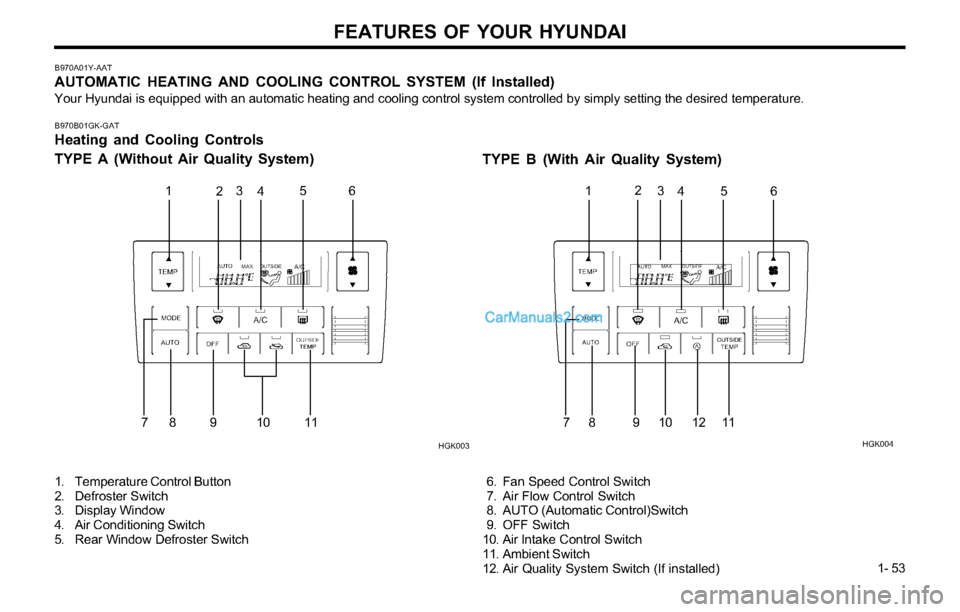
AUTOMATIC HEATING AND COOLING CONTROL SYSTEM (If lnstalled)
Your Hyundai is equipped with an automatic heating and cooling control system controlled by simply setting the desired temperature.
B970B01GK-GAT
Heating and Cooling Controls
TYPE A (Without Air Quality System)
TYPE B (With Air Quality System)
1. Temperature Control Button
2. Defroster Switch
3. Display Window
4. Air Conditioning Switch
5. Rear Window Defroster Switch 6. Fan Speed Control Switch
7. Air Flow Control Switch
8. AUTO (Automatic Control)Switch
9. OFF Switch
10. Air lntake Control Switch
11. Ambient Switch
12. Air Quality System Switch (If installed)
HGK004
HGK003
1
235
46
78 9 10 1112
3
45
6
78 910 1211
Page 62 of 169
FEATURES OF YOUR HYUNDAI
1- 54
B970C02E-AAT
Automatic Operation
HGK020
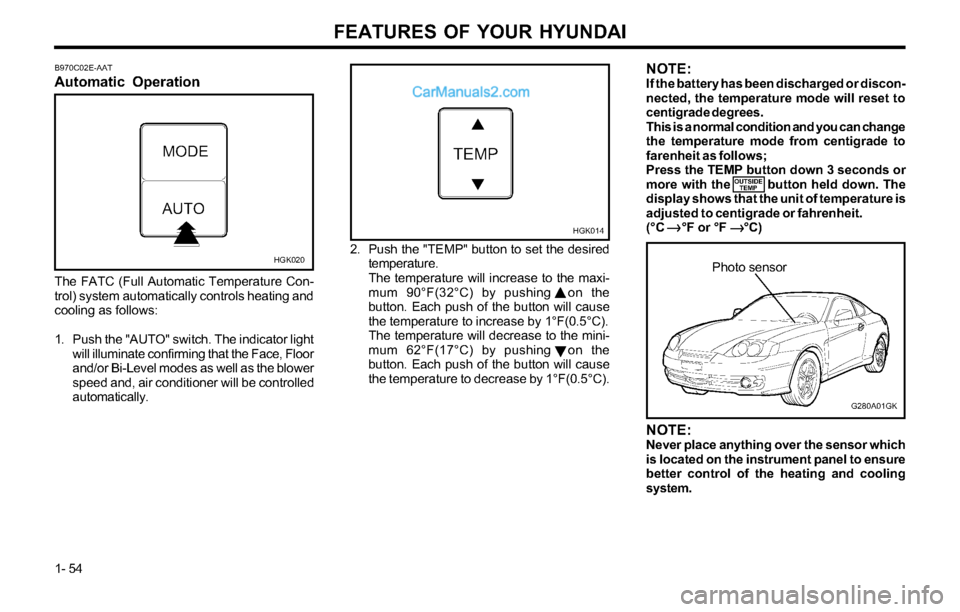
The FATC (Full Automatic Temperature Con-
trol) system automatically controls heating and
cooling as follows:
1. Push the "AUTO" switch. The indicator light
will illuminate confirming that the Face, Floor
and/or Bi-Level modes as well as the blower
speed and, air conditioner will be controlled
automatically.2. Push the "TEMP" button to set the desired
temperature.
The temperature will increase to the maxi-
mum 90°F(32°C) by pushing on the
button. Each push of the button will cause
the temperature to increase by 1°F(0.5°C).
The temperature will decrease to the mini-
mum 62°F(17°C) by pushing on the
button. Each push of the button will cause
the temperature to decrease by 1°F(0.5°C).
G280A01GK
Photo sensor
HGK014
NOTE:Never place anything over the sensor which
is located on the instrument panel to ensure
better control of the heating and cooling
system.
NOTE:If the battery has been discharged or discon-
nected, the temperature mode will reset to
centigrade degrees.
This is a normal condition and you can change
the temperature mode from centigrade to
farenheit as follows;
Press the TEMP button down 3 seconds or
more with the button held down. The
display shows that the unit of temperature is
adjusted to centigrade or fahrenheit.
(°C °F or °F °C)
OUTSIDE
TEMP
Page 63 of 169
FEATURES OF YOUR HYUNDAI
1- 55
B980B01Y-AAT
Fan Speed Control Switch
HGK015
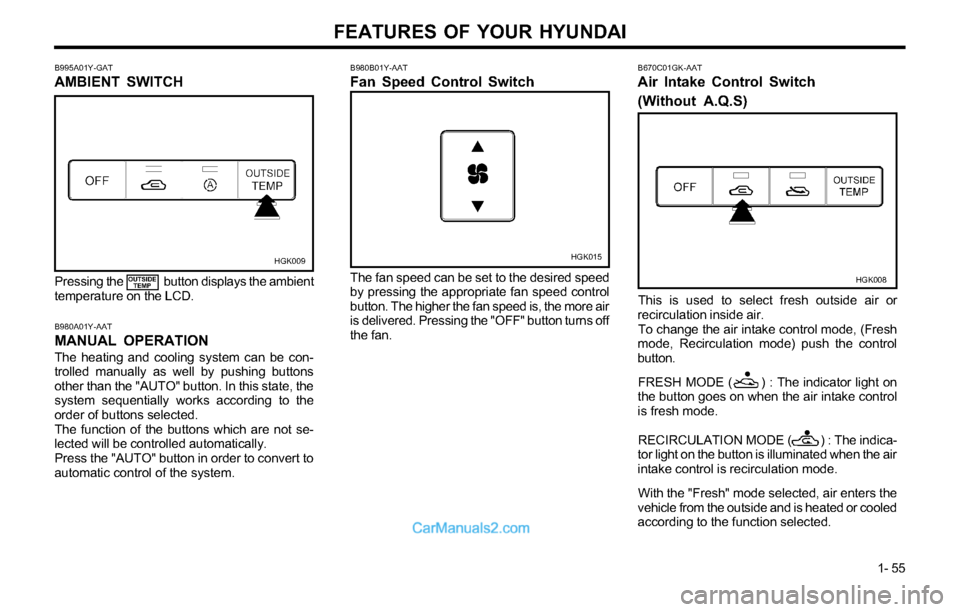
The fan speed can be set to the desired speed
by pressing the appropriate fan speed control
button. The higher the fan speed is, the more air
is delivered. Pressing the "OFF" button turns off
the fan.
B980A01Y-AAT
MANUAL OPERATION
The heating and cooling system can be con-
trolled manually as well by pushing buttons
other than the "AUTO" button. In this state, the
system sequentially works according to the
order of buttons selected.
The function of the buttons which are not se-
lected will be controlled automatically.
Press the "AUTO" button in order to convert to
automatic control of the system.Pressing the button displays the ambient
temperature on the LCD.
OUTSIDE
TEMP
B995A01Y-GAT
AMBIENT SWITCH
HGK009
B670C01GK-AAT
Air Intake Control Switch
(Without A.Q.S)
HGK008
This is used to select fresh outside air or
recirculation inside air.
To change the air intake control mode, (Fresh
mode, Recirculation mode) push the control
button.
FRESH MODE ( ) : The indicator light on
the button goes on when the air intake control
is fresh mode.
RECIRCULATION MODE ( ) : The indica-
tor light on the button is illuminated when the air
intake control is recirculation mode.
With the "Fresh" mode selected, air enters the
vehicle from the outside and is heated or cooled
according to the function selected.
Page 65 of 169
FEATURES OF YOUR HYUNDAI
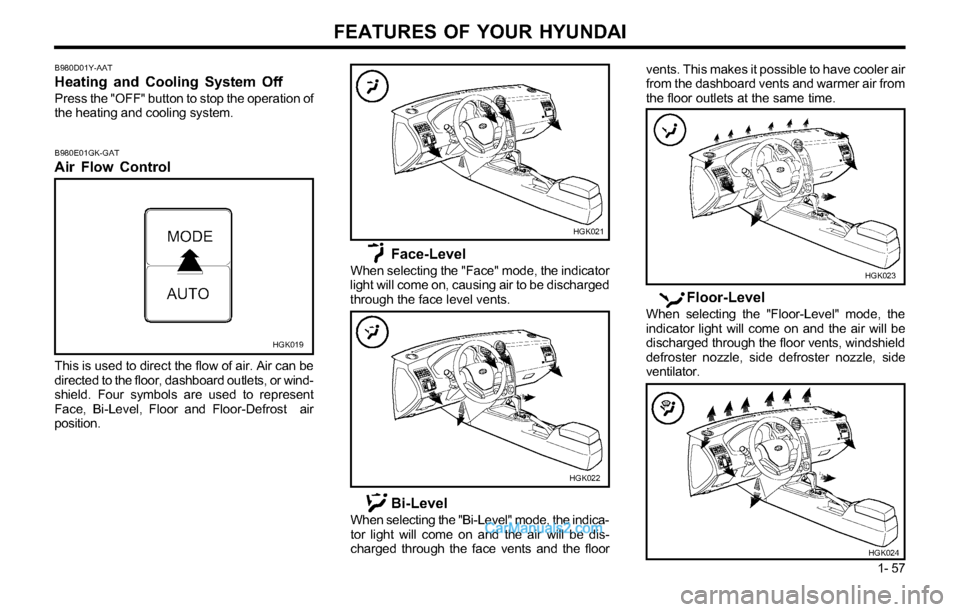
1- 57 This is used to direct the flow of air. Air can be
directed to the floor, dashboard outlets, or wind-
shield. Four symbols are used to represent
Face, Bi-Level, Floor and Floor-Defrost air
position.
B980D01Y-AAT
Heating and Cooling System Off
Press the "OFF" button to stop the operation of
the heating and cooling system.
B980E01GK-GAT
Air Flow Control
HGK019
HGK021
HGK022
Face-Level
When selecting the "Face" mode, the indicator
light will come on, causing air to be discharged
through the face level vents.
Bi-Level
When selecting the "Bi-Level" mode, the indica-
tor light will come on and the air will be dis-
charged through the face vents and the floorvents. This makes it possible to have cooler air
from the dashboard vents and warmer air from
the floor outlets at the same time.
Floor-Level
When selecting the "Floor-Level" mode, the
indicator light will come on and the air will be
discharged through the floor vents, windshield
defroster nozzle, side defroster nozzle, side
ventilator.
HGK023
HGK024
Page 106 of 169
DRIVING YOUR HYUNDAI
2- 11 o Remember, your Hyundai does not require
extended warm-up. As soon as the engine is
running smoothly, you can drive away. In
very cold weather, however, give your en-
gine a slightly longer warm-up period.
o Don't "lug" or "over-rev" the engine. Lugging
is driving too slowly in too high a gear
resulting in the engine bucking. If this hap-
pens, shift to a lower gear. Over-revving is
racing the engine beyond its safe limit. This
can be avoided by shifting at the recom-
mended speeds.
o Use your air conditioning sparingly. The air
conditioning system is operated by engine
power so your fuel economy is reduced
when you use it.
C150A01A-AAT
SMOOTH CORNERING
Avoid braking or gear changing in corners,
especially when roads are wet. Ideally, corners
should always be taken under gentle accelera-
tion. If you follow these suggestions, tire wear
will be held to a minimum.
C160A01A-AAT
WINTER DRIVING
The more severe weather conditions of winter
result in greater wear and other problems. To
minimize the problems of winter driving, you
should follow these suggestions: o Take care of your tires. Keep them inflated
to the recommended pressure. Incorrect in-
flation, either too much or too little, results in
unnecessary tire wear. Check the tire pres-
sures at least once a month.
o Be sure that the wheels are aligned correct-
ly. Improper alignment can result from hitting
curbs or driving too fast over irregular sur-
faces. Poor alignment causes faster tire
wear and may also result in other problems
as well as greater fuel consumption.
o Keep your car in good condition. For better
fuel economy and reduced maintenance
costs, maintain your car in accordance with
the maintenance schedule in Section 5. If
you drive your car in severe conditions,
more frequent maintenance is required (see
Section 5 for details).
o Keep your car clean. For maximum service,
your Hyundai should be kept clean and free
of corrosive materials. It is especially impor-
tant that mud, dirt, ice, etc. not be allowed to
accumulate on the underside of the car. This
extra weight can result in increased fuel
consumption and also contribute to corro-
sion.
o Travel lightly. Don't carry unnecessary weight
in your car. Weight reduces fuel economy.
o Don't let the engine idle longer than neces-
sary. If you are waiting (and not in traffic),
turn off your engine and restart only when
you're ready to go.
C160C01A-AATUse High Quality Ethylene Glycol
Coolant
Your Hyundai is delivered with high quality
ethylene glycol coolant in the cooling system. It
is the only type of coolant that should be used
because it helps prevent corrosion in the cool-
ing system, lubricates the water pump and
prevents freezing. Be sure to replace or replen-
ish your coolant in accordance with the main-
C160B01A-AATSnowy or Icy Conditions
To drive your vehicle in deep snow, it may be
necessary to use snow tires or to install tire
chains on your tires. If snow tires are needed,
it is necessary to select tires equivalent in size
and type to the original equipment tires. Failure
to do so may adversely affect the safety and
handling of your car. Speeding, rapid accelera-
tion, sudden brake applications, and sharp turns
are potentially very hazardous practices.
During deceleration, use engine braking to the
fullest extent. Sudden brake applications on
snowy or icy roads may cause skids to occur.
You need to keep sufficient distance between
the vehicle in front and your vehicle. Also, apply
the brake gently. It should be noted that install-
ing tire chains on the tire will provide a greater
driving force, but will not prevent side skids.
NOTE:Tire chains are not legal in all states. Check
state laws before fitting tire chains.