heating Hyundai Tiburon 2004 Owner's Guide
[x] Cancel search | Manufacturer: HYUNDAI, Model Year: 2004, Model line: Tiburon, Model: Hyundai Tiburon 2004Pages: 224, PDF Size: 18.86 MB
Page 135 of 224
2DRIVING YOUR HYUNDAI
18TRAILER OR VEHICLE TOWING
C170A01A-AAT
HIGHER SPEED MOTORING
Pre-Trip Inspections
1. Tires:
Adjust the tire inflation pressures to specifica-
tion. Low tire inflation pressures will result in
overheating and possible failure of the tires.
Avoid using worn or damaged tires which may
result in reduced traction or tire failure.
NOTE:Never exceed the maximum tire inflation
pressure shown on the tires.
2. Fuel, engine coolant and engine oil: High
speed travel consumes more fuel than urban
motoring. Do not forget to check both engine
coolant and engine oil.
3. Drive belt:
A loose or damaged drive belt may result in
overheating of the engine.
C180A01A-AATUSE OF LIGHTS
Check your lights regularly for correct opera-
tion and always keep them clean. When driving
during the day in conditions of poor visibility, it
is helpful to drive with headlights on low beam.
This enables you to be seen as well as to see.
C190A02S-AAT
If you are considering towing with your car, you
should first check with your State's Department
of Motor Vehicles to determine their legal re-
quirements.
Since laws vary from State to State, the require-
ments for towing trailers, cars, other types of
vehicles, or apparatus may differ. Ask your
Hyundai dealer for further details before towing.
CAUTION:Do not do any towing with your car during
its first 1,200 miles (2,000 km) in order to
allow the engine to properly break in. Fail-
ure to heed this caution may result in seri-
ous engine or transaxle damage.
!
C190B01S-AAT
Trailer Hitches
Select the proper hitch and ball combination,
making sure that its location is compatible with
that of the trailer or vehicle being towed. Use a
quality non-equalizing hitch which distributes
the tongue load uniformly throughout the chas-
sis.
The hitch should be bolted securely to the car
and installed by a qualified technician. DO NOT
USE A HITCH DESIGNED FOR TEMPORARY
INSTALLATION AND NEVER USE ONE THAT
ATTACHES ONLY TO THE BUMPER.
Page 138 of 224
2DRIVING YOUR HYUNDAI
21
(automatic). In addition, place wheel chocks
at each of the trailer's tires.
9. If the trailer has electric brakes, start your
vehicle and trailer moving, and then apply the
trailer brake controller by hand to be sure the
brakes are working. This lets you check
your electrical connection at the same time.
10.During your trip, occasionally check to be
sure that the load is secure, and that the
lights and any trailer brakes are still working.
11.Avoid jerky starts, sudden acceleration or
sudden stops.
12.Avoid sharp turns and rapid lane changes.
13.Avoid holding the brake pedal down too long
or too frequently. This could cause the brakes
to overheat, resulting in reduced braking
efficiency.
14.When going down a hill, shift into a lower gear
and use the engine braking effect.
When ascending a long grade, downshift the
transaxle to a lower gear and reduce speed
to reduce chances of engine overloading
and/or overheating.
15.If you have to stop while going uphill, do not
hold the vehicle in place by pressing on the
accelerator. This can cause the automatic
transaxle to overheat. Use the parking brake
or footbrake.
NOTE:When towing check transaxle fluid more
frequently.
CAUTION:If overheating should occur when towing,
(the temperature gauge reads near red zone),
taking the following action may reduce or
eliminate the problem.
1. Turn off the air conditioner.
2. Reduce highway speed.
3. Select a lower gear when going uphill.
4. While in stop and go traffic, place the
gear selector in park or neutral and idle
the engine at a higher speed.
!
Page 143 of 224
3WHAT TO DO IN AN EMERGENCY
5
!
6. If you cannot find the cause of the overheat-
ing, wait until the engine temperature has
returned to normal. Then, if the engine cool-
ant has been lost, carefully add water to the
reservoir (Page 6-8) to bring the fluid level in
the reservoir up to the halfway mark.
7. Proceed with caution, keeping alert for fur-
ther signs of overheating. If overheating
happens again, call a Hyundai dealer for
assistance.
CAUTION:Serious loss of engine coolant indicates
there is a leak in the cooling system and this
should be checked as soon as possible by
a Hyundai dealer.
TEMPORARY SPARE TIRE
D040A01GK-AAT
The following instructions for the temporary
spare tire should be observed:
1. Check inflation pressure as soon as practi-
cal after installing the spare tire, and adjust
to the specified pressure. The tire pressure
should be periodically checked and main-
tained at the specified pressure while the tire
is stored.
Tire Size
Inflation Pressure
T125/70R 16
420 kPa(60 psi)6. The temporary spare tire pressure should
be checked once a month while the tire is
stored.
2. The spare tire should only be used tempo-
rarily and should be returned to the luggage
compartment as soon as the original tire can
be repaired or replaced.
3. Continuous use at speeds of over 80 km/h
(50 mph) is not recommended.
4. As the temporary spare tire is specifically
designed for your car, it should not be used
on any other vehicle.
5. The temporary spare tire should not be used
on any other wheels, nor should standard
tires, snow tires, wheel covers or trim rings
be used with the temporary spare wheel. If
such use is attempted, damage to these
items or other car components may occur. Spare Tire Pressure
CAUTION:o Do not use snow chains with your tem-
porary spare tire.
o Do not use more than one temporary
spare tire at a time.
!
Page 170 of 224
6DO-IT-YOURSELF MAINTENANCE
4GENERAL CHECKS
G020C01A-AAT
Vehicle Interior
The following should be checked each time
when the vehicle is driven:
o Lights operation
o Windshield wiper operation
o Horn operation
o Defroster, heating system operation (and air
conditioning, if installed)
o Steering operation and condition
o Mirror condition and operation
o Turn signal operation
o Accelerator pedal operation
o Brake operation, including parking brake
o Manual transaxle operation, including clutch
operation
o Automatic transaxle operation, including
"Park" mechanism operation
o Seat control condition and operation
o Seat belt condition and operation
o Sunvisor operation
If you notice anything that does not operate
correctly or appears to be functioning incor-
rectly, inspect it carefully and seek assistance
from your Hyundai dealer if service is needed.
G020B01A-AAT
Vehicle Exterior
The following should be checked monthly:
o Overall appearance and condition
o Wheel condition and wheel nut torque
o Exhaust system condition
o Light condition and operation
o Windshield glass condition
o Wiper blade condition
o Paint condition and body corrosion
o Fluid leaks
o Door and hood lock condition
o Tire pressure and condition (including spare
tire)
G020A01A-AAT
Engine Compartment
The following should be checked regularly:
o Engine oil level and condition
o Transaxle fluid level and condition
o Brake fluid level
o Clutch fluid level
o Engine coolant level
o Windshield washer fluid level
o Accessory drive belt condition
o Engine coolant hose condition
o Fluid leaks (on or below components)
o Power steering fluid level
o Battery condition
o Air filter condition
Page 222 of 224
10INDEX
4
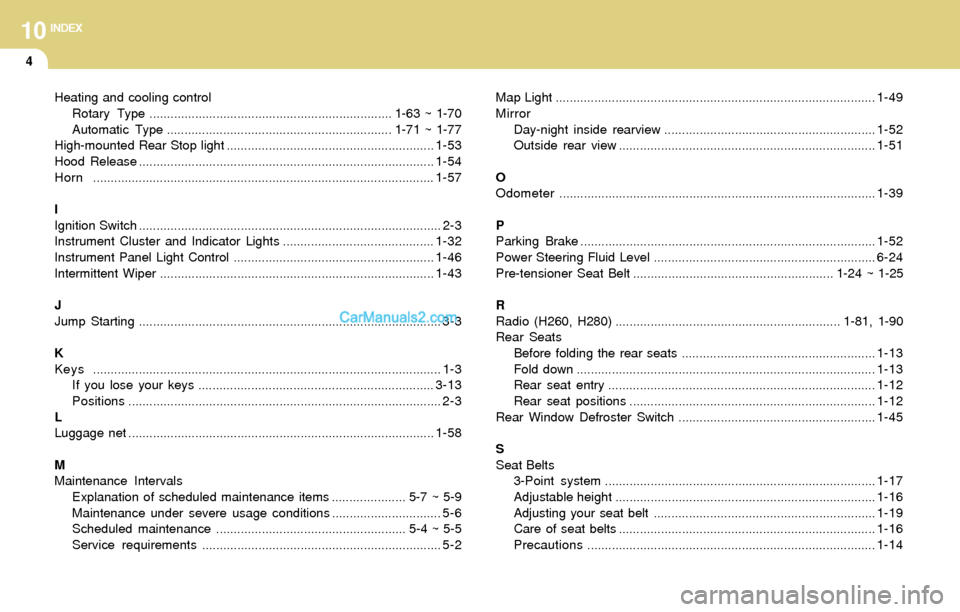
Heating and cooling control
Rotary Type..................................................................... 1-63 ~ 1-70
Automatic Type ................................................................ 1-71 ~ 1-77
High-mounted Rear Stop light ...........................................................1-53
Hood Release....................................................................................1-54
Horn.................................................................................................1-57
I
Ignition Switch ...................................................................................... 2-3
Instrument Cluster and Indicator Lights...........................................1-32
Instrument Panel Light Control .........................................................1-46
Intermittent Wiper..............................................................................1-43
J
Jump Starting...................................................................................... 3-3
K
Keys................................................................................................... 1-3
If you lose your keys ...................................................................3-13
Positions......................................................................................... 2-3
L
Luggage net.......................................................................................1-58
M
Maintenance Intervals
Explanation of scheduled maintenance items ..................... 5-7 ~ 5-9
Maintenance under severe usage conditions............................... 5-6
Scheduled maintenance...................................................... 5-4 ~ 5-5
Service requirements.................................................................... 5-2Map Light...........................................................................................1-49
Mirror
Day-night inside rearview ............................................................1-52
Outside rear view .........................................................................1-51
O
Odometer..........................................................................................1-39
P
Parking Brake....................................................................................1-52
Power Steering Fluid Level ...............................................................6-24
Pre-tensioner Seat Belt......................................................... 1-24 ~ 1-25
R
Radio (H260, H280)................................................................ 1-81, 1-90
Rear Seats
Before folding the rear seats .......................................................1-13
Fold down.....................................................................................1-13
Rear seat entry ............................................................................1-12
Rear seat positions......................................................................1-12
Rear Window Defroster Switch ........................................................1-45
S
Seat Belts
3-Point system.............................................................................1-17
Adjustable height..........................................................................1-16
Adjusting your seat belt ...............................................................1-19
Care of seat belts .........................................................................1-16
Precautions..................................................................................1-14