brake Hyundai Tiburon 2004 Service Manual
[x] Cancel search | Manufacturer: HYUNDAI, Model Year: 2004, Model line: Tiburon, Model: Hyundai Tiburon 2004Pages: 224, PDF Size: 18.86 MB
Page 172 of 224
6DO-IT-YOURSELF MAINTENANCE
6CHANGING THE OIL AND FILTER
!
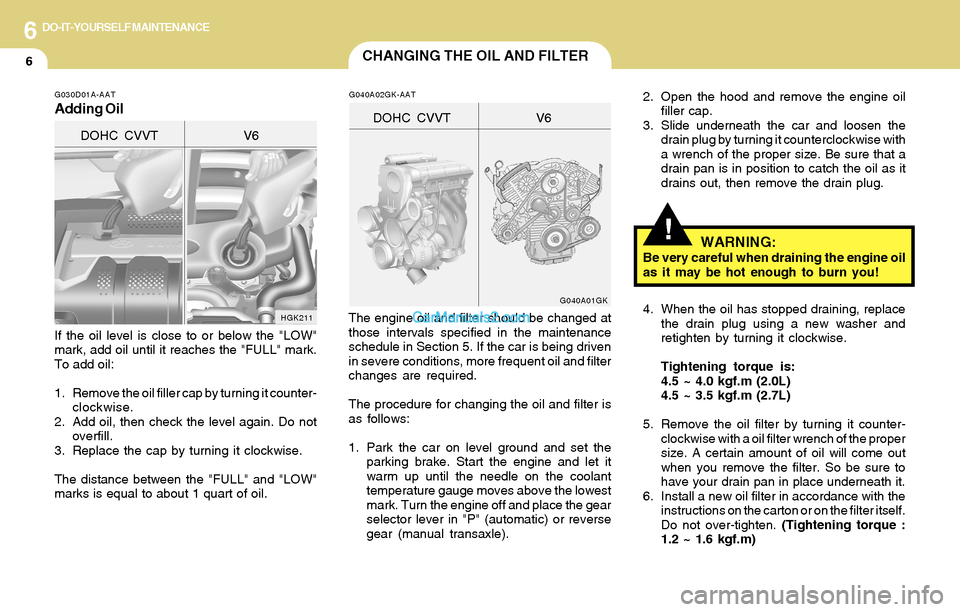
If the oil level is close to or below the "LOW"
mark, add oil until it reaches the "FULL" mark.
To add oil:
1. Remove the oil filler cap by turning it counter-
clockwise.
2. Add oil, then check the level again. Do not
overfill.
3. Replace the cap by turning it clockwise.
The distance between the "FULL" and "LOW"
marks is equal to about 1 quart of oil.
G040A02GK-AAT2. Open the hood and remove the engine oil
filler cap.
3. Slide underneath the car and loosen the
drain plug by turning it counterclockwise with
a wrench of the proper size. Be sure that a
drain pan is in position to catch the oil as it
drains out, then remove the drain plug.
G040A01GK
WARNING:Be very careful when draining the engine oil
as it may be hot enough to burn you!
G030D01A-AAT
Adding Oil
HGK211
DOHC CVVT V6
The engine oil and filter should be changed at
those intervals specified in the maintenance
schedule in Section 5. If the car is being driven
in severe conditions, more frequent oil and filter
changes are required.
The procedure for changing the oil and filter is
as follows:
1. Park the car on level ground and set the
parking brake. Start the engine and let it
warm up until the needle on the coolant
temperature gauge moves above the lowest
mark. Turn the engine off and place the gear
selector lever in "P" (automatic) or reverse
gear (manual transaxle).4. When the oil has stopped draining, replace
the drain plug using a new washer and
retighten by turning it clockwise.
Tightening torque is:
4.5 ~ 4.0 kgf.m (2.0L)
4.5 ~ 3.5 kgf.m (2.7L)
5. Remove the oil filter by turning it counter-
clockwise with a oil filter wrench of the proper
size. A certain amount of oil will come out
when you remove the filter. So be sure to
have your drain pan in place underneath it.
6. Install a new oil filter in accordance with the
instructions on the carton or on the filter itself.
Do not over-tighten. (Tightening torque :
1.2 ~ 1.6 kgf.m) DOHC CVVT V6
Page 174 of 224
6DO-IT-YOURSELF MAINTENANCE
8
G050C01A-AAT
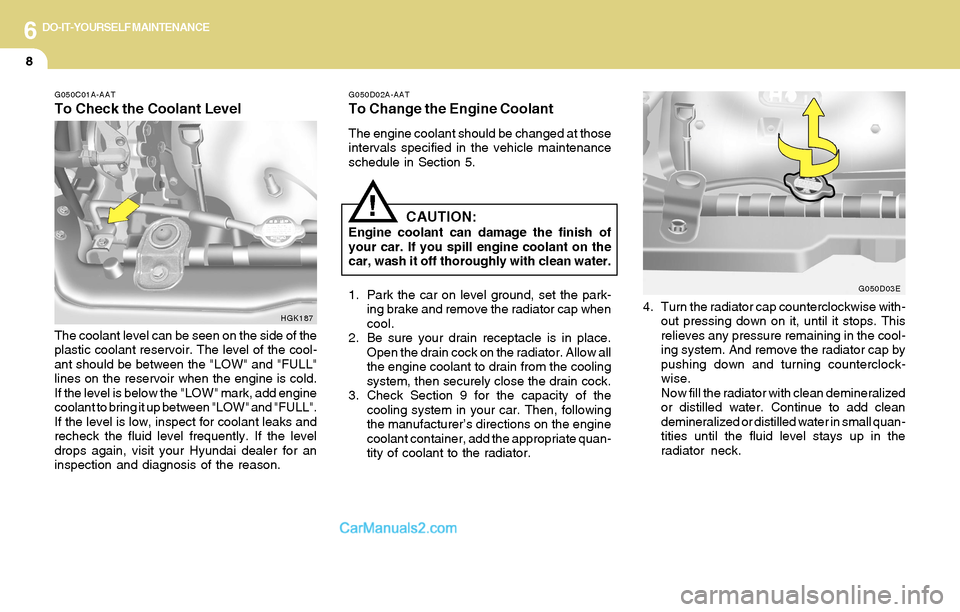
To Check the Coolant Level
G050D02A-AAT
To Change the Engine Coolant
The engine coolant should be changed at those
intervals specified in the vehicle maintenance
schedule in Section 5.
CAUTION:Engine coolant can damage the finish of
your car. If you spill engine coolant on the
car, wash it off thoroughly with clean water.
1. Park the car on level ground, set the park-
ing brake and remove the radiator cap when
cool.
2. Be sure your drain receptacle is in place.
Open the drain cock on the radiator. Allow all
the engine coolant to drain from the cooling
system, then securely close the drain cock.
3. Check Section 9 for the capacity of the
cooling system in your car. Then, following
the manufacturer’s directions on the engine
coolant container, add the appropriate quan-
tity of coolant to the radiator.
!
4. Turn the radiator cap counterclockwise with-
out pressing down on it, until it stops. This
relieves any pressure remaining in the cool-
ing system. And remove the radiator cap by
pushing down and turning counterclock-
wise.
Now fill the radiator with clean demineralized
or distilled water. Continue to add clean
demineralized or distilled water in small quan-
tities until the fluid level stays up in the
radiator neck.
G050D03E
The coolant level can be seen on the side of the
plastic coolant reservoir. The level of the cool-
ant should be between the "LOW" and "FULL"
lines on the reservoir when the engine is cold.
If the level is below the "LOW" mark, add engine
coolant to bring it up between "LOW" and "FULL".
If the level is low, inspect for coolant leaks and
recheck the fluid level frequently. If the level
drops again, visit your Hyundai dealer for an
inspection and diagnosis of the reason.
HGK187
Page 180 of 224
6DO-IT-YOURSELF MAINTENANCE
14
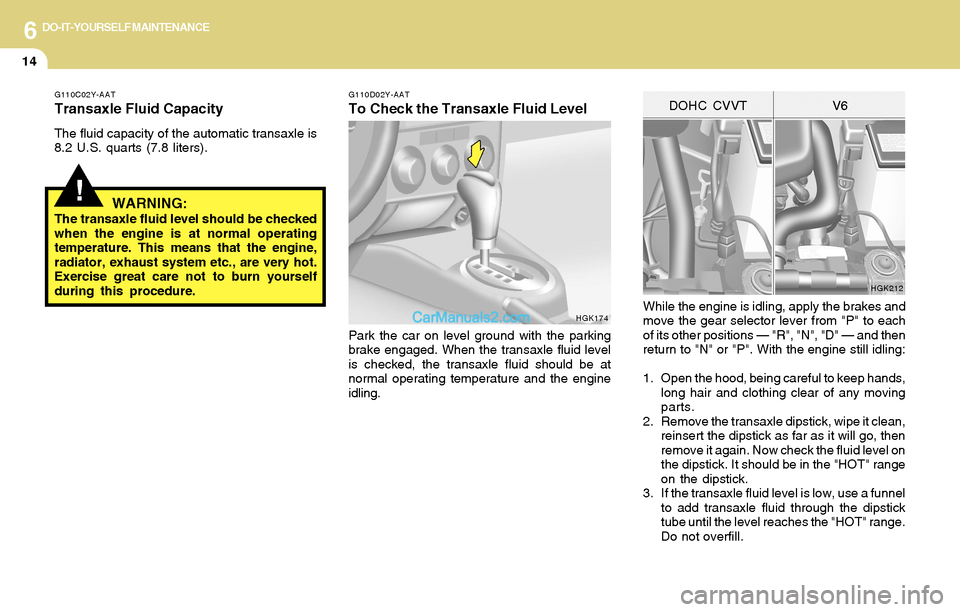
While the engine is idling, apply the brakes and
move the gear selector lever from "P" to each
of its other positions — "R", "N", "D" — and then
return to "N" or "P". With the engine still idling:
1. Open the hood, being careful to keep hands,
long hair and clothing clear of any moving
parts.
2. Remove the transaxle dipstick, wipe it clean,
reinsert the dipstick as far as it will go, then
remove it again. Now check the fluid level on
the dipstick. It should be in the "HOT" range
on the dipstick.
3. If the transaxle fluid level is low, use a funnel
to add transaxle fluid through the dipstick
tube until the level reaches the "HOT" range.
Do not overfill.
G110D02Y-AAT
To Check the Transaxle Fluid Level
Park the car on level ground with the parking
brake engaged. When the transaxle fluid level
is checked, the transaxle fluid should be at
normal operating temperature and the engine
idling.
HGK174HGK212
DOHC CVVT V6
!
G110C02Y-AAT
Transaxle Fluid Capacity
The fluid capacity of the automatic transaxle is
8.2 U.S. quarts (7.8 liters).
WARNING:The transaxle fluid level should be checked
when the engine is at normal operating
temperature. This means that the engine,
radiator, exhaust system etc., are very hot.
Exercise great care not to burn yourself
during this procedure.
Page 181 of 224
6DO-IT-YOURSELF MAINTENANCE
15
!WARNING:The cooling fan is controlled by engine
coolant temperature and may sometimes
operate even when the engine is not run-
ning. Use extreme caution when working
near the blades of the cooling fan, so that
you are not injured by a rotating fan blade.
As the engine coolant temperature de-
creases, the fan will automatically shut off.
This is a normal condition.
HGK249
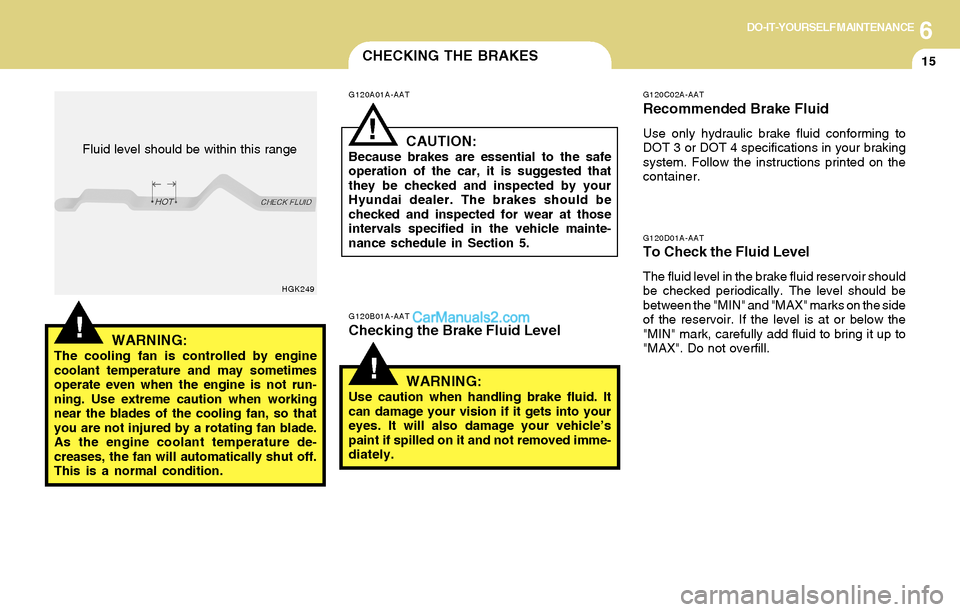
Fluid level should be within this range
CHECKING THE BRAKES
G120A01A-AAT
CAUTION:Because brakes are essential to the safe
operation of the car, it is suggested that
they be checked and inspected by your
Hyundai dealer. The brakes should be
checked and inspected for wear at those
intervals specified in the vehicle mainte-
nance schedule in Section 5.
!
!
G120B01A-AAT
Checking the Brake Fluid Level
WARNING:
Use caution when handling brake fluid. It
can damage your vision if it gets into your
eyes. It will also damage your vehicle’s
paint if spilled on it and not removed imme-
diately.
G120D01A-AATTo Check the Fluid Level
The fluid level in the brake fluid reservoir should
be checked periodically. The level should be
between the "MIN" and "MAX" marks on the side
of the reservoir. If the level is at or below the
"MIN" mark, carefully add fluid to bring it up to
"MAX". Do not overfill.
G120C02A-AAT
Recommended Brake Fluid
Use only hydraulic brake fluid conforming to
DOT 3 or DOT 4 specifications in your braking
system. Follow the instructions printed on the
container.
Page 182 of 224
6DO-IT-YOURSELF MAINTENANCE
16CHECKING THE CLUTCH FLUID
G130A01S-AAT
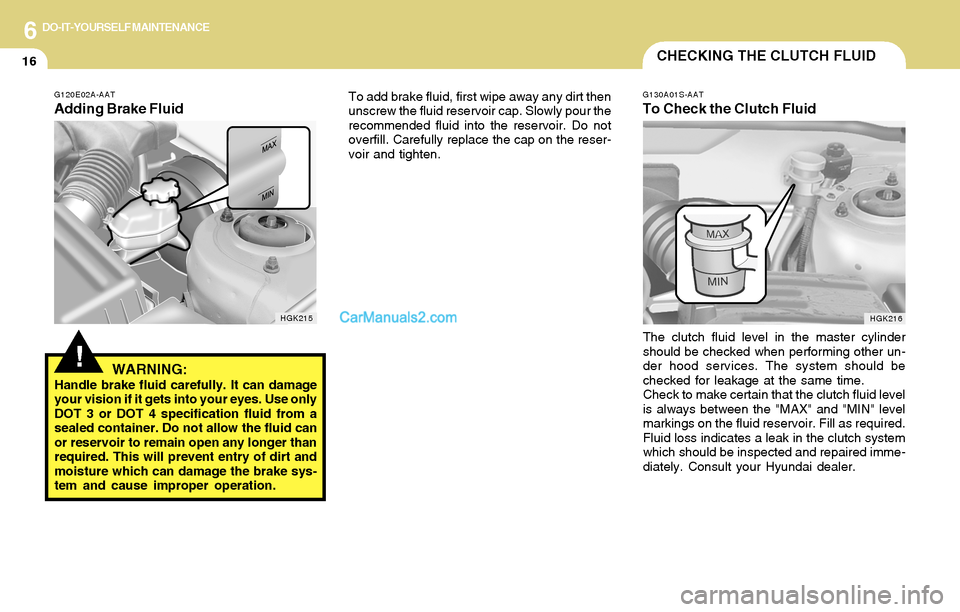
To Check the Clutch Fluid
The clutch fluid level in the master cylinder
should be checked when performing other un-
der hood services. The system should be
checked for leakage at the same time.
Check to make certain that the clutch fluid level
is always between the "MAX" and "MIN" level
markings on the fluid reservoir. Fill as required.
Fluid loss indicates a leak in the clutch system
which should be inspected and repaired imme-
diately. Consult your Hyundai dealer.
HGK216
To add brake fluid, first wipe away any dirt then
unscrew the fluid reservoir cap. Slowly pour the
recommended fluid into the reservoir. Do not
overfill. Carefully replace the cap on the reser-
voir and tighten.G120E02A-AAT
Adding Brake Fluid
HGK215
!WARNING:Handle brake fluid carefully. It can damage
your vision if it gets into your eyes. Use only
DOT 3 or DOT 4 specification fluid from a
sealed container. Do not allow the fluid can
or reservoir to remain open any longer than
required. This will prevent entry of dirt and
moisture which can damage the brake sys-
tem and cause improper operation.
Page 183 of 224
6DO-IT-YOURSELF MAINTENANCE
17
!
G130B02A-AAT
To Replace the Fluid
Recommended brake fluid conforming to DOT
3 or DOT 4 specification should be used. The
reservoir cap must be fully tightened to avoid
contamination from foreign matter or moisture.
NOTE:Do not allow any other liquids to contami-
nate the brake fluid. Seal damage will result.
WARNING:Use caution when handling brake fluid. It
can damage your vision if you get it in your
eyes. It will also damage your vehicle’s
paint if spilled on it and not removed imme-
diately.
AIR CONDITIONING CARE
G140A01A-AAT
Keeping the Condenser Clean
The air conditioning condenser (and engine
radiator) should be checked periodically for
accumulation of dirt, dead insects, leaves, etc.
These can interfere with maximum cooling ef-
ficiency. When removing such accumulations,
brush or hose them away carefully to avoid
bending the cooling fins.
!
G140C01A-AATLubrication
To lubricate the compressor and the seals in the
system, the air conditioning should be run for at
least 10 minutes each week. This is particularly
important during cool weather when the air
conditioning system is not otherwise in use.
G140B01A-AAT
Checking the Air Conditioning Opera-
tion
1. Start the engine and let it run at a fast idle for
several minutes with the air conditioning set
at the maximum cold setting.
2. If the air coming out of the in-dash vents is
not cold, have the air conditioning system
inspected by your Hyundai dealer.
CAUTION:Running the air conditioning system for
extended periods of time with a low refrig-
erant level may damage the compressor.
Page 186 of 224
6DO-IT-YOURSELF MAINTENANCE
20CHECKING DRIVE BELTS
G180A01A-AAT
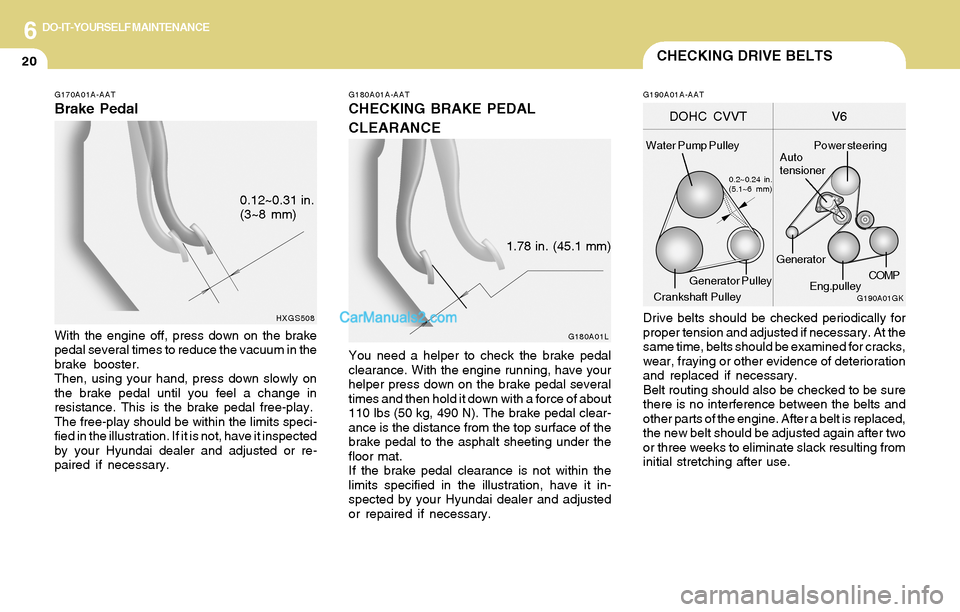
CHECKING BRAKE PEDAL
CLEARANCE
You need a helper to check the brake pedal
clearance. With the engine running, have your
helper press down on the brake pedal several
times and then hold it down with a force of about
110 lbs (50 kg, 490 N). The brake pedal clear-
ance is the distance from the top surface of the
brake pedal to the asphalt sheeting under the
floor mat.
If the brake pedal clearance is not within the
limits specified in the illustration, have it in-
spected by your Hyundai dealer and adjusted
or repaired if necessary.
G180A01L
1.78 in. (45.1 mm)
Drive belts should be checked periodically for
proper tension and adjusted if necessary. At the
same time, belts should be examined for cracks,
wear, fraying or other evidence of deterioration
and replaced if necessary.
Belt routing should also be checked to be sure
there is no interference between the belts and
other parts of the engine. After a belt is replaced,
the new belt should be adjusted again after two
or three weeks to eliminate slack resulting from
initial stretching after use.
G190A01A-AAT
G190A01GK
DOHC CVVT V6
Water Pump Pulley
0.2~0.24 in.
(5.1~6 mm)
Power steering
COMP
Auto
tensioner
Generator Pulley
Crankshaft PulleyGenerator
Eng.pulley
G170A01A-AAT
Brake Pedal
With the engine off, press down on the brake
pedal several times to reduce the vacuum in the
brake booster.
Then, using your hand, press down slowly on
the brake pedal until you feel a change in
resistance. This is the brake pedal free-play.
The free-play should be within the limits speci-
fied in the illustration. If it is not, have it inspected
by your Hyundai dealer and adjusted or re-
paired if necessary.
HXGS508
0.12~0.31 in.
(3~8 mm)
Page 216 of 224
9VEHICLE SPECIFICATIONS
2
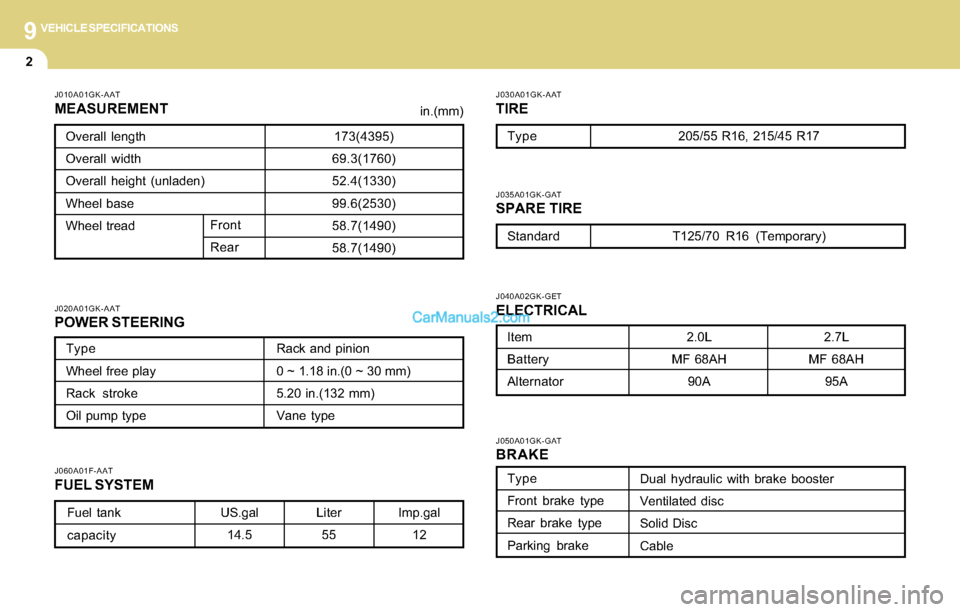
J050A01GK-GATBRAKE
J040A02GK-GET
ELECTRICAL
J030A01GK-AAT
TIRE
J060A01F-AATFUEL SYSTEM
J020A01GK-AATPOWER STEERING
J010A01GK-AAT
MEASUREMENT
173(4395)
69.3(1760)
52.4(1330)
99.6(2530)
58.7(1490)
58.7(1490) Overall length
Overall width
Overall height (unladen)
Wheel base
Wheel tread
Front
Rear
Type
Wheel free play
Rack stroke
Oil pump typeRack and pinion
0 ~ 1.18 in.(0 ~ 30 mm)
5.20 in.(132 mm)
Vane type
Liter
55Fuel tank
capacity
Type205/55 R16, 215/45 R17
Item
Battery
Alternator
US.gal
14.5
in.(mm)
Imp.gal
12
J035A01GK-GATSPARE TIRE
StandardT125/70 R16 (Temporary)
2.0L
MF 68AH
90A2.7L
MF 68AH
95A
Type
Front brake type
Rear brake type
Parking brake
Dual hydraulic with brake booster
Ventilated disc
Solid Disc
Cable
Page 218 of 224
9VEHICLE SPECIFICATIONS
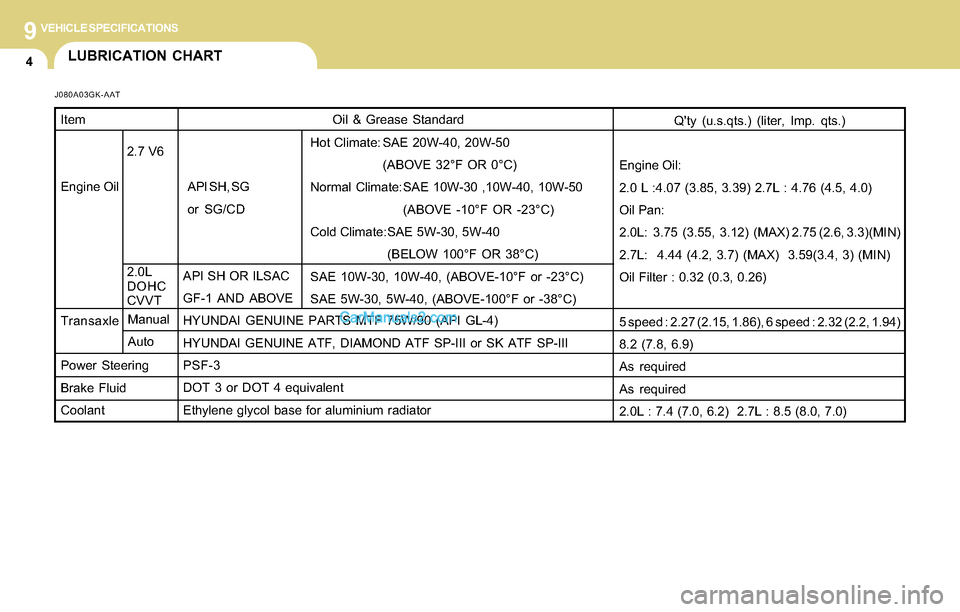
4LUBRICATION CHART
J080A03GK-AAT
Oil & Grease Standard
API SH OR ILSAC
GF-1 AND ABOVE
HYUNDAI GENUINE PARTS MTF 75W/90 (API GL-4)
HYUNDAI GENUINE ATF, DIAMOND ATF SP-III or SK ATF SP-III
PSF-3
DOT 3 or DOT 4 equivalent
Ethylene glycol base for aluminium radiatorAPI SH, SG
or SG/CDHot Climate: SAE 20W-40, 20W-50
(ABOVE 32°F OR 0°C)
Normal Climate: SAE 10W-30 ,10W-40, 10W-50
(ABOVE -10°F OR -23°C)
Cold Climate:SAE 5W-30, 5W-40
(BELOW 100°F OR 38°C)
SAE 10W-30, 10W-40, (ABOVE-10°F or -23°C)
SAE 5W-30, 5W-40, (ABOVE-100°F or -38°C)Item
Engine Oil
Transaxle
Power Steering
Brake Fluid
Coolant
Manual
Auto
Q'ty (u.s.qts.) (liter, Imp. qts.)
Engine Oil:
2.0 L :4.07 (3.85, 3.39) 2.7L : 4.76 (4.5, 4.0)
Oil Pan:
2.0L: 3.75 (3.55, 3.12) (MAX) 2.75 (2.6, 3.3)(MIN)
2.7L: 4.44 (4.2, 3.7) (MAX) 3.59(3.4, 3) (MIN)
Oil Filter : 0.32 (0.3, 0.26)
5 speed : 2.27 (2.15, 1.86), 6 speed : 2.32 (2.2, 1.94)
8.2 (7.8, 6.9)
As required
As required
2.0L : 7.4 (7.0, 6.2) 2.7L : 8.5 (8.0, 7.0)
2.0L
DOHC
CVVT 2.7 V6
Page 220 of 224
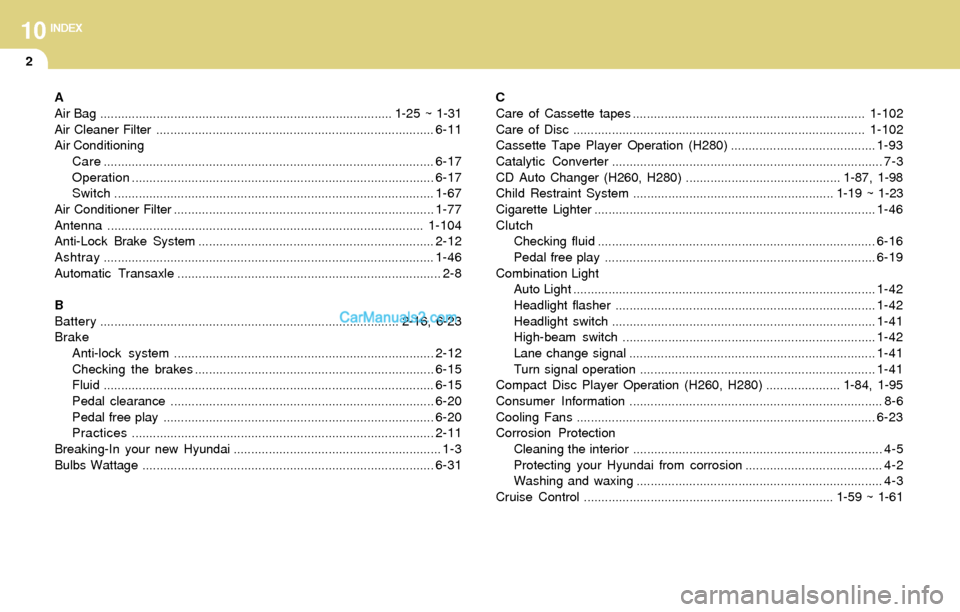
10INDEX
2
A
Air Bag................................................................................... 1-25 ~ 1-31
Air Cleaner Filter ...............................................................................6-11
Air Conditioning
Care..............................................................................................6-17
Operation......................................................................................6-17
Switch...........................................................................................1-67
Air Conditioner Filter ..........................................................................1-77
Antenna..........................................................................................1-104
Anti-Lock Brake System ...................................................................2-12
Ashtray..............................................................................................1-46
Automatic Transaxle........................................................................... 2-8
B
Battery..................................................................................... 2-16, 6-23
Brake
Anti-lock system..........................................................................2-12
Checking the brakes ....................................................................6-15
Fluid ..............................................................................................6-15
Pedal clearance...........................................................................6-20
Pedal free play .............................................................................6-20
Practices......................................................................................2-11
Breaking-In your new Hyundai ........................................................... 1-3
Bulbs Wattage...................................................................................6-31C
Care of Cassette tapes ..................................................................1-102
Care of Disc ...................................................................................1-102
Cassette Tape Player Operation (H280) .........................................1-93
Catalytic Converter............................................................................. 7-3
CD Auto Changer (H260, H280)............................................ 1-87, 1-98
Child Restraint System......................................................... 1-19 ~ 1-23
Cigarette Lighter................................................................................1-46
Clutch
Checking fluid...............................................................................6-16
Pedal free play .............................................................................6-19
Combination Light
Auto Light......................................................................................1-42
Headlight flasher..........................................................................1-42
Headlight switch...........................................................................1-41
High-beam switch........................................................................1-42
Lane change signal ......................................................................1-41
Turn signal operation...................................................................1-41
Compact Disc Player Operation (H260, H280) ..................... 1-84, 1-95
Consumer Information........................................................................ 8-6
Cooling Fans.....................................................................................6-23
Corrosion Protection
Cleaning the interior....................................................................... 4-5
Protecting your Hyundai from corrosion....................................... 4-2
Washing and waxing...................................................................... 4-3
Cruise Control....................................................................... 1-59 ~ 1-61