airbag Hyundai Tiburon 2005 Owner's Manual
[x] Cancel search | Manufacturer: HYUNDAI, Model Year: 2005, Model line: Tiburon, Model: Hyundai Tiburon 2005Pages: 262, PDF Size: 11.12 MB
Page 10 of 262
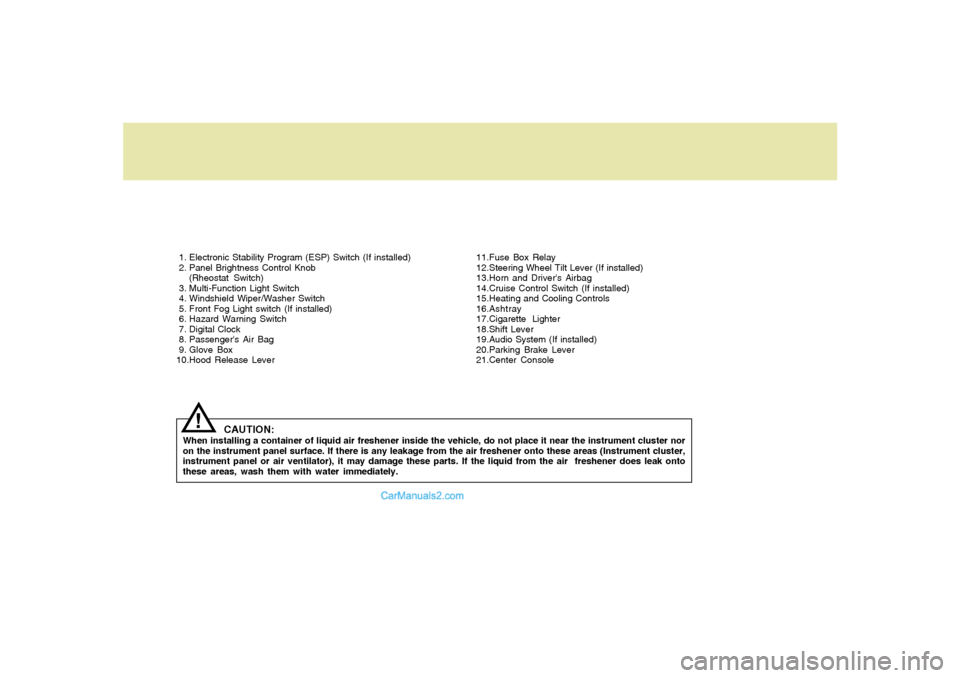
1. Electronic Stability Program (ESP) Switch (If installed)
2. Panel Brightness Control Knob
(Rheostat Switch)
3. Multi-Function Light Switch
4. Windshield Wiper/Washer Switch
5. Front Fog Light switch (If installed)
6. Hazard Warning Switch
7. Digital Clock
8. Passenger's Air Bag
9. Glove Box
10.Hood Release Lever11.Fuse Box Relay
12.Steering Wheel Tilt Lever (If installed)
13.Horn and Driver's Airbag
14.Cruise Control Switch (If installed)
15.Heating and Cooling Controls
16.Ashtray
17.Cigarette Lighter
18.Shift Lever
19.Audio System (If installed)
20.Parking Brake Lever
21.Center Console
CAUTION:
When installing a container of liquid air freshener inside the vehicle, do not place it near the instrument cluster nor
on the instrument panel surface. If there is any leakage from the air freshener onto these areas (Instrument cluster,
instrument panel or air ventilator), it may damage these parts. If the liquid from the air freshener does leak onto
these areas, wash them with water immediately.
!
Page 11 of 262
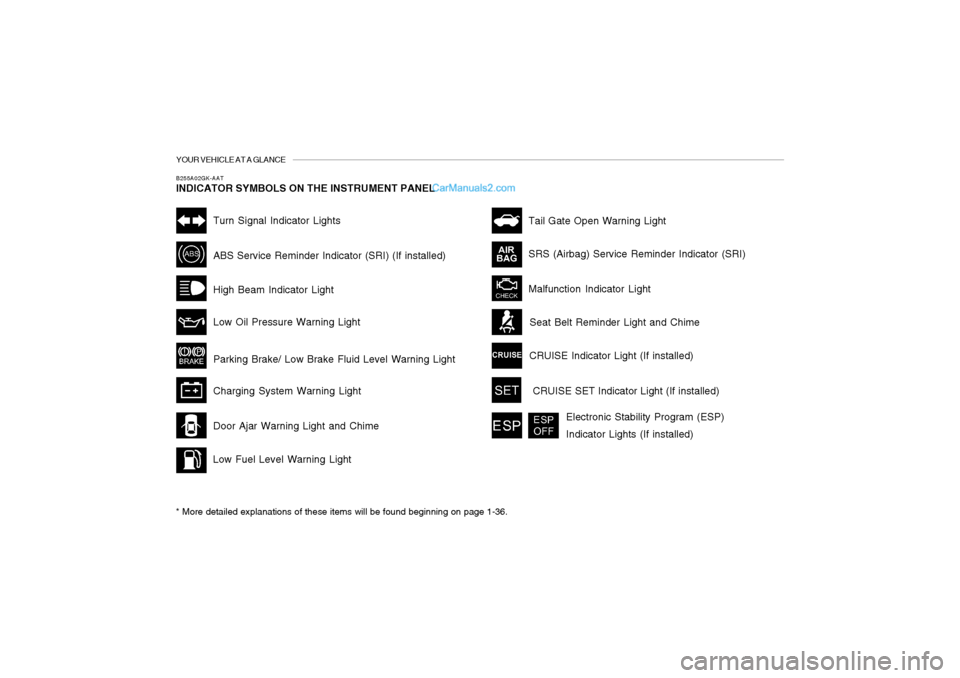
YOUR VEHICLE AT A GLANCEB255A02GK-AATINDICATOR SYMBOLS ON THE INSTRUMENT PANEL* More detailed explanations of these items will be found beginning on page 1-36.
Malfunction Indicator LightSRS (Airbag) Service Reminder Indicator (SRI) Tail Gate Open Warning Light
Low Fuel Level Warning LightDoor Ajar Warning Light and ChimeABS Service Reminder Indicator (SRI) (If installed)Turn Signal Indicator LightsHigh Beam Indicator Light
Low Oil Pressure Warning Light
Parking Brake/ Low Brake Fluid Level Warning Light
Charging System Warning LightCRUISE Indicator Light (If installed)
Seat Belt Reminder Light and Chime
CRUISE SET Indicator Light (If installed)
Electronic Stability Program (ESP)
Indicator Lights (If installed)
Page 12 of 262
FEATURES OF YOUR HYUNDAI
1
Fuel Recommendations ................................................ 1-2
Breaking in Your New Hyundai ..................................... 1-3
Keys.............................................................................. 1-3
Door (Teft-Alarm System) ...................................... 1-4, 1-6
Power Windows ............................................................ 1-8
Seats ............................................................................. 1-9
Seat Belts....................................................................1-14
Child Restraint System ...............................................1-20
Supplemental Restraint (AIRBAG) System (SRS) .....1-26
Instrument Cluster and Indicator Lights...................... 1-34
Warning and Indicator Lights......................................1-36
Multi-Function Light Switch .........................................1-45
Windshield Wiper/Washer Switch...............................1-47
Sunroof.......................................................................1-53
Mirror...........................................................................1-56
Hood Release .............................................................1-59
Cruise Control.............................................................1-65
Audio Remote Control Switch .....................................1-67
Heating and Cooling Control .......................................1-69
Stereo Sound System.................................................1-86
Audio System..............................................................1-88
Antenna.....................................................................1-125
1
Page 21 of 262
1FEATURES OF YOUR HYUNDAI10
!
WARNING:
To minimize risk of severe injury in the
event of a collision or a sudden stop, both
the driver's and passenger's seatbacks
should always be in an upright position
while the vehicle is in motion. The protec-
tion provided by the seat belts and airbags
in a frontal collision may be reduced signifi-
cantly when the seatbacks are reclined.
There is greater risk that the driver and
passenger will slide under the seatbelt which
may result in serious injury if a crash occurs
when the seatbacks are reclined. The seat
belt and airbags cannot provide proper
protection to an occupant if the seatback is
reclined.
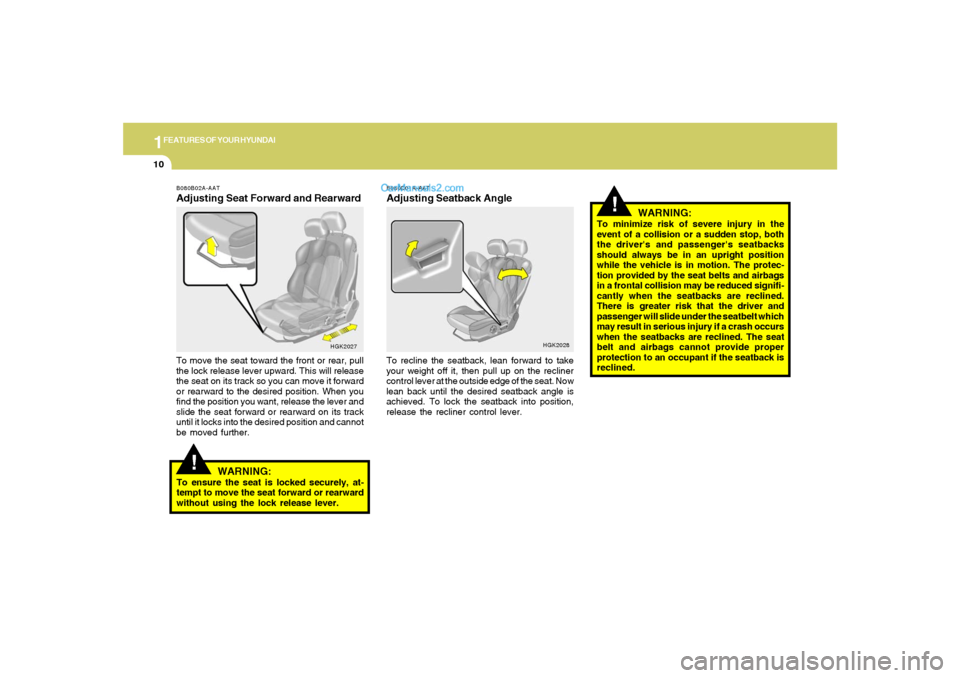
B080C01A-AATAdjusting Seatback AngleTo recline the seatback, lean forward to take
your weight off it, then pull up on the recliner
control lever at the outside edge of the seat. Now
lean back until the desired seatback angle is
achieved. To lock the seatback into position,
release the recliner control lever.
HGK2028
!
B080B02A-AATAdjusting Seat Forward and RearwardTo move the seat toward the front or rear, pull
the lock release lever upward. This will release
the seat on its track so you can move it forward
or rearward to the desired position. When you
find the position you want, release the lever and
slide the seat forward or rearward on its track
until it locks into the desired position and cannot
be moved further.
HGK2027
WARNING:
To ensure the seat is locked securely, at-
tempt to move the seat forward or rearward
without using the lock release lever.
Page 25 of 262
1FEATURES OF YOUR HYUNDAI14
!SEAT BELTSB150A01S-AATSEAT BELT PRECAUTIONS
WARNING:All occupants of the vehicle must wear their
seat belts at all times. Note that this vehicle
is equipped with a Supplemental Restraint
(Airbag) System as discussed beginning
on page 1-26. The seat belts must be used
in conjunction with the supplemental
airbag system. State laws may require that
some or all occupants of the vehicle use
seat belts. The possibility of increased in-
jury or severity of injury in an accident will
be increased if this elementary safety pre-
caution is not observed. In addition, follow
the other instructions provided in this sec-
tion.
!
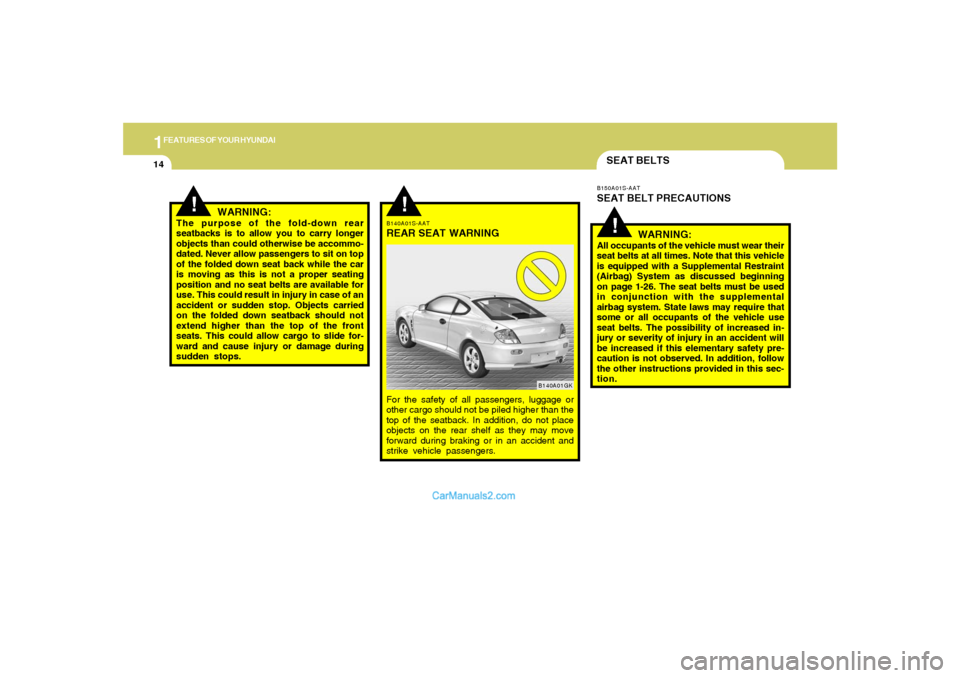
B140A01S-AATREAR SEAT WARNINGFor the safety of all passengers, luggage or
other cargo should not be piled higher than the
top of the seatback. In addition, do not place
objects on the rear shelf as they may move
forward during braking or in an accident and
strike vehicle passengers.
B140A01GK
!
WARNING:
The purpose of the fold-down rear
seatbacks is to allow you to carry longer
objects than could otherwise be accommo-
dated. Never allow passengers to sit on top
of the folded down seat back while the car
is moving as this is not a proper seating
position and no seat belts are available for
use. This could result in injury in case of an
accident or sudden stop. Objects carried
on the folded down seatback should not
extend higher than the top of the front
seats. This could allow cargo to slide for-
ward and cause injury or damage during
sudden stops.
Page 31 of 262
1FEATURES OF YOUR HYUNDAI20
!
o Always make sure that the shoulder belt
portion of the lap/shoulder belt is posi-
tioned midway over the shoulder, never
across the neck or behind the back.
Moving the child closer toward the seat
belt buckle may help provide a good
shoulder belt fit. The lap belt portion of
the lap/shoulder belt or the center seat
lap belt must always be positioned as
low as possible on the child's hips and
as snug as possible.
o If the seat belt will not properly fit the
child, Hyundai recommends the use of
an approved booster seat in the rear seat
in order to raise the child's seating height
so that the seat belt will properly fit the
child. Before purchasing a booster seat,
make sure that it meets applicable Fed-
eral Motor Vehicle Safety Standards
(FMVSS) and that it is satisfactory for
use with this vehicle.
o Never allow a child to stand up or kneel
on the seat.
o Never use an infant carrier or child safety
seat that "hooks" over a seatback; it may
not provide adequate security in an ac-
cident.
WARNING:
!
WARNING:
o A child restraint system must be placed
in the rear seat. Never install a child or
infant seat on the front passenger's seat.
Should an accident occur and cause the
passenger side airbag to deploy, it could
severely injure or kill an infant or child
seated in an infant or child seat. Thus,
only use a child restraint in the rear seat
of your vehicle.
o A safety belt or child restraint system
can become very hot if it is left in a closed
vehicle on a sunny day, even if the out-
side temperature does not feel hot. Be
sure to check the seat cover and buckles
before placing a child there.
o When the child restraint system is not in
use, store it in the trunk or fasten it with
a safety belt so that it will not be thrown
forward in the case of a sudden stop or
an accident.
o Children who are too large to be in a child
restraint should still sit in the rear seat
and be restrained with the available lap/
shoulder belts. Never allow children to
ride in the front passenger seat.
CHILD RESTRAINT SYSTEMB230A03A-AATChildren riding in the car should sit in the rear
seat and must always be properly restrained to
minimize the risk of injury in an accident, sudden
stop or sudden maneuver. According to acci-
dent statistics provided by the National High-
way Traffic Safety Administration (NHTSA),
children are safer when properly restrained in
the rear seats than in the front seat. Larger
children not in a child restraint should use one
of the seat belts provided.
All 50 states have child restraint laws. You
should be aware of the specific requirements in
your state. Child and/or infant safety seats must
be properly placed and installed in the rear seat.
You must use a commercially available child
restraint system that meets the requirements of
the Federal Motor Vehicle Safety Standards
(FMVSS).
Children could be injured or killed in a crash if
their restraints are not properly secured. For
small children and babies, a child seat or infant
seat must be used. Before buying a particular
child restraint system, make sure it fits your car
and seat belts, and fits your child. Follow all the
instructions provided by the manufacturer when
installing the child restraint system.
Page 35 of 262
1FEATURES OF YOUR HYUNDAI24
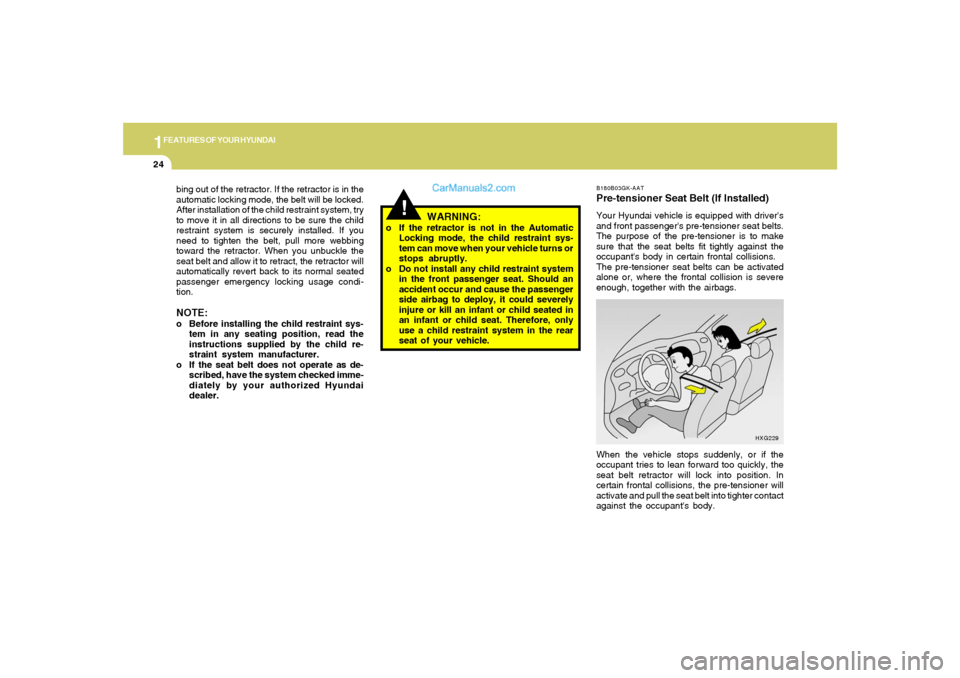
B180B03GK-AATPre-tensioner Seat Belt (If Installed)Your Hyundai vehicle is equipped with driver's
and front passenger's pre-tensioner seat belts.
The purpose of the pre-tensioner is to make
sure that the seat belts fit tightly against the
occupant's body in certain frontal collisions.
The pre-tensioner seat belts can be activated
alone or, where the frontal collision is severe
enough, together with the airbags.
When the vehicle stops suddenly, or if the
occupant tries to lean forward too quickly, the
seat belt retractor will lock into position. In
certain frontal collisions, the pre-tensioner will
activate and pull the seat belt into tighter contact
against the occupant's body.
HXG229
!
WARNING:
o If the retractor is not in the Automatic
Locking mode, the child restraint sys-
tem can move when your vehicle turns or
stops abruptly.
o Do not install any child restraint system
in the front passenger seat. Should an
accident occur and cause the passenger
side airbag to deploy, it could severely
injure or kill an infant or child seated in
an infant or child seat. Therefore, only
use a child restraint system in the rear
seat of your vehicle. bing out of the retractor. If the retractor is in the
automatic locking mode, the belt will be locked.
After installation of the child restraint system, try
to move it in all directions to be sure the child
restraint system is securely installed. If you
need to tighten the belt, pull more webbing
toward the retractor. When you unbuckle the
seat belt and allow it to retract, the retractor will
automatically revert back to its normal seated
passenger emergency locking usage condi-
tion.
NOTE:o Before installing the child restraint sys-
tem in any seating position, read the
instructions supplied by the child re-
straint system manufacturer.
o If the seat belt does not operate as de-
scribed, have the system checked imme-
diately by your authorized Hyundai
dealer.
Page 36 of 262
1
FEATURES OF YOUR HYUNDAI
25
NOTE:o Both the driver's and front passenger's
pre-tensioner seat belts will be activated
in certain frontal collisions. The pre-
tensioner seat belts can be activated
alone or, where the frontal collision is
severe enough, together with the
airbags.
o When the pre-tensioner seat belts are
activated, a loud noise may be heard and
fine dust, which may appear to be smoke,
may be visible in the passenger com-
partment. These are normal operating
conditions and are not hazardous.
o Although it is harmless, the fine dust
may cause skin irritation and should not
be breathed for prolonged periods. Wash
all exposed skin areas thoroughly after
an accident in which the pre-tensioner
seat belts were activated.
!
WARNING:
To obtain maximum benefit from a pre-
tensioner seat belt:
1. The seat belt must be worn correctly.
2. The seat belt must be adjusted to the
correct position.
CAUTION:
o The sensor that activates the SRS airbag
is connected with the pre-tensioner seat
belts. The SRS airbag warning light on
the instrument panel will illuminate for
approximately 6 seconds after the igni-
tion key has been turned to the "ON"
position, and then it should turn off.
o If the pre-tensioner seat belt is not work-
ing properly, this warning light will illu-
minate even if there is no malfunction of
the SRS airbag system. If the SRS airbag
warning light does not illuminate when
the ignition key is turned to "ON" or if it
remains illuminated after approximately
6 seconds, or if it illuminates while the
vehicle is being driven, please have an
authorized Hyundai dealer inspect the
pre-tensioner seat belts and SRS airbag
system as soon as possible.
!
AIR
BAG
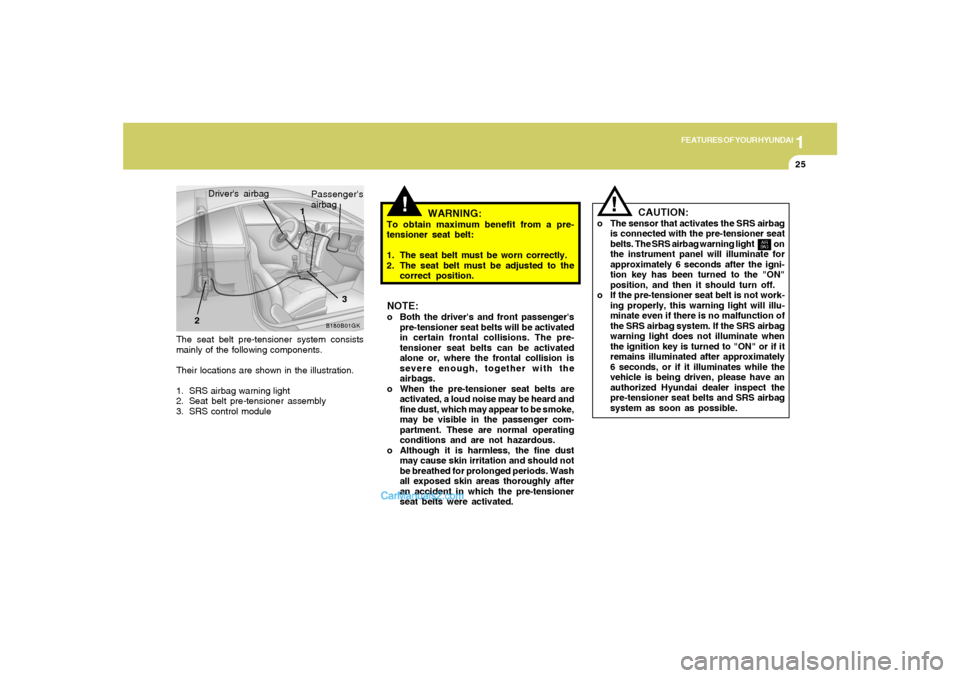
The seat belt pre-tensioner system consists
mainly of the following components.
Their locations are shown in the illustration.
1. SRS airbag warning light
2. Seat belt pre-tensioner assembly
3. SRS control moduleDriver's airbag
B180B01GK
23 Passenger's
airbag
1
Page 37 of 262
1FEATURES OF YOUR HYUNDAI26
!
NOTE:o Be sure to read information about the
SRS on the labels provided on the front
of the sun visor and in the glove box.
o If you are considering modification of
your vehicle due to a disability, please
contact the Hyundai Customer Assis-
tance Center at 1-800-633-5151.
WARNING:
o As its name implies, the SRS is designed
to work with, and be supplemental to,
the driver's and the passenger's three
point seat belt systems and is not a
substitute for them. Therefore, your seat
belts must be worn at all times while the
vehicle is in motion. The airbags deploy
only in certain frontal impact conditions
severe enough to cause significant in-
jury to the vehicle occupants.
o The SRS is designed to deploy the
airbags only when an impact is suffi-
ciently severe and when the impact angle
is less than 30° from the forward longi-
tudinal axis of the vehicle and will not
deploy in side, rear or rollover impacts.
Additionally, the airbags will only de-
ploy once. Thus, seat belts must be worn
at all times.
o Front airbags are not intended to deploy
in light collisions in which protection
can be provided by the seat belt alone.
SUPPLEMENTAL RESTRAINT
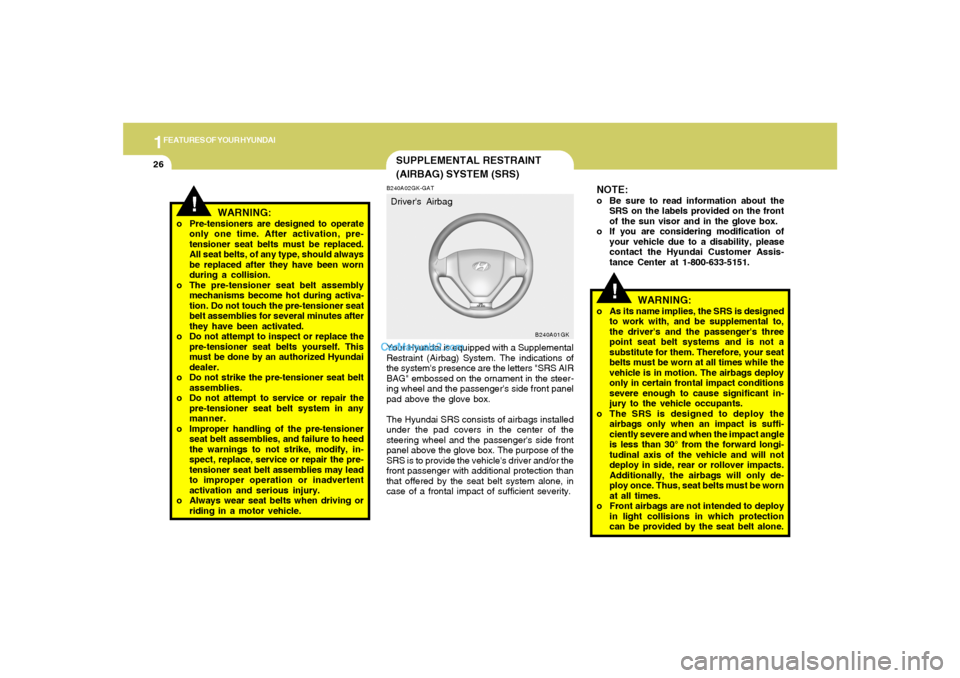
(AIRBAG) SYSTEM (SRS)B240A02GK-GATYour Hyundai is equipped with a Supplemental
Restraint (Airbag) System. The indications of
the system's presence are the letters "SRS AIR
BAG" embossed on the ornament in the steer-
ing wheel and the passenger's side front panel
pad above the glove box.
The Hyundai SRS consists of airbags installed
under the pad covers in the center of the
steering wheel and the passenger's side front
panel above the glove box. The purpose of the
SRS is to provide the vehicle's driver and/or the
front passenger with additional protection than
that offered by the seat belt system alone, in
case of a frontal impact of sufficient severity.
B240A01GK
Driver's Airbag
!
WARNING:
o Pre-tensioners are designed to operate
only one time. After activation, pre-
tensioner seat belts must be replaced.
All seat belts, of any type, should always
be replaced after they have been worn
during a collision.
o The pre-tensioner seat belt assembly
mechanisms become hot during activa-
tion. Do not touch the pre-tensioner seat
belt assemblies for several minutes after
they have been activated.
o Do not attempt to inspect or replace the
pre-tensioner seat belts yourself. This
must be done by an authorized Hyundai
dealer.
o Do not strike the pre-tensioner seat belt
assemblies.
o Do not attempt to service or repair the
pre-tensioner seat belt system in any
manner.
o Improper handling of the pre-tensioner
seat belt assemblies, and failure to heed
the warnings to not strike, modify, in-
spect, replace, service or repair the pre-
tensioner seat belt assemblies may lead
to improper operation or inadvertent
activation and serious injury.
o Always wear seat belts when driving or
riding in a motor vehicle.
Page 38 of 262
1
FEATURES OF YOUR HYUNDAI
27
o No objects should be placed over or near
the airbag modules on the steering
wheel, instrument panel, and the front
passenger's panel above the glove box,
because any such object could cause
harm if the vehicle is in a crash severe
enough to cause the airbags to deploy.
o If the airbags deploy, they must be re-
placed by an authorized Hyundai dealer.
o Do not tamper with or disconnect SRS
wiring, or other components of the SRS
system. Doing so could result in injury,
due to accidental firing of the airbags or
by rendering the SRS inoperative.
o Do not install a child restraint system in
the front passenger seat position. A
child restraint system must never be
placed in the front seat. The infant or
child could be severely injured or killed
by an airbag deployment in case of an
accident.
o Do not allow children to ride in the front
passenger seat. If older children (teen-
agers and older) must ride in the front
seat, make sure they are always properly
belted and that the seat is moved back as
far as possible.
!
WARNING:
!
o For maximum safety protection in all
types of crashes, all occupants includ-
ing the driver should always wear their
seat belts whether or not an airbag is
also provided at their seating position to
minimize the risk of severe injury or
death in the event of a crash. Do not sit
or lean unnecessarily close to the airbag
while the vehicle is in motion.
o The SRS airbag system must deploy very
rapidly to provide protection in a crash.
If an occupant is out of position because
of not wearing a seat belt, the airbag may
forcefully contact the occupant causing
serious or fatal injuries.
WARNING:
!
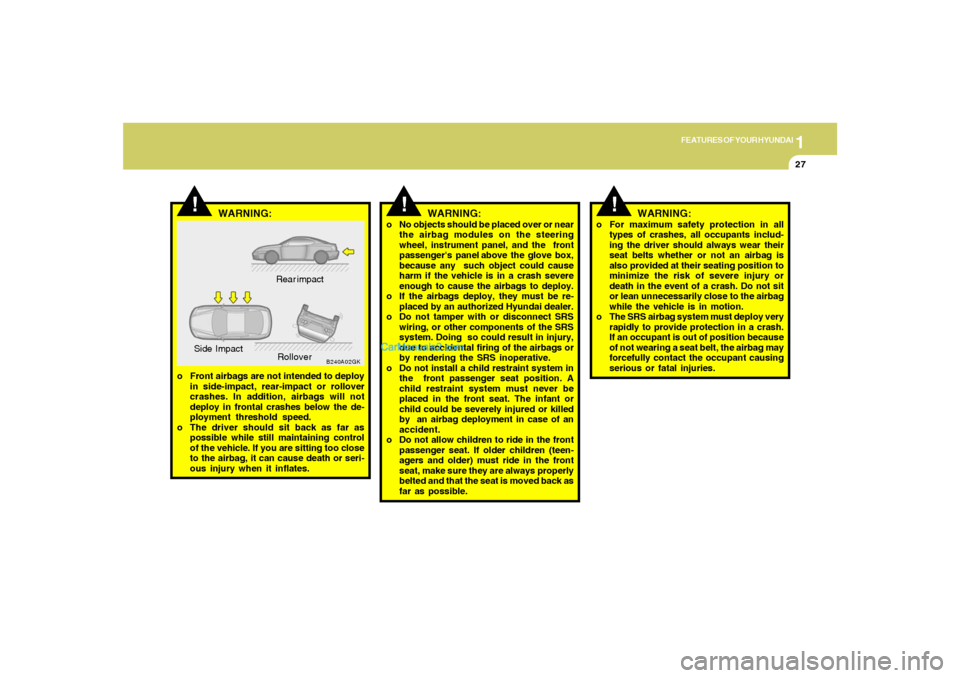
o Front airbags are not intended to deploy
in side-impact, rear-impact or rollover
crashes. In addition, airbags will not
deploy in frontal crashes below the de-
ployment threshold speed.
o The driver should sit back as far as
possible while still maintaining control
of the vehicle. If you are sitting too close
to the airbag, it can cause death or seri-
ous injury when it inflates.
WARNING:
Rear impact
B240A02GK
Side Impact
Rollover