airbag Hyundai Tiburon 2007 Owner's Manual
[x] Cancel search | Manufacturer: HYUNDAI, Model Year: 2007, Model line: Tiburon, Model: Hyundai Tiburon 2007Pages: 269, PDF Size: 10.37 MB
Page 6 of 269
A110A01A-AAT
VEHICLE DATA COLLECTION AND EVENT DATA RECORDERS
Your Hyundai vehicle is equipped with many high technology, electronically controlled systems that
help to ensure your vehicle operates properly and provides the performance that you expect. These
systems utilize computers to monitor the operation of various systems and components and help to
control their operation. These computerized system operations are wide-ranging and involve
components to reduce emissions, to continuously evaluate the readiness of the airbag and seat belt
pretensioner systems, to determine when the airbag and seat belt pre-tensioner systems should be
deployed and then to activate the deployment, and if equipped, to operate anti-lock braking, traction
control and electrical stability control to assist the driver to control the vehicle in difficult driving
situations. These systems electronically store information that is useful to service technicians when
they need to diagnose and repair these systems. Additional information is stored only when a crash
occurs that results in the deployment of the airbags or seat belt pre-tensioners. This type of data storage
is done by devices called event data recorders (EDR).
After a crash event, the airbag and seat belt pre-tensioner computer system, known as the Supplemental
Restraint System Control Module (SRSCM) or Airbag Control Unit (ACU), may record some information
about the condition of the vehicle and how it was being operated. This information consists of data
related to seat belt usage and if there was diagnostic information in the airbag or seat belt systems
at the time that a crash occurred, and if the ACU sensed that a crash of sufficient severity occurred to
require seat belt pre-tensioner or airbag deployment.
To retrieve this information, special equipment is needed and access to the vehicle or the device that
stores the data is required. Hyundai will not access information about a crash event or share it with
others except:
o in response to an official request of police or similar government office, or
o with the consent of the vehicle owner or, if the vehicle is leased, with the consent of the lessee, or
o as part of Hyundai’s defense of litigation, or
o as required by law.
gkflhma-0.p659/12/2006, 3:13 PM 6
Page 11 of 269

1. Multi-Function Light Switch
2. Horn and Driver's Airbag
3. Windshield Wiper/Washer Switch
4. Ignition Switch
5. Front Fog Light Switch (If installed)
6. Digital Clock
7. Hazard Warning Switch
8. Outside Temperature Switch
9. Passenger's Air Bag Off Indicator
10. Passenger's Air Bag11.Fuse Box Relay
12.Hood Release Lever
13.Steering Wheel Tilt Lever
14.Heating and Cooling Controls
15.Ashtray
16.Parking Brake Lever
17.Shift Lever
18.Cigarette Lighter
19.Audio System (If installed)
20.Glove Box
CAUTION:
When installing a container of liquid air freshener inside the vehicle, do not place it near the instrument cluster nor
on the instrument panel surface. If there is any leakage from the air freshener onto these areas (Instrument cluster,
instrument panel or air ventilator), it may damage these parts. If the liquid from the air freshener does leak onto
these areas, wash them with water immediately.
!
gkflhma-0.p659/12/2006, 3:13 PM 11
Page 12 of 269
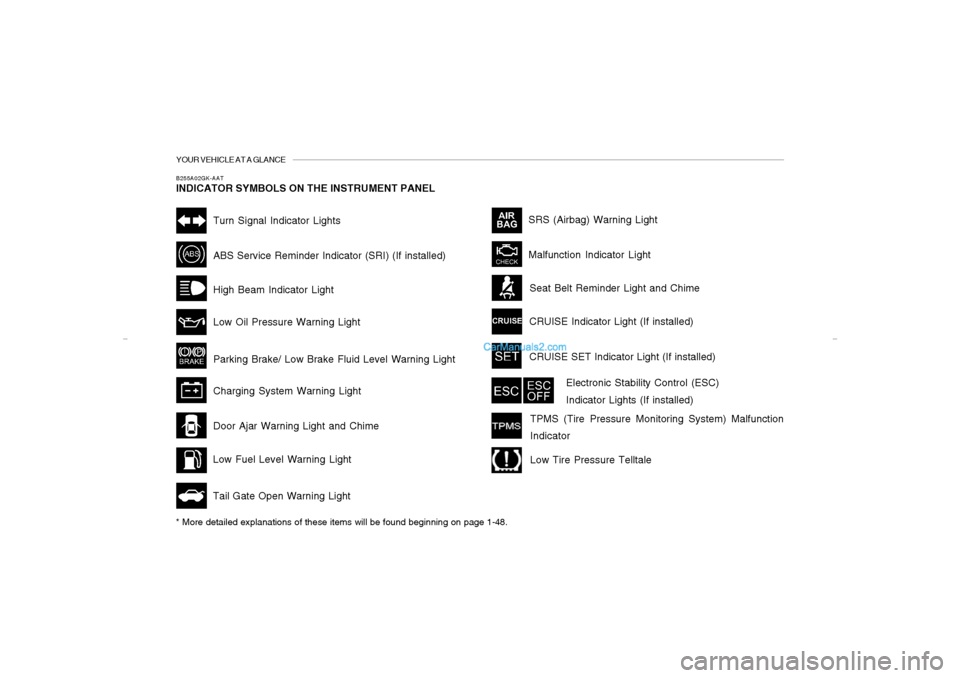
YOUR VEHICLE AT A GLANCEB255A02GK-AATINDICATOR SYMBOLS ON THE INSTRUMENT PANEL* More detailed explanations of these items will be found beginning on page 1-48.
Malfunction Indicator LightSRS (Airbag) Warning Light
Tail Gate Open Warning Light
Low Fuel Level Warning LightDoor Ajar Warning Light and ChimeABS Service Reminder Indicator (SRI) (If installed)Turn Signal Indicator LightsHigh Beam Indicator Light
Low Oil Pressure Warning Light
Parking Brake/ Low Brake Fluid Level Warning Light
Charging System Warning LightCRUISE Indicator Light (If installed)
Seat Belt Reminder Light and Chime
CRUISE SET Indicator Light (If installed)
Electronic Stability Control (ESC)
Indicator Lights (If installed)
TPMS (Tire Pressure Monitoring System) Malfunction
IndicatorLow Tire Pressure Telltale
gkflhma-0.p659/12/2006, 3:13 PM 12
Page 13 of 269

FEATURES OF YOUR HYUNDAI
1
Fuel Recommendations ................................................ 1-2
Breaking in Your New Hyundai ..................................... 1-3
Keys.............................................................................. 1-3
Door (Theft-Alarm System) .................................... 1-4, 1-6
Power Windows ............................................................ 1-9
Seats...........................................................................1-10
Seat Belts....................................................................1-16
Child Restraint System ...............................................1-22
Supplemental Restraint (AIRBAG) System (SRS) .....1-30
Instrument Cluster and Indicator Lights...................... 1-46
Warning and Indicator Lights......................................1-48
Multi-Function Light Switch .........................................1-58
Windshield Wiper/Washer Switch...............................1-60
Sunroof.......................................................................1-66
Mirror...........................................................................1-70
Hood Release .............................................................1-73
Cruise Control.............................................................1-80
Audio Remote Control Switch .....................................1-83
Heating and Cooling Control .......................................1-84
Stereo Sound System...............................................1-103
Antenna.....................................................................1-105
Audio System............................................................1-106
1
gkflhma-1a.p659/12/2006, 3:14 PM 1
Page 22 of 269

1FEATURES OF YOUR HYUNDAI10
!
HGK2016
WARNING:
o Passengers can be injured if their head,
hands or other body parts are trapped by
a closing window. Always check for
obstructions before raising any window.
o NEVER leave the ignition key in the ve-
hicle.
o NEVER leave any child unattended in the
vehicle. Even very young children may
inadvertently cause the vehicle to move,
entangle themselves in the windows, or
otherwise injure themselves or others.
o Do not attempt to operate the main switch
on the driver's door and a switch on
another door in opposing directions at
the same time. If this is done, the window
will stop and cannot be opened or closed.
SEATSB080A02A-AATAdjustable Front Seats
!
WARNING:
o Never adjust the driver’s seat while the
vehicle is moving. Any sudden or unex-
pected movement of the seat could cause
you to lose control of the vehicle result-
ing in an accident. Only adjust the
driver’s seat when the vehicle is station-
ary.
o Do not sit or lean unnecessarily close to
the airbag. Position the seat so that you
can sit as far back as possible from the
airbag and still comfortably reach all
controls. To stop at the desired opening, pull up and
release the switch. In order to prevent operation
of the passenger front window by the passen-
ger, a window lock switch (2) is provided on the
arm rest of the driver's door. To disable the
passenger's power window, push the window
lock switch. To revert to normal operation, push
in on the window lock switch again.
NOTE:The power windows can be operated for 30
seconds after the ignition key is turned to
the "ACC" or "LOCK" positions, or removed
from the ignition switch. If the front doors
are opened during this 30 second period,
the power windows can no longer be oper-
ated without the ignition key turned to the
"ON" position.
gkflhma-1a.p659/12/2006, 3:14 PM 10
Page 24 of 269

1FEATURES OF YOUR HYUNDAI12
!
B080D01JM
o For maximum effectiveness in case of an
accident the headrest should be ad-
justed so the middle of the headrest is at
the same height as the top of the
occupant's eyes. For this reason, the
use of a cushion that holds the body
away from the seatback is not recom-
mended.
o Do not operate vehicle with the head-
rests removed as injury to the occupants
may occur in the event of an accident.
Headrests may provide protection against
neck injuries when properly adjusted.
o Do not adjust the headrest hejght while
the vehicle is in motion.
WARNING:
!
WARNING:
Riding with a reclined seatback increases
your chance of serious or fatal injuries in
the event of a collision or sudden stop. The
protection of your restraint system (seat
belts and airbags) is greatly reduced by
reclining your seat. Seat belts must be snug
against your hips and chest to work prop-
erly. The more the seatback is reclined, the
greater the chance that an occupant's hips
will slide under the lap belt or the occupant's
neck will strike the shoulder belt. Drivers
and passengers should always sit well back
in their seats, properly belted, and with the
seatbacks upright.
B080D02JM-AATAdjustable HeadrestsHeadrests are designed to help reduce the risk
of neck injuries.
To raise the headrest, pull it up. To lower the
headrest, push it down while pressing the lock
knob. To remove the headrest, raise it as far as
it can go then press the lock knob while pulling
upward. This should only be done when the seat
is not occupied.Lock Knob
HGK2032
gkflhma-1a.p659/12/2006, 3:15 PM 12
Page 28 of 269

1FEATURES OF YOUR HYUNDAI16
!
B150B04Y-AATInfant or Small ChildAll 50 states have child restraint laws. You
should be aware of the specific requirements in
your state. Child and/or infant safety seats must
be properly placed and installed in the rear seat.
Information about the use of these restraints
begins on page 1-22.
WARNING:
Every person in your vehicle needs to be
properly restrained at all times, including
infants and children. Never hold a child in
your arms or lap when riding in a vehicle.
The violent forces created during a crash
will tear the child from your arms and throw
the child against the interior. Always use a
child restraint appropriate for your child's
height and weight, see page 1-21.
!SEAT BELTB150A02S-AATSeat Belt Precautions
WARNING:All occupants of the vehicle must wear their
seat belts at all times. Seat belts and child
restraints reduce the risk of serious or fatal
injuries for all occupants in the event of a
collision or sudden stop. Without a seat
belt, occupants could be shifted too close
to a deploying airbag, strike the interior
structure or be thrown from the vehicle.
Properly worn seat belts greatly reduce
these hazards. Even with advanced airbags,
unbelted occupants can be severely in-
jured by a deploying airbag. Always follow
the precautions about seat belts, airbags
and occupant safety contained in this
manual.
!
B140A01S-AATREAR SEAT WARNINGFor the safety of all passengers, luggage or
other cargo should not be piled higher than the
top of the seatback. In addition, do not place
objects on the rear shelf as they may move
forward during braking or in an accident and
strike vehicle passengers.
OGK016140
gkflhma-1a.p659/12/2006, 3:15 PM 16
Page 30 of 269

1FEATURES OF YOUR HYUNDAI18
B160C01A-AATKeep Belts Clean and DrySeat belts should be kept clean and dry. If belts
become dirty, they can be cleaned by using a
mild soap solution and warm water. Bleach, dye,
strong detergents or abrasives should not be
used because they may damage and weaken
the fabric.B160D01A-AATWhen to Replace Seat BeltsEntire in-use seat belt assembly or assemblies
should be replaced if the vehicle has been
involved in an accident. This should be done
even if no damage is visible. Additional ques-
tions concerning seat belt operation should be
directed to your Hyundai Dealer.
!
B150G02A-AATDo Not Lie DownTo reduce the chance of injuries in the event of
an accident and to achieve maximum effective-
ness of the restraint system, all passengers
should be sitting up and the front seats should
be in an upright position when the car is moving.
A seat belt cannot provide proper protection if
the person is lying down in the rear seat or if the
front seat is in a reclined position.
WARNING:
Riding with a reclined seatback increases
your chance of serious or fatal injuries in
the event of a collision or sudden stop. The
protection of your restraint system (seat
belts and airbags) is greatly reduced by
reclining your seat. Seat belts must be snug
against your hips and chest to work prop-
erly. The more the seatback is reclined, the
greater the chance that an occupant's hips
will slide under the lap belt causing serious
internal injuries or the occupant's neck
could strike the shoulder belt. Drivers and
passengers should always sit well back in
their seats, properly belted (see page 1-19),
and with the seatbacks upright.
!
B160A02A-AATCare of Seat BeltsSeat belt systems should never be disassembled
or modified. In addition, care should be taken to
assure that seat belts and belt hardware are not
damaged by seat hinges, doors or other abuse.
WARNING:
When you return the rear seatback to its
upright position after the rear seatback was
folded down, be careful not to damage the
seat belt webbing or buckle. Be sure that
the webbing or buckle does not get caught
or pinched in the rear seat. A seat belt with
damaged webbing or buckle will not be as
strong and could possibly fail during a
collision or sudden stop, resulting in seri-
ous injury.
B160B01A-AATPeriodic InspectionIt is recommended that all seat belts be in-
spected periodically for wear or damage of any
kind. Parts of the system that are damaged
should be replaced as soon as possible.
gkflhma-1a.p659/12/2006, 3:15 PM 18
Page 34 of 269
1FEATURES OF YOUR HYUNDAI22
!
WARNING:
o A child restraint system must be placed
in the rear seat. Never install a child or
infant seat on the front passenger's seat.
Should an accident occur and cause the
passenger side airbag to deploy, it could
severely injure or kill an infant or child
seated in an infant or child seat. Thus
only use a child restraint in the rear seat
of your vehicle.
o A safety belt or child restraint system
can become very hot if it is left in a closed
vehicle on a sunny day, even if the out-
side temperature does not feel hot. Be
sure to check the seat cover and buckles
before placing a child there.
o When the child restraint system is not in
use, store it in the trunk or fasten it with
a safety belt so that it will not be thrown
forward in the case of a sudden stop or
an accident.
o Children may be seriously injured or
killed by an inflating airbag. All children,
even those too large for child restraints,
must ride in the rear seat.
CHILD RESTRAINT SYSTEMB230A03A-AATChildren riding in the car should sit in the rear
seat and must always be properly restrained to
minimize the risk of injury in an accident, sudden
stop or sudden maneuver. According to acci-
dent statistics provided by the National High-
way Traffic Safety Administration (NHTSA),
children are safer when properly restrained in
the rear seats than in the front seat. Larger
children not in a child restraint should use one
of the seat belts provided.
All 50 states have child restraint laws. You
should be aware of the specific requirements in
your state. Child and/or infant safety seats must
be properly placed and installed in the rear seat.
You must use a commercially available child
restraint system that meets the requirements of
the Federal Motor Vehicle Safety Standards
(FMVSS).
Children could be injured or killed in a crash if
their restraints are not properly secured. For
small children and babies, a child seat or infant
seat must be used. Before buying a particular
child restraint system, make sure it fits your car
and seat belts, and fits your child. Follow all the
instructions provided by the manufacturer when
installing the child restraint system.
!
To reduce the chance of serious or fatal
injuries:
o Children of all ages are safer when re-
strained in the rear seat. A child riding in
the front passenger seat can be force-
fully struck by an inflating airbag result-
ing in serious or fatal injuries.
o Always follow the instructions for in-
stallation and use of the child restraint
maker.
o Always make sure the child seat is se-
cured properly in the car and your child
is securely restrained in the child seat.
o Never hold a child in your arms or lap
when riding in a vehicle. The violent
forces created during a crash will tear the
child from your arms and throw the child
against the car’s interior.
o Never put a seat belt over yourself and a
child. During a crash, the belt could
press deep into the child causing seri-
ous internal injuries.
o Never leave children unattended in a
vehicle – not even for a short time. The
car can heat up very quickly, resulting in
serious injuries to children inside. Even
very young children may inadvertently
cause the vehicle to move, entangle them-
selves in the windows, or lock them-
selves or others inside the vehicle.
WARNING:
gkflhma-1a.p659/12/2006, 3:15 PM 22
Page 39 of 269
1
FEATURES OF YOUR HYUNDAI
27
!
WARNING:
o If the retractor is not in the Automatic
Locking mode, the child restraint can
move when your vehicle turns or stops
suddenly. A child can be seriously in-
jured or killed if the child restraint is not
properly anchored to the car, including
setting the retractor to the Automatic
Locking mode.
o Do not install any child restraint system
in the front passenger seat. Should an
accident occur and cause the passenger
side airbag to deploy, it could severely
injure or kill an infant or child seated in
an infant or child seat. Therefore, only
use a child restraint system in the rear
seat of your vehicle. If the retractor is in the automatic locking mode,
the belt will be locked. After installation of the
child restraint system, try to move it in all
directions to be sure the child restraint system
is securely installed. If you need to tighten the
belt, pull more webbing toward the retractor.
When you unbuckle the seat belt and allow it to
retract, the retractor will automatically revert
back to its normal seated passenger emer-
gency locking usage condition.
NOTE:o Before installing the child restraint sys-
tem in any seating position, read the
instructions supplied by the child re-
straint system manufacturer.
o If the seat belt does not operate as de-
scribed, have the system checked imme-
diately by your authorized Hyundai
dealer.
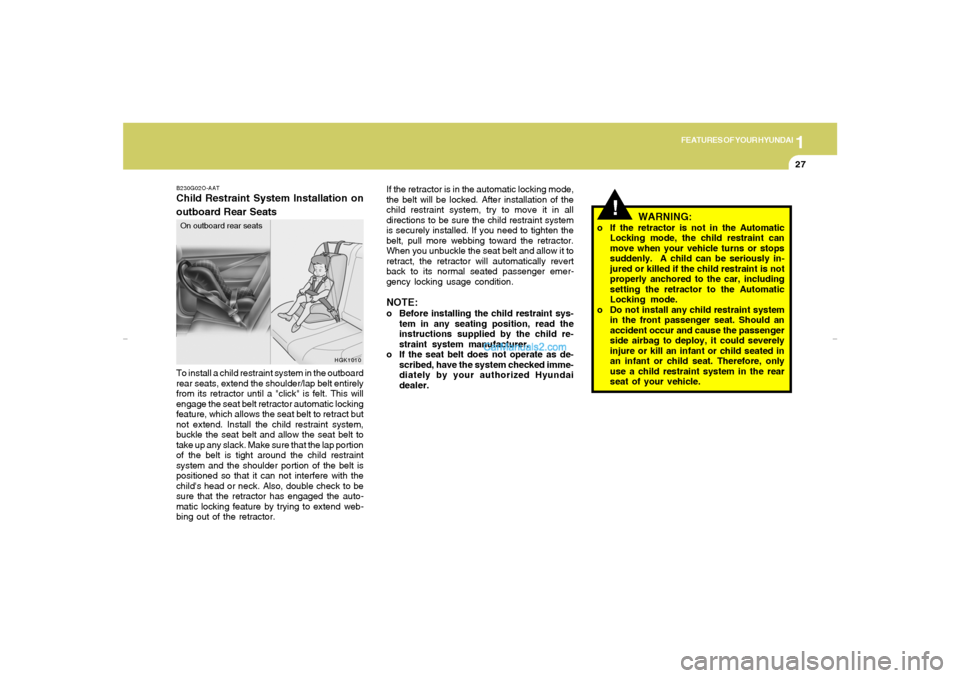
B230G02O-AATChild Restraint System Installation on
outboard Rear SeatsTo install a child restraint system in the outboard
rear seats, extend the shoulder/lap belt entirely
from its retractor until a "click" is felt. This will
engage the seat belt retractor automatic locking
feature, which allows the seat belt to retract but
not extend. Install the child restraint system,
buckle the seat belt and allow the seat belt to
take up any slack. Make sure that the lap portion
of the belt is tight around the child restraint
system and the shoulder portion of the belt is
positioned so that it can not interfere with the
child's head or neck. Also, double check to be
sure that the retractor has engaged the auto-
matic locking feature by trying to extend web-
bing out of the retractor.On outboard rear seats
HGK1010
gkflhma-1a.p659/12/2006, 3:15 PM 27