engine Hyundai Tiburon 2007 Owner's Manual
[x] Cancel search | Manufacturer: HYUNDAI, Model Year: 2007, Model line: Tiburon, Model: Hyundai Tiburon 2007Pages: 269, PDF Size: 10.37 MB
Page 7 of 269
A040A01A-AAT
FOREWORD
Thank you for choosing Hyundai. We are pleased to welcome you to the growing number of discriminating people who
drive Hyundais. The advanced engineering and high-quality construction of each Hyundai we build is something of which
we're very proud.
Your Owner's Manual will introduce you to the features and operation of your new Hyundai. It is suggested that you read
it carefully because the information it contains can contribute greatly to the satisfaction you receive from your new car.
The manufacturer also recommends that all service and maintenance on your car be performed by an authorized Hyundai
dealer. Hyundai dealers are prepared to provide high-quality service, maintenance and any other assistance that may
be required.A050A04A-AAT
HYUNDAI MOTOR COMPANY
Note: Because future owners will also need the information included in this manual, if you sell this Hyundai, please leave
the manual in the vehicle for their use. Thank you.
CAUTION:
Severe engine and transaxle damage may result from the use of poor quality fuels and lubricants that do not
meet Hyundai specifications. You must always use high quality fuels and lubricants that meet the specifica-
tions listed on Page 9-4 in the Vehicle Specifications section of the Owner's Manual and which also appear
in the Service Station Information on the back cover of the Owner's Manual.
Copyright 2006 Hyundai Motor Company. All rights reserved. No part of this publication may be reproduced, stored in
any retrieval system or transmitted in any form or by any means without the prior written permission of Hyundai Motor
Company.
!
gkflhma-0.p659/12/2006, 3:13 PM 7
Page 8 of 269
A100A03A-AATGUIDE TO HYUNDAI GENUINE PARTS1. What are Hyundai Genuine Parts?
Hyundai Genuine Parts are the same parts
used by Hyundai Motor Company to manu-
facture vehicles. They are designed and
tested for the optimum safety, performance,
and reliability to our customers.
2. Why should you use genuine parts?
Hyundai Genuine Parts are engineered and
built to meet rigid manufacturing require-
ments. Using imitation, counterfeit or used
salvage parts is not covered under the
Hyundai New Vehicle Limited Warranty or
any other Hyundai warranty. In addition, any
damage to or failure of Genuine Hyundai
Parts caused by the installation or failure ofan imitation, counterfeit or used salvage part
is not covered by any Hyundai Warranty.
3. How can you tell if you are purchasing
Hyundai Genuine Parts?
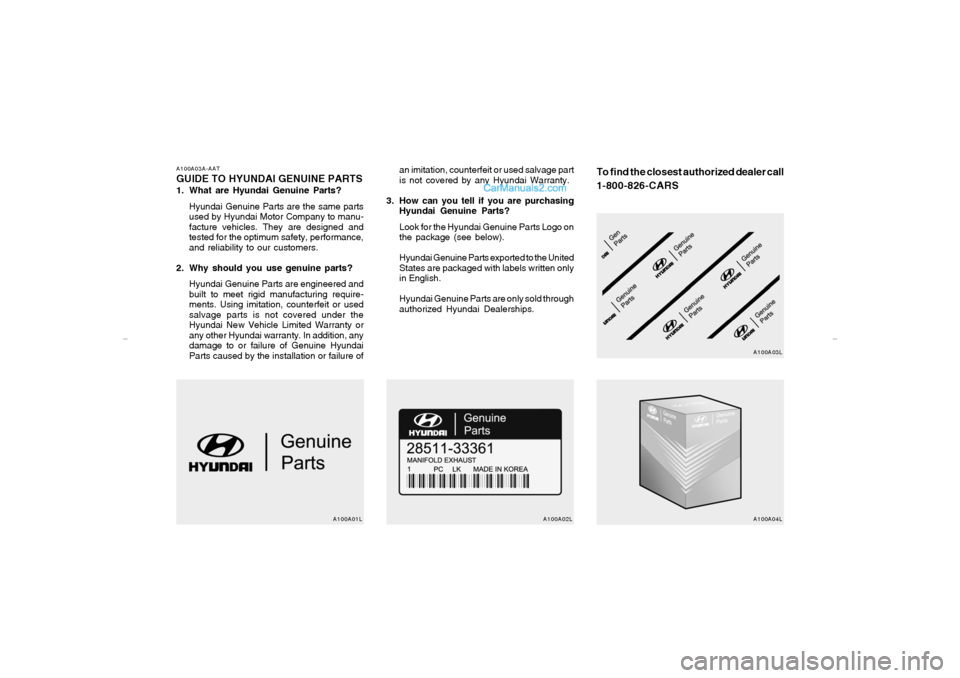
Look for the Hyundai Genuine Parts Logo on
the package (see below).
Hyundai Genuine Parts exported to the United
States are packaged with labels written only
in English.
Hyundai Genuine Parts are only sold through
authorized Hyundai Dealerships.
To find the closest authorized dealer call
1-800-826-CARS
A100A01L A100A02L A100A04LA100A03L
gkflhma-0.p659/12/2006, 3:13 PM 8
Page 14 of 269

1FEATURES OF YOUR HYUNDAI2
FUEL RECOMMENDATIONS
CAUTION:
Your Hyundai's New Vehicle Limited War-
ranty may not cover damage to the fuel
system and any performance problems that
are caused by the use of fuels containing
methanol or fuels containing MTBE (Methyl
Tertiary Butyl Ether) over 15.0% vol. (Oxy-
gen Content 2.7% weight.)
B010B01A-AATWhat About Gasohol?Gasohol (a mixture of 90% unleaded gasoline
and 10% ethanol or grain alcohol) may be used
in your Hyundai. However, if your engine devel-
ops driveability problems, the use of 100%
unleaded gasoline is recommended. Fuels with
unspecified quantities of alcohol, or alcohols
other than ethanol, should not be used.
B010A02JM-AATUse Unleaded GasolineUnleaded gasoline with a Pump Octane
Rating of 87 (Research Octane Number 91)
or higher must be used in your Hyundai.
B010D01A-AATDo Not Use MethanolFuels containing methanol (wood alcohol) should
not be used in your Hyundai. This type of fuel
can reduce vehicle performance and damage
components of the fuel system.
!
OGK016100N
UNLEADED
FUEL ONLY
B010C01A-AATUse of MTBEHyundai recommends that fuels containing
MTBE (Methyl Tertiary Butyl Ether) over 15.0%
vol. (Oxygen Content 2.7% weight) should not
be used in your Hyundai.
Fuel containing MTBE over 15.0% vol. (Oxygen
Content 2.7% weight) may reduce vehicle per-
formance and produce vapor lock or hard
starting.
!
WARNING:
o Do not "top off" after the nozzle auto-
matically shuts off when refueling.
o Tighten the cap until it clicks, otherwise
the "
" light will illuminate.
o Always check that the fuel cap is in-
stalled securely to prevent fuel spillage
in the event of an accident.
gkflhma-1a.p659/12/2006, 3:14 PM 2
Page 15 of 269
1
FEATURES OF YOUR HYUNDAI
3
BREAKING IN YOUR NEW
HYUNDAI
B010E01A-AATGasolines for Cleaner AirTo help contribute to cleaner air, Hyundai rec-
ommends that you use gasolines treated with
detergent additives, which help prevent deposit
formation in the engine. These gasolines will
help the engine run cleaner and enhance per-
formance of the Emission Control System.B010F01A-AATOperation in Foreign CountriesIf you are going to drive your Hyundai in another
country, be sure to:
o Observe all regulations regarding registra-
tion and insurance.
o Determine that acceptable fuel is available.
B020A01S-AATDuring the First 1,200 Miles (2,000 Km)No formal "break-in" procedure is required with
your new Hyundai. However, you can contrib-
ute to the economical operation and durability of
your Hyundai by observing the following recom-
mendations during the first 1,200 miles (2,000
km).
o Don't drive faster than 55 MPH (88 km/h).
o While driving, keep your engine speed (rpm,
or revolutions per minute) between 2,000
rpm and 4,000 rpm.
o Use moderate acceleration. Don't start
quickly or depress the accelerator pedal
fully.
o For the first 200 miles (300 km), try to avoid
hard stops.
o Don't lug the engine (in other words, don't
drive so slowly in too high a gear that the
engine "bucks"-shift to a lower gear).
o Whether going fast or slow, vary your speed
from time to time.
o Don't let the engine idle longer than 3 minutes
at one time.
o Don't tow a trailer during the first 1,200 miles
(2,000 km) of operation.
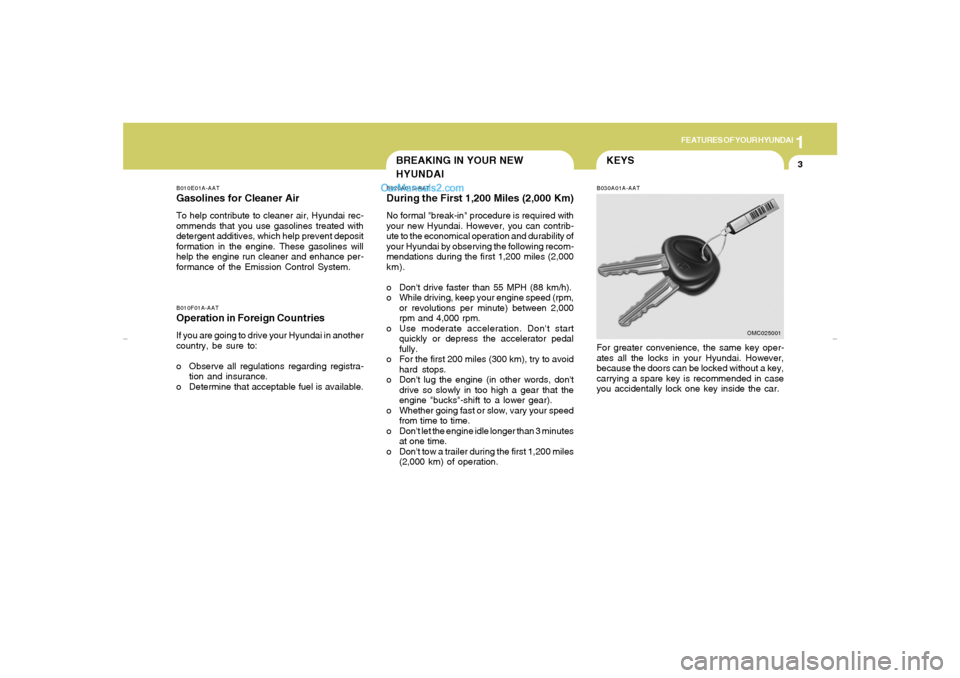
KEYSB030A01A-AATFor greater convenience, the same key oper-
ates all the locks in your Hyundai. However,
because the doors can be locked without a key,
carrying a spare key is recommended in case
you accidentally lock one key inside the car.
OMC025001
gkflhma-1a.p659/12/2006, 3:14 PM 3
Page 18 of 269
1FEATURES OF YOUR HYUNDAI6
B070B02GK-AATArmed StagePark the car and stop the engine. Arm the
system as described below.
1) Remove the ignition key from the ignition
switch.
2) Make sure that the engine hood and tail gate
are closed and latched.
3) Lock the doors using the transmitter of the
keyless entry system.
After completion of the steps above, the turn
signal light will blink once to indicate that the
system is armed.
OGK046003 B040G02GK-GAT
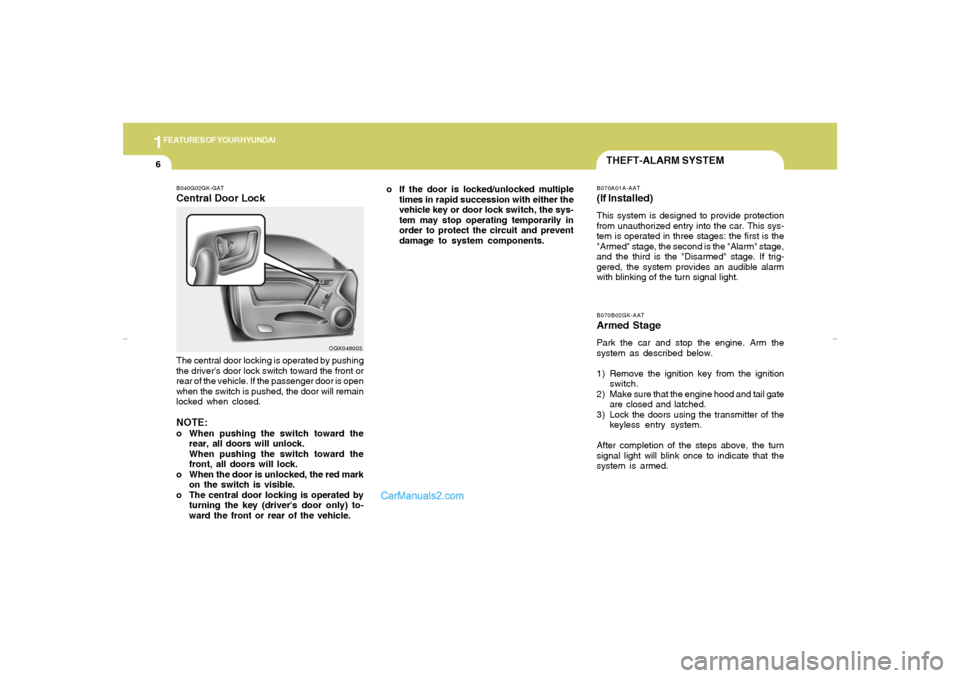
Central Door LockThe central door locking is operated by pushing
the driver's door lock switch toward the front or
rear of the vehicle. If the passenger door is open
when the switch is pushed, the door will remain
locked when closed.NOTE:o When pushing the switch toward the
rear, all doors will unlock.
When pushing the switch toward the
front, all doors will lock.
o When the door is unlocked, the red mark
on the switch is visible.
o The central door locking is operated by
turning the key (driver's door only) to-
ward the front or rear of the vehicle.
THEFT-ALARM SYSTEMB070A01A-AAT(If Installed)This system is designed to provide protection
from unauthorized entry into the car. This sys-
tem is operated in three stages: the first is the
"Armed" stage, the second is the "Alarm" stage,
and the third is the "Disarmed" stage. If trig-
gered, the system provides an audible alarm
with blinking of the turn signal light. o If the door is locked/unlocked multiple
times in rapid succession with either the
vehicle key or door lock switch, the sys-
tem may stop operating temporarily in
order to protect the circuit and prevent
damage to system components.
gkflhma-1a.p659/12/2006, 3:14 PM 6
Page 19 of 269
1
FEATURES OF YOUR HYUNDAI
7
!
NOTE:1) If any door, tail gate or engine hood
remains open, the system will not be
armed.
2) If this happens, rearm the system as
described above.
3) Once the system is armed, only the tail
gate may be unlocked using the key
without disarming the system.
CAUTION:
Do not arm the system until all passengers
have left the car. If the system is armed while
a passenger(s) remains in the car, the alarm
may be activated when the remaining
passenger(s) leaves the car.
B070C02GK-AATAlarm StageThe alarm will be activated if any of the following
occur while the car is parked and the system is
armed.
1) A front door is unlocked and opened without
using the transmitter.
2) The tail gate is opened without using the key.
3) The engine hood is opened.
The siren will sound and the turn signal lamp will
blink continuously for 27 seconds. (This hap-
pens 3 times). To turn off the system, unlock the
door with the transmitter.
CAUTION:
Avoid trying to start the engine while the
system is armed.
!
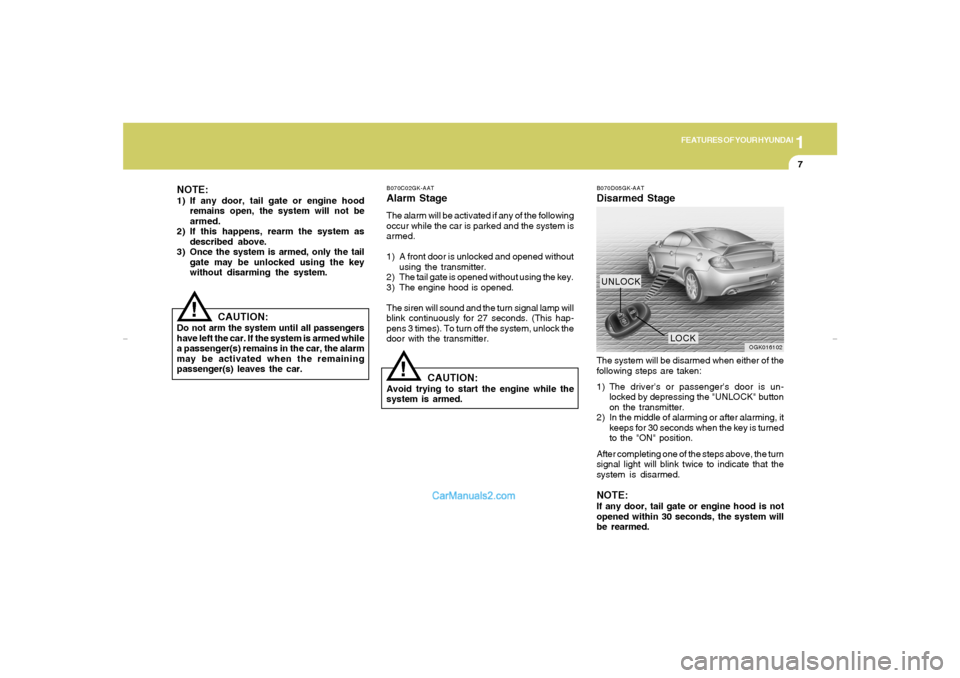
B070D05GK-AATDisarmed StageThe system will be disarmed when either of the
following steps are taken:
1) The driver's or passenger's door is un-
locked by depressing the "UNLOCK" button
on the transmitter.
2) In the middle of alarming or after alarming, it
keeps for 30 seconds when the key is turned
to the "ON" position.
After completing one of the steps above, the turn
signal light will blink twice to indicate that the
system is disarmed.NOTE:If any door, tail gate or engine hood is not
opened within 30 seconds, the system will
be rearmed.
OGK016102
LOCK
UNLOCK
gkflhma-1a.p659/12/2006, 3:14 PM 7
Page 47 of 269
1
FEATURES OF YOUR HYUNDAI
35
!
WARNING:
o The SRS airbag system must deploy very
rapidly to provide protection in a crash.
If an occupant is out of position because
of not wearing a seat belt, the airbag may
forcefully contact the occupant causing
serious or fatal injuries.
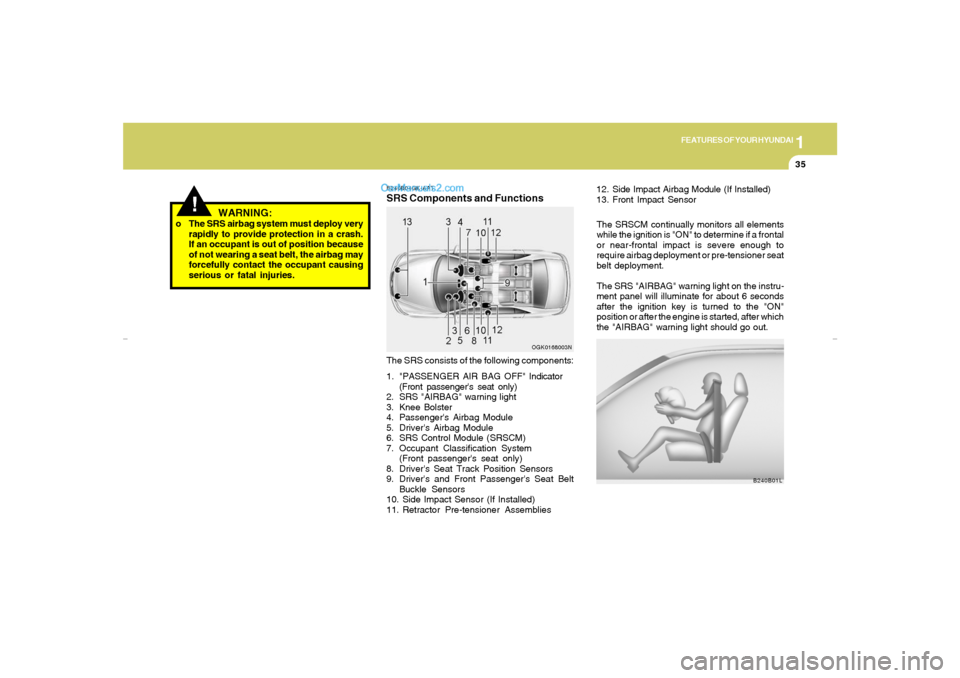
B240B04GK-AATSRS Components and FunctionsThe SRS consists of the following components:
1. "PASSENGER AIR BAG OFF" Indicator
(Front passenger's seat only)
2. SRS "AIRBAG" warning light
3. Knee Bolster
4. Passenger's Airbag Module
5. Driver's Airbag Module
6. SRS Control Module (SRSCM)
7. Occupant Classification System
(Front passenger's seat only)
8. Driver's Seat Track Position Sensors
9. Driver's and Front Passenger's Seat Belt
Buckle Sensors
10. Side Impact Sensor (If Installed)
11. Retractor Pre-tensioner Assemblies
OGK0168003N
12. Side Impact Airbag Module (If Installed)
13. Front Impact SensorThe SRSCM continually monitors all elements
while the ignition is "ON" to determine if a frontal
or near-frontal impact is severe enough to
require airbag deployment or pre-tensioner seat
belt deployment.
The SRS "AIRBAG" warning light on the instru-
ment panel will illuminate for about 6 seconds
after the ignition key is turned to the "ON"
position or after the engine is started, after which
the "AIRBAG" warning light should go out.
B240B01L
gkflhma-1a.p659/12/2006, 3:16 PM 35
Page 49 of 269
1
FEATURES OF YOUR HYUNDAI
37
CAUTION:
When installing a container of liquid air
freshener inside a vehicle, do not place it
near the instrument cluster nor on the in-
strument panel pad surface. If there is any
leakage from the air freshener onto these
areas (instrument cluster, instrument panel
pad or air ventilator), it may damage these
parts. If the liquid from the air freshener
does leak onto these areas, wash them with
water immediately.
!
!
B240B05L
WARNING:
o If an airbag deploys, there may be a loud
noise followed by a fine dust released in
the vehicle. These conditions are nor-
mal and are not hazardous - the airbags
are packed in this fine powder. The dust
generated during airbag deployment
may cause skin or eye irritation as well as
aggravate asthma for some persons.
Always wash all exposed skin areas thor-
oughly with lukewarm water and a mild
soap after an accident in which the
airbags were deployed.
o The SRS can function only when the
ignition key is in the "ON" position. If the
SRS "AIRBAG" warning light does not
illuminute, or continuously remains on
after illuminating for about 6 seconds
when the ignition key is turned to the
"ON" position, or after the engine is
started, illuminates while driving, the
SRS is not working properly. If this oc-
curs, have your vehicle immediately in-
spected by your Hyundai dealer.
o Before you replace a fuse or disconnect
a battery terminal, turn the ignition key
to the "LOCK" position or remove the
ignition key. Never remove or replace the
air bag related fuse(s) when the ignition
key is in the "ON" position. Failure to
heed this warning will cause the SRS
"AIRBAG" warning light to illuminate. Passenger's Airbag
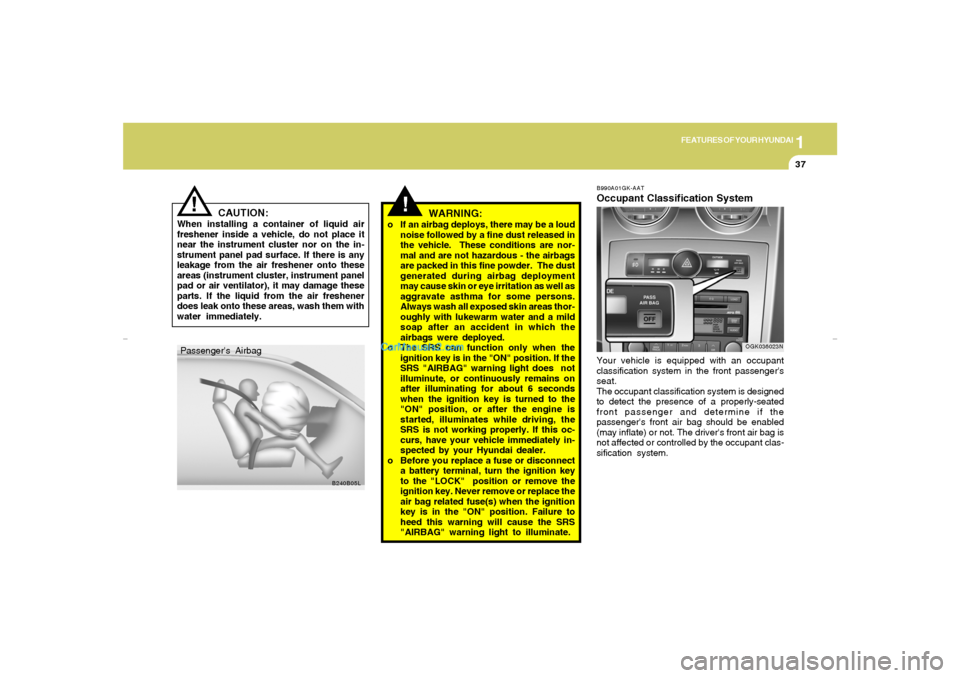
B990A01GK-AATOccupant Classification System
OGK036023N
Your vehicle is equipped with an occupant
classification system in the front passenger's
seat.
The occupant classification system is designed
to detect the presence of a properly-seated
front passenger and determine if the
passenger's front air bag should be enabled
(may inflate) or not. The driver's front air bag is
not affected or controlled by the occupant clas-
sification system.
gkflhma-1a.p659/12/2006, 3:16 PM 37
Page 52 of 269
1FEATURES OF YOUR HYUNDAI40
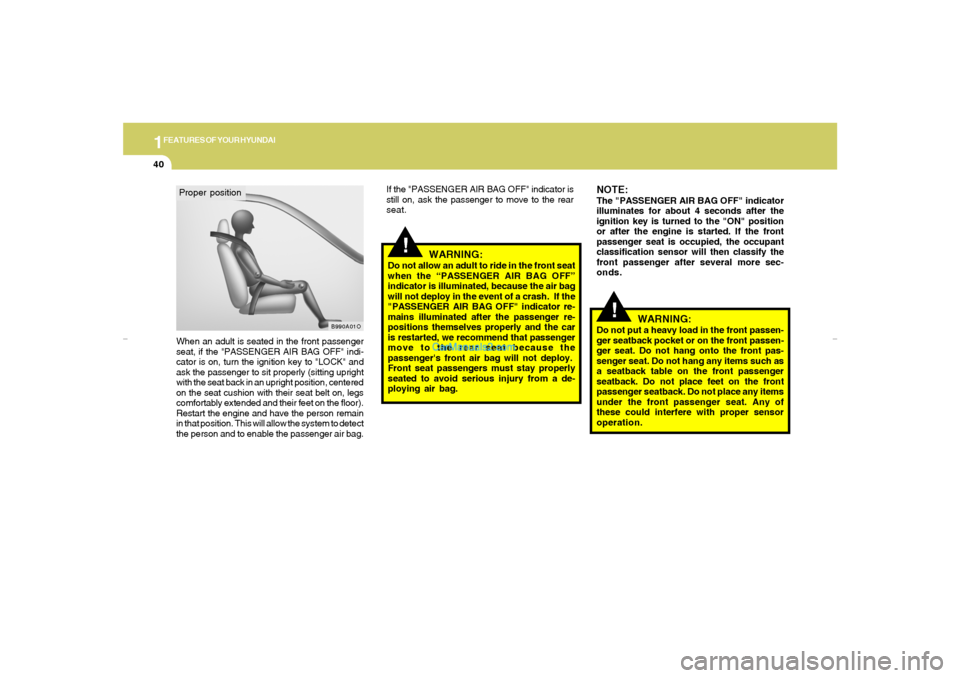
When an adult is seated in the front passenger
seat, if the "PASSENGER AIR BAG OFF" indi-
cator is on, turn the ignition key to "LOCK" and
ask the passenger to sit properly (sitting upright
with the seat back in an upright position, centered
on the seat cushion with their seat belt on, legs
comfortably extended and their feet on the floor).
Restart the engine and have the person remain
in that position. This will allow the system to detect
the person and to enable the passenger air bag.
Proper position
B990A01O
If the "PASSENGER AIR BAG OFF" indicator is
still on, ask the passenger to move to the rear
seat.
!
WARNING:
Do not allow an adult to ride in the front seat
when the “PASSENGER AIR BAG OFF”
indicator is illuminated, because the air bag
will not deploy in the event of a crash. If the
"PASSENGER AIR BAG OFF" indicator re-
mains illuminated after the passenger re-
positions themselves properly and the car
is restarted, we recommend that passenger
move to the rear seat because the
passenger's front air bag will not deploy.
Front seat passengers must stay properly
seated to avoid serious injury from a de-
ploying air bag.
NOTE:The "PASSENGER AIR BAG OFF" indicator
illuminates for about 4 seconds after the
ignition key is turned to the "ON" position
or after the engine is started. If the front
passenger seat is occupied, the occupant
classification sensor will then classify the
front passenger after several more sec-
onds.
!
WARNING:
Do not put a heavy load in the front passen-
ger seatback pocket or on the front passen-
ger seat. Do not hang onto the front pas-
senger seat. Do not hang any items such as
a seatback table on the front passenger
seatback. Do not place feet on the front
passenger seatback. Do not place any items
under the front passenger seat. Any of
these could interfere with proper sensor
operation.
gkflhma-1a.p659/12/2006, 3:16 PM 40
Page 56 of 269

1FEATURES OF YOUR HYUNDAI44
B240D02JM-AATAdditional Safety PrecautionsoNever let passengers ride in the cargo
area (trunk) or on top of a folded-down
back seat. All occupants should sit upright,
fully back in their seats with their seat belts
on and their feet on the floor.
oPassengers should not move out of or
change seats while the vehicle is mov-
ing. A passenger who is not wearing a seat
belt during a crash or emergency stop can
be thrown against the inside of the vehicle,
against other occupants, or out of the ve-
hicle.
oEach seat belt is designed to restrain one
occupant. If more than one person uses the
same seat belt, they could be seriously
injured or killed in a collision.
oDo not use any accessories on seat
belts. Devices claiming to improve occu-
pant comfort or reposition the seat belt can
reduce the protection provided by the seat
belt and increase the chance of serious
injury in a crash.
oPassengers should not place hard or
sharp objects between themselves and
the airbags. Carrying hard or sharp objects
on your lap or in your mouth can result in
injuries if an airbag inflates.
!
o If your car was flooded and has soaked
carpeting or water on the floor, you
shouldn't try to start the engine; have
the car towed to an authorized Hyundai
dealer.
WARNING:
!
o For cleaning the airbag pad covers, use
only a soft, dry cloth or one which has
been moistened with plain water. Sol-
vents or cleaners could adversely affect
the airbag covers and proper deploy-
ment of the system.
o No objects should be placed over or near
the airbag modules on the steering
wheel, instrument panel, and the front
passenger’s panel above the glove box,
because any such object could cause
harm if the vehicle is in a crash severe
enough to cause the airbags to inflate.
o If the airbags inflate, they must be re-
placed by an authorized Hyundai dealer.
o Do not tamper with or disconnect SRS
wiring, or other components of the SRS
system. Doing so could result in injury,
due to accidental inflation of the airbags
or by rendering the SRS inoperative.
o If components of the airbag system must
be discarded, or if the vehicle must be
scrapped, certain safety precautions
must be observed. Your Hyundai dealer
knows these precautions and can give
you the necessary information. Failure
to follow these precautions and proce-
dures could increase the risk of personal
injury.
WARNING:
gkflhma-1a.p659/12/2006, 3:16 PM 44