heating Hyundai Tiburon 2008 Owner's Guide
[x] Cancel search | Manufacturer: HYUNDAI, Model Year: 2008, Model line: Tiburon, Model: Hyundai Tiburon 2008Pages: 268, PDF Size: 9.93 MB
Page 161 of 268
2
DRIVING YOUR HYUNDAI
22
CAUTION:
If overheating should occur when towing,
(the temperature gauge reads near red zone),
taking the following action may reduce or
eliminate the problem.
1. Turn off the air conditioner.
2. Reduce highway speed.
3. Select a lower gear when going uphill.
4. While in stop and go traffic, place the
gear selector in park or neutral and idle
the engine at a higher speed.
!
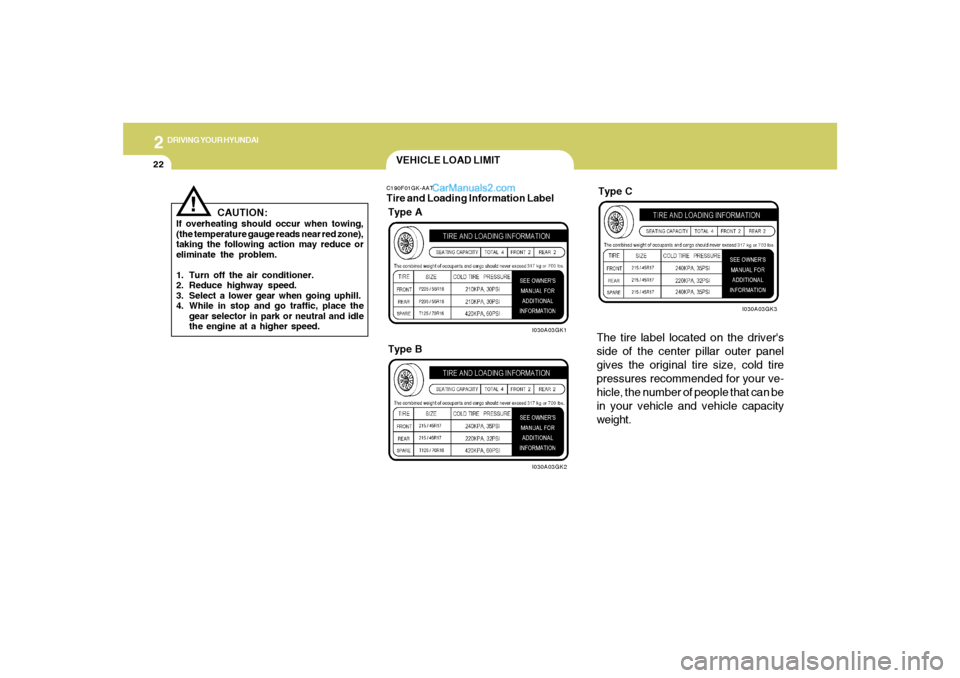
VEHICLE LOAD LIMITC190F01GK-AATTire and Loading Information Label
The tire label located on the driver's
side of the center pillar outer panel
gives the original tire size, cold tire
pressures recommended for your ve-
hicle, the number of people that can be
in your vehicle and vehicle capacity
weight.
I030A03GK1
Type A
I030A03GK2
Type B
I030A03GK3
Type C
Page 171 of 268
3
WHAT TO DO IN AN EMERGENCY
5
!
6. If you cannot find the cause of the overheat-
ing, wait until the engine temperature has
returned to normal. Then, if the engine cool-
ant has been lost, carefully add water to the
reservoir (Page 6-8) to bring the fluid level in
the reservoir up to the halfway mark.
7. Proceed with caution, keeping alert for fur-
ther signs of overheating. If overheating
happens again, call a Hyundai dealer for
assistance.
CAUTION:
Serious loss of engine coolant indicates
there is a leak in the cooling system and this
should be checked as soon as possible by
a Hyundai dealer.
TIRE PRESSURE MONITORING SYSTEM (TPMS)
OGK036400N C320A01JM-AAT
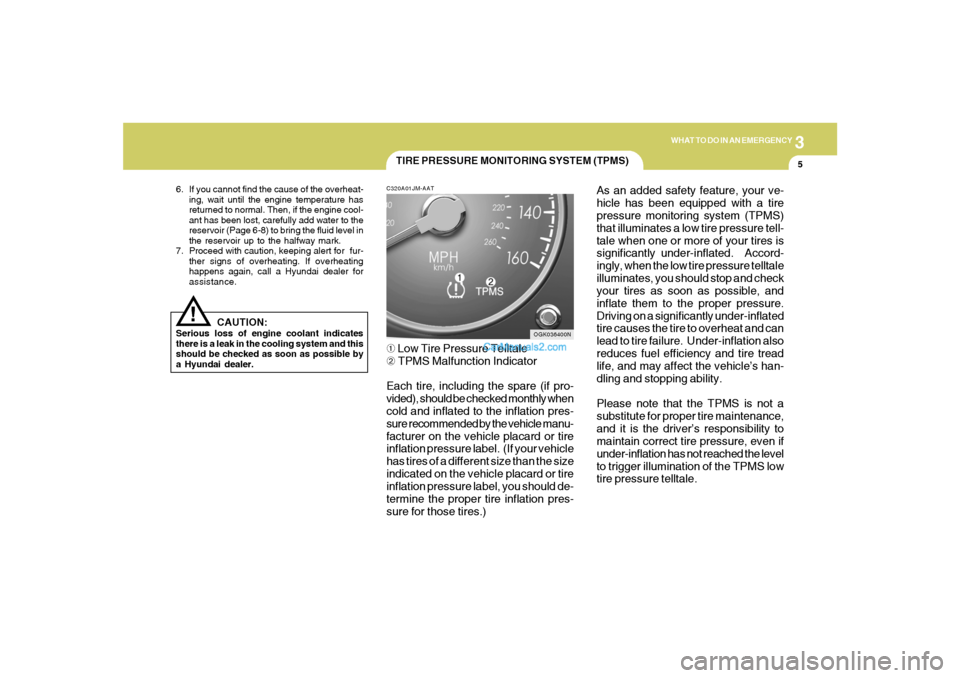
➀ Low Tire Pressure Telltale
➁ TPMS Malfunction Indicator
Each tire, including the spare (if pro-
vided), should be checked monthly when
cold and inflated to the inflation pres-
sure recommended by the vehicle manu-
facturer on the vehicle placard or tire
inflation pressure label. (If your vehicle
has tires of a different size than the size
indicated on the vehicle placard or tire
inflation pressure label, you should de-
termine the proper tire inflation pres-
sure for those tires.)As an added safety feature, your ve-
hicle has been equipped with a tire
pressure monitoring system (TPMS)
that illuminates a low tire pressure tell-
tale when one or more of your tires is
significantly under-inflated. Accord-
ingly, when the low tire pressure telltale
illuminates, you should stop and check
your tires as soon as possible, and
inflate them to the proper pressure.
Driving on a significantly under-inflated
tire causes the tire to overheat and can
lead to tire failure. Under-inflation also
reduces fuel efficiency and tire tread
life, and may affect the vehicle’s han-
dling and stopping ability.
Please note that the TPMS is not a
substitute for proper tire maintenance,
and it is the driver’s responsibility to
maintain correct tire pressure, even if
under-inflation has not reached the level
to trigger illumination of the TPMS low
tire pressure telltale.
Page 204 of 268
6
DO-IT-YOURSELF MAINTENANCE
4
GENERAL CHECKS
G020C01A-AATVehicle InteriorThe following should be checked each time
when the vehicle is driven:
o Lights operation
o Windshield wiper operation
o Horn operation
o Defroster, heating system operation (and air
conditioning, if installed)
o Steering operation and condition
o Mirror condition and operation
o Turn signal operation
o Accelerator pedal operation
o Brake operation, including parking brake
o Manual transaxle operation, including clutch
operation
o Automatic transaxle operation, including
"Park" mechanism operation
o Seat control condition and operation
o Seat belt condition and operation
o Sunvisor operation
If you notice anything that does not operate
correctly or appears to be functioning incor-
rectly, inspect it carefully and seek assistance
from your Hyundai dealer if service is needed.
G020B01A-AATVehicle ExteriorThe following should be checked monthly:
o Overall appearance and condition
o Wheel condition and wheel nut torque
o Exhaust system condition
o Light condition and operation
o Windshield glass condition
o Wiper blade condition
o Paint condition and body corrosion
o Fluid leaks
o Door and hood lock condition
o Tire pressure and condition (including spare
tire)
G020A01A-AATEngine CompartmentThe following should be checked regularly:
o Engine oil level and condition
o Transaxle fluid level and condition
o Brake fluid level
o Clutch fluid level
o Engine coolant level
o Windshield washer fluid level
o Accessory drive belt condition
o Engine coolant hose condition
o Fluid leaks (on or below components)
o Power steering fluid level
o Battery condition
o Air filter condition
Page 209 of 268
6
DO-IT-YOURSELF MAINTENANCE
9
!
WARNING:
The cooling fan is controlled by engine
coolant temperature and may sometimes
operate even when the engine is not run-
ning. Use extreme caution when working
near the blades of the coolant fan so that
you are not injured by a rotating fan blade.
As the engine coolant temperature de-
creases, the fan will automatically shut off.
This is a normal condition.
CAUTION:
o Engine coolant can damage the finish of
your car. If you spill engine coolant on
the car, wash it off thoroughly with clean
water.
o The engine in your vehicle has alumi-
num engine parts and must be protected
by an ethylene-glycol base coolant to
prevent corrosion and freezing.
Do not use hard water. Hard water can
cause engine damage from corrosion,
overheating or freezing.
!
CHANGING THE AIR CLEANER
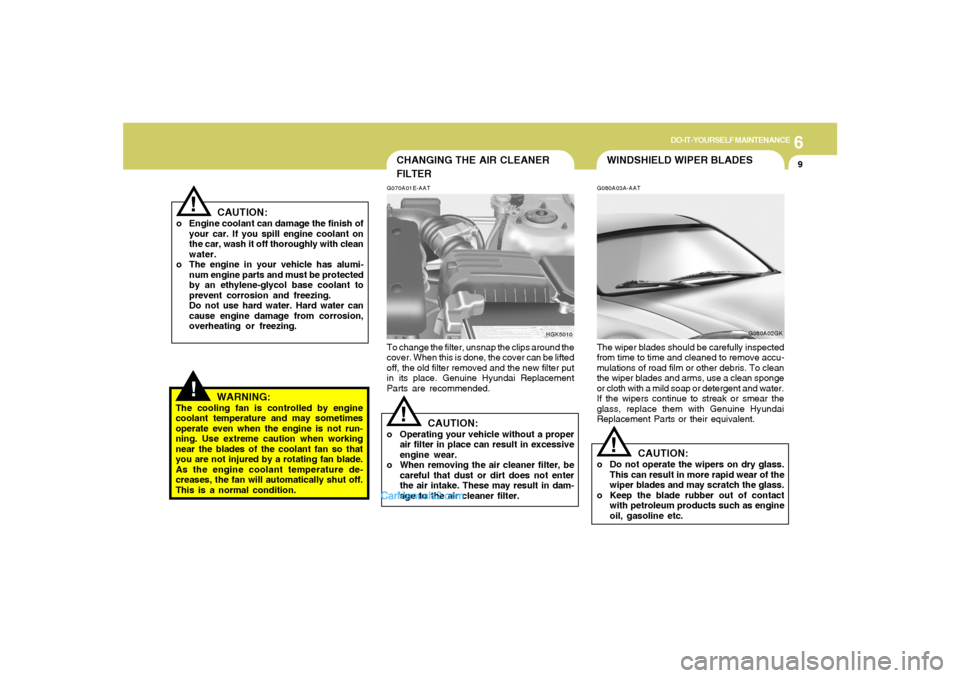
FILTERG070A01E-AATTo change the filter, unsnap the clips around the
cover. When this is done, the cover can be lifted
off, the old filter removed and the new filter put
in its place. Genuine Hyundai Replacement
Parts are recommended.
CAUTION:
o Operating your vehicle without a proper
air filter in place can result in excessive
engine wear.
o When removing the air cleaner filter, be
careful that dust or dirt does not enter
the air intake. These may result in dam-
age to the air cleaner filter.
HGK5010
!
WINDSHIELD WIPER BLADESG080A03A-AATThe wiper blades should be carefully inspected
from time to time and cleaned to remove accu-
mulations of road film or other debris. To clean
the wiper blades and arms, use a clean sponge
or cloth with a mild soap or detergent and water.
If the wipers continue to streak or smear the
glass, replace them with Genuine Hyundai
Replacement Parts or their equivalent.
G080A02GK
!
CAUTION:
o Do not operate the wipers on dry glass.
This can result in more rapid wear of the
wiper blades and may scratch the glass.
o Keep the blade rubber out of contact
with petroleum products such as engine
oil, gasoline etc.
Page 264 of 268
10
INDEX
3
Driving
Economical driving .......................................................................2-15
Smooth cornering.........................................................................2-16
Winter driving...............................................................................2-16
E
Electronic Stability Control (ESC) .....................................................2-12
Emissions Control Systems ............................................................... 7-1
Engine
Before starting the engine .............................................................. 2-3
Compartment................................................................................. 6-2
Coolant........................................................................................... 6-7
Coolant temperature gauge .........................................................1-53
If the engine overheats .................................................................. 3-4
Number........................................................................................... 8-2
Oil ................................................................................................... 6-5
Starting........................................................................................... 2-5
Engine Exhaust Can Be Dangerous .................................................. 2-2
F
Floor mat Anchor ..............................................................................1-79
Front Fog Light Switch ......................................................................1-63
Front Seats
Adjustable front seats ..................................................................1-10
Adjustable headrests...................................................................1-12
Adjusting seatback angle .............................................................1-11
Adjusting seat forward and rearward..........................................1-11
Lumbar support control ...............................................................1-13
Seat cushion height adjustment..................................................1-13Fuel
Capacity......................................................................................... 9-2
Gauge...........................................................................................1-52
Recommendations......................................................................... 1-2
Fuel Filler Lid
Remote release............................................................................1-74
Fuses
Fuse Panel Description ...............................................................6-32
G
General Everyday Checks................................................................. 6-4
Glove box ..........................................................................................1-69
H
Hazard Warning System ..................................................................1-63
Headlight Aiming Adjustment ............................................................6-23
Headlight Bulb....................................................................................6-24
Heating and cooling control
Rotary Type.................................................................................1-84
Automatic Type ............................................................................1-94
High-mounted Rear Stop light ...........................................................
1-72
Hood Release....................................................................................1-73
Horn.................................................................................................1-78
I
Ignition Switch ...................................................................................... 2-3
Instrument Cluster and Indicator Lights...........................................1-46
Intermittent Wiper..............................................................................1-61