seats HYUNDAI TUCSON 2005 User Guide
[x] Cancel search | Manufacturer: HYUNDAI, Model Year: 2005, Model line: TUCSON, Model: HYUNDAI TUCSON 2005Pages: 273, PDF Size: 11.53 MB
Page 41 of 273
1FEATURES OF YOUR HYUNDAI30
!
WARNING:
o Pre-tensioners are designed to operate
only one time. After activation, pre-
tensioner seat belts must be replaced.
All seat belts, of any type, should always
be replaced after they have been worn
during a collision.
o The pre-tensioner seat belt assembly
mechanisms become hot during activa-
tion. Do not touch the pre-tensioner seat
belt assemblies for several minutes after
they have been activated.
o Do not attempt to inspect or replace the
pre-tensioner seat belts yourself. This
must be done by an authorized Hyundai
dealer.
o Do not strike the pre-tensioner seat belt
assemblies.
o Do not attempt to service or repair the
pre-tensioner seat belt system in any
manner.
o Improper handling of the pre-tensioner
seat belt assemblies, and failure to heed
the warnings to not strike, modify, in-
spect, replace, service or repair the pre-
tensioner seat belt assemblies may lead
to improper operation or inadvertent
activation and serious injury.
o Always wear seat belts when driving or
riding in a motor vehicle.
ADVANCED SUPPLEMENTAL
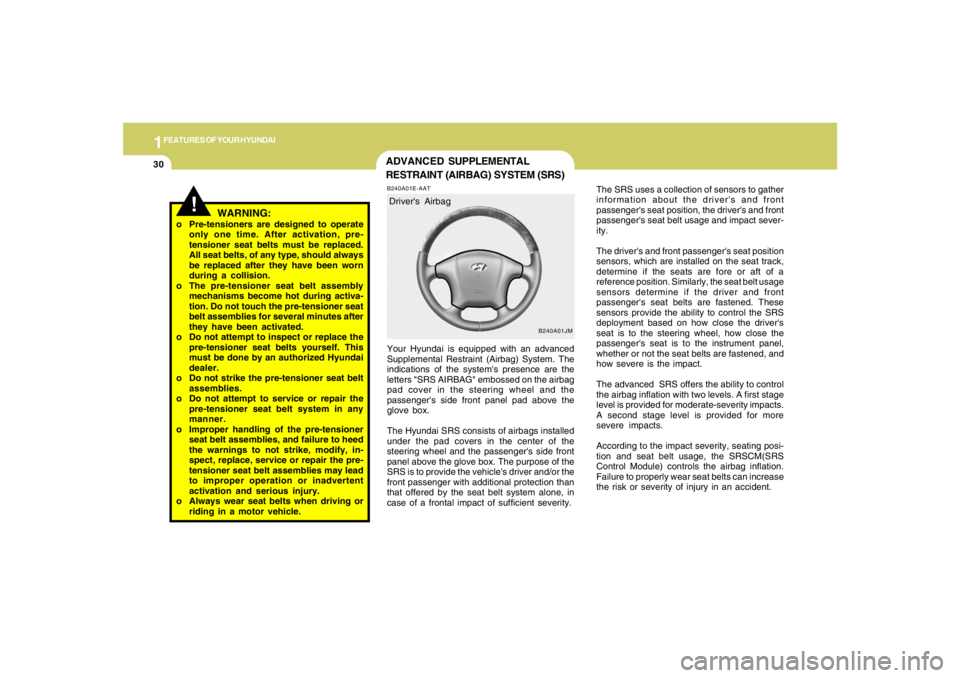
RESTRAINT (AIRBAG) SYSTEM (SRS)B240A01E-AATYour Hyundai is equipped with an advanced
Supplemental Restraint (Airbag) System. The
indications of the system's presence are the
letters "SRS AIRBAG" embossed on the airbag
pad cover in the steering wheel and the
passenger's side front panel pad above the
glove box.
The Hyundai SRS consists of airbags installed
under the pad covers in the center of the
steering wheel and the passenger's side front
panel above the glove box. The purpose of the
SRS is to provide the vehicle's driver and/or the
front passenger with additional protection than
that offered by the seat belt system alone, in
case of a frontal impact of sufficient severity.The SRS uses a collection of sensors to gather
information about the driver's and front
passenger's seat position, the driver's and front
passenger's seat belt usage and impact sever-
ity.
The driver's and front passenger's seat position
sensors, which are installed on the seat track,
determine if the seats are fore or aft of a
reference position. Similarly, the seat belt usage
sensors determine if the driver and front
passenger's seat belts are fastened. These
sensors provide the ability to control the SRS
deployment based on how close the driver's
seat is to the steering wheel, how close the
passenger's seat is to the instrument panel,
whether or not the seat belts are fastened, and
how severe is the impact.
The advanced SRS offers the ability to control
the airbag inflation with two levels. A first stage
level is provided for moderate-severity impacts.
A second stage level is provided for more
severe impacts.
According to the impact severity, seating posi-
tion and seat belt usage, the SRSCM(SRS
Control Module) controls the airbag inflation.
Failure to properly wear seat belts can increase
the risk or severity of injury in an accident.
B240A01JM
Driver's Airbag
Page 42 of 273
1
FEATURES OF YOUR HYUNDAI
31
!
CAUTION:
If the seat position sensor is not working
properly, the SRS airbag warning light on
the instrument panel will illuminate even if
there is no malfunction of the SRS airbag
system, because the SRS airbag warning
light is connected with the seat position
sensor. If the SRS airbag warning light does
not illuminate when the ignition key is
turned to the "ON" position, if it remains
illuminated after coming on for approxi-
mately 6 seconds, or if it illuminates while
the vehicle is being driven, have an autho-
rized Hyundai dealer inspect the seat posi-
tion sensor and the advanced SRS airbag
system as soon as possible.
!
WARNING:
o Modification to the seat structure can
adversely affect the seat position sensor
and cause the airbag to deploy at a
different level than should be provided.
o Do not place any objects underneath the
front seats which could damage the seat
position sensor or interfere with the
occupant classification system.
o Do not place any objects that may cause
magnetic fields near the front seats.
These may cause a malfunction of the
seat position sensor.NOTE:o Be sure to read information about the
SRS on the labels provided on the back-
side of the sun visor and in the glove box.
o Advanced airbags are combined with
pre-tensioner seat belts to help provide
enhanced occupant protection in fron-
tal crashes. Front airbags are not in-
tended to deploy in light collisions in
which protection can be provided by the
pre-tensioner seat belt.
o If you are considering modification of
your vehicle due to a disability, please
contact the Hyundai Customer Assis-
tance Center at 1-800-633-5151.
AIR
BAG
Additionally, your Hyundai is equipped with an
occupant classification system in the front
passenger's seat. The occupant classification
system detects the presence of a passenger in
the front passenger's seat and will turn off the
front passenger's airbag under certain condi-
tions. For more detail, see "Occupant Classifi-
cation System" later in this section.
!
WARNING:
o As its name implies, the SRS is designed
to work with, and be supplemental to,
the driver's and the passenger's three
point seat belt systems and is not a
substitute for them. Therefore, your seat
belts must be worn at all times. The
airbags deploy only in certain frontal
impact conditions severe enough to
cause significant injury to the vehicle
occupants.
o Sitting too close to a front airbag can
result in serious or fatal injury if the front
airbags inflate. Always sit as far back
from airbags as possible.
o Ignoring the SRS indicator light can re-
sult in serious or fatal injury if the airbags,
occupant classification system or pre-
tensioners do not work properly. Have
your car checked by a dealer as soon as
possible if the SRS warning light alerts
you to a potential problem.
o The SRS is designed to deploy the front
airbags only when an impact is suffi-
ciently severe and when the impact angle
is less than 30° from the forward longi-
tudinal axis of the vehicle. The front
airbags will not deploy in side, rear or
rollover impacts. Additionally, the
airbags will only deploy once. Seat belts
must be worn at all times.
Page 43 of 273
1FEATURES OF YOUR HYUNDAI32
B240A02JM
!
Rear impact
Side Impact
Rollover
o The driver should sit back as far as
possible while still maintaining control
of the vehicle. If you are sitting too close
to the airbag, it can cause death or seri-
ous injury when it inflates.
WARNING:
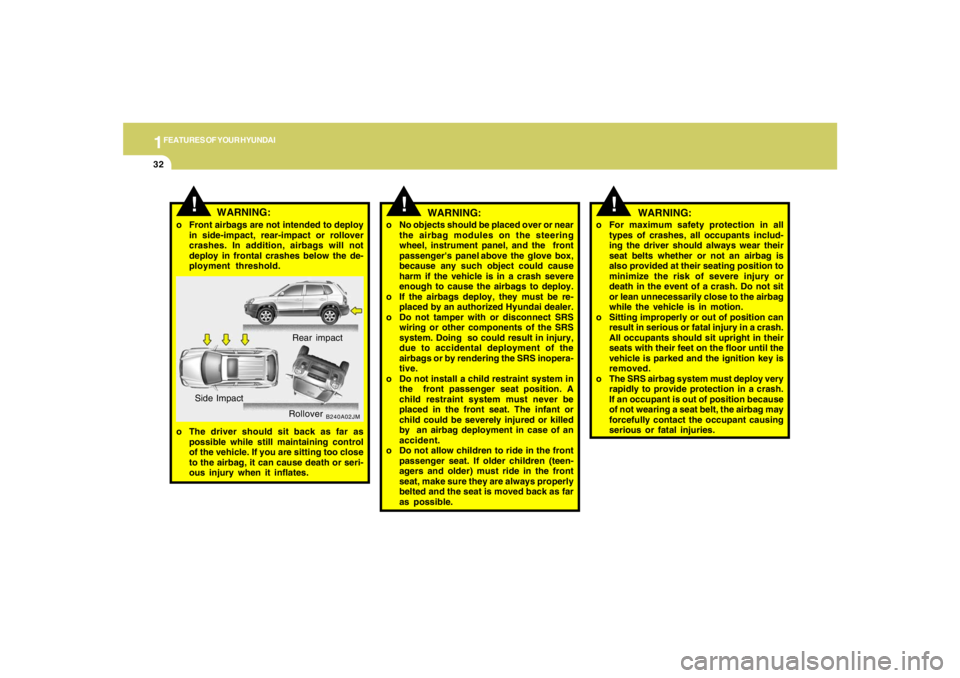
o Front airbags are not intended to deploy
in side-impact, rear-impact or rollover
crashes. In addition, airbags will not
deploy in frontal crashes below the de-
ployment threshold.
!
WARNING:
o No objects should be placed over or near
the airbag modules on the steering
wheel, instrument panel, and the front
passenger's panel above the glove box,
because any such object could cause
harm if the vehicle is in a crash severe
enough to cause the airbags to deploy.
o If the airbags deploy, they must be re-
placed by an authorized Hyundai dealer.
o Do not tamper with or disconnect SRS
wiring or other components of the SRS
system. Doing so could result in injury,
due to accidental deployment of the
airbags or by rendering the SRS inopera-
tive.
o Do not install a child restraint system in
the front passenger seat position. A
child restraint system must never be
placed in the front seat. The infant or
child could be severely injured or killed
by an airbag deployment in case of an
accident.
o Do not allow children to ride in the front
passenger seat. If older children (teen-
agers and older) must ride in the front
seat, make sure they are always properly
belted and the seat is moved back as far
as possible.o For maximum safety protection in all
types of crashes, all occupants includ-
ing the driver should always wear their
seat belts whether or not an airbag is
also provided at their seating position to
minimize the risk of severe injury or
death in the event of a crash. Do not sit
or lean unnecessarily close to the airbag
while the vehicle is in motion.
o Sitting improperly or out of position can
result in serious or fatal injury in a crash.
All occupants should sit upright in their
seats with their feet on the floor until the
vehicle is parked and the ignition key is
removed.
o The SRS airbag system must deploy very
rapidly to provide protection in a crash.
If an occupant is out of position because
of not wearing a seat belt, the airbag may
forcefully contact the occupant causing
serious or fatal injuries.
!
WARNING:
Page 46 of 273
1
FEATURES OF YOUR HYUNDAI
35
!
o The SRS can function only when the
ignition key is in the "ON" position. If the
SRS SRI does not illuminate or contin-
uously remains on after illuminating for
about 6 seconds when the ignition key
is turned to the "ON" position, or after
the engine is started, illuminates while
driving, the SRS is not working properly.
If this occurs, have your vehicle immedi-
ately inspected by your Hyundai dealer.
o Before you replace a fuse or disconnect
a battery terminal, turn the ignition key
to the "LOCK" position or remove the
ignition key. Never remove or replace the
air bag related fuse(s) when the ignition
key is in the "ON" position. Failure to
heed this warning will cause the SRS SRI
to illuminate.
WARNING:
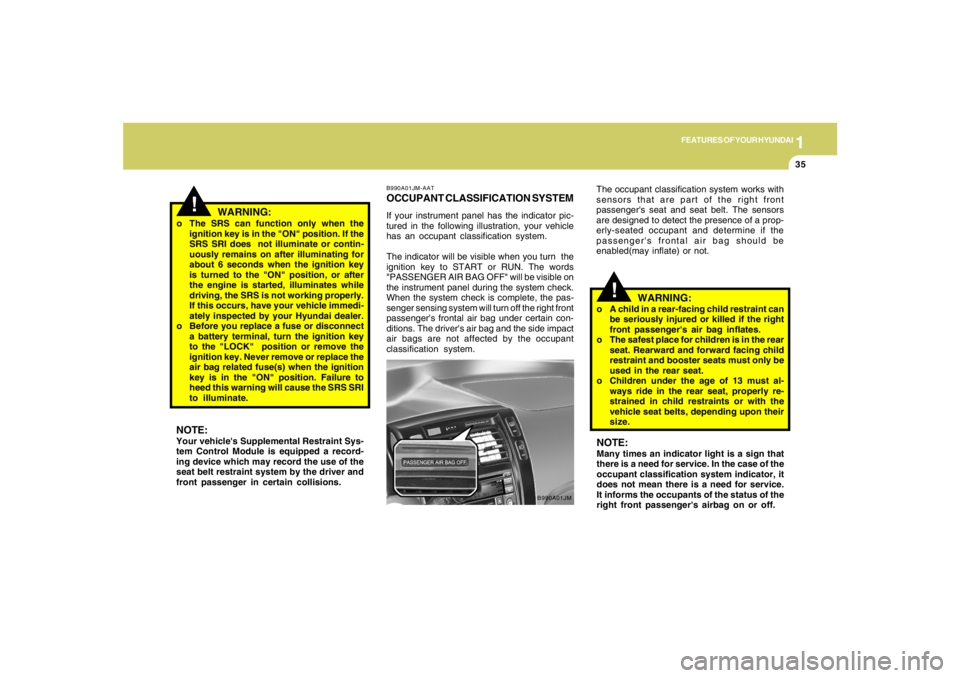
B990A01JM-AATOCCUPANT CLASSIFICATION SYSTEMIf your instrument panel has the indicator pic-
tured in the following illustration, your vehicle
has an occupant classification system.
The indicator will be visible when you turn the
ignition key to START or RUN. The words
"PASSENGER AIR BAG OFF" will be visible on
the instrument panel during the system check.
When the system check is complete, the pas-
senger sensing system will turn off the right front
passenger's frontal air bag under certain con-
ditions. The driver's air bag and the side impact
air bags are not affected by the occupant
classification system.
B990A01JM
NOTE:Your vehicle's Supplemental Restraint Sys-
tem Control Module is equipped a record-
ing device which may record the use of the
seat belt restraint system by the driver and
front passenger in certain collisions.The occupant classification system works with
sensors that are part of the right front
passenger's seat and seat belt. The sensors
are designed to detect the presence of a prop-
erly-seated occupant and determine if the
passenger's frontal air bag should be
enabled(may inflate) or not.
!
WARNING:
o A child in a rear-facing child restraint can
be seriously injured or killed if the right
front passenger's air bag inflates.
o The safest place for children is in the rear
seat. Rearward and forward facing child
restraint and booster seats must only be
used in the rear seat.
o Children under the age of 13 must al-
ways ride in the rear seat, properly re-
strained in child restraints or with the
vehicle seat belts, depending upon their
size.NOTE:Many times an indicator light is a sign that
there is a need for service. In the case of the
occupant classification system indicator, it
does not mean there is a need for service.
It informs the occupants of the status of the
right front passenger's airbag on or off.
Page 49 of 273
1FEATURES OF YOUR HYUNDAI38
!
WARNING:
!
WARNING:
o The occupant classification system can
function only when the ignition key is in
the "ON" position. If the "PASSENGER
AIR BAG OFF" indicator is illuminated
when the front passenger's seat is occu-
pied by an adult who is seated properly
(sitting upright with the seat in an up-
right position, centered on the seat cush-
ion, with the person's legs comfortably
extended, and feet on the floor), have
your vehicle immediately inspected by
your Hyundai dealer.
o If luggage or other objects are placed on
the front passenger's seat, the "Passen-
ger Airbag Off" indicator may be illumi-
nated. These conditions do not indicate
a problem.
o If an adult front seat passenger changes
their seating position(for example, not
sitting upright, sitting slouched , sitting
with legs spread, or otherwise being out
of position), the "PASSENGER AIR BAG
OFF" indicator may illuminate, and the
passenger's airbag may illuminate not
deploy in a collision. Always be sure to
sit properly in the front passenger seat
and wear the seat belt properly.o Do not modify or replace the front pas-
senger seat. Don't place or attach any-
thing on the front passenger seat. This
can adversely affect the occupant clas-
sification system.
o Do not install accessory seat covers on
the front passenger seats.
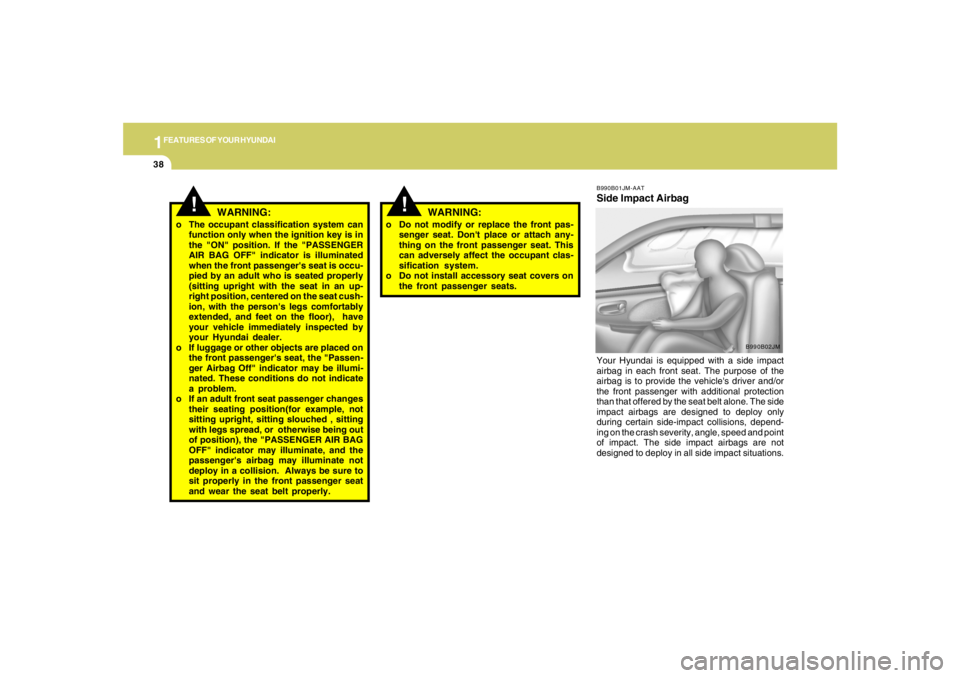
B990B01JM-AATSide Impact AirbagYour Hyundai is equipped with a side impact
airbag in each front seat. The purpose of the
airbag is to provide the vehicle's driver and/or
the front passenger with additional protection
than that offered by the seat belt alone. The side
impact airbags are designed to deploy only
during certain side-impact collisions, depend-
ing on the crash severity, angle, speed and point
of impact. The side impact airbags are not
designed to deploy in all side impact situations.
B990B02JM
Page 52 of 273
1
FEATURES OF YOUR HYUNDAI
41
B240D01JM-AATAdditional Safety PrecautionsoNever let passengers ride in the cargo
area (trunk) or on top of a folded-down
back seat. All occupants should sit upright,
fully back in their seats with their seat belts
on and their feet on the floor.
oPassengers should not move out of or
change seats while the vehicle is mov-
ing. A passenger who is not wearing a seat
belt during a crash or emergency stop can
be thrown against the inside of the vehicle,
against other occupants, or out of the ve-
hicle.
oEach seat belt is designed to restrain one
occupant. If more than one person uses the
same seat belt, they could be seriously
injured or killed in a collision.
oDo not use any accessories on seat
belts. Devices claiming to improve occu-
pant comfort or reposition the seat belt can
reduce the protection provided by the seat
belt and increase the chance of serious
injury in a crash.
oPassengers should not place hard or
sharp objects between themselves and
the airbags. Carrying hard or sharp objects
on your lap or in your mouth can result in
injuries if an airbag inflates.oKeep occupants away from the airbag
covers. All occupants should sit upright, fully
back in their seats with their seat belts on and
their feet on the floor. If occupants are too
close to the airbag covers, they could be
injured if the airbags inflate.
oDo not attach or place objects on or near
the airbag covers. Any object attached to
or placed on the front or side impact airbag
covers could interfere with the proper opera-
tion of the airbags.
oDo not modify the front seats. Modifica-
tion of the front seats could interfere with the
operation of the supplemental restraint sys-
tem sensing components or side impact
airbags.
oDo not place items under the front seats.
Placing items under the front seats could
interfere with the operation of the supple-
mental restraint system sensing compo-
nents and wiring harnesses.
oNever hold an infant or child on your lap.
The infant or child could be seriously injured
or killed in the event of a crash. All infants and
children should be properly restrained in
appropriate child safety seats or seat belts
in the rear seat.
!
WARNING:
o Sitting improperly or out of position can
result in serious injury or death in a
crash.
o Always sit upright, fully back in the seat,
with your seat belt on, and your feet on
the floor.Adding Equipment to or Modifying Your
Airbag-Equipped Vehicle.If you modify your vehicle by changing your
vehicle's frame, bumper system, front end or
side sheet metal or ride height, this may affect
the operation of your vehicle's airbag system.
Page 176 of 273
2
DRIVING YOUR HYUNDAI
30
NOTE:
o Overloading your vehicle may
cause damage. Repairs would not
be covered by your warranty. Do
not overload your vehicle.
o Using heavier suspension com-
ponents to get added durability
might not change your weight rat-
ings. Ask your dealer to help you
load your vehicle the right way.
The label will help you decide how much
cargo and installed equipment your
vehicle can carry.
If you carry items inside your vehicle –
like suitcases, tools, packages, or any-
thing else – they more as fast as the
vehicle goes. If you have to stop or turn
quickly, or if there is a crash, the items
will keep going and can cause an injury
if they strikes the driver or a passenger.
!
WARNING:
Items you carry inside your vehicle
can strike and injure people in a
sudden stop or turn, or in a crash.
o Put things in the cargo area of
your vehicle. Try to spread the
weight evenly.
o Never stack items, like suitcases,
inside the vehicle above the tops
of the seats.
o Do not leave an unsecured child
restraint in your vehicle.
o When you carry something inside
the vehicle, secure it.
o Do not drive with a seat folded
down unless necessary.
Page 253 of 273

8
CONSUMER INFORMATION & REPORTING SAFETY DEFECTS6
I030D01JM-AATTIRE TERMINOLOGY AND DEFINI-
TIONS
Air Pressure: The amount of air inside
the tire pressing outward on the tire. Air
pressure is expressed in pounds per
square inch (psi) or kilopascal (kPa).
Accessory Weight: This means the
combined weight of optional accesso-
ries. Some examples of optional ac-
cessories are, automatic transmission,
power seats, and air conditioning.
Aspect Ratio: The relationship of a
tire's height to its width.
Belt: A rubber coated layer of cords that
is located between the plies and the
tread. Cords may be made from steel or
other reinforcing materials.
Bead: The tire bead contains steel
wires wrapped by steel cords that hold
the tire onto the rim.
Bias Ply Tire: A pneumatic tire in which
the plies are laid at alternate angles
less than 90 degrees to the centerline of
the tread.Cold Tire Pressure: The amount of air
pressure in a tire, measured in pounds
per square inch (psi) or kilopascals
(kPa) before a tire has built up heat from
driving.
Curb Weight: This means the weight of
a motor vehicle with standard and op-
tional equipment including the maxi-
mum capacity of fuel, oil and coolant,
but without passengers and cargo.
DOT Markings: A code molded into the
sidewall of a tire signifying that the tire
is in compliance with the U.S. Depart-
ment of Transportation motor vehicle
safety standards. The DOT code in-
cludes the Tire Identification Number
(TIN), an alphanumeric designator which
can also identify the tire manufacturer,
production plant, brand and date of
production.
GVWR: Gross Vehicle Weight Rating
GAWR FRT: Gross Axle Weight Rating
for the front Axle.
GAWR RR: Gross Axle Weight Rating
for the rear axle. 6. Maximum load rating
This number indicates the maximum
load in kilograms and pounds that
can be carried by the tire. When
replacing the tires on the vehicle,
always use a tire that has the same
load rating as the factory installed
tire.
7. Uniform Tire Quality Grading
(UTQG):
Tire manufacturers are required to
grade tires based on three perfor-
mance factors: treadwear, traction
and temperature resistance. For more
information, see Uniform Tire Qual-
ity Grading on page 8-12.
Page 268 of 273

10
INDEX
3
Consumer Information......................................................................8-12
Cooling Fans.....................................................................................6-24
Corrosion protection
Cleaning the interior....................................................................... 4-5
Protecting your Hyundai from corrosion....................................... 4-2
Washing and waxing...................................................................... 4-3
Cruise Control...................................................................................1-80
D
Defrosting / Defogging ......................................................................1-91
Door
Central door lock............................................................................ 1-7
Door locks...................................................................................... 1-4
Front door edge warning light ......................................................1-79
Drink Holder ......................................................................................1-59
Drive Belts.........................................................................................6-21
Driving
Driving for economy .....................................................................2-19
Smooth cornering.........................................................................2-20
Winter driving...............................................................................2-20
E
Emission Control System ................................................................... 7-2
Engine
Before starting the engine .............................................................. 2-4
Compartment................................................................................. 6-2
Coolant........................................................................................... 6-8
Coolant temperature gauge .........................................................1-48
If the engine overheats .................................................................. 3-4Number........................................................................................... 8-2
Oil ................................................................................................... 6-5
Starting........................................................................................... 2-5
Engine Exhaust Can Be Dangerous .................................................. 2-2
F
4WD Lock System ............................................................................2-18
Fan Speed Control............................................................................1-85
Floor Mat Anchor ..............................................................................1-78
Fog Light
Front.............................................................................................1-56
Front Seats
Adjustable front seats ..................................................................1-12
Adjustable headrests...................................................................1-13
Adjusting seat forward and rearward ..........................................1-12
Adjusting seatback angle .............................................................1-12
Fuel
Capacity......................................................................................... 9-2
Gauge...........................................................................................1-48
Recommendations......................................................................... 1-2
Fuel Filler Lid
Remote release............................................................................1-75
Full-time 4WD Operation..................................................................2-15
Fuses ................................................................................................6-21
Fuse panel description......................................................................6-35
G
General Checks.................................................................................. 6-4
Glove Box..........................................................................................1-64