wheel HYUNDAI TUCSON 2005 Service Manual
[x] Cancel search | Manufacturer: HYUNDAI, Model Year: 2005, Model line: TUCSON, Model: HYUNDAI TUCSON 2005Pages: 273, PDF Size: 11.53 MB
Page 225 of 273
6
DO-IT-YOURSELF MAINTENANCE
19
G150A01JM
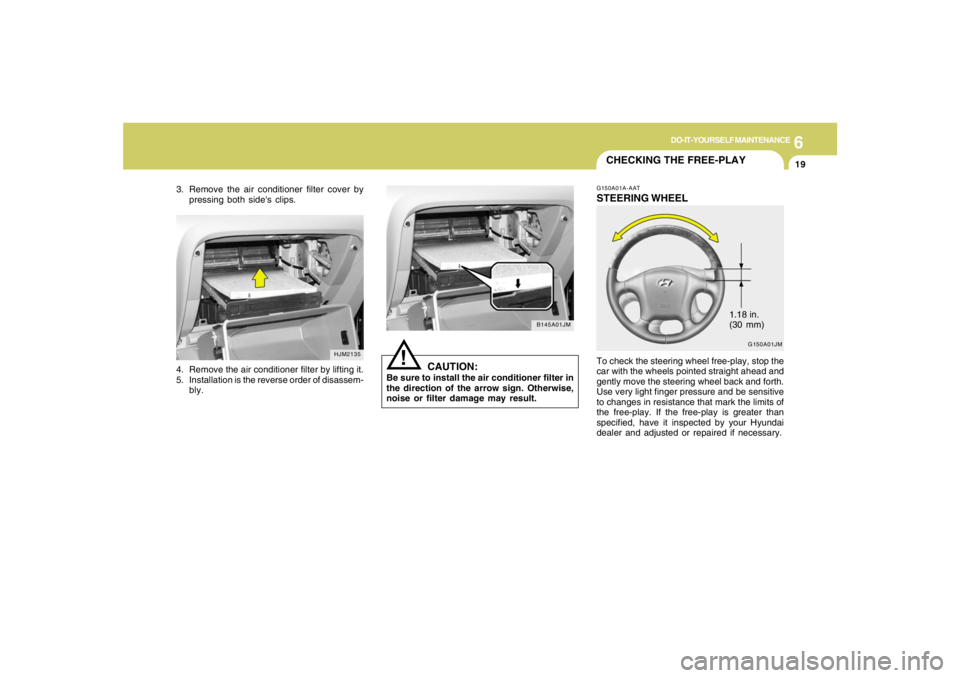
3. Remove the air conditioner filter cover by
pressing both side's clips.
HJM2135
!
B145A01JM
4. Remove the air conditioner filter by lifting it.
5. Installation is the reverse order of disassem-
bly.
CAUTION:
Be sure to install the air conditioner filter in
the direction of the arrow sign. Otherwise,
noise or filter damage may result.
CHECKING THE FREE-PLAYG150A01A-AATSTEERING WHEELTo check the steering wheel free-play, stop the
car with the wheels pointed straight ahead and
gently move the steering wheel back and forth.
Use very light finger pressure and be sensitive
to changes in resistance that mark the limits of
the free-play. If the free-play is greater than
specified, have it inspected by your Hyundai
dealer and adjusted or repaired if necessary.1.18 in.
(30 mm)
Page 246 of 273
7
EMISSION CONTROL SYSTEMS2
EMISSION CONTROL SYSTEM
H010D01A-AAT3. Exhaust Emission Control SystemThe Exhaust Emission Control System is a
highly effective system which controls exhaust
emissions while maintaining good vehicle
performace.
H010B01A-AAT1. Crankcase Emission Control
SystemThe positive crankcase ventilation system is
employed to prevent air pollution caused by
blow-by gases being emitted from the crank-
case. This system supplies filtered air to the
crankcase through the air intake hose. Inside
the crankcase, the fresh air mixes with blow-by
gases, which then pass through the PCV valve
and into the induction system.
H010A02O-AATYour Hyundai is equipped with an emission
control system to meet all requirements of the
U.S. Environmental Protection Agency or Cali-
fornia Air Resources Board.
There are three emission control systems which
are as follows.
(1) Crankcase emission control system
(2) Evaporative emission control system
(3) Exhaust emission control system
In order to assure the proper function of the
emission control systems, it is recommended
that you have your car inspected and main-
tained by an authorized Hyundai dealer in ac-
cordance with the maintenance schedule in this
manual.
Caution for the Inspection and Maintenance
Test (V6 Vehicle with Traction Control Sys-
tem)
o To prevent the vehicle from misfiring
during dynamometer testing, discon-
nect the ABS connector in the engine
compartment. (2.7 V6 only)
o For more information, see shop manual
(Wheel Speed Sensor).
o After dynamometer testing is completed,
erase the ABS/TCS DTC (Diagnotic
Trouble Code) with a GST (Generic Scan
Tool) or Hi-Scan Pro.
CanisterFuel vapors generated inside the fuel tank are
absorbed and stored in the canister. When the
engine is running, the fuel vapors absorbed in
the canister are drawn into the induction system
through the purge control solenoid valve.Purge Control Solenoid Valve (PCSV)The purge control solenoid valve is controlled
by the Engine Control Module (ECM); when the
engine coolant temperature is low during idling,
the PCSV closes so that evaporated fuel is not
taken into the engine. After the engine warms-
up during ordinary driving, the PCSV opens to
introduce evaporated fuel to the engine.
H010C01S-AAT2. Evaporative Emission Control (Includ-
ing ORVR: Onboard Refueling Vapor
Recovery) SystemThe Evaporative Emission Control System is
designed to prevent fuel vapors from escaping
into the atmosphere.
(The ORVR system is designed to allow the
vapors from the fuel tank to be loaded into a
canister while refueling at the gas station, pre-
venting the escape of fuel vapors into the
atmosphere.)
Page 252 of 273

8
CONSUMER INFORMATION & REPORTING SAFETY DEFECTS
5
1. Manufacturer or Brand name
o Manufacturer or Brand name is
shown.
2. Tire size (example: P235/60R16 99T)
o The "P" indicates the tire is de-
signed for passenger vehicles. A
"T" is the designation for a tempo-
rary spare tire.
o Three-digit number (235): This num-
ber gives the width in millimeters
of the tire from sidewall edge to
sidewall edge.
o Two-digit number (60): This num-
ber, known as the aspect ratio,
gives the tire's ratio of height to
width.
o R: The "R" stands for radial.
o Two-digit number (16): This num-
ber is the wheel or rim diameter in
inches.
o Two (or three) digit number (99):
This number is the tire's load in-
dex. It is a measurement of how
much weight each tire can sup-
port.o T: Speed Rating. The speed rating
denotes the speed at which a tire is
designed to be driven for extended
periods of time. The ratings range
from "A" to "Z" (98 to 186 MPH).
3. TIN (Tire Identification Number) for
new tire (example: DOT XX XX XXX
XXXX)
o DOT: Abbreviation for the "Depart-
ment of Transportation". The sym-
bol can be placed above, below or
to the left or right of the Tire Iden
tification Number. Indicates tire is
in compliance with the U.S. De-
partment of Transportation Motor
Vehicle Safety Standards.
o 1st two-digit code: Manufacturer's
identification mark
o 2nd two-digit code: Tire size
o 3rd three-digit code: Tire type code
(Optional)
o 4th four-digit code: Date of Manu-
factureo Four numbers represent the week
and year the tire was built. For
example, the numbers 3105 means
the 31st week of 2005.
4. Tire ply composition and material
The number of layers or plies of
rubbercoated fabric in the tire. Tire
manufacturers also must indicate
the materials in the tire, which in-
clude steel, nylon, polyester, and
others. The letter "R" means radial
ply construction; the letter "D" means
diagonal or bias ply construction;
and the letter "B" means belted-bias
ply construction.
5. Maximum permissible inflation
pressure
This number is the greatest amount
of air pressure that should be put in
the tire. Do not exceed the maximum
permissible inflation pressure. Refer
to the Tire and Loading Information
label for recommended inflation pres-
sure.
Page 255 of 273

8
CONSUMER INFORMATION & REPORTING SAFETY DEFECTS8
Vehicle Capacity Weight: The number
of designated seating positions multi-
plied by 150 lbs. (68 kg) plus the rated
cargo and luggage load
Vehicle Maximum Load on the Tire:
Load on an individual tire due to curb
and accessory weight plus maximum
occupant and cargo weight.
Vehicle Normal Load on the Tire:
That load on an individual tire that is
determined by distributing to each axle
its share of the curb weight, accessory
weight, and normal occupant weight
and driving by 2.
Vehicle Placard: A label permanently
attached to a vehicle showing the origi-
nal equipment tire size and recom-
mended inflation pressure
I040A01O-AATSNOW TIRES
If you equip your car with snow tires,
they should be the same size and have
the same load capacity as the original
tires. Snow tires should be installed on
all four wheels; otherwise, poor han-
dling may result.
Snow tires should carry 4 psi (28 kPa)
more air pressure than the pressure
recommended for the standard tires on
the tire label on the driver's side of the
center pillar , or up to the maximum
pressure shown on the tire sidewall
whichever is less.
Do not drive faster than 75 mph (120
km/h) when your car is equipped with
snow tires.
I040B01JM-AATALL SEASON TIRES
Hyundai specifies all season tires on
some models to provide good perfor-
mance for use all year round, including
snowy and icy road conditions. All sea-
son tires are identified by ALL SEASON
and/or M+S (Mud and Snow) on the tire
sidewall. Snow tires have better snow
traction than all season tires an may be
more appropriate in some areas.I040C01JM-AATSUMMER TIRES
Hyundai specifies summer tires on some
models to provide superior performance
on dry roads. Summer tire performance
is substantrally reduced in snow and ice.
Summer tires do not have the tire trac-
tion rating M+S (Mud and Snow) on the
tire side wall. if you plan to operate your
vehicle in snowy or icy conditions.
Hyundai recommends the use of snow
tires or all season tires on all four wheels.
Page 256 of 273
8
CONSUMER INFORMATION & REPORTING SAFETY DEFECTS
9
HEF-241I070A01A-AAT
TIRE BALANCING
A tire that is out of balance may affect
handling and tire wear. The tires on your
Hyundai were balanced before the car
was delivered but may need balancing
again during the years you own the car.
Whenever a tire is dismounted for re-
pair, it should be rebalanced before
being reinstalled on the car.
!
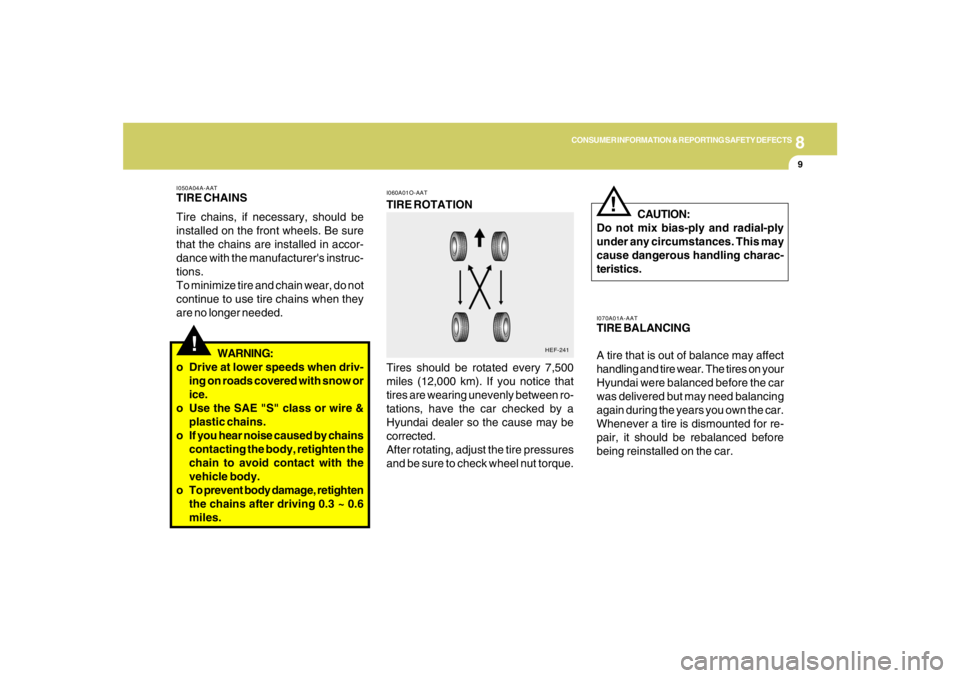
I060A01O-AATTIRE ROTATION
Tires should be rotated every 7,500
miles (12,000 km). If you notice that
tires are wearing unevenly between ro-
tations, have the car checked by a
Hyundai dealer so the cause may be
corrected.
After rotating, adjust the tire pressures
and be sure to check wheel nut torque.CAUTION:
Do not mix bias-ply and radial-ply
under any circumstances. This may
cause dangerous handling charac-
teristics.
!
I050A04A-AATTIRE CHAINS
Tire chains, if necessary, should be
installed on the front wheels. Be sure
that the chains are installed in accor-
dance with the manufacturer's instruc-
tions.
To minimize tire and chain wear, do not
continue to use tire chains when they
are no longer needed.
WARNING:
o Drive at lower speeds when driv-
ing on roads covered with snow or
ice.
o Use the SAE "S" class or wire &
plastic chains.
o If you hear noise caused by chains
contacting the body, retighten the
chain to avoid contact with the
vehicle body.
o To prevent body damage, retighten
the chains after driving 0.3 ~ 0.6
miles.
Page 257 of 273
8
CONSUMER INFORMATION & REPORTING SAFETY DEFECTS
10
!
WARNING:
o Driving on worn-out tires is dan-
gerous! Worn-out tires can cause
loss of braking effectiveness,
steering control and traction. When
replacing tires, never mix radial
and bias ply tires on the same car.
If you replace radial tires with bias-
ply tires, they must be installed in
sets of four.
o Wheels that do not meet Hyundai's
dimensional specifications may
fit poorly and result in damage to
the vehicle, including broken
wheel studs.
HJM5031 I090A02JM-AAT
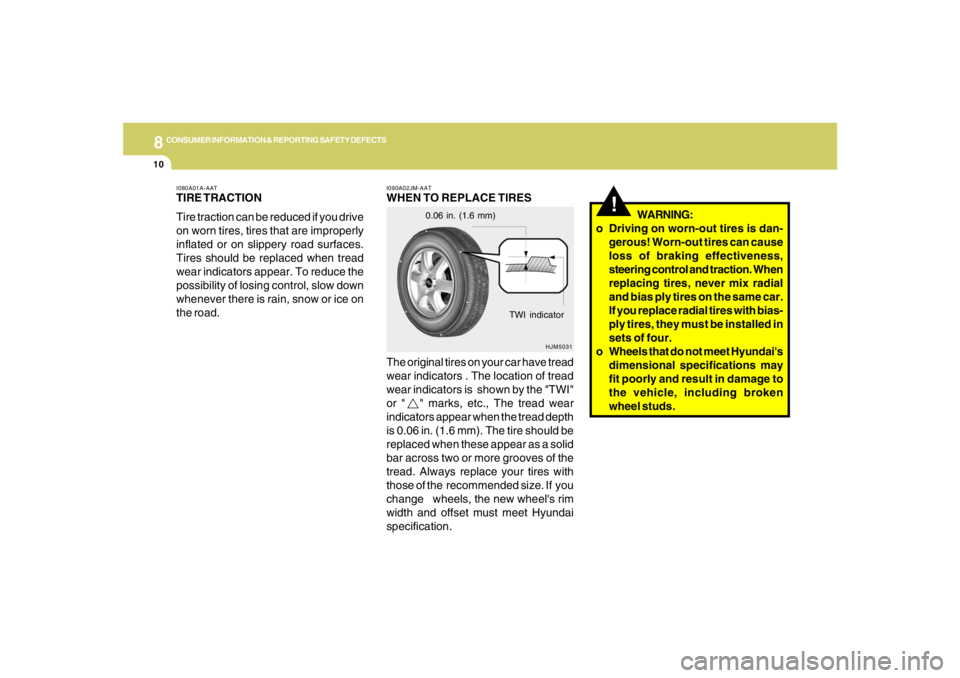
WHEN TO REPLACE TIRES
The original tires on your car have tread
wear indicators . The location of tread
wear indicators is shown by the "TWI"
or " " marks, etc., The tread wear
indicators appear when the tread depth
is 0.06 in. (1.6 mm). The tire should be
replaced when these appear as a solid
bar across two or more grooves of the
tread. Always replace your tires with
those of the recommended size. If you
change wheels, the new wheel's rim
width and offset must meet Hyundai
specification.
TWI indicator 0.06 in. (1.6 mm)
I080A01A-AATTIRE TRACTION
Tire traction can be reduced if you drive
on worn tires, tires that are improperly
inflated or on slippery road surfaces.
Tires should be replaced when tread
wear indicators appear. To reduce the
possibility of losing control, slow down
whenever there is rain, snow or ice on
the road.
Page 258 of 273
8
CONSUMER INFORMATION & REPORTING SAFETY DEFECTS
11
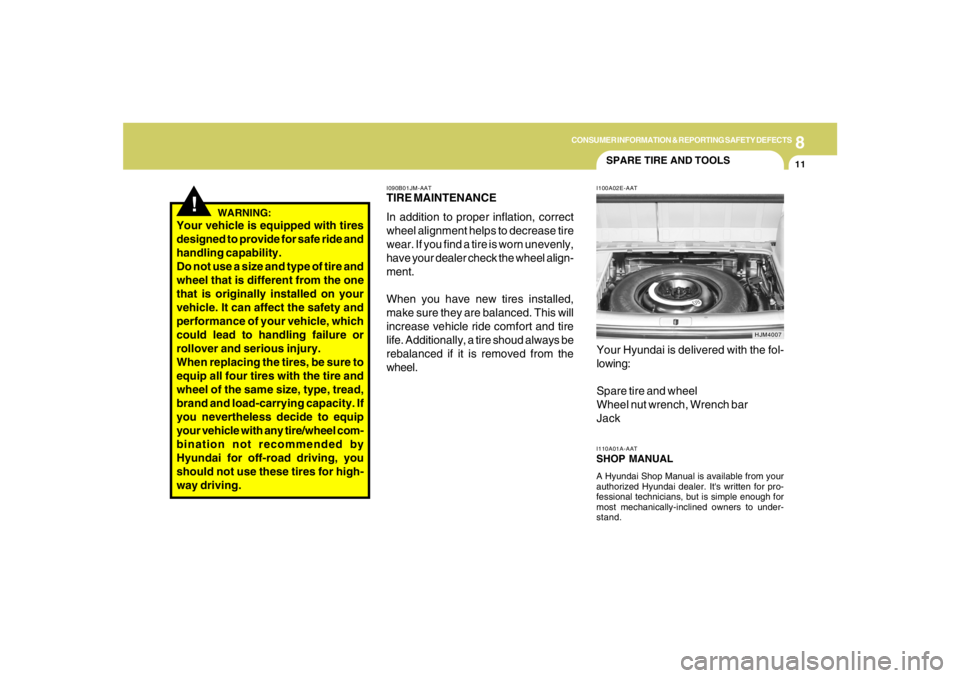
SPARE TIRE AND TOOLSI100A02E-AATYour Hyundai is delivered with the fol-
lowing:
Spare tire and wheel
Wheel nut wrench, Wrench bar
Jack
HJM4007
I110A01A-AAT
SHOP MANUALA Hyundai Shop Manual is available from your
authorized Hyundai dealer. It's written for pro-
fessional technicians, but is simple enough for
most mechanically-inclined owners to under-
stand.
I090B01JM-AATTIRE MAINTENANCE
In addition to proper inflation, correct
wheel alignment helps to decrease tire
wear. If you find a tire is worn unevenly,
have your dealer check the wheel align-
ment.
When you have new tires installed,
make sure they are balanced. This will
increase vehicle ride comfort and tire
life. Additionally, a tire shoud always be
rebalanced if it is removed from the
wheel.
!
WARNING:
Your vehicle is equipped with tires
designed to provide for safe ride and
handling capability.
Do not use a size and type of tire and
wheel that is different from the one
that is originally installed on your
vehicle. It can affect the safety and
performance of your vehicle, which
could lead to handling failure or
rollover and serious injury.
When replacing the tires, be sure to
equip all four tires with the tire and
wheel of the same size, type, tread,
brand and load-carrying capacity. If
you nevertheless decide to equip
your vehicle with any tire/wheel com-
bination not recommended by
Hyundai for off-road driving, you
should not use these tires for high-
way driving.
Page 260 of 273
8
CONSUMER INFORMATION & REPORTING SAFETY DEFECTS
13
Traction AA, A, B, C - The traction
grades, from highest to lowest, are AA,
A, B, and C. Those grades represent
the tire's ability to stop on wet pave-
ment as measured under controlled
conditions on specified government test
surfaces of asphalt and concrete. A tire
marked C may have poor traction per-
formance.
!
WARNING:
The traction grade assigned to this
tire is based on straight-ahead brak-
ing traction tests, and does not in-
clude acceleration, cornering, hy-
droplaning, or peak traction charac-
teristics.Temperature A, B, C - The tempera-
ture grades are A (the highest), B, and
C, representing the tire's resistance to
the generation of heat and
its ability to dissipate heat when tested
under controlled conditions on a speci-
fied indoor laboratory test wheel. Sus-
tained high temperature can cause the
material of the tire to degenerate and
reduce tire life, and excessive tempera-
ture can lead to sudden tire failure. The
grade C corresponds to a level of perfor-
mance which all passenger car tires
must meet under the Federal Motor
Vehicle Safety Standard No. 109.
Grades B and A represent higher levels
of performance on the laboratory test
wheel than the minimum required by
law.
!
WARNING:
The temperature grade for this tire is
established for a tire that is properly
inflated and not overloaded. Exces-
sive speed, underinflation, or exces-
sive loading, either separately or in
combination, can cause heat buildup
and possible tire failure.
Uniform Tire Quality Grading - Qual-
ity grades can be found on the tire
sidewall between the tread shoulder
and the maximum section width.
For example :
Treadwear 200 Traction AA Tempera-
ture A
Page 263 of 273

9
VEHICLE SPECIFICATIONS2
J010A01JM-AATMEASUREMENT
170 (4,325)
70 (1,795)
66 (1,680)
103 (2,630)
60 (1,540)
60 (1,540) Overall Length
Overall Width
Overall Height (Unladen)
Wheel base
Wheel tread
Front
Rear
J060A01JM-AATFUEL SYSTEMJ020A01JM-AATPOWER STEERING
in. (mm)
Engine
2.7L
2.0L
Fuel tank capacity
17 us.gal (65L)
15 us.gal (58L)
Type
Wheel free play
Rack stroke
Oil pump typeRack and pinion
0 ~ 1.18 in. (0 ~ 30 mm)
5.5 in. (142 mm)
Vane type
J030A01JM-AATTIREStandard
Option
Spare
215/65R16
235/60R16
T155/90R16 (Temporary)
2WD
4WD
J050A01JM-AATBRAKE
Dual hydraulic with brake booster
Ventilated disc
Cable operated on rear wheel Type
Front brake type
Rear brake type
Parking brake
Battery
AlternatorJ040A01JM-GATELECTRICAL
MF 60 AH, MF 68 AH
2.0L
2.7L90A (13.5V)
120A (13.5V)
CBS (With ABS)
ABS
CBS, ABSDrum type
Disc type
Disc type
Page 270 of 273

10
INDEX
5
R
Rear Seat
Adjusting seatback angle .............................................................1-15
Folding rear seatback ..................................................................1-15
Rear Window Defroster Switch ........................................................1-57
Reporting Safety Defects .................................................................8-14
Risk of Rollover................................................................................... 2-3
Roof Rack.........................................................................................1-74
S
Seat
Front.............................................................................................1-12
Rear..............................................................................................1-15
Seat warmer .................................................................................1-14
Seat Belts
3-point system.............................................................................1-20
Pretensioner seat belt ..................................................................1-28
Adjusting your seat belt ...............................................................1-21
Care of seat belts .........................................................................1-19
Precautions..................................................................................1-17
Shop Manual ......................................................................................8-11
Shopping Bag Holders......................................................................1-70
Sound
Brake pad warning sound ............................................................1-48
Spark Plugs .......................................................................................6-10
Spectacle Case.................................................................................1-64
Speedometer.....................................................................................1-49
Starting Procedure.............................................................................. 2-6Steering Wheel Free play .................................................................6-19
Steering Wheel Tilt Lever ..................................................................1-79
Stereo Sound System ....................................................................1-101
Sunroof..............................................................................................1-60
Sun Visor...........................................................................................1-78
T
Tachometer.......................................................................................1-49
Tail Gate............................................................................................1-69
Tail gate window...........................................................................1-69
Theft-Alarm System............................................................................ 1-8
Ticket Holder.....................................................................................1-79
Tires
Balancing........................................................................................ 8-9
Chains............................................................................................ 8-9
Changing a flat tire ......................................................................... 3-7
If you have a flat tire ....................................................................... 3-6
Information...................................................................................... 8-2
Maintenance.................................................................................8-11
Pressure......................................................................................... 8-3
Replacement................................................................................8-10
Rotation.......................................................................................... 8-9
Sidewall Labeling............................................................................ 8-4
Snow tires....................................................................................... 8-8
Spare tire........................................................................................ 3-5
Terminology and Definition ............................................................ 8-6