belt HYUNDAI TUCSON 2005 Workshop Manual
[x] Cancel search | Manufacturer: HYUNDAI, Model Year: 2005, Model line: TUCSON, Model: HYUNDAI TUCSON 2005Pages: 273, PDF Size: 11.53 MB
Page 223 of 273
6
DO-IT-YOURSELF MAINTENANCE
17
!
G130B02A-AATTo Replace the FluidRecommended brake fluid conforming to DOT
3 or DOT 4 specification should be used. The
reservoir cap must be fully tightened to avoid
contamination from foreign matter or moisture.NOTE:Do not allow any other liquids to contami-
nate the brake fluid. Seal damage will result.
WARNING:
Use caution when handling brake fluid. It
can damage your vision if you get it in your
eyes. It will also damage your vehicle's
paint if spilled on it and not removed imme-
diately.
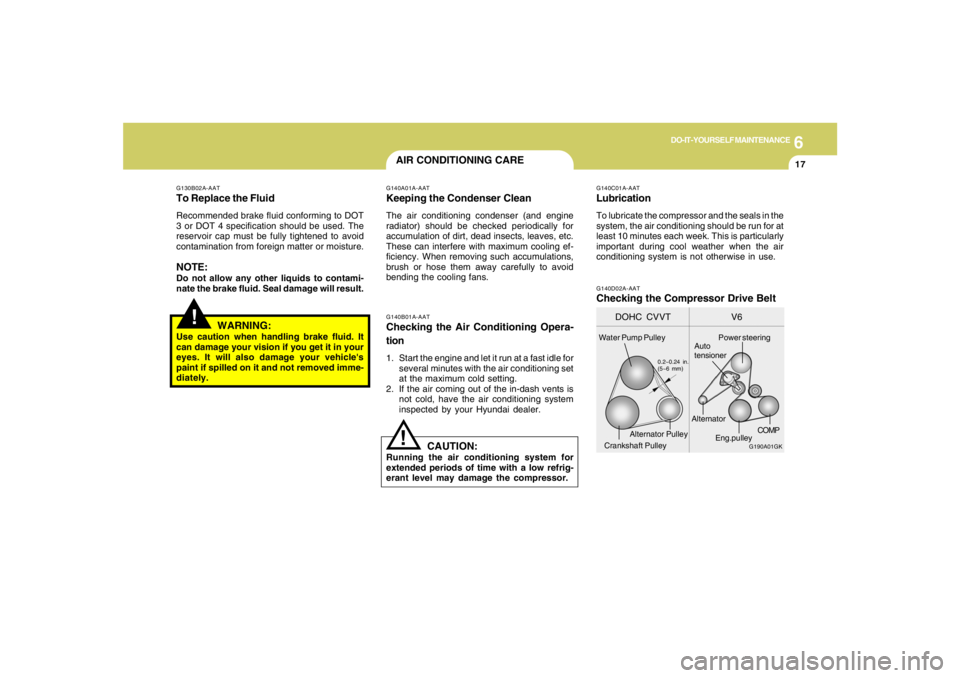
G190A01GK
DOHC CVVT V6
Water Pump Pulley
0.2~0.24 in.
(5~6 mm)
Power steering
COMP
Auto
tensioner
Alternator Pulley
Crankshaft PulleyAlternator
Eng.pulley
AIR CONDITIONING CARE
G140D02A-AATChecking the Compressor Drive Belt
!
G140A01A-AATKeeping the Condenser CleanThe air conditioning condenser (and engine
radiator) should be checked periodically for
accumulation of dirt, dead insects, leaves, etc.
These can interfere with maximum cooling ef-
ficiency. When removing such accumulations,
brush or hose them away carefully to avoid
bending the cooling fans.
G140C01A-AATLubricationTo lubricate the compressor and the seals in the
system, the air conditioning should be run for at
least 10 minutes each week. This is particularly
important during cool weather when the air
conditioning system is not otherwise in use.
G140B01A-AATChecking the Air Conditioning Opera-
tion1. Start the engine and let it run at a fast idle for
several minutes with the air conditioning set
at the maximum cold setting.
2. If the air coming out of the in-dash vents is
not cold, have the air conditioning system
inspected by your Hyundai dealer.
CAUTION:
Running the air conditioning system for
extended periods of time with a low refrig-
erant level may damage the compressor.
Page 224 of 273
6
DO-IT-YOURSELF MAINTENANCE
18
When the air conditioning is being used regu-
larly, the compressor drive belt tension should
be checked at least once a month with the
engine turned off.
To check the drive belt tension, press down on
the belt halfway between the engine crankshaft
and compressor pulleys. Pressing with your
finger, you should not be able to deflect this belt
anymore than 1/3 of an inch. If the belt is too
loose, have it adjusted by your Hyundai dealer.
CHANGING THE AIR
CONDITIONER FILTERB145A02JM-GAT(For Evaporator and Blower Unit)
(If Installed)The air conditioner filter is located in front of the
evaporator unit behind the glove box.
It helps to decrease the amount of pollutants
entering the car.
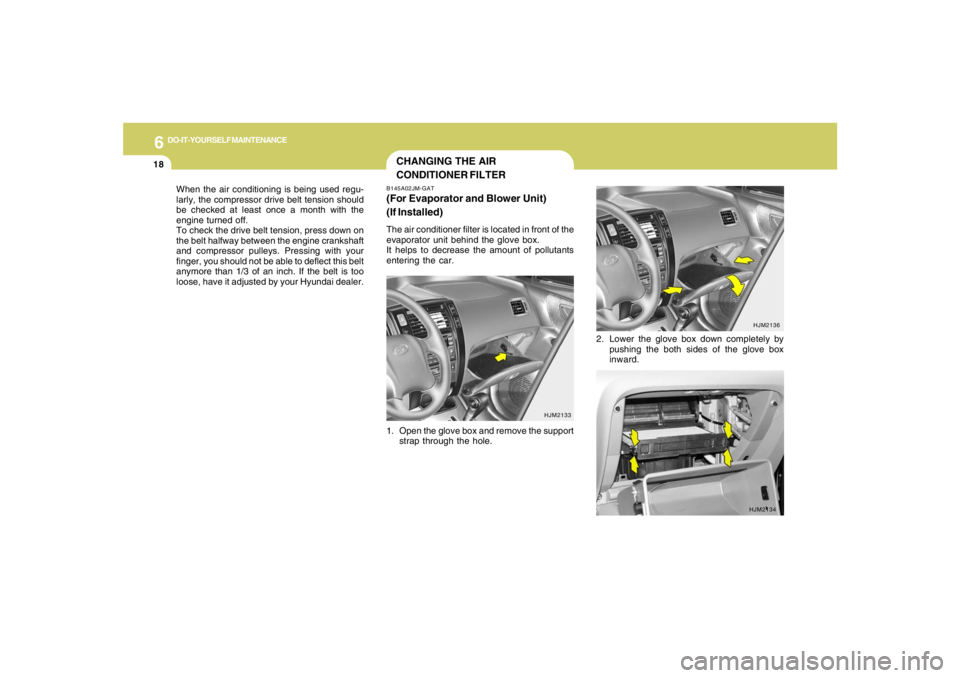
2. Lower the glove box down completely by
pushing the both sides of the glove box
inward.
1. Open the glove box and remove the support
strap through the hole.
HJM2133HJM2136
HJM2134
Page 227 of 273
6
DO-IT-YOURSELF MAINTENANCE
21
G190A01GK
DOHC CVVT V6
Water Pump Pulley
0.2~0.24 in.
(5~6 mm)
Power steering
COMP
Auto
tensioner
Alternator Pulley
Crankshaft PulleyAlternator
Eng.pulley
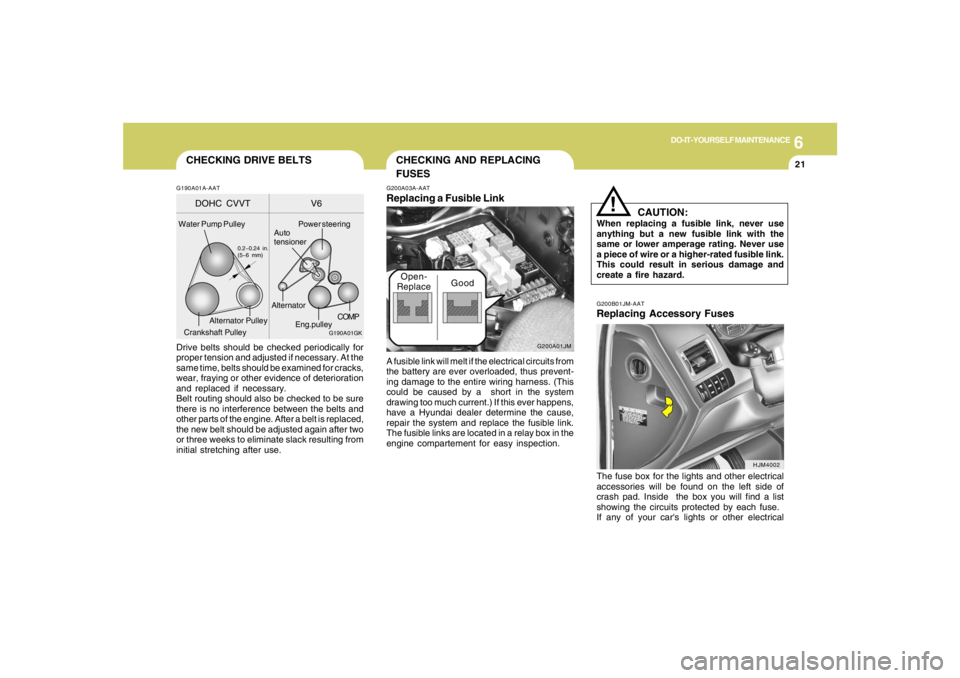
CHECKING DRIVE BELTSDrive belts should be checked periodically for
proper tension and adjusted if necessary. At the
same time, belts should be examined for cracks,
wear, fraying or other evidence of deterioration
and replaced if necessary.
Belt routing should also be checked to be sure
there is no interference between the belts and
other parts of the engine. After a belt is replaced,
the new belt should be adjusted again after two
or three weeks to eliminate slack resulting from
initial stretching after use.G190A01A-AAT
CHECKING AND REPLACING
FUSES
!
G200B01JM-AATReplacing Accessory FusesCAUTION:When replacing a fusible link, never use
anything but a new fusible link with the
same or lower amperage rating. Never use
a piece of wire or a higher-rated fusible link.
This could result in serious damage and
create a fire hazard.
The fuse box for the lights and other electrical
accessories will be found on the left side of
crash pad. Inside the box you will find a list
showing the circuits protected by each fuse.
If any of your car's lights or other electrical
G200A03A-AATReplacing a Fusible LinkA fusible link will melt if the electrical circuits from
the battery are ever overloaded, thus prevent-
ing damage to the entire wiring harness. (This
could be caused by a short in the system
drawing too much current.) If this ever happens,
have a Hyundai dealer determine the cause,
repair the system and replace the fusible link.
The fusible links are located in a relay box in the
engine compartement for easy inspection.
HJM4002
G200A01JM
Open-
ReplaceGood
Page 252 of 273

8
CONSUMER INFORMATION & REPORTING SAFETY DEFECTS
5
1. Manufacturer or Brand name
o Manufacturer or Brand name is
shown.
2. Tire size (example: P235/60R16 99T)
o The "P" indicates the tire is de-
signed for passenger vehicles. A
"T" is the designation for a tempo-
rary spare tire.
o Three-digit number (235): This num-
ber gives the width in millimeters
of the tire from sidewall edge to
sidewall edge.
o Two-digit number (60): This num-
ber, known as the aspect ratio,
gives the tire's ratio of height to
width.
o R: The "R" stands for radial.
o Two-digit number (16): This num-
ber is the wheel or rim diameter in
inches.
o Two (or three) digit number (99):
This number is the tire's load in-
dex. It is a measurement of how
much weight each tire can sup-
port.o T: Speed Rating. The speed rating
denotes the speed at which a tire is
designed to be driven for extended
periods of time. The ratings range
from "A" to "Z" (98 to 186 MPH).
3. TIN (Tire Identification Number) for
new tire (example: DOT XX XX XXX
XXXX)
o DOT: Abbreviation for the "Depart-
ment of Transportation". The sym-
bol can be placed above, below or
to the left or right of the Tire Iden
tification Number. Indicates tire is
in compliance with the U.S. De-
partment of Transportation Motor
Vehicle Safety Standards.
o 1st two-digit code: Manufacturer's
identification mark
o 2nd two-digit code: Tire size
o 3rd three-digit code: Tire type code
(Optional)
o 4th four-digit code: Date of Manu-
factureo Four numbers represent the week
and year the tire was built. For
example, the numbers 3105 means
the 31st week of 2005.
4. Tire ply composition and material
The number of layers or plies of
rubbercoated fabric in the tire. Tire
manufacturers also must indicate
the materials in the tire, which in-
clude steel, nylon, polyester, and
others. The letter "R" means radial
ply construction; the letter "D" means
diagonal or bias ply construction;
and the letter "B" means belted-bias
ply construction.
5. Maximum permissible inflation
pressure
This number is the greatest amount
of air pressure that should be put in
the tire. Do not exceed the maximum
permissible inflation pressure. Refer
to the Tire and Loading Information
label for recommended inflation pres-
sure.
Page 253 of 273

8
CONSUMER INFORMATION & REPORTING SAFETY DEFECTS6
I030D01JM-AATTIRE TERMINOLOGY AND DEFINI-
TIONS
Air Pressure: The amount of air inside
the tire pressing outward on the tire. Air
pressure is expressed in pounds per
square inch (psi) or kilopascal (kPa).
Accessory Weight: This means the
combined weight of optional accesso-
ries. Some examples of optional ac-
cessories are, automatic transmission,
power seats, and air conditioning.
Aspect Ratio: The relationship of a
tire's height to its width.
Belt: A rubber coated layer of cords that
is located between the plies and the
tread. Cords may be made from steel or
other reinforcing materials.
Bead: The tire bead contains steel
wires wrapped by steel cords that hold
the tire onto the rim.
Bias Ply Tire: A pneumatic tire in which
the plies are laid at alternate angles
less than 90 degrees to the centerline of
the tread.Cold Tire Pressure: The amount of air
pressure in a tire, measured in pounds
per square inch (psi) or kilopascals
(kPa) before a tire has built up heat from
driving.
Curb Weight: This means the weight of
a motor vehicle with standard and op-
tional equipment including the maxi-
mum capacity of fuel, oil and coolant,
but without passengers and cargo.
DOT Markings: A code molded into the
sidewall of a tire signifying that the tire
is in compliance with the U.S. Depart-
ment of Transportation motor vehicle
safety standards. The DOT code in-
cludes the Tire Identification Number
(TIN), an alphanumeric designator which
can also identify the tire manufacturer,
production plant, brand and date of
production.
GVWR: Gross Vehicle Weight Rating
GAWR FRT: Gross Axle Weight Rating
for the front Axle.
GAWR RR: Gross Axle Weight Rating
for the rear axle. 6. Maximum load rating
This number indicates the maximum
load in kilograms and pounds that
can be carried by the tire. When
replacing the tires on the vehicle,
always use a tire that has the same
load rating as the factory installed
tire.
7. Uniform Tire Quality Grading
(UTQG):
Tire manufacturers are required to
grade tires based on three perfor-
mance factors: treadwear, traction
and temperature resistance. For more
information, see Uniform Tire Qual-
ity Grading on page 8-12.
Page 268 of 273

10
INDEX
3
Consumer Information......................................................................8-12
Cooling Fans.....................................................................................6-24
Corrosion protection
Cleaning the interior....................................................................... 4-5
Protecting your Hyundai from corrosion....................................... 4-2
Washing and waxing...................................................................... 4-3
Cruise Control...................................................................................1-80
D
Defrosting / Defogging ......................................................................1-91
Door
Central door lock............................................................................ 1-7
Door locks...................................................................................... 1-4
Front door edge warning light ......................................................1-79
Drink Holder ......................................................................................1-59
Drive Belts.........................................................................................6-21
Driving
Driving for economy .....................................................................2-19
Smooth cornering.........................................................................2-20
Winter driving...............................................................................2-20
E
Emission Control System ................................................................... 7-2
Engine
Before starting the engine .............................................................. 2-4
Compartment................................................................................. 6-2
Coolant........................................................................................... 6-8
Coolant temperature gauge .........................................................1-48
If the engine overheats .................................................................. 3-4Number........................................................................................... 8-2
Oil ................................................................................................... 6-5
Starting........................................................................................... 2-5
Engine Exhaust Can Be Dangerous .................................................. 2-2
F
4WD Lock System ............................................................................2-18
Fan Speed Control............................................................................1-85
Floor Mat Anchor ..............................................................................1-78
Fog Light
Front.............................................................................................1-56
Front Seats
Adjustable front seats ..................................................................1-12
Adjustable headrests...................................................................1-13
Adjusting seat forward and rearward ..........................................1-12
Adjusting seatback angle .............................................................1-12
Fuel
Capacity......................................................................................... 9-2
Gauge...........................................................................................1-48
Recommendations......................................................................... 1-2
Fuel Filler Lid
Remote release............................................................................1-75
Full-time 4WD Operation..................................................................2-15
Fuses ................................................................................................6-21
Fuse panel description......................................................................6-35
G
General Checks.................................................................................. 6-4
Glove Box..........................................................................................1-64
Page 270 of 273

10
INDEX
5
R
Rear Seat
Adjusting seatback angle .............................................................1-15
Folding rear seatback ..................................................................1-15
Rear Window Defroster Switch ........................................................1-57
Reporting Safety Defects .................................................................8-14
Risk of Rollover................................................................................... 2-3
Roof Rack.........................................................................................1-74
S
Seat
Front.............................................................................................1-12
Rear..............................................................................................1-15
Seat warmer .................................................................................1-14
Seat Belts
3-point system.............................................................................1-20
Pretensioner seat belt ..................................................................1-28
Adjusting your seat belt ...............................................................1-21
Care of seat belts .........................................................................1-19
Precautions..................................................................................1-17
Shop Manual ......................................................................................8-11
Shopping Bag Holders......................................................................1-70
Sound
Brake pad warning sound ............................................................1-48
Spark Plugs .......................................................................................6-10
Spectacle Case.................................................................................1-64
Speedometer.....................................................................................1-49
Starting Procedure.............................................................................. 2-6Steering Wheel Free play .................................................................6-19
Steering Wheel Tilt Lever ..................................................................1-79
Stereo Sound System ....................................................................1-101
Sunroof..............................................................................................1-60
Sun Visor...........................................................................................1-78
T
Tachometer.......................................................................................1-49
Tail Gate............................................................................................1-69
Tail gate window...........................................................................1-69
Theft-Alarm System............................................................................ 1-8
Ticket Holder.....................................................................................1-79
Tires
Balancing........................................................................................ 8-9
Chains............................................................................................ 8-9
Changing a flat tire ......................................................................... 3-7
If you have a flat tire ....................................................................... 3-6
Information...................................................................................... 8-2
Maintenance.................................................................................8-11
Pressure......................................................................................... 8-3
Replacement................................................................................8-10
Rotation.......................................................................................... 8-9
Sidewall Labeling............................................................................ 8-4
Snow tires....................................................................................... 8-8
Spare tire........................................................................................ 3-5
Terminology and Definition ............................................................ 8-6