brakes HYUNDAI TUCSON 2009 User Guide
[x] Cancel search | Manufacturer: HYUNDAI, Model Year: 2009, Model line: TUCSON, Model: HYUNDAI TUCSON 2009Pages: 273, PDF Size: 10.29 MB
Page 157 of 273

2
DRIVING YOUR HYUNDAI
22
o Take care of your tires. Keep them in-
flated to the recommended pressure.
Incorrect inflation, either too much or
too little, results in unnecessary tire
wear. Check the tire pressures at least
once a month.
o Be sure that the wheels are aligned
correctly. Improper alignment can re-
sult from hitting curbs or driving too fast
over irregular surfaces. Poor alignment
causes faster tire wear and may also
result in other problems as well as
greater fuel consumption.
o Keep your car in good condition. For
better fuel economy and reduced main-
tenance costs, maintain your car in ac-
cordance with the maintenance sched-
ule in Section 5. If you drive your car in
severe conditions, more frequent main-
tenance is required (see Section 5 for
details).
o Keep your car clean. For maximum
service, your Hyundai should be kept
clean and free of corrosive materials. It
is especially important that mud, dirt,
ice, etc. not be allowed to accumulate
on the underside of the car. This extra
weight can result in increased fuel con-
sumption and also contribute to corro-
sion.o Travel lightly. Don't carry unnecessary
weight in your car. Weight reduces fuel
economy.
o Don't let the engine idle longer than
necessary. If you are waiting (and not in
traffic), turn off your engine and restart
only when you're ready to go.
o Remember, your Hyundai does not re-
quire extended warm-up. After the en-
gine has started, allow the engine to run
for 10 to 20 seconds prior to placing the
vehicle in gear. In very cold weather,
however, give your engine a slightly
longer warm-up period.
o Don't "lug" or "over-rev" the engine.
Lugging is driving too slowly in too high
a gear resulting in the engine bucking.
If this happens, shift to a lower gear.
Over-revving is racing the engine be-
yond its safe limit. This can be avoided
by shifting at the recommended speeds.
o Use your air conditioning sparingly. The
air conditioning system is operated by
engine power so your fuel economy is
reduced when you use it.
DRIVING FOR ECONOMYC140A02A-AATYou can save fuel and get more miles from
your car if you follow these suggestions:
o Drive smoothly. Accelerate at a moder-
ate rate. Don't make "jack-rabbit" starts
or full-throttle shifts and maintain a
steady cruising speed. Don't race be-
tween stoplights. Try to adjust your
speed to that of the other traffic so you
don't have to change speeds unneces-
sarily. Avoid heavy traffic whenever pos-
sible. Always maintain a safe distance
from other vehicles so you can avoid
unnecessary braking. This also reduces
brake wear.
o Drive at a moderate speed. The faster
you drive, the more fuel your car uses.
Driving at a moderate speed, espe-
cially on the highway, is one of the most
effective ways to reduce fuel consump-
tion.
o Don't "ride" the brake or clutch pedal.
This can increase fuel consumption and
also increase wear on these compo-
nents. In addition, driving with your foot
resting on the brake pedal may cause
the brakes to overheat, which reduces
their effectiveness and may lead to more
serious consequences.
Page 159 of 273

2
DRIVING YOUR HYUNDAI
24
C160K01A-AATCarry Emergency EquipmentDepending on the severity of the weather
where you drive your car, you should carry
appropriate emergency equipment. Some
of the items you may want to carry include
tire chains, tow straps or chains, flashlight,
emergency flares, sand, a shovel, jumper
cables, a window scraper, gloves, ground
cloth, coveralls, a blanket, etc.
C160H02A-AATUse Approved Window Washer Anti-
Freeze in SystemTo keep the water in the window washer
system from freezing, add an approved
window washer anti-freeze solution in
accordance with instructions on the con-
tainer. Window washer anti-freeze is avail-
able from Hyundai dealers and most auto
parts outlets. Do not use engine coolant or
other types of anti-freeze as these may
damage the paint finish.
C160G01A-AATTo Keep Locks from FreezingTo keep the locks from freezing, squirt an
approved de-icer fluid or glycerine into the
key opening. If a lock is covered with ice,
squirt it with an approved de-icing fluid to
remove the ice. If the lock is frozen inter-
nally, you may be able to thaw it out by
using a heated key. Handle the heated key
with care to avoid injury.
C160J01A-AATDon't Let Ice and Snow Accumulate
UnderneathUnder some conditions, snow and ice can
build up under the fenders and interfere
with the steering. When driving in severe
winter conditions where this may happen,
you should periodically check underneath
the car to be sure the movement of the front
wheels and the steering components is
not obstructed.
C160I01A-AATDon't Let Your Parking Brake FreezeUnder some conditions your parking brake
can freeze in the engaged position. This
is most likely to happen when there is an
accumulation of snow or ice around or
near the rear brakes or if the brakes are
wet. If there is a risk the parking brake may
freeze, apply it only temporarily while you
put the gear selector lever in "P" (auto-
matic) or in first or reverse gear (manual
transaxle) and block the rear wheels so the
car cannot roll. Then release the parking
brake.
C160F01A-AATCheck Spark Plugs and Ignition
SystemInspect your spark plugs as described in
Section 6 and replace them if necessary.
Also check all ignition wiring and compo-
nents to be sure they are not cracked, worn
or damaged in any way.C160E01A-AATChange to "Winter Weight" Oil if
NecessaryIn some climates it is recommended that a
lower viscosity "winter weight" oil be used
during cold weather. See Section 9 for
recommendations. If you aren't sure what
weight oil you should use, consult your
Hyundai dealer.
Page 161 of 273

2
DRIVING YOUR HYUNDAI
26
C190B01S-AATTrailer HitchesSelect the proper hitch and ball combina-
tion, making sure that its location is com-
patible with that of the trailer or vehicle
being towed.
Use a quality non-equalizing hitch which
distributes the tongue load uniformly
throughout the chassis.
The hitch should be bolted securely to the
car and installed by a qualified technician.
DO NOT USE A HITCH DESIGNED FOR
TEMPORARY INSTALLATION AND
NEVER USE ONE THAT ATTACHES
ONLY TO THE BUMPER.C190C01Y-AATTrailer BrakesIf your trailer is equipped with a braking
system, make sure it conforms to federal
and/or local regulations and that it is prop-
erly installed and operating correctly.NOTE:If you tow a trailer or vehicle, your car will
require more frequent maintenance due
to the additional load. See Maintenance
Under Severe Usage Conditions" on
page 5-6.
C190D01S-AATSafety ChainsShould the hitch connection between your
vehicle and the trailer or vehicle you are
towing fail, the trailer or vehicle could
wander dangerously across other lanes of
traffic and ultimately leave the roadway. To
eliminate this potentially dangerous situa-
tion, safety chains, attached between your
car and the trailer or towed vehicle, are
required in most states.
CAUTION:
o Never connect a trailer brake system
directly to the vehicle brake system.
o When towing a trailer on steep grades
(in excess of 6%) pay close attention
to the engine coolant temperature
gauge to ensure the engine does not
overheat. If the needle of the coolant
temperature gauge moves across the
dial towards "H" (HOT), pull over and
stop as soon as it is safe to do so, and
allow the engine to idle until it cools
down. You may proceed once the
engine has cooled sufficiently.
!
TRAILER OR VEHICLE TOWING!
C190A01S-AATIf you are considering towing with your car,
you should first check with your State's
Department of Motor Vehicles to deter-
mine their legal requirements.
Since laws vary from State to State the
requirements for towing trailers, cars, or
other types of vehicles or apparatus may
differ. Ask your Hyundai dealer for further
details before towing.
CAUTION:
Do not do any towing with your car during
its first 1,200 miles (2,000 km) in order to
allow the engine to properly break in.
Failure to heed this caution may result in
serious engine or transaxle damage.
Page 163 of 273
2
DRIVING YOUR HYUNDAI
28
C190F01O-AATTrailer or Vehicle Towing Tips1. Before towing, check hitch and safety
chain connections as well as proper
operation of the trailer running lights,
brake lights, and turn signals.
2. Trailer towing requires more fuel than
normal conditions.
3. To maintain engine braking efficiency,
do not tow a trailer with the transaxle in
fifth gear (manual transaxle) or over-
drive (automatic transaxle).
4. Always secure items in the trailer to
prevent load shift while driving.
5. Check the condition and air pressure of
all tires on the trailer and your car. Low
tire pressure can seriously affect the
handling. Also check the spare tire.
6. The vehicle/trailer combination is more
affected by crosswind and buffeting.
When being passed by a large vehicle,
keep a constant speed and steer straight
ahead. If there is too much wind buffet-
ing, slow down to get out of the other
vehicle's air turbulence.
7. When parking your car and trailer, es-
pecially on a hill, be sure to follow all the
normal precautions. Turn your front
wheel into the curb, set the parking
brake firmly, and put the transaxle in 1st
or Reverse (manual) or Park (automatic).
In addition, place wheel chocks at each
of the trailer's tires.8. If the trailer has electric brakes, start
your vehicle and trailer moving, and
then apply the trailer brake controller by
hand to be sure the brakes are working.
This lets you check your electrical con-
nection at the same time.
9. During your trip, check occasionally to
be sure that the load is secure, and that
the lights and any trailer brakes are still
working.
10. Avoid jerky starts, sudden accelera-
tion or sudden stops.
11. Avoid sharp turns and rapid lane
changes.
12. Avoid holding the brake pedal down
too long or too frequently. This could
cause the brakes to overheat, resulting
in reduced braking efficiency.
13. When going down a hill, shift into a
lower gear and use the engine braking
effect.
When ascending a long grade, down-
shift the transaxle to a lower gear and
reduce speed to reduce chances of
engine overloading and/or overheat-
ing.
14. If you have to stop while going uphill,
do not hold the vehicle in place by
pressing on the accelerator. This can
cause the automatic transaxle to over-
heat. Use the parking brake or
footbrake.
15.If the transaxle shifts frequently while
going up a hill, shift down one gear.
!
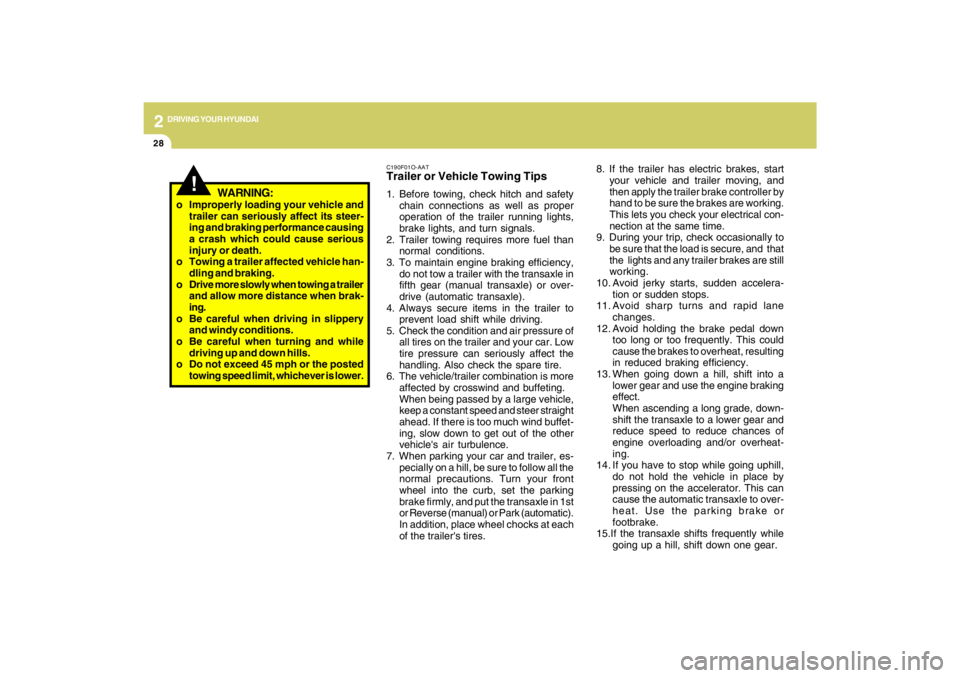
WARNING:
o Improperly loading your vehicle and
trailer can seriously affect its steer-
ing and braking performance causing
a crash which could cause serious
injury or death.
o Towing a trailer affected vehicle han-
dling and braking.
o Drive more slowly when towing a trailer
and allow more distance when brak-
ing.
o Be careful when driving in slippery
and windy conditions.
o Be careful when turning and while
driving up and down hills.
o Do not exceed 45 mph or the posted
towing speed limit, whichever is lower.
Page 177 of 273
38WHAT TO DO IN AN EMERGENCY
!
!
!
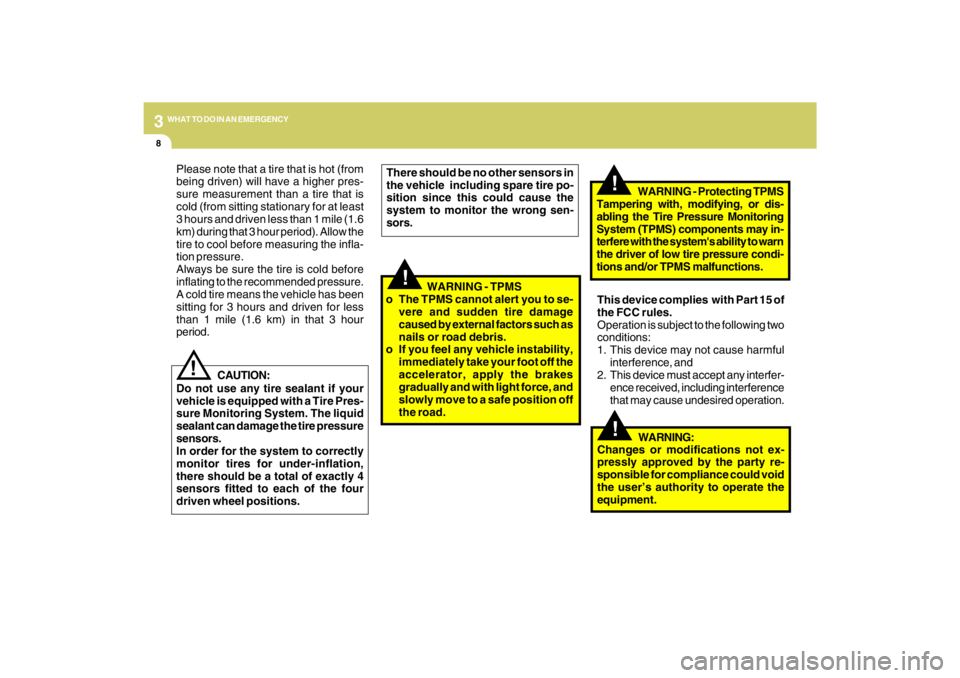
This device complies with Part 15 of
the FCC rules.
Operation is subject to the following two
conditions:
1. This device may not cause harmful
interference, and
2. This device must accept any interfer-
ence received, including interference
that may cause undesired operation. WARNING - TPMS
o The TPMS cannot alert you to se-
vere and sudden tire damage
caused by external factors such as
nails or road debris.
o If you feel any vehicle instability,
immediately take your foot off the
accelerator, apply the brakes
gradually and with light force, and
slowly move to a safe position off
the road.
WARNING:
Changes or modifications not ex-
pressly approved by the party re-
sponsible for compliance could void
the user’s authority to operate the
equipment. Please note that a tire that is hot (from
being driven) will have a higher pres-
sure measurement than a tire that is
cold (from sitting stationary for at least
3 hours and driven less than 1 mile (1.6
km) during that 3 hour period). Allow the
tire to cool before measuring the infla-
tion pressure.
Always be sure the tire is cold before
inflating to the recommended pressure.
A cold tire means the vehicle has been
sitting for 3 hours and driven for less
than 1 mile (1.6 km) in that 3 hour
period.
CAUTION:
Do not use any tire sealant if your
vehicle is equipped with a Tire Pres-
sure Monitoring System. The liquid
sealant can damage the tire pressure
sensors.
In order for the system to correctly
monitor tires for under-inflation,
there should be a total of exactly 4
sensors fitted to each of the four
driven wheel positions.
!
WARNING - Protecting TPMS
Tampering with, modifying, or dis-
abling the Tire Pressure Monitoring
System (TPMS) components may in-
terfere with the system's ability to warn
the driver of low tire pressure condi-
tions and/or TPMS malfunctions. There should be no other sensors in
the vehicle including spare tire po-
sition since this could cause the
system to monitor the wrong sen-
sors.
Page 179 of 273
310
WHAT TO DO IN AN EMERGENCY
IF YOU HAVE A FLAT TIRED050A02A-AATIf a tire goes flat while you are driving:
1. Take your foot off the accelerator
pedal and let the car slow down while
driving straight ahead. Do not apply
the brakes immediately or attempt to
pull off the road as this may cause a
loss of control. When the vehicle has
slowed to such a speed that it is safe
to do so, brake carefully and pull off
the road. Drive off the road as far as
possible and park on firm, level
ground. If you are on a divided high-
way, do not park in the median area
between the two traffic lanes.
2. When the car is stopped, turn on your
emergency hazard flashers, set the
parking brake and put the transaxle
in "P" (automatic) or reverse (manual
transaxle).
3. Have all passengers get out of the
vehicle. Be sure they all get out on
the side of the vehicle that is away
from traffic.
4. Change the tire following the instruc-
tions provided on the following pages.
HJM4008
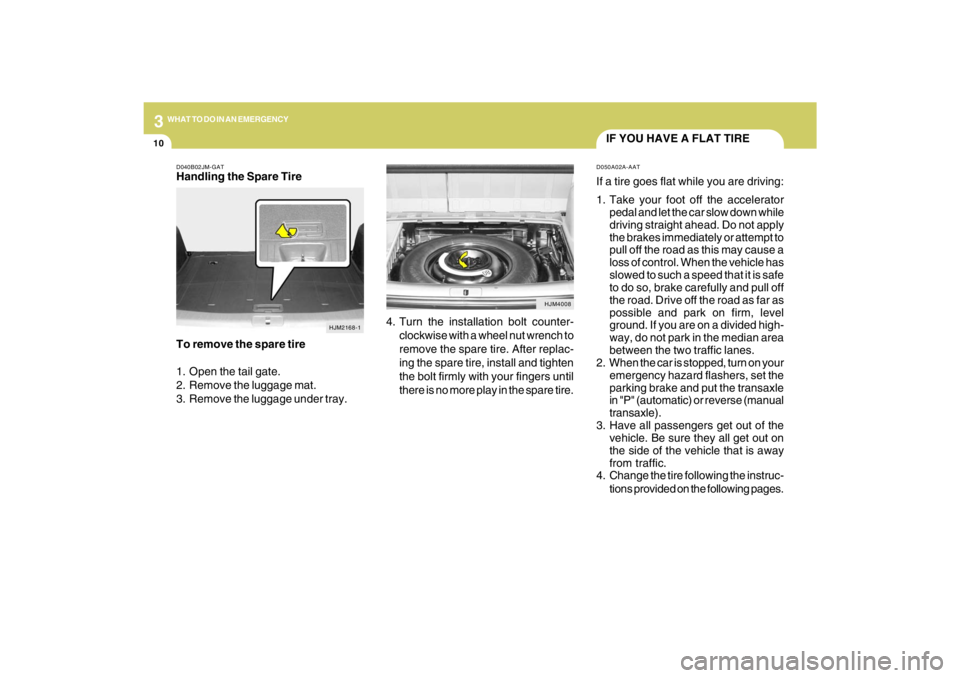
4. Turn the installation bolt counter-
clockwise with a wheel nut wrench to
remove the spare tire. After replac-
ing the spare tire, install and tighten
the bolt firmly with your fingers until
there is no more play in the spare tire.
D040B02JM-GATHandling the Spare Tire
To remove the spare tire
1. Open the tail gate.
2. Remove the luggage mat.
3. Remove the luggage under tray.
HJM2168-1
Page 188 of 273

3
WHAT TO DO IN AN EMERGENCY
19
IF YOU LOSE YOUR KEYSD120A01A-AATIf you lose your keys, many Hyundai deal-
ers can make you a new key if you have
your key number. If you lock the keys inside
your car and you cannot obtain a new key,
many Hyundai dealers can use special
tools to open the door for you. For emergency towing when no commer-
cial tow vehicle is available, attach a tow
cable, chain or strap to one of the towing
hooks under the front/rear of your vehicle.
Be very careful when attempting this pro-
cedure when the vehicle is on any un-
paved surface to avoid damage to your
vehicle.
Nor should towing be attempted if the
wheels, drive train, axles, steering or
brakes are damaged. Before towing, be
sure the transaxle is in neutral and the key
is in "ACC" (with the engine off) or in the
"ON" position (with the engine running). A
driver must be in the towed vehicle to steer
it and operate the brakes.
NOTE:o To avoid serious damage to your 4WD
vehicle, limit the towing to 15 km/h (10
mph) and not for more than 1.5 km (1
mile) at ANY TIME.
o Before towing, check the level of the
automatic transaxle fluid. If it is below
the "75°C" range on the dipstick, add
fluid. If you cannot add fluid, a towing
dolly must be used.
CAUTION:
If the Engine is not running, the power
assist for the brakes and steering will
not work so steering and braking will be
much harder than usual.
CAUTION:
If the car is being towed with all four
wheels on the ground, it can be towed
only from the front. Be sure that the
transaxle is in neutral. Do not tow at
speeds greater than 50 km/h (30 mph)
and for more than 25 km (15 miles).
Be sure the steering is unlocked by plac-
ing the key in the "ACC" position. A
driver must be in the towed vehicle to
operate the steering and brakes.
!!
Page 205 of 273
6
Engine Compartment .................................................... 6-2
General Checks ............................................................ 6-4
Checking the Engine Oil ............................................... 6-5
Changing the Oil and Filter ............................................ 6-6
Checking and Changing the Engine Coolant ................ 6-8
Changing the Air Cleaner Filter ...................................6-10
Checking the Transaxle Oil (Manual) .........................6-11
Checking the Transaxle Fluid (Automatic)..................6-12
Checking the Brakes ..................................................6-14
Checking the Clutch Fluid...........................................6-15
Air Conditioning Care..................................................6-16
Changing the Climate Control Air Filter .......................6-17
Checking the Free-play...............................................6-19
Checking Drive Belts ..................................................6-20
Checking and Replacing Fuses..................................6-21
Checking the Battery..................................................6-23
Power Steering Fluid Level .........................................6-25
Replacement of Light Bulbs ........................................6-27
Bulb Wattage ...............................................................6-34
Fuse Panel Description...............................................6-35
6
DO-IT-YOURSELF MAINTENANCE
Page 218 of 273
6
DO-IT-YOURSELF MAINTENANCE
14
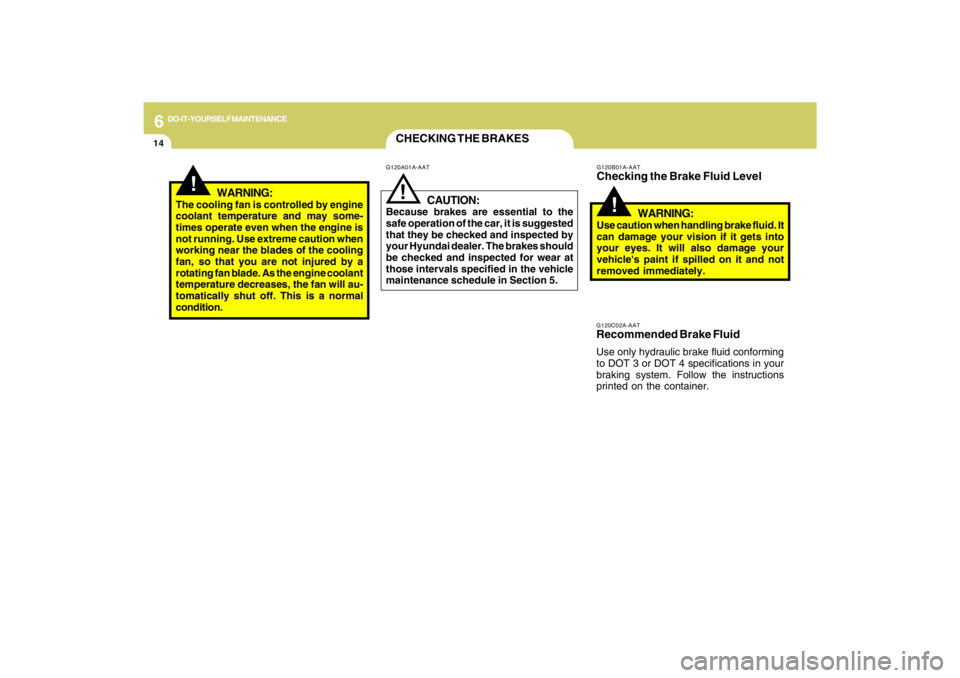
CHECKING THE BRAKES
!
G120B01A-AATChecking the Brake Fluid Level
WARNING:Use caution when handling brake fluid. It
can damage your vision if it gets into
your eyes. It will also damage your
vehicle's paint if spilled on it and not
removed immediately.
!
WARNING:
The cooling fan is controlled by engine
coolant temperature and may some-
times operate even when the engine is
not running. Use extreme caution when
working near the blades of the cooling
fan, so that you are not injured by a
rotating fan blade. As the engine coolant
temperature decreases, the fan will au-
tomatically shut off. This is a normal
condition.
G120A01A-AAT
CAUTION:
Because brakes are essential to the
safe operation of the car, it is suggested
that they be checked and inspected by
your Hyundai dealer. The brakes should
be checked and inspected for wear at
those intervals specified in the vehicle
maintenance schedule in Section 5.
!
G120C02A-AATRecommended Brake FluidUse only hydraulic brake fluid conforming
to DOT 3 or DOT 4 specifications in your
braking system. Follow the instructions
printed on the container.
Page 267 of 273
![HYUNDAI TUCSON 2009 User Guide 9
VEHICLE SPECIFICATIONS4
Oil & Grease Standard
SAE 5W-20, 5W-30
API SJ, SL or ABOVE,
ILSAC GF-3 or ABOVE
SAE 10W-30 [ABOVE 0°F (-18°C)]
HYUNDAI GENUINE PARTS SAE MTF SAE 75W/85 (API GL-4)
HYUNDAI G](/img/35/56208/w960_56208-266.png "HYUNDAI TUCSON 2009 User Guide 9
VEHICLE SPECIFICATIONS4
Oil & Grease Standard
SAE 5W-20, 5W-30
API SJ, SL or ABOVE,
ILSAC GF-3 or ABOVE
SAE 10W-30 [ABOVE 0°F (-18°C)]
HYUNDAI GENUINE PARTS SAE MTF SAE 75W/85 (API GL-4)
HYUNDAI G")
9
VEHICLE SPECIFICATIONS4
Oil & Grease Standard
SAE 5W-20, 5W-30
API SJ, SL or ABOVE,
ILSAC GF-3 or ABOVE
SAE 10W-30 [ABOVE 0°F (-18°C)]
HYUNDAI GENUINE PARTS SAE MTF SAE 75W/85 (API GL-4)
HYUNDAI GENUINE ATF SP III, DIAMOND ATF SP III, SK ATF SP III or other
brands meeting the SP III specification approved by Hyundai Motor Co.API GL-5, SAE 80W/90 (SHELL SPIRAX AX Equivalent)
API GL-5, SAE 80W/90 (SHELL SPIRAX AX Equivalent)
Ethylene glycol base for aluminum radiator
PSF-3 TYPE FLUID
DOT 3, DOT 4 or Equivalent Item
Engine Oil
Recommends
TransaxleManual
Automatic
Transfer case
Rear Axle
Coolant
Power steering gear
Brakes and clutch fluid
LUBRICATION CHARTJ080A03JM-AAT
Q'ty u.s.qts. (liter)
Drain and refill with oil filter
2.0 L : 4.23 (4.0)
2.7 L : 4.76 (4.5)
2.2 (2.1)
8.2 (7.8)
0.8 (0.8)
0.8 (0.75)
7.4 (7.0)
0.95 (0.9)
As required