child lock HYUNDAI TUCSON 2009 Owners Manual
[x] Cancel search | Manufacturer: HYUNDAI, Model Year: 2009, Model line: TUCSON, Model: HYUNDAI TUCSON 2009Pages: 273, PDF Size: 10.29 MB
Page 15 of 273
1FEATURES OF YOUR HYUNDAI4
B030C01E-1
DOOR LOCKS!
B040A01A-AAT B030C01JM-AAT
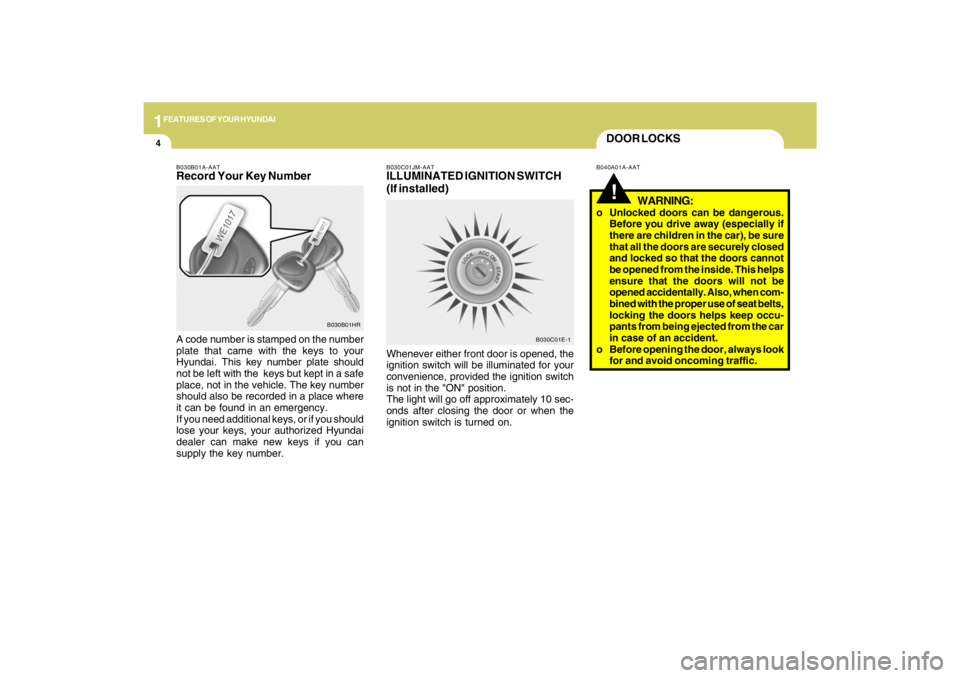
ILLUMINATED IGNITION SWITCH
(If installed)Whenever either front door is opened, the
ignition switch will be illuminated for your
convenience, provided the ignition switch
is not in the "ON" position.
The light will go off approximately 10 sec-
onds after closing the door or when the
ignition switch is turned on.
WARNING:
o Unlocked doors can be dangerous.
Before you drive away (especially if
there are children in the car), be sure
that all the doors are securely closed
and locked so that the doors cannot
be opened from the inside. This helps
ensure that the doors will not be
opened accidentally. Also, when com-
bined with the proper use of seat belts,
locking the doors helps keep occu-
pants from being ejected from the car
in case of an accident.
o Before opening the door, always look
for and avoid oncoming traffic.
B030B01A-AATRecord Your Key NumberA code number is stamped on the number
plate that came with the keys to your
Hyundai. This key number plate should
not be left with the keys but kept in a safe
place, not in the vehicle. The key number
should also be recorded in a place where
it can be found in an emergency.
If you need additional keys, or if you should
lose your keys, your authorized Hyundai
dealer can make new keys if you can
supply the key number.
B030B01HR
Page 18 of 273
1
FEATURES OF YOUR HYUNDAI
7
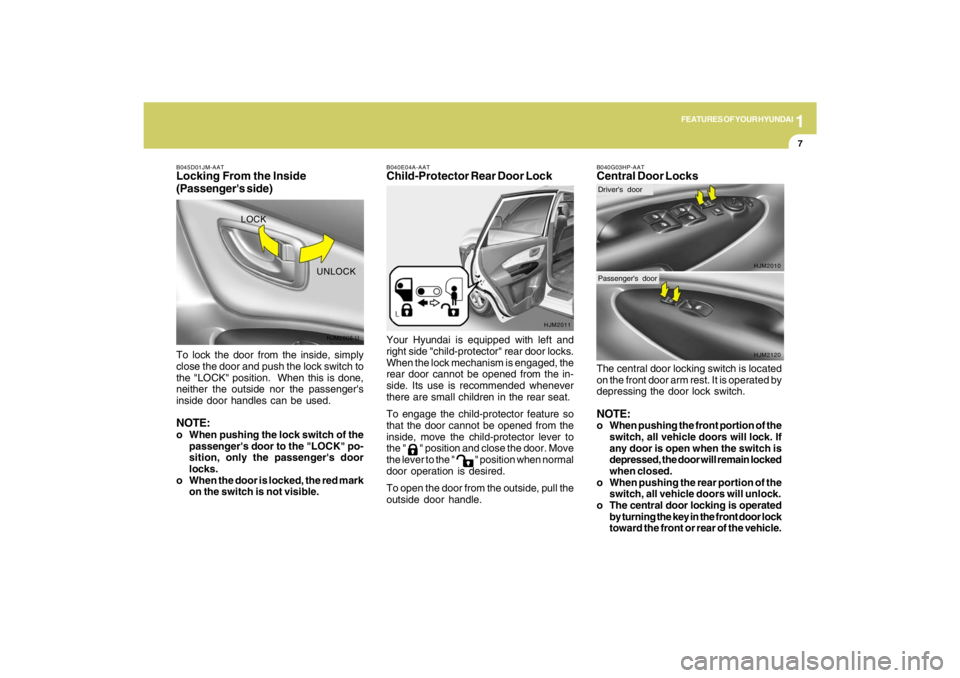
B045D01JM-AATLocking From the Inside
(Passenger's side)To lock the door from the inside, simply
close the door and push the lock switch to
the "LOCK" position. When this is done,
neither the outside nor the passenger's
inside door handles can be used.NOTE:o When pushing the lock switch of the
passenger's door to the "LOCK" po-
sition, only the passenger's door
locks.
o When the door is locked, the red mark
on the switch is not visible.
HJM2008-UUNLOCK LOCK
B040E04A-AATChild-Protector Rear Door LockYour Hyundai is equipped with left and
right side "child-protector" rear door locks.
When the lock mechanism is engaged, the
rear door cannot be opened from the in-
side. Its use is recommended whenever
there are small children in the rear seat.
To engage the child-protector feature so
that the door cannot be opened from the
inside, move the child-protector lever to
the "
" position and close the door. Move
the lever to the "
" position when normal
door operation is desired.
To open the door from the outside, pull the
outside door handle.
HJM2011
B040G03HP-AATCentral Door LocksThe central door locking switch is located
on the front door arm rest. It is operated by
depressing the door lock switch.NOTE:o When pushing the front portion of the
switch, all vehicle doors will lock. If
any door is open when the switch is
depressed, the door will remain locked
when closed.
o When pushing the rear portion of the
switch, all vehicle doors will unlock.
o The central door locking is operated
by turning the key in the front door lock
toward the front or rear of the vehicle.
HJM2010HJM2120
Driver's doorPassenger's door
Page 23 of 273
1FEATURES OF YOUR HYUNDAI12
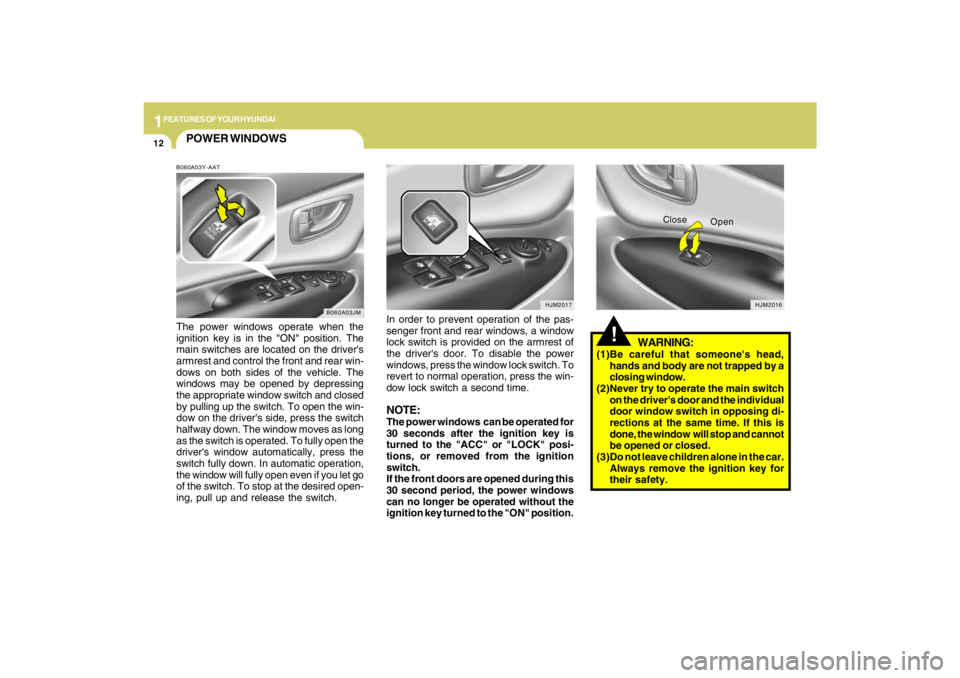
POWER WINDOWSB060A03Y-AATThe power windows operate when the
ignition key is in the "ON" position. The
main switches are located on the driver's
armrest and control the front and rear win-
dows on both sides of the vehicle. The
windows may be opened by depressing
the appropriate window switch and closed
by pulling up the switch. To open the win-
dow on the driver's side, press the switch
halfway down. The window moves as long
as the switch is operated. To fully open the
driver's window automatically, press the
switch fully down. In automatic operation,
the window will fully open even if you let go
of the switch. To stop at the desired open-
ing, pull up and release the switch.
B060A03JM
!
In order to prevent operation of the pas-
senger front and rear windows, a window
lock switch is provided on the armrest of
the driver's door. To disable the power
windows, press the window lock switch. To
revert to normal operation, press the win-
dow lock switch a second time.NOTE:The power windows can be operated for
30 seconds after the ignition key is
turned to the "ACC" or "LOCK" posi-
tions, or removed from the ignition
switch.
If the front doors are opened during this
30 second period, the power windows
can no longer be operated without the
ignition key turned to the "ON" position.
WARNING:
(1)Be careful that someone's head,
hands and body are not trapped by a
closing window.
(2)Never try to operate the main switch
on the driver's door and the individual
door window switch in opposing di-
rections at the same time. If this is
done, the window will stop and cannot
be opened or closed.
(3)Do not leave children alone in the car.
Always remove the ignition key for
their safety.
HJM2016
Close
Open
HJM2017
Page 33 of 273
1FEATURES OF YOUR HYUNDAI22
B190A02Y-AATSEAT BELTS-Front Passenger and
Rear Seat 3-Point System with Com-
bination Locking RetractorCombination retractor type seat belts are
installed in the rear seat positions to help
accommodate the installation of child re-
straint systems. Although a combination
retractor is also installed in the front passen-
ger seat position, Hyundai strongly recom-
mends that children always be seated in the
rear seat. NEVER place any infant restraint
system in the front seat of the vehicle.
This type of seat belt combines the fea-
tures of both an emergency locking retrac-
tor seat belt and an automatic locking
retractor seat belt. To fasten your seat belt,
pull it out of the retractor and insert the
metal tab into the buckle. There will be an
audible "click" when the tab locks into the
buckle. When not securing a child restraint,
the seat belt operates in the same way as
the driver's seat belt (Emergency Locking
Retractor Type). It automatically adjusts to
the proper length only after the lap belt
portion of the seat belt is adjusted manu-
ally so that it fits snugly around your hips.
When the seat belt is fully extended from
the retractor to allow the installation of a
child restraint system, the seat belt opera-
tion changes to allow the belt to retract, but
not to extend (Automatic Locking Retrac-
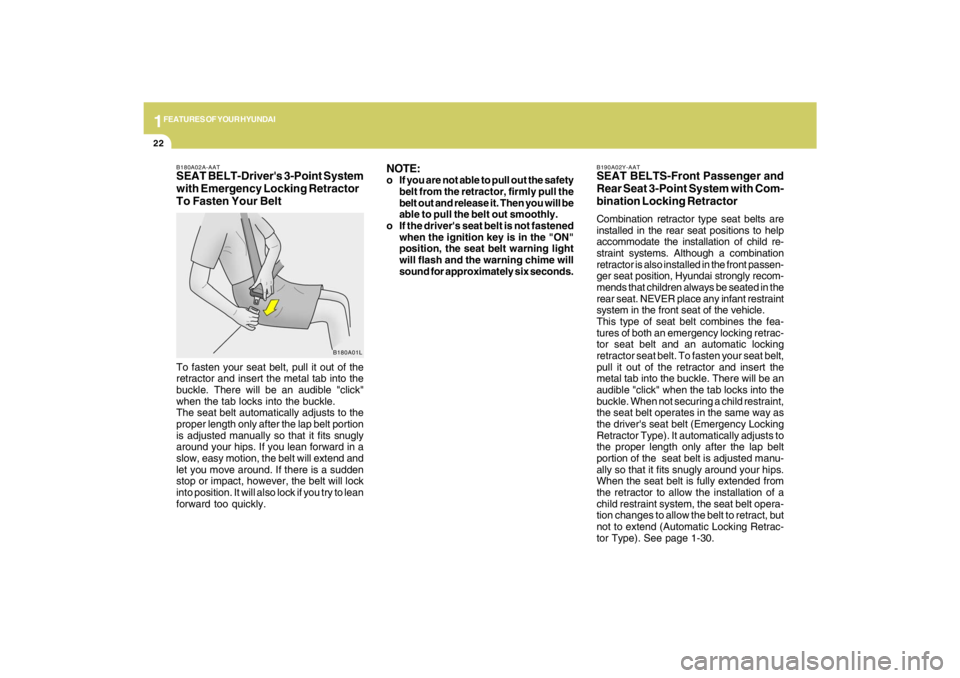
tor Type). See page 1-30. To fasten your seat belt, pull it out of the
retractor and insert the metal tab into the
buckle. There will be an audible "click"
when the tab locks into the buckle.
The seat belt automatically adjusts to the
proper length only after the lap belt portion
is adjusted manually so that it fits snugly
around your hips. If you lean forward in a
slow, easy motion, the belt will extend and
let you move around. If there is a sudden
stop or impact, however, the belt will lock
into position. It will also lock if you try to lean
forward too quickly.
B180A02A-AATSEAT BELT-Driver's 3-Point System
with Emergency Locking Retractor
To Fasten Your Belt
B180A01L
NOTE:o If you are not able to pull out the safety
belt from the retractor, firmly pull the
belt out and release it. Then you will be
able to pull the belt out smoothly.
o If the driver's seat belt is not fastened
when the ignition key is in the "ON"
position, the seat belt warning light
will flash and the warning chime will
sound for approximately six seconds.
Page 34 of 273
1
FEATURES OF YOUR HYUNDAI
23
!
NOTE:Although the combination retractor pro-
vides the same level of protection for
seated passengers in either emergency
or automatic locking modes, it is recom-
mended that seated passengers use the
emergency locking feature for improved
convenience. The automatic locking
function is intended to facilitate child
restraint installation. To convert from
the automatic locking feature to the
emergency locking operation mode, al-
low the unbuckled seat belt to fully re-
tract.
WARNING:
o For maximum restraint system pro-
tection, the seat belts must always be
used whenever the car is moving.
o Seat belts are most effective when
seatbacks are in the upright position.
o Children age 12 and younger must
always be properly restrained in the
rear seat. Never allow children to ride
in the front passenger seat. If a child
over 13 must be seated in the front
seat, he/she must be properly belted
and the seat should be moved as far
back as possible.
o Never wear the shoulder belt under
your arm or behind your back. An
improperly positioned shoulder belt
can cause serious injuries in a crash.
The shoulder belt should be positioned
midway over your shoulder across
your collarbone.
o Avoid wearing twisted seat belts. A
twisted belt can't do its job as well. In
a collision, it could even cut into you.
Be sure the belt webbing is straight
and not twisted.
o Be careful not to damage the belt
webbing or hardware. If the belt web-
bing or hardware is damaged, replace
it.
!
WARNING:
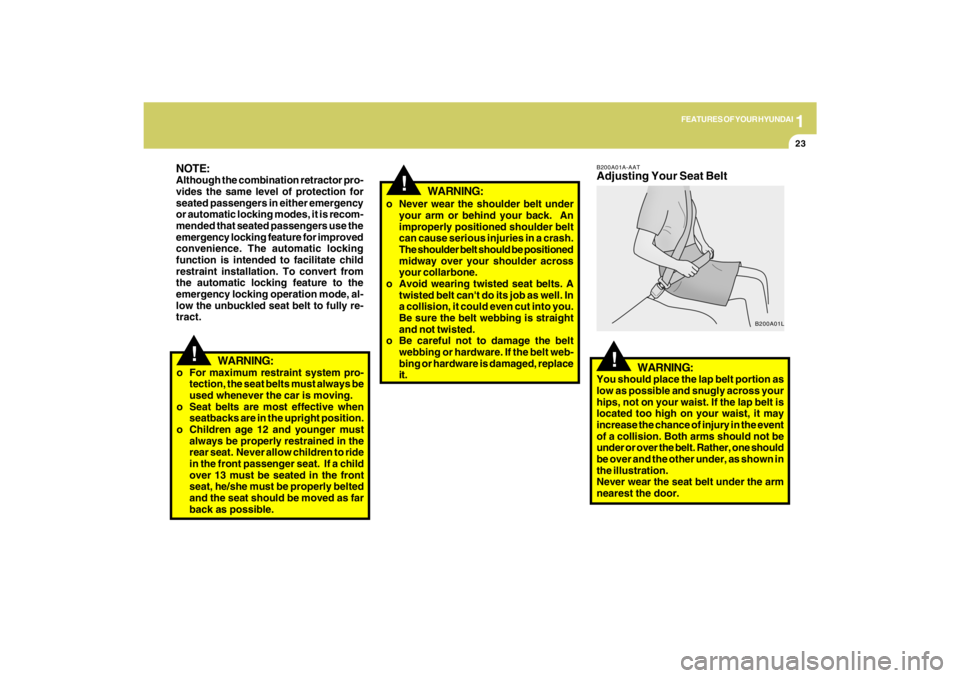
You should place the lap belt portion as
low as possible and snugly across your
hips, not on your waist. If the lap belt is
located too high on your waist, it may
increase the chance of injury in the event
of a collision. Both arms should not be
under or over the belt. Rather, one should
be over and the other under, as shown in
the illustration.
Never wear the seat belt under the arm
nearest the door.
!
B200A01A-AATAdjusting Your Seat Belt
B200A01L
WARNING:
Page 38 of 273
1
FEATURES OF YOUR HYUNDAI
27
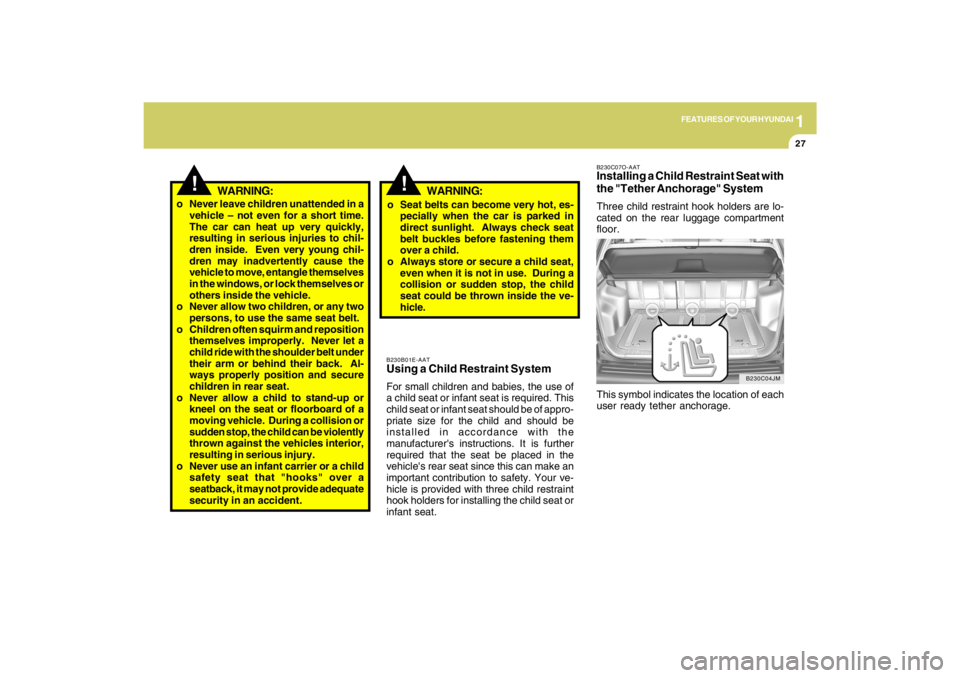
B230C07O-AATInstalling a Child Restraint Seat with
the "Tether Anchorage" SystemThree child restraint hook holders are lo-
cated on the rear luggage compartment
floor.
This symbol indicates the location of each
user ready tether anchorage.
B230C04JM B230B01E-AAT
Using a Child Restraint SystemFor small children and babies, the use of
a child seat or infant seat is required. This
child seat or infant seat should be of appro-
priate size for the child and should be
installed in accordance with the
manufacturer's instructions. It is further
required that the seat be placed in the
vehicle's rear seat since this can make an
important contribution to safety. Your ve-
hicle is provided with three child restraint
hook holders for installing the child seat or
infant seat.
!
o Never leave children unattended in a
vehicle – not even for a short time.
The car can heat up very quickly,
resulting in serious injuries to chil-
dren inside. Even very young chil-
dren may inadvertently cause the
vehicle to move, entangle themselves
in the windows, or lock themselves or
others inside the vehicle.
o Never allow two children, or any two
persons, to use the same seat belt.
o Children often squirm and reposition
themselves improperly. Never let a
child ride with the shoulder belt under
their arm or behind their back. Al-
ways properly position and secure
children in rear seat.
o Never allow a child to stand-up or
kneel on the seat or floorboard of a
moving vehicle. During a collision or
sudden stop, the child can be violently
thrown against the vehicles interior,
resulting in serious injury.
o Never use an infant carrier or a child
safety seat that "hooks" over a
seatback, it may not provide adequate
security in an accident.
WARNING:
!
WARNING:
o Seat belts can become very hot, es-
pecially when the car is parked in
direct sunlight. Always check seat
belt buckles before fastening them
over a child.
o Always store or secure a child seat,
even when it is not in use. During a
collision or sudden stop, the child
seat could be thrown inside the ve-
hicle.
Page 41 of 273
1FEATURES OF YOUR HYUNDAI30
!
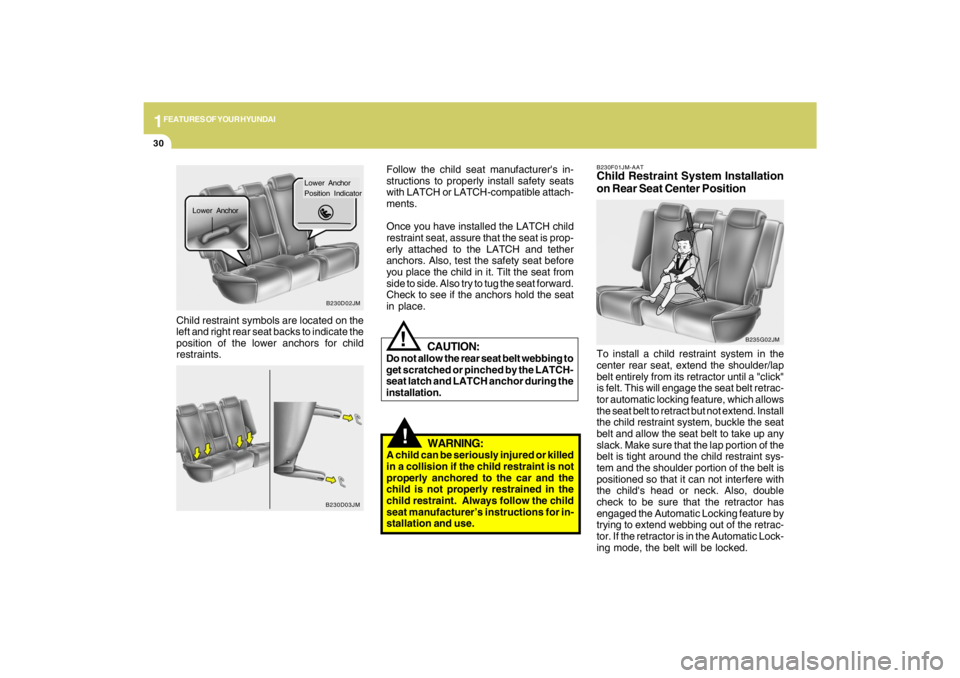
Child restraint symbols are located on the
left and right rear seat backs to indicate the
position of the lower anchors for child
restraints.Follow the child seat manufacturer's in-
structions to properly install safety seats
with LATCH or LATCH-compatible attach-
ments.
Once you have installed the LATCH child
restraint seat, assure that the seat is prop-
erly attached to the LATCH and tether
anchors. Also, test the safety seat before
you place the child in it. Tilt the seat from
side to side. Also try to tug the seat forward.
Check to see if the anchors hold the seat
in place.
Lower Anchor
Position Indicator
Lower Anchor
B230D02JMB230D03JM
WARNING:
A child can be seriously injured or killed
in a collision if the child restraint is not
properly anchored to the car and the
child is not properly restrained in the
child restraint. Always follow the child
seat manufacturer’s instructions for in-
stallation and use.
B230F01JM-AATChild Restraint System Installation
on Rear Seat Center PositionTo install a child restraint system in the
center rear seat, extend the shoulder/lap
belt entirely from its retractor until a "click"
is felt. This will engage the seat belt retrac-
tor automatic locking feature, which allows
the seat belt to retract but not extend. Install
the child restraint system, buckle the seat
belt and allow the seat belt to take up any
slack. Make sure that the lap portion of the
belt is tight around the child restraint sys-
tem and the shoulder portion of the belt is
positioned so that it can not interfere with
the child's head or neck. Also, double
check to be sure that the retractor has
engaged the Automatic Locking feature by
trying to extend webbing out of the retrac-
tor. If the retractor is in the Automatic Lock-
ing mode, the belt will be locked.
B235G02JM
CAUTION:
Do not allow the rear seat belt webbing to
get scratched or pinched by the LATCH-
seat latch and LATCH anchor during the
installation.
!
Page 42 of 273
1
FEATURES OF YOUR HYUNDAI
31
!
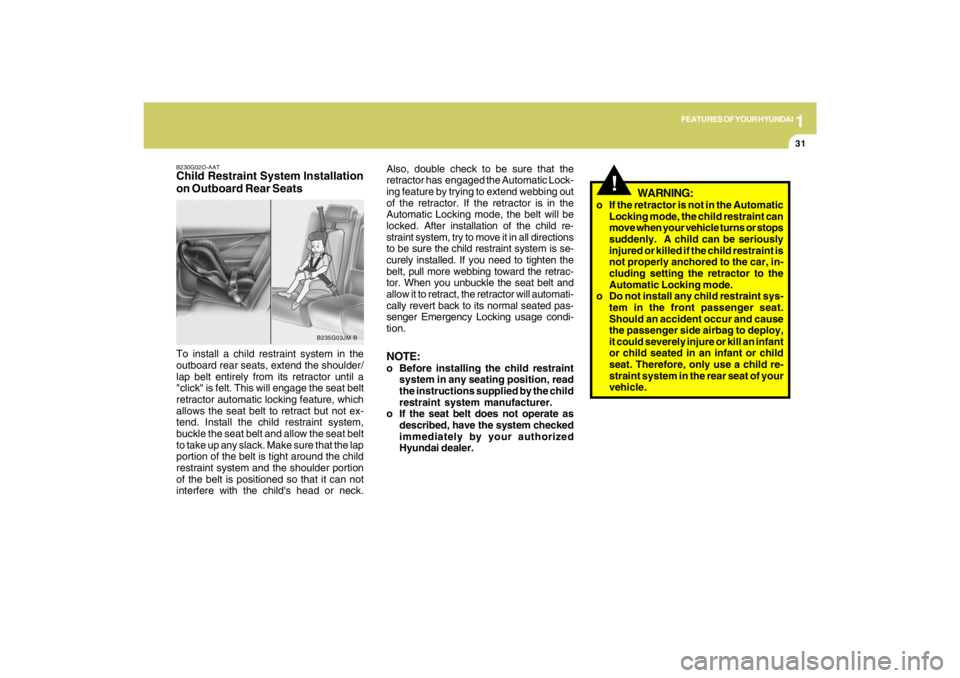
B230G02O-AATChild Restraint System Installation
on Outboard Rear Seats
WARNING:
o If the retractor is not in the Automatic
Locking mode, the child restraint can
move when your vehicle turns or stops
suddenly. A child can be seriously
injured or killed if the child restraint is
not properly anchored to the car, in-
cluding setting the retractor to the
Automatic Locking mode.
o Do not install any child restraint sys-
tem in the front passenger seat.
Should an accident occur and cause
the passenger side airbag to deploy,
it could severely injure or kill an infant
or child seated in an infant or child
seat. Therefore, only use a child re-
straint system in the rear seat of your
vehicle. To install a child restraint system in the
outboard rear seats, extend the shoulder/
lap belt entirely from its retractor until a
"click" is felt. This will engage the seat belt
retractor automatic locking feature, which
allows the seat belt to retract but not ex-
tend. Install the child restraint system,
buckle the seat belt and allow the seat belt
to take up any slack. Make sure that the lap
portion of the belt is tight around the child
restraint system and the shoulder portion
of the belt is positioned so that it can not
interfere with the child's head or neck.Also, double check to be sure that the
retractor has engaged the Automatic Lock-
ing feature by trying to extend webbing out
of the retractor. If the retractor is in the
Automatic Locking mode, the belt will be
locked. After installation of the child re-
straint system, try to move it in all directions
to be sure the child restraint system is se-
curely installed. If you need to tighten the
belt, pull more webbing toward the retrac-
tor. When you unbuckle the seat belt and
allow it to retract, the retractor will automati-
cally revert back to its normal seated pas-
senger Emergency Locking usage condi-
tion.
NOTE:o Before installing the child restraint
system in any seating position, read
the instructions supplied by the child
restraint system manufacturer.
o If the seat belt does not operate as
described, have the system checked
immediately by your authorized
Hyundai dealer.
B235G03JM-B
Page 54 of 273
1
FEATURES OF YOUR HYUNDAI
43
!
!
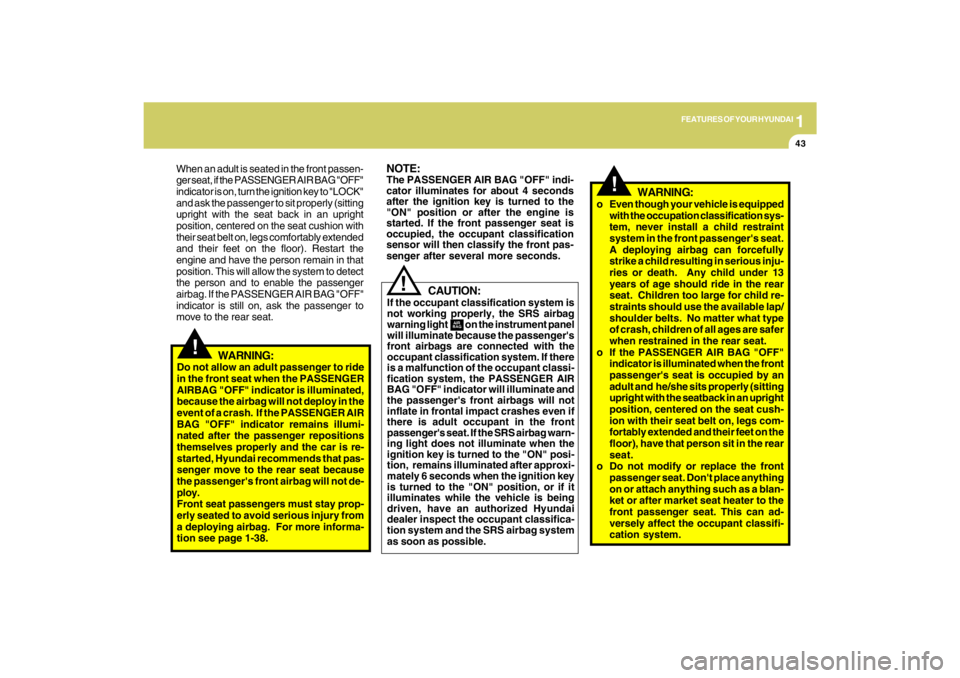
NOTE:The PASSENGER AIR BAG "OFF" indi-
cator illuminates for about 4 seconds
after the ignition key is turned to the
"ON" position or after the engine is
started. If the front passenger seat is
occupied, the occupant classification
sensor will then classify the front pas-
senger after several more seconds.
CAUTION:
If the occupant classification system is
not working properly, the SRS airbag
warning light on the instrument panel
will illuminate because the passenger's
front airbags are connected with the
occupant classification system. If there
is a malfunction of the occupant classi-
fication system, the PASSENGER AIR
BAG "OFF" indicator will illuminate and
the passenger's front airbags will not
inflate in frontal impact crashes even if
there is adult occupant in the front
passenger's seat. If the SRS airbag warn-
ing light does not illuminate when the
ignition key is turned to the "ON" posi-
tion, remains illuminated after approxi-
mately 6 seconds when the ignition key
is turned to the "ON" position, or if it
illuminates while the vehicle is being
driven, have an authorized Hyundai
dealer inspect the occupant classifica-
tion system and the SRS airbag system
as soon as possible.
WARNING:
Do not allow an adult passenger to ride
in the front seat when the PASSENGER
AIRBAG "OFF" indicator is illuminated,
because the airbag will not deploy in the
event of a crash. If the PASSENGER AIR
BAG "OFF" indicator remains illumi-
nated after the passenger repositions
themselves properly and the car is re-
started, Hyundai recommends that pas-
senger move to the rear seat because
the passenger's front airbag will not de-
ploy.
Front seat passengers must stay prop-
erly seated to avoid serious injury from
a deploying airbag. For more informa-
tion see page 1-38. When an adult is seated in the front passen-
ger seat, if the PASSENGER AIR BAG "OFF"
indicator is on, turn the ignition key to "LOCK"
and ask the passenger to sit properly (sitting
upright with the seat back in an upright
position, centered on the seat cushion with
their seat belt on, legs comfortably extended
and their feet on the floor). Restart the
engine and have the person remain in that
position. This will allow the system to detect
the person and to enable the passenger
airbag. If the PASSENGER AIR BAG "OFF"
indicator is still on, ask the passenger to
move to the rear seat.
!
WARNING:
o Even though your vehicle is equipped
with the occupation classification sys-
tem, never install a child restraint
system in the front passenger's seat.
A deploying airbag can forcefully
strike a child resulting in serious inju-
ries or death. Any child under 13
years of age should ride in the rear
seat. Children too large for child re-
straints should use the available lap/
shoulder belts. No matter what type
of crash, children of all ages are safer
when restrained in the rear seat.
o If the PASSENGER AIR BAG "OFF"
indicator is illuminated when the front
passenger's seat is occupied by an
adult and he/she sits properly (sitting
upright with the seatback in an upright
position, centered on the seat cush-
ion with their seat belt on, legs com-
fortably extended and their feet on the
floor), have that person sit in the rear
seat.
o Do not modify or replace the front
passenger seat. Don't place anything
on or attach anything such as a blan-
ket or after market seat heater to the
front passenger seat. This can ad-
versely affect the occupant classifi-
cation system.
Page 139 of 273
2
DRIVING YOUR HYUNDAI
4
TO START THE ENGINEC030A01E-AATCOMBINATION IGNITION SWITCHo If your Hyundai is equipped with a
manual transaxle, place the shift lever
in neutral and depress the clutch pedal
fully.
o If your Hyundai has an automatic
transaxle, place the shift lever in "P"
(park).
o To start the engine, insert the ignition
key and turn it to the "START" position.
Release it as soon as the engine starts.
Do not hold the key in the "START"
position for more that 15 seconds.NOTE:o For safety, the engine will not start if
the clutch pedal is not depressed fully
(Manual Transaxle) or the shift lever
is not in "P" or "N" Position (Auto-
matic Transaxle).
o The ignition key cannot be turned from
"ACC" position to "LOCK" position
unless the shift lever is in the "P"
(Park) position or the negative bat-
tery terminal is disconnected from
the battery. To remove the key, al-
ways confirm that the shift lever is
securely positioned in "P" (Park) (For
Automatic Transaxle).
o For additional information about start-
ing, see page 2-6.
BEFORE STARTING THE EN-
GINEC020A04A-AATBefore you start the engine, you should
always:
1. Look around the vehicle to be sure
there are no flat tires, puddles of oil,
water or other indications of possible
trouble.
2. After entering the car, check to be sure
the parking brake is engaged.
3. Check that all windows, and lights are
clean.
4. Check that the interior and exterior mir-
rors are clean and in position.
5. Check your seat, seatback and head-
rest to be sure they are in their proper
positions.
6. Lock all the doors.
7. Fasten your seat belt and be sure that all
other occupants have fastened theirs.
8. Turn off all lights and accessories that
are not needed.
9. When you turn the ignition switch to
"ON", check that all appropriate warn-
ing lights are operating and that you
have sufficient fuel.
10. Check the operation of warning lights
and all bulbs when key is in the "ON"
position.
!
WARNING:
o All passengers must be properly
belted whenever the vehicle is mov-
ing. Refer to pages: 1-19 through 1-
25 for more information on their proper
use.
o Always check the surrounding areas
near your vehicle for people, espe-
cially children, before putting a car
into 'drive.'
!
WARNING:
Always wear appropriate shoes when
operating your vehicle.
Unsuitable shoes (high heels, ski boots,
etc.) may interfere with your ability to
use the brake and accelerator pedal,
and the clutch (if installed).
!
WARNING:
When you intend to park or stop the
vehicle with the engine on, be careful not
to depress the accelerator pedal for a
long period of time. It may overheat the
engine or exhaust system and cause
fire.