coolant capacity HYUNDAI TUCSON 2009 Owners Manual
[x] Cancel search | Manufacturer: HYUNDAI, Model Year: 2009, Model line: TUCSON, Model: HYUNDAI TUCSON 2009Pages: 273, PDF Size: 10.29 MB
Page 213 of 273
6
DO-IT-YOURSELF MAINTENANCE
9
!
!
WARNING:
The cooling fan is controlled by engine
coolant temperature and may some-
times operate even when the engine is
not running. Use extreme caution when
working near the blades of the coolant
fan so that you are not injured by a
rotating fan blade. As the engine coolant
temperature decreases, the fan will au-
tomatically shut off. This is a normal
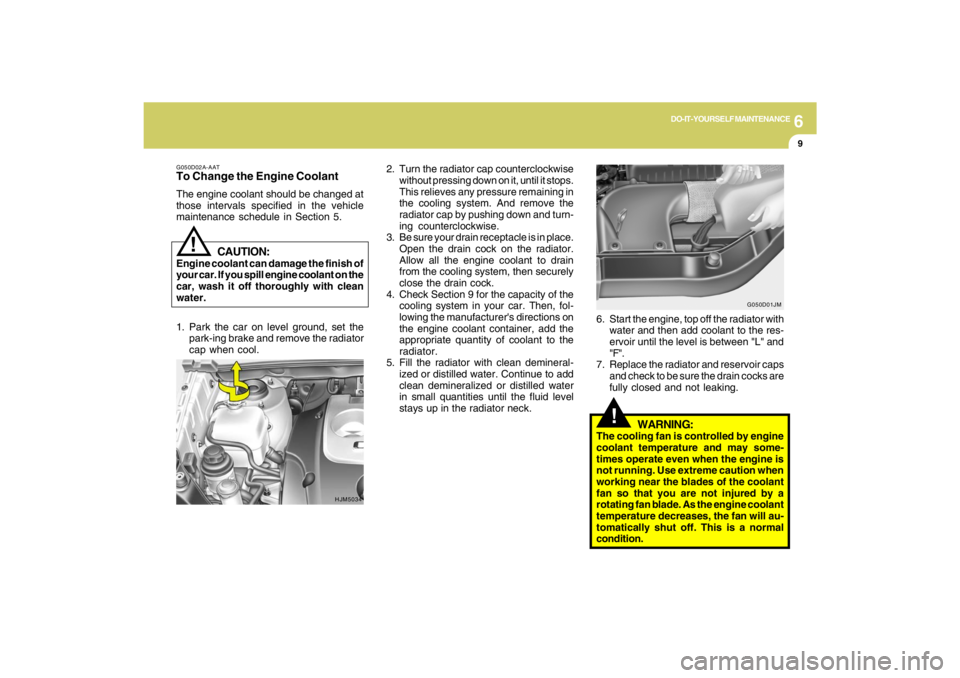
condition. 2. Turn the radiator cap counterclockwise
without pressing down on it, until it stops.
This relieves any pressure remaining in
the cooling system. And remove the
radiator cap by pushing down and turn-
ing counterclockwise.
3. Be sure your drain receptacle is in place.
Open the drain cock on the radiator.
Allow all the engine coolant to drain
from the cooling system, then securely
close the drain cock.
4. Check Section 9 for the capacity of the
cooling system in your car. Then, fol-
lowing the manufacturer's directions on
the engine coolant container, add the
appropriate quantity of coolant to the
radiator.
5. Fill the radiator with clean demineral-
ized or distilled water. Continue to add
clean demineralized or distilled water
in small quantities until the fluid level
stays up in the radiator neck.6. Start the engine, top off the radiator with
water and then add coolant to the res-
ervoir until the level is between "L" and
"F".
7. Replace the radiator and reservoir caps
and check to be sure the drain cocks are
fully closed and not leaking.
G050D02A-AATTo Change the Engine CoolantThe engine coolant should be changed at
those intervals specified in the vehicle
maintenance schedule in Section 5.
HJM5034G050D01JM
CAUTION:
Engine coolant can damage the finish of
your car. If you spill engine coolant on the
car, wash it off thoroughly with clean
water.
1. Park the car on level ground, set the
park-ing brake and remove the radiator
cap when cool.
Page 215 of 273
6
DO-IT-YOURSELF MAINTENANCE
11
G090A01JM
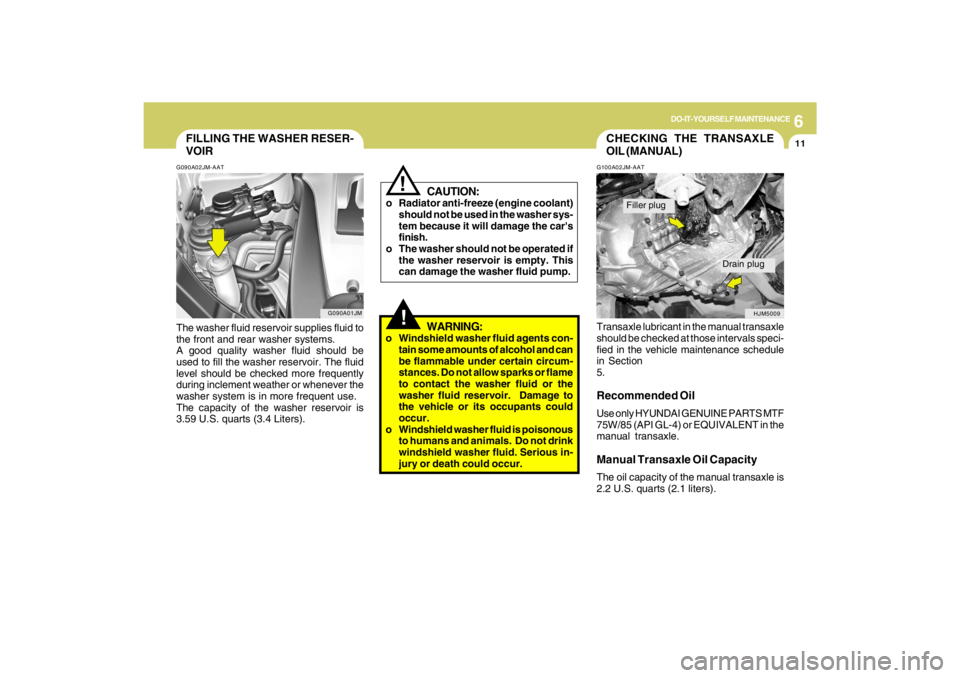
FILLING THE WASHER RESER-
VOIRG090A02JM-AATThe washer fluid reservoir supplies fluid to
the front and rear washer systems.
A good quality washer fluid should be
used to fill the washer reservoir. The fluid
level should be checked more frequently
during inclement weather or whenever the
washer system is in more frequent use.
The capacity of the washer reservoir is
3.59 U.S. quarts (3.4 Liters).
CAUTION:
o Radiator anti-freeze (engine coolant)
should not be used in the washer sys-
tem because it will damage the car's
finish.
o The washer should not be operated if
the washer reservoir is empty. This
can damage the washer fluid pump.
!!
WARNING:
o Windshield washer fluid agents con-
tain some amounts of alcohol and can
be flammable under certain circum-
stances. Do not allow sparks or flame
to contact the washer fluid or the
washer fluid reservoir. Damage to
the vehicle or its occupants could
occur.
o Windshield washer fluid is poisonous
to humans and animals. Do not drink
windshield washer fluid. Serious in-
jury or death could occur.
CHECKING THE TRANSAXLE
OIL (MANUAL)G100A02JM-AATTransaxle lubricant in the manual transaxle
should be checked at those intervals speci-
fied in the vehicle maintenance schedule
in Section
5.Recommended OilUse only HYUNDAI GENUINE PARTS MTF
75W/85 (API GL-4) or EQUIVALENT in the
manual transaxle.Manual Transaxle Oil CapacityThe oil capacity of the manual transaxle is
2.2 U.S. quarts (2.1 liters).
HJM5009
Filler plug
Drain plug
Page 253 of 273

8
CONSUMER INFORMATION, REPORTING SAFETY DEFECTS & BINDING ARBITRATION OF WARRANTY CLAIMS8
Intended Outboard Sidewall: The side
of an asymmetrical tire, that must al-
ways face outward when mounted on a
vehicle.
Kilopascal (kPa): The metric unit for
air pressure.
Load Index: An assigned number rang-
ing from 1 to 279 that corresponds to
the load carrying capacity of a tire.
Maximum Inflation Pressure: The
maximum air pressure to which a cold
tire may be inflated. The maximum air
pressure is molded onto the sidewall.
Maximum Load Rating: The load rat-
ing for a tire at the maximum permis-
sible inflation pressure for that tire.
Maximum Loaded Vehicle Weight:
The sum of curb weight; accessory
weight; vehicle capacity weight; and
production options weight.
Normal Occupant Weight: The num-
ber of occupants a vehicle is designed
to seat multiplied by 150 pounds (68
kg).Occupant Distribution: Designated
seating positions.
Outward Facing Sidewall: The side of
a asymmetrical tire that has a particular
side that faces outward when mounted
on a vehicle. The side of the tire that
contains a whitewall, bears white letter-
ing or bears manufacturer, brand and or
model name molding that is higher or
deeper than the same moldings on the
other sidewall of the tire.
Passenger (P-Metric) Tire: A tire used
on passenger cars and some light duty
trucks and multipurpose vehicles.
Recommended Inflation Pressure:
Vehicle manufacturer's recommended
tire inflation pressure and shown on the
tire placard.
Radial Ply tire: A pneumatic tire in
which the ply cords that extend to the
beads are laid at 90 degrees to the
centerline of the tread.
Rim: A metal support for a tire and upon
which the tire beads are seated. Cold Tire Pressure: The amount of air
pressure in a tire, measured in pounds
per square inch (psi) or kilopascals
(kPa) before a tire has built up heat from
driving.
Curb Weight: This means the weight of
a motor vehicle with standard and op-
tional equipment including the maxi-
mum capacity of fuel, oil and coolant,
but without passengers and cargo.
DOT Markings: A code molded into the
sidewall of a tire signifying that the tire
is in compliance with the U.S. Depart-
ment of Transportation motor vehicle
safety standards. The DOT code in-
cludes the Tire Identification Number
(TIN), an alphanumeric designator which
can also identify the tire manufacturer,
production plant, brand and date of
production.
GVWR: Gross Vehicle Weight Rating
GAWR FRT: Gross Axle Weight Rating
for the front Axle.
GAWR RR: Gross Axle Weight Rating
for the rear axle.
Page 270 of 273

10
INDEX
3
Drive Belts.........................................................................................6-20
Driving
Driving for economy .....................................................................2-22
Smooth cornering.........................................................................2-23
Winter driving...............................................................................2-23
E
Emission Control System ................................................................... 7-2
Engine
Before starting the engine .............................................................. 2-4
Compartment................................................................................. 6-2
Coolant........................................................................................... 6-8
If the engine overheats .................................................................. 3-4
Number........................................................................................... 8-2
Oil ................................................................................................... 6-5
Starting........................................................................................... 2-6
Engine Exhaust Can Be Dangerous .................................................. 2-2
F
4WD Lock System ............................................................................2-19
Fan Speed Control............................................................................1-94
Floor Mat Anchor ..............................................................................1-86
Fog Light
Front.............................................................................................1-64
Front Seats
Adjustable front seats ..................................................................1-13
Adjustable headrests...................................................................1-14
Adjusting seat forward and rearward..........................................1-13
Adjusting seatback angle .............................................................1-13
Fuel
Capacity......................................................................................... 9-2
Gauge...........................................................................................1-55
Recommendations......................................................................... 1-2Fuel Filler Lid
Remote release............................................................................1-83
Full-time 4WD Operation..................................................................2-16
Fuses ................................................................................................6-21
Fuse panel description......................................................................6-35
G
General Checks.................................................................................. 6-4
Glove Box..........................................................................................1-72
H
Hazard Warning System ..................................................................1-64
Heating and Cooling Control.............................................................1-93
Heating and Ventilation
Air flow control..............................................................................1-95
Air intake control switch ............................................................1-105
Bi-level heating.............................................................................1-99
Defrosting / Defogging ..............................................................1-101
Fan speed control (Blower control).............................................1-94
Temperature control....................................................................1-98
High-Mounted Rear Stop Light .........................................................1-83
Hood Release....................................................................................1-85
Horn.................................................................................................1-88
How to Use Luggage Room.............................................................1-80
I
Ignition Switch ...................................................................................... 2-5
Instrument Cluster and Indicator Lights...........................................1-48
Instrument Panel Light Control (Rheostat).......................................1-66
Interior Light.......................................................................................1-71
J
Jump Starting...................................................................................... 3-3