climate control HYUNDAI TUCSON 2012 User Guide
[x] Cancel search | Manufacturer: HYUNDAI, Model Year: 2012, Model line: TUCSON, Model: HYUNDAI TUCSON 2012Pages: 371, PDF Size: 5.39 MB
Page 158 of 371
477
Features of your vehicle
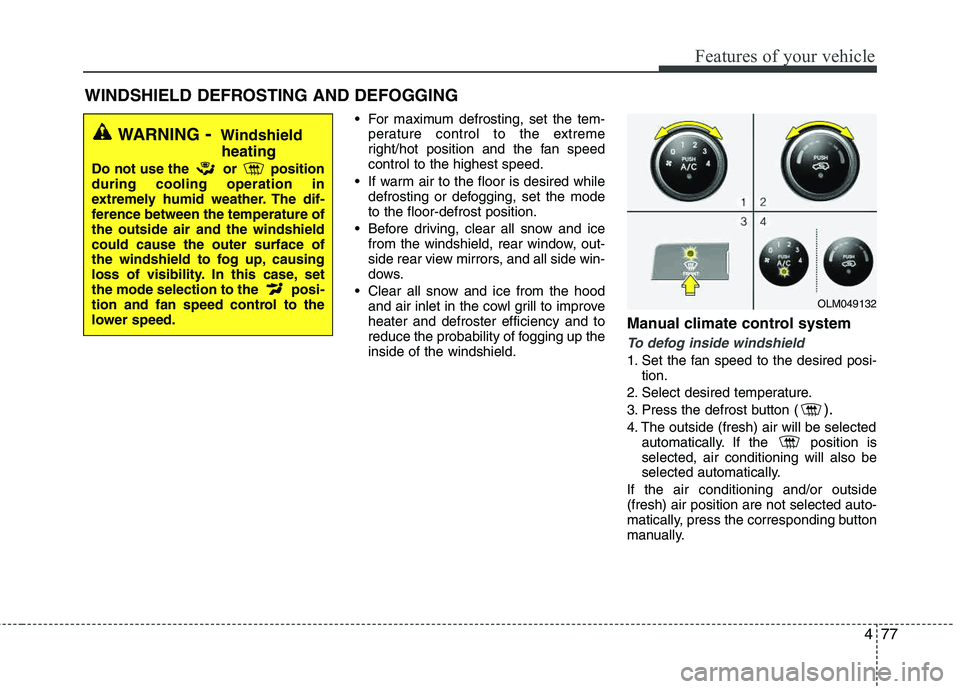
For maximum defrosting, set the tem-perature control to the extreme
right/hot position and the fan speedcontrol to the highest speed.
If warm air to the floor is desired while defrosting or defogging, set the modeto the floor-defrost position.
Before driving, clear all snow and ice from the windshield, rear window, out-
side rear view mirrors, and all side win-
dows.
Clear all snow and ice from the hood and air inlet in the cowl grill to improveheater and defroster efficiency and to
reduce the probability of fogging up the inside of the windshield.
Manual climate control system
To defog inside windshield
1. Set the fan speed to the desired posi-
tion.
2. Select desired temperature.
3. Press the defrost button (
).
4. The outside (fresh) air will be selected automatically. If the position is selected, air conditioning will also be
selected automatically.
If the air conditioning and/or outside(fresh) air position are not selected auto-
matically, press the corresponding button
manually.
WINDSHIELD DEFROSTING AND DEFOGGING
WARNING - Windshield
heating
Do not use the or position during cooling operation in
extremely humid weather. The dif-
ference between the temperature of the outside air and the windshield could cause the outer surface of
the windshield to fog up, causing
loss of visibility. In this case, set
the mode selection to the posi-
tion and fan speed control to the
lower speed.
OLM049132
Page 159 of 371
Features of your vehicle
78
4
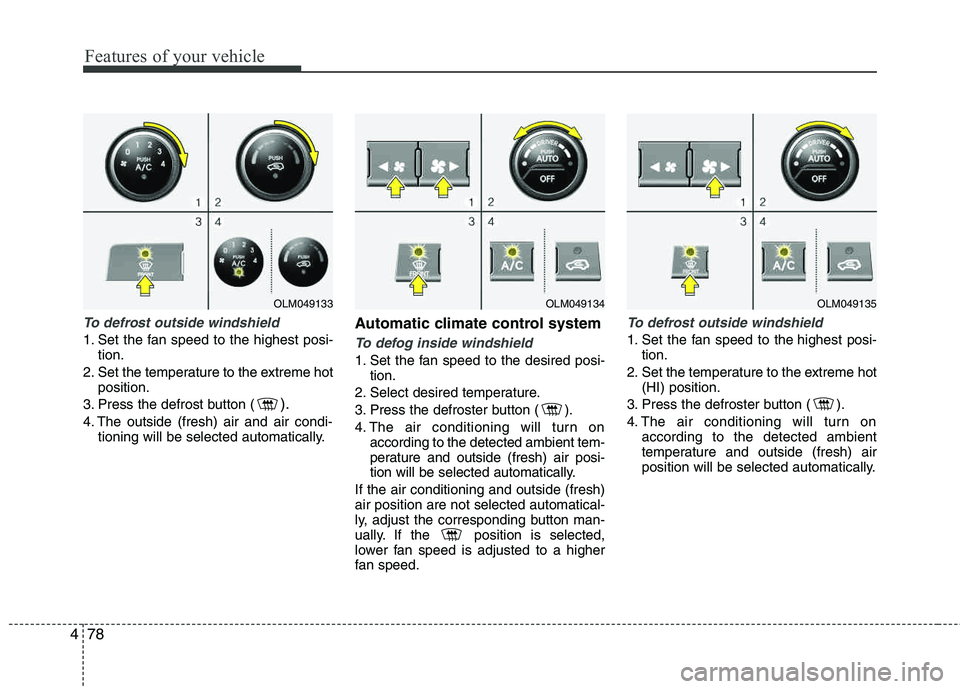
To defrost outside windshield
1. Set the fan speed to the highest posi-
tion.
2. Set the temperature to the extreme hot position.
3. Press the defrost button (
).
4. The outside (fresh) air and air condi- tioning will be selected automatically.
Automatic climate control system
To defog inside windshield
1. Set the fan speed to the desired posi- tion.
2. Select desired temperature.
3. Press the defroster button ( ).
4. The air conditioning will turn on according to the detected ambient tem-
perature and outside (fresh) air posi-
tion will be selected automatically.
If the air conditioning and outside (fresh)air position are not selected automatical-
ly, adjust the corresponding button man-
ually. If the position is selected,
lower fan speed is adjusted to a higher
fan speed.
To defrost outside windshield
1. Set the fan speed to the highest posi- tion.
2. Set the temperature to the extreme hot (HI) position.
3. Press the defroster button ( ).
4. The air conditioning will turn on according to the detected ambient
temperature and outside (fresh) air
position will be selected automatically.
OLM049134OLM049135OLM049133
Page 160 of 371
479
Features of your vehicle
Defogging logic
To reduce the possibility of fogging up
the inside of the windshield, the air intake or air conditioning are controlled auto-
matically according to certain conditions
such as or position. To cancel or
return to the defogging logic, perform the
following steps:
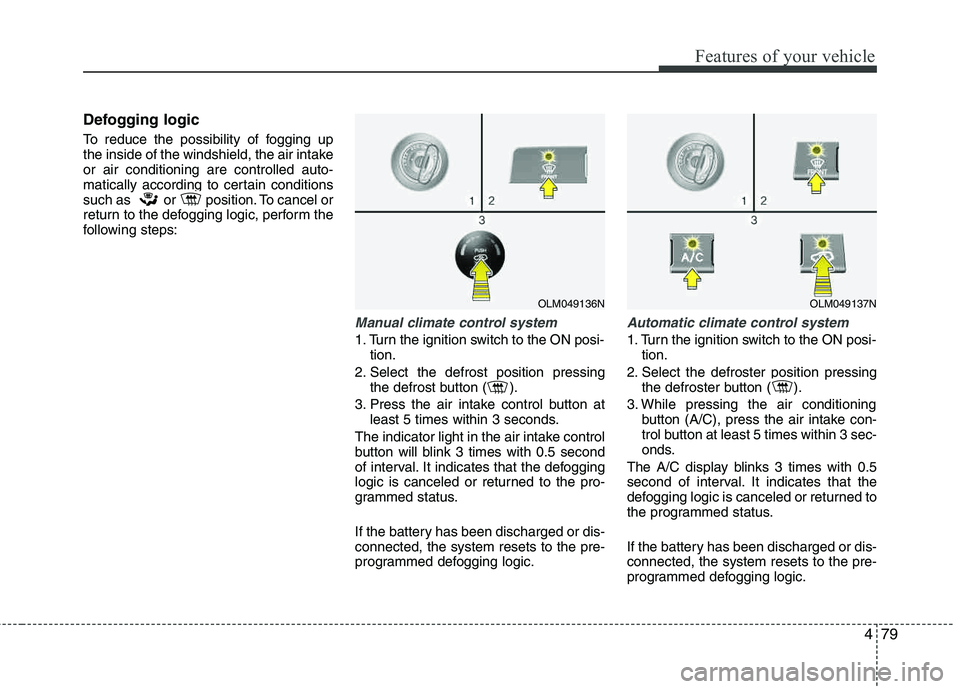
Manual climate control system
1. Turn the ignition switch to the ON posi-tion.
2. Select the defrost position pressing the defrost button ( ).
3. Press the air intake control button at least 5 times within 3 seconds.
The indicator light in the air intake control
button will blink 3 times with 0.5 second
of interval. It indicates that the defogging
logic is canceled or returned to the pro-
grammed status.
If the battery has been discharged or dis- connected, the system resets to the pre-
programmed defogging logic.
Automatic climate control system
1. Turn the ignition switch to the ON posi- tion.
2. Select the defroster position pressing the defroster button ( ).
3. While pressing the air conditioning button (A/C), press the air intake con-
trol button at least 5 times within 3 sec-
onds.
The A/C display blinks 3 times with 0.5
second of interval. It indicates that the
defogging logic is canceled or returned to
the programmed status.
If the battery has been discharged or dis- connected, the system resets to the pre-
programmed defogging logic.
OLM049137NOLM049136N
Page 226 of 371
525
Driving your vehicle
In the event of brake failure
If service brakes fail to operate while the
vehicle is in motion, you can make an
emergency stop with the parking brake.
The stopping distance, however, will be
much greater than normal.
Disc brakes wear indicator
Your vehicle has disc brakes.
When your brake pads are worn and new
pads are required, you will hear a high-
pitched warning sound from your front
brakes or rear brakes. You may hear this
sound come and go or it may occur
whenever you depress the brake pedal.
Please remember that some driving con-
ditions or climates may cause a brake
squeal when you first apply (or lightly
apply) the brakes. This is normal and does
not indicate a problem with your brakes.
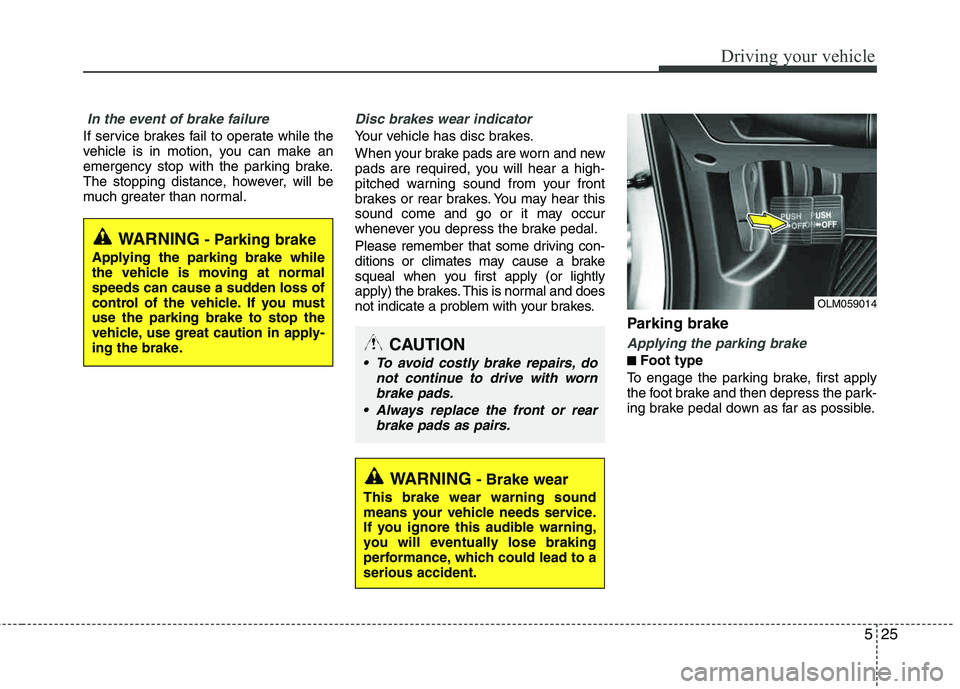
Parking brake
Applying the parking brake
■■Foot type
To engage the parking brake, first apply
the foot brake and then depress the park-
ing brake pedal down as far as possible.
WARNING- Brake wear
This brake wear warning sound
means your vehicle needs service.
If you ignore this audible warning,
you will eventually lose braking
performance, which could lead to a serious accident.
CAUTION
To avoid costly brake repairs, do not continue to drive with wornbrake pads.
Always replace the front or rear brake pads as pairs.
OLM059014
WARNING- Parking brake
Applying the parking brake while
the vehicle is moving at normal
speeds can cause a sudden loss of
control of the vehicle. If you mustuse the parking brake to stop the
vehicle, use great caution in apply-
ing the brake.
Page 288 of 371
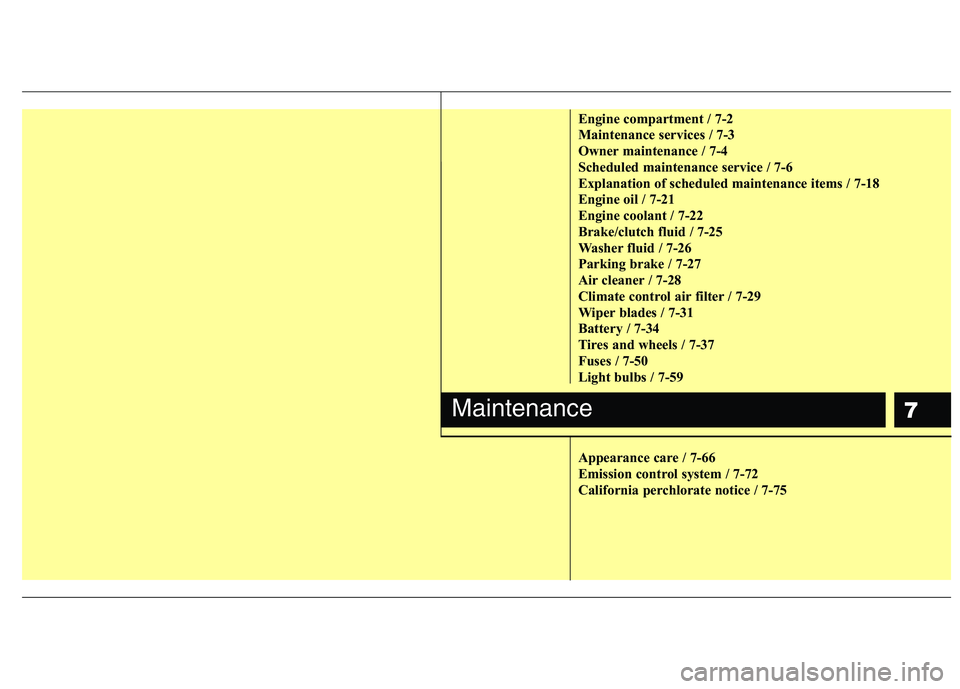
7
Engine compartment / 7-2
Maintenance services / 7-3
Owner maintenance / 7-4
Scheduled maintenance service / 7-6
Explanation of scheduled maintenance items / 7-18
Engine oil / 7-21
Engine coolant / 7-22
Brake/clutch fluid / 7-25
Washer fluid / 7-26
Parking brake / 7-27
Air cleaner / 7-28
Climate control air filter / 7-29
Wiper blades / 7-31
Battery / 7-34
Tires and wheels / 7-37
Fuses / 7-50
Light bulbs / 7-59
Appearance care / 7-66
Emission control system / 7-72
California perchlorate notice / 7-75
Maintenance
Page 294 of 371
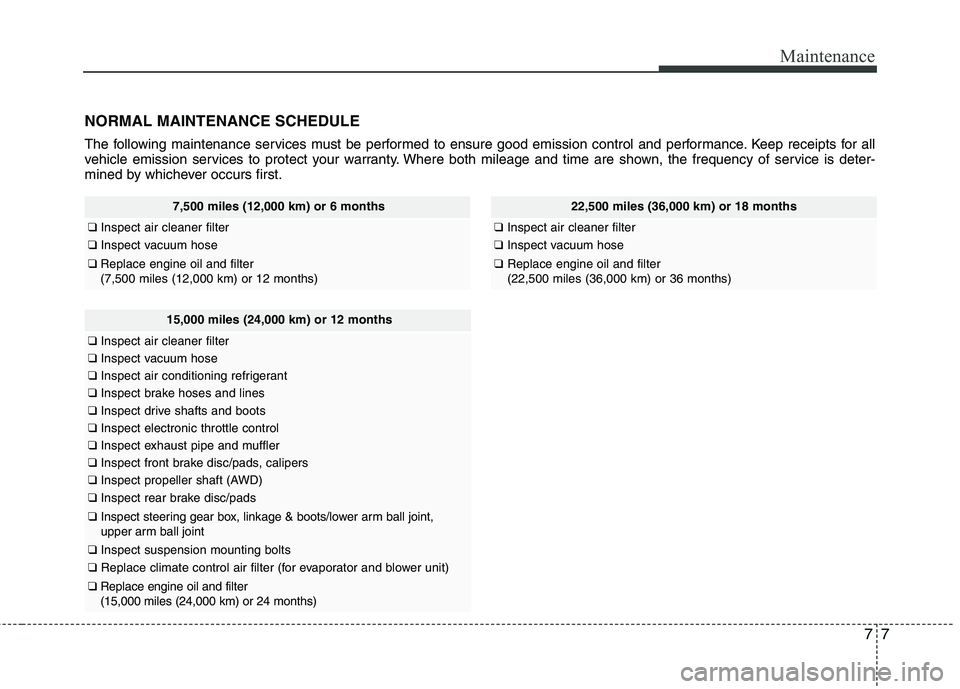
77
Maintenance
NORMAL MAINTENANCE SCHEDULE
The following maintenance services must be performed to ensure good emission control and performance. Keep receipts for all
vehicle emission services to protect your warranty. Where both mileage and time are shown, the frequency of service is deter-
mined by whichever occurs first.
15,000 miles (24,000 km) or 12 months
❑Inspect air cleaner filter
❑Inspect vacuum hose
❑Inspect air conditioning refrigerant
❑Inspect brake hoses and lines
❑Inspect drive shafts and boots
❑Inspect electronic throttle control
❑Inspect exhaust pipe and muffler
❑Inspect front brake disc/pads, calipers
❑Inspect propeller shaft (AWD)
❑Inspect rear brake disc/pads
❑Inspect steering gear box, linkage & boots/lower arm ball joint,
upper arm ball joint
❑ Inspect suspension mounting bolts
❑Replace climate control air filter (for evaporator and blower unit)
❑Replace engine oil and filter (15,000 miles (24,000 km) or 24 months)
22,500 miles (36,000 km) or 18 months
❑ Inspect air cleaner filter
❑Inspect vacuum hose
❑Replace engine oil and filter (22,500 miles (36,000 km) or 36 months)
7,500 miles (12,000 km) or 6 months
❑ Inspect air cleaner filter
❑Inspect vacuum hose
❑Replace engine oil and filter (7,500 miles (12,000 km) or 12 months)
Page 295 of 371
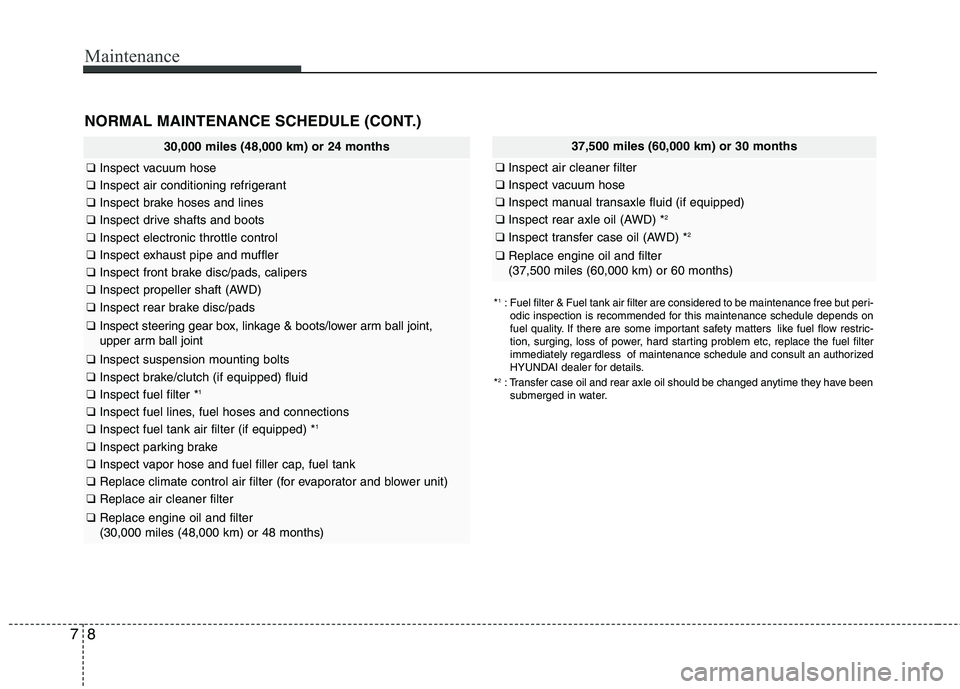
Maintenance
8
7
NORMAL MAINTENANCE SCHEDULE (CONT.)
37,500 miles (60,000 km) or 30 months
❑ Inspect air cleaner filter
❑Inspect vacuum hose
❑Inspect manual transaxle fluid (if equipped)
❑Inspect rear axle oil (AWD) * 2
❑
Inspect transfer case oil (AWD) * 2
❑
Replace engine oil and filter (37,500 miles (60,000 km) or 60 months)
*1
: Fuel filter & Fuel tank air filter are considered to be maintenance free but peri-
odic inspection is recommended for this maintenance schedule depends on
fuel quality. If there are some important safety matters like fuel flow restric-
tion, surging, loss of power, hard starting problem etc, replace the fuel filter
immediately regardless of maintenance schedule and consult an authorized
HYUNDAI dealer for details.
* 2
: Transfer case oil and rear axle oil should be changed anytime they have been
submerged in water.
30,000 miles (48,000 km) or 24 months
❑ Inspect vacuum hose
❑Inspect air conditioning refrigerant
❑Inspect brake hoses and lines
❑Inspect drive shafts and boots
❑Inspect electronic throttle control
❑Inspect exhaust pipe and muffler
❑Inspect front brake disc/pads, calipers
❑Inspect propeller shaft (AWD)
❑Inspect rear brake disc/pads
❑Inspect steering gear box, linkage & boots/lower arm ball joint,
upper arm ball joint
❑Inspect suspension mounting bolts
❑Inspect brake/clutch (if equipped) fluid
❑Inspect fuel filter * 1
❑
Inspect fuel lines, fuel hoses and connections
❑Inspect fuel tank air filter (if equipped) * 1
❑
Inspect parking brake
❑Inspect vapor hose and fuel filler cap, fuel tank
❑ Replace climate control air filter (for evaporator and blower unit)
❑Replace air cleaner filter
❑Replace engine oil and filter (30,000 miles (48,000 km) or 48 months)
Page 296 of 371
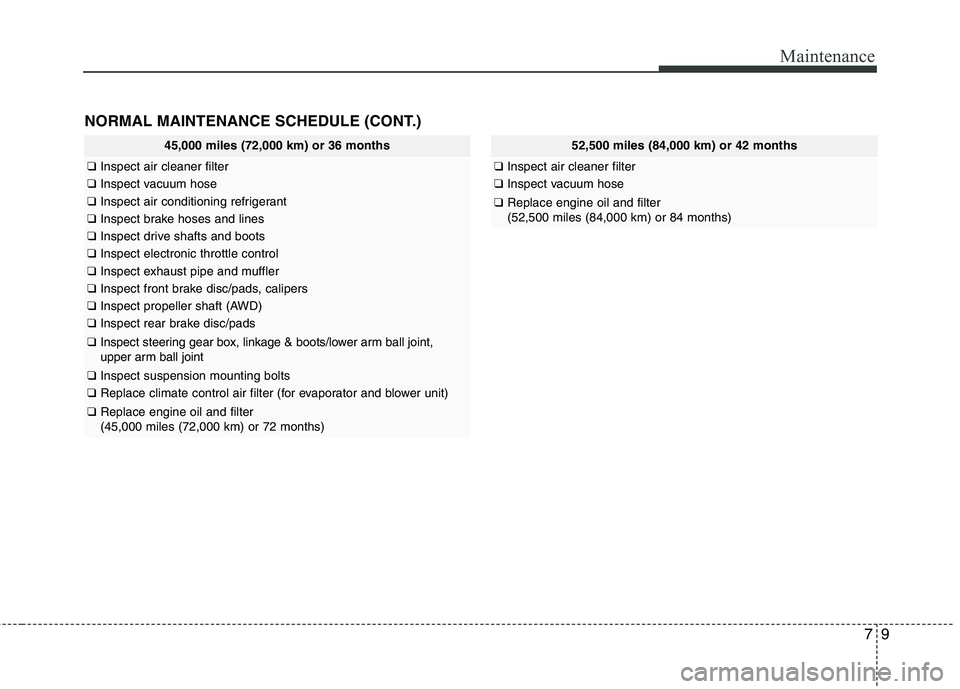
79
Maintenance
45,000 miles (72,000 km) or 36 months
❑Inspect air cleaner filter
❑Inspect vacuum hose
❑Inspect air conditioning refrigerant
❑Inspect brake hoses and lines
❑Inspect drive shafts and boots
❑Inspect electronic throttle control
❑Inspect exhaust pipe and muffler
❑Inspect front brake disc/pads, calipers
❑Inspect propeller shaft (AWD)
❑Inspect rear brake disc/pads
❑Inspect steering gear box, linkage & boots/lower arm ball joint,
upper arm ball joint
❑ Inspect suspension mounting bolts
❑Replace climate control air filter (for evaporator and blower unit)
❑Replace engine oil and filter (45,000 miles (72,000 km) or 72 months)
NORMAL MAINTENANCE SCHEDULE (CONT.)
52,500 miles (84,000 km) or 42 months
❑ Inspect air cleaner filter
❑Inspect vacuum hose
❑Replace engine oil and filter (52,500 miles (84,000 km) or 84 months)
Page 297 of 371
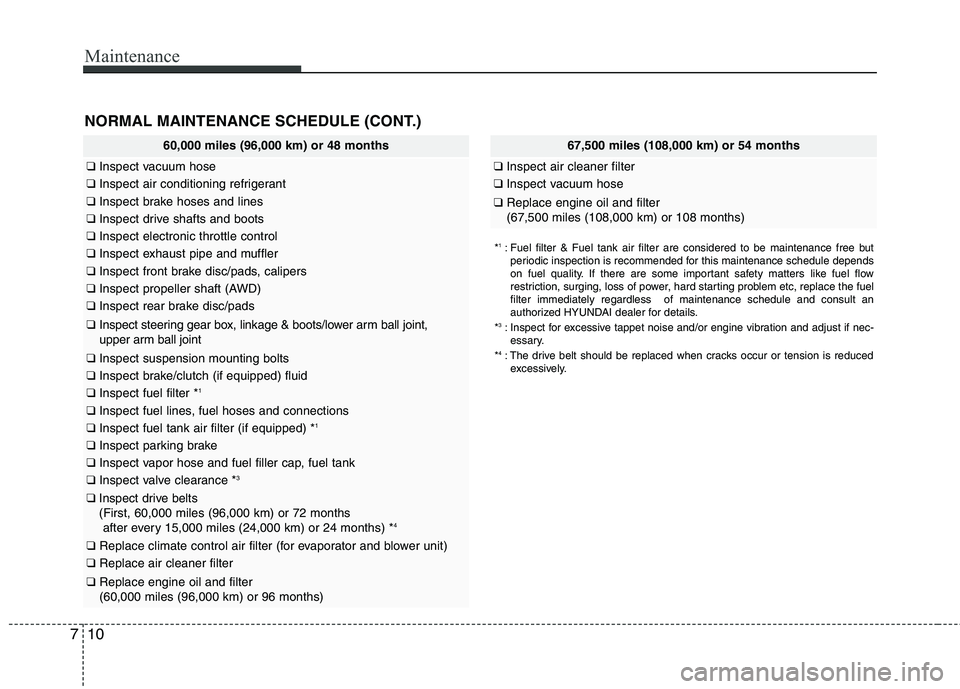
Maintenance
10
7
60,000 miles (96,000 km) or 48 months
❑ Inspect vacuum hose
❑Inspect air conditioning refrigerant
❑Inspect brake hoses and lines
❑Inspect drive shafts and boots
❑Inspect electronic throttle control
❑Inspect exhaust pipe and muffler
❑Inspect front brake disc/pads, calipers
❑Inspect propeller shaft (AWD)
❑Inspect rear brake disc/pads
❑Inspect steering gear box, linkage & boots/lower arm ball joint,
upper arm ball joint
❑ Inspect suspension mounting bolts
❑Inspect brake/clutch (if equipped) fluid
❑Inspect fuel filter * 1
❑
Inspect fuel lines, fuel hoses and connections
❑Inspect fuel tank air filter (if equipped) * 1
❑
Inspect parking brake
❑ Inspect vapor hose and fuel filler cap, fuel tank
❑Inspect valve clearance * 3
❑
Inspect drive belts (First, 60,000 miles (96,000 km) or 72 months
after every 15,000 miles (24,000 km) or 24 months) * 4
❑
Replace climate control air filter (for evaporator and blower unit)
❑Replace air cleaner filter
❑Replace engine oil and filter (60,000 miles (96,000 km) or 96 months)
67,500 miles (108,000 km) or 54 months
❑ Inspect air cleaner filter
❑Inspect vacuum hose
❑Replace engine oil and filter (67,500 miles (108,000 km) or 108 months)
NORMAL MAINTENANCE SCHEDULE (CONT.)
*1
: Fuel filter & Fuel tank air filter are considered to be maintenance free but
periodic inspection is recommended for this maintenance schedule depends
on fuel quality. If there are some important safety matters like fuel flow
restriction, surging, loss of power, hard starting problem etc, replace the fuelfilter immediately regardless of maintenance schedule and consult an
authorized HYUNDAI dealer for details.
* 3
: Inspect for excessive tappet noise and/or engine vibration and adjust if nec-
essary.
* 4
: The drive belt should be replaced when cracks occur or tension is reduced
excessively.
Page 298 of 371
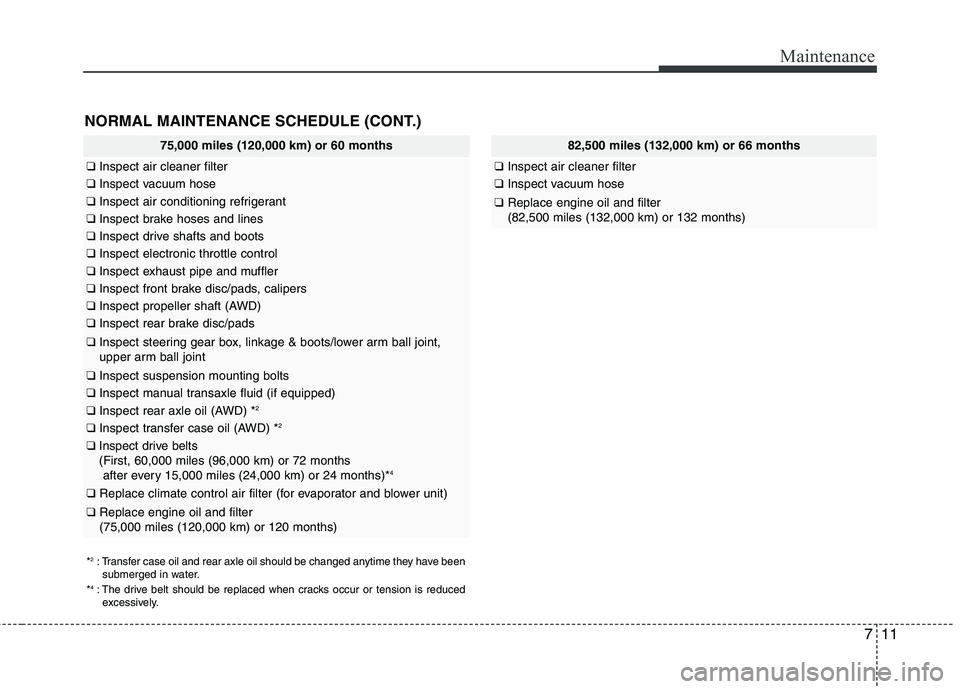
711
Maintenance
NORMAL MAINTENANCE SCHEDULE (CONT.)
75,000 miles (120,000 km) or 60 months
❑Inspect air cleaner filter
❑Inspect vacuum hose
❑Inspect air conditioning refrigerant
❑Inspect brake hoses and lines
❑Inspect drive shafts and boots
❑Inspect electronic throttle control
❑Inspect exhaust pipe and muffler
❑Inspect front brake disc/pads, calipers
❑Inspect propeller shaft (AWD)
❑Inspect rear brake disc/pads
❑Inspect steering gear box, linkage & boots/lower arm ball joint,
upper arm ball joint
❑ Inspect suspension mounting bolts
❑Inspect manual transaxle fluid (if equipped)
❑Inspect rear axle oil (AWD) * 2
❑
Inspect transfer case oil (AWD) * 2
❑
Inspect drive belts (First, 60,000 miles (96,000 km) or 72 months
after every 15,000 miles (24,000 km) or 24 months)* 4
❑
Replace climate control air filter (for evaporator and blower unit)
❑Replace engine oil and filter (75,000 miles (120,000 km) or 120 months)
82,500 miles (132,000 km) or 66 months
❑ Inspect air cleaner filter
❑Inspect vacuum hose
❑Replace engine oil and filter (82,500 miles (132,000 km) or 132 months)
*2
: Transfer case oil and rear axle oil should be changed anytime they have been
submerged in water.
* 4
: The drive belt should be replaced when cracks occur or tension is reduced
excessively.