engine coolant HYUNDAI TUCSON 2012 Owner's Manual
[x] Cancel search | Manufacturer: HYUNDAI, Model Year: 2012, Model line: TUCSON, Model: HYUNDAI TUCSON 2012Pages: 371, PDF Size: 5.39 MB
Page 311 of 371
Maintenance
24
7
Recommended engine coolant
When adding coolant, use only deion-
ized water or soft water for your vehicle
and never mix hard water in the
coolant filled at the factory. An improp-
er coolant mixture can result in serious
malfunction or engine damage.
The engine in your vehicle has aluminum engine parts and must be protected by
an ethylene-glycol-based coolant to pre-
vent corrosion and freezing.
DO NOT USE alcohol or methanol coolant or mix them with the specifiedcoolant.
Do not use a solution that contains more than 60% antifreeze or less than
35% antifreeze, which would reduce
the effectiveness of the solution.
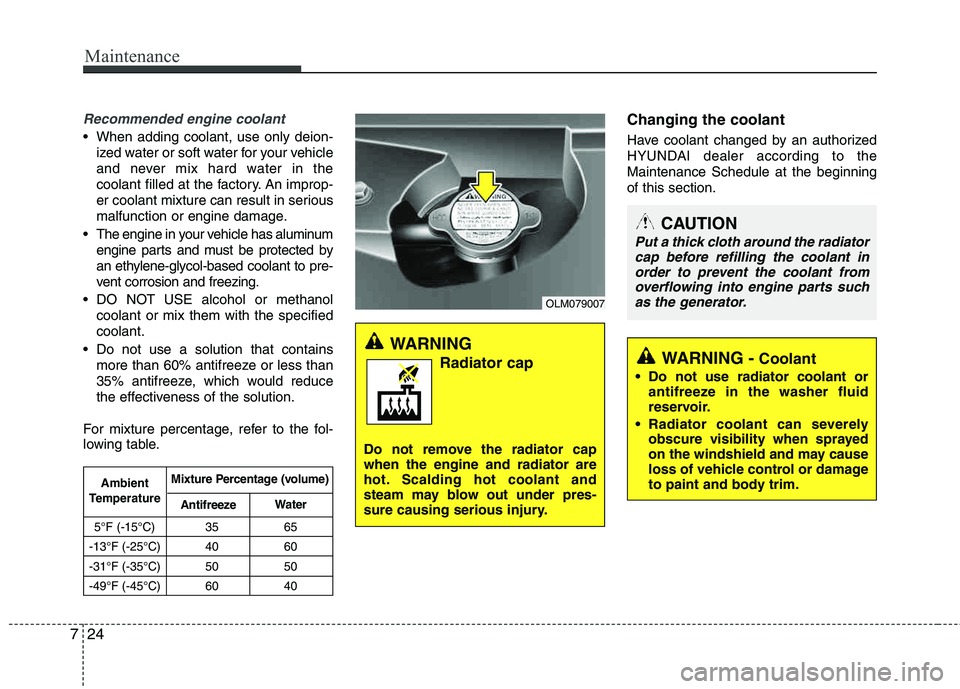
For mixture percentage, refer to the fol-
lowing table.
Changing the coolant
Have coolant changed by an authorized
HYUNDAI dealer according to theMaintenance Schedule at the beginningof this section.
WARNING
Radiator cap
Do not remove the radiator cap when the engine and radiator are
hot. Scalding hot coolant and
steam may blow out under pres-
sure causing serious injury.
OLM079007
CAUTION
Put a thick cloth around the radiator cap before refilling the coolant inorder to prevent the coolant from
overflowing into engine parts suchas the generator.
WARNING -Coolant
Do not use radiator coolant or antifreeze in the washer fluid
reservoir.
Radiator coolant can severely obscure visibility when sprayed
on the windshield and may cause
loss of vehicle control or damage
to paint and body trim.
5°F (-15°C) 35 65
-13°F (-25°C) 40 60
-31°F (-35°C) 50 50
-49°F (-45°C) 60 40
Ambient
Temperature Mixture Percentage (volume)
Antifreeze Water
Page 360 of 371
773
Maintenance
Canister
Fuel vapors generated inside the fuel tank are absorbed and stored in the
onboard canister. When the engine is
running, the fuel vapors absorbed in the
canister are drawn into the surge tank
through the purge control solenoid valve.
Purge Control Solenoid Valve (PCSV)
The purge control solenoid valve is con-
trolled by the Engine Control Module
(ECM); when the engine coolant temper-
ature is low during idling, the PCSV clos-
es so that evaporated fuel is not taken
into the engine. After the engine warms-
up during ordinary driving, the PCSV
opens to introduce evaporated fuel to the
engine.
3. Exhaust emission control system
The Exhaust Emission Control System is
a highly effective system which controls
exhaust emissions while maintaining
good vehicle performance.
Vehicle modifications
This vehicle should not be modified.
Modification of your vehicle could affect
its performance, safety or durability and
may even violate governmental safety
and emissions regulations.
In addition, damage or performance
problems resulting from any modification
may not be covered under warranty.
If you use unauthorized electronicdevices, it may cause the vehicle to
operate abnormally, wire damage, bat-
tery discharge and fire. For your safety,
be careful not to damage.
Engine exhaust gas precautions
(carbon monoxide)
Carbon monoxide can be present with other exhaust fumes. Therefore, if you
smell exhaust fumes of any kind inside
your vehicle, have it inspected and
repaired immediately. If you ever sus-
pect exhaust fumes are coming into
your vehicle, drive it only with all the
windows fully open. Have your vehicle
checked and repaired immediately.
WARNING - Exhaust
Engine exhaust gases contain car-
bon monoxide (CO). Though color-
less and odorless, it is dangerousand could be lethal if inhaled.
Follow the instructions on this
page to avoid CO poisoning.
CALIFORNIA PROPOSI-
TION 65 WARNING
Engine exhaust and a wide variety of automobile components and
parts, including components foundin the interior furnishings in a vehi-
cle, contain or emit chemicals
known to the State of California to
cause cancer and birth defects and
reproductive harm. In addition, cer-
tain fluids contained in vehicles
and certain products of component
wear contain or emit chemicals
known to the State of California to
cause cancer and birth defects or
other reproductive harm.
Page 366 of 371
Specifications, Consumer information, Reporting safety defects
4
8
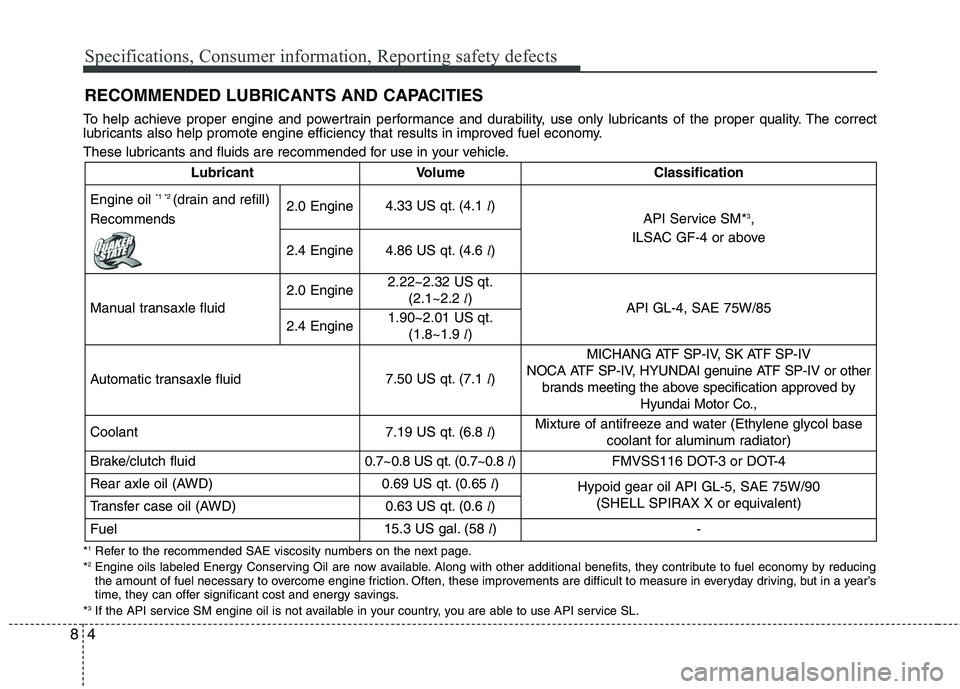
RECOMMENDED LUBRICANTS AND CAPACITIES
To help achieve proper engine and powertrain performance and durability, use only lubricants of the proper quality. The correct
lubricants also help promote engine efficiency that results in improved fuel economy.
These lubricants and fluids are recommended for use in your vehicle.
* 1
Refer to the recommended SAE viscosity numbers on the next page.
* 2
Engine oils labeled Energy Conserving Oil are now available. Along with other additional benefits, they contribute to fuel econo my by reducing
the amount of fuel necessary to overcome engine friction. Often, these improvements are difficult to measure in everyday driving, but in a year’s time, they can offer significant cost and energy savings.
* 3
If the API service SM engine oil is not available in your country, you are able to use API service SL.
LubricantVolumeClassification
Engine oil *1 *2
(drain and refill)
Recommends2.0 Engine4.33 US qt. (4.1 l)API Service SM* 3
,
ILSAC GF-4 or above
2.4 Engine4.86 US qt. (4.6 l)
Manual transaxle fluid
2.0 Engine2.22~2.32 US qt.
(2.1~2.2 l)
API GL-4, SAE 75W/85
2.4 Engine1.90~2.01 US qt.
(1.8~1.9 l)
Automatic transaxle fluid7.50 US qt. (7.1 l)
MICHANG ATF SP-IV, SK ATF SP-IV
NOCA ATF SP-IV, HYUNDAI genuine ATF SP-IV or other brands meeting the above specification approved by Hyundai Motor Co.,
Coolant 7.19 US qt. (6.8 l)Mixture of antifreeze and water (Ethylene glycol base
coolant for aluminum radiator)
Brake/clutch fluid0.7~0.8 US qt. (0.7~0.8 l)FMVSS116 DOT-3 or DOT-4
Rear axle oil (AWD)0.69 US qt. (0.65 l)Hypoid gear oil API GL-5, SAE 75W/90
(SHELL SPIRAX X or equivalent)
Transfer case oil (AWD)0.63 US qt. (0.6 l)
Fuel15.3 US gal. (58 l)-