key HYUNDAI TUCSON 2013 Service Manual
[x] Cancel search | Manufacturer: HYUNDAI, Model Year: 2013, Model line: TUCSON, Model: HYUNDAI TUCSON 2013Pages: 397, PDF Size: 5.55 MB
Page 214 of 397
Driving your vehicle
6
5
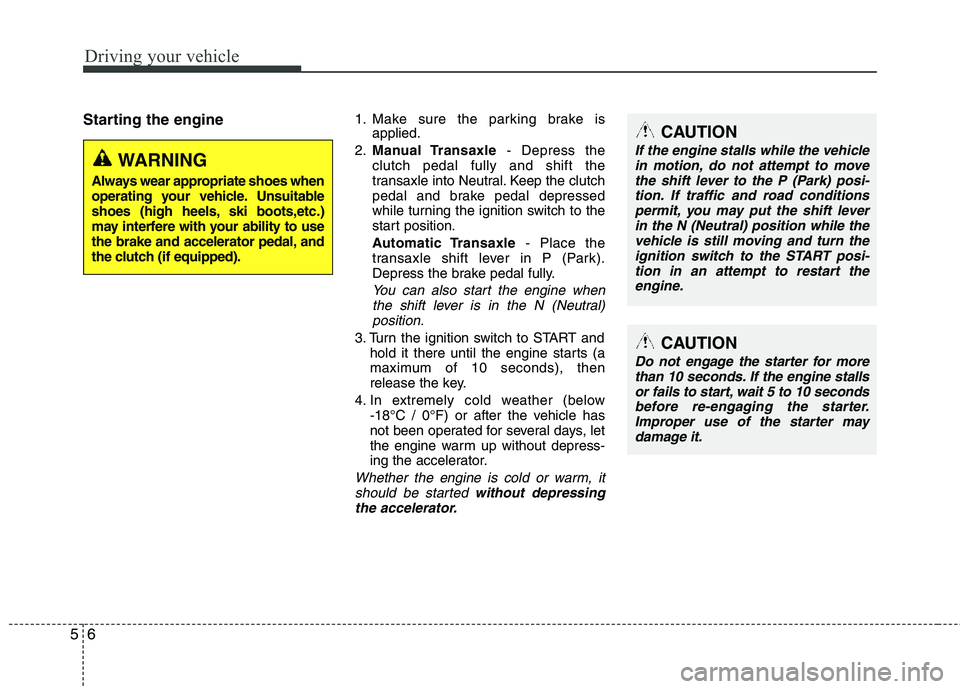
Starting the engine1. Make sure the parking brake is
applied.
2. Manual Transaxle - Depress the
clutch pedal fully and shift the
transaxle into Neutral. Keep the clutch
pedal and brake pedal depressed
while turning the ignition switch to the
start position.
Automatic Transaxle - Place the
transaxle shift lever in P (Park).
Depress the brake pedal fully.
You can also start the engine when
the shift lever is in the N (Neutral)position.
3. Turn the ignition switch to START and hold it there until the engine starts (a
maximum of 10 seconds), then
release the key.
4. In extremely cold weather (below -18°C / 0°F) or after the vehicle has
not been operated for several days, let
the engine warm up without depress-
ing the accelerator.
Whether the engine is cold or warm, it
should be started without depressing
the accelerator.
WARNING
Always wear appropriate shoes when
operating your vehicle. Unsuitable
shoes (high heels, ski boots,etc.)
may interfere with your ability to use
the brake and accelerator pedal, and
the clutch (if equipped).
CAUTION
If the engine stalls while the vehicle in motion, do not attempt to movethe shift lever to the P (Park) posi-
tion. If traffic and road conditionspermit, you may put the shift leverin the N (Neutral) position while the vehicle is still moving and turn the
ignition switch to the START posi- tion in an attempt to restart theengine.
CAUTION
Do not engage the starter for more than 10 seconds. If the engine stalls
or fails to start, wait 5 to 10 secondsbefore re-engaging the starter.Improper use of the starter may
damage it.
Page 215 of 397
57
Driving your vehicle
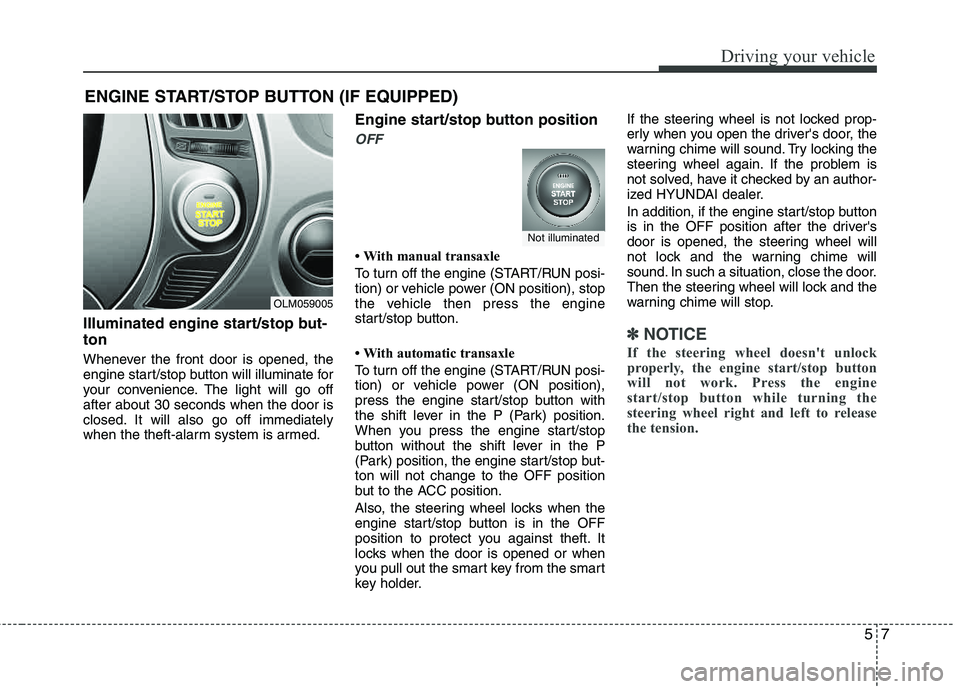
Illuminated engine start/stop but- ton
Whenever the front door is opened, the
engine start/stop button will illuminate for
your convenience. The light will go off after about 30 seconds when the door is
closed. It will also go off immediately
when the theft-alarm system is armed.
Engine start/stop button position
OFF
With manual transaxle
To turn off the engine (START/RUN posi-
tion) or vehicle power (ON position), stop
the vehicle then press the engine
start/stop button.
With automatic transaxle
To turn off the engine (START/RUN posi-
tion) or vehicle power (ON position),
press the engine start/stop button with
the shift lever in the P (Park) position.
When you press the engine start/stop
button without the shift lever in the P
(Park) position, the engine start/stop but- ton will not change to the OFF position
but to the ACC position.
Also, the steering wheel locks when the
engine start/stop button is in the OFF
position to protect you against theft. It
locks when the door is opened or when
you pull out the smart key from the smart
key holder.If the steering wheel is not locked prop-
erly when you open the driver's door, the
warning chime will sound. Try locking the
steering wheel again. If the problem is
not solved, have it checked by an author-
ized HYUNDAI dealer.
In addition, if the engine start/stop button
is in the OFF position after the driver's
door is opened, the steering wheel will
not lock and the warning chime will
sound. In such a situation, close the door.
Then the steering wheel will lock and the
warning chime will stop.
✽✽
NOTICE
If the steering wheel doesn't unlock
properly, the engine start/stop button
will not work. Press the engine
start/stop button while turning the
steering wheel right and left to release
the tension.
ENGINE START/STOP BUTTON (IF EQUIPPED)
OLM059005
Not illuminated
Page 218 of 397
Driving your vehicle
10
5
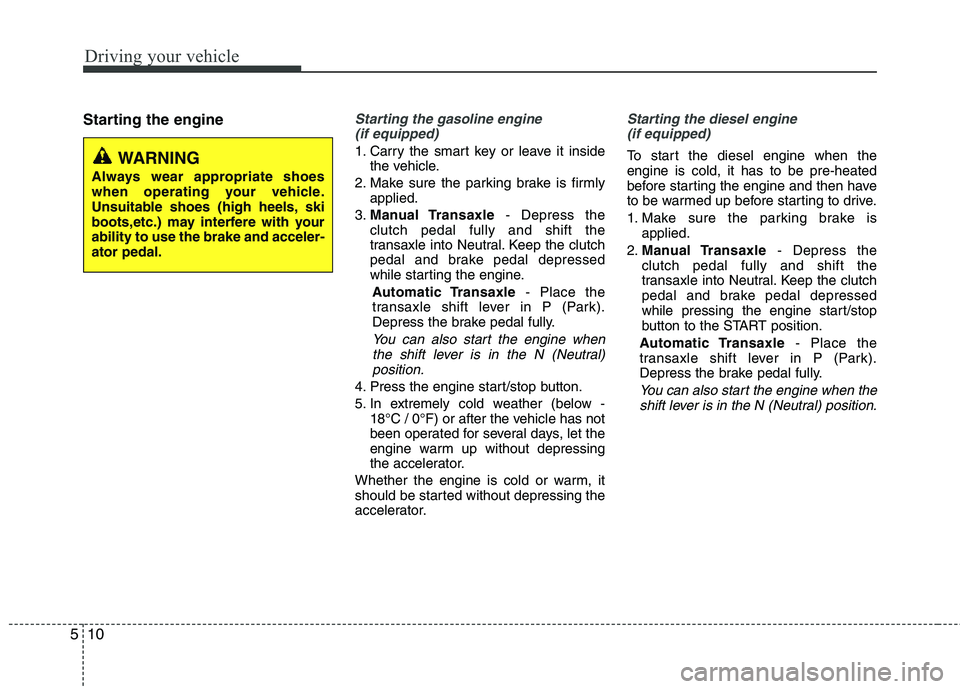
Starting the engineStarting the gasoline engine
(if equipped)
1. Carry the smart key or leave it inside the vehicle.
2. Make sure the parking brake is firmly applied.
3. Manual Transaxle - Depress the
clutch pedal fully and shift the
transaxle into Neutral. Keep the clutch
pedal and brake pedal depressed
while starting the engine.
Automatic Transaxle - Place the
transaxle shift lever in P (Park).
Depress the brake pedal fully.
You can also start the engine when
the shift lever is in the N (Neutral)position.
4. Press the engine start/stop button.
5. In extremely cold weather (below - 18°C / 0°F) or after the vehicle has not
been operated for several days, let the
engine warm up without depressing
the accelerator.
Whether the engine is cold or warm, it
should be started without depressing the
accelerator.
Starting the diesel engine (if equipped)
To start the diesel engine when the engine is cold, it has to be pre-heated
before starting the engine and then have
to be warmed up before starting to drive.
1. Make sure the parking brake is applied.
2. Manual Transaxle - Depress the
clutch pedal fully and shift the
transaxle into Neutral. Keep the clutch
pedal and brake pedal depressed
while pressing the engine start/stop
button to the START position.
Automatic Transaxle - Place the
transaxle shift lever in P (Park).
Depress the brake pedal fully.
You can also start the engine when the
shift lever is in the N (Neutral) position.
WARNING
Always wear appropriate shoes
when operating your vehicle.
Unsuitable shoes (high heels, ski
boots,etc.) may interfere with your ability to use the brake and acceler-ator pedal.
Page 219 of 397
511
Driving your vehicle
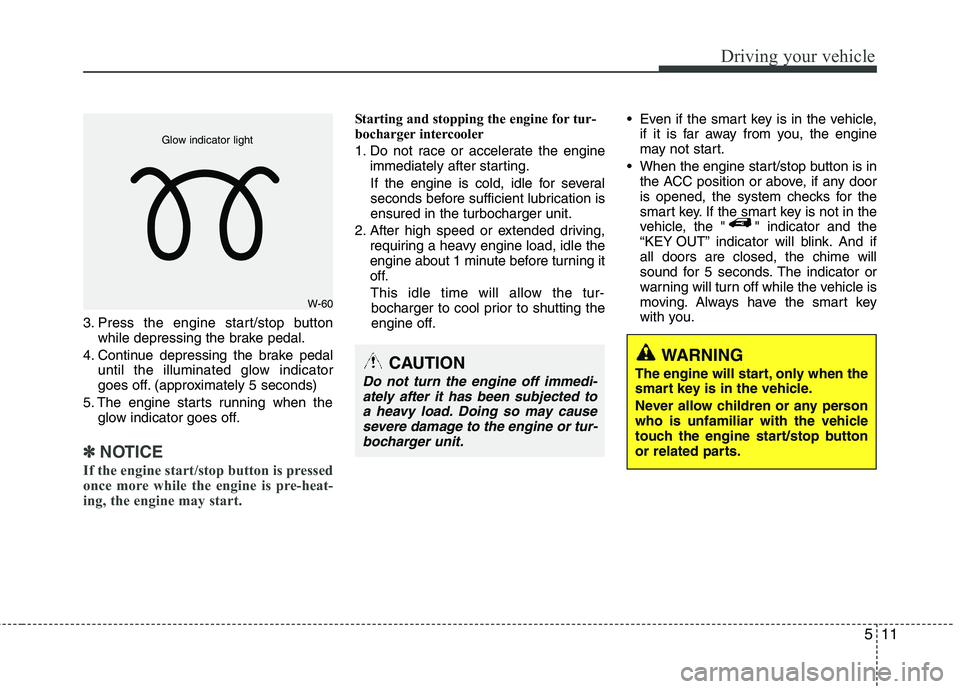
3. Press the engine start/stop buttonwhile depressing the brake pedal.
4. Continue depressing the brake pedal until the illuminated glow indicator
goes off. (approximately 5 seconds)
5. The engine starts running when the glow indicator goes off.
✽✽
NOTICE
If the engine start/stop button is pressed
once more while the engine is pre-heat-
ing, the engine may start.
Starting and stopping the engine for tur-
bocharger intercooler
1. Do not race or accelerate the engine immediately after starting.
If the engine is cold, idle for several
seconds before sufficient lubrication isensured in the turbocharger unit.
2. After high speed or extended driving, requiring a heavy engine load, idle the
engine about 1 minute before turning it
off.
This idle time will allow the tur- bocharger to cool prior to shutting the
engine off. Even if the smart key is in the vehicle,
if it is far away from you, the engine
may not start.
When the engine start/stop button is in the ACC position or above, if any door
is opened, the system checks for the
smart key. If the smart key is not in the
vehicle, the " " indicator and the
“KEY OUT” indicator will blink. And ifall doors are closed, the chime will
sound for 5 seconds. The indicator or
warning will turn off while the vehicle is
moving. Always have the smart key
with you.
WARNING
The engine will start, only when the
smart key is in the vehicle.
Never allow children or any person
who is unfamiliar with the vehicle
touch the engine start/stop button
or related parts.CAUTION
Do not turn the engine off immedi- ately after it has been subjected toa heavy load. Doing so may cause
severe damage to the engine or tur- bocharger unit.
W-60
Glow indicator light
Page 220 of 397
Driving your vehicle
12
5
✽✽
NOTICE
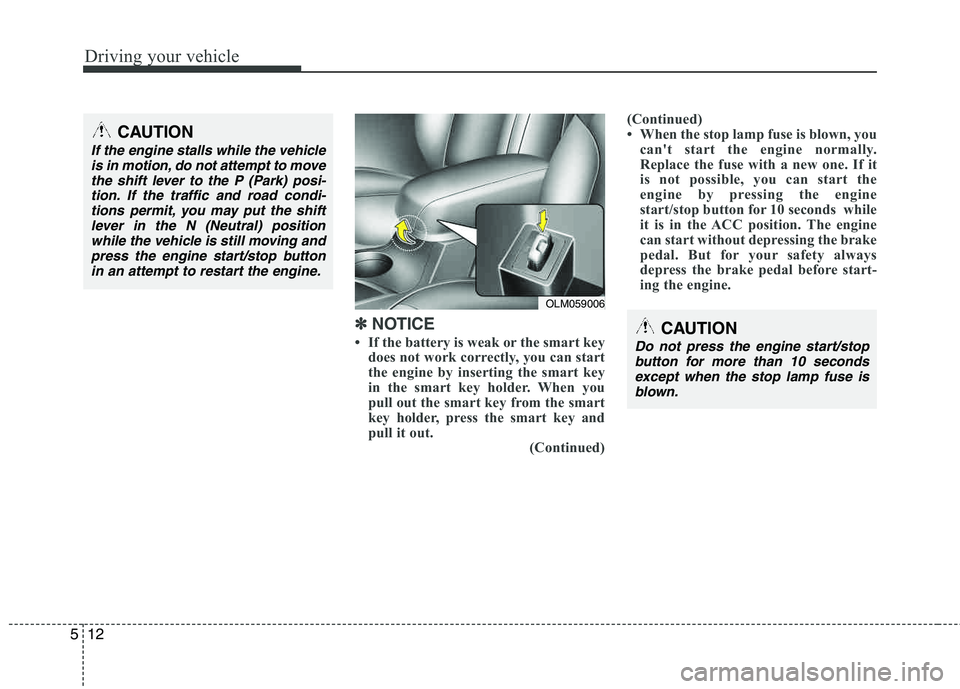
If the battery is weak or the smart key does not work correctly, you can start
the engine by inserting the smart key
in the smart key holder. When you
pull out the smart key from the smart
key holder, press the smart key and
pull it out. (Continued)(Continued)
When the stop lamp fuse is blown, you
can't start the engine normally.
Replace the fuse with a new one. If it
is not possible, you can start the
engine by pressing the engine
start/stop button for 10 seconds while
it is in the ACC position. The engine
can start without depressing the brake
pedal. But for your safety always
depress the brake pedal before start-
ing the engine.CAUTION
Do not press the engine start/stop
button for more than 10 secondsexcept when the stop lamp fuse isblown.
OLM059006
CAUTION
If the engine stalls while the vehicle is in motion, do not attempt to move the shift lever to the P (Park) posi-
tion. If the traffic and road condi-tions permit, you may put the shiftlever in the N (Neutral) positionwhile the vehicle is still moving and
press the engine start/stop button in an attempt to restart the engine.
Page 228 of 397
Driving your vehicle
20
5
Shift lock system
For your safety, the automatic transaxle
has a shift lock system which prevents
shifting the transaxle from P (Park) or N
(Neutral) into R (Reverse) unless the
brake pedal is depressed.
To shift the transaxle from P (Park) or N
(Neutral) into R (Reverse):
1. Depress and hold the brake pedal.
2. Start the engine or turn the ignition
switch to the ON position.
3. Move the shift lever.
If the brake pedal is repeatedly depressed and released with the shift
lever in the P (Park) position, a chattering
noise near the shift lever may be heard.
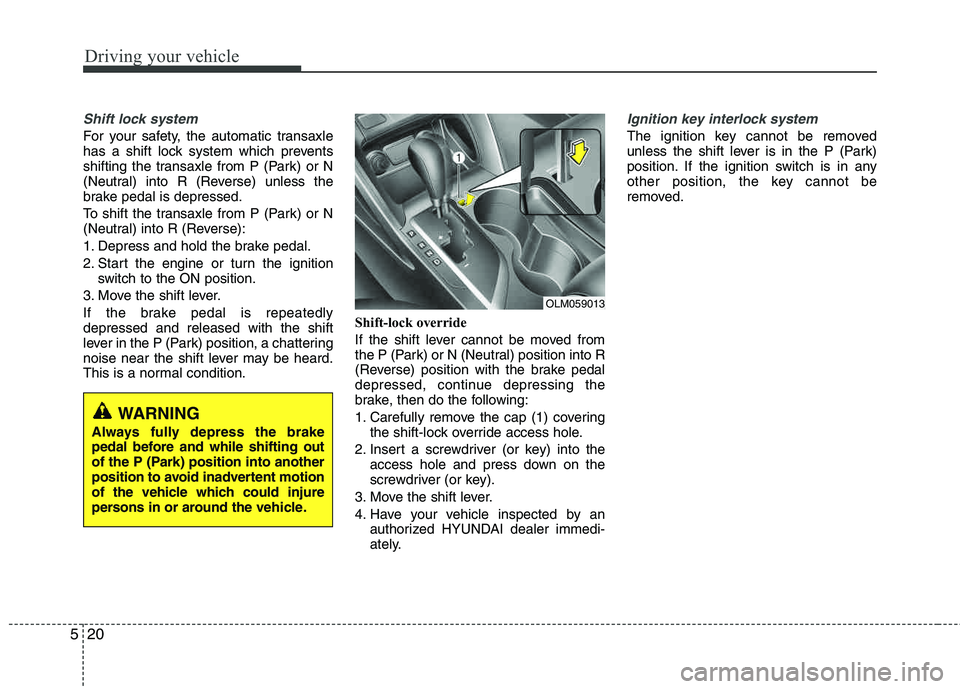
This is a normal condition. Shift-lock override
If the shift lever cannot be moved from
the P (Park) or N (Neutral) position into R
(Reverse) position with the brake pedal
depressed, continue depressing the
brake, then do the following:
1. Carefully remove the cap (1) covering
the shift-lock override access hole.
2. Insert a screwdriver (or key) into the access hole and press down on the
screwdriver (or key).
3. Move the shift lever.
4. Have your vehicle inspected by an authorized HYUNDAI dealer immedi-
ately.
Ignition key interlock system
The ignition key cannot be removed
unless the shift lever is in the P (Park)
position. If the ignition switch is in any
other position, the key cannot be
removed.
WARNING
Always fully depress the brake
pedal before and while shifting out
of the P (Park) position into another
position to avoid inadvertent motion
of the vehicle which could injure
persons in or around the vehicle.
OLM059013
Page 264 of 397
Driving your vehicle
56
5
To keep locks from freezing
To keep the locks from freezing, squirt an
approved de-icer fluid or glycerine into
the key opening. If a lock is covered with
ice, squirt it with an approved de-icing
fluid to remove the ice. If the lock is
frozen internally, you may be able to thaw
it out by using a heated key. Handle the
heated key with care to avoid injury.
Use approved window washer
anti-freeze in system
To keep the water in the window washer
system from freezing, add an approved
window washer anti-freeze solution in
accordance with instructions on the con-
tainer. Window washer anti-freeze is
available from an authorized HYUNDAI
dealer and most auto parts outlets. Donot use engine coolant or other types of
anti-freeze as these may damage the paint finish.
Don't let your parking brake
freeze
Under some conditions your parking
brake can freeze in the engaged position.
This is most likely to happen when there
is an accumulation of snow or ice around
or near the rear brakes or if the brakes
are wet. If there is a risk the parking
brake may freeze, apply it only temporar-
ily while you put the shift lever in P (auto-
matic transaxle) or in first or reverse gear
(manual transaxle) and block the rear
wheels so the car cannot roll. Then
release the parking brake.
Don't let ice and snow accumu- late underneath
Under some conditions, snow and ice
can build up under the fenders and inter-
fere with the steering. When driving in
severe winter conditions where this may
happen, you should periodically check
underneath the vehicle to be sure the
movement of the front wheels and the
steering components is not obstructed.
Carry emergency equipment
Depending on the severity of the weath-
er, you should carry appropriate emer-
gency equipment. Some of the items you
may want to carry include tire chains, tow
straps or chains, flashlight, emergency
flares, sand, a shovel, jumper cables, a
window scraper, gloves, ground cloth,
coveralls, a blanket, etc.
Page 375 of 397
775
Maintenance
CALIFORNIA PERCHLORATE NOTICE
Perchlorate Material-special handling
may apply, See www.dtsc.ca.gov/haz-
ardouswaste/perchlorate.
Notice to California Vehicle Dismantlers:
Perchlorate containing materials, such as
air bag inflators, seatbelt pretensioners
and keyless remote entry batteries, must
be disposed of according to Title 22
California Code of Regulations Section 67384.10 (a).
Page 386 of 397
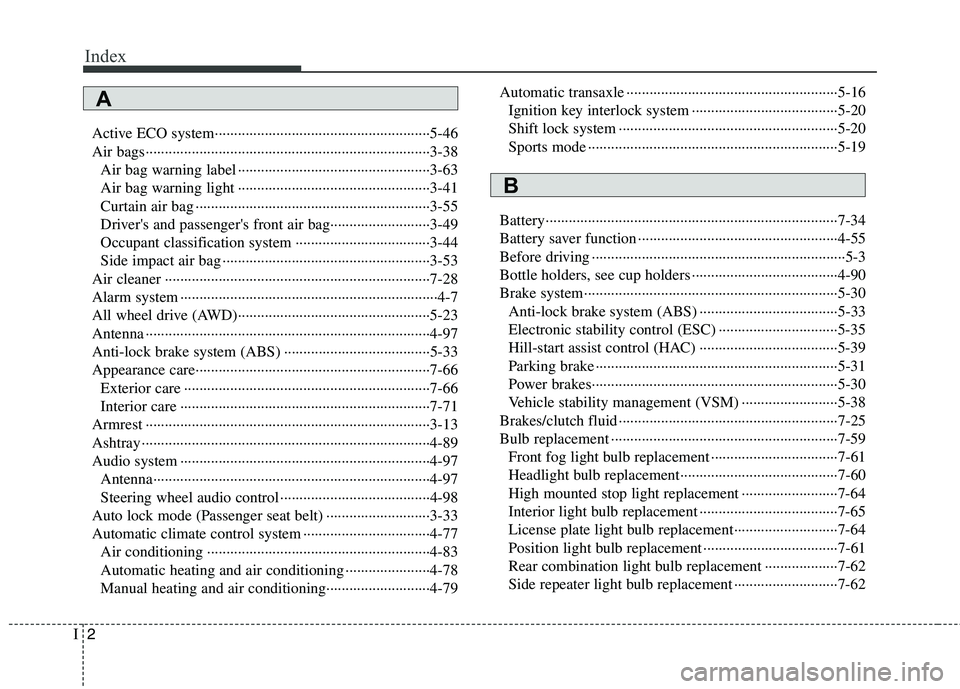
Index
2I
Active ECO system························································5-46
Air bags··········································································3-38Air bag warning label ··················································3-63
Air bag warning light ··················································3-41
Curtain air bag ·····························································3-55
Driver's and passenger's front air bag··························3-49
Occupant classification system ···································3-44
Side impact air bag ······················································3-53
Air cleaner ·····································································7-28
Alarm system ···································································4-7
All wheel drive (AWD)··················································5-23
Antenna ··········································································4-97
Anti-lock brake system (ABS) ······································5-33
Appearance care·····························································7-66 Exterior care ································································7-66
Interior care ·································································7-71
Armrest ··········································································3-13
Ashtray ···········································································4-89
Audio system ·································································4-97 Antenna········································································4-97
Steering wheel audio control ·······································4-98
Auto lock mode (Passenger seat belt) ···························3-33
Automatic climate control system ·································4-77 Air conditioning ··························································4-83
Automatic heating and air conditioning ······················4-78
Manual heating and air conditioning···························4-79 Automatic transaxle ·······················································5-16
Ignition key interlock system ······································5-20
Shift lock system ·························································5-20
Sports mode ·································································5-19
Battery············································································7-34
Battery saver function ····················································4-55
Before driving ··································································5-3
Bottle holders, see cup holders ······································4-90
Brake system··································································5-30 Anti-lock brake system (ABS) ····································5-33
Electronic stability control (ESC) ·······························5-35
Hill-start assist control (HAC) ····································5-39
Parking brake ·······························································5-31
Power brakes································································5-30
Vehicle stability management (VSM) ·························5-38
Brakes/clutch fluid ·························································7-25
Bulb replacement ···························································7-59 Front fog light bulb replacement ·································7-61
Headlight bulb replacement·········································7-60
High mounted stop light replacement ·························7-64
Interior light bulb replacement ····································7-65
License plate light bulb replacement···························7-64
Position light bulb replacement ···································7-61
Rear combination light bulb replacement ···················7-62
Side repeater light bulb replacement ···························7-62
B
A
Page 389 of 397
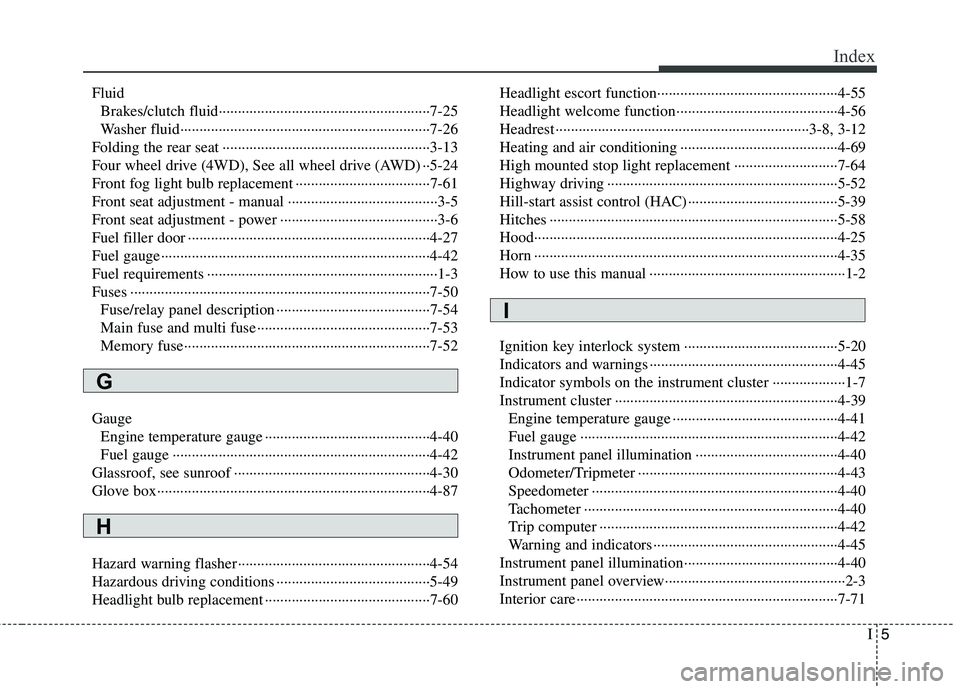
I5
Index
Fluid Brakes/clutch fluid·······················································7-25
Washer fluid·································································7-26
Folding the rear seat ······················································3-13
Four wheel drive (4WD), See all wheel drive (AWD) ··5-24
Front fog light bulb replacement ···································7-61
Front seat adjustment - manual ·······································3-5
Front seat adjustment - power ·········································3-6
Fuel filler door ·······························································4-27
Fuel gauge······································································4-42
Fuel requirements ····························································1-3
Fuses ··············································································7-50 Fuse/relay panel description ········································7-54
Main fuse and multi fuse ·············································7-53
Memory fuse································································7-52
Gauge Engine temperature gauge ···········································4-40
Fuel gauge ···································································4-42
Glassroof, see sunroof ···················································4-30
Glove box·······································································4-87
Hazard warning flasher ··················································4-54
Hazardous driving conditions ········································5-49
Headlight bulb replacement ···········································7-60 Headlight escort function···············································4-55
Headlight welcome function··········································4-56
Headrest ··································································3-8, 3-12
Heating and air conditioning ·········································4-69
High mounted stop light replacement ···························7-64
Highway driving ····························································5-52
Hill-start assist control (HAC) ·······································5-39
Hitches ···········································································5-58
Hood···············································································4-25
Horn ···············································································4-35
How to use this manual ···················································1-2
Ignition key interlock system ········································5-20
Indicators and warnings ·················································4-45
Indicator symbols on the instrument cluster ···················1-7
Instrument cluster ··························································4-39
Engine temperature gauge ···········································4-41
Fuel gauge ···································································4-42
Instrument panel illumination ·····································4-40
Odometer/Tripmeter ····················································4-43
Speedometer ································································4-40
Tachometer ··································································4-40
Trip computer ······························································4-42
Warning and indicators ················································4-45
Instrument panel illumination········································4-40
Instrument panel overview···············································2-3
Interior care····································································7-71
G
H
I