roof HYUNDAI TUCSON 2014 User Guide
[x] Cancel search | Manufacturer: HYUNDAI, Model Year: 2014, Model line: TUCSON, Model: HYUNDAI TUCSON 2014Pages: 542, PDF Size: 7.59 MB
Page 211 of 542
3-125
Convenient features of your vehicle
3
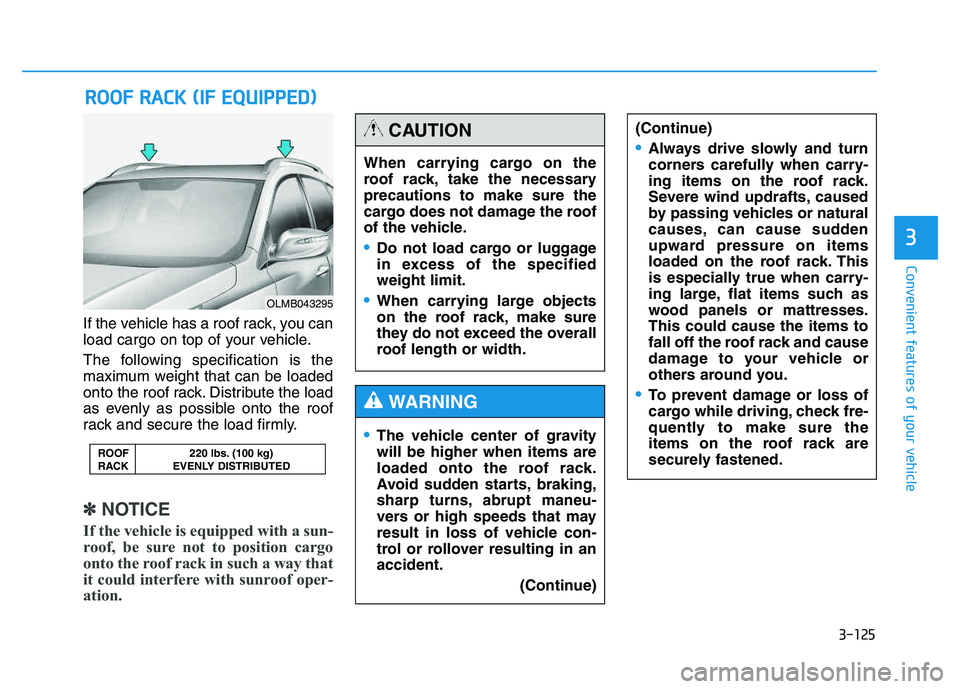
If the vehicle has a roof rack, you can
load cargo on top of your vehicle.
The following specification is the
maximum weight that can be loaded
onto the roof rack. Distribute the load
as evenly as possible onto the roof
rack and secure the load firmly.
✽✽NOTICE
If the vehicle is equipped with a sun-
roof, be sure not to position cargo
onto the roof rack in such a way that
it could interfere with sunroof oper-
ation.
RR OO OO FF RR AA CCKK (( IIFF EE QQ UUIIPP PPEEDD ))
ROOF 220 lbs. (100 kg)
RACK EVENLY DISTRIBUTED
OLMB043295
When carrying cargo on the
roof rack, take the necessaryprecautions to make sure the
cargo does not damage the roof
of the vehicle.
Do not load cargo or luggage
in excess of the specifiedweight limit.
When carrying large objects
on the roof rack, make sure
they do not exceed the overall
roof length or width.
CAUTION
The vehicle center of gravity will be higher when items are
loaded onto the roof rack.
Avoid sudden starts, braking,
sharp turns, abrupt maneu-
vers or high speeds that may
result in loss of vehicle con-
trol or rollover resulting in anaccident.
(Continue)
WARNING
(Continue)
Always drive slowly and turn
corners carefully when carry-
ing items on the roof rack.
Severe wind updrafts, caused
by passing vehicles or natural
causes, can cause sudden
upward pressure on items
loaded on the roof rack. This
is especially true when carry-
ing large, flat items such as
wood panels or mattresses.This could cause the items to
fall off the roof rack and cause
damage to your vehicle or
others around you.
To prevent damage or loss of
cargo while driving, check fre-
quently to make sure the
items on the roof rack are
securely fastened.
Page 213 of 542
4-2
✽✽NOTICE
If you install an aftermarket HID headlamp, your vehicle's audio
and electronic device may mal-
function.
Prevent chemicals such as per- fume, cosmetic oil, sun cream,
hand cleaner, and air freshener
from contacting the interior parts
because they may cause damage
or discoloration. Antenna
Roof antenna
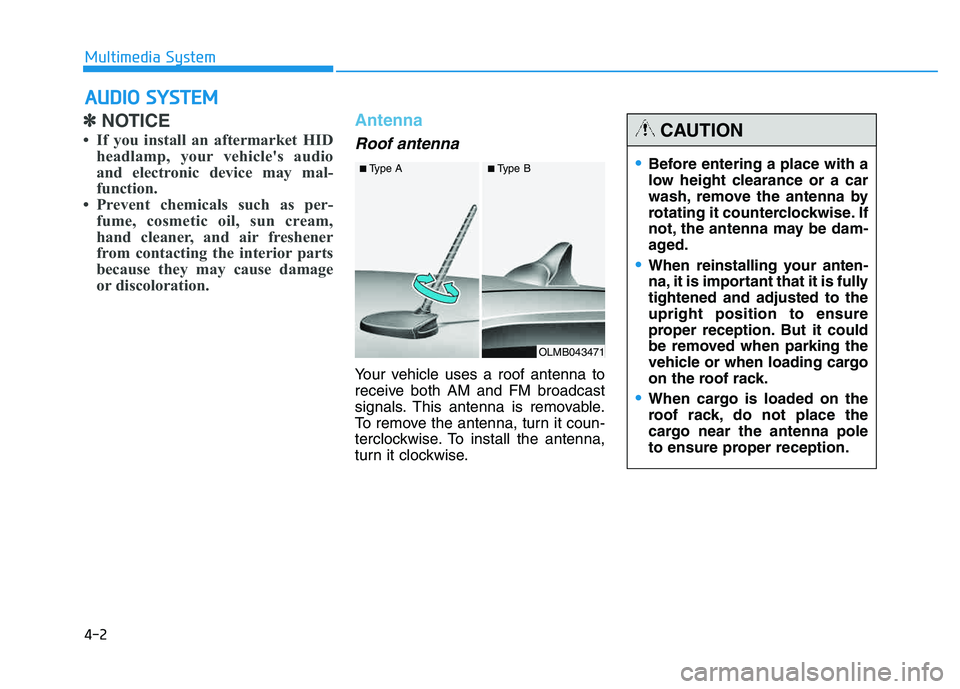
Your vehicle uses a roof antenna to
receive both AM and FM broadcast
signals. This antenna is removable.
To remove the antenna, turn it coun-
terclockwise. To install the antenna,
turn it clockwise.
AAUU DDIIOO SS YY SSTT EEMM
Multimedia System
OLMB043471
■
Type A ■Type B
•Before entering a place with a
low height clearance or a car
wash, remove the antenna by
rotating it counterclockwise. If
not, the antenna may be dam-
aged.
When reinstalling your anten-
na, it is important that it is fullytightened and adjusted to theupright position to ensure
proper reception. But it could
be removed when parking the
vehicle or when loading cargo
on the roof rack.
When cargo is loaded on the
roof rack, do not place the
cargo near the antenna pole
to ensure proper reception.
CAUTION
Page 226 of 542
4-15
Multimedia System
4
✽✽NOTICE - USING THE
Voice Recognition
When using the voice recognition feature, only commands listed
within the user's manual are sup-
ported.
Be aware that during the opera- tion of the voice recognition sys-
tem, pressing any key other than
the key terminate voice recog-
nition mode.
For superior voice recognition performance, position the micro-
phone used for voice recognition
above the head of the driver’s seat
and maintain a proper position
when saying commands.
Within the following situations, voice recognition may not function
properly due to external sound.
- When the windows and sunroofare open
- When the wind of the cooling / heating device is strong
- When entering and passing through tunnels (Continued)(Continued)
- When driving on rugged anduneven roads
- During severe rain (heavy rains, windstorms)
Phone related voice commands can be used only when a
Bluetooth ®
Wireless Technology
device is connected.
When making calls by stating a name, the corresponding contact
must be downloaded and stored
within the audio system.
After downloading the Bluetooth®
Wireless Technology phone book,
it may take some time to convert
the phone book data into voice
information. During this time,
voice recognition may not proper-
ly operate.
Pronounce the voice commands naturally and clearly as if in a nor-
mal conversation.
Page 390 of 542
5-54
Driving your vehicle
Hydroplaning
If the road is wet enough and you are
going fast enough, your vehicle may
have little or no contact with the road
surface and actually ride on the
water. The best advice is SLOW
DOWN when the road is wet. The
risk of hydroplaning increases as the
depth of tire tread decreases, refer to
“Tire Tread” in chapter 7.
Driving in flooded areas
Avoid driving through flooded areas
unless you are sure the water is nohigher than the bottom of the wheel
hub. Drive through any water slowly.
Allow adequate stopping distance
because brake performance may bereduced.
After driving through water, dry the
brakes by gently applying them sev-
eral times while the vehicle is moving
slowly.
Reducing the risk of a rollover
Your multi-purpose passenger vehi-
cle is defined as a Sports Utility
Vehicle (SUV). SUV’s have higher
ground clearance and a narrower
track to make them capable of per-
forming in a wide variety of off-road
applications. The specific design
characteristics give them a higher
center of gravity than ordinary vehi-
cles making them more likely to roll
over if you make abrupt turns. Utility
vehicles have a significantly higher
rollover rate than other types of vehi-
cles. Due to this risk, driver and pas-sengers are strongly recommended
to buckle their seat belts. In a rollover
crash, an unbelted person is signifi-
cantly more likely to die than a per-
son wearing a seat belt.
There are steps that a driver can
make to reduce the risk of a rollover.
If at all possible, avoid sharp turns or
abrupt maneuvers, do not load your
vehicle with heavy cargo on the roof,
and never modify your vehicle in any
way.Utility vehicles have a signifi-
cantly higher rollover rate than
other types of vehicles. To pre-
vent rollovers or loss of control:
Take corners at slower speeds
than you would with a passen-
ger vehicle.
Avoid sharp turns and abrupt
maneuvers.
Do not modify your vehicle in
any way that you would raise
the center of gravity.
Keep tires properly inflated.
Do not carry heavy cargo on
the roof.
WARNING
In a rollover crash, an unbelted
person is significantly more
likely to die than a person wear-
ing a seat belt. Make sure all
passengers are wearing theirseat belts.
WARNING
Page 453 of 542
7-23
7
Maintenance
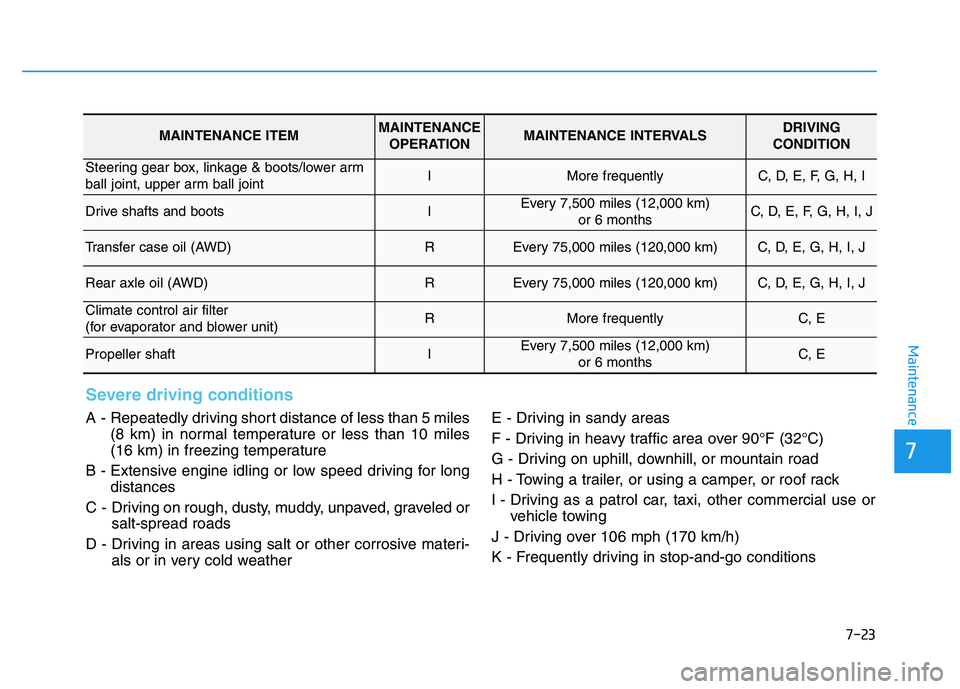
Severe driving conditions
A - Repeatedly driving short distance of less than 5 miles(8 km) in normal temperature or less than 10 miles
(16 km) in freezing temperature
B - Extensive engine idling or low speed driving for long distances
C - Driving on rough, dusty, muddy, unpaved, graveled or salt-spread roads
D - Driving in areas using salt or other corrosive materi- als or in very cold weather E - Driving in sandy areas
F - Driving in heavy traffic area over 90°F (32°C)
G - Driving on uphill, downhill, or mountain road
H - Towing a trailer, or using a camper, or roof rack
I - Driving as a patrol car, taxi, other commercial use or
vehicle towing
J - Driving over 106 mph (170 km/h)
K - Frequently driving in stop-and-go conditions
MAINTENANCE ITEMMAINTENANCE OPERATIONMAINTENANCE INTERVALSDRIVING
CONDITION
Steering gear box, linkage & boots/lower arm
ball joint, upper arm ball jointIMore frequentlyC, D, E, F, G, H, I
Drive shafts and bootsIEvery 7,500 miles (12,000 km) or 6 monthsC, D, E, F, G, H, I, J
Transfer case oil (AWD) REvery 75,000 miles (120,000 km)C, D, E, G, H, I, J
Rear axle oil (AWD)REvery 75,000 miles (120,000 km)C, D, E, G, H, I, J
Climate control air filter
(for evaporator and blower unit)RMore frequentlyC, E
Propeller shaftIEvery 7,500 miles (12,000 km) or 6 monthsC, E
Page 476 of 542
7-46
Maintenance
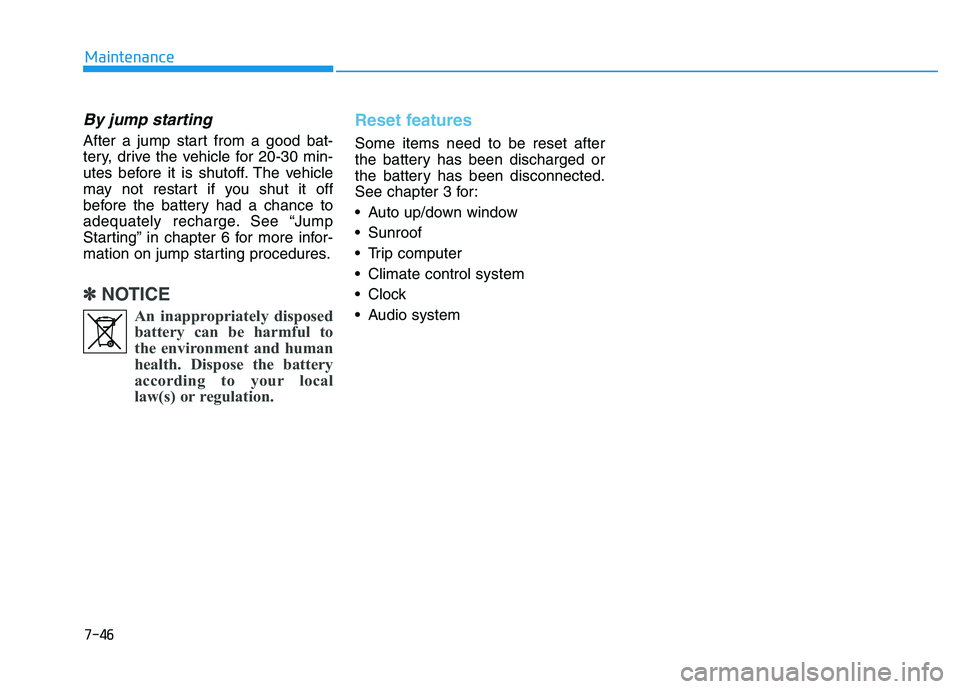
By jump starting
After a jump start from a good bat-
tery, drive the vehicle for 20-30 min-
utes before it is shutoff. The vehicle
may not restart if you shut it off
before the battery had a chance to
adequately recharge. See “Jump
Starting” in chapter 6 for more infor-
mation on jump starting procedures.
✽✽NOTICE
An inappropriately disposedbattery can be harmful to
the environment and human
health. Dispose the battery
according to your local
law(s) or regulation.
Reset features
Some items need to be reset after
the battery has been discharged or
the battery has been disconnected.
See chapter 3 for:
Auto up/down window
Sunroof
Trip computer
Climate control system
Clock
Audio system
Page 499 of 542
7-69
7
Maintenance
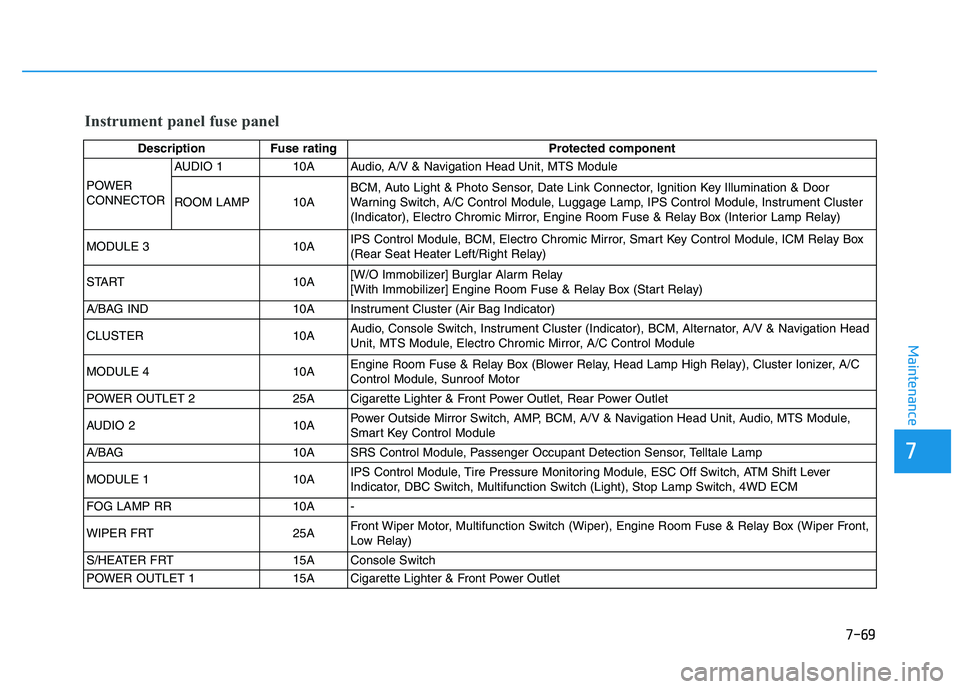
Instrument panel fuse panel
Description Fuse ratingProtected component
POWER
CONNECTOR AUDIO 1 10A Audio, A/V & Navigation Head Unit, MTS Module
ROOM LAMP 10A
BCM, Auto Light & Photo Sensor, Date Link Connector, Ignition Key Illumination & Door
Warning Switch, A/C Control Module, Luggage Lamp, IPS Control Module, Instrument Cluster
(Indicator), Electro Chromic Mirror, Engine Room Fuse & Relay Box (Interior Lamp Relay)
MODULE 3 10A IPS Control Module, BCM, Electro Chromic Mirror, Smart Key Control Module, ICM Relay Box
(Rear Seat Heater Left/Right Relay)
START 10A [W/O Immobilizer] Burglar Alarm Relay
[With Immobilizer] Engine Room Fuse & Relay Box (Start Relay)
A/BAG IND 10A Instrument Cluster (Air Bag Indicator)
CLUSTER 10A Audio, Console Switch, Instrument Cluster (Indicator), BCM, Alternator, A/V & Navigation Head
Unit, MTS Module, Electro Chromic Mirror, A/C Control Module
MODULE 4 10A Engine Room Fuse & Relay Box (Blower Relay, Head Lamp High Relay), Cluster Ionizer, A/C
Control Module, Sunroof Motor
POWER OUTLET 2 25A Cigarette Lighter & Front Power Outlet, Rear Power Outlet
AUDIO 2 10A Power Outside Mirror Switch, AMP, BCM, A/V & Navigation Head Unit, Audio, MTS Module,
Smart Key Control Module
A/BAG 10A SRS Control Module, Passenger Occupant Detection Sensor, Telltale Lamp
MODULE 1 10A IPS Control Module, Tire Pressure Monitoring Module, ESC Off Switch, ATM Shift Lever
Indicator, DBC Switch, Multifunction Switch (Light), Stop Lamp Switch, 4WD ECM
FOG LAMP RR 10A -
WIPER FRT 25A Front Wiper Motor, Multifunction Switch (Wiper), Engine Room Fuse & Relay Box (Wiper Front,
Low Relay)
S/HEATER FRT 15A Console Switch
POWER OUTLET 1 15A Cigarette Lighter & Front Power Outlet
Page 500 of 542
7-70
Maintenance
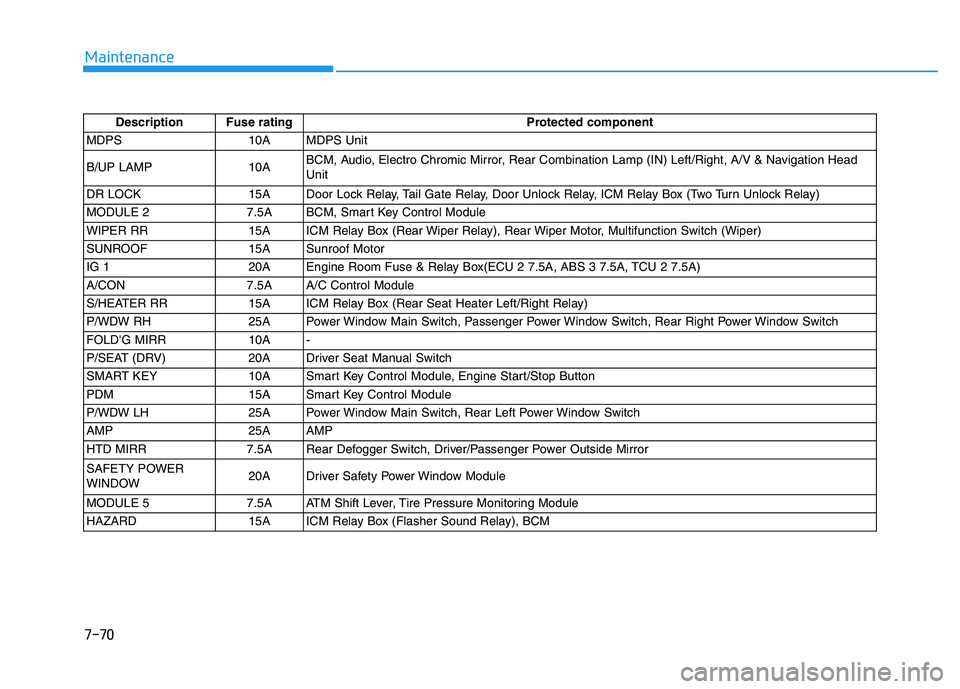
Description Fuse ratingProtected component
MDPS 10A MDPS Unit
B/UP LAMP 10A BCM, Audio, Electro Chromic Mirror, Rear Combination Lamp (IN) Left/Right, A/V & Navigation Head Unit
DR LOCK 15A Door Lock Relay, Tail Gate Relay, Door Unlock Relay, ICM Relay Box (Two Turn Unlock Relay)
MODULE 2 7.5A BCM, Smart Key Control Module
WIPER RR 15A ICM Relay Box (Rear Wiper Relay), Rear Wiper Motor, Multifunction Switch (Wiper)
SUNROOF 15A Sunroof Motor
IG 1 20A Engine Room Fuse & Relay Box(ECU 2 7.5A, ABS 3 7.5A, TCU 2 7.5A)
A/CON 7.5A A/C Control Module
S/HEATER RR 15A ICM Relay Box (Rear Seat Heater Left/Right Relay)
P/WDW RH 25A Power Window Main Switch, Passenger Power Window Switch, Rear Right Power Window Switch
FOLD'G MIRR 10A -
P/SEAT (DRV) 20A Driver Seat Manual Switch
SMART KEY 10A Smart Key Control Module, Engine Start/Stop Button
PDM 15A Smart Key Control Module
P/WDW LH 25A Power Window Main Switch, Rear Left Power Window Switch
AMP 25A AMP
HTD MIRR 7.5A Rear Defogger Switch, Driver/Passenger Power Outside Mirror
SAFETY POWER
WINDOW 20A Driver Safety Power Window Module
MODULE 5 7.5A ATM Shift Lever, Tire Pressure Monitoring Module
HAZARD 15A ICM Relay Box (Flasher Sound Relay), BCM
Page 502 of 542
7-72
Maintenance
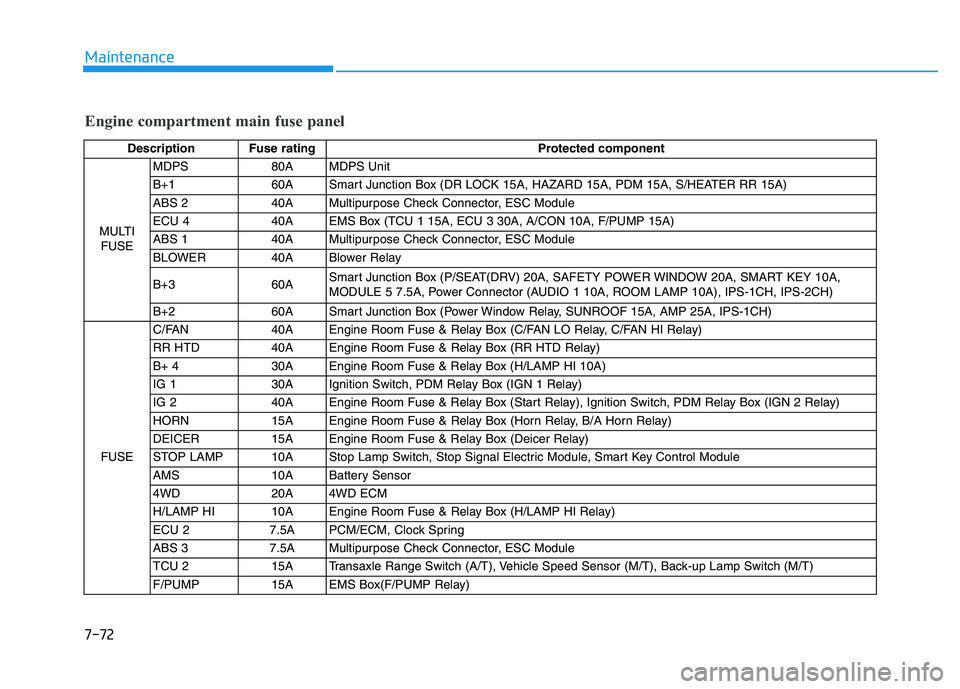
Engine compartment main fuse panel
Description Fuse ratingProtected component
MULTI FUSE MDPS 80A MDPS Unit
B+1 60A Smart Junction Box (DR LOCK 15A, HAZARD 15A, PDM 15A, S/HEATER RR 15A)
ABS 2 40A Multipurpose Check Connector, ESC Module
ECU 4 40A EMS Box (TCU 1 15A, ECU 3 30A, A/CON 10A, F/PUMP 15A)
ABS 1 40A Multipurpose Check Connector, ESC Module
BLOWER 40A Blower Relay
B+3 60A
Smart Junction Box (P/SEAT(DRV) 20A, SAFETY POWER WINDOW 20A, SMART KEY 10A,
MODULE 5 7.5A, Power Connector (AUDIO 1 10A, ROOM LAMP 10A), IPS-1CH, IPS-2CH)
B+2 60A Smart Junction Box (Power Window Relay, SUNROOF 15A, AMP 25A, IPS-1CH)
FUSE C/FAN 40A Engine Room Fuse & Relay Box (C/FAN LO Relay, C/FAN HI Relay)
RR HTD 40A Engine Room Fuse & Relay Box (RR HTD Relay)
B+ 4 30A Engine Room Fuse & Relay Box (H/LAMP HI 10A)
IG 1 30A Ignition Switch, PDM Relay Box (IGN 1 Relay)
IG 2 40A Engine Room Fuse & Relay Box (Start Relay), Ignition Switch, PDM Relay Box (IGN 2 Relay)
HORN 15A Engine Room Fuse & Relay Box (Horn Relay, B/A Horn Relay)
DEICER 15A Engine Room Fuse & Relay Box (Deicer Relay)
STOP LAMP 10A Stop Lamp Switch, Stop Signal Electric Module, Smart Key Control Module
AMS 10A Battery Sensor
4WD 20A 4WD ECM
H/LAMP HI 10A Engine Room Fuse & Relay Box (H/LAMP HI Relay)
ECU 2 7.5A PCM/ECM, Clock Spring
ABS 3 7.5A Multipurpose Check Connector, ESC Module
TCU 2 15A Transaxle Range Switch (A/T), Vehicle Speed Sensor (M/T), Back-up Lamp Switch (M/T)
F/PUMP 15A EMS Box(F/PUMP Relay)
Page 526 of 542
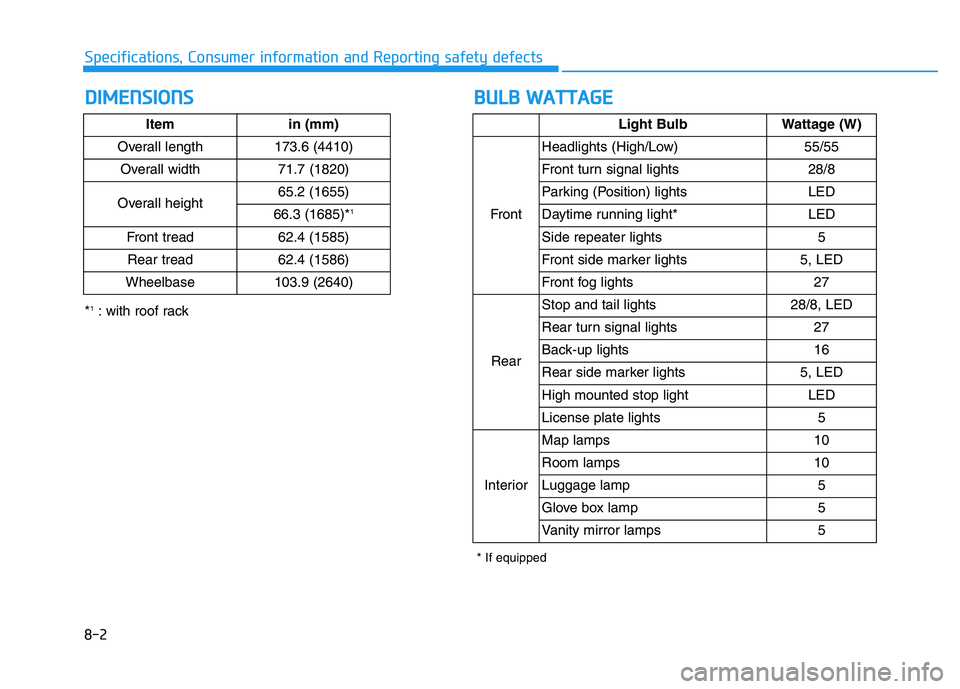
DDIIMM EENN SSIIOO NNSS
8-2
Specifications, Consumer information and Reporting safety defects
*1
: with roof rack
BB UU LLBB WW AATTTTAA GG EE
Item in (mm)
Overall length 173.6 (4410) Overall width 71.7 (1820)
Overall height 65.2 (1655)
66.3 (1685)*
1
Front tread 62.4 (1585) Rear tread 62.4 (1586)
Wheelbase 103.9 (2640)
Light Bulb Wattage (W)
Front Headlights (High/Low) 55/55
Front turn signal lights 28/8
Parking (Position) lights LED
Daytime running light* LED
Side repeater lights 5
Front side marker lights 5, LED
Front fog lights 27
Rear Stop and tail lights 28/8, LED
Rear turn signal lights 27
Back-up lights 16
Rear side marker lights 5, LED
High mounted stop light LED
License plate lights 5
Interior Map lamps 10
Room lamps 10
Luggage lamp 5
Glove box lamp 5
Vanity mirror lamps 5
* If equipped